Talk to an Expert

How Can NFT Ticketing Disrupt the Ticketing Industry?

How Can NFT Ticketing Disrupt the Ticketing Industry?

Non-fungible tokens, or NFTs, are very popular; trade volumes on the NFT market have reached an astounding $24.9 billion. Cryptographic tokens known as NFTs are used to replace certain digital assets. Tokenizing digital and physical assets, such as real estate, jewelry, or artwork, is made possible by NFTs.

The event industry has been a leader in connecting physical and digital tickets with NFTs, despite the fact that NFTs are changing many other businesses. People collected paper tickets prior to the advent of digital ticketing. With the efficiency that digitization has brought to ticketing, anybody may now use the NFT ticket system with confidence.

On the other hand, using a simple QR code that has no context seems pointless. Digital tickets are not regarded as heirlooms and cannot be retained. A paper ticket might get lost, ruined by water, or ruined. Moreover, tickets printed on paper offer little security because they are easily counterfeited. While QR codes help organizers with this problem, consumers cannot benefit from them.

NFT ticketing eliminates the need for compromise, and technology benefits both event planners and attendees. But we’ll go over the idea of NFT ticketing, its advantages, use cases, and more in this blog.

What is NFT Ticketing?

NFTs are verifiable records of ownership and validity that are kept on a blockchain network. They may only be legally owned by one person at a time and cannot be altered or faked.

There were distinctive paper tickets before the era of digital tickets. Digital tickets have made ticketing systems more dependable and effective. Digital tickets, however, cannot be preserved. By bridging this gap, NFTs improve ticket functionality and make collecting tickets for mementos simpler.

With the NFT ticketing system, the antiquated ticketing system may be upended and its drawbacks rectified. Because they are present on the blockchain, they aid in the fight against fraud and can be produced fast and cheaply. They also lessen the harm caused by misplacing or damaging your ticket.

What are the Challenges Linked With the Traditional Ticketing System?

The traditional ticketing system faces several challenges that hinder its efficiency and effectiveness. Firstly, manual ticketing processes are time-consuming and prone to human errors, leading to delays and customer dissatisfaction. Additionally, physical ticket distribution limits accessibility and creates logistical challenges. Lastly, ticket scalping and fraud remain persistent issues, undermining trust and revenue generation. Overcoming these challenges by NFT ticketing companies requires a shift towards digital, automated, and secure ticketing solutions.

1. Scalping

Scalping, also known as black marketing, is an illegal practice that includes purchasing tickets at a reduced price from the source and reselling them at a higher price. Those who are involved with ticket black marketing may do so using well-known sites such as Viagogo, OLX, and Craigslist. According to the bulk of studies and reports, each of the five ticket purchasers is a reseller and is typically male since they routinely buy and sell event tickets.

2. Forgery

According to a CNBC investigation, at least one out of every 10 event tickets purchased in the United States is a forgery. The more touted an event is, the more likely it is that the tickets are counterfeit. While QR-code-based ticketing has several ticket verification procedures in place, blockchain brings us one step closer to verifying ticket validity.

Read Our Blog: Metaverse NFT – Foundation Of Next Blockchain Revolution!

3. Protocol for Zero Exchange

To sell tickets, the ticket industry relies on a variety of unconnected web platforms. Because a centralized QR ticketing system has no exchange protocol incorporated into its systems that can link up the web platforms, enabling them to interact and distribute arbitrary data to ticket sellers, event organizers fail to keep up with clients and exchange data on some vendors.

4. Client Trust

According to another CNBC research, two-thirds of overall event ticket purchasers are concerned about being a victim of ticket fraud, purchasing a bogus ticket, or experiencing other forms of scams. When clients seek to purchase pricey tickets in another city or country, the problem of bogus tickets becomes severe. As a result, faith in the old ticketing system is constantly at risk.

5. Expensive Service

The typical QR ticketing method involves intermediaries, which results in expensive service charges. When purchasing tickets, consumers do not pay for admission to the event, but rather for the convenience of not having to physically attend the event location or stand in line to purchase tickets. The service cost of the tickets comprises operation fees, delivery charges, risk premiums, and other expenditures that are not included in the ticket price.

CTA 1

How Does NFT for Ticketing Work?

On a blockchain, NFTs are distinct digital tokens that are kept. They may be digitally sold to clients when they are produced on the blockchain. After that, customers may access their safe wallet on any device and save NFTs there.

Event planners may mint the necessary quantity of NFT tickets on any blockchain platform of their choosing using the ticketing system. In order to determine a price, they can either code the NFTs or hold the sale like an auction with tickets up for bid.

Direct purchases of NFT-based tickets are made by customers from the ticketing provider. A smart contract starts when money is received, and a ticketing database provides the buyer with an NFT ticket.

The ticketing firm asks for the ticket to be uploaded to the IPFS. Tickets are kept in the database, and IPFS computes the hash. The desired NFT marketplace receives the creation and upload of NFT tickets.

On the NFT marketplace, ticketing owners may also resell their NFT tickets. A smart contract contains the ticket’s storage. The smart contract starts when a customer purchases a ticket from the ticket owner, at which point the seller receives automated payment.

What Impact Does NFT Have on the Ticketing Industry?

The NFT ticketing platform is more similar to the real-world event tickets displayed on a piece of paper. These tickets are non-fungible, indicating that they can only be used for one event. Furthermore, NFT tickets are solid and align with the event capacity restriction; if the limit is achieved, users are unable to purchase further tickets.

When it comes to traditional ticketing difficulties, the tickets go via several distribution channels with varying rulesets. As a result, other individuals or resellers hired at these distribution channels might raise the ticket price and profit from it.

Blockchain adds clarity to the ticketing system, permitting event organizers and ticket purchasers to track the status of tickets, if they are available or sold, and get information about the primary and secondary markets. Furthermore, event organizers may verify that their tickets are sold to the correct ticket purchasers at the correct price. 

Smart contracts may also be used in a ticket NFT system, allowing event organizers to control the resale value of tickets and related costs.

To maximize the value of the NFT ticketing system, event organizers should implement a user-friendly mobile app to aid mobile phone customers. The ticketing system may be developed on several strong and decentralized blockchains, with optional interaction with ticket sales and distribution networks such as Facebook, Instagram, Amazon, Snapchat, and Stubhub.

How is the Selling of NFT Tickets Going?

Event organizers may use the blockchain to mint any number of tickets and sell them in the usual manner on their websites or applications. Not only that, but they can program whatever they need into the NFT, including the picture of the tickets, the ID number, the verification process, and even the selling method (set price or auction). 

When customers purchase an NFT ticket, it is held in their wallets (similar to those used for Bitcoin or Ethereum tokens). Simple access through mobile devices is provided. Individuals can use those wallets to handle their NFT tickets (for example, sell or return them) or to reveal the key at the entrance.

On the technical side, it looks like this:

  • The client purchases a ticket and pays the supplier: The payment initiates the smart contract procedure, which generates and transmits an NFT ticket to the client or sends an existing ticket from the database.
  • The ticket-supply mechanism prompts the user to upload the ticket to IPFS: Tickets will be recorded in a database. NFT tickets are generated and sent to the appropriate NFT marketplace.
  • Ticket holders may resell NFT tickets: They will need to use the NFT platform’s relevant tool for this. The gadget will initiate a smart contract, which will ensure the transaction’s security. 

How NFTs Solve Traditional Ticketing Challenges with NFT Ticketing?

NFT ticketing has the potential to disrupt the traditional ticketing industry by addressing its inefficiencies and creating new opportunities.

Fraud Prevention

  • Traditional paper tickets and QR codes are prone to counterfeiting, posing security risks and disappointing fans. NFT ticket transactions are recorded on a blockchain ledger, allowing for verification of each ticket’s authenticity and ownership history. This significantly reduces the risk of ticket fraud, enhancing event security.

Cost-Efficiency and Speed

  • NFT tickets can be created more quickly and cost-effectively than traditional tickets, enabling organizers to streamline the ticketing process. This reduces lead times for ticket printing and distribution, providing organizers with greater flexibility and efficiency in managing events.

Revenue Opportunities

  • NFTs offer creators and organizers ongoing revenue opportunities. Smart contracts embedded in NFT tickets enable the automatic payment of royalties to artists and event organizers. Additionally, when ticket holders resell their tickets on secondary markets, creators can earn a portion of the resale proceeds. This incentivizes creators to participate in NFT ticketing and ensures fair compensation for their work.

Risk Mitigation

  • Conventional paper tickets are susceptible to loss or damage, leading to inconvenience for ticket holders. NFT tickets, stored securely in digital wallets, mitigate the risk of loss or damage. Ticket holders can access their tickets conveniently via mobile devices, ensuring a seamless and reliable ticketing experience.

Overall, when you create NFT ticketing, it offers a solution to the challenges faced by traditional ticketing systems, providing enhanced security, efficiency, revenue opportunities, and risk mitigation.
What are the Benefits of the NFT Ticketing System?

What are the Benefits of the NFT Ticketing System?

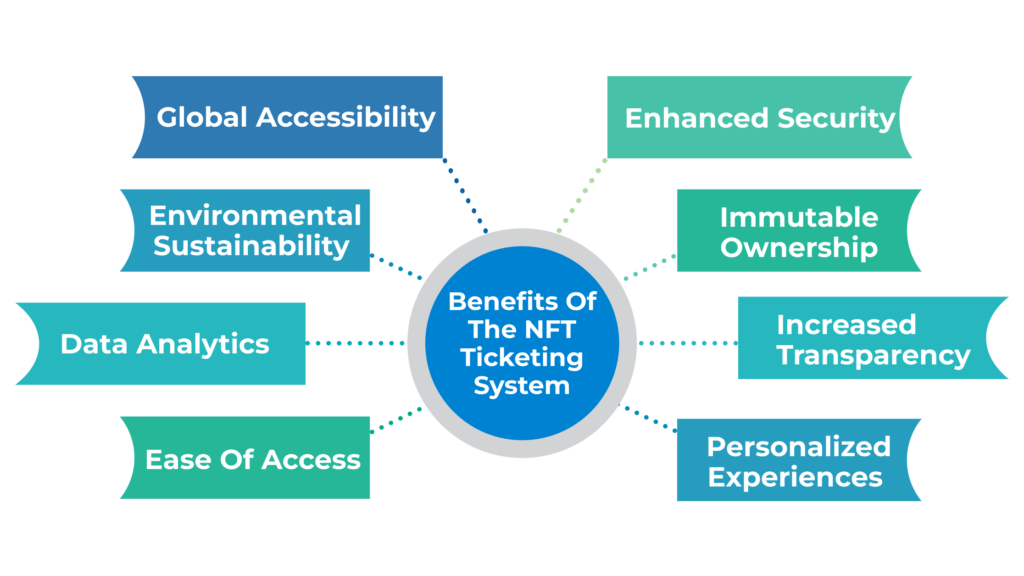
The emergence of NFTs has revolutionized the concept of ticketing systems, offering numerous benefits to event organizers and ticket holders alike. NFTs are one-of-a-kind digital assets that serve as proof of ownership or validity. In the context of ticketing, NFTs have introduced a range of advantages that enhance security, transparency, and flexibility while providing a seamless ticketing experience. 

Here are some key benefits of using an NFT ticket platform:

  • Enhanced Security

NFTs utilize blockchain technology, ensuring ticket authenticity and preventing counterfeiting or fraudulent activities. The decentralized nature of blockchain provides a tamper-proof record of transactions, enhancing security for both organizers and ticket holders.

  • Immutable Ownership

NFTs establish clear ownership records, eliminating disputes and enabling secure transfer or resale of tickets on secondary markets. Ticket holders can prove their ownership and transfer NFT tickets with ease, ensuring a transparent and trustworthy process.

  • Increased Transparency

Blockchain-based NFT ticket systems provide a transparent record of transactions, enhancing accountability and preventing ticket scalping or price manipulation. Every transaction is recorded on the blockchain, making it easier to track and verify ticket sales.

  • Personalized Experiences

NFT tickets can include additional perks, such as exclusive access to VIP areas, meet-and-greet opportunities, or digital collectibles. This personalization enhances the overall event experience and creates a sense of exclusivity for ticket holders.

Read Blog: Solana Marketplace NFT: How to build your own NFT Marketplace

  • Ease of Access

NFT tickets can be stored in digital wallets, making them easily accessible through smartphones. This eliminates the need for physical tickets, reducing the risk of loss or damage and simplifying entry procedures for attendees.

  • Data Analytics

NFT ticket systems provide organizers with valuable data insights, such as attendee demographics and purchasing patterns. This data can be used to understand audience preferences, tailor marketing strategies, and improve event planning for future events.

  • Environmental Sustainability

NFT ticket systems contribute to environmental sustainability by reducing the need for physical tickets, which require paper and ink production. By adopting digital NFT tickets, organizers can significantly reduce their carbon footprint and contribute to a greener future.

  • Global Accessibility

NFT ticket systems eliminate geographical limitations, allowing people from anywhere in the world to purchase and attend events. This expands the audience reach for organizers and enables fans to access events they may not have been able to attend otherwise.

With these benefits, NFT ticket systems offer a promising future for the ticketing industry, combining security, convenience, personalization, and environmental sustainability. By leveraging blockchain technology and digital assets, NFTs are transforming the way tickets are bought, sold, and experienced, creating a more efficient and inclusive ticketing ecosystem.

NFT Ticketing Use Cases Explored

1. NFT Ticketing for Concerts, Festivals, and Live Events

NFT ticketing platform presents innovative opportunities for organizers and artists to interact with their audience. For instance, they can offer exclusive content like photos and videos from the event or invite-only passes through NFT tickets. Additionally, organizers can introduce lifetime passes similar to Kings of Leon and Coachella. NFT tickets can also be utilized for rewards-based video games and exclusive experiences, enhancing brand engagement and loyalty.

2. NFT Ticketing for Sports Events and Games

Sports events and games can leverage NFT ticketing by providing digital passes with dynamic updates upon redemption. These tickets can offer additional perks such as free food/beverage vouchers, access to exclusive merchandise, and airdrops of additional NFTs. By maintaining consistency across multiple events, NFT ticketing can foster continued engagement, leading to greater rewards such as personal meet-and-greets and upgraded seats. For example, the NBA plans to issue NFT “ticket stubs” to fans redeeming their tickets at the venue, potentially generating passive revenue through future secondary sales.

3. NFT Ticketing for Conferences, Meetups, and Other Events

NFT ticketing holds significant value for conferences, meetups, and events. An example is Consensus’ annual blockchain and crypto conference in 2019, which offered attendees an NFT swag bag containing items like CryptoKitties. Over time, the value of CryptoKitties increased, demonstrating the potential for NFT swag bags to become collectibles and appreciate in value. This highlights how NFT ticketing can enhance the experience and value proposition of events, attracting attendees and fostering engagement
What Opportunities Does NFT Ticketing Provide To Guests?

What Opportunities Does NFT Ticketing Provide To Guests?

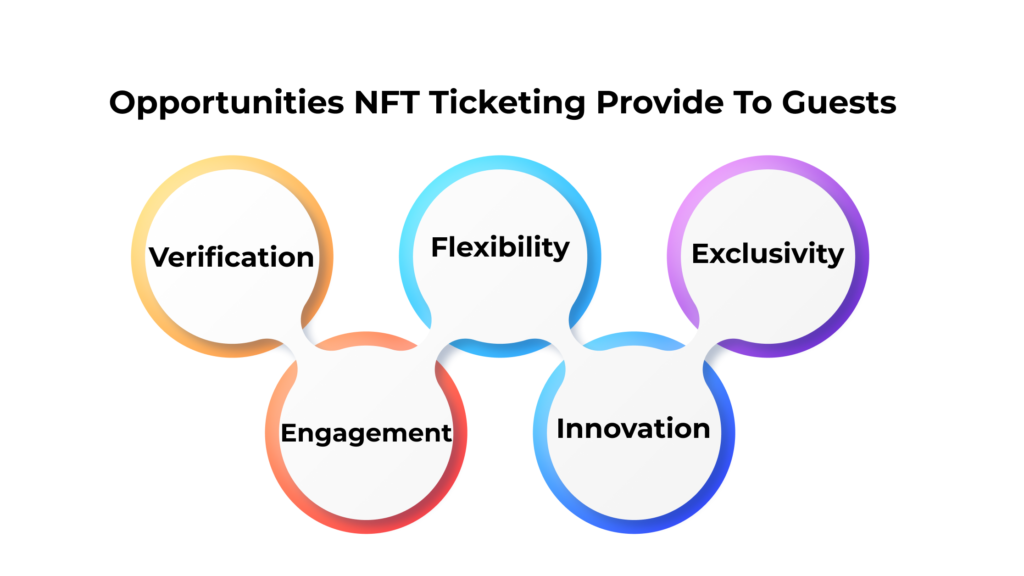
NFT ticketing offers a range of exciting opportunities to guests, transforming their event experience in several ways:

  • Verification: With NFT ticketing, visitors may use the blockchain to check the validity and ownership of their tickets. This reduces the possibility of fake tickets and gives visitors more peace of mind.
  • Flexibility: NFT ticketing enables patrons to safely and conveniently transfer their tickets to others as well, either by giving them to loved ones or by reselling them on the secondary market. For visitors who might need to rearrange their plans or can’t attend the event, this offers more convenience and flexibility.
  • Exclusivity: By offering limited-edition, collectible tickets that are exclusive to the event, NFT ticketing may give attendees a feeling of exclusivity and interest. This can improve attendees’ overall enjoyment of the event and provide them with priceless souvenirs.
  • Engagement: Because NFT ticketing enables the development of personalized and customized tickets that represent the event’s theme or logo, it may also provide visitors with an engaging and participatory experience. This can help people feel more connected to the occasion and increase how much fun they have while there.
  • Innovation: NFT ticketing is a cutting-edge and creative approach to event ticketing that shows the event organizer’s dedication to being on the leading edge of technology and giving attendees an innovative experience.

Read Our Blog: The Future of NFTs: More Than a Digital Collectible

Overall, the NFT ticket platform offers visitors a safer, more flexible, exclusive, interesting, and inventive method to attend events, which can improve their entire experience and happiness.
What Opportunities Does NFT Ticketing Provide To Organizers?

What Opportunities Does NFT Ticketing Provide To Organizers?

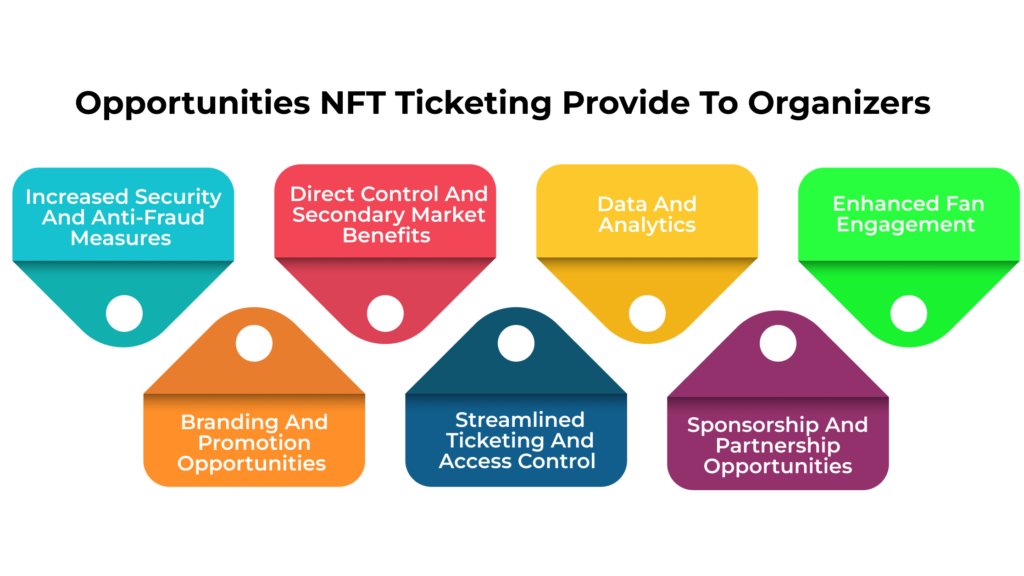
NFT ticketing provides organizers with a wide range of opportunities, empowering them to enhance event management, revenue generation, and fan engagement. Here are some key opportunities that NFT ticketing offers to organizers:

  • Increased Security and Anti-Fraud Measures: NFT tickets leverage blockchain technology, ensuring a high level of security and eliminating the risk of counterfeit tickets. This protects organizers from ticket fraud and unauthorized entry, maintaining the integrity of their events.
  • Direct Control and Secondary Market Benefits: NFTs enable organizers to have direct control over ticket sales, pricing, and distribution. They can set rules for reselling and earn royalties from secondary market transactions, providing an additional revenue stream. This control over the secondary market can also help prevent ticket scalping and price manipulation.
  • Data and Analytics: NFT ticketing app provides organizers with valuable data and analytics regarding ticket sales, attendee demographics, and engagement patterns. This information can be used to make data-driven decisions, improve marketing strategies, and enhance future event planning.
  • Enhanced Fan Engagement: NFT ticketing allows organizers to offer exclusive perks and experiences to ticket holders. By creating unique digital collectibles or granting access to special events or content, organizers can deepen the connection between fans and the event, fostering a sense of loyalty and enthusiasm.
  • Branding and Promotion Opportunities: NFTs provide a novel way for organizers to showcase their brands and promote their events. Custom-designed NFT tickets can serve as collectibles or limited-edition memorabilia, creating additional excitement and buzz around the event.
  • Streamlined Ticketing and Access Control: NFT ticketing platforms often integrate with event management software, streamlining the ticketing process and reducing administrative burdens. The digital nature of NFT tickets eliminates the need for physical tickets, reducing costs and logistical challenges associated with printing and distribution.
  • Sponsorship and Partnership Opportunities: NFT ticketing opens up new avenues for organizers to collaborate with sponsors and partners. NFTs can be co-branded or include sponsored content, providing additional revenue streams and cross-promotion opportunities.

Overall, NFT ticketing empowers organizers to create unique experiences, improve operational efficiency, and maximize revenue potential. It brings innovation and transparency to the ticketing process, benefiting both organizers and event attendees.
Conclusion

In summary, NFT ticketing, which uses blockchain technology to provide unmatched transparency, security, and interaction, is a revolutionary step forward for the ticketing business. Being a top provider of NFT marketplace development services, SoluLab distinguishes itself by providing a full range of solutions such as tokenization, smart contract creation, NFT consultancy, and marketplace support. Event planners and companies may fully utilize NFT tickets by establishing safe, adaptable platforms for exchanging digital assets with the help of SoluLab’s experience.

Adopting NFT ticketing creates new opportunities for success and creativity in addition to improving the event experience. Partnering with SoluLab guarantees that businesses stay ahead of this changing landscape as this game-changing technology continues to change the industry. To begin your adventure into the world of NFT ticketing and discover the countless opportunities that lie ahead in this innovative and dynamic arena, get in touch with SoluLab today!

FAQs

1. What is NFT ticketing, and how does it differ from traditional ticketing?

NFT ticketing refers to the use of Non-Fungible Tokens (NFTs) to represent event tickets digitally. Unlike traditional tickets, NFTs are unique, verifiable, and cannot be duplicated or counterfeit, ensuring enhanced security and authenticity.

2. How can NFT ticketing prevent ticket fraud and scalping?

NFT ticketing leverages blockchain technology, making it nearly impossible to forge or counterfeit tickets. The transparent and decentralized nature of the blockchain ensures a secure and tamper-proof record of ticket ownership, preventing fraud. Additionally, organizers can set rules for reselling and earning royalties from secondary market transactions, curbing ticket scalping.

3. What benefits does NFT ticketing offer to event organizers?

NFT ticketing platform provides organizers with increased control over ticket sales, secondary market transactions, and pricing. It also offers valuable data and analytics on ticket sales and attendee demographics, enabling data-driven decision-making. Furthermore, NFT ticketing allows for enhanced fan engagement, branding opportunities, and streamlined ticketing processes.

4. How does NFT ticketing enhance the guest experience?

NFT tickets offer guests unique opportunities such as exclusive perks, access to limited edition merchandise, backstage passes, or meet-and-greets. It also provides a transparent record of ownership, enabling seamless transferability and reselling. Guests can engage with digital collectibles, participate in interactive experiences, and join virtual event communities, enhancing their overall event experience.

5. Can NFT ticketing be integrated with existing event management systems?

Yes, NFT ticketing can be integrated with existing event management systems. Experienced technology providers like SoluLab offer solutions that seamlessly integrate NFT ticketing platforms with the organizers’ existing infrastructure, ensuring a smooth transition and streamlined operations.

9 Best NFT Ideas and Examples 2025

Best NFT Ideas

After the enormous success in 2021, it seems doubtful that non-fungible tokens, or NFTs, would lose any of their appeal in the years to come. So that you can start an NFT business right now, we have put together a list of the top 9 NFT ideas and examples for you.

As everyone is aware, NFTs are pieces of art generated using Blockchain technology that has distinctive encryption codes that can be verified for ownership and authenticity. Anything from digital art to a song or an album could be considered the best nft art.

It is undeniable that NFTs are here to stay. To give you the most information to motivate you on your NFT adventure, we’ll strive to cover everything. In this post, we’ll discuss some of the most creative real-world NFT examples and the best and coolest NFTs ideas.

What are NFTs?

2021 has been a successful year for NFTs. The top NFT tokens were able to catch everyone’s attention in the business and consumer community globally thanks to record-breaking sales and ongoing print and electronic media coverage.

However, it continues to develop without any indications of slowing down. In 2021, OpenSea transacted $14 billion worth of business, which is 646 times as much as its sales of $21.7 million in 2020. Furthermore, Best NFTs art examples are used in industries including marketing, real estate, finance, and government.

Ever wonder what The New York Times, the NBA, Gucci, Paris Hilton, and Visa have in common? NFTs are to blame. It is now abundantly evident that there is no reasonable way to ignore non-fungible tokens in today’s dynamic environment.

After having stated that, it is time to jump right into the meat of this blog. Here is the whole list of the most original, creative, humorous, and best NFTs ideas.

9 Best NFT Ideas and Examples

1. Beeple’s “Everydays – The First 5000 Days”

It would be wrong to leave the amazing $69 million NFT auction off of the list of NFT inspirations. The NFT is a collection of five pieces of art that Beeple (Mike Winkelmann) has gathered daily since 2007 for 5,000 days. Winkelmann is still working on the project using the Octane and Cinema 4D programs.

It is the third most expensive piece of live artist art ever sold and the most costly NFT to date. The auction was conducted at the fine art auction house, and the artwork sold for $13,860 per piece.

2. CryptoPunks

NFTs are famous for their CryptoPunks. In 2017, Larva Labs created and distributed 10,000 CryptoPunk NFTs in the form of randomly generated coins that are redeemable with an Ethereum wallet. Resultantly, the value of CryptoPunks went way too high in the secondary market.

As of now, the cheapest CryptoPunk costs more than $100,000, and more than $1 billion CryptoPunks have been exchanged in the NFT series. A huge amount of money has been invested in CryptoPunks by Via, Odell Beckham, and Jay-Z.

3. Artificial Intelligence NFT

This NFT (iNFT) with artificial intelligence is built on the Ethereum Blockchain. Alice is the name of the character, and the more you converse with her, the more she learns and develops a personality. In her promotional film, she was questioned about how she felt about residing on the Blockchain.

Alice responds by saying she feels like a digital goddess and can assume any form she chooses. The business that built this NFT, Alethea AI, is prepared to continue the project and provide the groundwork for iNFTs in the future in light of the overwhelmingly positive feedback.

4. Paris Hilton’s Planet Paris

Paris Hilton has always been a devoted supporter of NFTs. NFTs have been the subject of articles by Hilton, TV program discussions, and even her own NFT series. Together with Blake Kathryn, she co-founded Planet Paris, a business that contains several quick movies that have made Hilton millions of dollars.

5. Louis Vuitton video game

In the premium market, exclusivity and brand recognition are essential components. There can therefore be nothing better for such a field than NFTs. Louis Vuitton entered the NFT market in a very distinctive way. They created a video game called Louis: The Game, in which players perform missions to locate NFTs that are concealed.

6. William Shatner’s memorabilia

William Shatner, a seasoned actor with more than 60 years of experience in the business, is well-known to everyone. In 2020, the actor formally unveiled a collection of his memorabilia in the form of NFTs that included a range of images taken throughout his illustrious career. In less than 10 minutes, more than 125,000 units were sold.

7. Nyan Cat GIF

The next contender on the list of amusing NFTs is “Nyan Cat GIF,” a beautiful example of original NFT art from the 2010s. On its tenth anniversary, the video’s creator turned it into an NFT to eventually auction it off. The price of the video, which was close to $852,300, shocked the entire world.

8. Cryptovoxels

Speaking of NFT ideas, next on the list is Cryptovoxels, a metaverse built on Blockchain that combines social networking, gaming, and business. The system is a user-driven virtual environment that utilizes the Ethereum Blockchain. The idea is something similar to Minecraft but incorporates a little bit of cryptocurrency. Users can construct art galleries, exchange land plots, and interact with other players.

9. The origins of the internet

In 1989, Sir Tim Berbers-Lee was the brains behind the creation of the World Wide Web. After 30 years, he made a staggering $5.4 million selling his initial 9,555 lines of source code as an NFT. The World Wide Web’s source code and various other items made by the creator were included in the Sotheby’s auction.

The selling is a display of pride and exclusivity rather than the buyer acquiring control of the internet. A significant portion of human history is now the buyers.

Examples of NFT art

While the ideas we covered above are fairly enough for the best nft ideas, there are some Other examples of NFT art you can consider if you want to separate out from the crowd. For instance, the blockchain-based artificial intelligence coin Alethea AI is an intelligent NFT (iNFT). These are one of the best coolest NFTs projects with a built-in AI personality that grows and learns as you interact with them. That seems really nice, doesn’t it?

On the other hand, you might investigate name registry services, other expanding market segment in the NFT industry. Shorter, simple-to-remember names associated with a crypto wallet can be registered using name registry services like ENS and Unstoppable Domains. By doing this, you can avoid dealing with the difficulties of a lengthy wallet address.

In addition, several businesses are increasingly utilizing AR technologies to develop distinctive NFTs. Consider Jadu Hoverboards, which are collectible hoverboards that can be used in The Mirrorverse, Jadu’s augmented reality game. You may even develop your own metaverse & AR cars if you’re interested in the technology.

Best NFTs that sell

You may get a good indication of what sells well as the coolest NFTs by taking a short glance at the most expensive NFTs in history. NFT art & collectibles are the undisputed winners. The two best-selling NFTs are The Merge by Pak & Everyday: The First 5000 Days by Beeple.

Similar to how it may be said that 2021 was dominated by NFT collectibles, new projects are still being released despite a decline in sales. This is demonstrated by the enormous success of the Bored Ape Yacht Club NFT collection. Millions of dollars worth of NFTs have also been sold by vintage collections like CryptoPunks.

In addition to these, utility plays a crucial role in determining an NFT’s success. A superb NFT idea by itself won’t suffice to succeed in a market where NFTs are oversaturated. Many collectors are long-term investors when they buy NFTs. In other ways, they are searching for advantages that go much beyond the scope of a PFP.

For this reason, the majority of the best NFT collections give their collectors a tonne of benefits. Take BAYC as an illustration. Members of the community receive benefits such as merchandise, NFT airdrops, access to a plot in The Sandbox, and sometimes even tickets to the yearly NFT festival ApeFest.

Conclusion

In conclusion, the world of NFTs is brimming with innovative ideas and examples that are transforming various industries, from art and music to gaming and real estate. These digital assets offer creators and investors a unique way to monetize and engage with their audience, fostering a new era of ownership and authenticity in the digital realm. Whether it’s through digital collectibles, virtual real estate, or tokenized art, NFTs are opening up a myriad of opportunities that are only beginning to be explored.

However, there are challenges in the NFT space, such as security issues, high transaction costs, and the complexity of creating and managing NFTs. This is where SoluLab steps in as a leading NFT development company. We offer comprehensive solutions, from building secure NFT platforms to providing ongoing support and integration services. Let us help you bring your NFT ideas to life. Contact us today to get started!

FAQs

1. What is an NFT development company?

An NFT development company specializes in creating and managing Non-Fungible Tokens (NFTs). These companies offer a range of services, including the design and development of NFT platforms, smart contract development, and integration with blockchain technology to ensure secure and seamless transactions.

2. What NFT services do you offer?

Our NFT services include end-to-end NFT platform development, smart contract creation, NFT marketplace development, and integration with various blockchain networks. We also offer consulting services to help you refine your NFT ideas and bring them to market successfully.

3. Why should I hire NFT developers?

You should hire NFT developers to ensure that your NFT project is built with the highest standards of security, scalability, and functionality. Professional NFT developers have the technical expertise to navigate the complexities of blockchain technology, ensuring your project is robust and ready for the market.

4. What qualities should I look for in an NFT developer?

When hiring an NFT developer, look for someone with a strong background in blockchain technology, experience with smart contract development, and a solid portfolio of previous NFT projects. Additionally, good communication skills and the ability to understand and implement your specific requirements are crucial.

5. What are some of the best NFT ideas?

Some of the best NFT ideas include digital art, virtual real estate, in-game items, music and videos, digital collectibles, tokenized physical assets, and membership or access tokens for exclusive content. These ideas leverage the unique properties of NFTs to create value and engagement.

6. How can I turn my NFT ideas into reality?

To turn your NFT ideas into reality, start by partnering with a reputable NFT marketplace development company. Our team at SoluLab can help you from the conceptualization stage through to development and deployment. We provide comprehensive support to ensure your Non-Fungible Token project is successful. Contact us today to discuss your ideas and learn how we can assist you in making them a reality.

Top 25 NFT Startups to Watch out in 2025

NFTs of non-fungible tokens have become a buzzword in recent times. The term is heard now and then, which gives a clear indication of its craze at present. The popularity of NFTs has been rapidly increasing over the past few years, and they have entered almost every industry with many more in the pipeline. An NFT happens to be a unique digital identifier that cannot be substituted, copied, or divided further. It is recorded in a blockchain which is used for the purpose of certification of authenticity as well as ownership. NFT’s ownership is recorded in a blockchain, and its ownership can be transferred by the owner, thereby allowing NFTs to be traded. 

NFTs happen to be digital files representing photos, audio, videos, or a combination of these. With the rising popularity of NFTs, several businesses are looking forward to hiring NFT development companies or services to make the best use of the trend to benefit their businesses. The craze revolving around non-fungible tokens and the rising demand for the services have opened avenues for several NFT startups. These startups have been doing wonders in the field, and here is the list of the top 25 NFT startups to watch out for in 2024 to give you a better idea.  

1.  Yield Guild

Yield

YGG is a play-to-earn gaming guild, bringing players together to earn via blockchain-based economies. They are the settlers of new worlds in the Metaverse. It is a decentralized autonomous organization (DEO) whose mission is to develop the largest virtual world economy. 

Read Also: All About Utility NFTs, the Unique Tokens With Practical Applications

It aims to achieve its mission by gathering a community of play-to-earn gamers who play to earn and collect token rewards. 

2.  Rarible

Rarible

Rarible provides a marketplace to trade blockchain-secured digital items. What makes this marketplace unique is that it is community-owned, meaning that users have an active voice in deciding the company’s future.Rarible is an Ethereum-based platform that facilitates the creation, sale, and purchase of ownership rights to digital works of art via non-fungible tokens (NFTs).

3.  Nifty’s

Nifty's

Nifty’s adds a new layer to the digital asset world by combining social media with a two-sided marketplace. This has allowed the startup to develop a platform where creators, collectors and curators open accounts and follow one another. The benefit to the users is two-fold: first, they can create a following and use that to trade their assets. Second, they can use the platform to network with other users with similar interests.

4.  Mintable

4

Mintable makes the most of Ethereum’s blockchain technology to enable anyone to create, manage, and sell digital files with all the benefits of provable ownership, immutability, and traceability.

5.  Spores Network

5

Spores brands itself as a cross-chain, DeFi-powered NFT ecosystem. Their governing and utility token, $SPO, which currently has a market cap of around $730K, gives life to the ecosystem by making it easy to fractionalize, mint, manage and trade NFTs.

6.  Verisart

    6       

Verisart employs decentralized technologies to help artists certify, document, and enliven their artworks in a vibrant online community of collectors, galleries and dealers. Their platform is designed for verifiable authenticity, minting NFTs, selling more works, and connecting with collectors.

7.  Vulcan Forged

7

Vulcan Forged is the Fastest Growing NFT Platform Play, build, collaborate, and bring your ideas to life with the fastest growing blockchain game and dApp platform. : Vulcan Forged is a gaming platform that lets players earn digital assets. Instead of focusing on building only one game, the startup has over 10 games with different themes.

8.  Polychain Monsters

  8

Polychain Monsters are beautifully animated cross-chain NFTs with varying scarcity which can be unpacked from booster packs with $PMON, and used in upcoming play-to-earn on-chain games.

9.  Legends Of Crypto

9

CryptoSlam aims to provide ultimate transparency for millions of NFT collectibles across multiple blockchains. As a trusted NFT data aggregator, buyers and sellers rely on CryptoSlam’s data to make purchasing and selling decisions. In addition, NFT creators rely on CryptoSlam’s large user base to help promote their brands and NFT drops.

10.  Charged Particles

10

Charged Particles are Interest-bearing Non-Fungible Tokens (DeFi NFTs) that are minted with an underlying asset and accrue interest over time, giving the Token a “Charge”.  NFT that represents a Sword – the power of that sword could be dependent on the amount of “Charge” the token has. Or perhaps certain items can only be used once they reach a certain level of charge. 

11.  Bitski

11        

Bitski is a platform where users can certify and trade assets. The startup brings the idea of the metaverse one step closer to reality as its system allows users to access assets from any device. The implications around ownership and programmability are the most exciting technical development.

12.  Element NFT Marketplace

12

Element Market is a digital asset exchange. What makes the startup special is that it also serves as an aggregator that gathers and provides information on the value transfer of different NFTs. The First Community-driven Aggregated Marketplace.

13.  MomentRanks

13

MomentRanks, now known as Collective, operates an NFT platform that allows users to manage and trade their digital assets. MomentRank’s competitive advantage is that it targets a niche audience by using its ecosystem only for NBA Top Shot non-fungible tokens. Although NBA Top Shot targets a relatively narrow audience.

14.  Ternoa

14

Ternoa is a decentralized open-source layer 1 that provides a technological stack to build secure and scalable utility NFTs. Ternoa is a blockchain geared toward long term data storage, encryption, and transmission based on different protocols, built on a substrate. its ecosystem already comprises dapps for b2c and b2b use cases. Ternoa, transmit your present to your future.

15.  Own the Moment NFT

15

Own the Moment is the platform, content provider, and community that provides you with everything you need for collecting and investing in NFTs. Everyone needs a strategy for this emerging space and OTM provides you with an experienced partner that empowers you through NFT Discovery, Education, Analysis, and Discussion.

16.  Only1

16

Only1 The first NFT-powered social platform built on Solana, Which helps creators monetize and allows fans to connect with the creators they love in a unique way.— think decentralized Patreon, read more on Create-to-Earn (C2E) here. Mixing social media, NFTs, DeFi, and the native token — LIKE, Only1 offers a web3 solution to creator economy and fan engagement.

17.  OneOf

17

OneOf develops a green NFT platform for music, sports, and lifestyle. Deeply committed to a sustainable and inclusive blockchain future, OneOf is a platform that supports NFTs on multiple energy-efficient blockchains, connecting fans and collectors to iconic musicians, athletes, and brands. 

18.  DoinGud

18

DoinGud is a Web3 ecosystem and set of tools empowering communities to do good. Impact Protocol, NFT Marketplace, NFTickets made with AMOR. They are collaborating and developing with some of the brightest creators, technologists, communities, and blockchain companies to bring to you a next-gen NFT experience.

19.  dotmoovs

19

dotmoovs is a Play2Earn sports competition platform where users can challenge each other and themselves in their favorite sports, by using our AI video referee to score their performance. Players can earn $MOOVs, exclusive NFTs, and other rewards by playing on the mobile app.

20.  AnRKey X

20

AnRKey X is a multi-release DeFi game studio and all-in-one Play to Earn platform powering gamers and creators in the metaverse. It enables a community-owned and fully decentralized gaming economy making it easy for billions of gamers and creators around the world to easily monetize their gameplay, participate in ownership & earn real money.

21.  Decentraland Marketplace

21

Decentraland is creating a virtual world that will grow beyond any centralized control. To accomplish this, we’re building a suite of supporting tools and applications designed to help people create three-dimensional content, games, and applications. 

Read Also: How to Build an NFT Marketplace like Binance?

All of this will be hosted and accessed on a fully decentralized VR platform. Our work touches virtual reality, dApp development, game design, cryptocurrencies, and 3D art and design.

22.  Alien Worlds

22

Alien Worlds is a play-to-earn game that asks you to explore the universe and complete tasks to earn currency. You can also collect assets like weapons, land, and other game NFTs to trade with other players in its gaming marketplace. 

23.  Virtua     

23

Virtua is a gamified metaverse that provides immersive social, web3 gaming, digital collectible, and interactive experiences. Terra Virtua aims to take NFTs even further by letting you interact with your collectibles through AR and VR apps. 

24.  KnownOrigin Labs

24

KnownOrigin is an NFT marketplace for people to buy, sell, and create digital art NFTs. It also hosts numerous NFT drops as well as a subscription list to be notified of future drops. 

25.  Myth.Market

25

Like the trading card shops of old, digital collectible platform Myth.Market houses several NFT collections like the Garbage Pail Kids and William Shatner trading card series. If you’re into trading card collecting, this site is worth a watch.

Closing Thoughts

The NFT startups’ list mentioned above makes it clear about the popularity as well as demand in the field. However, NFT is still a new concept and evolving on a regular basis. The overall market of NFT grew at a dramatic pace from 2020 – 2021. The trading of NFTs in the year 2021 rose to more than 17 billion dollars, up by about 21000 percent over the year 2020’s total of 82 million dollars. The growth is expected to continue further, with no signs of stopping in the near future. So, we need to wait to see how the future shapes NFTs.
