Talk to an Expert

NFTs in Gaming: Unlocking the Future of Virtual Collectibles

NFTs in Gaming: Unlocking the Future of Virtual Collectibles

In recent years, the convergence of blockchain technology and the gaming industry has given rise to a transformative trend – Non-Fungible Tokens (NFTs) in gaming. This introduction will provide a brief overview of NFTs in gaming, delve into the essence of non-fungible tokens, highlight the significance of NFT gaming collectibles, and elucidate the purpose of the outlined discussion.

Non-Fungible Tokens, or NFTs, are cryptographic tokens built on blockchain technology, typically utilizing Ethereum’s ERC-721 or ERC-1155 standards. Each NFT possesses a distinct set of properties that differentiate it from other tokens. These properties could include metadata, ownership history, and rarity factors. NFTs have gained widespread attention and adoption not only in gaming but also in art, entertainment, and various digital ecosystems due to their ability to represent ownership and uniqueness in the digital realm.

The significance of NFT gaming collectibles lies in their capacity to revolutionize the gaming experience. These digital assets empower gamers with true ownership of in-game items and characters, granting them the freedom to buy, sell, or trade these assets across different gaming platforms. This new paradigm disrupts the traditional closed-loop system of gaming, where virtual items are typically owned by game developers and publishers, allowing gamers to derive real-world value from their in-game investments.

Read Our Blog Post: Top NFT Development Companies

What are NFTs in Gaming?

Non-fungible tokens (NFTs) have emerged as a revolutionary concept in the world of digital assets and gaming. To grasp their significance within the gaming sphere, it’s essential to delve into what NFTs are and how they have been seamlessly integrated into video games.

NFTs, or Non-Fungible Tokens, are unique digital assets that are indivisible, irreplaceable, and provably scarce. Unlike cryptocurrencies like Bitcoin or Ethereum, which are fungible and interchangeable, NFTs represent ownership of one-of-a-kind items, such as digital art, collectibles, or in-game assets. Each NFT is distinguished by a distinct token ID and is stored on a blockchain, ensuring its authenticity and ownership history.

NFTs have found a natural home in the gaming world, where virtual collectibles and in-game items have long held significant value for players. Game developers have begun leveraging NFT technology to create unique in-game assets and collectibles that players can buy, sell, and trade. These NFT gaming collectibles are often tied to blockchain technology, allowing players to truly own and control their virtual possessions. This integration has opened up exciting possibilities for both gamers and developers.
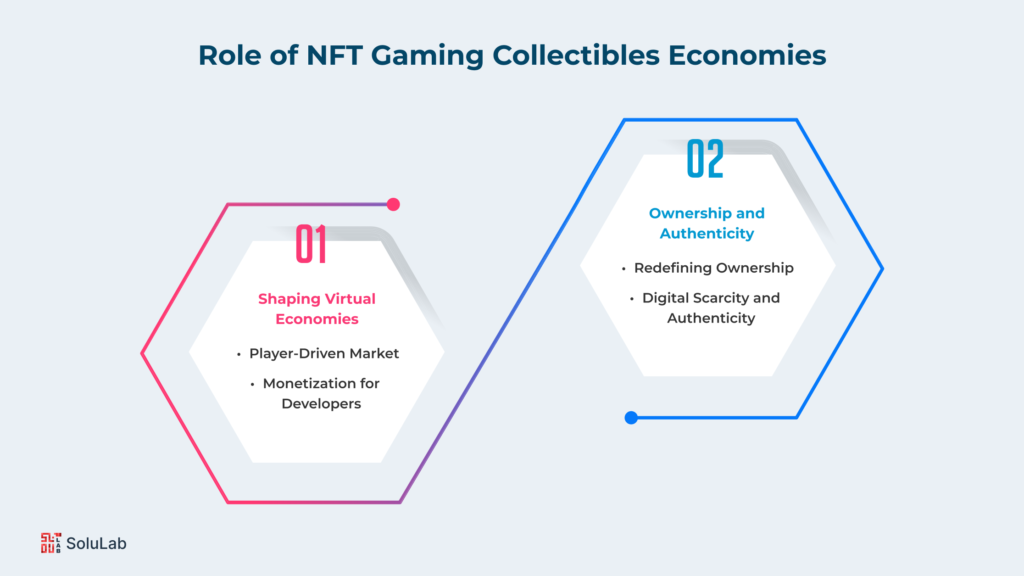
What Role Do NFT Gaming Collectibles Play in Shaping the Economies?

Role of NFT gaming collectibles Economies

NFT gaming collectibles are distinct digital items within video games, each represented as a unique NFT on a blockchain. Unlike traditional in-game assets that are often confined to specific game ecosystems, NFTs offer true ownership and portability. Players can buy, sell, and trade these collectibles both within and outside the game environment, with ownership records securely recorded on the blockchain. This creates a sense of ownership that transcends the boundaries of individual games, making NFT gaming collectibles highly coveted.

1. Shaping Virtual Economies: 

  • Player-Driven Market

NFT gaming collectibles have introduced a player-driven market within virtual gaming worlds. These assets are not just cosmetic; they hold real-world value. This economic dimension encourages players to actively participate in trading, buying, and selling NFTs, influencing their scarcity and value.

Check Our Blog Post: ERC-3643 vs ERC-1400 vs ERC-20

  • Monetization for Developers

Game developers benefit from the secondary market for NFTs as they often receive a percentage of each transaction involving in-game NFTs. This creates a sustainable revenue stream, which can support ongoing game development and maintenance.
CTA1

2. Ownership and Authenticity:

  • Redefining Ownership

NFT gaming collectibles provide a groundbreaking shift in ownership dynamics. Players truly own their digital assets, granting them the autonomy to control, trade, and transfer their NFTs across various games and platforms. This newfound ownership extends the value of in-game items beyond a single gaming experience.

  • Digital Scarcity and Authenticity

NFTs inherently possess digital scarcity and authenticity. Each NFT is unique, provably scarce, and irreplaceable, thanks to blockchain technology. This assures players and collectors of the rarity and authenticity of their digital possessions, enhancing their desirability.

Read Blog Post: Top NFT Trends That Will Build Revenue Streams to the Business

How are NFTs Revolutionizing the Future of the Gaming Industry?

The world of gaming has witnessed a significant transformation in recent years, thanks to the integration of Non-Fungible Tokens (NFTs) into the gaming landscape. NFTs, often referred to as NFT gaming collectibles, have become a buzzword, reshaping how gamers interact with virtual worlds. In this article, we delve into the potential of NFTs in gaming and the challenges and concerns that accompany this innovative technology.

1. Potential of NFTs in Gaming

  • Expansion Beyond Collectibles

Traditionally, collectibles in video games were limited to in-game items like skins, weapons, or cosmetic upgrades. NFTs, however, have broadened the scope of collectibles to an unprecedented level. Gamers can now own unique, verifiable digital assets, be it rare in-game characters, custom skins, or virtual real estate. These NFT gaming collectibles hold tangible value in the form of ownership and scarcity, allowing players to truly invest in their gaming experiences.

This expansion has given rise to a thriving marketplace where players can buy, sell, and trade their NFT gaming assets, fostering a sense of virtual ownership akin to physical possessions. As NFTs continue to proliferate, gaming ecosystems are evolving into dynamic, player-driven economies where creativity and value creation know no bounds.

2. Evolution of In-Game Assets

The incorporation of NFTs into gaming has set the stage for the evolution of in-game assets. Previously, players would often invest time and money in acquiring digital items with no real-world value or transferability. NFTs have changed this paradigm by imbuing in-game assets with real-world value.

Read Also: How to Make an NFT Game?

These NFTs can seamlessly move across different games and platforms, creating a versatile gaming experience. Gamers can now expect a level of continuity and personalization that extends beyond individual titles. This evolution has paved the way for cross-platform gaming, where assets can be ported between various virtual worlds, enhancing player engagement and interactivity.

What are the Challenges and Concerns Associated with the Integration of NFTs in Gaming?

The integration of Non-Fungible Tokens (NFTs) in gaming has been a revolutionary development, offering unique opportunities for gamers and developers alike. However, this innovation is not without its challenges and concerns, which require careful consideration to ensure the sustainable growth of NFT gaming collectibles.

 Scalability Issues

  • NFTs are blockchain-based assets, and as the popularity of NFT gaming grows, scalability becomes a significant concern. The blockchain network may struggle to handle the increasing volume of transactions, leading to slow processing times and higher fees.
  • Developers need to find solutions to scale NFT games efficiently, potentially through layer-2 solutions or blockchain upgrades. This ensures that NFT gaming remains accessible and enjoyable for a broad user base.

Environmental Impact

  • The energy consumption associated with blockchain networks, especially Proof-of-Work (PoW) blockchains, has raised environmental concerns. Some NFTs contribute to carbon footprints due to the energy-intensive mining process.
  • Game developers should consider transitioning to more environmentally friendly blockchains or exploring alternative consensus mechanisms like Proof-of-Stake (PoS) to mitigate this issue.

Regulatory and Legal Considerations

  • As NFTs gain prominence, regulators are taking an interest in their classification and taxation. The legal framework surrounding NFT gaming collectibles can be complex and vary by jurisdiction.
  • Game developers must stay informed about the evolving legal landscape of NFTs and gaming. Compliance with regulations is crucial to avoid potential legal issues or penalties.

Ownership and Security

  • While NFTs offer digital ownership, the security of these assets is a concern. Hacks, scams, and fraud can compromise players’ investments and hard-earned NFT gaming collectibles.
  • NFT developers should prioritize robust security measures, including secure wallets and authentication protocols, to protect gamers’ assets and build trust within the community.

Read Also: Best Play To Earn NFT Games In 2025
Market Saturation and Speculation

  • The rapid influx of NFT projects can lead to market saturation, making it challenging for new projects to stand out. Additionally, speculation can drive prices to unsustainable levels, potentially resulting in a bubble.
  • NFT developers should focus on creating unique and engaging gaming experiences rather than solely relying on the speculative nature of the NFT market. Building a strong community around a game can help sustain its value.

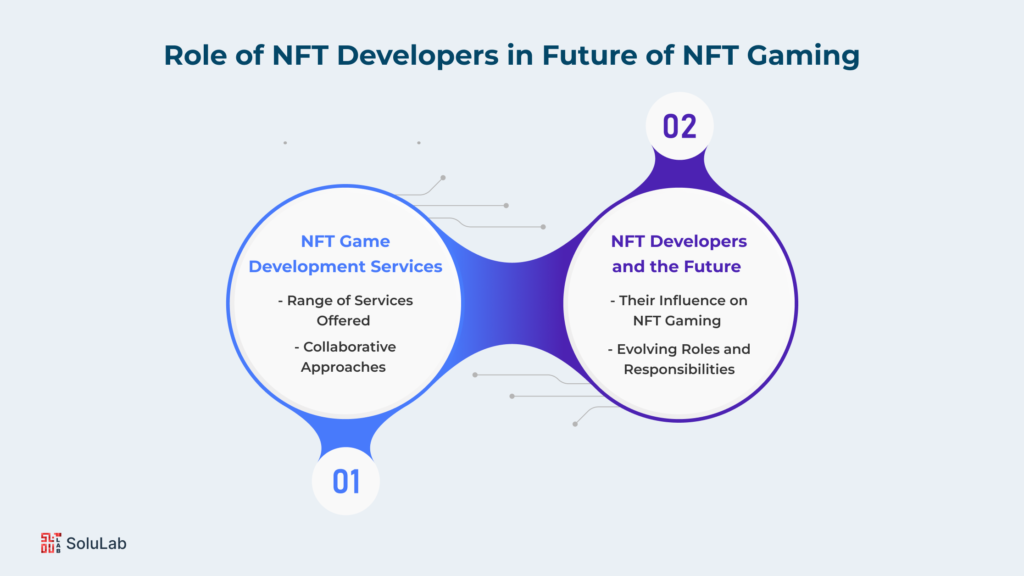
How do Top NFT Developers Influence the Future of NFT Gaming Amidst Evolving Roles and Technology?

Role of NFT developers in Future of NFT gaming

NFTs, or Non-Fungible Tokens, have rapidly become a transformative force within the gaming industry, particularly in the realm of NFT gaming collectibles. To harness the full potential of this technology, the role of NFT developers is pivotal. SoluLab, a prominent player in the NFT game development arena, is at the forefront of this exciting revolution. Let’s delve into the role of NFT developers, their qualities, services, and the impact they have on the future of NFT gaming.

1. NFT Game Development Services

  • Range of Services Offered

SoluLab, like other top NFT development firms, offers a comprehensive range of services. This includes NFT smart contract development, NFT marketplace creation, and the integration of NFTs into existing or new games. They also provide consultation on NFT strategies, tokenomics, and monetization methods specific to NFT gaming.

  • Collaborative Approaches

NFT game development is a collaborative endeavor. Developers work closely with game designers, artists, and publishers to create NFT gaming collectibles that resonate with players. SoluLab’s collaborative approach ensures that NFTs align with the overall game concept, enhancing player engagement and retention.

2. NFT Developers and the Future

  • Their Influence on NFT Gaming

NFT developers play a pivotal role in shaping the future of NFT gaming. Their innovative solutions drive the expansion of NFTs beyond collectibles. They enable in-game assets, skins, characters, and more to become NFTs, fundamentally changing the way gamers perceive ownership and trade.

  • Evolving Roles and Responsibilities

As the NFT gaming landscape evolves, so do the roles and responsibilities of NFT developers. They are increasingly involved in addressing scalability challenges, sustainability concerns, and adapting to regulatory changes. Their ability to provide solutions in these areas is instrumental in maintaining the growth and legitimacy of NFT gaming.
CTA2

Conclusion

In conclusion, SoluLab stands at the forefront of the revolution in NFTs in gaming, shaping the future of virtual collectibles. As the world increasingly embraces Non-Fungible Tokens (NFTs) and their potential in the gaming industry, SoluLab’s expertise in NFT game development services and solutions is nothing short of visionary. Their commitment to excellence and innovation has led to the creation of immersive NFT games that redefine the way we perceive NFT gaming collectibles.

NFTs in gaming are not just digital assets; they represent a profound shift in how gamers interact with and own in-game items. SoluLab’s dedication to pushing the boundaries of NFT gaming has not only defined what NFT games are but has also unveiled the true meaning of NFT gaming.

By offering the opportunity to hire top NFT developers, SoluLab empowers businesses and individuals alike to enter the exciting world of NFTs in gaming confidently. In doing so, they are unlocking a future where virtual collectibles are not only a form of entertainment but a groundbreaking form of ownership, trade, and self-expression.

In a world where NFT gaming is rapidly evolving, SoluLab is the trusted partner you need to navigate this transformative landscape successfully. With their NFT game development expertise, they are helping shape the future of gaming, one non-fungible token at a time. For expert support, contact SoluLab today.

FAQs

1. What are NFTs in gaming?

NFTs in gaming refer to Non-Fungible Tokens, unique digital assets that are used within video games as collectibles, items, or characters. These tokens are blockchain-based and represent ownership of in-game assets.

2. How do NFTs work in gaming?

NFTs work by utilizing blockchain technology to create verifiable and unique digital assets that can be bought, sold, and traded by gamers. Each NFT has a distinct value and can be owned by individual players.

3. What is the significance of NFT gaming collectibles?

NFT gaming collectibles hold value because they are scarce and cannot be replicated. Gamers can buy, sell, or trade these collectibles, fostering a sense of ownership and uniqueness in virtual worlds.

4. Can you explain NFT game development?

NFT game development is the process of creating video games that integrate NFTs as in-game assets or collectibles. This includes designing, coding, and implementing NFT functionality within a game.

5. What services do NFT game development solutions offer?

NFT game development services provide comprehensive solutions for creating blockchain-based games. They include NFT asset creation, smart contract development, integration with NFT marketplaces, and more.

 

Best Play To Earn NFT Games In 2026

Best Play to Earn NFT Games

When did you first attempt to play a game? Did you triumph? Did your group triumph? Don’t all the fun we’ve played throughout the years bring back many memories? Many gamers believe that gaming goes beyond the screen and the device. Gamers have celebrated both victories and defeats. More specifically, there is a mysterious camaraderie among gamers. By researching and regularly playing a game, players have actively contributed to its promotion. Some people spend a lot of time playing one game. Some people enjoy playing many games at once. Few players will desire a more captivating and engaging experience. Some gamers choose titles with certain themes. Sports-specific themes, fantasy-specific themes, etc. In this blog, let’s look at some of the top 2026 play to earn NFT game.

A Change in the Gaming Industry

Despite the changing styles and modes, one aspect of gaming has not altered over the years. It is the gamers’ support and spirit. The dedicated developers must ensure they offer a healthy atmosphere for gamers, as this industry depends heavily on the community. Thus far, players have used a conventional paradigm, so the standard gaming models may seem more familiar. However, it is always preferable for players to have an open mind, be adaptable, and try out various gaming genres.

NFTs’ Debut into the Gaming Industry

We employ non-fungible tokens, often play to earn NFT, to signify ownership of particular assets. An NFT games play to earn can be created using digital artwork and audio and video samples. What harm did these NFTs cause to gaming, then?

A new type of gaming known as “play-to-earn games” has emerged due to the introduction of NFTs into the gaming industry (P2E). The in-game items, winnings, and even the game’s setting can all be turned into NFTs gaming in a play to earn NFT by tokenizing them. In a conventional gaming setting, all the items the player purchased during the game will be rendered useless as soon as it ends.

However, this flaw is entirely closed up with the introduction of NFT play to earn.

The play-to-earn games’ assets are tokenized, so each player owns their own. In addition, he or she benefits from receiving royalties each time the asset is sold again. To level up in the game, gamers can even rent out the asset to other players. Gamers can get passive revenue in this manner by playing video games.

CTA 1

Examining Some of the Top P2E Games to Buy in 2026 will be Helpful.

1. Axie Infinity

Axie Infinity has gained significant acclaim as an Ethereum-based game where individuals engage in pet battles using creatures known as Axies. Players participate in collecting and training these unique NFT pets, enabling them to enter competitive arenas and strive for higher standings. The gameplay of Axie Infinity necessitates astute strategic thinking, as diverse environments demand various approaches to achieve success.

2. Silks

Silks, an exciting new NFT game gaining significant attention within the crypto community, represents the first-ever derivative play-to-earn metaverse, closely emulating real-world thoroughbred horse racing. The game’s core objective revolves around making thoroughbred racehorse ownership accessible to the general public.

3. Gods Unchained

Gods Unchained is a collectible card game that allows players to own and trade digital cards representing powerful creatures, spells, and artifacts. Players can participate in ranked matches, tournaments, and events to earn rewards and increase the value of their card collection. Gods Unchained combines the thrill of traditional card games with the benefits of blockchain technology, creating a captivating play-to-earn experience.

4. The Sandbox

The Sandbox is a multiplayer metaverse game that blends creativity and monetization. Within this virtual realm, players have the opportunity to design and trade their unique NFTs, ranging from virtual worlds and buildings to various forms of art. The platform has garnered considerable attention through partnerships with distinguished figures in the entertainment industry, establishing itself as a promising avenue for players to capitalize on their imaginative works.

5. Tamadoge

Tamadoge, a game with promising investment opportunities, draws inspiration from the beloved 1990s sensation Tamagotchi. In this game, players take on the role of caregivers for their adorable Doge-themed pets, referred to as Doges. Through the process of nurturing, feeding, and training these virtual companions, participants have the chance to earn valuable rewards in the form of the native token TAMA. The game’s NFT pets have already garnered significant attention and popularity on the OpenSea platform.

6. Splinterlands

In Splinterlands, a player-versus-player card game utilizing the Hive blockchain, participants partake in fierce battles, pitting their monsters against each other. Victorious outcomes yield Dark Energy Crystals (DEC), the game’s native currency, enabling players to bolster their DEC holdings and seize greater opportunities for earnings within the game.

7. Decentraland

Decentraland has claimed the top position on the list as a widely favored crypto gaming platform that grants its users the ability to engage in games, possess virtual land, and acquire NFTs. Players can generate income and monetize diverse constructions like houses, parks, and art galleries by engaging in the buying and selling of land plots. Furthermore, Decentraland presents avenues for hosting events and earning profits from fellow participants.

8. Guild of Guardians

Guild of Guardians is a mobile RPG fantasy game where players have the opportunity to transform their gaming sessions into valuable NFTs. In this captivating collectible game, players are empowered to assemble their formidable team of “Guardians” and engage in thrilling guild-based challenges, all while earning desirable tradeable prizes. The most remarkable aspect of this gaming experience is its accessibility as it is completely free to play.

9. Battle Infinity

Battle Infinity, an upcoming metaverse game, presents distinctive gaming mechanics and numerous advantages to its players. Within the Battle Infinity ecosystem, individuals have the opportunity to participate in fantasy sports games seamlessly integrated with the metaverse, acquire exclusive avatars, and venture into diverse platforms and NFT games.

10. Illuvium

Illuvium, an eagerly anticipated crypto game, amalgamates RPG action with the thrill of planetary exploration. Within this gaming realm, players are tasked with capturing and nurturing formidable creatures known as Illuvials, which become their companions for engaging in PvP challenges and accomplishing various missions. The game’s interplanetary encounters promise to deliver exhilarating gameplay experiences, adding an extra dimension of excitement to the overall adventure.

Final Words

Gamers have come a long way in exploring various game models. Play-to-earn NFT games are worth trying, even though straying from the gaming norm can be daunting. The top Play-to-earn NFT games should be played straight away. In conclusion, NFT games play to earn offer a unique and innovative gaming experience where players can have fun and earn real-world value.

With the growing popularity of these games, it’s important to choose a reliable and experienced partner for NFT game development. SoluLab is a leading provider of NFT game development services, offering tailored solutions to meet the specific needs of businesses in the gaming industry. With their expertise and knowledge, SoluLab can help you create a successful marketplace for NFT games play to earn, hire skilled NFT developers, or launch your own white-label NFT platform. Embrace the exciting world of Play-to-earn NFT games with SoluLab and unlock the potential for growth and success in this emerging industry.

CTA 2

FAQs

1. What are play-to-earn NFT games?

Play-to-earn NFT games are online games where players can earn valuable in-game assets, currencies, or non-fungible tokens (NFTs) that can be traded or sold in the real world. These games provide an opportunity for players to monetize their gaming skills and time investment, creating a new paradigm where gaming becomes a source of income.

2. How do play-to-earn NFT games work?

In play-to-earn NFT games, players engage in various activities such as completing quests, battling opponents, or participating in virtual economies to earn rewards. These rewards are often in the form of NFTs or in-game currencies that can be converted into real-world value. Players can then sell or trade their earned assets on NFT marketplaces or use them within the game ecosystem.

3. What are some popular play-to-earn NFT games in 2026?

Some popular play-to-earn NFT games in 2026 include Axie Infinity, Splinterlands, The Sandbox, Decentraland, and Gods Unchained. These games offer unique gameplay mechanics, vibrant virtual worlds, and the potential to earn valuable NFTs, making them highly sought after by players and collectors alike.

4. How can I get started with play-to-earn NFT games?

To get started with play-to-earn NFT games, you’ll need a compatible device, an internet connection, and a digital wallet to store and manage your earned NFTs. You can download the game client or access the game through a web browser. It’s important to research and choose a game that aligns with your interests, gameplay preferences, and earning potential. Additionally, familiarize yourself with the game mechanics, community guidelines, and marketplace dynamics to maximize your chances of success.

How to Create an NFT Game: A Step-by-Step Guide


How to Create an NFT Game A Step-by-Step Guide

You must be familiar with non-fungible tokens (NFTs). Transaction processing, which is dependent on blockchain technology, has already achieved success in several specialized areas. Particularly, it has changed how much money NFT games make. Until the start of last year, the NFT-based transaction volume had already surpassed $10.67 billion, according to a DapRadar analysis. For a game production company, NFT Games opened up a world of possibilities for marketing its intellectual and creative rights safely and securely. For those who want how to create an NFT game? Here, we’ll walk you through the multiple steps involved in the making of an NFT game. But first, let’s explore NFT and find out how NFT games function.

The Non-Fungible Token, or NFT, is nothing more than a cryptographic token built on blockchain technology. These tokens serve as a stand-in for specific and unique digital items, such as gaming characters, unique digital artwork, different credentials, and in-game aesthetic components.

Read also: What are NFT Games and How Do They Work?

NFTs are used by players of these games to sell the Unique game characters and receive prizes from the game developers. NFT Games made a substantial contribution to the “pay as you earn” movement in the gaming sector. Let’s check out a clear step-by-step tutorial for creating an NFT game and some more details about it. 

NFT Game Model’s

There are two types of models you can use to create an NFT game, and both come with their features and services:-

P2E (Play-to-earn):-  The highest conversion ratio is seen in this model. This methodology allows NFT games to only employ their coin as a form of player compensation. Players will receive a set number of coins, but they cannot be traded on the open market.

F2P (Free-to-play):- The fact that the coins may be traded on the market makes this model superior to P2E in the eyes of NFT game players. In contrast, players in this model play with their earned NFT coins and are rewarded through the game itself.

A Step-by-Step Guide on How to Create an NFT Game

Step 1: Have a great NFT game idea 

Start by concentrating on the type of NFT game you want to develop. This would benefit you. Find out which models are best for the type of game you want to create. To capture the interest of your intended player audience, research several comparable games and then create something more captivating and original.

Step 2: Accommodate creative design. 

You must make room for imaginative game characters & game skin designs because NFT games are known for employing NFT to depict innovative and artistic game features and characters in commercial usage. The 2D or 3D graphical artists on the game development and design team have to be knowledgeable and skillful.

Step 3: Decision between the Web App or Mobile App

It’s time to decide what kind of platform you want to use to construct your game now. Which would you want to design, a web app or maybe a mobile app? What must be decided in this situation? Remember that all sides have advantages and disadvantages.

Your NFT game would be available to more players without restrictions on time, location, or device if you built it as a web app. Web apps are also able to play games online without having to download them.

On the other hand, you can guarantee a more engaged custom mobile-specific user experience & features by developing a mobile NFT gaming app. You have a lot of options when using mobile platforms to provide a more interesting and engaging gaming experience. However, building two distinct apps, including Android and iOS, is required for mobile apps, which results in greater development expenses.

Step 4: Decide the appropriate tech stack

The correct tech stack and skilled developers are the two main factors that determine an app’s success. It is impossible to construct an NFT game in any other way. You must pick the appropriate frontend, backend, wallet, as well as smart contract technology to develop a high-performance NFT game.

For NFT game apps, some of the tried-and-true technologies are Unity3d, ASP.NET Core, C#, MySQL, MongoDB, Truffle Suite, Amazon Web Services (AWS), and several others. Depending on your target platforms, you can also use a range of OS, including iOS, Android, Web, Windows, Linux, macOS, and so on.

Step 5: Frontend development 

For front-end development, both JavaScript and TypeScript can be used to develop the NFT app’s front end. ReactJS, VueJS, is your best available framework option for front-end development. Angular is viewed as a poor front-end option by many developers due to its complexity.

Step 6: Integrate a Wallet

The NFT application project requires a wallet address to be included for authentication and login purposes. You’ll be able to store tokens conveniently and safely online thanks to this.

Step 7: Establishing communication with Smart contract

The front end must take the user address from either the wallet & then pass it to the Smart Contract in order to give the NFT URL to the users. Use the well-known Web library to establish communication between Blockchain-based Smart Contracts. Transactions can also be tailored using this library based on users.

All of the fundamental guidelines, obligations, & roles of NFT Games are normally defined through smart contracts. On the Ethereum Blockchain, smart contracts use programming languages like Vyper, Solidity, Yul, and so on. The majority of NFT game creators utilize Solidity, a language that is quite similar to JavaScript, to code the Smart Contracts. Python-proficient programmers may want to use Vyper as their language of choice.

Developers with less experience should always adhere to well-known languages like Solidify because this aspect of development calls for some prior experience as well as project exposure. They can simply access numerous educational resources on GitHub as well as other platforms thanks to such a well-liked option. Finally, Yul is appropriate for seasoned engineers who have been working on smart contract projects for a while.

Step 8: Backend Development 

An NFT game app project requires extensive back-end programming because SmartContract would only make requests again for NFT URLs. After all, storing the complete NFT with its extensive metadata would be too laborious. The metadata needed to request the Smart Contract in more detail is provided by the NFT gaming app’s backend.

Since Blockchain database technology is used by NFT game apps, keeping centralized data access through the backend of the app will negate the main advantages of this decentralized database technology. Many NFT apps employ a technology called Chainlink to ensure a seamless connection between both the data off Blockchain and the data on Blockchain.

Read also: How to Make an NFT Game?

Because of its scalability, compact size, and expressive code, Node.js is a fantastic option for such a back-end programming language. NodeJS is already regarded as a strong and reliable backend development framework.

Step 9: Testing the game

You have to use the right tool to test your or any NFT gaming app. Several great tools are available to assess the NFT game app. The Rinkeby or Ropsten Testnet is available for app testing. For testing purposes, some developers also favor building a mimic blockchain. Some use Ganache for developing, a tool provided by Truffle, specifically for this function.

The types of blockchain game testing can be as follows:

Functional testing: This is a test of the game’s general functionality, data transfer, block and chain sizes, and other factors in order to assess requirements, processes, etc.

Security testing: To look for any dangers to the blockchain system, this is a requirement.

UI testing: To ensure a fantastic user experience, it’s crucial to test fonts, colors, graphics, and other elements of the game’s functioning and workflow.

Integration testing: This is a test of how well various software components communicate with one another.

API testing: The key is to ensure that software components are properly communicating with an external API and that the system is correctly processing the request and answer.

Step 10: Deploy the game and reach out to a wider audience. 

Finally, Your NFT game is set to launch in the market and is ready to be released after being conceived, produced, and tested. There is a brief stage of mainnet preparation left before the launch of the NFT game. It’s advised to take your time testing & deploying the game. Check for security flaws and remain vigilant for them.

Future of NFT gaming

The future of NFT gaming is promising! There will be an increase in the number of blockchain NFT platforms available, and more games will be created using these new tech platforms. According to the analysis, the play-to-earn non-fungible token (NFT) game market would be worth $2.8 billion between 2022 and 2028. Furthermore, throughout the same six-year period, the industry’s compound annual growth rate was 20.4%.

Wrapping Up 

That’s it, it is my take on how to create an NFT game, The marketplace for NFT games already has established its position as a niche one, providing game developers with tremendous opportunities. NFTs have made it possible for game projects to concentrate more on promoting unique and innovative gameplay, characters, and design components. However, it is crucial to first keep to the path of tried-and-true development procedures to realize the benefits of NFT. This detailed guide was created expressly to analyze and address this.

What are NFT Games and How Do They Work?

What are NFT Games and How Do They Work

Are you interested in playing a game that can help you earn money too? The NFT games are here.  An NFT gaming market is more than buying non-fungible tokens and saving them on your digital crypto wallet. When it comes to features, NFT games have it all, player interactions and transactions of characters or avatars. Players can now make money in the form of NFT tokens. In this blog, we will learn about NFTs in gaming, their financial aspect, genres, top NFT games and much more. 

Understanding NFTs in gaming

Crypto money is similar to a digital wallet, where instead of money, you can store crypto. To simplify this further, crypto is a form of currency. Unique cryptographic tokens are used to play these games. Additionally, each NFT has an internal metadata system. Like an authenticated certificate, the metadata stored inside the NFT specifies what it stands for, its history, and the transaction record. 

NFT gaming differs from traditional gaming. Here, crypto money can also be used in the marketplace. To participate in a game, a participant must first register an account. It appears on a digital platform or mobile app. Installing an NFT wallet utilised in a game and having cryptocurrency wallets is required.

The financial aspect of NFT gaming

Here is how an NFT game functions financially. Its economy is based on in-game asset purchases, unlike traditional game monetisation, which involves users purchasing games or watching advertisements.

Players frequently need to purchase some gaming NFT assets to begin playing an NFT game. Additionally, game creators have listed in-game items for purchase on a marketplace. Further, game developers charge a fee for every platform transaction. There is an actual NFT marketplace for games where you can play your heart out and earn money.

What are In-game NFTs?

One method of earning money via NFT games is through in-game NFTs. Using this gameplay mechanic has been the standard way to make money off NFT games for many years. The worth of an item in the game will vary greatly depending on its aesthetic qualities, rarity, or function.

Read more: 8 Best NFT Games You Should Check Out in 2022

Popular genres in NFT games

Not sure what type of NFT game you wish to play? Check out these popular genres to choose from-

  • Action games – In this genre, the players usually engage in a battle to fight enemies. This can be using guns, grenades, one-on-one battles, etc. These games generally have action scenes. 
  • RPG – RPG stands for role-playing games. These games usually have a solid storyline, and the players are characters. These players have their avatars. RPG games are also popular for groups. To understand this, let’s take the example of Jumanji. It was a popular RPG where a group of friends where each has their strengths and weaknesses, are stuck in the jungle on a mission. 
  • Sports games – If you are a crazy sports fan, this NFT gaming genre is meant for you. This genre doesn’t need much explaining. It usually has football matches, car racing, etc., where the players compete with one another or the bot to win.
  • Strategy games – Making the right and wise decisions can be a tricky task. But if you feel good at it, these games are for you. You need to make a series of right choices or plan your actions ahead of time to win the game. 

Mechanics for NFT games

Here are some of the mechanics you need to know about – 

  • Resource collection – You need complete tasks or levels in these games. Based on your accuracy, speed, etc., you are scored. You shall receive tokens, coins, or points per your scores. Further, you may redeem these to upgrade your items. 
  • Breeding – These games require you to care for and nurture your digital pets or babies. These games need you or your character to work and provide for them. For example, in cattle, you are supposed to grow grass and feed them to sell their milk in the market and make money. 
  • Farming – Unlike the regular farming games where you need to buy seeds, grow crops and sell them to run farmland, these NFT games are different. In these games, players can buy and own digital land and sell it further. 

Top NFT Games that you Must know About 

If you are ready to play NFT games and fill your crypto wallets, here are some of the most popular NFT games that you must know about – 

Axie Infinity

Would you believe that 2.8 million players play this game regularly? This is true! Axie Infinity is a leading and loved NFT game in the market. This game follows a play-to-earn system where the players earn AXS tokens within the gameplay. In this game, each player can nurture and care for their three digital pets called Axie. These Axie further have their offspring and pass their traits, strengths, and weaknesses to them.

Alien Worlds

Alien World is a play-to-earn game where the players earn in Trillium. The players use this to control planet organisations, where the players need to participate in councils and run for elections. Players can also go for missions and battles in the Metaverse.

Gods unchained

Gods unchained is another popular play-to-earn game where the players get about 140 free cards. Each of these cards has its strengths, and the players can trade these cards within the game. 

The sandbox

In reality, the sandbox is a lot like Minecraft but based on a community-driven NFT platform. Players here need to create their voxel ASSETS. These can further be marketed and sold in the gaming NFT marketplace.

Battle racer

Battle racer gives a different look to the original car racing games. To play this game, you also need to design your own car, with skill sets of your choice, such as speed, firing rate, defence Power, etc.

Conclusion

Have you tried these NFT games yet? NFT games are leading the market and are very popular. There is a game for every gamer, whatever their choice be. While playing these games, you can entertain yourself and earn a handsome amount. NFT games marketplace is a new reality. 


Best NFT Games – Top Play-to-Earn Blockchain Games 2025

Best NFT Games

Play to earn NFT games is Changing the gaming industry, redefining the relationship between gamers and developers. Fueled by the increasing popularity of non-fungible tokens (NFTs) and blockchain technology, P2E games are changing the way games are designed, played, and monetized.

With a market size projected to reach over $8800 million by 2028, P2E games are showing no signs of slowing down. The surging popularity of digital assets like cryptocurrencies and NFTs is driving the growth of this sector, offering gamers new opportunities to earn while they play.

Are you interested in getting started with P2E games? Look no further! Check out our carefully curated list of the best play-to-earn crypto games in 2025. Dive into the world of P2E and explore the exciting potential of blockchain-based gaming.

How Do Play-to-Earn Games Work?

Play-to-earn (P2E) games have revolutionized the gaming landscape by introducing a novel economic model. Unlike traditional games that solely focus on immersive gameplay, P2E games allow players to earn cryptocurrencies as they embark on their in-game journeys. This innovative concept empowers players to create tangible real-world value from their gaming experiences. In this article, we will explore the mechanics of how P2E games operate and the profound impact they have had on the gaming industry.

1. Tokenized Assets and In-Game Items:
Play-to-earn games leverage blockchain technology to transform in-game assets and items into non-fungible tokens (NFTs) or fungible tokens. These assets are securely stored on the blockchain, providing players with indisputable ownership and a sense of rarity.

2. Economic Ecosystem:
Within the game’s universe, players can buy, sell, and trade their tokenized assets, creating a self-sustaining economic ecosystem. This ecosystem is often facilitated by a native cryptocurrency, enabling seamless transactions.

3. Gameplay and Earning:
Players engage in various in-game activities, unlocking opportunities to acquire valuable items, tokens, or cryptocurrencies. These rewards can enhance gameplay experiences or be exchanged for tangible real-world worth beyond the best NFT games 2025.

4. Blockchain Verification:
The blockchain ensures the integrity and security of in-game transactions, preventing manipulation or fraudulent activities. Every exchange, acquisition, and sale is meticulously recorded on the blockchain, creating an impervious barrier against dishonesty.

5. Marketplaces and Exchanges:
Many play-to-earn games have integrated marketplaces where players can list and sell their tokenized assets. These assets can be purchased using the game’s native cryptocurrency or other compatible tokens. Certain assets gain value due to their rarity or utility, leading to a thriving secondary market.

6. Decentralization:
Play-to-earn games often operate on decentralized platforms, reducing the influence of central authorities. This decentralization gives players more control over their in-game assets and earnings.

7. Economic Opportunities:
Play-to-earn games have opened up new economic opportunities, allowing players to earn a living by dedicating time and skill to the virtual world. Some players have even turned gaming into a full-time career, earning substantial amounts of cryptocurrency.

8. Community and Governance:
Many P2E games involve their communities in decision-making processes through governance mechanisms. Token holders may have the power to influence the game’s development, updates, and other aspects, promoting a sense of ownership and involvement.

Types of Play-to-Earn Crypto Games

In play-to-earn (P2E) crypto games, players can immerse themselves in various gaming genres while earning cryptocurrency rewards. These games combine the excitement of gaming with the power of blockchain technology, offering unique opportunities for players to engage, explore, and profit. Let’s dive into the diverse categories of P2E best NFT games 2025:

1. Role-Playing Games (RPGs): Embark on epic adventures across virtual worlds in P2E RPGs. Conquer quests, battle monsters, and master crafting skills to acquire valuable in-best NFT Games assets that hold real-world value as cryptocurrencies.

2. Strategy Games: In strategy-based P2E games, players make tactical decisions to build, manage, and expand virtual assets. From constructing kingdoms to governing civilizations, optimizing strategies leads to rewarding outcomes.

3. Collectible Card Games (CCGs): P2E CCGs merge traditional card game mechanics with blockchain technology. Collect, trade, and battle with digital cards, each possessing unique attributes and potential value in the crypto market.

4. Virtual Real Estate Games: P2E virtual real estate games enable players to buy, sell, and develop virtual properties using blockchain. These properties can generate passive income or appreciate in value over time.

5. Play-to-Earn NFT Games: Non-Fungible Tokens (NFTs) play a vital role in many P2E games. Players can earn, buy, and sell NFTs representing in-game items, characters, or assets, enabling them to monetize their gaming achievements.

6. Battle Royale and PvP Games: P2E battle royale and player-versus-player games offer competitive environments where players compete for rewards based on their performance. These games encourage skill development and engagement.

7. Idle and DeFi Games: Idle games require minimal active participation, generating rewards over time based on in-game actions. DeFi games integrate blockchain’s financial features, allowing players to earn interest or rewards by participating in DeFi protocols within the game.

8. Sports and Racing Games: P2E sports and racing games bring the excitement of virtual tournaments and adrenaline-fueled races. Players’ skills directly influence the rewards they earn, making each victory even more satisfying.

9. Adventure and Exploration Games: P2E adventure and exploration games offer captivating journeys. Players uncover hidden treasures, solve puzzles, and immerse themselves in enchanting narratives, earning enticing rewards and recognition along the way.

10. Social and Virtual World Games: In P2E social games and virtual worlds, players can forge meaningful connections, acquire virtual property, and benefit from their social interactions. Dynamic events and creative expression are rewarded in these vibrant communities.

List of the 10 Best Play-to-Earn Games

We’ve rounded up some of the best NFT games 2025 that you can enjoy while earning virtual assets and other in-game rewards.

1. Axie Infinity

Axie Infinity, an immensely popular play-to-earn game, offers a Pokémon-style experience where players can earn cryptocurrency. The game revolves around breeding and raising Axies, adorable creatures that can be used for battles. Aside from purchasing Axies in the in-game marketplace, players can also acquire virtual real estate represented as non-fungible tokens (NFTs). Transactions occur on Ronin, a sidechain specifically designed for Axie Infinity by Sky Mavis.

As a play-to-earn game, Axie Infinity allows players to monetize their in-game assets, primarily by selling Axies in the marketplace. Players can also earn by collecting unique crypto tokens. The game features two distinct crypto tokens:

  • Axie Infinity Shards (AXS): This primary token serves as a governance token and can be purchased through cryptocurrency exchanges. Additionally, players have the option to trade major currencies like Bitcoin or Dogecoin to participate in the game. It’s worth noting that AXS has a limited supply of approximately 270 million tokens.
  • Small Love Potion (SLP): The SLP is a unique token rewarded to players for completing quests and emerging victorious in competitions.

To initiate gameplay in Axie Infinity, ensure you possess a crypto wallet compatible with the Ethereum blockchain platform. Additionally, you will require ETH and a Ronin wallet to establish a connection to the game. Upon completion of these steps, you can commence playing Axie Infinity on various devices, including PCs, Macs, Android devices, or iOS devices.

About Axie Infinity:

Sky Mavis, a Vietnamese studio established in 2018, developed Axie Infinity, a play-to-earn (P2E) game. Initially launched in March 2018, it gained significant popularity in 2021 and 2022, becoming one of the most prominent crypto apps on the Ethereum blockchain in 2021.

While Axie Infinity reached its peak in 2022 with an impressive monthly player base of nearly 3 million, its current active player count has dwindled to approximately 390,000 within the last 30 days, as indicated by ActivePlayer’s Live Player Count.

2. Polywin

Polywin, built on the Polygon blockchain, seamlessly merges crypto trading and gaming, revolutionizing online entertainment. It provides adrenaline-packed 45-second rounds, where strategic bets yield substantial rewards. The user experience is streamlined, eliminating lengthy registrations and deposits, allowing users to place bets in just 30 seconds. The outcome is revealed in a thrilling 15-second period, with immediate wins and direct deposits into users’ crypto wallets.

Polywin stands out due to its transparency, with no house edge and purely player-vs-player dynamics, where users’ predictive skills determine their success. The combination of real-time crypto trading and gamified elements offers an exhilarating experience that captivates players.

CTA1

Furthermore, Polywin prioritizes trust and transparency. The platform leverages the security and immutability of blockchain technology, ensuring that every action is verifiable and fair for all participants. Additionally, the rigorous audit by CertiK places Polywin among the top 10% of blockchain projects, solidifying its commitment to security and reliability.

About Polywin:

Polywin, a prominent play-to-earn platform built on the Polygon network, has achieved remarkable success. Certified by CertiK for security, Polywin revolutionizes online entertainment by harmoniously combining cryptocurrency trading and gaming on the Polygon blockchain. With transparent gameplay and instant rewards, Polywin offers captivating 45-second rounds, placing participants in a strategic betting environment where they have the opportunity for substantial earnings.

3. Decentraland

Decentraland is a virtual universe where players can investigate LANDS, make unique artworks or scenes, and trade their computerized resources, like LAND and symbol wearables, through the Decentraland Marketplace on the Ethereum blockchain.

This Decentralized Autonomous Organization (DAO) controlled world allows players to choose and manage how Decentraland works. This blockchain-based game offers two administering digital currency tokens:

  • LAND: A Non-Fungible Token (NFT) that addresses a player’s virtual land.
  • MANA: A cryptographic money utilized inside Decentraland to purchase in-game resources like LAND and virtual items.

As proprietors of this virtual world, Decentraland clients are answerable for its advancement and administration. Players investigate the Decentraland metaverse through their symbol, and clients continually foster this virtual domain. Here, you can buy computerized craftsmanship, exchange resources with different players, and even join the Decentraland University, available with advanced tokens.

Decentraland offers different ways to procure. One can obtain MANA or LAND tokens, plan attire for symbols to sell in the commercial center, or request awards from the Decentraland DAO.

About Decentraland:

  • Decentraland, a real estate metaverse game created by the Decentraland Foundation, launched in January 2020.
  • Currently, the game is accessible exclusively through desktop devices.

Related: Top NFT Development Companies 

4. The Sandbox

The Sandbox, built on the Ethereum blockchain, is more than just a game; it’s a virtual universe where players can explore, acquire, and design their virtual lands. Recognized as one of the leading play-to-earn Top NFT games, it has gained popularity as a preferred platform for virtual events. The Sandbox metaverse has also attracted notable celebrities like Snoop Dogg and Paris Hilton, as well as global brands like Ubisoft, Adidas, and Gucci, who are actively constructing within it.

As a blockchain-based game, The Sandbox offers three distinct products: VoxEdit, The Sandbox Marketplace, and The Sandbox Game Maker. VoxEdit empowers users to create and animate their own 3D objects for the game. The Marketplace serves as a platform for players to publish and sell their digital assets. Lastly, the Game Maker allows users to craft their own 3D games.

To obtain digital real estate known as ASSETS and LANDS, players must use SAND tokens, the native currency of The Sandbox. These tokens can also be utilized to purchase more SAND within the game.

About The Sandbox:

  • The Sandbox, a collaborative project between Arthur Madrid and Sébastien Borget, was initially conceived by Pixowl in 2012.
  • In 2018, the project was revamped, transforming it into a blockchain-based version.

5. Ember Sword

Ember Sword is a fantasy MMORPG that allows you to immerse yourself in epic adventures, possess in-game assets, engage in battles with monsters and other players, and share your experiences with a vibrant community. Operating on a player-centric PvP and PVE model, it grants true ownership of digital assets to its players. This empowers players to influence the game’s ecosystem and have complete control over their actions.

Ember Sword offers an unparalleled level of freedom, allowing you to choose your adventure, explore vast landscapes, interact with the environment, and even make modifications to the digital landscape. Its innovative classless combat system enables you to fuse various abilities and refine your combat skills. Additionally, the AI-Game Master orchestrates unique and dynamic events, providing players with endless challenges and opportunities.

To maximize the play-to-earn potential, Ember Sword has joined forces with OpenSea, enabling players to seamlessly sell their official game NFTs on the OpenSea marketplace. This partnership ensures a secure and transparent platform for players to trade their in-game assets and generate real-world income. By combining captivating gameplay with true ownership and a lucrative Play to earn NFT games, Ember Sword redefines the MMORPG experience and establishes itself as a trailblazer in the gaming industry.

About Ember Sword:

Ember Sword, developed by Bright Star Studios, is yet to be released as the developers work on enhancing the game and establishing true ownership for it. To stay informed about the latest developments, players can engage with the game’s communities on various platforms, including Telegram, Instagram, LinkedIn, Facebook, Medium, Twitch, Discord, Twitter, YouTube, and Reddit. The game is scheduled for initial release on PC (Windows and Mac), accessible either through a browser or as a standalone client. Additionally, the developers are in the process of making the game available on mobile devices, expanding its reach to a broader audience.

6. Forest Knight

Forest Knight, a turn-based strategy game developed for mobile devices, seamlessly merges mobile gaming and blockchain technology to provide players with epic adventures while allowing them to earn NFTs. These NFTs can be transferred to crypto wallets and traded on marketplaces, setting Forest Knight apart from other best nft play to earn games. Uniquely, players can rent out their characters and NFTs to others, and they can mint and withdraw NFTs free of charge at the time of writing.

Furthermore, Forest Knight features a staking mechanism where players can earn interest on their $KNIGHT holdings. These tokens serve as the game’s utility tokens, granting players access to in-game benefits and voting rights to shape the game’s future developments.

The game operates on both PVE and PvP models, enabling players to create team combinations to defeat enemies, collect loot, complete missions, and engage in competitive battles with other players in the Arena.

About Forest Knight:

Forest Knight, an NFT-based game, was created by Chrono Games. While the mobile version is currently limited to Android devices, players can still enjoy the game on their desktops or laptops, providing cross-platform accessibility.

7. Galaxy Fight Club

Galaxy Fight Club stands out as a cross-platform player-versus-player game, enabling players to compete for rewards such as Ethereum (ETH) and non-fungible tokens (NFTs). Notably, this play-to-earn game allows players to utilize various NFT collections to begin playing and earning. This means you can participate in the game with your existing NFTs or play without owning any.

To partake in Galaxy Fight Club, you must possess at least one Galaxy Fighter. This grants you the ability to engage in battles as the character or utilize your own NFT to confront challengers.

The NFT in Gaming employs its in-game utility currency, $GCOIN. Players can use $GCOIN to access loot boxes, train their fighters, and acquire new weapons. Galaxy Fight Club offers multiple avenues for players to earn rewards.

Owners of Galaxy Fighters can earn approximately 5-15 $GCOIN. Additionally, players can win key fragments in deathmatches, triumph in weekly tournaments and claim ETH or its equivalent in $GCOIN, craft weapons and sell them on the marketplace, or rent out their Galaxy Fighters to collect $GCOIN.

About Galaxy Fight Club:

Galaxy Fight Club, a cross-platform game built on the Polygon blockchain and developed with Unity, is available for download on Google Play, the App Store, and PC. This accessibility allows players to engage in the game regardless of their preferred platform.

8. Gods Unchained

Gods Unchained, a free-to-play P2E trading card game, offers players complete ownership of their in-game assets, making it one of the most popular P2E Top NFT games in 2023. Players can collect cards, build their own deck, and trade or sell them to others.

To play and earn in Gods Unchained, players need to have the Gods Unchained Coin ($GODS), which acts as a governance and utility token. $GODS can be used to pitch governance proposals, purchase in-game assets, or acquire expansion packs. There is a limited supply of $GODS, with only 500 million tokens in circulation. Players can earn $GODS, which have real-world value, and transfer and convert them into fiat currency.

Another way to earn in Gods Unchained, aside from staking rewards, is by selling cards. Players can play Gods Unchained with or without a crypto wallet and even without a background in blockchain systems or the Ethereum network. However, a crypto wallet is required to connect to a gaming account to make the most of cards (NFTs) and earn $GODS tokens as rewards.

About Gods Unchained:

Gods Unchained, a game built on the Ethereum platform, was first announced in 2018 by its founders, James and Robbie Ferguson.

Currently, the NFT Games can be played on computers running Windows or Mac, with development underway for Android devices. According to the game’s developers, the plan is to make Gods Unchained available exclusively for Android rather than iOS devices like the iPhone.

There are two reasons behind this decision: firstly, the Android platform allows for sideloading of APK builds, and secondly, while an early iOS build exists, it is not yet part of the Early Alpha access program.

9. Illuvium

Illuvium, a top-tier interoperable blockchain game (IBG) based on the Ethereum network, offers players an immersive open-world experience, an autobattler, and a city builder. Notably, Illuvium provides a free-to-play option for new players, allowing them to explore the game without owning ILV tokens. However, unlocking the full range of features requires joining the paid experience, enabling players to collect NFTs and delve into more regions.

Within the game, players can discover and navigate seven distinct landscapes, including the Illuvium Overworld, Arena, and City. Each universe presents unique in-game experiences, such as capturing over 150 Illuvials, crafting custom teams, and constructing digital industrial complexes.

Similar to other blockchain best nft play to earn games, Illuvium empowers players with true ownership of their in-game assets, allowing them to collect, trade, and sell items within the marketplace. Additionally, players can stake tokens to earn rewards and purchase ILV tokens, which hold utility in governance, liquidity mining, and vault distributions. ILV tokens can be acquired on platforms like Sushi or supported centralized exchanges, such as Binance and KuCoin.

About Illuvium:

Illuvium, co-founded by Kieran and Aaron Warwick in 2020, is currently undergoing a Closed Beta testing phase. While not yet accessible on mobile devices, the developers are actively working on a tailored mobile version. Additionally, a console version is in the works, designed for gaming consoles such as Xbox and PlayStation.

10. Sliks

Silks stands out among the top play-to-earn games due to its innovative gaming experience. This fantasy horse racing game, modeled after real-world horseracing, enables players to breed, purchase, and trade thoroughbreds using the game’s native token, STT.

Silks offers a complex ecosystem comprising diverse in-game assets, including avatars, racehorses, land, stables, and land parcels in the Sky Falls region. The game’s unique feature is that when players purchase a racehorse, they essentially acquire a digital clone of a real-world racehorse. Each NFT Silks racehorse mirrors its real-world counterpart’s bloodline, training progress, and racing results. This means that if the real-world counterpart wins a competition, the same information will be reflected in the digital twin, rewarding players in the game for real-world events.

Silks’ play-to-earn aspect allows players to sell fractional interests in their horses. By doing so, they can earn a percentage of the rewards each time the Silks racehorse’s real-world counterpart wins real-world competitions.

About Silks:

Troy Levy, the CEO of Tropical Racing, a horseracing enterprise, and owner of Circle 8, a racing and breeding company, developed the unique concept of Silks.

CTA2

Conclusion

In conclusion, the realm of NFT games is rapidly evolving, with 2025 promising to bring some of the best NFT games to date. Our curated NFT Games list highlights top titles and showcases the growing trend of play-to-earn NFT games. As NFT game development continues to advance, companies like SoluLab are at the forefront, NFT game development Company driving innovation in this exciting space. The integration of non-fungible tokens in games has revolutionized how players engage and earn, making the best play-to-earn crypto games a significant part of the gaming industry. Whether you’re new to the world of NFT games or a seasoned player, the opportunities to explore, play, and earn are more abundant than ever. Dive into the best NFT play-to-earn games and discover how the future of gaming is being reshaped by NFT game development.

FAQs

1. What are the Best NFT Games?

The best NFT games are those that offer immersive gameplay, valuable rewards, and a strong community. These games often incorporate non-fungible tokens (NFTs) to enhance the gaming experience and provide unique digital assets that players can own, trade, and earn from.

2. Which are the best NFT games in 2025?

The best NFT games of 2025 are expected to include a variety of genres and innovative mechanics. These games will leverage advanced NFT game development to offer new ways for players to engage and earn through play-to-earn crypto games.

3. What is the significance of NFTs in games?

NFTs in games allow for the creation of unique, tradable digital assets that players can own. This adds a new layer of value and engagement, as players can earn real-world value through their in-game activities. The integration of NFTs is a key trend in the development of top NFT games.

4. Can you provide an NFT Games list?

Yes, our NFT Games list includes some of the top NFT games available today, ranging from RPGs to strategy games. These games are known for their innovative use of NFTs and play-to-earn mechanics, making them some of the best NFT play-to-earn games on the market.

5. How do play-to-earn NFT games work?

Play-to-earn NFT games reward players with NFTs or cryptocurrency for their in-game activities. This model allows players to earn real-world value while playing, making these games a popular choice for those looking to monetize their gaming time. Some of the best play-to-earn crypto games offer substantial rewards and engaging gameplay.

6. What should I look for in an NFT game development company?

When choosing an NFT game development company, look for one with a strong track record in creating successful NFT games. Companies like SoluLab are known for their expertise in NFT game development, providing innovative solutions that enhance the gaming experience.

Gaming NFTs & How They Are Creating New Value for Video Games

Gaming NFTs & How They Are Creating New Value for Video Games (1)

NFTs got attention by creating hype and riding the trend wave. Although everybody knows about NFTs, many people imagine NFTs like cryptocurrency’s not-so-smart little brother.

In reality, NFTs have the power to disrupt the world as much as any crypto asset. Unlike bitcoin, where you can exchange almost any bitcoin for another, an NFT is unique and as the acronym states, “non-fungible”.

To put it simply, bitcoin is like the $10 bills in your wallet — you don’t care which bill you have as long as you have it in your pocket. NFTs are like having a Mona Lisa in your house. There’s only one original, and you do care which version you have.

NFTs are finding their practicality in many industries. At Arianee, we take real assets and give them a digital identity, also utilizing NFT technology. And even though we personally haven’t touched the world of gaming yet, imagine if proof of ownership of a physical object could open up unique in-game experiences! You own a collectible, that give you special powerups. You own a particular pair of shoes, well, you can now wear them in-game. But we’ll get to all this later..

Here are some of the leading gaming projects incorporating blockchain technology and NFTs and how they are changing the world of the NFT gaming marketplace.

Axie Infinity

As the pandemic hit the world in 2020, many people found themselves locked inside their homes without jobs.

In the Philippines, people found a way to deal with both issues simultaneously by playing Axie Infinity.

Axie Infinity is your regular trading and battling game. Imagine Pokemon, but add blockchain to the mix. Players can collect, raise, battle, and trade creatures called “axies.”

But while in the Pokemon game, each creature is nothing more but a digital code made to look cute, in Axie Infinity, each monster is also an NFT.

So let’s say you breed a rare axie that’s one of its kind. It isn’t Mona Lisa, but you can still fetch a reasonable price for the NFT. Considering the “Genesis” virtual land in Axie Infinity got sold for $1.5 million, the fire-spitting monster you own might be worth something in the future.

Finally, in the little economy of Axie Infinity, you can battle your NFT monsters and earn Small Love Potions (SLP). SLP are necessary to breed your axies and is a fungible token you can trade on any exchange where the token is available.

Decentraland

Instead of a specific game, Decentraland is an entire virtual world where players can do whatever they want. Like Minecraft, players can purchase real estate parcels, build houses, create items, and even clothes.

Naturally, everything in the game can be an NFT. Maybe you own a piece of land on the top of an active volcano, or you have a rare art piece hanging in your virtual home. You can auction and sell it to the highest bidder. Remember we mentioned bridging physical ownership of goods to the digital world? Well, Decentraland would be a perfect example of a platform that could support “digital-twin” wearables. You just bought a limited edition designer watch? Now you can wear it in the game.

Furthermore, Decentraland has its native cryptocurrency called MANA. Besides using it to buy items inside the game, players can use MANA to vote for changes in the game. Meaning, instead of being mere players, people can participate in how the world develops.

Decentraland is like an open-source, decentralized virtual world. Decentraland plans to allow players to create their games inside the world, form virtual communities, and even advertise.

For that to happen, Decentraland needs attention. The same goes for NFTs. It can be silly to think how a pixeled shirt can hit a 5-digit dollar value. But with enough eyes on it, anything can happen, and Decentraland is heading in the right direction.

The Sandbox

Like Decentraland, The Sandbox is a virtual world where players can build NFTs, buy and sell their NFTs, and create various gaming experiences for other players.

You can create unique and scarce NFTs on every step and have genuine ownership of a one-of-a-kind item.

The engine allows everybody to animate and design 3D objects such as people, animals, and countless other items. On top of that, players can use their NFTs and develop their 3D games inside the Sandbox metaverse.

This allows the players to sell their NFTs on the marketplace and advertise their games and earn additional income through the game’s popularity.

If you’re still not convinced, keep in mind that Sandbox has partnerships with some well-known names such as DeadMau5, Hell’s Kitchen, and Atari. They are also another player in the space that is bridging digital and physical worlds.

Read more: 9 Strategies You Can Use to Promote NFT Games

Cometh

Cometh goes back to old-school space games and takes them to a whole new level. You create or buy a spaceship (you guessed it, the spaceship is an NFT) and go on an adventure throughout the universe.

As you explore the space, you’ll stumble upon comets that you can mine for tokens. The stronger the ship, the faster you can mine. After you finish gathering resources, you can either trade them or use them to improve your ship and add more value.

Players are selling their ship NFTs on popular markets such as OpenSea. The most expensive spacecraft so far is Sunriser and it goes for 32.235 ETH.

Gods Unchained

For people who’re into card-trading games such as Hearthstone and Magic: The Gathering, they will be glad to know that there’s a similar game, but with NFTs.

Like Axie Infinity, Gods Unchained prides itself on the “game that pays you to play” slogan. But unlike Axie Infinity, Gods Unchained is a card-trading game where you collect cards, create decks and take part in strategical 1-on-1 battles.

In every card-trading game, some cards are more valuable than others. If we go back to physical trading card games such as the initial Magic: The Gathering, cards like Black Lotus (Beta) from 1993 can fetch a price of $42,000.

Naturally, this wasn’t possible with video game cards because how could you prove the origin and rarity of a Black Lotus card designed and created in 1993? NFTs provide precisely that type of verification.

Every card in Gods Unchained is an NFT you can collect, exchange, or sell. Give the card a couple of years, and maybe you’ll be the owner of a digital card that’s as rare as Black Lotus.

Strawberry.wtf

Strawberry.wtf is a small but remarkable project that builds on early ’90s gaming nostalgia. It’s similar to big NFT avatars projects such as CryptoPunks and the Bored Ape Yacht Club, but with the gaming aspect added to it.

Although not available yet, you’ll be able to play simple 2D platforming games with gorgeous pixelated art that are reminiscent of the ’90s Gameboy games. And after 100% of sales on the platform, limited physical Gameboy and game cartridges will be released.

Besides exchanging and selling NFTs, players can also alter the games and provide a unique touch. Strawberry.wtf is a community project mixed with video games that can make a significant change in the world of gaming nostalgia with the right community.

Final Note

The gaming industry has been evolving rapidly in the last 30 years — from pixelated sprites to immersive graphics and gameplay. But up to now, games were nothing more than entertainment (unless we’re speaking of pro players).

It seems that video games, NFTs, and blockchain technology go hand-in-hand. About the same group of people interested in video games also have a knack for crypto and NFTs. With technology being gamified and now games being augmented technologically, the possibilities are endless. We’re personally interested to see how we can bring what we’re working on with our current clients to the gaming industry, and might even have a few pilot projects in the works.

Although there are many hurdles to overcome, mainly finding the balance between fun gameplay and earning money, gaming and NFTs will evolve in the upcoming years. The fuse has been lit. All that is left is for game and blockchain developers to show NFT gaming’s true potential.

Blog Credits: Medium


NFTs in Gaming: A Deep Dive

NFTs in Gaming: A Deep Dive

Why do NFTs in games matter?

NFTs are essential to many of the most successful blockchain games of the past twelve months. Axie Infinity, Crabada, Cryptoraiders, and DeFi Kingdoms, to name a few, all rely on the use of NFT technology to function. At the peak of their valuations, the combined market cap of just these four games would be roughly $12B. This is impressive for a group of projects that have only existed in their current form for a maximum of one year, especially when comparing these valuations to legacy game developers’ ones. The total market capitalization for Ubisoft at writing is $7.2B, Corsair is $1.8B, and Atari is $110M.

It seems as though NFTs should be a natural fit. Gamers are already well versed in the core concepts of blockchain gaming: complex in-game economies, bartering and trade of virtual items, and the use of virtual currencies to acquire said items. Despite this latent understanding of the fundamentals of blockchain gaming, integration of NFTs into the business model of legacy game developers is not popular with the traditional gaming community. This lack of popularity doesn’t make sense to those in the blockchain and NFT gaming community. However, when you consider how legacy developers are suggesting NFTs be integrated into the gaming experience, the reasons for this resistance become crystal clear.

Grounded fears

Legacy developers are being seen to view NFTs as nothing more than another potential revenue stream, extracting even more value from their already disgruntled player base. Microtransactions and pay-to-unlock games have become the prevailing model in today’s gaming industry. It’s understandable, then, why gamers are resistant to implementing a technology that does nothing more than further entrench existing predatory practices.

Ubisoft Quartz is an excellent example of gamers’ fears realized. Critics quickly stated that the NFTs add nothing of value to the experience while simultaneously draining precious resources. Scalpers were also quick to buy up all of the Ghost Recon NFTs available at the launch of Quartz, relisting them with prices ranging from $634 to $423,000.

Couple these fears with growing environmental concerns around using Proof-of-Work blockchains as the backbone for much of the NFT movement, and it becomes easy to empathize with traditional gamers.

Web2 vs. Web3

At their core, these discussions around how NFTs can be implemented into games are a microcosm. They are representative of the coming battle between incumbent centralized entities and the decentralized future, or, Web2 vs. Web3. The core difference between Web2 and Web3 is in the distribution of benefits. Web2 entities centralize the benefits and extract value from the user, whereas Web3 entities distribute the benefits and empower the community.

The gaming world is going to look very different in the coming years. The concerns of traditional gamers are real and valid, and more has to be done to address them. It is the responsibility of the Web3 community to do this, and if that means encouraging gamers to move away from legacy platforms, then so be it.

Read also: How Metaverse Could be a Game Changer for NFT Gaming

Blockchain games are evolving in their complexity and appeal at lightning speed, and it won’t be long before legacy developers are seriously challenged. Platforms that make it easy for developers to build quality games first while leveraging the transformative power of blockchain technology, play-to-earn, and community-empowering NFTs will change everything. Web3 is coming, and legacy developers would do well to understand how and why this will happen.

By gamers, for gamers

NFTs have captured the world’s attention and brought the importance of community back to the forefront of the cultural zeitgeist. Cryptopunks and BAYC have shown that an engaged community can achieve far more in a short space of time than any Web2 company ever could. Blockchain games are evolving rapidly, delivering more value to gamers than Web2 business models would ever allow for.

Web3 is all about providing the community with the tools it needs to help its members grow into the best versions of themselves. This is something that GuildFi resonates with. Everything we do is to empower the gamer. For this very reason, GuildFi is a community-driven platform above anything and everything else. In the following few articles, we’ll be exploring how we as a platform believe Web3 technologies can be used to add to a gamer’s experience instead of monetizing it.

GuildFi is and always will be by gamers and gamers.

Blog Credits: Medium 

How Metaverse Could be a Game Changer for NFT Gaming

How Metaverse Could be a Game Changer for NFT Gaming

While most industries suffered a major setback due to the pandemic, the gaming industry was on the opposite side of the spectrum. There was a surge in the number of gamers as gaming was seen as a good way to relieve stress and kill time during the lockdown. The online gaming industry clocked in a revenue of an estimated $21.1 billion in 2020 globally. When compared to the previous year, it accounted for an unprecedented 21.9 per cent surge. As opposed to traditional gaming, which offered limited engagement to gamers, technological innovations have heralded a new era in the gaming world. From metaverse, NFT gaming, AI and virtual world interaction to cloud gaming and VR, you name it, you get it.

NFT game development for the metaverse has become the talk of the town these days because it has a lot to offer to the modern-day gamers, developers and industry players. The games built on this technology boast a better gaming experience and are more entertaining.

Metaverse and NFT gaming

If we visualise the future of NFT game development for the metaverse, there’s certainly no end. NFTs serve as a depiction of in-game virtual goods or items that may be purchased or sold in the real world. As a result, this creates an altogether new market for developers and gamers. Additionally, users could access their chosen blockchain gaming platforms and play games there using NFTs from the metaverse. The cherry on the cake is that players can integrate their in-game awards into the metaverse and spend them however they see fit.

Impact of NFT metaverse on future gaming

One way that NFTs have altered the gaming business is the possibility of playing to earn. Players that hold NFTs get access to a variety of gaming products and exclusive in-game content. Play-to-earn NFT games are not new to the market; the only difference is that the availability of blockchain technology and the ability to use metaverse tokens for various uses have increased trading volume. Additionally, the metaverse has improved the interaction among gamers by providing them with real-world gaming experiences. It is safe to state that NFTs and the metaverse cover the whole online gaming landscape.

Read aslo: How NFT Gaming Will Revolutionise The Indian Gaming Industry

Apart from that, NFT and Metaverse in the gaming paradigm are used to identify each player’s unique identity. To enter and navigate the metaverse, NFTs serve as access tokens. This method encourages NFT gaming, which is improved by blockchain gaming.

Road Ahead

The gaming industry has come a long way from limited player involvement to real-world gaming experience with increased interaction. NFT game development for the metaverse has gained attention since the games based on this technology are more thrilling and captivating. It is harmless to assume that NFTs and the metaverse cover the entire digital landscape of gaming ventures. And if we see the future of metaverse and NFT gaming, the sky’s the limit.

Blog Credits: Financial Express

How NFT Gaming Will Revolutionise The Indian Gaming Industry


How NFT Gaming Will Revolutionise The Indian Gaming Industry

The introduction of Web 3.0, or simply Web3, is expected to have a significant impact on how we use the internet. One such arena yielding most of the features and uses of Web3 is gaming. 

The goal is to blur the line between the virtual and real worlds by creating new opportunities for both creators and users in the gaming industry. 

Web3, NFT, And Gaming

Web3 is reshaping the gaming environment, bringing new and creative methods to play that incorporate blockchains, cryptocurrencies, and non-fungible tokens (NFTs). It is democratizing many different aspects of nft gaming and giving gamers an aspect of success in the domain.

It’s essentially a situation in which players can earn by investing in and dealing with digital assets. As creators profit by creating valuable digital assets and monetizing them through the transfer of ownership, the age-old gaming traditions are being swept away.

It’s a paradigm that gives players so much power, and instead of concentrating that power in a single game, it can be carried across multiple games across the ecosystem.

NFTs are the new face of Web3 gaming, and their popularity has skyrocketed in recent months. This is due to the fact that they offer something that previous gaming models did not: the ability to own virtually any type of unique in-game asset or object. With these new Web3 prospects, gamers will discover an ecosystem tailored to them rather than just big tech. Thanks to the ecosystem’s promise of digital asset ownership and interoperability, there is a slew of new ways to make money and win.

Read more: ​What is NFT in Gaming? The Blockchain Crypto Game Market

There is no data tracking or selling to third parties in Web3 games, and all data is kept private and anonymous. As blockchains eliminate double-spending, there are no fraudulent payments, as there are in traditional credit and debit payment systems. In this way, the transactions in the gaming platforms are secured. Web3 games have low development fees, and end users are given tokens or NFTs to allow them to grow their holdings and vote on the game’s future governance.

What Do The Statistics Mean?

When researchers put the results into context, the statistics are startling. In 2021, gaming accounted for 49% of all blockchain usage. More than 1.4 Mn active wallets were connected to blockchain-based games on a year-on-year basis, making it the most popular category. In a similar vein, Web3 games attracted 1.22 Mn unique active wallets, accounting for 52% of blockchain activity in the first six months of 2022. It is also worth noting that the player base of blockchain-based games is constantly growing. 

According to a DappRadar and Blockchain Game Alliance report from Q1 2022, the blockchain-based gaming industry has grown by 2000% in the last year. Surprisingly, $2.5 Bn in investments in the blockchain gaming space were made in the first quarter of 2022, compared to a total of $4 Bn raised for the sector in 2021. This indicates the scale of investment that Web3 games are aiming for and how NFTs are assisting the transition from what will seem a thing of a bygone era.

Impact Of NFTs On The Growth Of Web3 Games

NFTs are accelerating the growth of Web3 games in unprecedented ways. Many of its proposed benefits have yet to be realized, and it also requires an understanding of how to put it into practice. As the world gradually moves toward Web3, the development of web games is assisting the transition. 

While Web3 is still in its early stages, more and more Web3 decentralized applications (Dapps) and games are being developed on a daily basis and are gaining immense popularity among its users. The ability of blockchains and NFTs to allow actual ownership and interoperability in gaming opens up several possibilities for Web3 metaverse participants.

Read also: NFT Games: A Quick Guide for Beginners

There’s still a lot of work to be done to figure out how Web3-based games will change the industry. To address this, industry players must collaborate to create a world in which players may invest in digital assets at reasonable prices and build them through their own active engagement in games. 

In the near future, new blockchain-based games will feature the powerful support of blockchain to ensure security and transparency, as well as more fluid participation of NFTs.

Blog Credits: Inc42
