Talk to an Expert

NFTs in Gaming: Unlocking the Future of Virtual Collectibles

NFTs in Gaming: Unlocking the Future of Virtual Collectibles

In recent years, the convergence of blockchain technology and the gaming industry has given rise to a transformative trend – Non-Fungible Tokens (NFTs) in gaming. This introduction will provide a brief overview of NFTs in gaming, delve into the essence of non-fungible tokens, highlight the significance of NFT gaming collectibles, and elucidate the purpose of the outlined discussion.

Non-Fungible Tokens, or NFTs, are cryptographic tokens built on blockchain technology, typically utilizing Ethereum’s ERC-721 or ERC-1155 standards. Each NFT possesses a distinct set of properties that differentiate it from other tokens. These properties could include metadata, ownership history, and rarity factors. NFTs have gained widespread attention and adoption not only in gaming but also in art, entertainment, and various digital ecosystems due to their ability to represent ownership and uniqueness in the digital realm.

The significance of NFT gaming collectibles lies in their capacity to revolutionize the gaming experience. These digital assets empower gamers with true ownership of in-game items and characters, granting them the freedom to buy, sell, or trade these assets across different gaming platforms. This new paradigm disrupts the traditional closed-loop system of gaming, where virtual items are typically owned by game developers and publishers, allowing gamers to derive real-world value from their in-game investments.

Read Our Blog Post: Top NFT Development Companies

What are NFTs in Gaming?

Non-fungible tokens (NFTs) have emerged as a revolutionary concept in the world of digital assets and gaming. To grasp their significance within the gaming sphere, it’s essential to delve into what NFTs are and how they have been seamlessly integrated into video games.

NFTs, or Non-Fungible Tokens, are unique digital assets that are indivisible, irreplaceable, and provably scarce. Unlike cryptocurrencies like Bitcoin or Ethereum, which are fungible and interchangeable, NFTs represent ownership of one-of-a-kind items, such as digital art, collectibles, or in-game assets. Each NFT is distinguished by a distinct token ID and is stored on a blockchain, ensuring its authenticity and ownership history.

NFTs have found a natural home in the gaming world, where virtual collectibles and in-game items have long held significant value for players. Game developers have begun leveraging NFT technology to create unique in-game assets and collectibles that players can buy, sell, and trade. These NFT gaming collectibles are often tied to blockchain technology, allowing players to truly own and control their virtual possessions. This integration has opened up exciting possibilities for both gamers and developers.
What Role Do NFT Gaming Collectibles Play in Shaping the Economies?

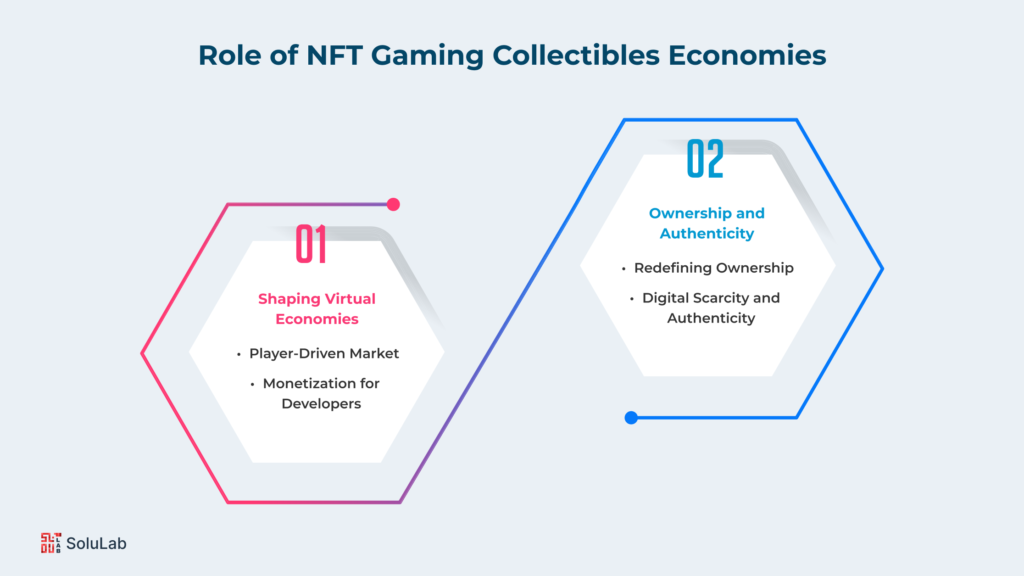
Role of NFT gaming collectibles Economies

NFT gaming collectibles are distinct digital items within video games, each represented as a unique NFT on a blockchain. Unlike traditional in-game assets that are often confined to specific game ecosystems, NFTs offer true ownership and portability. Players can buy, sell, and trade these collectibles both within and outside the game environment, with ownership records securely recorded on the blockchain. This creates a sense of ownership that transcends the boundaries of individual games, making NFT gaming collectibles highly coveted.

1. Shaping Virtual Economies: 

  • Player-Driven Market

NFT gaming collectibles have introduced a player-driven market within virtual gaming worlds. These assets are not just cosmetic; they hold real-world value. This economic dimension encourages players to actively participate in trading, buying, and selling NFTs, influencing their scarcity and value.

Check Our Blog Post: ERC-3643 vs ERC-1400 vs ERC-20

  • Monetization for Developers

Game developers benefit from the secondary market for NFTs as they often receive a percentage of each transaction involving in-game NFTs. This creates a sustainable revenue stream, which can support ongoing game development and maintenance.
CTA1

2. Ownership and Authenticity:

  • Redefining Ownership

NFT gaming collectibles provide a groundbreaking shift in ownership dynamics. Players truly own their digital assets, granting them the autonomy to control, trade, and transfer their NFTs across various games and platforms. This newfound ownership extends the value of in-game items beyond a single gaming experience.

  • Digital Scarcity and Authenticity

NFTs inherently possess digital scarcity and authenticity. Each NFT is unique, provably scarce, and irreplaceable, thanks to blockchain technology. This assures players and collectors of the rarity and authenticity of their digital possessions, enhancing their desirability.

Read Blog Post: Top NFT Trends That Will Build Revenue Streams to the Business

How are NFTs Revolutionizing the Future of the Gaming Industry?

The world of gaming has witnessed a significant transformation in recent years, thanks to the integration of Non-Fungible Tokens (NFTs) into the gaming landscape. NFTs, often referred to as NFT gaming collectibles, have become a buzzword, reshaping how gamers interact with virtual worlds. In this article, we delve into the potential of NFTs in gaming and the challenges and concerns that accompany this innovative technology.

1. Potential of NFTs in Gaming

  • Expansion Beyond Collectibles

Traditionally, collectibles in video games were limited to in-game items like skins, weapons, or cosmetic upgrades. NFTs, however, have broadened the scope of collectibles to an unprecedented level. Gamers can now own unique, verifiable digital assets, be it rare in-game characters, custom skins, or virtual real estate. These NFT gaming collectibles hold tangible value in the form of ownership and scarcity, allowing players to truly invest in their gaming experiences.

This expansion has given rise to a thriving marketplace where players can buy, sell, and trade their NFT gaming assets, fostering a sense of virtual ownership akin to physical possessions. As NFTs continue to proliferate, gaming ecosystems are evolving into dynamic, player-driven economies where creativity and value creation know no bounds.

2. Evolution of In-Game Assets

The incorporation of NFTs into gaming has set the stage for the evolution of in-game assets. Previously, players would often invest time and money in acquiring digital items with no real-world value or transferability. NFTs have changed this paradigm by imbuing in-game assets with real-world value.

Read Also: How to Make an NFT Game?

These NFTs can seamlessly move across different games and platforms, creating a versatile gaming experience. Gamers can now expect a level of continuity and personalization that extends beyond individual titles. This evolution has paved the way for cross-platform gaming, where assets can be ported between various virtual worlds, enhancing player engagement and interactivity.

What are the Challenges and Concerns Associated with the Integration of NFTs in Gaming?

The integration of Non-Fungible Tokens (NFTs) in gaming has been a revolutionary development, offering unique opportunities for gamers and developers alike. However, this innovation is not without its challenges and concerns, which require careful consideration to ensure the sustainable growth of NFT gaming collectibles.

 Scalability Issues

  • NFTs are blockchain-based assets, and as the popularity of NFT gaming grows, scalability becomes a significant concern. The blockchain network may struggle to handle the increasing volume of transactions, leading to slow processing times and higher fees.
  • Developers need to find solutions to scale NFT games efficiently, potentially through layer-2 solutions or blockchain upgrades. This ensures that NFT gaming remains accessible and enjoyable for a broad user base.

Environmental Impact

  • The energy consumption associated with blockchain networks, especially Proof-of-Work (PoW) blockchains, has raised environmental concerns. Some NFTs contribute to carbon footprints due to the energy-intensive mining process.
  • Game developers should consider transitioning to more environmentally friendly blockchains or exploring alternative consensus mechanisms like Proof-of-Stake (PoS) to mitigate this issue.

Regulatory and Legal Considerations

  • As NFTs gain prominence, regulators are taking an interest in their classification and taxation. The legal framework surrounding NFT gaming collectibles can be complex and vary by jurisdiction.
  • Game developers must stay informed about the evolving legal landscape of NFTs and gaming. Compliance with regulations is crucial to avoid potential legal issues or penalties.

Ownership and Security

  • While NFTs offer digital ownership, the security of these assets is a concern. Hacks, scams, and fraud can compromise players’ investments and hard-earned NFT gaming collectibles.
  • NFT developers should prioritize robust security measures, including secure wallets and authentication protocols, to protect gamers’ assets and build trust within the community.

Read Also: Best Play To Earn NFT Games In 2025
Market Saturation and Speculation

  • The rapid influx of NFT projects can lead to market saturation, making it challenging for new projects to stand out. Additionally, speculation can drive prices to unsustainable levels, potentially resulting in a bubble.
  • NFT developers should focus on creating unique and engaging gaming experiences rather than solely relying on the speculative nature of the NFT market. Building a strong community around a game can help sustain its value.

How do Top NFT Developers Influence the Future of NFT Gaming Amidst Evolving Roles and Technology?

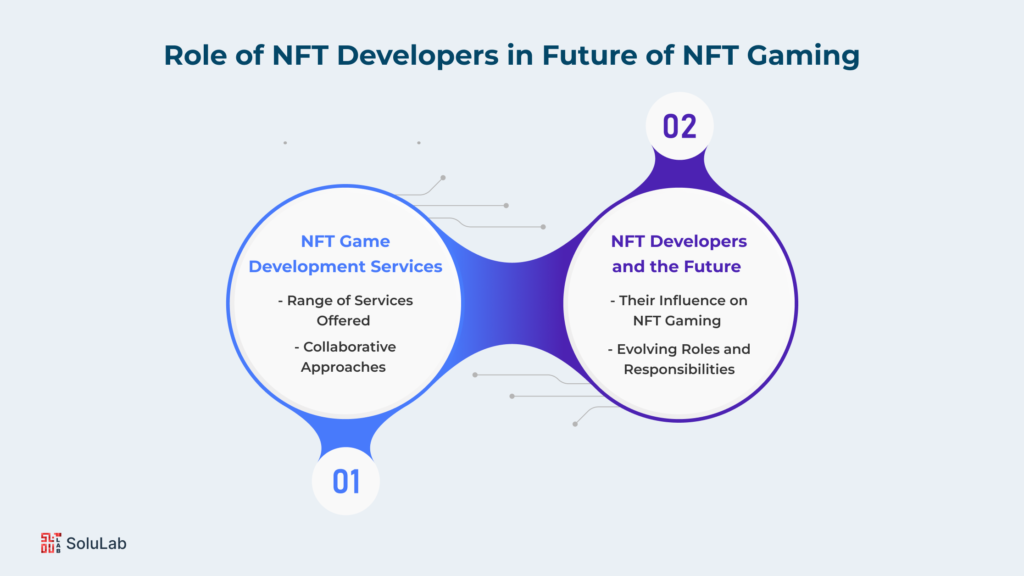
Role of NFT developers in Future of NFT gaming

NFTs, or Non-Fungible Tokens, have rapidly become a transformative force within the gaming industry, particularly in the realm of NFT gaming collectibles. To harness the full potential of this technology, the role of NFT developers is pivotal. SoluLab, a prominent player in the NFT game development arena, is at the forefront of this exciting revolution. Let’s delve into the role of NFT developers, their qualities, services, and the impact they have on the future of NFT gaming.

1. NFT Game Development Services

  • Range of Services Offered

SoluLab, like other top NFT development firms, offers a comprehensive range of services. This includes NFT smart contract development, NFT marketplace creation, and the integration of NFTs into existing or new games. They also provide consultation on NFT strategies, tokenomics, and monetization methods specific to NFT gaming.

  • Collaborative Approaches

NFT game development is a collaborative endeavor. Developers work closely with game designers, artists, and publishers to create NFT gaming collectibles that resonate with players. SoluLab’s collaborative approach ensures that NFTs align with the overall game concept, enhancing player engagement and retention.

2. NFT Developers and the Future

  • Their Influence on NFT Gaming

NFT developers play a pivotal role in shaping the future of NFT gaming. Their innovative solutions drive the expansion of NFTs beyond collectibles. They enable in-game assets, skins, characters, and more to become NFTs, fundamentally changing the way gamers perceive ownership and trade.

  • Evolving Roles and Responsibilities

As the NFT gaming landscape evolves, so do the roles and responsibilities of NFT developers. They are increasingly involved in addressing scalability challenges, sustainability concerns, and adapting to regulatory changes. Their ability to provide solutions in these areas is instrumental in maintaining the growth and legitimacy of NFT gaming.
CTA2

Conclusion

In conclusion, SoluLab stands at the forefront of the revolution in NFTs in gaming, shaping the future of virtual collectibles. As the world increasingly embraces Non-Fungible Tokens (NFTs) and their potential in the gaming industry, SoluLab’s expertise in NFT game development services and solutions is nothing short of visionary. Their commitment to excellence and innovation has led to the creation of immersive NFT games that redefine the way we perceive NFT gaming collectibles.

NFTs in gaming are not just digital assets; they represent a profound shift in how gamers interact with and own in-game items. SoluLab’s dedication to pushing the boundaries of NFT gaming has not only defined what NFT games are but has also unveiled the true meaning of NFT gaming.

By offering the opportunity to hire top NFT developers, SoluLab empowers businesses and individuals alike to enter the exciting world of NFTs in gaming confidently. In doing so, they are unlocking a future where virtual collectibles are not only a form of entertainment but a groundbreaking form of ownership, trade, and self-expression.

In a world where NFT gaming is rapidly evolving, SoluLab is the trusted partner you need to navigate this transformative landscape successfully. With their NFT game development expertise, they are helping shape the future of gaming, one non-fungible token at a time. For expert support, contact SoluLab today.

FAQs

1. What are NFTs in gaming?

NFTs in gaming refer to Non-Fungible Tokens, unique digital assets that are used within video games as collectibles, items, or characters. These tokens are blockchain-based and represent ownership of in-game assets.

2. How do NFTs work in gaming?

NFTs work by utilizing blockchain technology to create verifiable and unique digital assets that can be bought, sold, and traded by gamers. Each NFT has a distinct value and can be owned by individual players.

3. What is the significance of NFT gaming collectibles?

NFT gaming collectibles hold value because they are scarce and cannot be replicated. Gamers can buy, sell, or trade these collectibles, fostering a sense of ownership and uniqueness in virtual worlds.

4. Can you explain NFT game development?

NFT game development is the process of creating video games that integrate NFTs as in-game assets or collectibles. This includes designing, coding, and implementing NFT functionality within a game.

5. What services do NFT game development solutions offer?

NFT game development services provide comprehensive solutions for creating blockchain-based games. They include NFT asset creation, smart contract development, integration with NFT marketplaces, and more.

 

How is Gaming Contributing to the NFT Industry?

How is Gaming Contributing to the NFT Industry?

The gaming industry has long been a pioneer in pushing technological boundaries and immersing players in captivating virtual universes. In recent years, it has also emerged as a powerful catalyst for the Non-Fungible Token (NFT) revolution. This intersection often referred to as “gaming NFT” or “NFT gaming,” has given rise to groundbreaking innovations that are redefining how we perceive and interact with digital assets.

NFTs, or Non-Fungible Tokens, have transcended their origins as digital collectibles to disrupt various sectors, from art and music to real estate and sports. These unique digital assets have unlocked new possibilities for ownership, provenance, and value exchange. Understanding the widespread impact of NFTs across different domains is crucial to appreciating their significance in gaming.

In a rapidly evolving digital landscape, the worlds of gaming and NFTs have collided, creating a dynamic synergy that is reshaping industries and capturing the imagination of enthusiasts and entrepreneurs alike. This blog will delve into this exciting intersection, exploring the profound influence of gaming on the NFT industry.

Why is it Crucial to Understand How Gaming and NFTs Interact?

Why is it Crucial to Understand How Gaming and NFTs Interact?

In the ever-evolving landscape of digital innovation, the intersection of gaming and NFTs (Non-Fungible Tokens) has emerged as a phenomenon that cannot be overlooked. Understanding the dynamic relationship between gaming and NFTs is not just beneficial; it is crucial for a multitude of reasons. Let’s delve into why it is so essential to grasp how gaming and NFTs interact.

  • Pioneering Innovation in Digital Ownership

The fusion of gaming and NFTs has ushered in a new era of digital ownership. Gamers can now truly own in-game assets, characters, and virtual items as NFTs. This innovation challenges traditional notions of ownership in the digital realm, making it imperative to understand how this transformation affects both gamers and the NFT industry.

  • Shaping the NFT Industry’s Trajectory

Gaming’s influence on the NFT industry has been instrumental in shaping its trajectory. The gaming community’s active participation and adoption of NFTs have accelerated the industry’s growth. By understanding this relationship, one gains insights into the driving forces behind the NFT market’s expansion.

Read Also: Best Play To Earn NFT Games In 2025

  • NFT Solutions for the Gaming Ecosystem

NFTs offer unique solutions to long-standing challenges within the gaming ecosystem. These solutions include secure asset ownership, cross-platform compatibility, and enhanced player experiences. Recognizing the potential of NFTs in addressing these issues is vital for game developers and enthusiasts alike.

  • NFT Marketplaces as Key Enablers

NFT marketplaces play a central role in the gaming-NFT fusion. Gamers and collectors use these platforms to trade and acquire valuable NFTs. Understanding the mechanics of NFT marketplaces is crucial for those seeking to navigate this exciting space effectively.

  • Talent Acquisition and Collaboration

As the demand for NFT-related projects in the gaming industry grows, the ability to hire the best NFT developers becomes paramount. Understanding the skill sets required and the intricacies of NFT development is essential for businesses aiming to thrive in this evolving landscape.

CTA1

What Are NFTs (Non-Fungible Tokens), and How Do They Differ From Cryptocurrencies?

In the ever-evolving landscape of digital assets and blockchain technology, NFTs, or Non-Fungible Tokens, have emerged as a groundbreaking concept. They are revolutionizing various industries, including gaming, by redefining how we perceive and interact with digital assets. To fully grasp the significance of NFTs, it’s essential to understand what they are and how they differ from traditional cryptocurrencies.

NFTs: Uniqueness and Individuality

At their core, NFTs are unique digital assets. Each NFT represents ownership of a specific item, character, artwork, or any other digital or physical object. The key characteristics that set NFTs apart from cryptocurrencies like Bitcoin or Ethereum are as follows:

  • Uniqueness

Every NFT is one-of-a-kind, with distinct attributes that differentiate it from other tokens. In the gaming context, each in-game item, character skin, or virtual object can be tokenized as an NFT, and no two NFTs are identical.

  • Indivisibility

NFTs are indivisible, meaning they cannot be divided into smaller units. Unlike cryptocurrencies that can be broken down into fractions, NFTs exist as whole entities.

Read Our Blog: What are NFT Games and How Do They Work?

  • Provenance

The ownership history of NFTs is recorded on a blockchain, providing a transparent and immutable ledger of ownership. This feature ensures that the true origin and ownership of an NFT can be easily traced.

  • Interoperability

NFTs can be used across various platforms and applications, enabling seamless transfer and use. This interoperability is particularly valuable in the gaming industry, where in-game assets can be bought, sold, and used in different games or virtual worlds.

NFTs in the Gaming Industry

The gaming industry has embraced NFTs as a transformative technology. Gamers are accustomed to owning and trading in-game assets, such as skins, weapons, and characters. NFTs enable gamers to have true ownership of these virtual items by representing them as unique tokens on a blockchain. This integration has several implications:

  • Ownership and Scarcity

Gamers can truly own their in-game assets as NFTs, giving them a sense of rarity and exclusivity. This ownership can extend beyond a specific game, allowing gamers to trade or use their NFTs in different gaming environments.

  • Player-driven Economies

NFTs empower players to participate in player-driven economies, where the value of in-game items is determined by supply and demand. This can lead to new gaming experiences and opportunities for players to monetize their gaming activities.

Check Our Blog Post: How to Make an NFT Game?

  • NFT Marketplaces

NFT marketplaces cater to gamers, offering platforms to buy, sell, and trade gaming-related NFTs. These marketplaces provide a bridge between the gaming and NFT communities, facilitating the exchange of digital assets.

What is the Emergence of NFTs in Video Games?

In recent years, the convergence of gaming and NFTs (Non-Fungible Tokens) has created a fascinating synergy within the broader blockchain landscape. As the gaming industry continues to evolve, NFTs have emerged as a revolutionary force, providing unique solutions and opportunities for gamers, developers, and collectors alike. This article delves into the remarkable journey of how gaming has embraced NFTs and transformed the landscape of interactive entertainment.

NFTs and Gaming: A Perfect Match

The term “NFT gaming” has become synonymous with innovation in the gaming industry. NFTs are digital assets that are indivisible, verifiable, and irreplaceable, making them a natural fit for gaming. Here’s how gaming and NFTs have come together:

Ownership and Scarcity: In the digital realm, true ownership of in-game assets was a challenge until NFTs came along. NFTs enable players to have provable ownership of unique in-game items, characters, and skins. This has revolutionized the concept of digital scarcity.

  • Player Empowerment

NFTs empower players by allowing them to trade, sell, or showcase their in-game assets outside of the gaming environment. This has led to the rise of a player-driven virtual economy.

Read Our Blog Post: Top 9 Best NFT Games for Android

  • Play-to-earn

The concept of “play-to-earn” has gained traction, where players can earn NFT-based rewards for their in-game achievements. This has transformed gaming from a mere pastime into a potential source of income.

NFTs in Gaming: Key Milestones

The integration of NFTs into video games didn’t happen overnight. It evolved through several key milestones:

  • Blockchain Integration

Early experiments focused on integrating blockchain technology into gaming, setting the stage for NFTs. This laid the foundation for secure asset ownership.

  • CryptoKitties (2017)

CryptoKitties, a blockchain-based game, allows players to collect, breed, and trade digital cats as NFTs. This marked the dawn of NFTs in gaming.

Read Also: What are the Features of NFT Gaming Platform?

  • Decentraland (2017)

Decentraland introduced the concept of virtual real estate, where NFTs represent parcels of land in a virtual world. This showcased the potential of NFTs beyond traditional gaming.

  • Axie Infinity (2018)

Axie Infinity popularized the “play-to-earn” model, where players could earn NFT-based rewards through gameplay. It ignited widespread interest in blockchain gaming.

Examples of Video Games Utilizing NFTs

Examples of Video Games Utilizing NFTs

Today, numerous video games actively incorporate NFTs into their gameplay and economies:

  • Sorare

This fantasy football game employs NFTs to represent official digital player cards, allowing players to collect, trade, and compete in virtual football leagues.

  • The Sandbox

A user-generated content platform where NFTs enable players to create, own, and monetize their gaming experiences, including virtual assets.

  • Lost Relics

An action-adventure RPG that employs NFTs to represent unique in-game items and gear, creating a vibrant player-driven marketplace.

Read Our Blog: How to Create an NFT Game: A Step-by-Step Guide

  • Gods Unchained

A digital trading card game where each card is an NFT. Players can own, trade, and use these cards in competitive battles.

  • Axie Infinity

Continues to thrive, with NFT-based creatures, land, and items forming the core of its ecosystem, offering players the potential for substantial earnings.

How Does Tokenization of Virtual Items, Characters, and Skins Work in NFT Gaming?

Tokenization is the process of converting in-game assets, characters, and skins into NFTs, and it’s a game-changer in the gaming industry. But how does this process work?

  • Item Tokenization

Game developers can assign a unique NFT to each in-game item. This means that when a player acquires an item, they receive a corresponding NFT representing that item. This NFT can be transferred, sold, or traded, giving the player full ownership rights.

  • Character and Skin Tokenization

Similarly, characters and skins can also be tokenized. When a player unlocks or purchases a character or skin, they receive an NFT that represents it. This NFT can be personalized and used across different games or even sold to other players.

What Are the Advantages of Using NFTs in the Gaming Industry?

What Are the Advantages of Using NFTs in the Gaming Industry?

The adoption of NFTs in the gaming industry offers a multitude of advantages, reshaping the way we play and engage with virtual worlds. But what are these advantages?

  • Ownership and Interoperability

NFTs provide players with true ownership of in-game assets, characters, and skins, giving them the freedom to use, sell, or trade them across different games and platforms.

  • Monetization

Gamers can now earn real-world value through their in-game achievements. “Play-to-earn” models, enabled by NFTs, allow players to monetize their skills and investments in virtual assets.

Check Our Blog Post: Top 10 Defi NFT Games to Look for in 2025

  • Community Engagement

NFTs foster vibrant player communities. Gamers can connect on NFT marketplaces, discuss strategies, and trade assets, enhancing the social aspect of gaming.

  • Developer Creativity

Game developers have more creative freedom, as they can design unique, limited-edition NFTs that drive engagement and excitement among players.

  • Long-Term Value

NFTs can appreciate in value over time, making them both enjoyable in the short term and potentially profitable in the long run.

What Does the Gaming Industry’s NFT Game Development Services Entail?

What Does the Gaming Industry's NFT Game Development Services Entail?

In the ever-evolving landscape of the gaming industry, the emergence of NFTs (Non-Fungible Tokens) has opened up exciting new possibilities. NFTs have transcended their origins as digital collectibles and are now seamlessly integrated into video games, transforming the way players engage with in-game assets and economies. SoluLab, as a prominent player in the field, offers comprehensive NFT game development services that encapsulate a wide array of crucial elements.

  • Conceptualization and Ideation

At the core of SoluLab’s NFT game development services is the process of conceptualization and ideation. Collaborating closely with game developers and studios, SoluLab helps in brainstorming and formulating innovative concepts for NFT-based game mechanics and assets. This initial phase lays the foundation for creating a unique and engaging gaming experience that leverages the power of NFTs.

Read Our Blog: Top NFT Development Companies To Look At In 2025

  • Smart Contract Development

A pivotal aspect of NFT game development is the creation of blockchain-based smart contracts. SoluLab excels in developing these intricate pieces of code that underpin NFTs. These smart contracts tokenize in-game items, characters, skins, and other assets, transforming them into NFTs. These NFTs are then stored securely on a blockchain, ensuring immutable ownership and scarcity.

  • NFT Marketplace Integration

SoluLab specializes in building and integrating NFT marketplaces within games. These marketplaces serve as vibrant hubs where players can seamlessly buy, sell, and trade their NFT assets. The inclusion of such marketplaces not only enhances the player’s sense of ownership but also fosters dynamic in-game economies. SoluLab ensures that these marketplaces are user-friendly, secure, and scalable.

  • Interoperability

One of the key advantages of NFTs in gaming is their ability to function across different games and platforms. SoluLab ensures that NFTs developed for a specific game can be used flexibly, allowing players to enjoy cross-game interoperability. This feature enhances the overall gaming experience by giving players the freedom to utilize their NFT assets across various titles.

Read Also: 9 Strategies You Can Use to Promote NFT Games

  • Security and Scalability

Security is paramount in NFT game development. SoluLab implements robust security measures to safeguard NFTs and blockchain infrastructure from potential threats. Additionally, scalability is a critical consideration, ensuring that the game can handle a growing player base and increased NFT transactions without compromising performance.

  • Player Engagement Features

SoluLab understands the importance of player engagement in the success of NFT-powered games. To enhance player engagement, SoluLab incorporates a variety of NFT-related features into the games. These may include NFT-based rewards, achievements, leaderboards, and other mechanics that incentivize player participation.

How Has Gaming Contributed to the Growth of the NFT Industry?

How Has Gaming Contributed to the Growth of the NFT Industry?

The fusion of gaming and NFTs (Non-Fungible Tokens) has given rise to a transformative synergy within the blockchain landscape, profoundly impacting both industries. The emergence of NFTs in gaming has not only enriched the gaming experience but has also propelled the NFT industry to new heights. Let’s explore how gaming has played a pivotal role in the remarkable growth of the NFT industry.

  • Pioneering Mass Adoption

Gaming has long been a fertile ground for experimentation with new technologies. When NFTs entered the gaming arena, they found a ready and enthusiastic audience. Gamers, accustomed to collecting virtual items and engaging in digital economies, quickly grasped the concept of NFTs. This led to mass adoption as gaming communities embraced NFTs as a natural extension of their virtual world interactions.

  • Fueling Economic Activity

The integration of NFTs has revolutionized in-game economies. Gaming enthusiasts are now actively participating in virtual marketplaces, buying, selling, and trading NFT-based assets such as skins, characters, and items. This economic activity injects significant value into the NFT ecosystem, contributing to its rapid growth.

  • Inspiring Innovation

Gaming has been a hotbed of innovation when it comes to NFT use cases. Beyond traditional collectibles, game developers have explored unique applications for NFTs, such as:

  • Virtual Real Estate

Games like Decentraland and The Sandbox allow players to buy, own, and develop virtual land as NFTs, opening up a new dimension of ownership and creativity.

  • Play-to-Earn Models

Titles like Axie Infinity have popularized the “play-to-earn” model, where players can earn NFT-based rewards by engaging in gameplay. This innovation has sparked immense interest in blockchain gaming.

Read Also: Step-By-Step Guide For Developing NFT Marketplace

  • Cross-Game Compatibility

NFTs have enabled players to carry their virtual assets across different games, creating a seamless and personalized gaming experience.

  • Engaging the NFT Collector Community

Gaming’s dynamic NFT integration has not only attracted gamers but also collectors within the NFT community. NFT collectors recognize the value of in-game assets and unique digital items as collectibles. This convergence has created a dynamic synergy, with collectors seeking exclusive NFTs from their favorite games, driving demand and value.

  • Showcasing Collaborations

To further accelerate the growth of the NFT industry, games have begun collaborating with renowned NFT artists. These collaborations bridge the gap between gaming and the broader NFT ecosystem, fostering a sense of unity and mutual benefit.

CTA2

Conclusion

In conclusion, the intersection of gaming and the NFT industry has created a fascinating synergy, revolutionizing how we perceive and interact with digital assets. As the demand for unique and tradable in-game items continues to grow, the incorporation of NFTs into the gaming ecosystem has not only breathed new life into the gaming industry but also paved the way for innovative NFT solutions for gaming.

The advent of video game NFTs has opened doors to entirely new revenue streams for developers and gamers alike. NFT game development services have emerged as a critical component, facilitating the creation of immersive and collectible gaming experiences that blur the lines between virtual and tangible assets. As NFT marketplaces expand and evolve, gaming enthusiasts can now buy, sell, and trade their prized in-game possessions with unprecedented security and authenticity.

SoluLab, a leading NFT gaming marketplace development company, has been at the forefront of this transformative journey, offering top-tier NFT game development services and connecting the gaming industry with the thriving NFT marketplace development. With the ability to hire the best NFT developers, SoluLab empowers gaming studios to harness the full potential of NFTs, creating a more engaging and rewarding gaming ecosystem.

FAQs

1. What is the connection between gaming and the NFT industry?

Gaming is significantly contributing to the NFT industry by integrating non-fungible tokens (NFTs) into video games. This trend, often referred to as “NFT gaming” or “gaming in the NFT industry,” has opened up new possibilities for gamers and NFT enthusiasts alike.

2. How are video game NFTs changing the gaming landscape?

Video game NFTs are altering the gaming landscape by allowing players to own, trade, and use in-game assets as NFTs. This introduces true ownership of in-game items, making gaming experiences more immersive and financially rewarding.

3. What are NFT solutions for the gaming industry?

NFT solutions for the gaming industry include the development of NFT marketplaces within games, allowing players to buy, sell, and trade in-game items as NFTs. Additionally, blockchain technology ensures transparency and security for these transactions.

4. How can I get involved in the NFT gaming space?

To get involved in the NFT gaming space, consider partnering with an NFT game marketplace development company or hiring the best NFT developers. They can help you create and integrate NFTs into your game, enhancing its value and appeal to players.

5. What is an NFT marketplace development, and why is it important for gaming?

NFT marketplace development refers to creating platforms where players can trade their in-game items as NFTs. This is crucial for gaming as it provides a secure and transparent environment for buying, selling, and showcasing virtual assets.

6. How do NFT game development services benefit the gaming industry?

NFT game development services benefit the gaming industry by enabling game developers to incorporate blockchain technology and NFTs into their projects. This enhances player engagement, encourages player-driven economies, and opens up new revenue streams.


How to Make an NFT Game?

How to Make an NFT Game

Even if you don’t actively pursue NFTs, you have undoubtedly already heard of them. Regardless of the amount of interest, popular trends frequently permeate all areas of the information space and capture everyone’s attention. However, the fact that you are reading this post indicates that you are undoubtedly interested in learning more about NFT and how to create an NFT game.

Numerous industries employ NFTs. 38 NFT creations were included in a digital art exhibition that the Hermitage hosted in 2021. The NFT token from Jack Dorsey’s initial tweet, which launched Twitter, was sold for $2.9 million. For his NFT artwork, artist Mike Winkelmann got a record-breaking $69 million.

What are NFTs?

Infusible Token is referred to as NFT. NFTs emerged as a result of the creation of the blockchain, just like cryptocurrencies. But unlike, say, Bitcoin, every NFT is distinct and has a separate value. This is not the case with NFT if one traditional cryptocurrency unit is identical to another like one (for instance, one Ethereum is identical to another and totally transferable without losing value). Let’s start with the NFT ecosystem, or the blockchain, to better grasp this.

What Are NFT Games?

NFT games are blockchain-based entertainment items that include non-fungible tokens, which are digital objects. NFT technology can be employed in video games to draw in funding. Any in-game object can have a token created, purchased, or sold by players, helping to support the creator. For instance, skins, artifacts, weapons, and other game elements can be tokenized using NFTs.

In NFT games, players access game resources that have been mathematically certified. It is simple to figure out who owns the gaming equipment. Many NFT games are gaining in popularity as they enable players to play and earn.

1. Axie Infinity 

Axie Infinity is one of the popular NFT games in the Pokémon style. Games feature imaginary creatures called Axies. You can play the game on a computer, an Android device, or an iOS device.

The NFTs used in this game were constructed in line with the ERC-721 standard. The Ethereum standard for NFTs is ERC-721. The ERC-20 token standard was used in the development of the “Axie Infinity Shard” (AXS) which is the governance token of the game.

Gamers can exchange the NFTs they gain in this game on the popular Ethereum NFT exchanges. Players also earn a good amount by playing in this amazing game.  It was created on the Ethereum blockchain.

2. Cryptokitties

CryptoKitties is a blockchain-based game that allows players to breed virtual cats. These virtual cats are used as game assets and these are NFTs.

The Ethereum blockchain platform was used in the creation of this game. It was unveiled in November 2017, and soon it gained popularity. Players are required to buy virtual pets using ether, the native currency of Ethereum

The game instantly attracted more players. At the start of 2018, the game had 1.5 million users. There was $40 million worth of transactions at that time. A number of the virtual cats earned more than $300,000 each at auction.

3. Cryptopunks

CryptoPunks was one of the first NFT games. The creator of this game introduced it in June 2017. They used the Ethereum blockchain platform to develop this.

Over 10,000 different collectible digital “avatars” are offered in the game. They were created as NFTs by the CryptoPunks developers.  The Ethereum project team was inspired by CryptoPunks to build the ERC-721 NFT standard. For these virtual “avatars,” thousands of dollars were traded at a time.

4. Gods Unchained

Gods Unchained is a well-known NFT-based game. It’s an online trading card game. Players can make money by playing this.

The developers of the game were announced in 2018. They developed it using the Ethereum blockchain network. In actuality, “Immutable X” is used to mint the game assets for this game. It is a layer 2-based Ethereum network.

The developers of the GODS token, the game’s native cryptographic token, will make it accessible. The game’s developers have used the ERC-20 standard to create this token.

It enables players to use the GODS token as payment for rare trade cards. They will also have access to internet markets where they may purchase and sell them, such as Coinlist.

5. Sandbox

Sandbox is a well-known blockchain-based game and you can also consider it a virtual universe. The game’s creators developed it using the Ethereum network. NFTs serve as the assets of the game.

The ecosystem of the sandbox enables players to build and produce game items. Users can create their own games using a “Game Maker” interface. Finally, players can exchange video game items in the Sandbox market section.

How to Create an NFT Game: Preparation Stage

What role does NFT play in the gaming world? Developers write smart contracts with the rules for using such tokens in order to create NFTs and use them in the game. Let’s now discuss how to make an NFT game in more detail.

Game Model

NFT games can be categorized into two main categories:

  • P2E (play-to-earn): Players must acquire their first NFT before they may begin playing. There is a chance to recoup the investment in the future. The majority of P2E games allow players to purchase NFTs that represent characters, perks, or power-ups as well as win so-called utility tokens.
  • F2P (free-to-play): There are significantly fewer such games, but they don’t require any initial costs – you can start playing right away. In this case, the possible income will be lower. Such games may not include utility tokens.

Design for Your Game

Select the genre of the future game. The NFT game is not some scary beast that exists in another reality. This is the same game as the others but with its own characteristics. So strategy, combat, adventure, simulation, role-playing, or card games – all options are available. After choosing a genre, it is important to conduct a competitive analysis. Find similar games on the blockchain and beyond. Do not mindlessly copy successful games – take the most interesting features and fuse your idea with them. Of course, game art is an absolutely creative field, and you are free to do whatever you want there. But note one thing for yourself.

Read also: Top 9 Best NFT Games for Android

To avoid the risks and huge investments in an untested concept, start with a simpler graphic option. Later, after getting your hands on it and understanding the specifics of NFT games, you will be able to move on to games with a more advanced level of art.

Web or Mobile

Applications built on blockchain technologies are called dApps – decentralized applications. The main code and data (backend) of a decentralized application are stored and executed on the peer-to-peer blockchain, unlike client-server applications, whose data and code are processed on servers. In fact, all cryptocurrencies are already variants of decentralized applications. But usually, they are considered the basic foundation of the blockchain, on top of which a variety of decentralized applications already work. Decentralized applications are usually open-source.

The next question to ask is how do you want your users to interact with the game. Through a web browser or mobile app?

Both options are valid. The web application is universal and can be launched from any device, from a computer to a smartphone, anywhere in the world. On the other hand, a mobile app will run much faster on smartphones and may have many more features. Therefore, its development is often more expensive.

Suitable Technology

To get your feet on the ground in NFT, take advantage of open source. For example, you can go to GitHub and find both ready-made games and templates for NFT games that you can manipulate to better understand the specifics of such games.

If GitHub is Greek to you, then pave the way for the initial orientation in it. You will definitely need it in the future. This is the most famous project and code version management system. 

One of the most common dApp development ecosystems is Truffle Suite. It is the leading smart contract development environment. Truffle tools are used by well-known companies such as Microsoft, Amazon, and VMWare. Truffle Suite provides blockchain developers with a standardized testing environment and asset pipeline to create high-quality and reliable smart contracts.

Read also: What are NFT Games and How Do They Work?

Another dApps development platform is Moralis, which has an infinitely scalable server infrastructure and is able to remove the biggest obstacles in dApp development. The platform provides you with a fully managed back-end infrastructure. This means that you, as a developer, can focus on developing the front end and the main user interface.

The Front-End Stage

As frameworks, React and Vue can be good options. Angular, with its huge API, may seem too complicated for beginners. Truffle Suite was originally built to connect to React, but as of 2019 they also offer a Vue plugin.

The front end can be hosted on Netlify. It is one of the most advanced web development platforms that helps programmers publish projects online. It is ideal for small teams or solo developers who are not able to create the infrastructure for their resources on their own, but still want to put their product on the Internet. Besides, it’s free.

The Wallet

Unlike ordinary money, cryptocurrency is not stored in a real or virtual wallet, it is located directly in the blockchain ecosystem. A crypto wallet is a special software or hardware that allows you to store digital currency, as well as perform various operations with it.

Any crypto wallet should have a high level of security. To select a suitable wallet, you first need to go to the website of the cryptocurrency you are going to store and familiarize yourself with the list of recommended applications. Every secure wallet must meet the following requirements:

  • have private and public keys;
  • have several levels of security.

Smart Contract

We have already mentioned that smart contracts are programs stored on the blockchain that run when predetermined conditions are met. If users want to access their NFT, it goes like this:

1. The front end receives the user’s address from the crypto wallet.

2. The front end sends the user’s address to the smart contract.

3. The smart contract gives the user the NFT address owned by the given user.

To work with a smart contract, you can use the official Ethereum blockchain library called Web3.js. Web3 allows you to abstract from the internal mechanics of Ethereum and work with the network and smart contracts as if they were ordinary JavaScript objects.

The Solidity programming language is used to write smart contracts. Solidity is a Turing-complete language, which means you can create complex contracts in a well-defined code format.

The Back-End Stage

So, we have already determined that the smart contract deals with the URL of the desired NFT. With this address, the front end makes a request to the backend to get the metadata for this NFT. The backend sends metadata to the front end. They include the name of the NFT, its address, and its identifier. After receiving this data, the front end can send another request to the server with the NFT URL. The interface can then display the available data and the user can see their NFT’s name and image.

For the backend, you can use node.js. It is a software platform that translates JavaScript into machine code that runs on the server side. So JavaScript can be used to build the backend.

The Testing Stage

To test your NFT game, you can use special test blockchains like Rinkeby. Ganache by Truffle makes it easy to create a mock blockchain. The types of blockchain game testing can be as follows:

  • Functional testing. This is a test of the overall functioning of the game, data transfer, block, and chain sizes to evaluate requirements, processes, etc.
  • Security testing. This is mandatory to check for any threats to the blockchain system.
  • UI testing. It’s important to make sure the game’s workflow and functionality are working properly and to test fonts, colors, graphics, and more for a great user experience.
  • Integration testing. This is a test of interconnection between different software components.
  • API testing. The bottom line is to check the communication of software components with an external API to make sure that the request and response are correctly processed by the system.

Conclusion

Now you have a general idea of how to make an NFT game. In this case, it is important not to get carried away with the number of NFT assets, but to think about what value they represent for the players. Will players want to buy them and what will be their motivation?

If you want to keep up with the trends, but have no idea what NFT features can be offered to jaded players.

How to Create an NFT Game: A Step-by-Step Guide


How to Create an NFT Game A Step-by-Step Guide

You must be familiar with non-fungible tokens (NFTs). Transaction processing, which is dependent on blockchain technology, has already achieved success in several specialized areas. Particularly, it has changed how much money NFT games make. Until the start of last year, the NFT-based transaction volume had already surpassed $10.67 billion, according to a DapRadar analysis. For a game production company, NFT Games opened up a world of possibilities for marketing its intellectual and creative rights safely and securely. For those who want how to create an NFT game? Here, we’ll walk you through the multiple steps involved in the making of an NFT game. But first, let’s explore NFT and find out how NFT games function.

The Non-Fungible Token, or NFT, is nothing more than a cryptographic token built on blockchain technology. These tokens serve as a stand-in for specific and unique digital items, such as gaming characters, unique digital artwork, different credentials, and in-game aesthetic components.

Read also: What are NFT Games and How Do They Work?

NFTs are used by players of these games to sell the Unique game characters and receive prizes from the game developers. NFT Games made a substantial contribution to the “pay as you earn” movement in the gaming sector. Let’s check out a clear step-by-step tutorial for creating an NFT game and some more details about it. 

NFT Game Model’s

There are two types of models you can use to create an NFT game, and both come with their features and services:-

P2E (Play-to-earn):-  The highest conversion ratio is seen in this model. This methodology allows NFT games to only employ their coin as a form of player compensation. Players will receive a set number of coins, but they cannot be traded on the open market.

F2P (Free-to-play):- The fact that the coins may be traded on the market makes this model superior to P2E in the eyes of NFT game players. In contrast, players in this model play with their earned NFT coins and are rewarded through the game itself.

A Step-by-Step Guide on How to Create an NFT Game

Step 1: Have a great NFT game idea 

Start by concentrating on the type of NFT game you want to develop. This would benefit you. Find out which models are best for the type of game you want to create. To capture the interest of your intended player audience, research several comparable games and then create something more captivating and original.

Step 2: Accommodate creative design. 

You must make room for imaginative game characters & game skin designs because NFT games are known for employing NFT to depict innovative and artistic game features and characters in commercial usage. The 2D or 3D graphical artists on the game development and design team have to be knowledgeable and skillful.

Step 3: Decision between the Web App or Mobile App

It’s time to decide what kind of platform you want to use to construct your game now. Which would you want to design, a web app or maybe a mobile app? What must be decided in this situation? Remember that all sides have advantages and disadvantages.

Your NFT game would be available to more players without restrictions on time, location, or device if you built it as a web app. Web apps are also able to play games online without having to download them.

On the other hand, you can guarantee a more engaged custom mobile-specific user experience & features by developing a mobile NFT gaming app. You have a lot of options when using mobile platforms to provide a more interesting and engaging gaming experience. However, building two distinct apps, including Android and iOS, is required for mobile apps, which results in greater development expenses.

Step 4: Decide the appropriate tech stack

The correct tech stack and skilled developers are the two main factors that determine an app’s success. It is impossible to construct an NFT game in any other way. You must pick the appropriate frontend, backend, wallet, as well as smart contract technology to develop a high-performance NFT game.

For NFT game apps, some of the tried-and-true technologies are Unity3d, ASP.NET Core, C#, MySQL, MongoDB, Truffle Suite, Amazon Web Services (AWS), and several others. Depending on your target platforms, you can also use a range of OS, including iOS, Android, Web, Windows, Linux, macOS, and so on.

Step 5: Frontend development 

For front-end development, both JavaScript and TypeScript can be used to develop the NFT app’s front end. ReactJS, VueJS, is your best available framework option for front-end development. Angular is viewed as a poor front-end option by many developers due to its complexity.

Step 6: Integrate a Wallet

The NFT application project requires a wallet address to be included for authentication and login purposes. You’ll be able to store tokens conveniently and safely online thanks to this.

Step 7: Establishing communication with Smart contract

The front end must take the user address from either the wallet & then pass it to the Smart Contract in order to give the NFT URL to the users. Use the well-known Web library to establish communication between Blockchain-based Smart Contracts. Transactions can also be tailored using this library based on users.

All of the fundamental guidelines, obligations, & roles of NFT Games are normally defined through smart contracts. On the Ethereum Blockchain, smart contracts use programming languages like Vyper, Solidity, Yul, and so on. The majority of NFT game creators utilize Solidity, a language that is quite similar to JavaScript, to code the Smart Contracts. Python-proficient programmers may want to use Vyper as their language of choice.

Developers with less experience should always adhere to well-known languages like Solidify because this aspect of development calls for some prior experience as well as project exposure. They can simply access numerous educational resources on GitHub as well as other platforms thanks to such a well-liked option. Finally, Yul is appropriate for seasoned engineers who have been working on smart contract projects for a while.

Step 8: Backend Development 

An NFT game app project requires extensive back-end programming because SmartContract would only make requests again for NFT URLs. After all, storing the complete NFT with its extensive metadata would be too laborious. The metadata needed to request the Smart Contract in more detail is provided by the NFT gaming app’s backend.

Since Blockchain database technology is used by NFT game apps, keeping centralized data access through the backend of the app will negate the main advantages of this decentralized database technology. Many NFT apps employ a technology called Chainlink to ensure a seamless connection between both the data off Blockchain and the data on Blockchain.

Read also: How to Make an NFT Game?

Because of its scalability, compact size, and expressive code, Node.js is a fantastic option for such a back-end programming language. NodeJS is already regarded as a strong and reliable backend development framework.

Step 9: Testing the game

You have to use the right tool to test your or any NFT gaming app. Several great tools are available to assess the NFT game app. The Rinkeby or Ropsten Testnet is available for app testing. For testing purposes, some developers also favor building a mimic blockchain. Some use Ganache for developing, a tool provided by Truffle, specifically for this function.

The types of blockchain game testing can be as follows:

Functional testing: This is a test of the game’s general functionality, data transfer, block and chain sizes, and other factors in order to assess requirements, processes, etc.

Security testing: To look for any dangers to the blockchain system, this is a requirement.

UI testing: To ensure a fantastic user experience, it’s crucial to test fonts, colors, graphics, and other elements of the game’s functioning and workflow.

Integration testing: This is a test of how well various software components communicate with one another.

API testing: The key is to ensure that software components are properly communicating with an external API and that the system is correctly processing the request and answer.

Step 10: Deploy the game and reach out to a wider audience. 

Finally, Your NFT game is set to launch in the market and is ready to be released after being conceived, produced, and tested. There is a brief stage of mainnet preparation left before the launch of the NFT game. It’s advised to take your time testing & deploying the game. Check for security flaws and remain vigilant for them.

Future of NFT gaming

The future of NFT gaming is promising! There will be an increase in the number of blockchain NFT platforms available, and more games will be created using these new tech platforms. According to the analysis, the play-to-earn non-fungible token (NFT) game market would be worth $2.8 billion between 2022 and 2028. Furthermore, throughout the same six-year period, the industry’s compound annual growth rate was 20.4%.

Wrapping Up 

That’s it, it is my take on how to create an NFT game, The marketplace for NFT games already has established its position as a niche one, providing game developers with tremendous opportunities. NFTs have made it possible for game projects to concentrate more on promoting unique and innovative gameplay, characters, and design components. However, it is crucial to first keep to the path of tried-and-true development procedures to realize the benefits of NFT. This detailed guide was created expressly to analyze and address this.

Top 9 Best NFT Games for Android

Best NFT Games for Android

Think about the opportunity to make money while engaging in risky actions in that specific region. Today let’s look at the top 9 NFT games on Android. A play-to-earn strategy game is also quite popular in the NFT gaming industry. By playing for cash, gamers can generate passive revenue in this situation. The low initial outlay and subsequent reliable return are the main reasons why NFT games are so well-liked. Many NFT games for android allow players to share rewards with other players. These are inspired by several different game subgenres, such as action, strategy, hyper-casual, etc. 

These NFT games take gaming to an entirely new level.

1. Axie Infinity

One of the key factors contributing to NFT’s rising popularity is this game. Another game made using Ethereum’s Blockchain technology is Axie Infinity. Additionally, this game is renowned for its endearing, trivial, and fluffy qualities termed as access, and all these adorable animals will each be unique and differ in a variety of aspects, like strength, clothing, etc. Axie infinite makes its debut in 2018. Here are several cryptocurrency-related earning strategies. The aim of the game is to craft as many axes as you can, and you can now exchange them with other players on the market. I think that’s encouraging.

2. Splinterlands

One of the best NFT games for Android is titled Splinterlands. Splinterlands is a firm that provides NFT gaming systems based on card games. This NFT-based card game is essential for anyone who is sick of card games that demand a substantial outlay of cash to play. The card count in this game is initially limited, but as players win more games and accumulate more cards quickly, the card count rises. The way in which you can obtain tokens is also one of the game’s most exciting features; you can earn the DEC token by competing in the weekly seasonal final.

3. Forest Knight

A strategy game that takes you to a wonderful fantasy world is another option. A complete in-game economy based on token standards is present in this turn-based strategy game. The game also has a sizable environment with a variety of locations, critters, and fun items to explore. Moving up the levels, crashing ministers, and gaining as much experience as you possibly can is your objectives. However, once you reach the sixth level, you’ll be able to engage in PvPs with actual users. Each assignment will come with a reward in the form of NFT and useful items. There are currently more than 100 things in the game, with more on the way. In addition, you get to put together a group of knights using various skills and battle techniques. Additionally, you’ll get the chance to design your city and control its economy. You must make sure your people have access to enough food, supplies, and other requirements. In addition, you’ll need plenty of armor and weapons to protect your city against monsters and dragons.

Read more: 9 Strategies You Can Use to Promote NFT Games

4. Delta Time

One of the most popular NFT games on Android is Delta Time. Are you a fervent Formula One fan? Here is a Christian gaming site created especially for Formula One enthusiasts. Crypto Kitties is one of the top NFT games for Android. They allow users to gather and pre-order gorgeous virtual kittens that live on the Ethereum Blockchain. This game is well-known for its adorable kittens, and it is one of the first Ethereum Blockchain games available.  Additionally, players in crypto-cats can sell their virtual kittens on the market or the central N. F. T marketplace. In 2017, dapper Labs created the Game of Crypto Kitties on Ethereum.  However, you may get Crypto Kitties in one of two ways: buy them on the market or breed them together. It’s worth noting that breeding allows gamers to unlock rare traits. We have the luxury of time as athletes. The Grand Prix mode in this game, which is comparable to a standard Blockchain-based game, allows players to race, which is one of its exciting features. An ERC 20 shock is available in this game, and it may be used for the REVV in-game currency. The fascinating moniker of the special money.

5. League of Kingdoms

Simple controls and ownership of a portion of the game’s map comprise the mechanics. Because of this, you have full power over what occurs next. You can develop the economy, sabotage alliances, create a war, or do anything that comes to mind. Choosing a strategy you’ll stick to is what’s most crucial here. As you might expect, the game’s resources are finite, so you’ll need to ensure that you quickly replace all of your stockpiles. Additionally, time, distance, or any real-world variables will affect your strategies. You might also invite your friends to join you in the game and become allies.

6. Merge Cats: Earn Crypto Reward

One of the most popular NFT games on Android is Crypto Kitties. On the Ethereum Blockchain, they enable users to gather & pre-order adorable virtual kittens. This game was one of the very first Ethereum Blockchain games released and is highly recognized for its cute kitties. Furthermore, participants in crypto-cats have the option of selling their digital kittens on the market or even the main N. F. T. marketplace. The Game of Crypto Kitties was developed by dapper Labs in 2017 for Ethereum. However, there are two ways to obtain Crypto Kitties: either buy them off the market or breed them together. It’s important to note that breeding enables players to access uncommon features.

7. Skyweaver TCG

It’s a more difficult card game where however many cards you can get depends on your competence. It’s a brand-new card game with vivid, intricate graphics and a wide variety of available cards. You can level up to your matched levels by playing any of the base 500+ cards for free here. You will play the game competitively to move up the leaderboards even though your gaming skills and expertise will dictate every aspect of the gameplay. However, you can win trade-in silver to buy new gold every week.

8. Spells of Genesis

One of the top NFT games on Android is Spells of Genesis. The game will keep you interested with its amazing setting and several epic battles. It is necessary to acknowledge all of his gaming efforts for the scenario, including level design, card creation, and other elements. Your voyage starts in Askian’s home country. You must join a squad & eliminate every opponent in order to get the magical skills. Typically, you begin with a basic deck of cards and eventually upgrade it. After you get the hang of it, you’ll be able to mix and match the cards to create uncommon and potent combinations. Each card has a special quality that could help you win tournaments, so think carefully before assembling your deck.

9. SorareData

The game of football is great for someone who regularly plays it. You’re in for a treat now: In the Blockchain game Sorare, which was created in Algeria, users may play football plus earn cryptocurrency at the same time. Additionally, you can create your virtual squad using different digital cards from NFTS here. Fun fact: These cards are also legally licensed. Additionally, each of these cards will depict a real-life football player for a certain season. You can acquire complete control of one of these vehicles and sell it to other similarly mad people once you buy just one of them.

Conclusion

It is obvious that the NFT gaming industry has considerable future growth potential. The underlying crypto asset that supports the NFT game will be valuable from an investing standpoint. Demand and supply will determine how much it is worth. As a result, as the idea gains more traction, the value of the game to earn cryptocurrency may rise. For instance, investors in MANA, which supports the Decentraland metaverse, have seen gains of more than 20,000% since the platform’s introduction. Even greater results were achieved by Axie Infinity, with peak gains exceeding 100,000%. This is why value investors are growing more and more interested in new cryptocurrency initiatives in the NFT gaming industry, like Tamadoge and Battle Infinity.
