Talk to an Expert

NFT Art for Beginners – How to Make and Sell

NFT Art for Beginners - How to Make and Sell

In the ever-evolving world of art, a revolutionary digital phenomenon is making waves – Non-Fungible Tokens (NFTs). These digital tokens have transformed the way we create, own, and trade art. If you’re new to the world of NFTs and intrigued by the concept of owning and selling digital art, you’re in the right place. In this blog, we’ll take you on a journey through the universe of NFT art, equipping you with the knowledge and tools to create and sell your very own digital masterpieces.

Understanding NFT Art

NFT art stands for Non-Fungible Token art, a term that might sound complex at first but is rather straightforward once demystified. At its core, NFT art is digital artwork, but it’s far from ordinary. What sets it apart is the innovative technology behind it – blockchain.

  • Blockchain Technology: At the heart of every NFT is a blockchain, a decentralized and immutable digital ledger. This ledger records the ownership and provenance of a piece of digital art. Unlike traditional art, where authenticity can be a challenge to verify, NFTs offer indisputable proof of ownership and a unique digital fingerprint for each artwork.
  • Digital Asset Ownership: NFTs provide a revolutionary concept of ownership. When you purchase an NFT, you aren’t just buying a copy of an artwork; you’re acquiring a digital certificate of ownership for that specific piece. This ownership is secured by blockchain technology, making it tamper-proof and transparent.

Check Out The Blog: How To Launch Your Own NFT Marketplace Website in Less Than 2 Days?

Why Are Artists Embracing NFTs?

For artists, NFTs represent a groundbreaking opportunity. They offer a direct connection with their audience, eliminating the need for intermediaries like galleries or agents. This newfound autonomy allows artists to retain a larger share of their earnings and creative control over their work. It’s no wonder that many artists are flocking to NFTs to explore this brave new world.

Beyond the financial incentives, NFTs also enable artists to engage with their audience in unique ways. Artists can embed unlockable content, such as behind-the-scenes footage or special editions, adding extra value for collectors. This dynamic relationship between artist and collector is redefining the art world.

Process of Creating NFT Art

Creating NFT Art

Now that we’ve demystified the concept of NFT art, let’s dive into the creative process. Creating NFT art isn’t limited to the digital elite; anyone with a passion for creativity can participate.

Read Our Blog Also: Everything You Need to Know About Metaverse NFT Marketplace Development

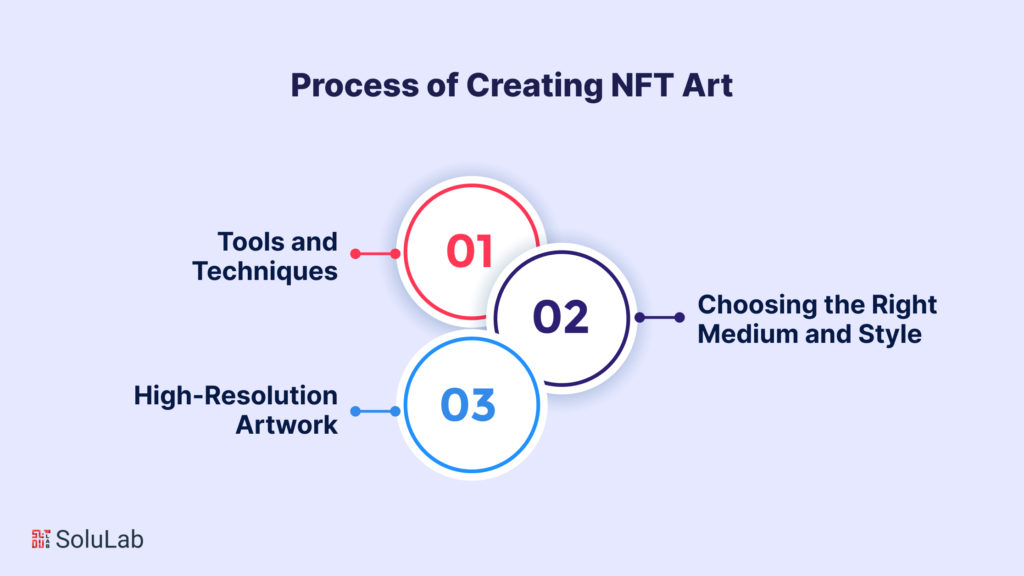
  • Tools and Techniques: To embark on your NFT art journey, you’ll need the right tools. Fortunately, there’s a wealth of user-friendly software and apps tailored for digital art creation. Programs like Adobe Photoshop, Procreate, or even free options like GIMP can help bring your vision to life. It’s all about finding the one that best suits your artistic style and preferences.
  • Choosing the Right Medium and Style: NFT art knows no bounds when it comes to medium and style. Whether you’re a painter, illustrator, 3D artist, or photographer, your skills can find a home in the digital realm. Experiment with various styles to discover what resonates most with your artistic identity. The diversity of NFT art is one of its strengths, offering something for every taste.
  • High-Resolution Artwork: A crucial aspect of NFT art is ensuring your creations are high-resolution. High-quality files are essential for presenting your art in the best possible light and ensuring potential buyers can appreciate the details. Plus, it’s a reflection of your commitment to delivering top-notch art to your collectors.

CTA1

Preparing Your Art for NFT Sale

Preparing Your Art for NFT Sale

Now that you’ve ventured into the creative process of making digital art, it’s time to prepare your creations for sale as NFTs. This involves several crucial steps that ensure your artwork is ready to find its digital home.

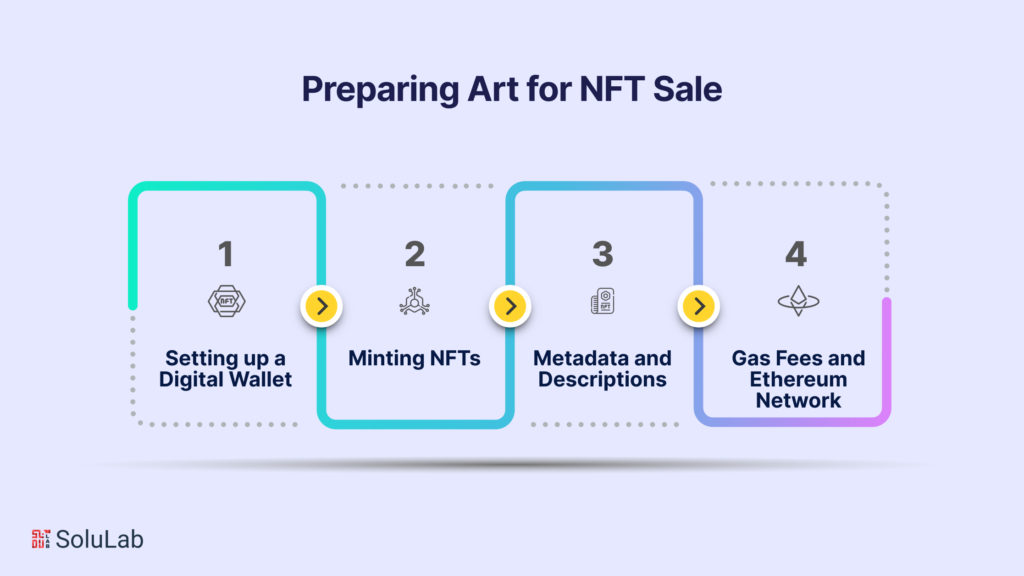
  • Setting up a Digital Wallet: To engage with the world of NFTs, you’ll need a digital wallet. Think of it as your virtual art vault. Popular options include MetaMask and Trust Wallet. These wallets securely store your NFTs and enable you to interact with NFT marketplaces. Ensure you keep your wallet’s private keys safe; they are the keys to your digital kingdom.
  • Minting NFTs: Minting is the process of creating NFTs from your digital artwork. This process varies slightly depending on the NFT marketplace you choose, but the general steps involve uploading your art, adding metadata (more on this later), and confirming the minting process. It’s the moment your art becomes a unique digital asset on the blockchain.

Read Also: Benefits Of An NFT Marketplace On Cardano

  • Metadata and Descriptions: Metadata plays a crucial role in presenting your NFTs. It’s the digital backstory of your artwork. Describe your art, share your creative process, and provide any relevant information about the piece. A compelling story can captivate potential buyers, making your art more desirable.
  • Gas Fees and Ethereum Network: Before minting your NFTs, it’s essential to understand gas fees. These are transaction fees on the Ethereum network required for minting and transferring NFTs. Gas fees can fluctuate, so it’s a good practice to check current rates before proceeding. Some marketplaces may allow you to choose when to mint your NFTs to optimize costs.

NFT Art Platforms

With your NFTs minted and ready, it’s time to choose the right platform to showcase and sell your art. NFT marketplaces are where collectors discover and purchase NFTs, making it crucial to select the one that aligns with your artistic goals.

  • Overview of Popular Platforms: There’s a diverse landscape of NFT marketplaces, each with its unique features and audience. OpenSea, Rarible, Foundation, and Mintable are some of the most prominent names. Research these NFT marketplace platforms to find the best fit for your art. Consider factors like user base, fees, and user experience.
  • Creating an Artist Profile and Portfolio: Setting up your presence on an NFT marketplace is akin to curating your art gallery. Create a compelling artist profile that tells your story and showcases your portfolio. Use this space to connect with potential buyers and fellow artists, sharing your creative journey.

Remember, the NFT marketplace you choose can significantly impact your visibility and success. Take your time in making this decision, as it’s a pivotal step in your NFT art adventure.

Pricing and Marketing Your NFT Art

Pricing and Marketing Your NFT Art

Now that your art is on display, it’s essential to understand how to price and market your NFTs effectively.

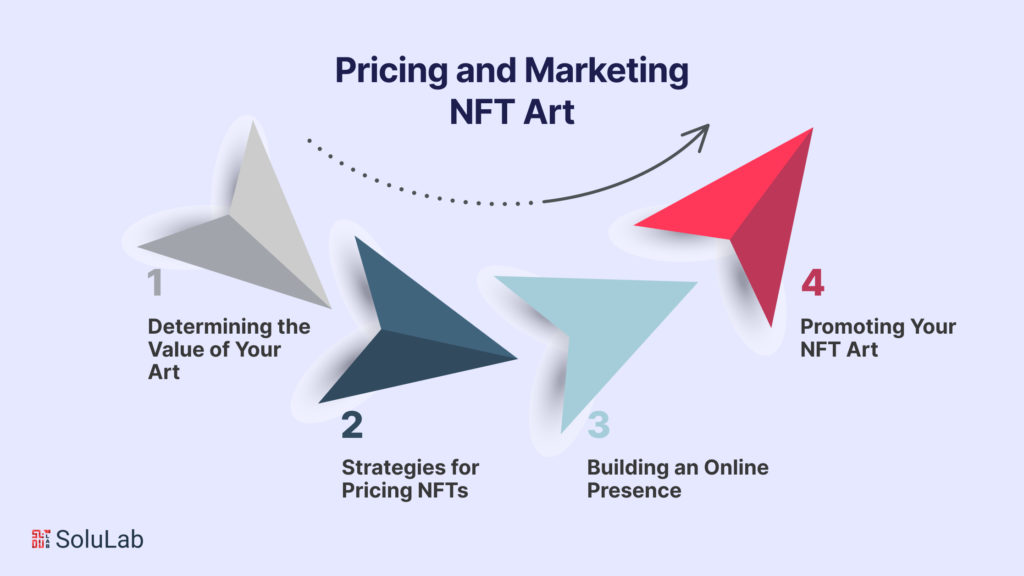
  • Determining the Value of Your Art: Pricing your NFTs can be a challenge. Factors like your reputation, demand for your art, and scarcity all play a role. Research similar artworks and engage with the community to gauge fair market value. Be open to adjusting prices as you gain experience.
  • Strategies for Pricing NFTs: There are various pricing strategies to consider, from fixed prices to auctions and reserve prices. Each has its advantages and suits different scenarios. Experiment and find the approach that aligns with your art and goals.

Know More: 9 Trending White-Label NFT Marketplace Solutions

  • Building an Online Presence:  In the digital art world, your online presence is your calling card. Actively engage on social media platforms, art forums, and NFT communities to connect with potential buyers and fellow artists. Share your artistic journey, behind-the-scenes glimpses, and insights into your creative process. Building a loyal following can significantly boost your NFT sales.
  • Promoting Your NFT Art: Effective promotion is essential. Use social media platforms like Twitter, Instagram, and TikTok to showcase your art. Participate in NFT-related discussions and engage with your audience authentically. Communities like Discord and Clubhouse can be excellent places to connect with art enthusiasts.

Selling Your NFT Art

Your NFT art is now out in the digital world, but selling NFT art for beginners effectively is an art in itself. This section will guide you through the process of selling your NFTs and ensuring a successful NFT art drop.

Tips for a Successful NFT Art Drop 

Timing is crucial in the NFT world. Consider factors like market trends, events, and your audience when scheduling your NFT art drop. Engage with your community beforehand to generate excitement and anticipation. Provide clear instructions for potential buyers on how to participate.

Read Our Blog Also: How to Build an NFT Marketplace from Scratch?

  • Handling Auctions and Fixed-Price Listings: NFTs can be sold through auctions, fixed-price listings, or a combination of both. Auctions can create a sense of urgency and competition, while fixed-price listings offer stability. Experiment with different approaches to find what works best for your art.
  • Managing Royalties and Secondary Sales: One of the remarkable features of NFTs is the ability to earn royalties on secondary sales. When your art is resold, you can receive a percentage of the sale price. Make sure to set your desired royalty rate when minting your NFTs, and understand how different platforms handle royalties.

Navigating Legal and Ethical Considerations

Navigating Legal and Ethical Considerations

As an NFT artist, it’s crucial to navigate legal and ethical considerations responsibly.

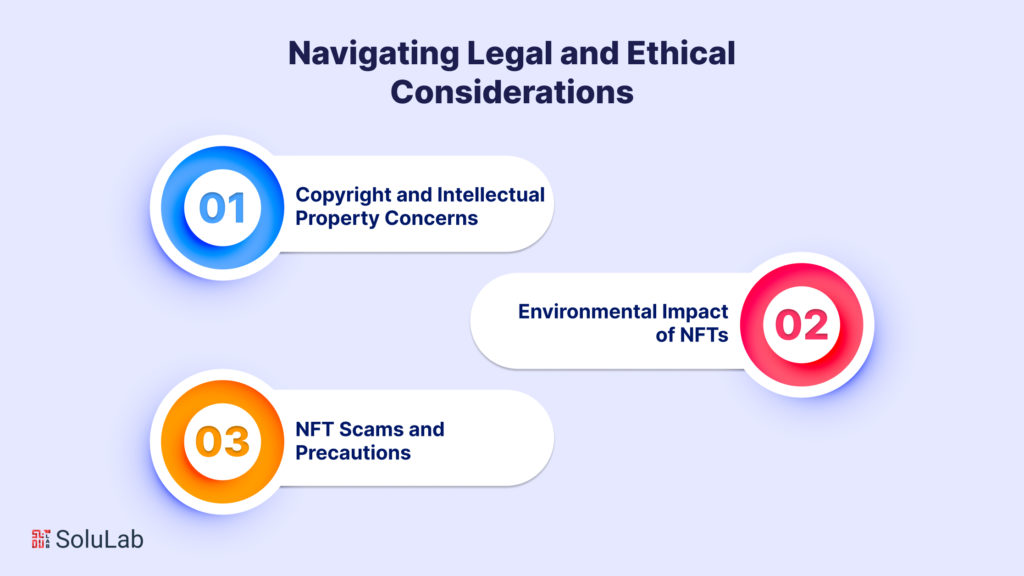
  • Copyright and Intellectual Property Concerns: Ensure that the art you mint as NFTs doesn’t infringe on any copyrights or intellectual property rights. If you’re using third-party content, obtain the necessary permissions and licenses. Respect the rights of other creators as you would want yours to be respected.

Read Also: Best Tron NFT Marketplace Platforms of 2025

  • Environmental Impact of NFTs: The environmental impact of blockchain technology used in NFTs has raised concerns. Some blockchains, like Ethereum, consume significant energy. Consider eco-friendly blockchain alternatives, or offset your carbon footprint through initiatives like carbon credits to contribute positively to the environment.
  • NFT Scams and Precautions: Unfortunately, scams can occur in the NFT space. Be cautious when dealing with buyers, use reputable marketplaces, and verify the authenticity of the art and the identity of the seller. Staying informed and vigilant is your best defense against potential scams.

CTA2

Conclusion

In closing, your journey into the world of NFT art has been an exploration of creativity, innovation, and community. You’ve learned how to make and sell NFT art, as well as navigate legal and ethical considerations. The White-label NFT marketplace development services space is dynamic and evolving, offering endless opportunities for artists like you.

SoluLab is a prominent technology company known for its expertise in blockchain technology and development services. With a solid track record of delivering innovative solutions, SoluLab plays a vital role in the evolving landscape of NFT art. Their proficiency in blockchain technology and smart contracts can be a valuable resource for artists and creators venturing into the NFT space. Whether you’re seeking to mint NFTs, explore eco-friendly blockchain alternatives, or need guidance on the technical aspects of NFT art, SoluLab’s experience and commitment to cutting-edge technology make them a potential partner in your NFT art journey. Their contribution to the blockchain ecosystem aligns with the transformative potential of NFTs for artists worldwide.

If you’re in search of top-notch NFT developers specializing in cryptocurrency and blockchain solutions, your quest ends here! Our team of seasoned NFT programmers offers premium NFT services, including blockchain and smart contract development for process automation. Our user-friendly yet advanced platform development, coupled with highly secure custom digital wallets, is tailored to your specific business requirements.

Obtain a fully customized white-label NFT art marketplace, complete with support for multiple blockchains. Facilitate seamless bidding and buying experiences for your art NFTs’ buyers. Contact SoluLab today to embark on your NFT journey with confidence.

FAQs

1. What exactly is an NFT, and how is it different from traditional digital art?

NFT stands for Non-Fungible Token, a type of digital asset that represents ownership or proof of authenticity of a unique item, in this case, digital art. Unlike traditional digital art, NFTs are indivisible and cannot be replicated or altered, making them a secure and traceable way to own and trade digital creations.

2. Do I need to be a professional artist to create and sell NFT art?

No, you don’t need to be a professional artist to get started with NFT art. NFT art welcomes creators of all levels, from beginners to seasoned artists. What matters most is your passion, creativity, and dedication to your craft. Experiment, learn, and grow as you engage with the NFT art community.

3. How do I protect my NFT art from copyright infringement or theft?

To protect your NFT art, ensure that you have the rights to use all elements within your artwork, or obtain the necessary permissions and licenses for third-party content. Additionally, consider using watermarks or low-resolution previews when sharing your art online to deter unauthorized use. It’s also important to document your creative process and ownership history.

4. Are there any eco-friendly alternatives to blockchain platforms with high energy consumption for minting NFTs?

Yes, there are eco-friendly blockchain platforms, such as Tezos and Flow, that have lower energy consumption compared to Ethereum. These platforms have gained popularity among artists concerned about the environmental impact of NFTs. Research and choose a blockchain that aligns with your values and sustainability goals.

5. How can I promote my NFT art effectively and build a following in the NFT community?

Effective promotion of your NFT art involves engaging with the NFT community and showcasing your work on social media platforms like Twitter, Instagram, and TikTok. Participate in relevant forums, Discord communities, and Clubhouse discussions. Building a strong online presence, being authentic, and interacting with potential buyers and fellow artists can help you grow your following.


8 Best Software to Create NFT Art

Best Software to Create NFT Art

NFTs, or Non-Fungible Tokens, are unique digital assets stored on blockchain networks, serving as proof of ownership or authentication for various digital or physical items. Unlike cryptocurrencies such as Bitcoin or Ethereum, which are interchangeable, NFTs cannot be replicated or exchanged on a one-to-one basis.

These tokens are utilized to represent a diverse array of digital content, including artwork, music, videos, collectibles, virtual real estate, and even social media posts. Each NFT possesses distinct metadata, detailing information about the asset’s creator, its origins, and its ownership history, all recorded on the blockchain.

One of the primary appeals of NFTs lies in their ability to establish ownership and scarcity in the digital realm, enabling creators to monetize their digital creations and collectors to acquire and own unique digital assets. NFTs have gained significant popularity in the art world, with digital artists selling their works as NFTs for substantial sums of money.

Explore and Buy an Already Created NFT Art Piece

In addition to influencing the actions you must take before generating your artwork, investigating what NFTs sell and what markets desire to mint your NFT will assist you in determining which markets may benefit from the newly produced design. This is owing to the fact that the first step in creating any type of art is to research the market.

Although some NFT marketplaces need an invitation from an existing member to get access, others provide features tailored exclusively to new artists. The distinct qualities of each of the several online markets for obtaining and selling NFT art will influence how simply and effortlessly your most current NFT art may be utilized.

How to Create NFTs?

Creating NFTs involves several steps, including choosing a blockchain platform, creating digital content, minting the NFT, and listing it for sale. Here’s a section outlining the steps of how to create NFTs in detail:

Choose a Blockchain Platform

1. Select a blockchain platform that supports NFTs. Ethereum is the most popular choice for creating NFTs, but there are other platforms like Binance Smart Chain, Flow, and Tezos.

2. Consider factors such as transaction fees, scalability, and community support when choosing a platform.

Create Digital Content

1. Produce or digitize the content you want to tokenize as an NFT. This can include artwork, music, videos, virtual collectibles, or even tweets.

2. Ensure that the digital content is of high quality and has value to potential buyers.

Mint the NFT

1. Use an NFT marketplace or a dedicated platform to mint your NFT. Minting involves creating a unique token on the blockchain that represents ownership of your digital asset.

2. Provide metadata for your NFT, including details about the artwork, its creator, and any other relevant information.

3. Pay the required gas fees (transaction fees) associated with minting the NFT on the blockchain.

Store the NFT

Once minted, your NFT is stored on the blockchain and can be accessed through your digital wallet. Make sure to securely store your wallet’s private keys to maintain ownership of your NFT.

List for Sale

1. Choose a marketplace to list your NFT for sale. Popular NFT marketplaces include OpenSea, Rarible, and Foundation.

2. Set a price for your NFT or opt for an auction-style listing where buyers can bid on the item.

3. Write a compelling description and include high-quality images or previews to attract potential buyers.

Promote Your NFT

1. Promote your NFT listing through social media, online communities, and any other channels where potential buyers may be present.

2. Engage with collectors and respond to inquiries promptly to build trust and interest in your NFT.

Transfer Ownership

Once a buyer purchases your NFT, transfer ownership to their digital wallet. This process typically involves executing a transaction on the blockchain, which may require paying additional gas fees.

Manage Ownership and Royalties

Consider implementing smart contracts that allow you to earn royalties whenever your NFT is resold in the secondary market. Platforms like Ethereum support ERC-721 and ERC-1155 standards, which include royalty mechanisms.

Selecting The Best NFT Marketplace

If you own Ethereum cryptocurrency and wish to diversify your earnings, try buying NFTs yourself. However, it is strongly advised that you conduct an extensive study and become as informed about cryptocurrencies as possible before making any purchases.

After you’ve finished, evaluate which online market you want to use. You may opt to purchase an NFT from a reputable source, hold it for a while, and wait for its price to rise over time. Alternatively, you might participate in low-value deals and sell the NFTs right away.

In this scenario, there is no right or wrong answer; it all depends on whether you want to make a quick profit or retain the NFTs for future generations.

Interested? Here are the 8 best software to create NFT Art.

1. Adobe Illustrator

Another excellent choice for creating NFTs and massive collections is Adobe Illustrator. Illustrator is among the most widely used digital art programs in the world, as you are undoubtedly already aware. It appears to work well for NFTs as well. Illustrator provides the tools necessary to create generative NFTs without the requirement for coding expertise. Illustrator now allows artists a lot of freedom. You can design just about anything using its vast toolkit.

Layering is still a fundamental design-building technique in this case. To achieve final outcomes, you can add or build your own things. Some artists create entirely original works, but you can also use ready-made presets and objects to create original NFTs more quickly. The fact that Adobe accepts the cryptocurrency platform Polygon is another significant point to make. It ought to make it simpler to display and market NFT innovations.

2. NFT Art Generator

NFT Art Generator is indeed the platform you need if you seek all of the tools you could possibly need to build NFTs. It is a layer-based tool that allows you to construct NFTs without needing to have a strong background in graphic design. You merely need to upload each one of your layers & construct your NFT. As an illustration, you may begin with your background and then layer on other things to get your desired effect.

NFTs can be downloaded and arranged into collections. Setting up attribute rarity, producing metadata, and producing sophisticated collections using categories, blocklists, and other features are all possible using the NFT art generator. Users of the NFT art generator have complete control over their works; there are no watermarks on collections as a result. You may find some helpful tutorials on the official NFT art generator website that will assist you in using the program and beginning to create NFTs straight away. It is really intuitive and easy to use. Without creating an account, you can use the generator without cost and download your initial sample.

3. Fotor

Don’t you want to easily succeed as an NFT artist? According to the first sentence on their landing page, Fotor is the software that makes it simple for you to produce digital art. You will be able to produce your digital art in a matter of clicks with the aid of cutting-edge AI (Artificial Intelligence) tools. The use of this tool has a little learning curve.

Utilizing Fotor, the creation of NFT is a rather straightforward process. Simply upload the image and choose the art style you want your image to be converted to, and you’re done. The remainder will be handled by the software, and you won’t need to do much. You don’t need to know how to code to generate NFTs thanks to tools like Fotor. With the click of a button, you can add layers, add your unique touch, and improve the art’s appearance.

4. Krita

Another of the best open-source drawing programs you may use to produce your NFT art is Krita. Its availability for free is its best feature. Using the abundance of drawing tools provided by this software, you may produce original digital art that you can then sell in the market of your choice.

Krita is one of the most dependable software programs for producing NFT art because it supports HDR painting and has more than 100 brushes, brush stabilizers, vector tools, etc. You can download brushes from your favored community artists through the Resource Manager feature.

5. Bueno

Bueno NFT art generator is an excellent choice for beginners seeking to create professional NFTs. Its user-friendly interface, accompanied by video tutorials, makes the learning process easy. Users can import their art and layers into Bueno, customize them, and preview the results before exporting.

One unique feature is the ability to set the rarity of layer attributes through simple sliders, with detailed explanations provided via videos. Bueno also stands out by offering its Microverse platform, allowing users to bring their NFTs to life in a 2D world. Additionally, the platform offers a valuable blog featuring advice and tips from experienced artists and teams who have successfully launched their collections using Bueno. To acquire the NFT art collection, payment is made with Ethereum, starting at 0.01 ETH for a collection of 100 NFTs. The prices may vary according to the fluctuating value of Ethereum.

6. NightCafe

Additionally, NightCafe uses cutting-edge AI to make it simple for users to produce beautiful digital art. Neural style transfer is a machine learning method used by the tool. This facilitates the software’s conversion of your uploaded photographs into whatever art style you have selected. Digital image creation is a rather easy process.

One of the simplest tools for creating NFT art, all you have to do is upload your image, choose the art style from the tool’s many options, and let AI take care of the rest. You can make and download artwork with a high resolution (up to 2.2-megapixel resolution) using NightCafe. Additionally, there is a bulk creation mode that enables you to make hundreds of images at once. The best feature of NightCafe is that you can create and download up to five watermark-free artworks every day for free across multiple devices.

7. SketchAR

According to the SketchAR website, it was founded by and for artists. Only the mobile platform is able to access this artistic tool. Its benefit is that you can make your own art while you’re on the run because of this. You may use the software to use sophisticated AR to turn your digital artwork or photographs into NFT (Augmented Reality). Use SktechAR’s offered drawing tool to easily create digital art & convert it.

If you are chosen as the Creator of the Week, your artwork will be turned into NFT and shared with the large and vibrant SketchAR community. This tool’s automatic listing of your artwork on marketplaces like Opensea and Rarible is another benefit.

8. VoxEdit

VoxEdit is last but not least. It is one of the best programs for producing top-notch NFT artworks. The instrument has a gorgeous design that makes it usable for beginners as well. VoxEdit provides a comprehensive range of tools that make it simple for users to produce their artwork.

Additionally, you may use the timeline to animate your artwork. You can list & sell your art on The Sandbox marketplace once it has been produced. VoxEdit software is available for download on Windows, macOS, and even Linux operating systems. You can get the VoxEdit beta program for free.

Conclusion

The NFT art space is full of opportunities, and the right tools can make all the difference. Whether you’re a beginner or a pro, this guide covers software tailored to various styles—from 2D illustrations to intricate 3D designs. Choose tools that align with your vision and workflow.

Beyond mastering software, focus on developing your unique style and engaging with the community. Creativity, consistency, and smart choices will help you stand out.

Stay true to your passion while adapting to trends, and you’ll create NFTs that resonate with collectors and leave a lasting impact. So, follow the above guidelines to hire an NFT developer. SoluLab is an NFT development company that has a team of experts who help you create NFT art contact today to discuss further.

CTA 2

FAQs

1. What Makes a Great NFT Art Software?

A great NFT art software offers intuitive tools, features, and export options compatible with blockchain platforms. It should support 2D/3D design, layering, and smart contract integration for minting.

2. What Advantages Come with Making NFT Art?

NFT art provides NFT ownership security, royalties for artists, and global exposure. It eliminates intermediaries, allowing direct artist-collector interactions and potential long-term value appreciation.

3. Do I Need Technical Skills to Create NFT Art?

No, many NFT art tools are beginner-friendly with drag-and-drop features. While some advanced tools require skill, basic creativity is enough to start.

4. How Can I Mint My NFT Art?

After creating your art, upload it to an NFT marketplace like OpenSea or Rarible, connect a crypto wallet, and follow the platform’s minting process to tokenize your artwork.

5. How Does NFT Art Differ from Traditional Art?

NFT art exists digitally, ensuring provable ownership via blockchain. Unlike traditional art, it can include smart contracts for royalties and is easily shared, sold, or traded worldwide.

The 15 Best NFT Art Marketplace Websites

The 15 Best NFT Art Marketplace Websites

In the world of digital creativity and ownership, Non-Fungible Tokens (NFTs) have emerged as the revolutionary force redefining how we perceive and interact with art. At the heart of this transformative movement are NFT Art Marketplace Websites, the virtual galleries of the future. These NFT websites serve as the nexus where artists, collectors, and enthusiasts converge to explore, trade, and celebrate the boundless world of digital art.

In this exploration of the vibrant NFT ecosystem, we embark on a journey to uncover the very best. From the pioneers who set the stage to the rising stars shaping the technology, these NFT sites stand as the epitome of innovation and creativity. Join us as we delve into the intricacies of NFT Art Marketplace Websites, navigating through the diverse offerings, unique features, and the dynamic fusion of blockchain technology and artistic expression.

What defines the best in the realm of NFT Marketplaces? Is it the user interface that seamlessly guides creators and collectors? The innovative revenue models that balance the scales for both artists and investors? Or perhaps the commitment to security and authentication features that safeguard the integrity of digital assets?

As we embark on this exploration, we’ll unravel the stories behind each platform, each marketplace contributing to the ever-evolving narrative of digital art ownership. From the recognized leaders such as OpenSea to the unique offerings of platforms like BakerySwap, we aim to showcase the diversity, creativity, and unprecedented opportunities that define the best NFT Art Marketplaces.

What is NFT?

In the world of digital creativity, the advent of Non-Fungible Tokens (NFTs) has ushered in a transformative era for artists, collectors, and enthusiasts alike. This introduction serves as our gateway into the dynamic world of NFT Art Marketplace Websites, where innovation converges with artistic expression, and the traditional boundaries of ownership are redefined. Join us on a journey into the heart of the NFT websites revolution, where pixels become art, and ownership takes on an entirely new dimension.

  • Rise of NFTs in the Art World

The art world has undergone a transformative shift with the meteoric rise of Non-Fungible Tokens (NFTs). These unique digital assets have disrupted traditional notions of art ownership and transactional mechanisms. The intersection of blockchain technology and digital art has given birth to a new era, where creators and collectors engage in a decentralized, transparent marketplace.

  • Significance of NFT Art Marketplaces

NFT Art Marketplaces serve as the nexus where artistic innovation converges with technological prowess. NFT Marketplace platforms offer artists unprecedented opportunities for monetization, empowering them to tokenize their work and establish direct connections with a global audience. Simultaneously, collectors gain access to an expansive, diverse array of digital art, securely authenticated and stored on the blockchain.

  • Overview of the Top 15 NFT Art Marketplaces

In navigating the dynamic landscape of NFTs, it’s essential to highlight the platforms that have emerged as industry leaders. These top 15 NFT Art Marketplaces, each with its unique features and contributions, collectively shape the narrative of digital art ownership and exchange.

Top 15 NFT Art Marketplaces

Embark on a curated journey through the virtual galleries that stand at the pinnacle of the NFT website’s art movement. The Top 15 NFT Art Marketplaces, each with its unique offerings and contributions, take center stage in this section. From the well-established giants to the rising stars, we explore the diverse ecosystems that have reshaped the way we buy, sell, and appreciate digital art. Get ready to discover the platforms that define the forefront of the NFT art revolution.

1. OpenSea

OpenSea, renowned as one of the pioneers in the NFT space, stands out for its user-friendly interface and extensive collection of digital assets. Artists and collectors converge on OpenSea to explore, trade, and discover NFTs across various categories, from digital art to virtual real estate.


$90-$95


101-250


2017


Warner Music Group, Aramco

2. Origin Story

Origin Story, the premier NFT art marketplace, collaborates with top collections for an exclusive experience. Enjoy comprehensive analytics, showcasing holder distribution and prominent holders, along with aggregated volume metrics for NFT collections across major marketplaces. Partnered with elite groups like Pudgy Penguins, Karafuru, Moonrunners, and more, Origin Story ensures a fraud-free environment, permitting only legitimate NFTs from a collection.


$50-$70


10-49


2018


Forbes, Fox

3. Rarible

Rarible distinguishes itself through its decentralized approach and commitment to supporting artists. The platform empowers creators to issue their custom-branded tokens, enabling them to retain royalties on secondary sales. Rarible’s decentralized autonomous organization (DAO) further enhances community engagement and decision-making.


$55-$90


51-100


2020


Adobe, Immutable X

4. GameTrade

GameTrade, the premier NFT art marketplace, caters to gamers and seasoned traders, offering cutting-edge communication features for a seamless trading experience within virtual metaverses. With automatic buying and selling price tracking, buyer-seller communication, and item trading among customers, GameTrade also provides professional traders with multiple accounts, streamlining their trading endeavors. Utilizing blockchain technology, all transactions are securely safeguarded, ensuring items can only be transferred with the owner’s permission.


$14-$54


11-50


2014


Meta, Apple

5. Mintable

Mintable has gained popularity for its user-friendly features, making it accessible to both creators and collectors. The platform enables creators to mint NFTs without coding knowledge, expanding the reach of digital art creation. Mintable’s commitment to accessibility and ease of use makes it a preferred choice for emerging and established artists.


$25-$50


11-50


2018


Airbnb, Sony, Nintendo

6. Foundation

An invite-only best NFT art marketplace is Foundation. A creator who has previously posted work on the site must invite you to list your best NFT art marketplace. You get 10% royalties for each subsequent sale of your NFTs, which can be sold on OpenSea and Rarible. Each deal on the site is subject to a 15% commission fee. It is less well-known than the other marketplaces.


$55-$90


10-49


2020


Fedex, KraftFoods

7. SuperRare

A curated platform is called SuperRare. It only collaborates with a select group of carefully chosen artists. The primary focus of SuperRare is on premium single-edition art NFTs. Only 1% of the applications from artists are accepted. The buyer pays the transaction fee, which is 3% of the sale price. For each sale, the site levies a 15% commission fee.


$25-$50


25-99


2018


Google, Gucci, STARZ

8. Nifty Gateway

Nifty Gateway is another particular NFT art market. It also hosts NFTs built on Ethereum. Acceptance into Nifty Gateway’s carefully curated collections is difficult. They collaborate with well-known musicians, including Steve Aoki, Beeple, and Grimes. They also stage NFT collaborations with famous people, such as the one with Paris Hilton and artist Blake Kathryn. Therefore, unless you’re incredibly well-known, getting accepted for the curated drops is very tough. On Nifty Gateway, there are also verifiable drops, though. The permission procedure is also necessary here, but it is laxer. Each sale has a 5% commission fee from Nifty Gateway. Artists are free to choose their remuneration for subsequent sales.


$55-$90


11-50


2017


Samsung, J2 Global

9. Makersplace

You require an invite from a member of the Makersplace group to list your NFT art marketplace. A 15% commission is incurred every time you make a sale. All secondary sales result in a 10% royalty payment to the seller. Ethereum is not required for payment; credit cards are accepted.


$45-$89


11-50


2016


Binance, Coinbase, Kraken

10. KnownOrigin

Similar to SuperRare, KnownOrigin concentrates on rare and best NFT marketplace for art. It deducts 15% commission fees from each sale and gives the NFT creator 85% of the proceeds. All secondary sales generate a 12.5% royalty. Most of the popular NFTs are created and sold on the Ethereum blockchain. In this article, we concentrated on the marketplaces that host Ethereum-based NFTs. Many other marketplaces allow creators to sell their NFTs based on different blockchains. Some notable ones are the Binance NFT art marketplace for NFTs created on the Binance Smart Chain, AtomicHub for Wax-based NFTs, and Solanart for NFTs built on the Solana blockchain.


$55-$99


11-50


2020


Amazon, Mitsubishi

11. Solanart

The Ethereum blockchain is used to build and trade most of the well-known best NFT marketplace for art. Because of this, we focused on the marketplaces that house Ethereum-based NFTs in this study. There are numerous additional marketplaces where developers can sell NFTs based on various blockchains. The Binance NFT marketplace for NFTs developed on the Binance Smart Chain, AtomicHub for NFTs based on wax, and Solanart for NFTs developed on the Solana blockchain are a few famous examples.


$72-$450


11-50


2021


Visa, American Express, Mastercard

12. DecentraLand

In the decentralized virtual world, Decentraland, you can build and sell goods you make and now own. Various digital assets, including wearables, estates, names, etc., are available on this best NFT marketplace for art. In Decentraland, you may purchase and sell virtual properties, give them your touches, and save them in an Ethereum-based smart contract.


$120-$200


11-50


2017


Apple, Microsoft, Intel

13. NBA Top Shots

Launched in 2020, NBA Top Shot is a well-liked marketplace operated by the NBA. You can purchase their unique NBA highlights and acquire them as digital collectibles. Additionally, this best NFT marketplace for art offers a certification that grants the purchaser ownership rights and guarantees the validity of that singular moment.


$75-$90


10-49


2020


Zara, H&M

14. BakerySwap

On the Binance Smart Chain, BakerySwap is an automated marketplace & decentralized exchange (BSC). It makes use of a local BakerySwap token (BAKE). This best NFT marketplace for art is a multi-purpose cryptocurrency hub that provides non-fungible tokens, a crypto launchpad, and several decentralized finance (DeFi) services. Additionally, you can utilize NFTs in “Combo Meals” to get additional BAKE tokens.


$25-$50


11-50


2020


Airbnb, Nintendo

15. Async Art

A non-fungible token art market called Async was established in February 2020. You can manufacture your NFT tokens using this best NFT art marketplace development and purchasing and trading NFTs. The NFT platform also makes it simple for artists to specify the appearance and behavior of their works of art.


$45-$55


11-50


2020


T-Mobile, World Wide Web Consortium (W3C)

Read Our Blog Post: Top NFT Development Companies

Unique Features of Each NFT Art Marketplace

In the digital symphony of NFT Art Marketplaces, each platform plays a unique note. Dive deep into this section to explore the distinctive features that set apart every marketplace on our list. From special offerings and community engagement features to groundbreaking integrations with emerging technologies, discover the elements that make each platform a vibrant and essential part of the NFT site’s world.

  • Special Offerings

Each NFT Art Marketplace has distinctive features that set it apart. For instance, NBA Top Shot offers licensed sports moments as NFTs, attracting sports enthusiasts and collectors seeking a unique digital collectible experience. These special offerings contribute to the diverse appeal of the NFT website’s ecosystem.

  • Community Engagement Features

Community engagement is a hallmark of successful NFT Art Marketplaces. Platforms like BakerySwap actively encourage user participation through community-driven initiatives, governance mechanisms, and collaborative decision-making. The integration of community engagement features fosters a sense of belonging among users, enhancing the overall experience.

  • Integration with Emerging Technologies

Certain marketplaces, like Portion, embrace emerging technologies to enhance user experiences. Integration with virtual and augmented reality (VR and AR) creates immersive interactions with digital art, offering users a novel way to engage with NFTs. The exploration of these technologies contributes to the forward-thinking nature of NFT Art Marketplaces.

Artist Success Stories

Behind every digital masterpiece lies the journey of an artist who has harnessed the power of NFT Art Marketplaces. In this section, we showcase the success stories of artists who have thrived in the NFT ecosystem. Their narratives, challenges, and triumphs serve as inspiration for aspiring creators, shedding light on the transformative impact of digital art ownership on the artistic community.

  • Profiles of Successful NFT Artists

The success of artists within NFT Art Marketplaces is a testament to the transformative impact of digital art ownership.

  • Their Journeys on NFT Art Marketplaces

Exploring the journeys of successful Non-fungible token artists sheds light on the diverse avenues of creative expression within these marketplaces. From the initial minting of NFTs to building a dedicated following, artists navigate a unique path that reflects the evolving landscape of digital art.

  • Impact on the Artistic Community

The rise of NFT art has created a ripple effect within the artistic community. As artists gain autonomy over the monetization of their work, traditional notions of gallery representation are challenged. The NFT art movement has inspired collaborative projects, community-driven initiatives, and a redefinition of the artist-collector relationship.

Tips for Buying and Selling NFT Art

Navigating the NFT art marketplace requires a set of strategic insights. This section provides valuable tips for both buyers and sellers, offering guidance on effective navigation, evaluating authenticity, and understanding the intricacies of smart contracts. Whether you’re a seasoned collector or a budding artist, these tips are your compass in the digital sea of NFT sites.

  • Navigating the Marketplace

Effectively navigating the best NFT art marketplace requires an understanding of the features and nuances of each platform. Intuitive interfaces, clear categorization, and search functionalities enhance the overall experience for both collectors and creators.

  • Evaluating the Authenticity of NFTs

Ensuring the authenticity of NFTs is a paramount consideration for buyers. Platforms like KnownOrigin and SuperRare, with their commitment to curation and quality, provide users with a level of confidence in the authenticity and rarity of the digital assets they acquire.

  • Understanding Smart Contracts

A fundamental understanding of smart contracts is essential for participants in the NFT space. Knowing how these contracts operate, particularly regarding royalties and resale rights, empowers both artists and collectors with a clear understanding of the terms governing their transactions.

Challenges and Opportunities in the NFT Art Marketplace

  • Scalability and Environmental Concerns

As the popularity of NFTs continues to soar, challenges related to scalability and environmental impact have surfaced. Platforms like MintNFTs actively address these concerns by exploring eco-friendly blockchain alternatives, contributing to the ongoing discourse on sustainable NFT practices.

  • New Avenues for Artistic Expression

The NFT art marketplace has opened new avenues for artistic expression. Artists are no longer confined to traditional mediums, with digital and interactive art gaining prominence. Platforms like Mintbase, enabling creators to establish their marketplaces, exemplify the democratization of artistic expression within the NFT ecosystem.

  • Emerging Trends in NFT Art

Emerging trends within the NFT art space include the integration of blockchain gaming, virtual events, and collaborative projects. Platforms like Axie Marketplace showcase the potential of combining gaming and NFTs, creating novel and engaging experiences for users.

Conclusion

In conclusion, the 15 best NFT art marketplace websites are transforming how digital artists and collectors engage, offering platforms for showcasing, trading, and monetizing digital assets. As NFTs continue to reshape the art world, choosing the right marketplace is essential for both creators and buyers.

A prime example of blockchain-powered innovation is the Source Independent Entertainment (SIE) project, which leverages blockchain for content sharing and rewards. It showcases how blockchain can enhance user experiences and security in digital platforms.

At SoluLab, a leading NFT Marketplace Development Company, we help businesses create innovative NFT solutions. Whether you’re looking to build an NFT marketplace or need expert guidance, our team is here to assist. Hire NFT Developers from SoluLab to bring your vision to life and succeed in the growing NFT space.

CTA 2

FAQs

1. What is an NFT Art Marketplace?

An NFT art marketplace is a platform where digital artists can create, sell, and trade their artwork as non-fungible tokens (NFTs). These platforms use blockchain technology to verify ownership and authenticity of digital assets.

2. How do I choose the best NFT art marketplace?

When selecting an NFT marketplace, consider factors like platform fees, supported blockchains, audience size, and ease of use for both creators and buyers. It’s also helpful to assess the type of art or assets the marketplace focuses on.

3. Can I create my own NFT art marketplace?

Yes, businesses can create custom NFT art marketplaces. Collaborating with a professional NFT Development Company ensures that your platform is tailored to your needs, with features like secure transactions, user-friendly interfaces, and blockchain integration.

4. What are the benefits of using an NFT marketplace for artists?

NFT marketplaces allow artists to monetize their digital work, gain global exposure, and retain more control over their creations. These platforms also enable artists to earn royalties on resales, providing long-term revenue opportunities.

5. How can I hire NFT developers to build my marketplace?

To build a custom NFT marketplace, you can Hire NFT Developers who specialize in blockchain technology, smart contracts, and digital asset creation. They can help you design a secure, scalable, and user-friendly platform.

A Marketer’s Musing on NFTs & the Future of Digital Art

A Marketer’s Musing on NFTs & the Future of Digital Art

By now, you’re probably familiar with the concept of NFTs (non-fungible tokens), which are digital art nft authenticated by blockchain technology. I’m guessing that one of these headline stories caught your eye:

  • To celebrate the 10th anniversary of the iconic Nyan Cat gif, its creator Chris Torres sold the original for 300.00 Ethereum (about $600K).
  • The digital artist Mike Winkelmann, aka Beeple, brought crypto to Christie’s — and the auction of his “Everydays — The First 5000 Days” sold for a jaw-dropping $69,346,250. (Until October 2020, $100 was the most he’d ever sold a piece for.)
  • Kings of Leon is the first band to release a new album (When You See Yourself) as an NFT. It’s already generated a reported $2 million — and the sale goes until March 20th. (So keep checking that number!)
  • The digital collectibles platform NBA Top Shot just sold 10,631 packs of basketball videos for a record $1.05 million in revenue.

Why NFTs are suddenly getting all this ink seems to be all about the coin. (Cryptocurrency, that is.)

But this situation reminds me of that famous scene in the movie Jerry Maguire. It’s not about the coin at all. If you think that, you’re missing the bigger picture.

It’s really about the Quan, as Jerry’s client, wide receiver Rod Tidwell explained:

“You know some dudes might have the coin. But they’ll never have the Quan…It means love, respect, community, and the dollar too. The entire package!”

Something the proverbial starving artist rarely gets in her or his lifetime — dying broke and unknown or underappreciated isn’t just a cliché. From Vincent Van Gogh to Johann Sebastian Bach, Emily Dickinson, and Jean-Michel Basquiat, artistic genius has a long tradition of suffering in poverty and isolation.

Until now.

Art drives culture, and culture drives art. NFTs are a tipping point to finally give makers their due. The entire package.

They can be a boon for marketers, too, if we don’t screw it up.

The (Digital) Artist’s Way

Topping the list of what I think is most interesting about NFTs is how they transcend the concepts of ownership and trust. And how they support the involvement of the artist with their creation as it iterates over time.

This is a major shift from how it used to be for most successful artists: once you can’t make art any longer (i.e., you’ve gone insane or died), the value goes up.

For the digital artist, whose works are so easily copied, the option to make money on your art was even more dismal. Nyan Cat was seen 90,000,000 in its first few years of existence and spawned endless memes, riffs, and videos. But I’m imagining Chris Torres didn’t get any direct profits a decade ago from having melded a Pop-Tart body onto a pixelated, rainbow-fueled cat.

With NFTs, digital content creators are now able to put value on their service. Crypto art transforms authentication, which is important for the seller and buyer alike. Plus, creators can build whatever they want into their work. This goes beyond being self-serving. For example, the New York Times reported that artist Sara Ludy built profit-sharing with her staff into her NFT sales, saying, “I wanted to set an example of one of the many ways funds could be redistributed with this new market.”

Likewise, Grimes’ new music, WarNymph Collection Volume I, which sold out in 20 minutes to the tune of $6 million, donated a percentage of the proceeds to a carbon offset non-profit. (Blockchain technology/mining is notoriously bad for the environment. My hope is that proof of stake, which is much more sustainable than proof of work, will become the norm for Ethereum, the platform that houses most NFTs.)

The new market takes collecting to the next level. If you haven’t already, take a look at some of the marketplaces: Zora, Foundation, OpenSea, Nifty Gateway, SuperRare, and Rarible, among others. As you’ll notice, basically any creation can be signed, not just digital art. Everything from music to collectibles and tangible goods are all there. As a maker, tokenizing ensures that it is unique and branded as your work. The bridge between creator, seller, and buyer is an immutable ledger — the blockchain — which breeds more fairness across the board.

This is a sea change for artists, giving them more power and a direct connection to their audience. The blockchain authenticates creators’ works AND includes rules for future use. When the market speculates and ownership changes, the artist stays in the digital picture.

So, for example, Beeple’s contract builds 10% of every sale of his work to secondary markets. As he told the New York Times, “When you buy the artwork, you’re sort of entering into a relationship with me.” (Like Grimes, he’s now planning to contribute to carbon offsets to neutralize his environmental impact.)

Read also: NFT Art Marketplace Development: A Detailed Guide to Create NFT Marketplace for Artists

For this, and everything else I’ve mentioned, I think NFTs are one of the more exciting things to happen to the art community in a long time. It brings next-level legacy value to the artist and their family because the digital signature and fingerprint are forever minted in the work — forgery-proof, steal-or-hack-proof, and the ultimate preservation of originality.

The Evolution of Art and Commerce

“Direct to consumer” or DTC is the buzzword for today’s consumer market. From small independent brands to massively well-known brands, the playing field is leveled without a third party.

So too, is the case in the world of NFTs. For example, on Rarible, you can buy art from countless aspiring artists and Taco Bell. The latter just made news selling out a collection of fast-food-themed tokens of primarily animated art, with profits going to the Taco Bell Foundation, which supports education and career progression for young people.

Clearly, Taco Bell isn’t in it for the beans (sorry, I had to). But they are positioning themselves as cutting-edge and artsy. They are speaking directly to their fans. And in this new economy, that’s valuable.

So, what’s interesting to the marketing side of me about the whole crypto movement from the OG NFTs, CryptoKitties, to today is the growing interest in both originality and collectibility of everyday items. This is, of course, nothing new — from sneaker culture to the iconic Eames chair, aesthetic integrity and authenticity are worth preserving, cherishing, and paying for.

Read also: 6 Tips to Promote Your NFT Art

As they say, where the energy goes, the attention flows. And what we’re talking about here is the concept of currency. That root word — current — guides you to see where the market is going. When Elon Musk Tweets you can now use Bitcoin to buy a Tesla, the shift has happened. (For the record, you can also use Bitcoin for lease and membership payments at District, the co-working space that’s home to Digital Surgeons HQ.)

The more we digitize our life, the more we need immutable transactions.

To go with the flow, forward-thinking companies should consider how NFTs might factor into their brand and content syndication strategies. So, for example, I might recommend sponsoring the creation of a series of digital art pieces by underrepresented artists. We then mint the designs as an NFT collection, selling them off to benefit the artists and a worthy cause. Everybody wins.

The possibilities are quite literally endless. Not just for profit, but for a whole new form of currency — the real Quan. NFTs are the entire package for those of us who care about art and design: love, respect, community, and the (ETH)coin, too.

Blog Credits: Medium

NFT Art Marketplace Development: A Detailed Guide to Create NFT Marketplace for Artists

A Detailed Guide to Create NFT Marketplace for Artists

Digital artwork is one of the fastest-growing industries. NFTs were created to tokenize unique and different digital artwork and generate ownership rights to prevent counterfeiting. Digital artists can sell their work online. Tokenized paintings and smart contracts enable digital artists to add extensive qualities such as metadata, file links, and identity of ownership, allowing them to retain copyright.

NFT marketplace has offered many new opportunities for traders, and digital assets are becoming popular day by day. If you want to learn and understand more about NFT art marketplace development, you’re at the correct place. In this blog, you’ll learn how to launch the NFT art platform, its features, etc. Let’s get started.

What is an NFT art marketplace?

It is a platform that allows you to store and sell NFT (Non-Fungible Tokens) effortlessly. These tokens are available for purchase or auction at a fixed price. It would be best if you had a crypto wallet to make trades and save your assets to use such a marketplace.

Users can create an account, upload digital artwork, and sell on an NFT marketplace. In general, niche marketplaces are already in higher demand than conventional ones because they include everything a client would require, specialize in marketing some digital artworks, and have a specific demographic.

Top Features of NFT art Marketplace development

Here are some of the features that an NFT marketplace can have:

Storefront

A successful NFT marketplace will typically have a storefront function similar to a dashboard. It gives the users all the information they need about an asset:

  • Owners
  • Bids
  • Value history
  • Previews

Token Advanced Search

Buyers should be able to receive full information about the products they require quickly and easily. Your NFT marketplace app should include every product organized by features (for instance, art, images, music, and videos). Buyers’ satisfaction increases when searches are completed more quickly.

Filter

The use of filters is advantageous. It allows users to select assets based on category, payment method, due date, and listing status. Add this functionality to build an NFT marketplace platform for collectibles.

Bid and Buy

Traders must be able to buy and sell NFTs stored on the platform while using a marketplace. Their bids should also include a bid validity date and allow them to view data on the status of those bids.

Make Listings

Give customers the ability to create and send digital collectibles. Make sure they require the least effort to do the task. Try building a page where they may upload files and provide a full product description. Tags, titles, and illustrations are required.

Wallet

Customers should be able to use your NFT marketplace’s wallet to store, transmit and receive NFTs and cryptocurrencies. You can create your wallets or combine multiple wallets such as Formatic, MyEtherWallet, or Coinbase onto your site.

Listing Status

It benefits people who can provide items and complete the product verification process. It enables you to keep track of the status of the authentication process. It facilitates collectible verification execution.

Rating

It’s a feature for newbies who might not know where to start, select things rapidly, and how the system works. Users may determine whether a seller is honest by looking at their rating. Participants in an NFT marketplace can rank and provide comments based on their experience. It enables others to assess a user’s credibility.

Types of NFT marketplaces

If you intend to launch an NFT marketplace, you should first select an appropriate type of platform. Mass platforms are among the most common types of NFT marketplaces. Platforms for art, gaming, and sports. The kinds of NFT marketplaces are:

  • Art NFT marketplaces: non-curated
  • Art NFT marketplaces: non-curated or invite-only
  • Gaming NFT marketplaces
  • Sports NFT marketplaces
  • Fashion NFT marketplaces
  • Real estate NFT marketplace
  • Music NFT marketplaces

Non-Curated Art NFT Marketplaces

Anyone can use this NFT to trade their artwork. As a result, the value of the digital artworks portrayed on such a platform may vary.

Non-Curated or Invite-Only Art NFT Marketplaces

Launch an NFT marketplace of this sort only if your target audience is interested in one-of-a-kind artwork. To be featured on such a platform, an artist must undergo a rigorous vetting procedure that can take months.

Steps to access the NFT art marketplace platform

Here’s a step-by-step guide to developing an NFT art marketplace.

  • Users should sign up and choose their preferred digital wallet.
  • NFT owners can list their digital assets or NFTs on the platform and the asset’s details. Now, they can select the type of sale — fixed or auction-based sale.
  • Once the platform approves the listed NFTs, buyers can view them.
  • Buyers choose their preferable NFTs and start placing the bids.
  • The smart contract will execute the trade.
  • Now, the NFTs will get transferred to the buyer’s wallet.

NFT Marketplace Development for Artists

NFT marketplace development for artists has now become a marketplace platform for artists and producers where they may list their digital artworks and collections. The website enables digital artists to display their excellence and talents and sell or trade their artworks worldwide and gain recognition for their work. With their expertise, NFT artists have the great opportunity to become billionaires.

Read also: How NFTs Changed Digital Art & The Life Of Artists?

Create the NFT art marketplace to showcase the creativity of digital artists and provide them with a good and new source of income. The development of the NFT art platform can promote contemporary artists and generate significant revenue.

Conclusion

The hype about the NFT market has increased in recent years. People can purchase and create art pieces, cards, and other collectibles on numerous marketplaces — mass, art, sports, and gaming NFT platforms. NFT creates one-of-a-kind digital treasures by utilizing a blockchain’s transparent and secure digital record.

You can create an NFT marketplace to dominate one of the most promising industries in the technology sector. You should select what type of platform to build and what kind of features you should offer. Following that, choosing the correct tech stack is one of the most crucial processes in the development process: blockchain and blockchain standard, testing tools, front-end, and back-end technologies, and developments.

Blog Credits: Medium

How NFTs Changed Digital Art & The Life Of Artists?

How NFTs Changed Digital Art & The Life Of Artists?

We have collected some valuable data published by “ThePrint” news, sharing about the auction made for NFT arts. Let’s dig into this topic in detail by exploring the real-time experiences shared by visual engineers describing their sales in the digital art nft market!

3o yrs old, Karan Kalra, a visual engineer shared his story in public describing the pricing insights for this artwork in the NFT art gallery.

It’s a sparkling sunny day, he woke up and was surprised while he checked his barrage of emails. It’s an acknowledgment email, describing his artwork purchased for “600 wazirx”. In his art, he portrayed an illustration of his dog enjoying a happy ride in a car. Once he finished his masterpiece he waited for his first big sale.

Karan further added, it happened on one fine day in 2021. He was overjoyed that this work has earned him 600 wazirx, that’s around 80,000 rupees in India.

Sounds interesting, right?

NFTs can give you huge returns, beyond what you think. It could be any NFT from art, ranging from the soundtrack, image, video, GIF, or any collectibles that you think of in the real world. NFT welcomes any physical piece of work into digital guaranteeing ownership to the owner. It’s unique in our world and could be replicated. Its jaw-dropping features like immutability attract the buyer on the other hand.

As a token of appreciation to the artist, much Indian art industry steps forward in integrating with modern NFT ideas. By the way, the NFTs art gallery becomes a better medium for the artists to collab with their buyers at the cheapest source. Intermediaries are permanently shut off with the arrival of NFTs.

Once a buyer is ready to purchase, the artist transfers the ownership by making a “digital signature”. It is recorded proof or guarantees a buyer possesses an original work from the artist. A digitally signed painting can hang on your digital wall, and even you can take complete ownership from the artist by paying them.

Read also: Generative Art NFTs: Shining a Spotlight On the Algorithmic Art Movement

In terms of collaboration, NFTs for arts created a huge revolution in the life of artists, said Kalra. Kalra added, before NFTs, it was really challenging for him to sell this artwork, and even felt he was a second-class citizen for selling his art. He needs to approach a middleman to make a sale. Now, he was delighted to make his sale without relying on a middleman.

Shreya Daffney also shared her story. She is 29, an artist and architect, who sold over 30+ artworks in the last 5 years. She said she was selling art that represented a coastal town, like udupi.

Another one, Christie’s sold Beeple’s ‘Everydays: The First 5000 Days’ in 2021 for a stunning $69M. This art is sold for a bigger price at a major auction and it was the first ever NFT art sold at that auction.

Art Vs Artist

35 old visual artist from Kerala, named Vimal Chandran, too shared his experience while selling his nft art. For a long period of time, he was creating digital art in his workspace. On one fine day in 2021, his work was sold at an unimaginable price.

Further his new series called “Folk SciFi”, was minted on the previous day of the sale. Within the next 24 hrs, it was sold.

Constantly being a success factor, nft arts largely transformed the lives of young artists. The above examples prove it quietly.

Are Art Galleries Ready?

Digital art galleries have become one of the best alternatives to traditional galleries. Arts are portrayed digitally and placed for auction in the digital art gallery which holds a huge potential to attract visual audiences. High-walled traditional galleries are being replaced by the nft art galleries proving the evolution of our generation.

Beyond offering constant support for the artist, NFTs for arts are becoming a mainline business for youngsters by creating massive opportunities for buying and selling.

Read also: How to Turn Digital Art into NFTs?

A popular traditional art gallery named, Vadehra Art Gallery, has not yet showcased any art nft but silently insisted that they support any representation of art in nfts.

Vedehra also said nothing can replace exposure to real physical art in person.

NFT — Art Or Money?

Top celebrities like Amitabh Bachchan, Yuvraj Singh, and Manish Malhotra, are inspiring youngsters by owning their own NFT. So, being a good space to showcase individual talents, tons of digital creators are flourishing in this NFT era.

Quite a few questions are raised, saying whether nfts is for art or for money.

N number of allegations are placed before, let’s see one of those. Curator and faculty at Ashoka University, Srinivas Aditya Mopidevi said, cryptos became mainstream but a sudden hype boomed in NFTs in 2021. Momentum passed from cryptos to ntfs creating big business opportunities. Success stories created by nfts are viral and proven. You can even step forward and make your success story by creating an NFT Marketplace For Arts. Developers at a reputed NFT Art Marketplace Development Company can offer endless development solutions to inspirational business freaks who are into nfts.

Blog Credits: Medium

Are NFTs Shaking Up the Digital Art World?


Are NFTs Shaking Up the Digital Art World?

Thanks to Christie’s sale of Beeple’s “EVERYDAYS: THE FIRST 5000 DAYS” making international headlines and Grimes, a multi-hyphenate artist, selling $6 million worth of digital art as Non-fungible tokens (NFTs), NFTs have solidified themselves into the digital zeitgeist, capturing the hearts of many artists and collectors. For example, before the advent of NFTs, it was difficult for artists to create digital artwork that would hold value or scarcity. But because NFTs are secured on an immutable public ledger, digital assets now have a claim on ownership, history, and authenticity previously only associated with physical objects – creating a fundamental shift in the art world. 

What Is NFT Art? 

Non-fungible tokens (NFTs) are cryptographic tokens issued on a blockchain to represent unique digital assets such as artworks, music, or collectibles. Each NFT has a unique identifier that distinguishes them from each other. Meaning they can’t be altered or copied. NFT art marketplace is simply a piece of digital artwork tokenized on a blockchain network which also functions as proof of ownership and authenticity of the artwork. 

Non-fungibility, A Game-Changer For Digital Artists

NFTs are not fungible because each one is a unique digital asset and can’t be interchangeable or replicated. For example, a bitcoin is fungible, you can trade one bitcoin for another bitcoin and get exactly the same thing. Whereas a one-of-a-kind painting like the Mona Lisa is non-fungible. Sure, you can buy a print of the Mona Lisa, but there is only one original painting of the Mona Lisa. 

While the non-fungibility element of an NFT is one factor that determines the scarcity and worth of an NFT art piece, the value of an NFT can also depend on several factors: the team behind it, its use cases, community, or market supply and demand. 

How Have NFTs Changed the Art World?

The usual benefits of NFTs such as proof of ownership, freedom of issuance, and immutability of records have revolutionized the way we create, collect and own art. Below, we’ve highlighted seven more ways NFTs have shaken up the art world. 

Connect artists with a global audience

In a sense, galleries can be seen as gatekeepers of the artwork since they’re the ones who choose what artwork they will display. Compared to traditional art establishments, NFT marketplaces are much more inclusive of emerging artists and niche art concepts. This has enabled artists to thrive outside of the gallery and auction house structure. 

Introduce potential ongoing revenue for artists 

Usually, once an artist sells their artwork, they don’t make anything from subsequent resales. NFTs have revolutionized the secondary art market, and artists can determine the number of royalties they receive with the help of a smart contract – a blockchain program that self-executes tasks whenever certain conditions are met. Artists can set up a rule within the smart contract that triggers a royalty payment whenever their NFT art changes hand the secondary market.

Eliminate the need for intermediaries

Traditionally, galleries and some online marketplaces take a percentage of sales from an artist’s revenue. With NFTs, artists can directly interact with buyers and sell their artwork on NFT marketplaces without needing agents or intermediaries.

More transparency behind transactions

An artwork’s authenticity and origin are one of the factors that influence a buyer’s decision. The ones who verify these metrics are usually auction houses or galleries, but while provenance mistakes and well-produced forgeries are fairly uncommon – they do happen. 

Since an NFT is secured on a blockchain network, anyone can track its transaction and previous ownership history to verify its authenticity. What’s more, the immutable nature of blockchain ledgers significantly minimizes the risk of forgery.

Read also: How to Buy your First Art NFT

Digital art isn’t the only medium that can benefit from NFTs. When it comes to physical artwork, NFTs can function as a digital certificate that proves the artwork’s authenticity with some artists minting digital and physical works together as one NFT. Compared to a piece of paper, NFTs are a more secure way to record ownership, verify its origin, and mitigate risks of forgery. 

Lifting entry barriers

The rise in popularity of NFTs and the accessibility of NFT marketplaces have lifted the veil of mystery covering art galleries and auction houses. Prestigious museums like the State Hermitage Museum recognize NFTs as a form of art, and NFT art galleries pop up across the world. Art has been more accessible than ever before, presenting artists with a wider reach, and connecting them with potential clients from all walks of life. 

Pushing innovation in the art space

As a newly recognized art form, NFTs have pushed creative and innovative boundaries since their conception, with some notable artists toying with their potential.

In 2021, the world-renowned artist and notorious art provocateur Damien Hirst launched a conceptual take on NFT potential. “The Currency” is a collection of hand-painted dot art comprising 10,000 NFTs with 10,000 corresponding physical A4 versions. Each physical piece features a watermark and hologram, making it hard to forge. 

Read also: NFT art—a sales mechanism or a medium?

But here’s the twist: Buyers of the artwork have to choose whether they want to keep the digital or physical version of the artwork. They are given a year from when the NFTs are sent out to make a decision. If they choose to keep the NFT, the physical artwork will be destroyed and vice versa. The final decisions will be made in July 2022. 

Conclusion

The NFT phenomenon has unveiled the mysterious art world and opened up new opportunities for artists and collectors. Compared to art galleries and auction houses, NFT marketplaces are much more inclusive, giving emerging artists niche ideas, and new art collectors the chance to explore art on their own terms. 

While NFT technology is still considered relatively new, the current trajectory of the space suggests that NFTs will continue to open new opportunities and experiences for artists and collectors alike. 

Blog Credits: Binance

How to get started with NFT art?


How to Get Started with NFT Art

The way both creators and artists can sell their work has been reinvented by NFTs. Even though the majority of people won’t earn $70 million from an NFT, producing and selling NFT artwork has given artists more control over the publishing and distribution of their work. We’ll assist you in learning the fundamentals of blockchain, cryptocurrencies, and NFTs if you’re a beginner who wants to learn how to create and sell NFT art marketplace.

You can list your NFT artwork on well-known markets for free by following a few simple steps. You can learn the fundamentals of becoming an NFT artist with the id of this Blog.

NFT in depth

An NFT is a work of art that serves as a token in the sense of Web3 and is connected to a specific line of programming code on the blockchain. Due to the openly distributed nature of the blockchain, which serves as a record of transactions, this line of code will be distinct and impossible to duplicate.

How to make an NFT

NFTs can be created from a variety of different digital media. NFTs in the form of simple graphics are arguably the most popular and discussed type. Since each of these photographs possesses a special bit of code that cannot be reproduced and leaves no room for doubt as to who owns them, they are all non-fungible.

However, a tonne of additional resources, like images, music, animations, films, 3D objects, and even virtual plots of land in the metaverse, can be made into NFTs.

It’s a rather simple process to mint and sells art if you already have an idea in mind that you want to sell as an NFT, such as a sketch, painting, or 3D model. However, if you’re unsure of what artwork to convert into an NFT, get ideas from other well-known NFT collections.

How to sell an NFT

How to Sell an NFT

1. Create a digital wallet

You will initially require a digital wallet. You may store, use, and transact with your cryptocurrencies through a wallet. It also enables you to conduct business on exchanges that allow you to buy and sell NFTs. Since the most popular cryptocurrency used during NFT sales is Ethereum (or ether, as it is formally known), it is often a good idea to select a wallet that is functional with the Ethereum blockchain.

2. Choose an NFT marketplace

Finding a marketplace to advertise, mint, and sell your NFT art is necessary after you’ve set up your wallet. These well-known markets have comprehensive support sections and a wealth of information to get you started with purchasing and selling NFT art. Regardless of the marketplace you select, be aware of the platform fees involved with listing your NFT artwork as well as the cryptocurrencies that each site supports.

3. Buy Cryptocurrency

Ethereum is the most widely used cryptocurrency for the NFT art marketplace (ETH). One of the earliest blockchains is Ethereum, and its namesake cryptocurrency has grown to be one of the most popular ones globally. Remember that regardless of the cryptocurrency you choose, any blockchain transactions will have fees, including minting and listing costs, so you’ll need to buy some ETH before you can get began and put your artwork for sale.

Read more: Create NFT Digital Art in 3 Simple Steps

4. Connect the wallet to an NFT marketplace

You can now connect your digital wallet to a marketplace.

5. Upload the file you want to turn into NFT

Once you’ve set up your wallet, stored some crypto in it, and connected to a marketplace, you’re ready to start uploading and selling your NFT art. 

6. Set up an auction or fixed price

You can choose between an auction and a fixed-price listing type on the majority of NFT markets. These are two types of methods for buying and selling NFTs. You can set a reserve price or the lowest bid that must be made for the sale of the NFT to proceed, during an auction. Typically, the transaction will not go through if the reserve is not met. An NFT’s specified price is known as a fixed price. While fixed prices provide the possibility of quick and predictable sales, auctions have more erratic results, with some NFTs selling for substantially more than they would have at a fixed price.

Pros and cons of NFT art

There are a variety of advantages to offering NFT artworks that didn’t exist previously, as well as a few disadvantages to selling the art in this new market, as long as you’re reasonable in your expectations.

The pros

  • You may instantly advertise your artwork to a global audience by selling NFT art.
  • NFT art can be created using a wide range of software, including illustration applications like Photoshop and Procreate, generative images created using Python, and 3D models created with tools.
  • There are several markets for NFTs, and each one has its audience. There is something for everyone, from projects with a tonne of value linked to tremendous art.
  • NFTs give artists a special connection to their fans by allowing them to participate in exclusive communities, have early access to upcoming drops, and get royalties.

The cons

  • The NFT market has very little transparency, which can occasionally be perplexing. Web3 is still a rapidly developing field, with currency fluctuations, several currencies, and many more being created daily, scam NFT projects, ambiguous fees, and terminologies. We’re still very much in the Wild West of Web3 for the time being as a result of the NFT gold rush.
  • NFTs remain intrinsically dangerous. It takes time and money to mint and sells NFTs, and you might not initially produce enough to break even. When beginning new projects, especially if you’re listing and minting numerous coins at once, it’s important to proceed with caution given the volatility of various cryptocurrencies and the somewhat erratic nature of the NFT market.

Are NFTs worth it?

The global NFT market is anticipated to increase by more than 400% over the following five years, leading to a total market value of 13.6 billion USD by 2027, according to Yahoo Finance. Numerous artists have used NFTs to generate sizable returns for their work while the potential of NFTs is still only beginning to be understood. Additionally, NFTs offer something that has never previously been done in the field of art. Because NFTs are blockchain-based, the idea of artistic scarcity has become publicly visible in the code. The ideas of authenticity, ownership and subjective value are revolutionized by NFTs.

As with any creative pursuit, the more time you devote to expanding your knowledge and skill set, the more probable it is that you will discover something useful. NFTs give artists a special chance to hone their talent and manage a business. NFTs offer a terrific option to maintain greater control over how you divide your effort and earn money, even if you aren’t initially producing large stacks.

How to Buy your First Art NFT


How to Buy your First Art NFT

The future of art has arrived! It’s digital and purchased with cryptocurrency. You’re probably familiar with traditional art — the physical kind, usually in the form of a painting that hangs on a wall, renamed by this generation as Art In-Real-Life (IRL). Digital art comes in the form of a Non-Fungible Token (NFT) and exists on a blockchain.

NFTs are in their infancy and if you get in early you could make bank, kind of like when Bitcoin was in its infancy in 2010 and if your struggling self scraped up $100 to invest, you would be a millionaire today and probably spending the pandemic on a yacht in Monte Carlo. What? Yep. Today 1 Bitcoin is worth more than $46,000. In mid-2010, 1 Bitcoin was worth 6 cents.

Art NFT marketplace is an appreciating asset in two regards. If the artist blows up, so will the value of the artwork. Secondly, the lead cryptocurrency used to purchase an NFT, Ethereum, is an appreciating asset just like Bitcoin, so your NFT will appreciate as Ethereum appreciates.

Ready to get rich already? Ok, here’s how to buy your first Art NFT:

1. Marketplace — Where to Shop!

We’re all familiar with Amazon for our online shopping needs. Digital art has its equivalent shopping sites including OpenSea, Mintable, Rarible, and Foundation.

2. Search Artists 

NFT artworks like CryptoPunk #7804, worth $7M and listed for sale by the current owner at $397.58M, prove that digital artwork can be just as valuable as traditional art. Move over Picasso! If you stumble on an up-and-coming artist before they officially blow up, you could be purchasing the next $7M masterpiece at dirt-cheap. Then you can turn around and resell it for whatever insane amount because, in this new world, freedom and creativity are one. Emerging artists like Moriartsy, who was recently featured in Beijing’s first NFT Show, Stratosphere NFT Art International, have NFTs listed for as low as 0.10 ETH (around $300US equivalent) including a humorous piece of Carole Baskin as Catwoman. Find artists you like and invest in them. It’s shopping so it should be fun. Just think of it as Pinterest meets real-life Monopoly.

Read also: Five Trends Shaping the Future of Art NFTs

3. Create a Digital Wallet  

You’ll need to set up an online wallet to finalize your NFT purchase. The most popular one is MetaMask. Follow the prompts and then purchase Ethereum using PayPal or Venmo.

4. Buy or Bid

You can purchase some NFTs directly. Others you bid on in an online auction, much like eBay. You got this!

5. Display it or Leave it and Wait for the Money Gods to Come! 

Once you’ve purchased your first NFT, you’re done! If you want to show off your purchase, you can display your NFT in a virtual gallery like Decentraland. If you love art and want to visually enjoy it, you can purchase a digital frame and hang it on your wall or plonk it on your desk. Kinda meta — of NFT art doubling as Art IRL. Trippy, right? If you’re looking at this purely as an investment, just live your life and your digital art asset will live its too. If the artist suddenly has a Beeple style breakthrough (that’s the artist who sold his Everydays collection via Christie’s for $69 million), you might find yourself the accidental owner of an artwork worth millions.

Blog Credits: Medium

Five Trends Shaping the Future of Art NFTs


Five Trends Shaping the Future of Art NFTs

Art is ever-evolving. Tastes and styles change, movements rise and fall, and artists turn to new mediums through which to present their vision. Yet one of the biggest leaps forward in the art world has come with the recent boom in NFTs, which are not only providing new ways for artists to create, but also challenging traditional beliefs and practices around who makes art, how art can be purchased, who owns art, and what form or medium art can take.

First, what is art NFTs? An NFT, or “nonfungible token,” is a unique token that lives on the blockchain and corresponds to a digital file—often, this is a piece of art. When an artist creates an NFT, the process is called minting, and doing so creates a token tied to a unique work of art, a song, an experience, etc. When someone purchases an NFT, they become the verifiable owner of that original digital asset because the NFT is kept on the blockchain, which is a public ledger. Blockchain technology also offers the ability for creators to earn royalties on secondary sales, deploy smart contracts to execute transactions, and offer fractionalization or partial ownership of an artwork, among other new and exciting functionalities.

NFTs are not only innovative but they’re also priced high. NFTs saw $2.5 billion in sales in just the first half of 2021, and the market cap of NFTs grew tenfold between 2018 and 2020. In December 2021, digital artist Pak set the record for the largest sale by a living artist with their NFT drop “Merge.” CryptoPunks are regularly selling for around $500,000 apiece (at current ETH prices), with a dozen purchased per day.

Read also: How To Become a Top Earning NFT Artist

Founded upon blockchain technology, NFTs are indeed changing the world of art. What follows are five trends that show how art NFTs are impacting the world today, and how they will influence the world tomorrow.  

Trend 1: New Patronage Of Artists

One of the opportunities that NFTs and blockchain technology offer is the ability to pay an artist directly for their work because the blockchain enables one-to-one transactions outside of third parties. This means that patronage of the arts is changing. No longer will artists have to create for corporate sponsors, brands, or mega-collectors. Instead, they can make the work that they want to produce, while connecting directly with their audience. Because the digitization of art provides access to anyone with an internet connection, we’re seeing more individuals, who may have never thought about collecting before, entering into the art space because it’s now available to them.

Trend 2: Built-In Utility

Beyond the promise of owning the original artwork, there is also a growing movement to add additional utility for token owners, resulting in a number of benefits and usages outside of “art for art’s sake.” To start with, added layers of functionality increase the value not only of the art but also of the transaction and the entire NFT ecosystem, including blockchain security, verifiable ownership, smart contracts, token transferability, and more. Built-in utilities can also include having an NFT attached to something physical, like a sculpture, an experience, a reward or membership, or another unique value-add. 

Trend 3: Nft Communities

Because NFTs are making art more accessible and allowing more artists and collectors to get involved, they’re also forging new communities. It’s not only strengthening the art community by bringing together artists and individuals who are interested in supporting and fostering each other’s work, but it’s also building collector communities and “clubs” around specialized drops.

Read also: The 6 Best NFT Marketplaces to Sell your Art

One way we’ve seen this has been in the rise of PFPs, or “profile picture” projects, where individuals collect limited-run generative art pieces—Cool Cats, CryptoKitties, or the Bored Ape Yacht Club (one of which recently sold for $404,000) are among some of the most well-known. Participating in these communities gives you the chance to collect something unique and ties you to a community that shares similar interests. PFP projects can also lend status, and exhibiting your PFP (as an avatar on social media, for instance) signals that you’re part of a community.

Trend 4: Innovative Projects

Because of the unique technological offerings of NFTs, we’re seeing the rise of innovative projects that are challenging the traditional concepts of art. These may include the aforementioned PFPs, where artists create original characters that buyers collect. A group called the CryptoBaristas is launching characters and using their profits to open an NFT-funded cafe. Nouns.wtf auctions one generative NFT every day, forever, and collects the proceeds in a treasury where Noun NFT holders can vote on its use as part of a DAO, or a decentralized autonomous organization. There’s even NFT clothing, or “wearables,” for your virtual avatars, and NFTs tied to virtual land purchases as well. 

Trend 5: Art Nfts As A Gateway Into Crypto

Finally, we’re seeing NFTs become a gateway into crypto. While there is a thriving community of crypto natives who are transacting in NFTs, those who haven’t had any interaction with crypto are finding their way through art, something that is easily understandable and that can be appreciated by everyone. Through the process of setting up a digital wallet, transferring fiat money into crypto, and minting to the blockchain, both artists and collectors are learning how to navigate a new digital world.

Shaping The Future Of Art

Digital creations, coupled with blockchain technology, have brought us to this moment in time, where the only limit on innovation is our own imagination. Mainstream adoption will be crucially important to support this innovation. We can achieve that by continuing to educate artists and collectors about NFTs and showing them the value NFTs can bring to their work and the art world.

Blog Credits: Fast Company