
Talk to an Expert

The Impact of the Metaverse on Education and Learning

The Impact of the Metaverse on Education and Learning

The digital age has ushered in a wave of technological innovations that are transforming the way we live, work, and interact with the world around us. One of the most exciting and potentially revolutionary concepts to emerge in recent years is the Metaverse. A term that was once confined to the realms of science fiction and virtual gaming has now become a tangible and increasingly significant part of our digital reality.

The Metaverse, often described as a virtual, interconnected universe, has the power to change not only how we socialize and entertain ourselves but also how we educate and learn. In this blog, we will embark on an exploration of the Metaverse learning’s profound impact on education and learning.

So, let’s get started!

Understanding the Metaverse

Before we delve into its implications for education, it’s essential to grasp what the Metaverse is. In essence, the Metaverse is a digital universe, an expansive, interconnected realm where users can interact with each other and computer-generated environments. It blurs the lines between the physical and digital worlds, offering diverse experiences that can include social interactions, gaming, commerce, and, intriguingly, education.

Imagine a world where students can explore ancient civilizations in a virtual history class, collaborate on scientific experiments with peers from across the globe, or even conduct job interviews in a completely immersive virtual environment. This is the promise of the Metaverse in Education.

The Current Educational Landscape

To appreciate the potential impact of the Metaverse development, it’s essential to consider the current state of education. Traditional education methods have evolved over the centuries but remain largely classroom-centered, with students and teachers physically present. The internet and online learning platforms have brought about significant changes, offering flexibility and access to a wealth of resources.

However, challenges persist. Some students face barriers to access, and the one-size-fits-all approach to education doesn’t cater to individual learning styles. This is where the Metaverse comes into play, offering innovative solutions to these longstanding issues.

CTA1

The Potential of the Metaverse in Education

The concept of the Metaverse, a virtual, interconnected universe, has taken the world by storm, capturing the imagination of innovators and educators alike. Beyond its applications in gaming and entertainment, the Metaverse holds immense potential for the realm of education. In this section, we will delve deeper into the possibilities it offers and how it might reshape the way we teach and learn.

  • Immersive and Interactive Learning: The Metaverse provides an unprecedented level of immersion. Students can virtually step into historical events, explore complex scientific concepts, or even practice language skills in virtual environments. This immersive learning can make educational content more engaging and memorable.
  • Accessibility and Inclusivity: The Metaverse has the potential to bridge the digital divide. With the right infrastructure, students from all backgrounds can access the same high-quality educational experiences, creating a more inclusive learning environment.

Read Our Blog: Is Metaverse the Future of Digital Connection?

  • Personalized Learning Journeys: In the Metaverse, learning can be tailored to the individual. Smart algorithms can adapt content and experiences to match each student’s pace and preferences, making education more effective and enjoyable.
  • Collaboration and Social Learning: Just as in the physical world, students can collaborate and learn from one another. The Metaverse enables social interactions and group projects, enhancing the social aspects of learning.

The potential is vast, and as the technology matures, we are likely to see even more innovative applications in education.
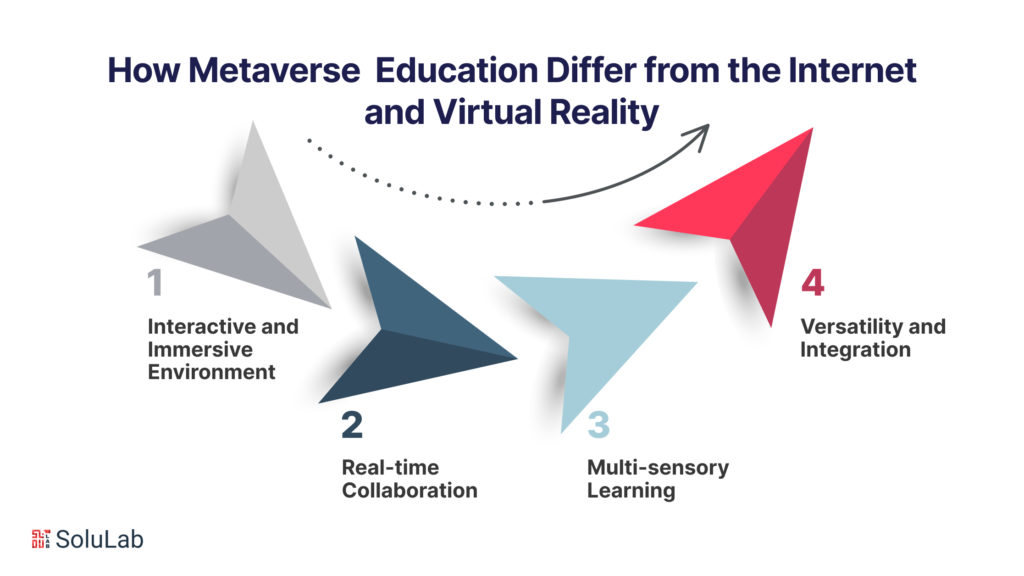
How Does the Metaverse in Education Differ from the Internet and Virtual Reality?

How Does the Metaverse in Education Differ from the Internet and Virtual Reality?

The integration of the Metaverse into education represents a significant departure from both the traditional Internet and virtual reality (VR). The Metaverse creates interactive and immersive environments where students can engage with one another and computer-generated worlds. It goes beyond the traditional internet by offering real-time interactions, socialization, and a sense of presence, similar to in-person experiences. In education, this translates to dynamic, 3D learning spaces and experiences that closely resemble real-world interactions, with the involvement of Metaverse development companies providing cutting-edge technological advancements. While there are similarities, there are also crucial differences that set the Metaverse apart. Let’s explore these distinctions:

Interactive and Immersive Environments

  • Metaverse: The Metaverse creates interactive and immersive environments where students can engage with one another and computer-generated worlds. It goes beyond the traditional internet by offering real-time interactions, socialization, and a sense of presence, similar to in-person experiences. In education, this translates to dynamic, 3D learning spaces and experiences that closely resemble real-world interactions.
  • Internet: The traditional internet primarily offers static web pages and resources. While it supports e-learning platforms, communication tools, and content sharing, the experience is generally two-dimensional and lacks the depth and immersion that the Metaverse provides.
  • Virtual Reality (VR): VR, on the other hand, is immersive but often isolating. It transports users to entirely virtual environments, but these are usually solitary experiences, making collaborative learning and social interaction more challenging.

Real-time Collaboration

  • Metaverse: The Metaverse enables real-time collaboration and communication within a virtual space. In educational settings, this means students and teachers can interact with each other, engage in discussions, and participate in group activities just as they would in a physical classroom.
  • Internet: While the Internet offers communication tools like email, chat, and video conferencing, these are typically separate from the learning content and often asynchronous. They lack the seamless integration and real-time interactivity that the Metaverse provides.
  • Virtual Reality (VR): VR experiences often lack real-time collaboration features, making them less suitable for synchronous group learning, discussions, and teamwork.

Read Also: Top 15 Metaverse Startups

Multi-sensory Learning

  • Metaverse: The Metaverse offers multi-sensory learning experiences by allowing students to engage with content through sight, sound, and sometimes touch. This enhances the retention and understanding of complex subjects.
  • Internet: The Internet primarily relies on text, images, and videos, offering a limited range of sensory input compared to the Metaverse.
  • Virtual Reality (VR): VR provides immersive sensory experiences, primarily focusing on sight and sound. However, it may lack the same depth of interactivity and the social aspects found in the Virtual Reality Metaverse.

Versatility and Integration

  • Metaverse: The Metaverse is versatile, as it integrates various technologies, including AR and VR, to provide a broad range of educational experiences. It supports diverse learning styles and can cater to a wide array of subjects and disciplines.
  • Internet: The Internet relies on external tools and platforms for specific learning needs, making it less seamless for educators and learners.
  • Virtual Reality (VR): VR is specialized for immersive experiences but may not have the same versatility for a wide range of educational applications as the Metaverse.

In brief, the Metaverse in education stands out by offering interactive, immersive, and real-time learning experiences with an emphasis on collaboration and multi-sensory engagement. While the traditional internet and VR have their respective strengths, the Metaverse combines elements of both to create a transformative educational environment that provides students with a truly unique and holistic learning experience.
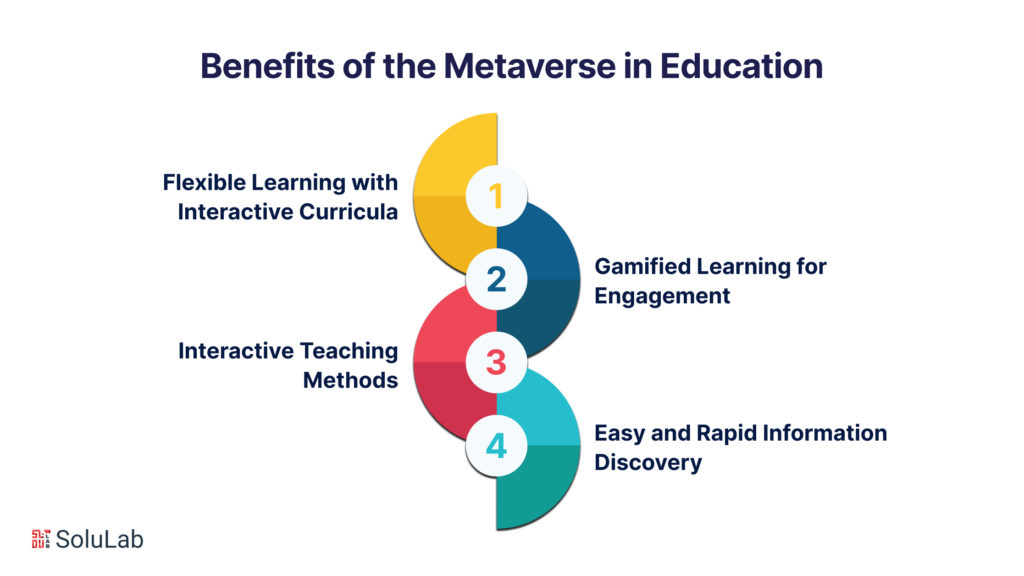
Benefits of the Metaverse in Education

Benefits of the Metaverse in Education

Technology has played a vital role in reshaping education, from virtual cloud-based classrooms and webinars to self-paced learning environments, microlearning applications, and now, with the integration of AR and VR, the introduction of immersive learning experiences. In this section, we’ll focus on the Metaverse’s impact on education and explore its key benefits in the educational sector.

  • Flexible Learning with Interactive Curricula

Explaining concepts interactively in a virtual environment simplifies understanding. For instance, comprehending the solar ecosystem becomes much easier when one can virtually traverse the galaxy, witnessing planet placements and orbits. 

Similarly, understanding rocket launches can be made more accessible by virtually experiencing the process from a space launch station. A virtual 3D classroom setup allows students to observe every detail, from pre-launch preparations to final assembly and technical aspects. Professions demanding practical skills, such as medical surgeries and astrophysics experiments, can be effectively practiced when education converges with the Metaverse.

  • Gamified Learning for Engagement

Gamification keeps learners motivated and engaged. The Metaverse in education can support focused learning by rewarding learners with badges and recognition for completing tasks.

For example, students can explore various geographical areas within the Metaverse to understand their features and environments. They can then create avatars based on the culture of their chosen location and even design the area according to their preferences.

Check Our Blog Post: Metaverse AI: Integrating Artificial Intelligence into Virtual Worlds

  • Interactive Teaching Methods

Effective teaching is essential to making learning interesting. The Metaverse offers numerous opportunities for educators to experiment and engage their students. Realistic social interactions in immersive scenarios enhance collaboration and problem-solving skills. 

Avatars can be used to explain concepts through role-playing techniques, bringing real-life situations into the educational experience. Creating different scenarios within the Metaverse facilitates hands-on, realistic learning experiences.

  • Easy and Rapid Information Discovery

The Metaverse, when used in education, widens access to knowledge. Courses, once created, can be accessed by multiple learners, saving time and resources.

Personalized search results and advanced social collaboration tools enable individualized learning paths that are easily comprehensible and accessible.
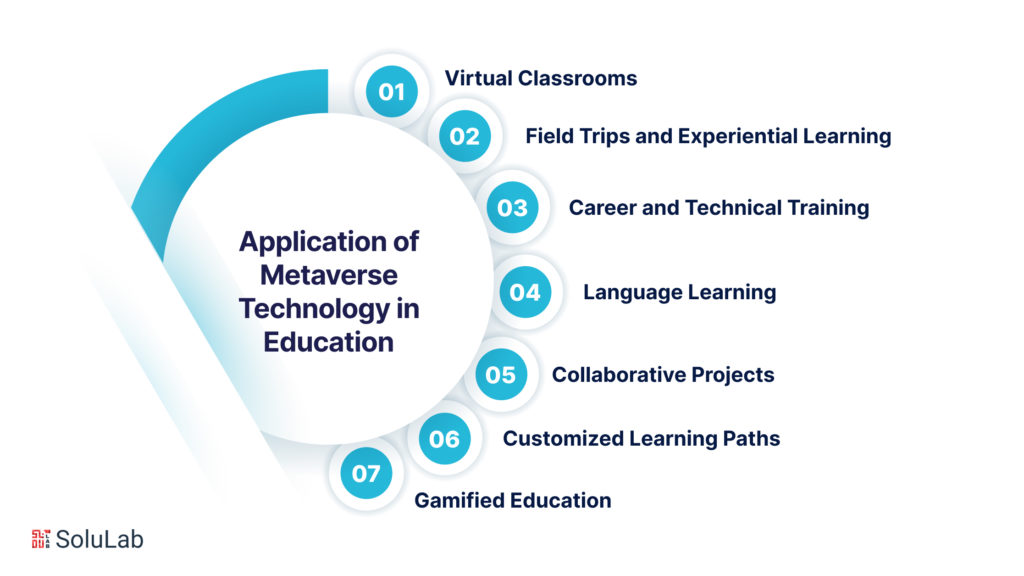
Application of Metaverse Technology in Education

Application of Metaverse Technology in Education

As the Metaverse continues to evolve, it’s making its presence felt in the field of education. With various top Metaverse platforms gaining traction, the possibilities for enhancing the learning experience are growing rapidly. Let’s explore some of the most promising use cases of the Metaverse technology in education.

  • Virtual Classrooms

Metaverse platforms offer an immersive alternative to traditional classrooms. Students and teachers can interact within a virtual environment, attending classes as avatars. This concept brings a new level of engagement, enabling students to explore and interact with the subject matter. Leading platforms such as “Metaverse” and “Decentraland” are increasingly used to create virtual classrooms and lecture halls.

  • Field Trips and Experiential Learning

The Metaverse opens up new horizons for experiential learning. Students can take virtual field trips to historical sites, explore ecosystems, or even journey to outer space. Platforms like “Roblox” and “Minecraft” provide tools for educators to create immersive, educational experiences.

  • Career and Technical Training

Metaverse technology can be particularly beneficial for technical and vocational training. Simulated environments, resembling real-world workplaces, enable students to gain practical experience. For example, medical students can practice surgeries, and aviation students can learn to operate aircraft. Platforms like “Second Life” and “Sansar” have been used to create such training simulations.

Read Also: How Will Metaverse Change the World? A New Era of Connectivity and Innovation!

  • Language Learning

Learning a new language becomes more engaging and effective in the Metaverse. Students can interact with native speakers in virtual environments, participate in role-playing scenarios, and practice language skills in realistic settings. “AltspaceVR” and “VRChat” are platforms that facilitate language exchange and practice.

  • Collaborative Projects

Metaverse platforms foster collaboration among students and educators, no matter where they are located. Group projects, workshops, and discussions become more dynamic and interactive. “High Fidelity” and “Engage” are platforms that promote collaborative learning experiences.

  • Customized Learning Paths

One of the most significant advantages of Metaverse technology is the ability to provide personalized learning experiences. Advanced AI algorithms can tailor educational content and experiences to individual preferences and learning styles. Leading platforms, such as “Facebook Horizon” and “Rec Room,” use Artificial Intelligence (AI) to adapt content to each learner’s unique needs.

  • Gamified Education

Gamification is an effective way to keep students engaged and motivated. The Metaverse supports the integration of gamification elements, offering rewards, badges, and competitive elements to encourage active learning. “VRChat” and “Mozilla Hubs” enable the gamification of educational content.

Incorporating Metaverse technology in education is a game-changer, offering a wide array of opportunities for creating immersive, engaging, and personalized learning experiences. As the Metaverse continues to expand and innovate, we can expect even more creative applications that revolutionize the way we teach and learn. These top Metaverse platforms, each with its unique features and capabilities, are at the forefront of this educational transformation.
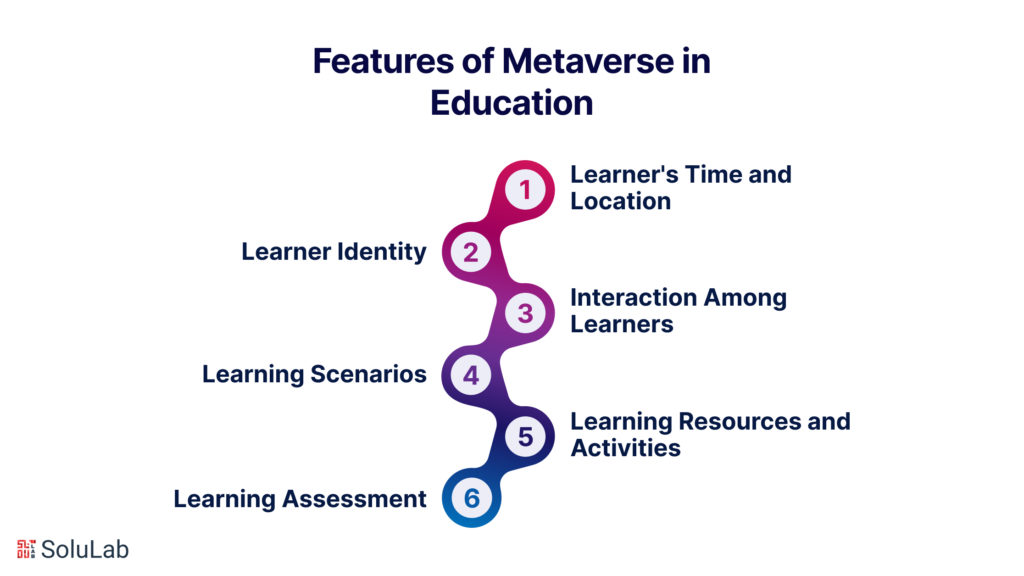
Features of Metaverse in Education

Features of Metaverse in Education

We have been emphasizing that Metaverse learning represents a distinct world offering experiences similar to the real world. However, there are key differences when comparing it to conventional classroom settings and remote learning. Let’s delve into these distinctions.

Learner’s Time and Location

  • Traditional learning necessitates both teacher and learner to be physically present at the same time and location. Remote learning provides flexibility in learning from different places, but it doesn’t grant the same flexibility regarding time for learners and teachers.
  • In contrast, the Metaverse offers complete flexibility. Learners can engage from anywhere, at any time, using smart wearable devices and robust internet connectivity. This empowers teachers to innovate teaching methods for both synchronous and asynchronous learning.

Learner Identity

  • Conventional and screen-based classrooms can only identify learners based on their real identities, limiting the scope for creative expression.
  • The Metaverse allows individuals to create avatars, representing themselves in imaginative, immersive ways, irrespective of background, race, or appearance.

Read Our Blog: Metaverse NFT – Foundation Of Next Blockchain Revolution!

Interaction Among Learners

  • In a traditional classroom, learners interact with teachers and peers in person, which can be challenging in remote or screen-based learning, leading to social isolation and limitations in collaboration.
  • The Metaverse overcomes these limitations by enabling learner avatars to interact with teacher and peer avatars, facilitating real-time feedback, socialization, expert assistance in concept comprehension, personalized support, and more.

Learning Scenarios

  • Conventional learning environments provide limited practical learning opportunities, such as labs and role-playing.
  • Screen-based learning primarily supports theoretical learning methods, lacking the engagement of hands-on experiences.
  • In contrast, the Metaverse can create realistic scenarios, allowing learners to actively participate in real-world situations, and providing practical and safe learning environments.

Learning Resources and Activities

  • Conventional and screen-based learning often rely on static learning materials like textbooks, images, videos, and similar resources.
  • The Metaverse equips learners with dynamic learning scenarios, offering the resources required to create and learn through hands-on activities and participation.

Check Our Blog Post: Metaverse Use Cases and Benefits
Learning Assessment

  • Conventional and screen-based learning frequently rely on summative assessments in the form of tests and scores, making real-time, impactful feedback a challenge.
  • The Metaverse in education facilitates both formative and summative assessments through learning analytics, providing comprehensive assessments and immediate feedback, thus contributing to more effective learner growth.

Future Trends and Developments of Metaverse in Education

Future Trends and Developments of Metaverse in Education

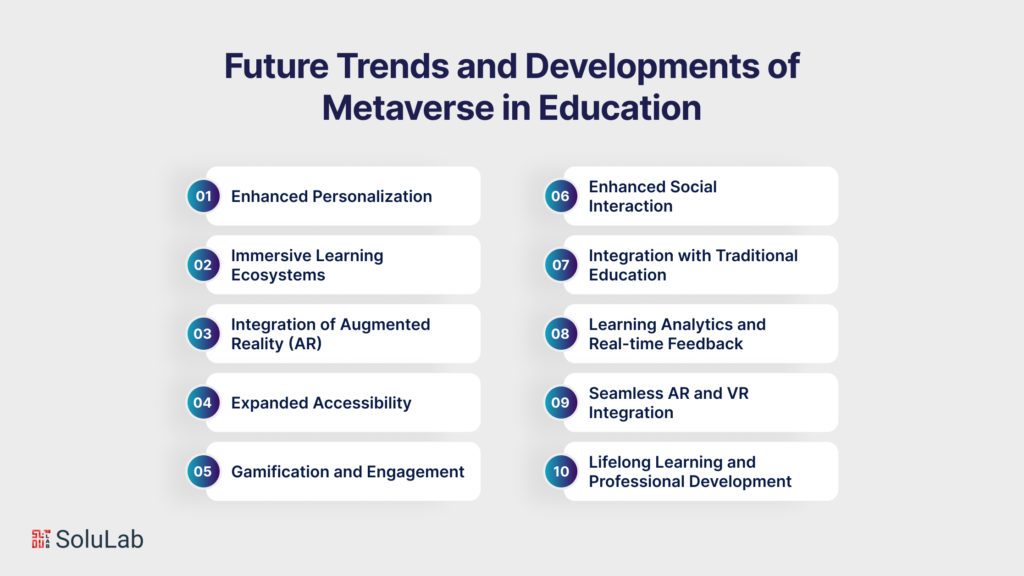
As the Metaverse continues to gain prominence in education, it’s essential to look ahead at the future-based developments that promise to reshape the landscape further. Let’s explore the potential trends, with a focus on the integration of augmented reality (AR) and the evolution of virtual reality and augmented reality in education.

  • Enhanced Personalization

Future Metaverse applications in education will prioritize even greater personalization. Advanced AI algorithms will adapt content to the specific needs, preferences, and learning styles of individual students, providing tailored educational experiences.

  • Immersive Learning Ecosystems

The Metaverse will increasingly become an immersive learning ecosystem. It will encompass a wide range of educational content, resources, and activities, enabling students to explore, interact, and learn in virtual environments.

  • Integration of Augmented Reality (AR)

AR technology will play a pivotal role in the Metaverse’s educational future. AR devices will seamlessly blend digital content with the real world, enabling students to access information, engage in interactive learning, and gain real-time insights through smart glasses or augmented reality applications.

  • Expanded Accessibility

The Metaverse will bridge geographical and socioeconomic gaps in education. It will provide access to high-quality educational experiences, connecting students and educators worldwide. The use of low-cost devices and platforms will make the Metaverse accessible to a broader audience.

Read Our Blog: Tech Stack of a Metaverse Developer

  • Gamification and Engagement

Gamification will continue to be a significant trend, making learning more engaging and interactive. Virtual badges, achievements, and competitive elements will motivate students to remain focused and complete educational tasks in the Metaverse.

  • Enhanced Social Interaction

Future Metaverse platforms will focus on further enhancing social interaction in virtual spaces. Students will collaborate, communicate, and learn with peers from diverse backgrounds, fostering cross-cultural interactions and global perspectives.

  • Integration with Traditional Education

The future of the Metaverse in education will involve greater integration with traditional educational institutions. Universities, schools, and training centers will incorporate Metaverse technologies into their curricula, offering blended learning experiences.

Read Also: Web 3 vs Metaverse: What’s The Difference

  • Learning Analytics and Real-time Feedback

Advanced learning analytics tools will provide in-depth insights into student progress. Educators can track student performance, identify areas for improvement, and provide real-time feedback to enhance the learning experience.

  • Seamless AR and VR Integration

The lines between virtual reality (VR) and augmented reality (AR) will blur as they converge into Mixed Reality (MR). This integration will allow for more seamless transitions between fully immersive virtual environments (VR) and augmented real-world experiences (AR).

  • Lifelong Learning and Professional Development

Metaverse technology will extend beyond K-12 and higher education, offering a platform for lifelong learning and continuous professional development. Professionals in various fields can engage in immersive training and skill development experiences.

Thus, the future based on Metaverse in Education is bright and dynamic. It will offer unparalleled personalization, immersive learning environments, and seamless integration of Augmented Reality (AR) and VR technologies. These trends will not only transform how we teach and learn but also open up new horizons for education in the digital age. As the Metaverse evolves, educators, students, and institutions must adapt to harness its full potential for the betterment of education worldwide.

CTA2

Conclusion

The Metaverse is on the verge of revolutionizing education and learning, offering a rich tapestry of opportunities for students and educators alike. As we’ve explored throughout this blog, the Metaverse provides immersive, interactive, and personalized learning experiences that surpass what the traditional internet and virtual reality can offer. The potential for bridging geographical divides, enhancing collaboration, and providing multi-sensory education is a tantalizing prospect. However, it’s not without its challenges. Privacy concerns, equitable access, and integration with traditional education systems must be carefully addressed as we journey into this new frontier. As we step into the Metaverse’s educational realm, the key to its success lies in collaboration, innovation, and the dedication of Metaverse development companies to shape the future of education.

SoluLab, a leading Metaverse development company, plays a pivotal role in crafting the future of the Metaverse. With expertise in a multitude of technologies, SoluLab is also a renowned Metaverse game development company that can bring your immersive experiences to life. We offer the capability to hire Metaverse developers who are dedicated to shaping your vision, ensuring that your Metaverse projects are built to the highest standards. Our comprehensive range of Metaverse development services encompasses design, development, and deployment, making them a one-stop solution for all your Metaverse needs. SoluLab is committed to pushing the boundaries of innovation in the Metaverse and continues to lead the way in creating transformative educational experiences.

FAQs

1. What is the Metaverse, and how can it benefit education?

The Metaverse is a virtual, interconnected universe that offers immersive, interactive learning experiences. It benefits education by providing personalized, multi-sensory, and real-time collaborative learning, transcending traditional Internet and VR limitations. SoluLab, a leading Metaverse Development Company, helps in realizing the potential of the Metaverse for education by offering innovative solutions and experiences.

2. What are the challenges of integrating the Metaverse into education?

Challenges include privacy concerns, equitable access, and the integration of the Metaverse with traditional education systems. SoluLab, as an experienced Metaverse Development Company, addresses these challenges by developing secure and accessible solutions that seamlessly blend with existing educational structures.

3. How can I hire dedicated Metaverse developers for my educational project?

SoluLab offers the opportunity to hire Metaverse developers who are experts in Metaverse development. They can work on your educational project, ensuring that it meets your unique requirements and delivers the desired learning experiences.

4. Can the Metaverse be used for creating educational games?

Yes, the Metaverse is an ideal platform for creating immersive educational games. SoluLab, a Metaverse game development company, specializes in designing and developing educational games that engage students and enhance learning.

5. What services does SoluLab offer for Metaverse development in education?

SoluLab provides a wide range of Metaverse development services, including design, development, and deployment. We create customized Metaverse solutions for educational institutions, ensuring that students and educators can make the most of this innovative technology.

How Will Metaverse Change the World? A New Era of Connectivity and Innovation!

How Will Metaverse Change the World? A New Era of Connectivity and Innovation!How Will Metaverse Change the World? A New Era of Connectivity and Innovation!

The metaverse, once confined to the realms of science fiction and video games, is now a burgeoning digital landscape that has the potential to reshape our world in profound ways. It promises to create a new era of connectivity and innovation, bridging the gap between the physical and digital realms.

Imagine a universe where reality and virtuality coalesce seamlessly, where individuals from disparate corners of the globe can gather in a shared digital space, and where the boundaries between the physical and the digital blur into insignificance. This is the promise of the metaverse for business, a multifaceted digital realm where augmented reality (AR) and virtual reality (VR) converge, creating a communal landscape where individuals and businesses can interact, collaborate, and innovate in ways hitherto unimaginable.

The metaverse is not merely a technological leap; it is a paradigm shift, a transformative force with the potential to reshape industries, societies, and human interaction itself. In this blog post, we embark on a journey to unravel the profound ways in which the metaverse is set to change the world as we know it.

Read Our Blog Post: 10 Real-World Use Cases of the Metaverse in 2023

Breaking Down the Metaverse

Let’s start by unraveling the metaverse, breaking it down into simpler parts to understand what it really is.

Imagine the metaverse as a giant digital playground. It’s a place where technology combines the real world with make-believe in a super cool way. When you put on special glasses or use certain gadgets, you can step into this digital playground and feel like you’re in a different world, even though you’re still in your own room.

This digital playground isn’t just about having fun, though. It’s a space where you can meet and hang out with people from all over the world, just like meeting friends at a park. But here, you can do it from your computer or a special device. You can chat, play games, or even work together as if you were all in the same place, even if you’re actually miles apart.

So, in simple terms, the metaverse is like a magical digital world where you can play, chat, and work with others, and it’s all made possible by some very clever technology!

The Metaverse Mechanics

The Metaverse Mechanics

To fully grasp the transformative potential of the metaverse solutions, it’s essential to delve into its mechanics—the intricate inner workings that make this digital wonderland possible. At its core, the metaverse is a blend of augmented reality (AR) and virtual reality (VR) technologies, creating a unique space where the digital and physical realms converge seamlessly.

AR and VR: The Building Blocks

The metaverse draws its strength from the symbiotic relationship between AR and VR. These two technologies, while distinct, work together to craft the immersive experiences that define the metaverse.

  • Augmented Reality (AR): AR enhances our real-world environment by overlaying digital information or objects onto it. This technology can be experienced through devices like smartphones or AR glasses. In the metaverse technology, AR provides a bridge between the physical and digital worlds, enriching our surroundings with interactive elements and information.
  • Virtual Reality (VR): VR, on the other hand, transports users entirely into a digital realm. With VR headsets, users are immersed in a computer-generated environment, shutting out the physical world. Metaverse technology employs VR to create entirely new, digital spaces where users can interact with each other and digital objects, just as they would in the physical world.

Read Also: Everything You Need to Know About Metaverse NFT Marketplace Development

Creating the Illusion of Presence

The magic of the metaverse development lies in its ability to make users feel present in a digital environment. This sensation, known as “presence,” is achieved through a combination of advanced technologies:

  • Sensory Engagement: VR headsets immerse users by providing a 3D visual experience and surround sound, effectively replacing their real-world sensory inputs with digital ones.
  • Interactivity: The metaverse allows users to interact with the environment and with each other. This interactivity creates a sense of agency and engagement, reinforcing the feeling of being truly “there.”
  • Haptic Feedback: Some metaverse solutions experiences incorporate haptic feedback devices that simulate touch sensations, enhancing immersion by enabling users to “feel” virtual objects.

CTA1

Connecting the Digital Dots

To create a cohesive metaverse experience, a vast digital landscape is necessary. This landscape is composed of interconnected virtual spaces or worlds, akin to various rooms in a massive digital mansion.

  • Metaverse Platforms: Companies and developers are building metaverse platforms, which serve as the foundation for these interconnected virtual spaces. Examples include the “metaverse within the metaverse” in popular video games like Fortnite or dedicated metaverse platforms like Facebook’s Horizon Workrooms.
  • User Avatars: In the metaverse, users typically represent themselves with digital avatars. These avatars can range from lifelike representations to fantastical creations, allowing for self-expression and personalization.

Understanding these metaverse mechanics helps us appreciate the technology’s potential to create a new realm where the boundaries between the tangible and the virtual dissolve. As we explore the transformative power of the metaverse, we’ll see how these mechanics enable the creation of unique and innovative experiences that promise to change the world as we know it.

Read Also: Top 10 Metaverse Development Companies in 2023

How Will Metaverse Change the World?

How Will Metaverse Change the World?

The Metaverse developers have the potential to bring about profound changes to our world across various aspects of life. While it’s impossible to predict the future with certainty, here are some ways in which the metaverse could change the world:

1. Enhance Education

The metaverse holds tremendous potential to revolutionize education. In a traditional classroom, students are limited by physical space and resources. However, within the metaverse, education takes on a new dimension. Students can immerse themselves in interactive, three-dimensional learning experiences that make subjects come alive.

Virtual classrooms are not limited by geographical boundaries. Students from different parts of the world can participate in shared virtual learning spaces, fostering cross-cultural exchanges and global collaboration. This has the potential to break down educational disparities and provide all students with access to high-quality educational experiences.

Read Our Blog: Metaverse AI: Integrating Artificial Intelligence into Virtual Worlds

Furthermore, metaverse technology can accommodate various educational needs, including special education and personalized learning. Virtual environments can be tailored to individual students’ preferences, offering a level of flexibility and adaptability that traditional education systems struggle to provide.

In short, the metaverse has the power to transform education by making it more immersive, interactive, and accessible to a global audience. It can transcend the limitations of physical classrooms and offer innovative learning experiences that cater to the needs of diverse students.

2. Reduce Crime Rates

The potential for the metaverse development company to reduce crime rates lies in its ability to serve as a training ground for law enforcement agencies and offer new avenues for crime prevention.

Law enforcement agencies can use the metaverse development guide to create realistic training scenarios for police officers, detectives, and first responders. These simulations can range from active shooter situations to cybercrime investigations. By practicing in these virtual environments, law enforcement personnel can hone their skills and make better decisions in high-pressure situations.

Additionally, the metaverse services can be employed for crime scene reconstruction. Investigators can recreate crime scenes in virtual space, allowing for a more detailed analysis of evidence and potential scenarios. This can lead to more accurate and efficient investigations.

Moreover, the metaverse can serve as a platform for rehabilitation and reintegration programs for offenders. Virtual environments can offer controlled spaces where individuals can learn new skills, access educational resources, and receive counseling. These programs aim to reduce recidivism rates by addressing the root causes of criminal behavior.

3. Travel and Connection Through the Metaverse

The metaverse promises to redefine the way we travel and connect with others, transcending the limitations of physical space and distance. In this immersive digital realm, users can traverse the globe, attend events, and establish connections in ways previously unimaginable.

Virtual travel in the metaverse technology has the potential to foster cross-cultural understanding. Users can engage with locals, explore cultural landmarks, and partake in virtual events and festivals. This not only broadens horizons but also reduces the carbon footprint associated with physical travel, contributing to sustainable tourism practices.

Moreover, the metaverse facilitates global connectivity on a scale previously unmatched. Users from diverse backgrounds and geographical locations can come together in shared digital spaces, breaking down barriers to communication and collaboration. Whether it’s attending a virtual conference with industry experts, participating in a global art exhibition, or simply socializing with friends from different continents, the metaverse enables connections that transcend physical borders.

This newfound connectivity has profound implications for business, education, and social interactions. It opens doors to global collaborations, cross-cultural exchanges, and diverse perspectives, enhancing creativity and innovation.

Read Our Blog Post: Tech Stack of a Metaverse Developer

4. Reshape the Global Economics and Business

The metaverse development is poised to have a profound impact on the global economy, ushering in a new era of economic activity and innovation. This digital frontier represents a convergence of technology, commerce, and human interaction, offering opportunities for businesses and individuals alike.

One of the most significant ways the metaverse will reshape the global economy is through the creation of virtual economies. Within these virtual realms, users can buy, sell, and trade digital assets, including virtual real estate, unique collectibles, and virtual currencies. These digital economies have already begun to emerge in the gaming industry, where virtual goods and assets are bought and sold for real-world currency. As the metaverse expands, these economies will diversify and extend beyond gaming, creating new opportunities for entrepreneurship and investment.

Furthermore, the metaverse will foster the development of new industries and job opportunities. Virtual architects, designers, content creators, and developers will be in high demand as the metaverse continues to expand. This shift in employment opportunities could have far-reaching implications for the global job market, with individuals from various backgrounds finding opportunities in this digital landscape.

Thus, the metaverse is set to reshape the global economy by creating virtual economies, enabling businesses to thrive in digital storefronts, and opening new avenues for job creation. As this transformation unfolds, it will be essential to strike a balance between fostering innovation and addressing the regulatory and ethical considerations that come with this new economic frontier.

5. Revolutionize Online Shopping 

The metaverse is set to revolutionize online shopping, presenting consumers with a completely immersive and novel approach to browsing and buying products and services. This evolution in e-commerce promises to revolutionize the way we shop, bridging the gap between physical and digital retail experiences.

In the metaverse technology, traditional e-commerce websites give way to virtual malls, boutiques, and showrooms. Shoppers can create personalized avatars, representing themselves in these digital spaces. These avatars can try on digital clothing, and accessories, and even test out virtual versions of products, providing an interactive and personalized shopping experience.

One of the key advantages of metaverse-based online shopping is the ability to inspect products in 3D. Shoppers can view products from all angles, zoom in to examine fine details, and even interact with them before making a purchase decision. This level of engagement enhances the online shopping experience and reduces uncertainties about the product’s appearance or functionality.

Read Also: 5 Ways To Develop A Metaverse Digital Real Estate

Moreover, the metaverse enables a social aspect of shopping. Friends and family can join you in virtual shopping trips, offering advice and opinions just as they would during a physical shopping excursion. These shared shopping experiences add a layer of interactivity and connection to the process, making it more enjoyable and sociable.

6. The Demise of the 2D Internet

The metaverse promises to reshape the internet as we know it, marking the gradual transition from a predominantly 2D online environment to a multidimensional, immersive digital realm. This transformation holds the potential to redefine how we navigate and interact with digital information, content, and services.

Traditional internet experiences are rooted in two-dimensional web pages and applications. Users navigate through static pages and interact with text, images, and videos. While this format has served us well for decades, the metaverse introduces a paradigm shift.

Within the metaverse, web pages and apps are replaced by immersive, three-dimensional virtual spaces. Instead of clicking links, users traverse digital landscapes, exploring virtual environments that represent websites, businesses, and digital services. These immersive spaces offer richer and more interactive content, allowing users to engage with information and media in a more dynamic and intuitive manner.

This shift brings a new level of interactivity to online experiences. Users can explore virtual representations of physical locations, such as art galleries or educational institutions as if they were physically present. Information is no longer static; it can be presented in 3D, making data visualization, educational content, and product presentations more engaging and informative.

Read Our Blog: Top 15 Metaverse Startups to Watch out in 2023

7. The Evolution of Work in a Digital Era

The digital age is ushering in a profound transformation in the way we work, and the metaverse is at the forefront of this evolution. As businesses and employees adapt to this new digital landscape, the future of work is undergoing a radical shift, marked by remote collaboration, innovative technologies, and global connectivity.

One of the most notable changes in the future of work is the evolution of remote collaboration. 

The metaverse is redefining traditional office spaces by offering virtual workplaces where teams can meet and interact seamlessly. These digital workspaces replicate the physical office experience, enabling colleagues to collaborate, brainstorm, and share ideas in real-time, irrespective of their geographical locations. This transition to virtual collaboration brings about greater flexibility and the potential for more diverse, globally distributed teams.

Meetings and conferences are also evolving in this digital era. Instead of conventional video calls, professionals may gather in immersive virtual spaces. Whether it’s a digital boardroom, a virtual summit on a tropical island, or a high-tech space station, these virtual meetings enhance engagement and make long-distance collaboration more dynamic and effective.

Moreover, the metaverse is blurring the boundaries between professional and personal life. Virtual workspaces can be customized to cater to individual preferences, promoting a comfortable and productive work environment. Employees can seamlessly transition between work-related tasks and personal activities within the metaverse, offering a new level of work-life balance.

Read Our Blog Post: Metaverse Use Cases and Benefits

8. Impact on Mental Well-Being

As we navigate the digital era, characterized by the rise of technologies like the metaverse, the effects on mental health are coming to the forefront. While technology offers numerous benefits, it also presents challenges and potential implications for our well-being.

One of the key considerations regarding the impact of the digital era on mental health is the potential for increased screen time and digital addiction. As we immerse ourselves in virtual environments, whether for work, socializing, or entertainment, the line between the digital and physical worlds can blur. Prolonged screen time may lead to issues such as digital eye strain, disrupted sleep patterns, and a sense of detachment from reality.

The metaverse, with its immersive experiences and persistent virtual presence, could exacerbate these challenges. Users may find themselves spending extended periods in digital spaces, potentially leading to feelings of isolation, anxiety, or depression. It is essential to strike a balance between the digital and physical worlds to maintain mental well-being.

Moreover, the metaverse introduces new dynamics in social interactions. While it offers opportunities for connection, it also raises concerns about the authenticity of these interactions. Social media and virtual environments may lead to social comparison, self-esteem issues, and a heightened sense of online identity, which can impact mental health negatively. The digital era, including the metaverse, presents both opportunities and challenges for mental health. Awareness, proactive measures, and ethical considerations are essential in ensuring that technology enhances rather than detracts from our well-being in this evolving digital landscape.

CTA2

Conclusion

In conclusion, the metaverse technology is heralding a new era of connectivity and innovation that promises to reshape our world in profound ways. It represents a digital frontier where the boundaries between the physical and digital realms blur, fostering connections, collaborations, and experiences that were once unimaginable. From enhancing education and redefining work to revolutionizing industries like entertainment and e-commerce, the metaverse is a transformative force with vast potential.

As we step into this digital wonderland, it is essential to navigate its opportunities and challenges with a thoughtful and ethical approach. Safeguarding privacy, addressing digital inequalities, and promoting responsible digital citizenship will be paramount. The metaverse is not just about technology; it’s about how we choose to harness it to create a better, more connected world. With the right balance of innovation and responsibility, the metaverse has the potential to change the world in ways that benefit us all, ushering in an era where the digital and physical coexist harmoniously.

As the metaverse continues to evolve, businesses and individuals will seek trusted partners to navigate this transformative landscape. SoluLab, recognized as the best metaverse development company, offers its expertise in cutting-edge technologies and can be your reliable partner. With a proven track record of innovation and a deep understanding of emerging digital trends, SoluLab is well-equipped to assist businesses in harnessing the power of the metaverse. Whether it’s developing immersive metaverse experiences, ensuring data security and privacy, or creating bespoke virtual solutions, SoluLab’s commitment to excellence makes it a valuable resource in this new era of connectivity and innovation. Feel free to reach out to SoluLab for expert guidance. When you’re ready to take action and hire top metaverse developers, you’ll unlock the full potential of the metaverse, shaping a brighter, more connected future.

FAQs

1. What is the Metaverse?

The Metaverse is a collective virtual shared space that encompasses augmented and virtual reality environments. It’s a digital universe where users can interact with each other, digital objects, and computer-generated environments. It offers a multidimensional, immersive experience that goes beyond the traditional internet.

2. How will the Metaverse impact education?

The Metaverse has the potential to revolutionize education by offering immersive and interactive learning experiences. Students can explore historical events, conduct experiments, and collaborate with classmates worldwide in virtual classrooms, making education more engaging and accessible.

3. What are the implications of the Metaverse on mental health?

Spending significant time in virtual environments may have mental health implications, including digital addiction, isolation, and blurred lines between virtual and real worlds. It’s crucial to practice digital wellness and strike a balance between digital and physical life.

4. How will the Metaverse change the way we work?

The Metaverse is reshaping the future of work by enabling remote collaboration in virtual offices and redefining meetings with immersive digital experiences. It offers greater flexibility in work environments but also raises questions about data security and privacy.

5. What role does SoluLab play in the Metaverse?

SoluLab is a technology partner well-equipped to assist businesses in navigating the metaverse. With expertise in emerging digital trends, SoluLab can help develop immersive metaverse experiences, ensure data security, and create custom virtual solutions, enabling businesses to harness the power of this transformative digital landscape.

10 Real-World Use Cases of the Metaverse in 2025

Internet technology is always evolving and providing consumers with amazing options. We have all seen the power of digital progress, from utilizing static webpages to interacting with Web 2 experiences. The next step in this progression is the Metaverse. The original Metaverse idea, which Neal Stephenson conceived in 1992, has been updated with the help of IT specialists from all across the world. The phrase was first used by him in a science-fiction book, and it is now commonplace in modern technology.

The idea of the Metaverse technology has been around for more than ten years, but it has recently gained popularity due to announcements of similar initiatives from major corporations like Facebook and Microsoft. As more individuals become aware of this permanent shared virtual world’s intriguing possibilities, the excitement surrounding it intensifies. The metaverse platforms gained popularity amid the recent epidemic when individuals tended to avoid face-to-face connection, businesses embraced remote working rules, and digital communication methods were widely used. People were interested in learning more about the Metaverse and its uses as a result of its emergence.

Both controlled and decentralized metaverses may be created by businesses. But now that other businesses are already reaping the rewards of blockchain technology, there is a greater need for a blockchain-based Metaverse. Blockchain technology is also required for Metaverse development, as the web’s future is decentralized. As a result, blockchain use cases such as NFTs and cryptocurrencies will have a greater influence than they do now. For a more in-depth assessment of Metaverse’s value, this blog will look at the top 10 real-world use cases of the Metaverse in 2025.

Read Our Blog: Building Worlds Beyond Reality: A Guide to Metaverse Development

What is Metaverse Technology?

Metaverse technology represents a groundbreaking evolution in the way we interact with digital spaces and one another. Essentially, it’s a collective virtual shared universe that encompasses multiple interconnected virtual and augmented reality environments. In 2025, the Metaverse is rapidly moving from a science fiction concept to a tangible reality with profound real-world use cases.

One of the most prominent applications of the Metaverse development is in the realm of remote work and collaboration. As businesses continue to adapt to hybrid and remote work models, the Metaverse provides a platform for immersive and dynamic virtual meetings, conferences, and collaboration spaces. Instead of flat video calls, employees can gather in 3D virtual environments, enhancing communication and fostering a stronger sense of presence.

Furthermore, the Metaverse is transforming education by offering immersive and interactive learning experiences. Instructors can conduct classes in virtual classrooms, museums, or historical simulations, making learning engaging and accessible to a global audience. Students can explore historical events, conduct virtual experiments, and interact with classmates and teachers as if they were physically present. Overall, the Metaverse is poised to revolutionize the way we work, learn, socialize, and entertain ourselves in 2025 and beyond.

Why Does Metaverse Matter in 2025?

In 2025, the Metaverse stands at the crossroads of our digital future, poised to redefine our relationship with technology and the virtual world. It represents the culmination of years of technological advancements, merging augmented and virtual reality, blockchain, artificial intelligence, and social connectivity into a cohesive digital tapestry. The significance of the Metaverse in 2025 cannot be overstated, as it represents a seismic shift in how we perceive, interact with, and leverage the digital landscape.

Read Our Blog: Tech Stack of a Metaverse Developer

Metaverse services offer an immersive, interconnected, and experiential realm where the boundaries between the physical and the digital blur. It’s a space where individuals can traverse a myriad of virtual environments, socialize, work, learn, and entertain themselves in ways that were once confined to the realm of science fiction. In this section, we’ll explore why the Metaverse matters in 2025 and how its transformation can impact our lives and society at large!

  • Digital Evolution: In 2025, the Metaverse marks a significant leap in our digital evolution. It represents a convergence of augmented and virtual reality, blockchain technology, and social connectivity, creating a seamless and immersive online environment. This evolution opens up new possibilities for human-computer interaction and digital experiences.
  • Reshaping the Workplace: As remote and hybrid work models become the norm, the Metaverse is redefining the workplace. It provides a platform for more engaging and productive remote collaboration, offering virtual office spaces, interactive meetings, and training environments that transcend the limitations of traditional video conferencing.
  • Educational Innovation: The Metaverse is revolutionizing education. It offers immersive learning experiences that appeal to students of all ages. Whether exploring historical events, conducting virtual science experiments, or attending virtual classes, the Metaverse is making education more accessible, engaging, and adaptable to individual needs.
  • Entertainment Hub: 2025 sees the Metaverse as an entertainment hub like no other. It blurs the lines between gaming, social media, and digital events. Users can attend concerts, explore virtual theme parks, or participate in interactive storytelling experiences, making entertainment more interactive and social.
  • Economic Opportunities: The Metaverse is creating an entirely new digital economy. Virtual real estate, digital assets, and Metaverse-based businesses are booming. Entrepreneurs, content creators, and investors are exploring this landscape, offering economic opportunities that extend beyond traditional online commerce.

The Top 10 Real-World Use Cases of the Metaverse in 2025

The concept of the Metaverse is all-encompassing, with its reach extending to numerous industries, including education, gaming, tourism, healthcare, and more. So, let’s delve into some essential Metaverse use cases that have widespread relevance across various sectors in 2025:

  • Gaming

Gaming is at the forefront of Metaverse examples in 2025. The Metaverse offers gamers an unprecedented level of immersion and interaction. Players can seamlessly traverse interconnected virtual worlds, share experiences with friends, and even monetize their in-game achievements. 

Read Also:  Metaverse NFT Marketplace Development

Game developers are leveraging the Metaverse to create expansive and persistent virtual realms that provide players with endless adventures and social interactions. This enhances not only the gaming experience but also opens up new revenue streams through virtual item sales and in-game advertising. As the Metaverse continues to evolve, gaming is set to become even more dynamic, social, and profitable.

  • Travel and Tourism

In 2025, the travel and tourism industry is undergoing a Metaverse-driven revolution. Travelers can now explore virtual replicas of destinations before making bookings, providing a more informed and engaging trip-planning process. Virtual tourism experiences enable individuals to visit exotic locations, historical sites, or cultural events from the comfort of their homes, making travel accessible to those with physical limitations or budget constraints. 

Virtual travel agents and concierge services have emerged, offering personalized recommendations and immersive travel experiences, reshaping the way we explore the world in the digital age. The Metaverse is transforming the very essence of travel, making it more inclusive, informative, and enjoyable.

  • Private Digital Space

Private digital spaces are becoming increasingly important in 2025, as individuals seek secure and personalized environments within the Metaverse development services. These spaces offer users a sanctuary where they can control access to their data, engage in confidential conversations, and host private gatherings. 

From secure virtual boardrooms for sensitive corporate discussions to private VR chat rooms for personal interactions, the Metaverse empowers users to curate their digital surroundings in a way that prioritizes privacy and security. This development ensures that users can enjoy the benefits of the Metaverse while safeguarding their personal and sensitive information.

CTA1

  • Real Estate

The real estate industry is undergoing a transformative shift in 2025 thanks to the Metaverse. Virtual property tours and immersive 3D property showcases are now standard practices, allowing potential buyers and renters to explore properties from anywhere in the world. 

Real estate developers are also investing in virtual real estate within the Metaverse, creating digital properties that can be bought, sold, and developed. This not only expands investment opportunities but also blurs the line between physical and virtual property ownership. The Metaverse is redefining the way we buy, sell, and experience real estate, making it a dynamic and innovative sector to watch.

Read Our Blog Post: Metaverse NFT – Foundation Of Next Blockchain Revolution!

  • Industry and Manufacturing

In the realm of industry and manufacturing, the Metaverse is streamlining operations and enhancing efficiency. Manufacturers are using virtual simulations and digital twins within the Metaverse to optimize production processes, reduce waste, and identify potential issues before they occur in the physical world. 

Additionally, remote monitoring and maintenance of industrial equipment have become more accessible through Metaverse-powered interfaces, reducing downtime and improving overall productivity. The Metaverse ecosystem is revolutionizing how industries operate, making them more agile, cost-effective, and environmentally sustainable.

  • Banking and Finance

The banking and finance sector in 2025 is leveraging the Metaverse applications to provide innovative financial services. Virtual banks and blockchain-powered financial platforms are enabling secure and efficient digital transactions within the Metaverse. Users can manage their digital assets, conduct cross-border transactions, and explore investment opportunities within a seamless virtual financial ecosystem. 

The Metaverse also enhances financial education through immersive simulations, enabling users to make informed investment decisions. As the Metaverse continues to evolve, it promises to democratize access to financial services and redefine the way we interact with money.

  • Healthcare

In the field of healthcare, the best Metaverse experiences are revolutionizing patient care and medical training. Telemedicine has reached new heights, with doctors and patients meeting in virtual clinics for consultations, diagnosis, and treatment. Medical practitioners are also using the Metaverse for training and simulation, allowing healthcare professionals to practice surgical procedures and emergency responses in a risk-free environment. 

Furthermore, patient data management and privacy are enhanced through secure virtual healthcare records. The Metaverse applications in business are making healthcare more accessible, efficient, and safe, transforming the way we receive and deliver medical services.

  • Social Media

Social media platforms have embraced the Metaverse in 2025 to provide users with immersive and interactive experiences. Users can create personalized avatars, socialize in virtual spaces, and attend virtual events and concerts. The Metaverse projects blur the lines between different social media networks, allowing users to seamlessly connect with friends and followers across various platforms. 

It also introduces new monetization opportunities for content creators, who can host virtual meet-and-greets, sell virtual merchandise, and engage with their audiences in innovative ways. The Metaverse is redefining social media as a dynamic and immersive space for both personal connections and professional engagement.

  • Remote Working

Remote working has been transformed by the Metaverse development in 2025. Virtual offices, meeting spaces, and collaborative environments are now the norm. Instead of conventional video calls, employees can meet in 3D virtual spaces, enhancing communication and fostering a stronger sense of presence. 

The Metaverse also enables employees to create customizable digital workstations and collaborate on projects in real-time, regardless of their physical location. This evolution has not only made remote work more engaging but has also improved productivity and work-life balance.

  • Education and Learning

Education is experiencing a profound transformation in 2025, thanks to the Metaverse technology. Virtual classrooms, immersive historical simulations, and interactive learning experiences are now commonplace. Students can explore diverse subjects through virtual field trips, conduct science experiments in digital laboratories, and engage with peers and instructors in lifelike virtual environments. 

This approach not only enhances learning engagement but also makes education more accessible to a global audience, regardless of geographical limitations. The Metaverse is reshaping the future of education by providing students and educators with powerful tools for interactive and personalized learning experiences.

Benefits of Metaverse Technology

Benefits of Metaverse Technology

In recent years, the concept of the Metaverse has gained significant traction, and it’s not just confined to the realm of science fiction anymore. The Metaverse is fast becoming a tangible reality with profound implications for a wide range of industries and aspects of our lives. In this section, we’ll explore the myriad of Metaverse benefits and why it’s generating so much excitement.

  • Collaboration Without Borders

One of the standout advantages of the Metaverse is its ability to facilitate collaboration among individuals or teams, regardless of where they are in the world. This is a game-changer for remote work and global partnerships. Virtual offices and meeting spaces within the Metaverse allow colleagues to collaborate seamlessly, bridging geographical gaps and making remote work more efficient than ever before.

Read Our Blog: Top 15 Metaverse Startups to Watch out in 2025

  • Innovative Learning Environments

Education is undergoing a radical transformation thanks to the Metaverse. It offers educators and learners alike immersive and interactive learning experiences. Whether it’s exploring historical events, conducting virtual science experiments, or attending classes in lifelike virtual environments, the Metaverse is making education more engaging and accessible.

  • Revolutionized Entertainment

Entertainment is another domain that’s seeing a profound shift thanks to the Metaverse. It blurs the lines between gaming, social media, and digital events, offering users novel and interactive experiences. Whether you’re attending virtual concerts, exploring digital theme parks, or participating in interactive storytelling experiences, the Metaverse promises entertainment like you’ve never experienced before.

  • New Economic Opportunities

The Metaverse is not just reshaping how we interact; it’s also fostering a thriving digital economy. It’s creating job opportunities and enabling digital entrepreneurship. Virtual real estate, digital assets, and Metaverse-focused businesses are booming, offering exciting prospects for those looking to innovate in this space.

  • Improved Healthcare

In the healthcare sector, the Metaverse is enhancing telemedicine, medical training, and patient data management. It’s making healthcare services more accessible and efficient, allowing doctors and patients to connect in virtual clinics, medical professionals to practice procedures in risk-free digital environments, and ensuring secure management of patient data.

  • Enhanced Social Media Engagement

Social media is undergoing a metamorphosis within the Metaverse. It’s redefining the way we socialize by offering immersive virtual spaces for users to interact, attend events, and engage with content creators in entirely new ways. Social media is becoming a more dynamic and immersive space for both personal connections and professional engagement.

Read Also: Top 10 Metaverse Development Companies in 2025

  • Optimized Remote Work

With remote work becoming increasingly prevalent, the Metaverse is stepping in to optimize the experience. Virtual offices, collaborative environments, and 3D virtual spaces for meetings make remote work more engaging and productive. It’s not just about video calls; it’s about creating a virtual workspace that feels like a physical one, boosting productivity and work-life balance.

  • Personalized Learning

In education, the Metaverse is enabling personalized learning experiences. It caters to individual student needs and preferences, allowing learners to explore subjects through virtual field trips, conduct science experiments in digital laboratories, and engage with peers and instructors in lifelike virtual environments.

  • Privacy and Security

Within the Metaverse, private digital spaces offer users control over their data and online interactions. This heightened level of privacy and security ensures that individuals can enjoy the benefits of the Metaverse while safeguarding their personal and sensitive information.

The Future of Metaverse Technology

The Future of Metaverse Technology

As we journey further into the digital age, the Metaverse applications are poised to play an increasingly integral role in our lives. Its current capabilities offer a mere glimpse into the boundless potential of this emerging technology. Here, we’ll peer into the crystal ball and explore what the future holds for the Metaverse.

1. Hyper-Realistic Virtual Environments

Imagine stepping into a virtual world that is indistinguishable from reality. While we’re not quite there yet, advancements in hardware, software, and sensory technologies are rapidly pushing the boundaries of what’s possible. In the not-so-distant future, the Metaverse could provide hyper-realistic virtual environments that engage all our senses—sight, sound, touch, taste, and smell. This immersive experience would revolutionize not only gaming and entertainment but also areas like virtual tourism and training simulations.

2. Blockchain Integration

Blockchain technology is set to become an even more integral part of the Metaverse. Decentralized ledgers offer unparalleled security and transparency, making them ideal for managing digital assets, virtual property, and in-game currencies. Expect to see an increased convergence of blockchain and the Metaverse, enabling users to truly own and trade digital assets within virtual spaces, from rare virtual collectibles to virtual real estate.

Read Our Blog Post: A Future Based On Metaverse – A Solulab Take

3. AI-Driven Personalization

Artificial intelligence will play a pivotal role in shaping the Metaverse of the future. AI-driven personalization will ensure that virtual experiences are tailored to each user’s preferences and needs. Whether it’s curating content, adapting learning materials, or creating unique gaming challenges, AI will make the Metaverse an incredibly individualized space.

4. Cross-Platform Integration

The silos between different virtual worlds and platforms will continue to crumble. Interoperability will become the norm, allowing users to seamlessly transition between various Metaverse spaces. Think about traveling from a virtual work meeting to a virtual concert and then to a virtual classroom—all within the same overarching Metaverse. This seamless integration will make the Metaverse a more cohesive and comprehensive digital universe.

5. Expanded Real-World Applications

Beyond entertainment and work, the Metaverse will extend its influence into other real-world applications. From urban planning and architecture to healthcare simulations and disaster preparedness drills, the Metaverse will be an indispensable tool for training, testing, and experiencing real-world scenarios in a safe and controlled digital environment.

6. Ethical and Regulatory Challenges

As the Metaverse matures, it will inevitably face ethical and regulatory challenges. Issues like data privacy, digital ownership rights, and virtual identity protection will come to the forefront. Policymakers, businesses, and users will need to navigate these complex issues to ensure the responsible and ethical development of the Metaverse.

In closing, the future of Metaverse technology is a thrilling frontier filled with possibilities. It’s a realm where reality and imagination intersect, where we redefine how we interact with the digital world and each other. As we continue this journey, it’s crucial to approach the development and adoption of Metaverse technology with foresight, responsibility, and a commitment to creating a digital landscape that benefits us all. The Metaverse is not just the future—it’s a canvas on which we can paint the dreams and innovations of tomorrow.

CTA2

Conclusion

In the ever-evolving landscape of technology, the Metaverse stands as a testament to human innovation and imagination. In this blog, we’ve delved into ten real-world Metaverse use cases and applications in 2025, witnessing the profound impact it has across various industries. From transforming remote work and revolutionizing education to reshaping how we entertain, socialize, and engage with the digital world, the Metaverse has become an indispensable part of our lives.

As we navigate this digital frontier, it’s clear that the Metaverse is not just a fleeting trend—it’s a seismic shift in how we interact with technology and each other. The benefits are undeniable, from enhanced digital experiences to new economic opportunities and improved healthcare. However, it’s crucial to tread carefully, addressing ethical, privacy, and regulatory challenges along the way. The Metaverse is not just a destination; it’s a journey, and in the years to come, we can expect its use cases and applications to continue evolving, unlocking new possibilities and reshaping our reality in ways we’re only beginning to fathom.

In the fast-paced digital landscape of 2025, businesses are seeking innovative ways to leverage the Metaverse and redefine their online presence. That’s where SoluLab, a leading Metaverse development company, steps in as your trusted partner. With a team of top Metaverse developers, SoluLab brings unparalleled expertise and a proven track record in creating immersive and impactful Metaverse services for businesses.

The Metaverse is not just a buzzword; it’s a game-changer for companies looking to engage customers, optimize operations, and stay ahead in the digital race. SoluLab understands this, and our commitment to excellence shines through our comprehensive suite of Metaverse solutions. Whether you need to hire top Metaverse developers to build immersive virtual experiences, integrate Metaverse capabilities into your existing platforms, or develop custom Metaverse applications, SoluLab’s team has the skills and vision to turn your ideas into reality.

We don’t just stop at development; we offer end-to-end Metaverse services, including consulting, strategy, design, and maintenance. Our deep industry knowledge and technical prowess ensure that your Metaverse initiatives align with your business objectives and deliver tangible results. So, if you’re looking to unlock the immense potential of the Metaverse for your business, look no further than SoluLab. We are not just a service provider; we are your trusted partner on your Metaverse journey.

FAQs

1. What exactly is the Metaverse?

The Metaverse is a collective virtual shared space, merging augmented and virtual reality, where users can interact with each other and digital objects in real time. It’s a convergence of various technologies to create a comprehensive digital universe.

2. How does the Metaverse benefit businesses?

The Metaverse benefits businesses by offering immersive marketing, enhanced collaboration, new revenue streams, and innovative customer engagement. It can transform the way companies operate and interact with customers.

3. Is the Metaverse only for gaming and entertainment?

While gaming and entertainment are prominent Metaverse use cases, they extend far beyond that. The Metaverse has applications in education, healthcare, remote work, social media, and numerous other industries.

4. What are the privacy and security concerns in the Metaverse?

As with any digital environment, privacy and security are paramount concerns. The Metaverse must address issues related to data privacy, identity protection, and cybersecurity as it continues to evolve.

5. How can businesses get started with Metaverse development?

Businesses can begin by partnering with Metaverse development companies like SoluLab, which offer a range of services, including consulting, development, and maintenance. Collaborating with experienced experts can help navigate the complexities of Metaverse development.

6. What’s the future of the Metaverse?

The future of the Metaverse holds exciting possibilities, including hyper-realistic virtual environments, increased blockchain integration, AI-driven personalization, and expanded real-world applications. It’s a rapidly evolving landscape with limitless potential for innovation and growth.

Top 10 Metaverse Platforms to Watch Out in 2025

Top Metaverse Platforms

Metaverse technology is causing quite a stir in the technological world. In 2022, approximately $3 billion was spent on virtual lands, according to Blockchain Gamer. The concept of the metaverse, a collective virtual shared space, has captured the imagination of tech enthusiasts, investors, and creative minds alike. In 2025, the metaverse is no longer a distant vision; it’s becoming a tangible reality. As the boundaries between the physical and digital worlds blur, various platforms are emerging as key players in shaping this interconnected virtual landscape. In this blog, we’ll explore the top 10 metaverse platforms that are poised to make waves in 2025 and beyond. But first, let us explore what the Metaverse is all about.

What Exactly is the Metaverse?

The Metaverse is only an online recreation of reality. Customers may visit art galleries, attend events, and travel to exotic locations in these virtual worlds by using an online customizable avatar. In other words, Metaverse technology is a three-dimensional cosmos that is known to include a variety of digital domains. Users will be able to communicate, conform, engage, and play video games in these 3D areas, which are akin to a future internet. You should also be aware that there is more than one Metaverse since multiple firms are developing several variants, each with its unique set of network protocols. Furthermore, while cryptocurrencies are primarily used for transaction processing and a variety of other real-world functions, they are digital assets that, as previously said, are used as a means of exchange and a store of value in these online worlds.

These products serve as a type of currency in the Metaverse, where they may be traded for other goods and services utilizing the aforementioned technologies and cryptocurrencies. The Metaverse’s knowledge development in the technological world has resulted in the growth of crypto initiatives that might determine the future of digital real estate and crypto jobs. Metaverse development efforts are being pursued by tech titans such as Meta, Google, Microsoft, and Tencent in order to become powerful shapers in the evolving digital world.

Exploring Metaverse Platform Attributes: Shaping the Future of Virtual Interaction

The concept of the metaverse has swiftly transformed from science fiction speculation to a tangible reality, offering a vast virtual landscape where people connect, create, and engage in ways previously unimaginable. As this digital frontier expands, it’s essential to understand the key attributes that define a metaverse platform and contribute to its success. These attributes collectively shape the future of virtual interaction, creating a new era of immersive experiences.

  • Interconnectedness: At the heart of the metaverse lies interconnectedness. A robust metaverse platform facilitates seamless movement between virtual spaces, enabling users to transition effortlessly from one environment to another. This attribute encourages exploration, collaboration, and the integration of various experiences within a cohesive whole.
  • Persistence: Persistence ensures that the metaverse remains active and evolving, even when users log off. Changes made by users, events, and interactions continue to exist and influence the virtual environment, creating a sense of continuity and community-building.
  • User-Generated Content: Metaverse platforms thrive on user-generated content. From virtual architecture to digital art and interactive experiences, users contribute to the richness of the metaverse by creating, sharing, and monetizing their content, resulting in a diverse and dynamic ecosystem.
  • Digital Ownership: The concept of digital ownership is a defining characteristic of the metaverse. Through blockchain technology, users can own virtual land, assets, and creations, granting them agency and economic opportunities within the virtual realm.
  • Multimodal Interaction: Successful metaverse platforms support various modes of interaction, catering to different devices and preferences. This can range from virtual reality headsets and augmented reality glasses to traditional screens and input methods, enabling widespread accessibility.
  • Social Presence: Social interaction is a cornerstone of the metaverse experience. Platforms offer features like avatars, voice chat, and gestures, allowing users to engage with others in a manner that mimics real-world interactions, fostering a sense of shared presence.
  • Economy and Monetization: A thriving economy within the metaverse is powered by digital currencies, NFTs (non-fungible tokens), and blockchain technology. This enables users to buy, sell, trade, and monetize their creations and services, blurring the line between work and play.
  • Privacy and Security: As the metaverse becomes an extension of our lives, ensuring privacy and security becomes paramount. Platform attributes that safeguard personal data, provide control over interactions, and prevent unauthorized access are vital for user trust.

Why Should You Pay Attention to the Metaverse in 2025?

The Metaverse is gearing up to revolutionize the digital landscape in the coming years. With the concept gaining widespread traction, the Metaverse market is primed for exceptional growth. Projections indicate that the Metaverse Market’s value reached around USD 61.8 billion in 2022 and is set to surge to an astounding USD 426.9 billion by 2027, boasting an impressive compound annual growth rate of 47.2%.

This surge is fueled by several factors, including the soaring popularity of virtual reality and online gaming. The backbone of the Metaverse, its decentralized and secure digital ecosystems, heavily relies on blockchain technology. Moreover, blockchain is being harnessed to generate digital assets that can be traded within the Metaverse, creating innovative avenues for content creators, artists, and developers to monetize their offerings.

Emerging Trends Propelling the Metaverse’s Evolution in 2025

By staying informed and adopting best security practices, you can enjoy the benefits of cryptocurrencies while ensuring the safety of your investments in this dynamic and exciting financial landscape. Some key factors to keep in mind include:

1. Rising Integration of Artificial Intelligence

A pivotal driver is the growing adoption of artificial intelligence (AI) and machine learning (ML) within virtual realms. These technologies enhance virtual environments’ realism and complexity, elevating user engagement. AI-powered chatbots offer tailored assistance, while ML algorithms analyze user preferences for more captivating content.

2. Expanding Blockchain Technology Applications

By staying informed and adopting best security practices, you can enjoy the benefits of cryptocurrencies while ensuring the safety of your investments in this dynamic and exciting financial landscape. Some key factors to keep in mind include:

3. Innovative Gaming Business Models

The Metaverse is poised to reshape the gaming industry by integrating diverse games into virtual settings. This presents game developers with fresh opportunities to craft captivating content and generate new revenue streams.

4. Deepened Industry Collaboration

Enhanced industry collaboration stands as a pivotal Metaverse development driver in 2025. Transforming collaboration and innovation across sectors, the Metaverse births novel forms of interaction.

5. Expanded Adoption of Haptic Technologies

Haptic technology’s wider use heightens immersion in virtual environments by introducing touch and feedback sensations. Implementing haptic technologies in the Metaverse enhances engagement, interaction, and overall user experience.

CTA1

Top 10 Metaverse Platforms in 2025

1. Decentraland (MANA)

As a trailblazer in the realm of Metaverse platforms, Decentraland transforms the digital landscape into an immersive universe where users are not just spectators but active participants. This platform redefines ownership, enabling users to possess virtual land and build unique experiences upon it. With the Ethereum blockchain as its foundation, Decentraland not only offers creative freedom to users but also exemplifies the potential for secure and decentralized virtual ownership. As one of the top Metaverse platforms, it’s a testament to how Metaverse developers can shape the digital world, inspiring innovation and creativity in a global community.

2. The Sandbox (SAND)

The Sandbox (SAND) emerges as an interactive haven for creators and gamers alike, fusing gaming with artistic expression. This platform doesn’t just invite users to play games; it empowers them to become architects of virtual worlds. Utilizing the SAND Token on the Ethereum Blockchain, it introduces a novel approach where gamers design, own, and monetize their content, setting a new standard for interactive engagement within Metaverse platforms. By bridging the gap between creativity and gaming, The Sandbox pioneers a future where imagination knows no bounds.

3. AXIE INFINITY (AXS)

Among the leading Metaverse platforms, Axie Infinity is a game-changer that transcends conventional gaming experiences. It pioneers the concept of play-to-earn, allowing players to generate income through in-game activities. By incorporating blockchain technology and NFTs, Axie Infinity introduces true digital ownership and scarcity to virtual assets. This innovative model redefines the traditional gaming landscape, positioning it as a frontrunner in the realm of Metaverse development services where entertainment and economics converge.

4. GALA

Gala is a standout among Metaverse platforms that envision a decentralized gaming ecosystem. By introducing a blockchain-powered approach, it encourages active user participation and contribution to the platform’s growth. The Gala token lies at the core of this economy, enabling users to engage in a dynamic ecosystem of gaming and rewards. As a driving force in the evolution of top Metaverse platforms, Gala embraces collaboration, engagement, and a new era of player-driven.

5. Enjin Coin (ENJ)

Enjin Coin stands as a pioneering force in the domain of Metaverse development services, redefining the concept of virtual ownership and transactions. Tokenizing in-game assets as NFTs, it unlocks a world of tradable and verifiable virtual goods. This introduces a paradigm shift in the way users interact with digital content, bridging the gap between the virtual and real worlds. Enjin Coin is a prime example of how blockchain technology empowers Metaverse platforms to reshape digital economies and redefine value.

Read Our Recent Press Release: A Future Based On Metaverse – A Solulab Take

6. Metahero (HERO)

Among the best Metaverse platforms, Metahero emerges as a beacon of technological innovation. It seamlessly merges cutting-edge 3D scanning technology with blockchain, crafting avatars and assets that mirror reality. This transformative approach redefines self-representation within the Metaverse, enhancing user identity and engagement. As Metaverse developers push the boundaries of creative expression, Metahero exemplifies the fusion of advanced technology and artistic imagination.

7. Star Atlas (ATLAS)

Star Atlas represents an astronomical leap among top Metaverse platforms, pioneering the integration of space exploration, gaming, and NFTs. By offering a universe teeming with interactive experiences, it captures the imagination of gamers and traders alike. This innovative fusion of elements showcases how Metaverse development services can reimagine narratives, where players can explore celestial realms and embark on unprecedented journeys.

8. Bloktopia

Bloktopia is a noteworthy innovation among leading Metaverse platforms, redefining gaming dynamics through a play-to-earn framework. This approach transforms gamers into stakeholders, as their participation translates into tangible rewards. By intertwining blockchain and gaming, Bloktopia paints a future where virtual engagement translates into economic empowerment, exemplifying the multifaceted potential of Metaverse platforms.

9. Voxels (CVPA)

Voxels represent a haven for creativity and expression among the best Metaverse platforms. By enabling users to shape and share their worlds, it turns digital landscapes into artful canvases. This platform’s emphasis on user-generated content fosters a sense of community and collaboration, where Metaverse developers and users coalesce to create immersive environments that captivate and inspire exploration.

10. Roblox

As the capstone among the leading Metaverse platforms, Roblox is a transformative force that intertwines gaming, creativity, and social interaction. Its expansive and dynamic universe presents a playground for both gamers and Metaverse developers to collaborate and innovate. With a community-driven approach, Roblox stands as a prime example of a platform where users not only consume content but actively contribute to its creation. This synergy between creators and players elevates Roblox to a realm beyond gaming, where virtual experiences transcend entertainment to become a means of artistic expression and shared interaction.

Final Words

In conclusion, as we embark on the journey into 2025, the realm of metaverse platforms appears more promising and dynamic than ever before. The top metaverse platforms outlined in this article represent a diverse array of technological advancements, creative innovations, and immersive experiences that are reshaping the way we interact, work, and play in the digital realm. From blockchain-based worlds that empower users with ownership and control to interconnected universes blurring the lines between reality and virtuality, the metaverse landscape is evolving at a remarkable pace.

As these best metaverse platforms continue to evolve and intertwine, it’s clear that the metaverse is poised to become an integral part of our digital lives, transcending boundaries and enabling new forms of expression, collaboration, and commerce. However, while the potential is immense, challenges related to privacy, security, inclusivity, and ethical considerations must be vigilantly addressed to ensure that the metaverse becomes a space that benefits all. As we watch these top 10 metaverse platforms unfold in 2025, let us remain both excited and cautious, working collectively to shape a metaverse that fosters innovation, connection, and positive change for a global community.

SoluLab emerges as a pivotal partner in the flourishing metaverse landscape, poised to elevate your vision from concept to reality. With a team of seasoned experts well-versed in cutting-edge technologies, SoluLab offers top Metaverse development services that encompass virtual reality, blockchain integration, interactive environments, and more. Looking to bring your metaverse idea to life? Hire top Metaverse developers at SoluLab and unlock a world of innovation, seamless user experiences, and transformative digital spaces. Step into the metaverse revolution with SoluLab today and reshape the future of interconnected virtual realms.

CTA2

FAQs

1. What is the metaverse, and why is it gaining so much attention in 2025?

The metaverse is a digital universe comprising interconnected virtual spaces, where users can interact, socialize, work, and play. Its rise in prominence is due to advancements in technology, enabling more immersive experiences and the potential for new forms of online interaction.

2. How do metaverse platforms ensure user privacy and security?

Metaverse platforms are actively addressing privacy and security concerns through a combination of encryption, user authentication methods, and decentralized systems. Blockchain technology is also being integrated to enhance data ownership and control.

3. Can I develop my own metaverse application or platform?

Yes, you can! Platforms like SoluLab offer Metaverse development services, allowing you to bring your Metaverse concept to life. Our team of skilled developers can assist in creating immersive environments, integrating blockchain functionalities, and more.

4. What role does blockchain play in the metaverse?

Blockchain technology plays a crucial role in the metaverse by providing secure and transparent transactions, establishing digital ownership, and enabling the creation of unique digital assets that users can own and trade.

5. What challenges does the metaverse face in terms of internet infrastructure and accessibility?

The metaverse demands robust internet infrastructure for seamless experiences, posing challenges in regions with limited connectivity. Ensuring accessibility to a diverse range of users, including those with disabilities, remains a priority.

6. How can SoluLab assist in metaverse development?

SoluLab offers a dedicated team of skilled developers experienced in metaverse technologies. Whether it’s creating immersive environments, integrating blockchain solutions, or ensuring user-friendly experiences, SoluLab provides tailored metaverse development services to bring your vision to fruition.

Building Worlds Beyond Reality: A Guide to Metaverse Development

Building Worlds Beyond Reality: A Guide to Metaverse Development

The Metaverse technology is a collective virtual world that is made up of a network of 3D virtual worlds. It is a place where people can connect with each other and socialize in a variety of ways. In these shared virtual spaces, users can interact with each other through digital avatars. The metaverse allows for an immersive social experience that bridges the physical and digital worlds., enabling users to connect, communicate, and collaborate in ways that were previously not possible.

The concept of metaverse development services has gained significant attention in recent years, with technology companies investing heavily in its development. It is envisioned as a collective virtual shared space where people can engage in various activities, such as attending virtual events, exploring virtual environments, playing games, conducting business meetings, and even shopping.

One of the key aspects of the metaverse is the ability for users to customize their digital avatars, representing themselves in the virtual world. These avatars can be personalized to reflect the user’s appearance, preferences, and even abilities, allowing for self-expression and identity exploration.

Interaction in the metaverse is not limited to just visual representations. Users can communicate through voice chat or text messages, fostering real-time conversations and connections. Additionally, users can engage in virtual experiences together, participating in activities or events that simulate real-life interactions.

The metaverse also offers opportunities for businesses and creators to thrive. Companies can establish virtual storefronts, allowing users to browse and purchase products in a virtual environment. Moreover, content creators can develop and monetize virtual experiences, such as virtual concerts, art exhibitions, or even virtual tourism.

Read Also: Everything You Need to Know About Metaverse NFT Marketplace Development

However, the development and realization of a fully functional metaverse are still ongoing. Challenges such as technological limitations, privacy concerns, and ensuring inclusivity for all users need to be addressed. Nonetheless, the metaverse holds immense potential to reshape social interaction and redefine the way we connect with others in the digital age.

Some key characteristics of the metaverse include:

  • Persistent virtual worlds continue to exist even when users are not logged in.
  • Shared spaces where users can collaborate and interact together.
  • 3D environments that mimic aspects of the physical world.
  • Virtual economies are where users can create, buy, and sell digital assets.
  • Support for virtual reality headsets that allow for immersive experiences.

The metaverse has opened up new opportunities for social connection, entertainment, work, and commerce. Major technology companies like Meta (formerly Facebook) are investing heavily in developing metaverse platforms. However, the metaverse is still in its early stages, and there is ample room for growth and innovation.

CTA1

The Concept of Virtual Real Estate in the Metaverse

Virtual real estate refers to digital land, properties, and spaces that exist within metaverse environments. Just like physical real estate, virtual real estate can be bought, sold, developed, and monetized. Key differences include:

  • Virtual real estate exists entirely in digital form with no physical counterpart.
  • It requires significantly lower upfront capital to purchase compared to physical real estate.
  • Development costs are also comparatively lower for virtual real estate.
  • It allows for creative designs and structures not bound by real-world physics.

Virtual real estate enables new business models and revenue streams in the metaverse. For example, virtual plots of land can be rented out for advertising space, in-world virtual events can charge admission fees, and developers can sell customizable templates for virtual buildings and structures.

Read Our Blog: 5 Ways To Develop A Metaverse Digital Real Estate

The potential value lies in acquiring virtual real estate in popular metaverse environments where user traffic and engagement are high. With major tech investment driving metaverse growth, virtual real estate is poised to become a substantial market segment in the coming years.

Steps to Developing Virtual Real Estate in the Metaverse

Steps to Developing Virtual Real Estate in the Metaverse

Step 1: Market Research for Metaverse Real Estate Development

Importance of Market Research

Conducting thorough market research is a critical first step when developing virtual real estate in the metaverse. As the metaverse matures, understanding user trends, behavior patterns, and emerging opportunities will be key to success.

Important reasons to conduct metaverse market research include:

  • Identifying the most popular metaverse platforms and environments.
  • Understanding user demographics and preferences.
  • Gauging demand for different types of virtual spaces and digital assets.
  • Analyzing the competitive landscape.
  • Projecting future growth areas and trends.

This data-driven approach helps developers recognize promising investment opportunities, align with user needs, and mitigate risks. Those who neglect market research may end up developing virtual properties that fail to attract users or generate revenue.

Conducting Effective Market Research

Useful methods of conducting metaverse market research include:

  • Surveys: Survey metaverse users about their interests, values, and needs.
  • Focus groups: Hold discussions with users to gain deeper qualitative insights.
  • Data analysis: Examine usage metrics and virtual asset transactions for various metaverse platforms.
  • Traffic estimation: Assess user traffic and popularity for specific metaverse environments.
  • Competitor benchmarking: Analyze competing virtual properties and development firms.

Read Also: Metaverse NFT – Foundation Of Next Blockchain Revolution!

Third-party data and reports can also provide valuable metaverse market insights. Useful sources include analytics firms, market research companies, real estate consultants, and industry associations.

Ongoing market research is also recommended even after initial development to identify new metaverse growth areas and inform future projects. With careful research, virtual real estate developers can make smart investments in the metaverse.

Step 2: Choosing a Metaverse Development Company

Considerations When Choosing a Metaverse Development Company

Once promising opportunities have been identified through market research, partnering with an experienced metaverse development company is key for bringing a virtual real estate project to life.

Here are some key considerations to evaluate when selecting a metaverse developer:

  • Technical expertise – Look for expertise in 3D modeling, VR/AR technologies, blockchain integration, gaming engines, and metaverse platform customization.
  • Design skills – Seek creative design capabilities for developing immersive and engaging virtual spaces.
  • Development portfolio – Review examples of past metaverse projects completed.
  • Domain experience – Prior experience building on specific metaverse platforms like Decentraland is valuable.
  • Quality assurance – Ensure the company has strong testing and bug-fixing capabilities.
  • Project management – Look for coordinated and structured development processes.
  • Support services – Post-launch maintenance and support should be offered.

Established real estate developers may partner with technology firms or outsource to specialist metaverse agencies. New startups focused exclusively on metaverse real estate are also emerging.

Thoroughly evaluating potential partners against key criteria will help identify the right metaverse developer for your project vision and needs.

Step 3: Designing Your Virtual Property

Key Elements of Virtual Property Design

The design process lays the foundation for bringing your virtual real estate vision to life. Key design elements to consider include:

  • Concept and Aesthetics – Develop an overarching design theme and visual style.
  • Architecture – Design the layout, structures, landscapes, and infrastructure.
  • 3D modeling – Create detailed and realistic 3D models of the property.
  • Customization – Incorporate customizable spaces and assets for users.
  • Functionality – Enable core functionalities like navigation, interactions, transactions, etc.
  • Scalability – Allow room to expand the property as needed.

Creative and strategic design is crucial for driving user engagement. Analyzing the successes and failures of existing virtual properties can provide valuable design insights.

User Engagement and Community Building in Design

Designing specifically for user engagement and community building is key. Useful strategies include:

  • Incorporating public spaces for users to socialize and interact
  • Enabling users to customize personal spaces to drive ownership
  • Designing scavenger hunts, contests, and games on the property
  • Creating event spaces for live performances, parties, and other activities
  • Allowing for user-generated content creation and sharing
  • Integrating real-time communication features like chat
  • Providing services and amenities that support community building

User engagement can make or break a virtual property. Evaluating design choices through the lens of the user experience is key to fostering an active and thriving community.

Step 4: Developing Your Virtual Property

Process of Virtual Property Development

Once the design phase is complete, the hard work of bringing the property to life begins. The development process typically involves:

  • Creating all required 3D models and artwork assets
  • Programming core functionalities like navigation, physics, transactions
  • Integrating interactive elements and mini-games
  • Building in social features for communication and collaboration
  • Developing the backend architecture and databases
  • Implementing security protections and access controls
  • Conducting alpha and beta testing
  • Fixing bugs and issues prior to launch

For large virtual properties, developing in phases may be more feasible than completing everything at once. The process requires close collaboration between real estate owners and technical developers.

Related: Top 10 Metaverse Development Companies in 2024

Monetization Strategies for Virtual Properties

There are several potential monetization strategies to consider building into virtual properties:

  • Renting out space for advertising, events, stores, etc.
  • Charging for access to premium amenities and features.
  • Offering paid customization options.
  • Facilitating in-world transactions and taking a percentage.
  • Selling virtual merchandise and collectibles.
  • Enabling virtual property and asset trading.

Monetization models should align closely with design elements and the overall user experience. Striking the right balance is key for generating revenue while maintaining engagement.

Step 5: Setting Up Database for Your Virtual Property

Importance of Database in Virtual Real Estate

Behind every metaverse virtual property is a robust backend database infrastructure. This serves several crucial functions, including:

  • Storing user account data and authentication credentials securely
  • Managing virtual asset ownership and inventory
  • Processing in-world transactions
  • Saving user-generated content and creations
  • Supporting persistent world states when users go offline
  • Providing access to property analytics and metrics

Without the database layer, virtual real estate could not deliver persistent and interconnected user experiences.

Steps to Set Up a Database for Your Virtual Property

Key steps involved in setting up the database include:

1. Structuring data into tables like users, assets, transactions, etc.

2. Choosing the right database technology like SQL, NoSQL, blockchain, etc.

3. Establishing data security protections, backups, and recovery processes

4. Developing APIs and schemas for interfacing with the application layer

5. Creating admin dashboards for monitoring and managing data

6. Integrating analytics to derive insights from property data

7. Load testing data infrastructure to ensure smooth performance

The optimal database architecture will depend on factors like the scale of users and data, the complexity of transactions, and security needs. Proper setup is well worth the investment for smooth operations.

Step 6: Incorporating AI and VR into Your Virtual Property

Role of AI and VR in the Metaverse

Integrating artificial intelligence (AI) and virtual reality (VR) can greatly enhance metaverse real estate properties in the following ways:

  • Immersion – VR allows users to deeply immerse themselves in the virtual environment.
  • Realism – AI and physics simulations make interactions more lifelike.
  • Personalization – AI can customize experiences to user preferences.
  • Automation – AI bots can automate tasks like customer service.
  • Analytics – AI derives insights from user data to improve the property.

As AI and VR advance, they will enable more seamless blending between virtual and physical spaces. Those leveraging these technologies early will gain a competitive edge.

Read Our Blog: A Future Based On Metaverse – A Solulab Take

Effective Use of AI and VR in Virtual Real Estate

Here are some examples of effective AI and VR incorporation:

  • Let users view property remotely in VR before purchasing.
  • Create AI assistants to guide and engage users.
  • Generate personalized recommendations for users based on data.
  • Use AI bots as virtual staff for information, sales, and support.
  • Incorporate VR gaming zones with simulated physics.
  • Enable voice commands via AI assistants.
  • Use data analytics to improve property design and features.

Gradual integration and consistent testing are key to smooth adoption. When thoughtfully implemented, AI and VR can greatly boost customer satisfaction and business performance.

Step 7: Testing Your Virtual Property

Importance of Testing in Virtual Real Estate Development

Thorough testing is crucial for identifying issues before launch. Testing virtual real estate provides the following benefits:

  • Fixes software bugs and glitches before users encounter them.
  • Ensures design elements are functioning as intended.
  • Validates proper integration with metaverse platforms.
  • Confirms stability, security, and performance can scale.
  • Allows time to improve complex features.
  • Reduces potential for problems post-launch.

Insufficient testing often results in virtual properties riddled with issues that drive users away. Investing in comprehensive testing pays dividends through smooth operations and increased customer satisfaction.

Read Also: Top 15 Metaverse Startups to Watch out in 2024

How to Conduct Effective Testing?

Some tips for effective testing include:

  • Develop a detailed test plan covering all key functions and use cases.
  • Conduct unit, integration, system, and user acceptance testing to ensure the quality and functionality of a product.
  • Automate testing where possible for faster results.
  • Conduct public beta testing to catch issues before launch.
  • Test on multiple platforms and devices.
  • The stress test at scale to validate robustness.
  • Fix high-priority bugs first before launch.

Allocate sufficient time and resources for testing – at least 25% of the overall project timeline. Leverage user feedback to keep improving the property even after launch.

Step 8: Deploying Your Virtual Property

Process of Deployment in Virtual Real Estate

When ready for launch, deploying a virtual property involves:

1. Integrating with the target metaverse platform.

2. Allocating sufficient computing resources.

3. Establishing monitoring and alert systems.

4. Creating operational procedures and documentation.

5. Developing a deployment schedule and rollout plan.

6. Running final tests before going live.

7. Providing user support during the launch phase.

8. Tracking issues and performance post-launch.

Gradual rollout to subsets of users is recommended to minimize risk. Allowing Gradual rollout to subsets of users is recommended to minimize risk. Allocating technical staff for ongoing monitoring and quick issue resolution is key. Leverage user feedback to continually refine and optimize the live property.

Read Our Recent Blog: Metaverse AI: Integrating Artificial Intelligence into Virtual Worlds

Maintaining and Updating Your Virtual Property Post-Deployment

Launching is only the beginning – ongoing maintenance and updates are critical for success. Post-deployment priorities include:

  • Monitoring performance metrics and usage data.
  • Quickly resolving any emerging issues or bugs.
  • Regularly creating new content and features.
  • Communicating frequently with users.
  • Releasing updates and bug fixes.
  • Improving designs based on user feedback.
  • Balancing stability with innovation.

Dedicate resources for ongoing development, not just a one-time launch. The most successful virtual properties continually evolve and improve over time. Leverage data and user input to determine high-impact maintenance priorities post-deployment.

Future of Metaverse Real Estate Development

Virtual real estate is still in its early days, but its future potential is vast. As metaverse platforms grow more advanced and immersive, demand for virtual property will rise across industries like retail, hospitality, offices, and housing. Truly persistent 3D social worlds will become mainstream within the next decade.

Real estate developers who gain competency early will have a first-mover advantage as the market matures. Creative developers who provide best-in-class user experiences will see their virtual properties appreciate substantially in value over time. The next few years represent an exciting inflection point for the metaverse real estate industry.

Opportunities and Challenges in Metaverse Real Estate Development

While the metaverse presents groundbreaking opportunities, it also poses new challenges, including:

  • Nascent technology still requires maturation.
  • Fragmentation across multiple emerging platforms.
  • Unclear regulatory environments and rights of ownership.
  • Lack of standards and best practices.
  • Evolving user preferences and behaviors.

Agility, creativity, and a tolerance for uncertainty will be key success factors. The rewards will be substantial for those bold enough to pioneer virtual real estate development amidst such challenges during these early frontier times.

In the realm of metaverse development, SoluLab’s commitment to crafting tailored solutions that align with unique business goals and creative aspirations sets it apart. Whether it’s creating immersive virtual environments, interactive experiences, or leveraging blockchain for decentralized applications within the metaverse, SoluLab’s proven track record makes it a trusted partner on the journey to building worlds beyond reality estate.

CTA2

Conclusion

In the ever-evolving landscape of technology, the concept of the metaverse has emerged as a beacon of innovation, offering a glimpse into a world beyond reality estate. As we explored the metaverse guide, it’s clear that this digital universe holds immense potential for reshaping how we interact, collaborate, and experience the digital realm.

The metaverse is not just a realm of entertainment; it’s a space where businesses, communities, and individuals can come together to create, explore, and thrive. With the power to blend virtual and physical experiences seamlessly, the metaverse offers a new horizon for connection, engagement, and imagination.

As we conclude this exploration of the metaverse, one thing is clear: the metaverse isn’t just a vision of the future; it’s a transformative force shaping the present. Embracing metaverse development isn’t just about creating virtual worlds; it’s about crafting meaningful experiences that resonate with people on a profound level.

To embark on a journey into the metaverse, partnering with a trusted and experienced metaverse development agency is essential. SoluLab stands as a beacon in this realm, with its deep understanding of immersive technologies, innovation-driven approach, and a team of skilled developers and designers. With SoluLab’s expertise, businesses and creators can navigate the complexities of metaverse development, translating visionary concepts into tangible experiences that captivate audiences.

So, whether you’re a business seeking to engage customers in new ways, a content creator envisioning immersive narratives, or an individual yearning for new dimensions of interaction, you can hire the best Metaverse developers from SoluLab. And with SoluLab as your metaverse development partner, the journey to building worlds beyond reality estate becomes an exhilarating reality in itself. Ready to take the leap into the Metaverse? Contact SoluLab today to embark on this exciting journey!

FAQs

1. What is metaverse development?

Metaverse development refers to the process of creating immersive digital environments that blend virtual and physical experiences. It involves using technologies like augmented reality (AR), virtual reality (VR), blockchain, and other emerging tech to build interactive and interconnected virtual worlds where users can engage, socialize, create content, and even conduct business.

2. What are the key components of a metaverse?

A metaverse comprises various components, including virtual environments, avatars, interactive objects, social features, and digital economies. These elements come together to create a seamless and interconnected digital universe where users can explore, interact, and collaborate.

3. How can businesses benefit from metaverse development?

Businesses can leverage metaverse development to engage customers in novel ways, enhance brand experiences, and create new revenue streams. It opens doors to immersive marketing, virtual events, product launches, and interactive customer interactions, enabling deeper connections with the audience.

4. What role does blockchain play in the metaverse?

Blockchain technology adds transparency, security, and ownership to the metaverse. It can be used to authenticate digital assets, enable secure transactions, and build decentralized applications within the metaverse. This empowers users with true ownership of digital items and enhances trust within virtual ecosystems.

5. Why should I choose SoluLab for metaverse development?

SoluLab stands out as a reputable metaverse development company with a proven track record in immersive technologies and innovation. With a team of skilled developers and designers, SoluLab offers tailored solutions that align with your unique creative vision and business goals. Their expertise spans virtual environments, interactive experiences, and the integration of cutting-edge technologies like AR, VR, and blockchain.

6. What kind of experiences can be created in the metaverse?

The metaverse offers a wide range of experiences, from virtual events and social gatherings to interactive storytelling, gaming, education, and even virtual commerce. Users can explore vast landscapes, connect with others, attend concerts, participate in workshops, and engage in activities that were previously limited by physical constraints.

7. How can I get started with metaverse development?

To embark on metaverse development, you can begin by defining your goals and vision for the virtual world you want to create. Partnering with a metaverse development agency like SoluLab can help you navigate the complexities of technology, design, and user experience, ensuring that your metaverse aligns with your objectives and resonates with your target audience.
