An immutable ledger in blockchain refers to any records that can remain unchanged. It cannot be altered, so the data cannot be easily changed. Immutability means that it’s easier to make changes with collusion. The central idea is the security of data and proof that data has not been changed. Let us delve into the topic to understand blockchain immutability and its benefits.
Understanding Blockchain Immutability
Immutability is defined as the ability of a blockchain ledger to remain unchanged, unaltered, and memorable. Each of the blocks of information, like facts or transaction details, is carried out with the help of a cryptographic principle or a hash value. Now, this hash value has an alphanumeric string generated by each block individually. Each block contains a hash value or digital signature for itself and the previous one. This, in turn, ensures that the blocks are retroactively coupled and unrelenting. Blockchain technology functionality ensures no one can interfere with the system or change the already saved data in the league.
It knows that blockchain is distributed, and decentralization is also quite essential. Here a consensus is made among the different storing a copy of the data. It is this consensus that makes sure the originality of data is righty maintained. Immutability is undoubtedly one of the most outstanding features of blockchain technology and also brings out the best use cases of smart contracts that can be deployed. The concept can redefine the entire process of auditing data to make it much more efficient and cost-effective, bringing about more trust and integrity in the data.
How to Achieve Immutability?
As explained above, the hash value helps secure each code block separately. To understand how to achieve immutability, clarification of the concept of cryptographic hashing is essential. Nowadays, the generation of a cryptographic is not a manageable task. It is because modern programming languages come with an array of hash functions. With the help of these hash functions, passing a set of bytes is required, and the process will return a checksum signature. These functions always generate a length of 64 characters, and we always get the fixed string length regardless of the input size, which is referred to as a digital signature.
The digital signature points to the exact data that the user input. But hash cannot be reverse-engineered, which means that the users cannot use this output string to find the input data. This, in turn, results in the immutability of the blockchain ledger. In this system, each of the transactions is verified with the help of a blockchain network. It includes blocks of information embedded with timestamps and is secured by a hashing process. It links together and incorporates the hash of the last block. This mechanism plays a major role in developing the chronological chain, which helps join each block.
The meta-data of the last block is always included by hashing when generating a new hash for it. This, in turn, helps create a link between the union and the chain, making it unbreakable. Once this is done, none can alter or delete the block’s data placed in the blockchain. It is because whenever anyone attempts to make a change, the modification is rejected by the subsequent block since the hash of the league would no longer be valid.
Understanding the Challenges to Blockchain Immutability!
The entire blockchain mechanism is indeed quite robust but there are a few challenges that the mechanism requires to overcome. Let us understand the challenges in detail.
51 Percent Attack – The major challenge for this mechanism is the possibility of a “51 Percent Attack” where an attacker can acquire enormous computing power over the other network members. A blockchain is a decentralized network; no single entity is in charge here. But the miners can still spell death for the blockchain system’s immutability by creating hashing power. Now, because of the rapid rise in mining marketplaces and the accessibility to renting mining capacity, it is not at all challenging for people to carry out such an attack. This, in turn, makes it easy for the attackers to change the transaction data that is supposed to be “immutable” first. With the help of this facility, the attackers can reverse the high-value transaction, spend the money the second time, and make the profit secure.
Scalability: Blockchain networks face scalability challenges as the number of transactions increases. The current design of many blockchain systems limits the transaction processing capacity, leading to slower transaction times and higher fees.
Energy Consumption: The energy consumption of blockchain networks, especially proof-of-work-based systems like Bitcoin, is a significant challenge. The computational power required for mining and maintaining the blockchain can result in substantial energy consumption and environmental impact.
Interoperability: Interoperability between different blockchain networks and traditional systems is a challenge. The lack of standardization and compatibility hinders seamless communication and transfer of assets between other blockchain platforms.
Governance and Regulation: Blockchain technology’s decentralized nature poses management and regulation challenges. Determining legal frameworks, resolving disputes, and ensuring compliance with existing laws can be complex in a decentralized environment.
Privacy and Security: While blockchain technology offers inherent security through its cryptographic mechanisms, protecting user privacy and securing sensitive data can still be challenging. The immutability of blockchain also means that once data is recorded, it cannot be easily altered or deleted, raising concerns about data privacy.
User Experience: Blockchain technology is often associated with complex user experiences and technical barriers. Improving the user interface and making blockchain technology applications more user-friendly is crucial for wider adoption.
Education and Awareness: Lack of awareness and understanding about blockchain technology is a significant challenge. Widespread adoption requires education and awareness initiatives to help individuals and businesses understand blockchain technology’s potential benefits and use cases.
Quantum Computing – Another major challenge in blockchain mechanism is quantum computing. It is threatening the immutable nature of blockchain. Several studies from experts have brought to light that quantum computing has the potential to reverse-engineer the public key of the blockchain network, which in turn, can find the private keys for breaking into the system. It is undoubtedly a real challenge and can affect almost 50 percent of the blockchain.
Overcoming the Challenges
Overcoming the challenges mentioned above is of immense importance in this regard. Studies from experts suggest that the “51 percent attack” can be dealt with in the right way by the creation of a powerful protocol and by making use of a consensus algorithm like delegated “proof-of-stake” or simply “proof-of-stake” algorithm. It is quite difficult to stake numbers of tokens on a network instead of renting out the power of computing. But it is still quite hard to ascertain that these solutions can be completely trusted for a threat like this.
To overcome the common challenges faced by blockchain technology, the following approaches can be taken:
Implementing sharding, off-chain transactions, or layer-two protocols can enhance scalability. These techniques allow for increased transaction throughput and improved network performance.
Exploring alternative consensus mechanisms, such as proof-of-stake or proof-of-authority, can significantly reduce energy consumption. Transitioning to more energy-efficient blockchains or utilizing renewable energy sources for mining operations can also address this challenge.
Developing standardized protocols and frameworks that enable interoperability between different blockchain networks can facilitate seamless communication and transfer of assets. Initiatives like cross-chain bridges and interoperability-focused projects aim to bridge the gap between disparate blockchains.
Establishing clear governance models, self-regulatory organizations, and legal frameworks specific to blockchain technology can address management and regulatory challenges. Collaborative efforts between industry stakeholders, governments, and regulatory bodies are essential to create a conducive regulatory environment.
Implementing privacy-enhancing technologies like zero-knowledge proofs or secure multi-party computation can protect user privacy and secure sensitive data on the blockchain. Adhering to best practices in cybersecurity and conducting regular security audits can strengthen the overall security posture of blockchain systems.
Improving the user interface and simplifying blockchain applications’ functionality can enhance user experience. Creating intuitive wallets, user-friendly dApps, and providing clear instructions and educational resources can help users easily navigate the blockchain ecosystem.
Promoting blockchain education and awareness initiatives can address the need for more understanding and knowledge. Offering training programs, hosting workshops, and collaborating with educational institutions can empower individuals and businesses to leverage blockchain technology effectively.
Integrating quantum cryptography into the core of blockchain is recommended to deal with the challenge of quantum computing. In the future, the blockchain architecture developed with quantum particles will have the potential to record all history more securely. The solutions to overcome the challenges are still quite futuristic. Thus, it is essential to be cautious while adopting blockchain to deal with the challenges.
Benefits of Immutable Ledger in Blockchain
Let us now understand the benefits of the immutable ledger on the blockchain.
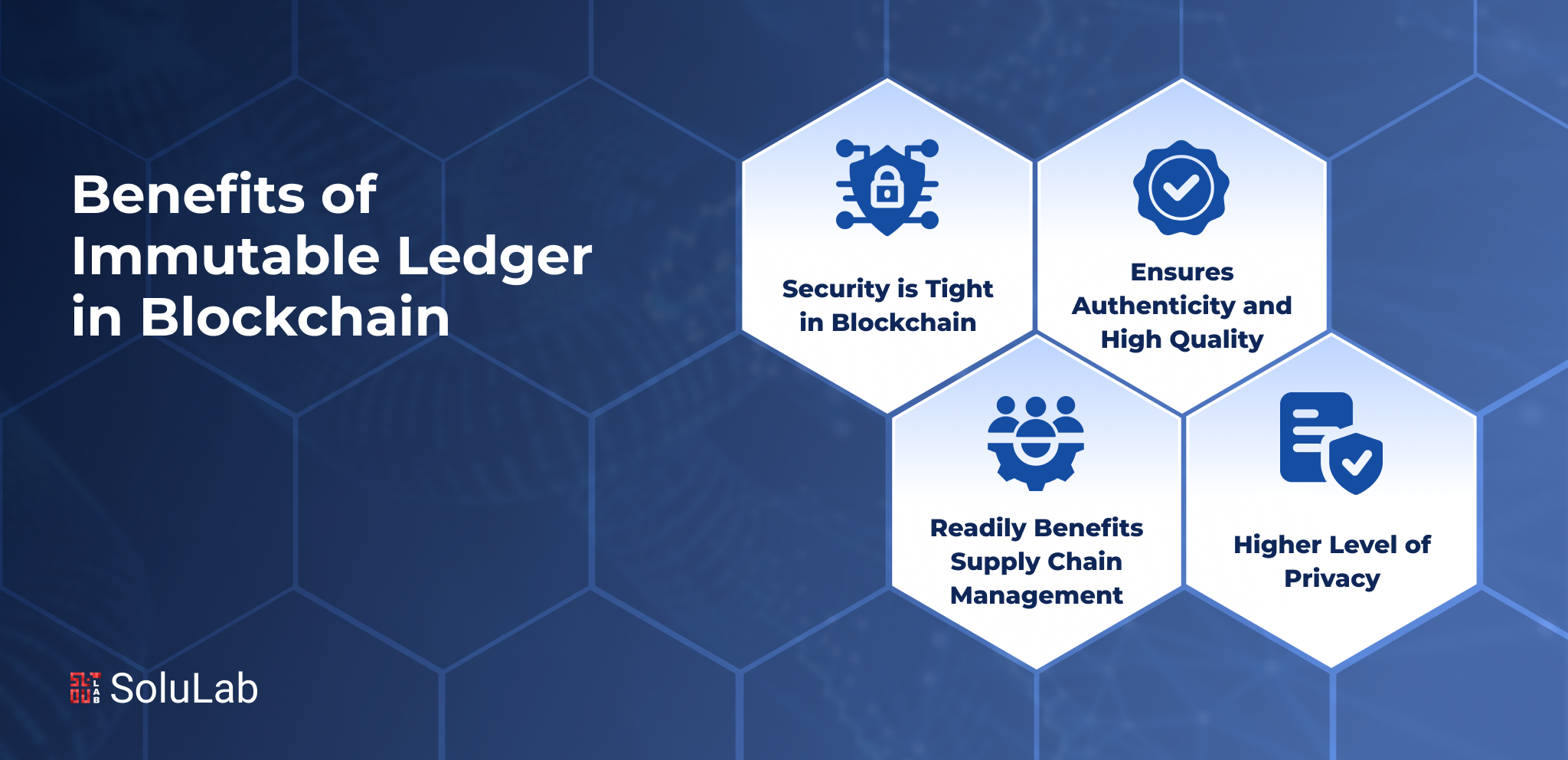
Security is Tight in Blockchain: The immutable ledger on the blockchain is quite secure. We already know that blockchain is distributed ledger. It means that no central point of authority can control it. Thus, at any point in time, hackers try to compromise the data, and it is just next to impossible to do the same when it is managed with more than two servers or nodes. Additionally, each action made on a digital ledger is encrypted with a unique hash code to which most nodes must agree upon the activity. This, in turn, ensures a free and transparent flow of data and protects the information from being corrupted.
Ensures Authenticity and High Quality: It is known that an immutable ledger on blockchain benefits the users with its high level of security and traceability. These features play a significant role in effectively dealing with the fraudulent market. Every year counterfeit goods cost authorized brands a huge sum of money, but blockchain could be the revolutionary solution. It works by registering different items on the blockchain system, where the manufacturers can very easily provide all the required information to their customers regarding the origins of the products, their historical records, and current and previous owners. By tagging the items on a blockchain, the buyers can understand whether the thing is authentic.
Immutable and Tamper-Proof: The immutable ledger ensures that once data is recorded on the blockchain, it cannot be altered or tampered with, providing high data integrity and preventing unauthorized changes.
Enhanced Security: Blockchain’s distributed nature and consensus mechanisms make it highly secure. The decentralized network eliminates single points of failure and reduces the risk of hacking or data manipulation. The use of cryptographic techniques adds an extra layer of security.
Transparency and Traceability: Blockchain enables transparent and auditable transactions by recording every transaction on a public ledger. This transparency fosters trust and accountability as anyone can verify and trace the history of transactions or assets, promoting transparency in various sectors.
Improved Efficiency and Cost Reduction: Blockchain streamlines processes by eliminating intermediaries, automating workflows, and reducing paperwork. This leads to increased efficiency, faster transactions, and cost savings by eliminating the need for third-party verification or reconciliation.
Enhanced Supply Chain Management: Blockchain enables end-to-end visibility and traceability in supply chains. It allows participants to track the movement of goods, verify authenticity, and ensure compliance with regulations. This reduces fraud and counterfeiting and improves inventory management.
Decentralization and Resilience: Blockchain operates on a decentralized network, making it highly resilient to failures or attacks. The absence of a single point of control ensures that the system continues functioning even if some nodes or participants go offline.
Improved Data Integrity: Blockchain’s consensus mechanisms ensure that data entered into the blockchain is accurate and consistent. The decentralized nature of the network makes it difficult for malicious actors to manipulate or corrupt data.
Fast and Efficient Settlements: Blockchain enables speedier settlement of transactions by eliminating intermediaries and automating processes. Smart contracts, self-executing contracts stored on the blockchain, allow automatic and instantaneous payments based on predefined conditions.
Cross-Border Transactions: Blockchain facilitates faster and more cost-effective cross-border transactions by removing the need for multiple intermediaries, reducing fees, and eliminating delays associated with traditional banking systems.
Empowering Individuals: Blockchain empowers individuals by giving them control over their data. Users can securely manage their digital identities, selectively disclose information, and retain data ownership, leading to increased privacy and autonomy.
Readily Benefits Supply Chain Management: Supply chain management is another area where the immutable blockchain ledger proves immensely beneficial. The entire process of exchanging goods must be handled with much responsibility. There are chances of loss, stealing, misplacing, or damage when transporting items. Considering this, several logistics companies have already started using blockchain to avail the benefits. On the other hand, some companies are experimenting with blockchain before using it in their mainstream. With blockchain technology, the parties are allowed to share data very quickly. Most importantly, even the slightest inconvenience caused at the time of a shipment would be registered. In this regard, a digital ledger plays a crucial role in providing very tight security by enhancing transparency and traceability of goods in the supply chain.
Higher Level of Privacy: The information we share or put online is always vulnerable to outside harm, like leaks, hacks, and personal threats. We treat the data as private and ensure privacy is not easily compromised. The use of blockchain is beneficial here since it differs from the standard database, ensuring privacy is much better for the users. Blockchain is anonymous, and each user is protected with encrypted codes, making it next to impossible to detect any users’ account information. But it is to be kept in mind that levels of privacy depend on a specific blockchain and its security features.
What is the Future of Immutable Ledger in Blockchain?
Immutable ledger in blockchain readily benefits brands in a wide range of industries. It helps transform the overall business landscape and create new distribution methods of goods and information. The benefits mentioned above clearly indicate a revolutionary change and, simultaneously, have an enormous scope that will be utilized in the future. With more and more industries and brands starting to integrate blockchain into their business, its popularity is on the rise. Using blockchain plays a significant role in solving an array of authenticity, security, and traceability issues.
In 2017, the blockchain market was valued at 708 million dollars. Studies conducted by experts forecast that by the year 2025, the value of the call will reach about 60 billion dollars. This forecast gives an unambiguous indication of the growth of the blockchain market. Several market giants such as Walmart, IBM, Microsoft, Huawei Technologies, MasterCard, and many more are successfully implementing blockchain technology in their regular business operations. The entire picture tends to change when the reputed and leading brands start depending on technologies that were rated negatively before.
Conclusion
Blockchain, a distributed electronic ledger system, was developed due to the previous limitations imposed by traditional databases. The primary objective of disseminating and synchronizing data among multiple independent players is to democratize information. In the end, blockchain and immutable ledger technology will be a good alternative to all database applications for businesses. The trust in the data businesses use daily can be increased to an unprecedented level with blockchain implementations. Immutability ensures that fundamental and technical definitions are complete. Blockchain technology makes the verification process more effective, meaningful, and cost-effective, demonstrating that the information presented and utilized by stakeholders has yet to be altered.
As a leader in blockchain development services, SoluLab emphasizes the importance of trust and transparency in organizational operations. By leveraging blockchain’s inherent characteristics, such as immutability and decentralization, SoluLab enables businesses to establish a higher level of trust within their ecosystem. Blockchain solutions provided by SoluLab enhance transparency by maintaining an immutable record of transactions and ensuring that information is securely shared among relevant parties.
If you are seeking to distinguish yourself in the competitive field of Blockchain development, SoluLab offers a solution worth considering. By hiring skilled blockchain developers from SoluLab, companies can stand out in this crowded space. SoluLab’s team sets itself apart by prioritizing agile development methodologies and a strong dedication to delivering exceptional business outcomes. Through its unique approach, SoluLab strives to differentiate itself from other companies operating in the same industry.
FAQs
1. What does immutability mean?
Immutability is the capacity of an object to remain intact, unaltered, and indestructible. This feature of blockchain technology ensures that no one can tamper with the system or change the data that has already been saved into the block.
Each information block, such as facts or transaction details, is created using cryptographic principles or hashes. Cryptographic hashing is key to blockchain immutability, and the most common hash function is SHA-256. The algorithm is a subset of the parameters that connect all of the network’s blocks, resulting in immutability. These blocks cannot be altered and are sequentially secure.
3. What is the benefit of an immutable ledger in blockchain?
Blockchain immutable ledgers offer consumers a high level of security and traceability. These characteristics are crucial for effectively combating the counterfeit industry. Similarly, a digital catalog is necessary for the supply chain industry to improve commodity transparency and privacy to guarantee extremely high levels of security.
4. How can we use an immutable blockchain?
A permanent record in blockchain helps brands in many businesses. It helps change the general business scene and makes strategies. The blockchain exchanges’ permanent trademark eliminates the reliance on extra review. It gives proof to members who execute on a carefully designed network.
5. Can data on the blockchain be deleted or modified?
No, one of the fundamental characteristics of blockchain technology is immutability. Once data is recorded on the blockchain, it becomes nearly impossible to delete or modify it. This ensures the integrity and trustworthiness of the information stored on the blockchain.
6. Is blockchain technology only applicable to cryptocurrencies?
No, blockchain technology has applications beyond cryptocurrencies. While cryptocurrencies like Bitcoin were the first use case of blockchain, the technology has evolved to be used in various industries such as supply chain management, healthcare, finance, and more. Blockchain can securely record and manage any transaction or data exchange where transparency, security, and immutability are desired.
7. Is blockchain technology energy-efficient?
The energy efficiency of blockchain technology depends on the specific consensus algorithm used. Some blockchain networks, like Bitcoin’s proof-of-work, have been criticized for their high energy consumption. However, newer blockchain platforms are adopting more energy-efficient consensus mechanisms, such as proof-of-stake, which require significantly less computational power. Additionally, ongoing research and development focus on making blockchain technology more environmentally friendly and sustainable.