Talk to an Expert

ICO vs. STO: What’s the Difference?


ICO vs. STO: What’s the Difference?

Initial Coin Offerings (ICOs) and Security Token Offerings (STOs) have made significant waves in the world of fundraising and investment within the blockchain and cryptocurrency industry. However, these two fundraising methods differ significantly in their nature, regulatory aspects, and potential benefits. 

In this blog post, we’ll delve into the distinctions between ICOs and STOs, exploring their characteristics, advantages, and drawbacks. Understanding these differences is crucial for entrepreneurs, investors, and blockchain enthusiasts to make informed decisions in the evolving crypto landscape.

What is ICO (Initial Coin Offering)?

ICOs are fundraising events where cryptocurrency tokens are issued to investors in exchange for capital. The primary purpose of ICOs is to raise funds for new blockchain projects or decentralized applications (DApps). These tokens typically represent future access to the project’s products or services.

ICOs gained immense popularity around 2017, with projects like Ethereum, EOS, and Tezos raising substantial amounts through token sales. These events often attracted global attention and investment due to the potential for high returns.

ICOs offer several advantages, including accessibility for a wide range of investors, quick fundraising, and potential for exponential growth. However, they are also associated with significant drawbacks, such as a lack of regulatory oversight, potential scams, and volatility in token prices.

ICOs have faced increasing regulatory scrutiny in various countries, leading to legal challenges and restrictions. Governments have been concerned about fraudulent projects and the need to protect investors.

What is STO (Security Token Offering)?

STOs, on the other hand, are a more regulated and secure method of fundraising. They involve issuing tokens that are backed by real-world assets, such as equity in a company, real estate, or commodities. STOs are designed to comply with existing securities regulations.

Several successful STOs have demonstrated the viability of this fundraising method. Projects in real estate, art, and venture capital have used STOs to tokenize assets and offer fractional ownership.

STOs offer advantages such as improved investor protection, transparency, and compliance with legal frameworks. However, they also require more regulatory compliance, which can be costly and time-consuming for issuers.
Difference between ICO and STO

Difference between ICO and STO

STOs differ from ICOs in several crucial ways. Firstly, STOs are security offerings, subject to securities regulations, while ICOs are often utility token sales. Secondly, STOs are typically backed by tangible assets, providing investors with more security and potential for dividends or profit-sharing.

Key Differences Between ICOs and STOs

Initial Coin Offerings (ICOs) and Security Token Offerings (STOs) are both methods of raising capital in the cryptocurrency and blockchain space. However, they have distinct differences in terms of their nature, regulation, and purpose. Here are the key differences between ICOs and STOs:

Read Blog Post: 10 Best Defi Exchanges 2024

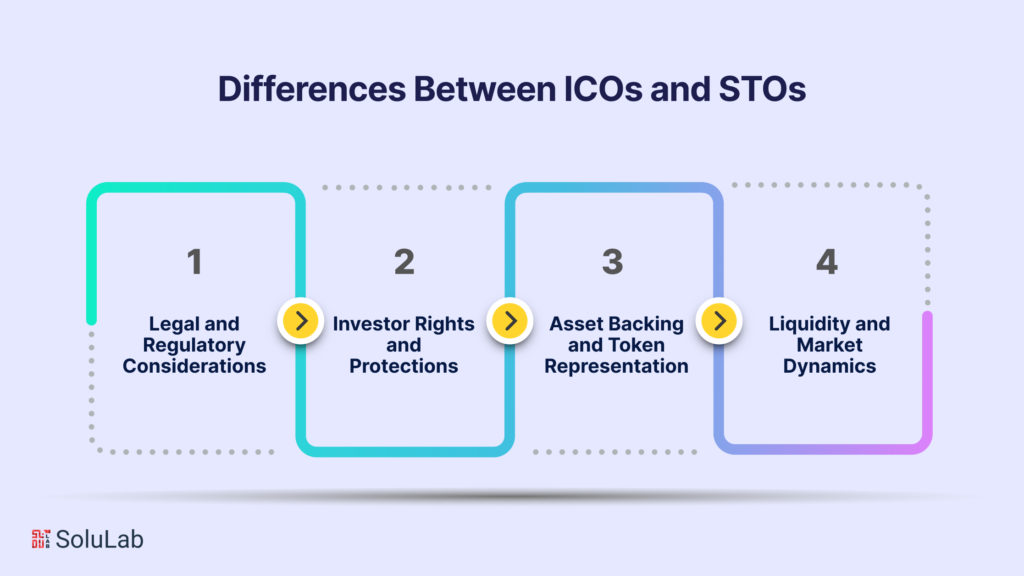
1. Legal and Regulatory Considerations

  • ICOs often operate in a legal grey area, while STOs are subject to securities regulations.
  • ICOs may face legal consequences for non-compliance with securities laws.

2. Investor Rights and Protections

  • STO investors typically have more rights and protections, such as ownership shares and potential dividends.
  • ICO investors often have limited rights and rely on the project’s success for returns.

CTA1

3. Asset Backing and Token Representation

  • ICO tokens may not necessarily be backed by tangible assets or represent ownership.
  • STO tokens are backed by real assets, offering a clear value proposition to investors.

4. Liquidity and Market Dynamics

  • ICO tokens often trade on cryptocurrency exchanges, which can lead to extreme price volatility.
  • STO tokens may have a more stable price due to their asset-backed nature, but liquidity can be lower.

What to Choose: ICO or STO?

What to Choose: ICO or STO?

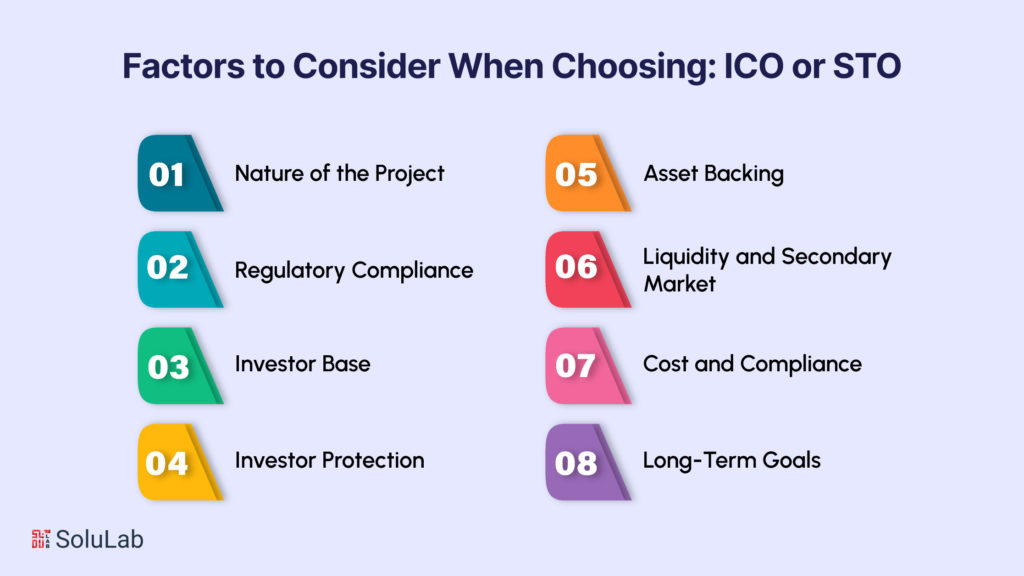
Choosing between an Initial Coin Offering (ICO) and a Security Token Offering (STO) depends on several factors, including the nature of your project, regulatory considerations, and your target audience. Here are some key factors to consider when deciding which fundraising method to choose:

1. Nature of the Project

  • If your project involves a utility token that provides access to a specific product or service within your platform (e.g., a decentralized application or ecosystem), an ICO development may be suitable.
  • If your project involves asset-backed tokens, such as company equity, real estate, or revenue-sharing, and you want to comply with securities regulations, an STO is more appropriate.

Read Also: 7 Most Successful ICOs of All Time

2. Regulatory Compliance

  • Consider the regulatory environment in your jurisdiction and the jurisdictions of your potential investors. STOs are typically subject to securities regulations, which can be complex and vary from country to country. Ensure you have legal counsel to navigate these regulations.
  • ICOs may have fewer regulatory requirements but could still face legal scrutiny in some jurisdictions.

3. Investor Base

  • Determine your target investor base. If you want to attract a broad and global audience of retail investors, an ICO may be more suitable.
  • If you are targeting accredited or institutional investors who are comfortable with regulatory compliance, an STO may be the better choice.

4. Investor Protection

  • If you prioritize strong investor protection and transparency, an STO is more likely to provide these features due to securities regulations.
  • ICOs have historically been associated with a higher risk of fraud and less legal protection for investors.

5. Asset Backing

  • Consider whether your project involves tangible assets or revenue streams that can back your tokens. If so, an STO can provide a direct link between the tokens and the underlying assets.
  • If your tokens are primarily utility-based and don’t represent ownership or assets, an ICO may be more appropriate.

6. Liquidity and Secondary Market

  • Evaluate how you plan to provide liquidity to your investors. Security tokens are typically designed to be more liquid, potentially allowing trading on traditional securities exchanges.
  • ICO tokens may face liquidity challenges and may not be listed on major exchanges.

Read Also: How To Write A Compelling ICO Whitepaper That Actually Sells?

7. Cost and Compliance

  • Be aware that conducting an STO can be more expensive and time-consuming due to regulatory compliance requirements, legal fees, and the need for thorough due diligence.
  • ICOs may have lower upfront costs, but they may require significant marketing efforts to attract investors.

8. Long-Term Goals

  • Consider your long-term goals for the project. STOs may offer a more structured path to traditional financial markets and long-term sustainability.
  • ICOs may provide more flexibility but can also be riskier and less predictable in terms of future outcomes.

Check Out Our Blog: Top 25 Smart Contract Companies To Look For in 2024

Future Trends and Developments

The crypto fundraising landscape continues to evolve, and several trends are shaping the future of ICOs and STOs:

1. Hybrid Models: Some projects are exploring hybrid models that combine elements of ICOs and STOs to strike a balance between fundraising and regulatory compliance.

2. Secondary Markets: The development of secondary trading platforms for security tokens could improve liquidity and provide investors with more options for buying and selling tokens.

3. Regulatory Clarity: As regulatory frameworks become more defined, the crypto industry may see increased participation from traditional financial institutions and mainstream investors.
Blockchain and the Future of ICOs and STOs

Blockchain and the Future of ICOs and STOs

Understanding these blockchain trends and their potential impact on ICOs and STOs is essential for stakeholders in the crypto fundraising space. As the technology matures, we can anticipate exciting developments that will shape the future of token offerings and the broader blockchain industry.

Blockchain technology continues to evolve, presenting opportunities and challenges for ICOs and STOs. As the underlying technology for both fundraising methods, the future of blockchain plays a pivotal role in shaping their trajectories.

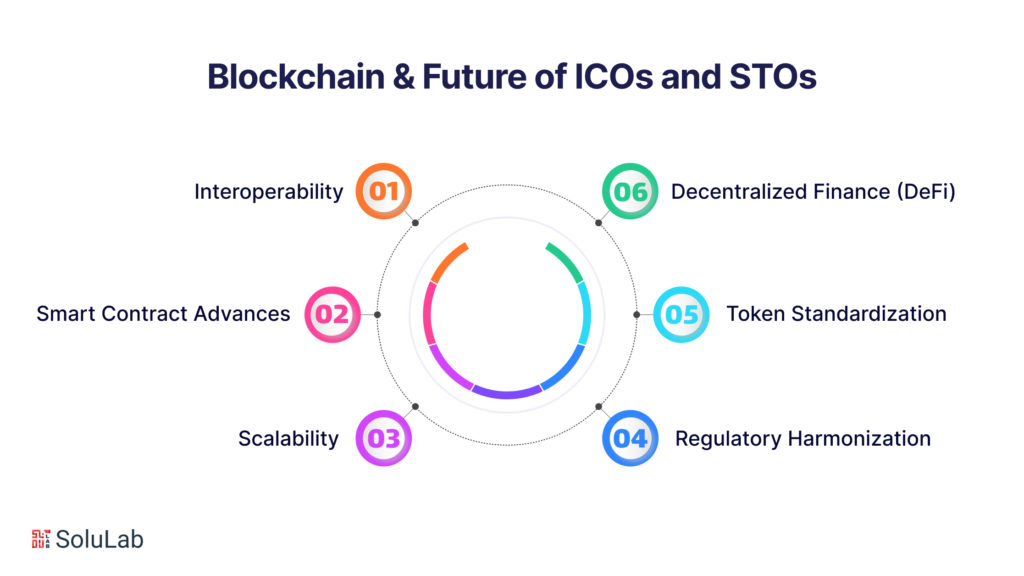
1. Interoperability: Interoperability between different blockchain networks is becoming a key focus. This will allow assets from one blockchain to be traded on another, potentially increasing liquidity for tokens from both ICOs and STOs.

Read Blog Post: Top 10 STO Development Companies in 2024

2. Smart Contract Advances: Smart contracts are at the heart of ICOs and STOs. As blockchain technology matures, we can expect more advanced and secure smart contract platforms, reducing the risk of contract vulnerabilities.

3. Scalability: Scalability issues have plagued blockchain networks, affecting transaction speeds and costs. Solving these issues will enhance the efficiency of token offerings, making them more accessible and cost-effective.

4. Regulatory Harmonization: The crypto industry seeks harmonization of regulatory frameworks globally. A cohesive approach to regulation could reduce uncertainty and promote a more favorable environment for both ICOs and STOs.

5. Token Standardization: Standardisation of token types can simplify the token creation process and enhance interoperability. Ethereum’s ERC-20 and ERC-1400 standards are examples of how standardization can facilitate token issuance.

6. Decentralized Finance (DeFi): DeFi platforms have gained traction, offering new opportunities for fundraising and investment. DeFi projects are increasingly exploring ICO and STO models within their ecosystems.

CTA2

Concluding Remarks

In conclusion, comprehending the distinctions between Initial Coin Offerings (ICOs) and Security Token Offerings (STOs) is crucial within the blockchain and cryptocurrency arena. ICOs once celebrated for their rapid fundraising potential, faced regulatory uncertainties and concerns about investor safeguarding. Conversely, STOs have emerged as a more regulated and secure fundraising approach, offering investors tangible asset-backed ownership and compliance with securities laws, which has garnered institutional interest and bolstered trust in the crypto fundraising landscape.

Looking forward, expect to witness the emergence of hybrid fundraising models blending ICO and STO elements, the growth of secondary markets to enhance token liquidity, and increasing regulatory clarity. As blockchain technology matures, the crypto fundraising landscape will continually adapt, providing innovative opportunities. For entrepreneurs and investors, a deep understanding of these distinctions will serve as a compass in navigating the dynamic world of ICOs and STOs successfully. Whether you’re seeking capital or investment opportunities, staying informed and compliant will be paramount in this evolving blockchain ecosystem protocol.

SoluLab is a prominent company in the blockchain technology and software development sector, offering expertise in various industries, including decentralized finance, supply chain management, and healthcare. SoluLab has earned a reputation for delivering innovative blockchain solutions. In the context of ICOs and STOs, SoluLab provides crucial technical support and development services. They assist startups and enterprises in launching ICOs and STOs by offering secure smart contract development and wallet creation while ensuring compliance with regulatory frameworks, which is particularly vital for STOs. SoluLab serves as a valuable partner for those navigating the complex landscape of blockchain-based fundraising, offering ICO development services and STO development services, all while adhering to regulatory standards. Contact SoluLab today to explore their comprehensive blockchain solutions.

FAQs

1. What is the primary difference between an ICO and an STO?

An ICO (Initial Coin Offering) is a fundraising method where cryptocurrency tokens are issued, often as utility tokens, without direct ownership rights. In contrast, an STO (Security Token Offering) involves the issuance of tokens backed by real-world assets, such as equity or property, offering investors ownership rights and potential dividends.

2. Why are ICOs often associated with regulatory challenges?

ICOs have faced regulatory challenges due to their lack of compliance with securities laws in many jurisdictions. This lack of oversight has raised concerns about investor protection, leading to increased regulatory scrutiny.

3. What are the benefits of participating in an STO for investors?

Investors in STOs typically gain ownership rights in the underlying asset, such as shares in a company or real estate. This can provide more security and the potential for dividends or profit-sharing, making STOs appealing to those seeking traditional investment features.

4. Are ICOs still a viable fundraising method in today’s regulatory landscape?

ICOs have evolved in response to regulatory challenges. Some projects conduct compliant ICOs, while others opt for alternative fundraising methods like STOs. The viability of an ICO development company depends on the project’s nature and its ability to navigate regulatory requirements.

5. How do secondary markets impact the liquidity of security tokens from STOs?

Secondary markets, such as security token exchanges, can significantly impact the liquidity of tokens from STOs. They provide a platform for investors to buy and sell security tokens, potentially increasing liquidity and tradability compared to traditional assets.

6. What trends can we expect in the ICO and STO space shortly?

The future of ICOs and STOs will likely see increased regulatory clarity, hybrid fundraising models, and the integration of blockchain technology into traditional financial systems. Institutional involvement and a focus on compliance are also expected to shape the industry’s direction.

What are Some of the Benefits of an ICO?

What are Some of the Benefits of an ICO?

Initial coin offerings (ICO) are becoming an exciting fundraising tool in the constantly evolving cryptocurrency world in which investors receive virtual tokens and coins in return for money. MasterCoin was the first initial coin offering J.R. Willet started the first-ever initial coin offering (ICO) token sale in 2013. Through the initial coin offering (ICO), the token, known as MasterCoin, raised an incredible $500,000 in Bitcoin. Numerous ICOs were subsequently sparked by its success. Projects creating financial goods, including DeFi, accounted for 36% of all initial coin offerings (ICO) in 2023. 

This important strategy has transformed how businesses and projects obtain capital, with several advantages for investors and entrepreneurs alike. We will examine what an initial coin offering is and the benefits it offers to businesses in the cryptocurrency space. 

What is an Initial Coin Offering?

The cryptocurrency industry’s version of an IPO is called an ICO or an Initial Coin Offering. An ICO can be used by a business looking to generate capital to develop a new blockchain application or service using cryptocurrencies. To obtain new cryptocurrency created by the company, interested investors might participate in an initial coin offering. This token could donate some ownership in the business or project, or it might have some use concerning the goods or services the company provides. 

ICOs are frequently security offerings that require registration. In some cases, though they might not be required to register. Companies that have submitted Form D after selling their securities for the first time are permitted to make offers on up to $10 million in shares within 12 months under Rule 504 Of Regulation D. If coin issuers follow this requirement, they can lawfully sell coins to purchasers as securities.

A common method of raising money for goods and services that are typically associated with cryptocurrencies is through ICOs. While IPOs and ICOs are comparable, ICO-issued currencies may also be used for software services or other products. Inventors have made money from a few initial coin offerings. Many others have done poorly or have been exposed as fraudsters, registering is required for the majority of initial coin offers. a few intial coin offerings.

Read Also: ICO vs. STO

What are Five Successful Initial Coin Offerings (ICO)?

What are Five Successful Initial Coin Offerings (ICO)?

The biggest initial coin offerings have helped millions of people and organizations to raise billions of dollars. Although the IT industry has witnessed many successful ICOs, it still provides many business opportunities. Here is the list of the top five token releases to date;

  • Known to be one of the first initial coin offerings, Ethereum has made more than digital money compared to its predecessor, Bitcoin. Using smart contracts, decentralized apps can be created using Ethereum, a blockchain technology.
  • IOTA’s initial coin offering (ICO) is based on blockchain technology with the Internet of Things. Also, a cost-free, scalable environment was given via their decentralized transaction ledger.
  • Stratis is a software platform that supports many programming languages and enables companies to develop, test, and deploy programs.  Furthermore, none of this requires the setup or administration of a development environment. Nearly 1,000 BTC were raised during their ICO, valued at $675,000 and now over $8 million.
  • EOS, this popular cryptocurrency, raised more than $185 million in the first five days of its initial coin offering (ICO). Now, it is renowned for being the biggest ICO. EOS asserts in its white paper that its network is competitive (Alternative to Ethereum’s). They provide a wide range of blockchain-compatible business solutions.
  • Formerly known as Antshares, and now NXT, undergone two times of token sales. This ICO has tied up with Microsoft and the Chinese government to launch 3 cents in its initial coin offering (ICO). From October 2015 and January 2018, the cost of their coins soared to $180M. NXT is known to be one of the largest ROI coin offerings, as mentioned in its white paper.

Read Also: Which are the Best ICO Listing Websites Out There?

Benefits of ICO

Benefits of ICO

Below, we’ll discuss the usually analyzed advantages/ benefits of ICO, namely;

  • Convenient for Start-ups and Investors

The biggest advantage of an Initial Coin Offering (ICO) is that it gives access to a range of people, from freelancers and startups to mature investors. There aren’t any time constraints; contributors can also invest at any time, unlike traditional funding set-ups. Anyone who wishes can become an early investor. Thus, ICOs are a favorable option for Startups because, more often than not, startup companies lack the required funds to kick-start their project but can potentially raise their value over time.  

A Token launch is similar to the sale of API keys, and it’s difficult to restrict the sale of these keys to accredited investors alone. Hence it is bound to increase the buyer base relative to traditional equity financing for a start-up.

Read Our Blog: What is ICO and How Does it Work?

  • Online Marketing

It’s easier to gather information about tokens via surfacing the net. Buyers interested in these coins can learn about the ICO through the organization’s website, online forums, messaging applications, and social media websites. The internet leverages ICOs, and a large, general audience is attracted to the venture if marketed right. Also, companies seeking to raise capital through innovative blockchain-based technologies do not need high marketing and advertising costs which helps to reduce the cost of raising capital. 

  • Swift and Unchallenging Mechanism

All the transactions are done online. One can sell tokens internationally over the internet. Instead of relying on regulatory filings, as with other exchange forms like IPOs, stocks, bonds, etc., an ICO relies on blockchain technology to maintain a ledger of its multiple transactions. Data is constantly updated within seconds. All this makes an ICO less time-consuming, less energy-draining, and more efficient.

  • Decentralization – Blockchain 

From substantiating and establishing contributions to distributing tokens, ICOs only require monitoring and updating the distributed digital ledgers.

A distributed ledger lets all investors know about the ICO process daily, as the status of an ICO at each time is written on the Blockchain. This decentralization concept prevents issuers’ fraudulence over investors through ICO. ICO also changes our notion of property rights. As in the case of tokens, the final arbiter of who possesses what property is not a national court system but an international blockchain. 

CTA1

  • High Liquidity

High liquidity refers to an asset’s ability to be quickly bought or sold in the market without significantly affecting its value. ICOs are advantageous because early contributors have more liquidity in early-stage companies. Most popular tokens could exceed $100 million in 24-hour volume. Huge liquidity premium alone causes tokens to predominate (provided they are legally and technically feasible) because the time to liquidity enters inversely in the exponent of the compound annual growth rate. 

  • Profit Potential & High ROI

ICOs are said to be unregulated and risky for investment, but surely “the profits from the hits outweigh the losses of the misses.” For instance, the price of bitcoin was around $100 in June 2013 and was trading at $4,000-5,000 in early September 2017. Now investors are searching for a token that can replace Bitcoin in terms of economic appreciation. Many are citing Ethereum as “the next bitcoin.” 

ICOs are high-risk and high-reward assets. Investors seek high liquidity and the ability to recover the invested money quickly and other additional returns. A quick fix is provided to them through an ICO, making it a fairly attractive investment solution.

  • Democratizing Model/Network

Initial Coin Offerings (ICOs) are changing fundraising by democratizing access to financial capital. It’s the era of globalization of financing. ICO virtualization has made it possible for anyone, anywhere in the world, to invest in a company that is established or operating in any country. 

ICOs have caused the significance of going to Silicon Valley / Wall Street to raise funding to diminish. Everything is on the internet from the workings and marketing to opportunities. It paves the way for more expanded investment opportunities as more international clients/investors are lured into these projects. 

  • Lack of Intermediaries

Tokens mean instant custody, not requiring the role played by intermediaries. Elimination of financial intermediaries automatically minimizes the cost of funding and also the funding speed. There’s also less government control compared to traditional financing methods.

Specific Considerations

In 2019, ICO activity started to decline sharply, partly due to the legal ambiguity that ICOs operate. However, there is no foolproof way to sustain with the recent initial coin offerings even if investors do their research and track down the ICOs to invest in.

If necessary, the U.S. Securities and Exchange Commission (SEC) is permitted to intervene in an ICO, such as when the SEC has taken emergency action against Telegram and received a restraining order (temporary) after the Telegram development team allegedly engaged in illegal conduct and by the act raised $1.7 billion in an ICO during the years of 2018 and 2019. In March 2020, the Southern District of New York U.S. Court granted a preliminary injunction. An $18.5 million civil sanction and the repayment of $1.2 billion to investors were both mandated for Telegram.

Read Our Blog: ICO Vs Crowdfunding

When considering investing in an ICO, there is no assurance that the investor won’t become the victim of fraud or scam. However, you can follow these to take precautions against ICO scams.

  • Make sure the project developers can articulate their objectives properly. White papers for successful ICOs often have simple and clear goals.
  • Always seek transparency. Investors have to demand complete transparency from every company that runs an ICO.
  • Evaluate each legal term and condition of the ICO. Since there is a lack of traditional regulators, it is the investors’ responsibility to confirm the legitimacy of an ICO.
  • It is advised to keep ICO funds in an Escrow wallet. Escrow wallet protects against scams as multiple access keys are mandatory to form and open this wallet.
  • This type of wallet effectively prevents fraud and requires several access keys.

You may have to buy more coins to invest in the project since certain ICOs use other cryptocurrencies.

Why is there Immense Hype Around ICO?

The hype surrounding ICOs is tremendous. And there are many internet forums where investors meet to discuss potential opportunities. Some of the most well-known celebrities, including Steven Seagal, have urged his followers or fans to invest in a trending new initial coin offering (ICO). 

The SEC previously warned that it was illegal for celebrities to advertise ICOs on media platforms without disclosing the payment they received to do so.

Read Also: Top 10 ICO Development Companies

Centra Tech (an ICO that closed in 2017 with $30 million in funding) has previously been endorsed by DJ Khaled and the legendary boxer Floyd Mayweather Jr. The two celebrities reached a settlement with American regulators when Centra Tech was ultimately revealed to be a fraud in court. Three of the company’s founders were found guilty of ICO fraud.

Before taking part in an ICO, investors looking to invest should become familiar with cryptocurrencies and learn everything there is to know about ICOs. ICOs are not legally regulated, so it is advised for investors to proceed with utmost caution when it involves ICOs.

CTA2

How Can SoluLab Assist You With ICOs?

The amount of funding attracted by the ICO remains the most commonly used indicator for the success of companies or entrepreneurs. Organizations are considering issuing tokens as they are assumed to be securities. Because unlike holding a stock of a company (whose products a contributor never used), ironically, tokens can be more tangible than securities. On the market end, token buyers are trying to be more cautious about buying and trading ICO tokens. On the other hand, the cryptocurrency community is putting its best efforts into regulating token sales and conducting due diligence on behalf of the public.

SoluLab stands out as a premier ICO development company, particularly valuable for startups aiming to establish their presence and raise essential capital. Using their expertise, SoluLab maximizes fundraising potential through top-tier ICO development services, tailored to fuel success in the evolving ICO technology. Their adept team specializes in pioneering solutions, guaranteeing optimal outcomes for fundraising campaigns. For those looking to redefine the cryptocurrency venture experience, SoluLab offers a fully customized white-label ICO platform with multi-blockchain support. To embark on this transformative journey, connect with SoluLab and initiate the next phase of your business expansion.

In the end, we’ll advise you if you have an inclination in the crypto universe and are interested in buying ICOs, practice proper precaution before you invest in a company just to be safe.

FAQs

1. What is an ICO, and what benefits does it offer to businesses?

An Initial Coin Offering (ICO) is a fundraising method that allows businesses, especially startups, to secure capital by issuing and selling their own cryptocurrency tokens. One major benefit of ICOs is their global accessibility, enabling businesses to tap into a vast pool of potential investors without geographical constraints. This democratized funding model fosters inclusivity, as anyone can participate and support innovative projects, thereby enhancing the overall reach and visibility of the venture.

2. How does an ICO contribute to business innovation and growth?

ICOs provide a unique avenue for businesses to showcase their innovative ideas and technological solutions to a wide audience. This exposure can attract tech-savvy investors who believe in the project’s potential, leading to increased funding. Additionally, ICOs often offer early adopters the chance to acquire tokens at a lower cost, fostering a community of supporters who are genuinely invested in the project’s success. This community can become vocal advocates, amplifying the project’s credibility and driving growth.

3. What role does SoluLab play in enhancing the benefits of ICOs?

SoluLab is a leading ICO development company that specializes in creating tailored solutions for startups looking to launch their ICO campaigns. With their expertise in blockchain technology and software development, SoluLab crafts ICO platforms that are secure, user-friendly, and adaptable to multiple blockchains. By collaborating with SoluLab, businesses can ensure their ICOs are built on robust foundations, increasing investor trust and raising the likelihood of successful fundraising.

4. How do ICOs promote liquidity for investors and token holders?

One of the appealing aspects of ICOs is the liquidity they offer to investors and token holders. Once tokens are listed on cryptocurrency exchanges, they can be traded, providing investors with the flexibility to buy or sell their tokens as desired. This liquidity fosters a dynamic secondary market, where the value of tokens can appreciate based on demand and adoption, ultimately benefiting both the project and its supporters.

5. Can you elaborate on the advantages of a white label ICO platform?

A white label ICO platform, such as the one offered by SoluLab, provides businesses with a fully customized solution for launching their ICOs. This platform can be tailored to match the brand’s identity, ensuring a consistent user experience. Moreover, white label platforms often come with pre-built functionalities, reducing development time and costs. By leveraging a white label ICO platform, businesses can focus on refining their core offerings while leaving the technical intricacies to experts.

6. How do ICOs empower projects in niche industries to raise funds?

ICOs have the power to democratize fundraising, making it possible for projects in niche industries to attract capital that might be otherwise challenging to secure through traditional methods. Investors with a keen interest in a particular niche can find and support projects that align with their passions, thus fueling innovation in unique sectors. This ability to tap into a dedicated investor base enhances the viability of niche projects and contributes to diversifying the global economy.

7. What sets SoluLab apart in the ICO development landscape?

SoluLab is a trailblazer in the realm of ICO development services, offering an unparalleled combination of expertise and innovation. Their hallmark lies in providing businesses with the opportunity to launch their own white label ICO platform, complete with multi-blockchain support. This customized approach ensures that ICO campaigns are not only secure and reliable but also tailored to the brand’s vision. With a deep understanding of blockchain technology, SoluLab is committed to transforming fundraising experiences and driving success for new cryptocurrency ventures.

How To Write A Compelling ICO Whitepaper That Actually Sells?

How To Write A Compelling ICO Whitepaper That Actually Sells?

Initial Coin Offerings (ICOs) have become a popular fundraising method in the world of cryptocurrencies, enabling new projects to gain financial support from investors around the globe. An essential part of any ICO is the whitepaper on blockchain – a document that details all aspects of the project, from its purpose and business plan to the technology behind it and profit projections. Writing an effective ICO whitepaper on the blockchain can be daunting, but with the right approach and understanding, you can create a compelling document that captivates potential investors. This blog post will provide a comprehensive guide on crafting an ICO whitepaper on the blockchain, covering everything from explaining the business problem to formulating a content marketing strategy and establishing trust and credibility.

Introduction

Understanding the Purpose of an ICO White Paper

An ICO white paper serves multiple purposes. It provides detailed information about the crypto project, such as its objectives, the technology it uses, and how it plans to generate profits. Investors use this document to evaluate whether the project is worth investing in. Apart from attracting potential investors, the white paper also helps educate the public about the project’s products and services, promoting brand legitimacy.

The Importance of Quality Content in a White Paper

Quality content is vital for an ICO blockchain white paper. Not only does it inform potential investors about the project, but it also establishes the project’s credibility and legitimacy. The blockchain white paper should be well-researched and present reliable information backed up by references to established informational documents and academic papers. Simple language is also crucial – it ensures that even readers without a technical background can understand the project.

Explaining the Business Problem

Identifying the Problem from the User’s Perspective

The first step in writing an ICO white paper is to identify the business problem that the project aims to solve. The problem should be presented from the user’s perspective to make it relatable to potential investors. By clearly defining the problem, you can explain why your project is necessary and how it offers a solution.

Using Layman’s Terms to Explain the Problem

While explaining the problem, it’s essential to use layman’s terms. Assume that your readers are not tech-savvy and may not understand technical jargon. Instead, focus on the business value that your project offers. Remember to demonstrate how your solution addresses the problem and why it’s better than alternatives.

Presenting the Solution

The next step is to present the solution – the service or product your project offers. Here, you must convince the reader that your solution effectively addresses the problem. Use facts, statistics, and diagrams to demonstrate how your solution works and why it’s beneficial. Avoid using Persuasive language; instead, present your solution factually and convincingly.

Details about the ICO

The Kind of Problem an ICO Aims to Solve

An ICO, or Initial Coin Offering, is a type of crowdfunding that uses cryptocurrencies. It’s a way for start-ups to raise capital without going through the traditional routes of venture capital funding or issuing shares. ICOs aim to solve various problems, from improving transaction speed and reducing costs to providing new data storage methods or executing contracts.

The Technology Used to Provide Solutions

The technology behind an ICO plays a crucial role in providing solutions. Most ICOs are based on blockchain technology, which allows for secure, transparent transactions. The blockchain white paper should describe the technology used, including its features, benefits, and how it supports the project’s objectives. Again, explaining the technology in simple terms is essential so that non-technical readers can understand it.

Discussing Project Growth and Fund Usage

The blockchain white paper should also discuss the project’s growth strategy and how funds raised from the ICO will be used. Potential investors want to see that the project has a solid plan for future development and that their money will be used wisely. Be clear and transparent about where and how funds will be spent, whether it’s on product development, marketing, legal costs, or other expenses.

CTA 1

Writing an ICO White Paper

Using Simple Language for Better Understanding

When writing an ICO white paper, simplicity is key. As mentioned earlier, assume that your readers don’t have a technical background. Use simple language and avoid jargon to ensure that your message is clear and understandable. Start with an assumption that your investors and users don’t know about technology. Write a white paper on the blockchain, assuming that potential customers and investors only want to see your business value.

Highlighting the Business Value Offered

It’s important to highlight the business value offered by your project. This could be anything from reducing costs and increasing efficiency to creating new business opportunities or solving a pressing problem. Make sure to reinforce these unique selling points throughout the white paper on blockchain, so that by the end, investors are left with no doubt about the value of your project.

Importance of Original Research and Citing Reliable Sources

Original research is another crucial aspect of an ICO white paper. Conduct thorough research about your target business opportunity or problem and present your findings in the white paper. Always quote reliable sources and provide references to universally established informational documents and academic papers. Doing so will add credibility to your claims and help establish trust with potential investors.

Formulating a Content Marketing Strategy

Creating Blog Posts, Landing Pages, and Social Media Marketing

A good ICO white paper is not enough on its own; it needs to be supported by a strong content marketing strategy. This could include creating blog posts, designing a landing page for the ICO, and marketing the project on social media platforms. These activities will help drive traffic to your white paper and increase its visibility among potential investors.

Understanding the Role of Lead Generation and Valuable Content Creation

Lead generation and valuable content creation are key components of a successful content marketing strategy. Creating high-quality content that resonates with your target audience can attract potential investors and generate leads for your ICO. It’s also important to conduct external research to understand your audience’s needs and interests and tailor your content accordingly.

Periodically Reviewing and Modifying the Strategy as Needed

Finally, it’s important to review your content marketing strategy regularly and make changes as needed. This could involve analyzing the performance of your blog posts or social media campaigns, gathering feedback from your audience, or keeping up with the latest trends in the crypto industry. By continually refining your strategy, you can ensure that your white paper on blockchain reaches the right people and achieves its goals.

Establishing Trust and Credibility

The Role of Trust in Blockchain/Crypto Businesses

Trust is a crucial aspect of any business, especially for blockchain/crypto businesses. Given the high level of uncertainty and risk associated with the crypto industry, potential investors need to trust that you and your project are reliable. Your ICO blockchain white paper plays a key role in establishing this trust. By providing accurate, well-researched information and demonstrating transparency in your operations, you can build a strong relationship with your audience and gain their trust.

Providing Reliable Information to Gain Trust

As mentioned earlier, providing reliable information is a key way to gain trust. Make sure all the information in your white paper is accurate and up-to-date, and don’t make unsupported claims or promises. Always cite your sources and provide references to established informational documents and academic papers. This will show your audience that you’ve done your homework and are serious about your project.

Referencing Established Informational Documents and Academic Papers

Referencing established informational documents and academic papers not only adds credibility to your claims but also provides your readers with further resources to learn about the topic. Make sure to give due credit to the authors or organizations if you quote their research findings. This shows respect for their work and also helps to avoid issues of plagiarism.

Advanced Tips for Writing a Winning White Paper

Demonstrating Thought Leadership from the Beginning

Thought leadership is an essential quality for any successful ICO. From the very start of your blockchain white paper, you should demonstrate your expertise and innovative thinking in the field of cryptocurrencies and blockchain technology. Show your audience that you have a deep understanding of the industry and the unique challenges it faces and that your project offers a novel solution to these challenges.

Reinforcing the Unique Selling Points Throughout the Paper

To make your ICO stand out from the competition, you must emphasize its unique selling points throughout the white paper. Whether it’s a groundbreaking technology, a unique business model, or a significant market opportunity, highlight these points clearly and persuasively. By repeatedly reinforcing these unique features, you can leave a lasting impression on your readers and convince them of the value of your project.

Making the Value Offered Clear at the Start

Do not wait until the end of your white paper to reveal the value offered by your project. Instead, make it clear right from the start what benefits your project will bring to potential investors and customers. They should not have to read the entire white paper to understand the value you will offer. Explain your winning product idea at the very beginning of your white paper. This will help to grab the reader’s attention and keep them engaged throughout the document.

Here are some additional tips for writing a great white paper:

  • Keep your white paper concise and to the point.
  • Use clear and concise language.
  • Use visuals to support your points.
  • Proofread your white paper carefully before publishing it.

CTA 2

Conclusion

Final Thoughts on Crafting a Successful ICO White Paper

Writing an ICO blockchain white paper is a challenging task, but with careful planning and a clear understanding of your project and audience, you can create a compelling document that attracts potential investors. Remember to use simple language, focus on the business value your project offers, conduct thorough research, and formulate a robust content marketing strategy. Most importantly, strive to establish trust and credibility with your audience by providing reliable information and demonstrating transparency in your operations.

Recap of Key Points Covered

In this comprehensive guide, we’ve covered everything from understanding the purpose of an ICO white paper on blockchain, explaining the business problem, detailing the ICO, writing the white paper, formulating a content marketing strategy, and establishing trust and credibility. We also provided advanced tips for writing a winning white paper, such as demonstrating thought leadership, reinforcing unique selling points, and making the value offered clear at the start.

SoluLab, renowned for its exceptional ICO development services, provides startups and businesses with the ideal opportunity to establish a strong market presence. Leveraging its expertise, SoluLab maximizes fundraising potential through top-tier ICO software development. Their team excels at crafting innovative solutions tailored for success in the dynamic ICO landscape. To launch a fully-customized white label ICO platform, complete with support for multiple blockchains, and revolutionize fundraising for your cryptocurrency venture. Contact SoluLab today to redefine your fundraising journey.

FAQs

1. What is a whitepaper in the context of a blockchain ICO?

A whitepaper is a comprehensive document that outlines the technical details, vision, and purpose of a blockchain project or Initial Coin Offering (ICO). It serves as an informational guide for potential investors and stakeholders, providing in-depth information about the project’s technology, target market, use case, tokenomics, team, and roadmap.

2. Why is a well-written whitepaper crucial for a successful ICO?

An effectively written whitepaper is crucial for a successful ICO because it is the primary information source for investors and the community. It helps build trust and credibility, showcasing the project’s expertise, thorough research, and thoughtfulness in addressing real-world problems. A clear and compelling whitepaper can attract more investors, create interest in the project, and increase the chances of successful fundraising.

3. How do you ensure clarity and simplicity in a whitepaper for a blockchain ICO?

To ensure clarity and simplicity, avoid using technical jargon or complex language that may confuse readers. Straightforwardly present technical concepts and provide clear explanations of any blockchain-specific terms. Using visual aids, such as charts and infographics, can also help convey complex information more effectively.

4. Should a whitepaper focus solely on technical aspects?

While technical aspects are essential, a whitepaper should balance technical details and a clear value proposition. The document should explain the project’s use case, target audience, and how it brings value to users or the market. A compelling narrative that captures the project’s vision and potential impact is equally important in attracting investors.

5. How can professional help be beneficial in crafting a whitepaper for a blockchain ICO?

Professional help from experienced blockchain consultants or technical writers can be highly beneficial in crafting a whitepaper. They possess expertise in blockchain technology, tokenomics, and market research, ensuring the document is well-researched, accurate, and follows industry best practices. Their assistance can enhance the whitepaper’s credibility and make it more appealing to potential investors.


7 Most Successful ICOs of All Time

7 Most Successful ICOs of All Time

There are many factors that contribute to the success of ICOs. It could be the distributed ledger technologies upon which they are primarily founded or the ease with which they can be moved across international and governmental borders. Despite the increase in ICOs, “the Bitcoin explosion” left a gap that hasn’t been filled. What will be “the next bitcoin,” or who will it be? What will the cryptocurrency industry’s next big thing be? Maybe the future will make it clear.

We suggest that you carry out the proper research and study the company’s white paper if you have any interest. To help with your investigation, you may wish to check into the most successful ICOs. So let’s discuss the 7 most successful ICO initiatives that have, in no particular order, generated results with a certain degree of success.

What is an ICO?

The road to growth for conventional businesses is very predictable. Most businesses start off modest and grow as their profits rise. Companies usually turn to outside investment via transferring a portion of ownership in exchange for a quick infusion of cash. And businesses frequently “go public,” or give a share of the business (also known as stock) to investors on the open market in exchange for their money, by way of an Initial Public Offering, or IPO.

An Initial Coin Offering (ICO) is essentially comparable to a traditional initial public offering (IPO) in the world of cryptocurrencies. Companies raise money for their projects through ICOs, often referred to as crowd sales / token sale occasions, by releasing cryptocurrency to prospective buyers in the shape of crypto tokens.

What Factors Contribute to an ICO’s Success?

So, during the past several years, the ICO industry has experienced incredible growth. But what were some of the factors that contributed to this story’s success?

  • Utility: Whether the coin genuinely has good utility is one of the key success factors for an ICO. Although ICO specialists may disagree on a number of points, most concur that a coin must be more than a thing that can be purchased and traded on an exchange. The top-performing ICOs are distinguished from the countless others languishing fruitlessly in wallets or even on exchanges by their fundamental utility. An excellent way to demonstrate the usability of the ICO is to provide potential investors with a demo (or perhaps a visual model) that shows how the proposed enterprise will operate and what advantages it will provide. Furthermore, if the project is just a rehash of previous ideas, the ICO may still fail even if the coin represents a key part of the venture it is intended to support. Additionally, a reliable ICO launching platform that unites various stakeholders and offers a central dashboard can aid in ideation & customer acquisition and increase the likelihood of its success.
  • Solid Marketing, PR & Communication Strategies: Even the most innovative concept can fall short if the launch team’s PR, marketing, and communication efforts are shoddy. The likelihood of success can increase significantly if the marketing plan is comprehensive as well as the information is conveyed in an understandable manner, such as what specific problem the ICO’s project seeks to tackle. Webpages, white papers, e-newsletters, and social media accounts that are clear, succinct, and free of jargon can all be helpful in this regard. In fact, one of the main factors influencing an ICO’s influence and, consequently, its ultimate success, is its website and Alexa Rank (a measure of a website’s popularity).
  • Community Support: ICOs which are active in social media & discussion forums are likely to succeed more than those that aren’t, according to several analysts who’ve already studied past successful ICOs. Successful ICOs have, according to research by the cryptocurrency startup RAD Lending Inc., 4000-5471 Twitter/Facebook followers. Additionally, ICO teams who interact with the public on websites like Quora, Reddit, and Telegram tend to attract a larger audience of potential backers and thus have access to a larger pool of funding.
  • ICO Audits To Increase Trustworthiness: Companies that have their initial coin offerings (ICOs) audited by independent auditing advisories convey their inherent reliability to potential investors because many fraudsters and con artists occasionally utilize ICOs as a weapon to prey on overeager and ignorant investors. These audits may reveal possible problems with the ICO, such as with its corporate governance, financial model, or projections. More importantly, audits provide investors confidence, helping them see the ICO as a “non-scam” and increasing their willingness to contribute.

Some Benefits of an ICO

The benefits for all parties involved are the reason that ICOs have become more and more popular. A lot of the perks for contributors also apply to founders. These advantages motivate more participants to put their money in ICOs rather than alternative options, at the very least.

  • Liquidity: Lack of liquidity is a common barrier for people seeking new investing opportunities. Capital is often unreachable for years in many possibilities. With ICOs, investors have great liquidity as well as the secondary market, which implies that real-time price is based on the project’s current value.
  • Decentralization: Everyone may be able to participate in ICOs, especially if they take bitcoins. For the majority of ICOs, the contributors’ ability to transfer money in time to make a purchase is the only prerequisite.
  • Openness: ICOs not only let anyone invest; donors can also invest whenever they choose. Contrary to conventional models of startup finance, this makes it practically impossible to be an early investor if you don’t have a personal relationship with one of the founders.

ICOs have a lot of reasons attributed to their success. Be it the distributed ledger technologies on which they are mostly based or the fact that they can be transferred easily across national and jurisdictional boundaries. Despite the spike in ICOs, there is still a void left after “the bitcoin explosion” that remains unfulfilled. Who or maybe what is going to be “the next bitcoin”? What will be the next big thing in the crypto world? Perhaps the future will reveal it. We advise you to conduct your due diligence and read the white paper of the company you’re interested in. However, you might want to look into ICOs that closely resemble successful ICOs of the past to aid your analysis.

CTA 1

Here are the 7 Most Successful ICOs of All Time

So now as we discussed most of the ICO info, let’s discuss 7 most successful ICO initiatives that have, in no particular order, generated results with a certain degree of success:

1. NEO

NEO is an open-source Chinese blockchain project that goes by many different names. Perhaps the most common among them are Antshares, the former official title, and the nickname China’s Ethereum. NEO not only utilizes smart contract applications but also decentralized commerce & digitized assets and identification. The company gathered huge support from the Chinese government, Microsoft Corp. (MSFT), Alibaba, and other major companies. And as a result, was able to launch a successful ICO. NEO has provided exceptional ROI for many early investors and is a non-profit, community-driven blockchain project aiming to create a “Smart Economy.”

2. Stratis

This Stratis platform is a U.K.-based company that wishes to streamline business processes. Simultaneously reducing the complexity of Blockchain adoption and implementation. Stratis is one of the only platforms enabling full-stack utilization of Microsoft’s .NET Core Framework. The Stratis platform is well adaptable with multiple programming languages. It enables businesses to seamlessly create, design, and deploy custom applications without setting up or maintaining their own infrastructure. Furthermore, Stratis has made significant efforts to ensure that developers who lack previous experience can quickly pick up and become proficient with Blockchain technology.

3. Ethereum

Ethereum, a prominent cryptocurrency, has emerged as a groundbreaking platform for decentralized applications with the use of smart contracts. Unlike Bitcoin, it extends beyond being just a digital currency and has captivated the corporate world. Currently valued at an impressive $713, Ethereum has seen remarkable growth since its initial coin offering (ICO) in 2014, where it raised $18.30 million. Its potential for further innovation remains untapped, making it a significant player in the crypto space with an astonishing ROI of 4,137.54x in USD, 103.70x in BTC, and 1.00x in ETH from its ICO price of $0.31.

4. Ark

ARK is a dynamic digital currency platform that aims to provide passionate users with a solid foundation and a thriving ecosystem. Among its proprietary features is SmartBridge, an incredibly fast ecosystem enabling seamless integration of other cryptocurrencies into its blockchain. The project is supported by a distinguished team of 15 core members from 11 different countries, uniting to create a welcoming space for all blockchain enthusiasts. The ICO took place from Nov 7, 2016, to Dec 11, 2016, and successfully raised $22.00 million at an ICO price of $0.00995394. Currently in the trading stage, ARK has achieved a remarkable ROI of 36.79x in USD, 1.48x in BTC, and 0.24x in ETH.

5. Lisk

Lisk is a widely popular ICO within the programming community, and for good reason. Developed using JavaScript and involving key members from Ethereum, Lisk stands out as the pioneer in modular blockchain-based application platforms. With its innovative SDK, developers gain access to a comprehensive set of tools, empowering them to effortlessly build their own apps and deploy them on sidechains. This streamlined process of creating blockchain applications is remarkably simple due to Lisk’s modular design, which accommodates a diverse range of blockchain technology use cases.

6. Alias

Alias, formerly known as Spectrecoin, is an innovative privacy-focused cryptocurrency designed to safeguard users’ privacy. Its primary goal is to ensure real transactional anonymity, which is achieved through a distinctive integration of Tor within the ICO. By utilizing Tor, Alias ensures that users’ real IP addresses remain protected whenever they use the software, providing an extra layer of security and anonymity. This approach empowers users with the confidence to engage in transactions while keeping their identities and activities private and secure.

7. Cardano

Cardano, founded by Charles Hoskinson, one of Ethereum’s co-founders, debuted with its internal cryptocurrency ADA and a market cap of $600 million. It holds the distinction of being the largest proof-of-stake cryptocurrency, solidifying its position with a market cap of $77 billion in May 2021. One of its standout features is its innovative applications, including a collaboration with electronic dance music DJ Paul Oakenfold for the release of the album “Zombie Lobster” on the Cardano blockchain. Additionally, Cardano made significant strides in improving education in Ethiopia, with IOHK and the Ethiopia Ministry of Education partnering to launch an identity and record-keeping system on the Cardano blockchain for the country’s five million students.

Final Words

Mastercoin performed the first token sale (often known as an ICO) in July 2013. After that, they saw a decline, but they then experienced a resurgence in 2017. Initial coin offerings only have increased since that time. ICOs are excellent business financing and fundraising instrument. But as the saying goes, “It’s better to be secure than sorry.” You should therefore do so at your own risk. Watch out for con artists that attempt to use ICOs to carry out fraudulent operations.

SoluLab, renowned for its excellence in ICO development services, empowers businesses, especially startups, to achieve remarkable fundraising success and establish a strong market presence. Their top-tier ICO software development solutions ensure maximum potential for fundraising campaigns in the fast-paced ICO landscape. With an expert team dedicated to creating innovative solutions, SoluLab offers a fully-customized white label ICO platform with support for multiple blockchains, revolutionizing the fundraising experience for new cryptocurrency ventures. To leverage the full potential of their project’s fundraising capabilities, businesses can trust SoluLab’s expertise. Contact SoluLab today to launch your own white-label ICO platform and embark on a successful fundraising journey.

CTA 2

FAQs

1. What is an ICO?

ICO stands for Initial Coin Offering, which is a fundraising method used by blockchain projects to raise capital. During an ICO, companies offer new digital tokens in exchange for cryptocurrencies like Bitcoin or Ethereum. These tokens represent an investment in the project and can be traded on various cryptocurrency exchanges.

2. What makes an ICO successful?

Several factors contribute to the success of an ICO. Firstly, a strong and innovative project with a clear use case and value proposition attracts more investors. Additionally, a well-defined whitepaper detailing the project’s goals, team members, and technical aspects builds credibility. Effective marketing and community engagement also play a crucial role in attracting investors and building a strong community around the project.

3. What are the benefits of participating in successful ICOs?

Participating in successful ICOs can offer significant benefits to investors. Early investors in successful projects can enjoy substantial returns on their investment if the value of the tokens appreciates over time. Additionally, holding tokens of a successful project may provide access to various utilities within the platform or ecosystem, offering additional value to the token holders.

4. How can I participate in an ICO?

To participate in an ICO, you need to have a compatible cryptocurrency wallet and the required cryptocurrency (usually Bitcoin or Ethereum). When the ICO starts, you send your cryptocurrency to the ICO’s smart contract address, and in return, you receive the new tokens based on the exchange rate specified in the ICO’s terms.

5. Are all ICOs successful?

No, not all ICOs are successful. While some ICOs have raised significant funds and achieved their goals, many others have failed to gain traction or deliver on their promises. The success of an ICO depends on various factors, including the project’s viability, market conditions, team expertise, and execution. Investors should conduct thorough due diligence before participating in any ICO.

Disclaimer: Please note that the information contained herein is not intended to be a source of advice or credit analysis with respect to the material presented, and the information contained in this blog does not constitute investment advice.

Top 10 ICO Development Companies in 2025

ICO Development Companies

According to CoinSchedule, a leading ICO listing platform, more than 3,000 ICOs have been launched since 2014, collectively raising over $30 billion, highlighting the immense popularity and investor enthusiasm surrounding this innovative fundraising mechanism. The ICO boom not only disrupted traditional fundraising methods but also enabled projects to raise millions of dollars in a matter of minutes, revolutionizing the world of startup financing.

In this blog, we will delve into the definition and significance of ICOs as a popular fundraising mechanism in the blockchain industry. We will also explore what are the top 10 ICO development companies in 2025.

What is an ICO?

An ICO, or Initial Coin Offering, is a fundraising mechanism used by blockchain startups to secure capital for their projects. It involves the issuance and sale of digital tokens or coins to investors in exchange for established cryptocurrencies, such as Bitcoin or Ethereum, or traditional currencies like the US dollar. These tokens are typically built on a blockchain platform and represent various forms of value or utility within the project’s ecosystem.

Significance of ICOs in the Blockchain Industry

ICOs have revolutionized the fundraising landscape, offering several key advantages that have contributed to their popularity:

  • Access to Capital: ICOs provide an avenue for startups and organizations to access capital globally, removing geographical barriers and democratizing investment opportunities. Anyone with an internet connection can participate, enabling broader participation from potential investors.
  • Disintermediation: By leveraging blockchain technology, ICOs eliminate the need for intermediaries like banks or venture capitalists, reducing transaction costs and enhancing efficiency. This direct peer-to-peer fundraising model empowers both entrepreneurs and investors.
  • Tokenized Economy: ICOs enable the creation of tokenized economies, where tokens represent assets, utilities, or ownership rights within a blockchain ecosystem. This allows for innovative business models, such as decentralized applications (dApps), decentralized finance (DeFi), and tokenized assets.

The Role of ICO Development Companies

ICO development companies play a crucial role in supporting startups and organizations throughout the ICO process. Here’s how they assist:

  • Token Creation and Smart Contract Development: ICO development companies help create custom tokens and develop smart contracts that govern token issuance, distribution, and functionalities. They ensure the tokens align with the project’s objectives and comply with relevant standards.
  • Whitepaper Development: ICO development companies assist in crafting well-structured and informative whitepapers, which outline the project’s vision, technology, roadmap, and token economics. They ensure transparency and clarity to attract potential investors.
  • Technical Expertise: These companies possess in-depth technical knowledge and experience in blockchain development. They ensure the project’s technical infrastructure is secure, scalable, and aligned with industry best practices.
  • Legal Compliance and Regulatory Guidance: ICO development companies help navigate the complex legal landscape by providing guidance on compliance with regulations and ensuring adherence to applicable laws. They assist in conducting due diligence and implementing necessary Know Your Customer (KYC) and Anti-Money Laundering (AML) procedures.
  • Marketing and Community Management: ICO development companies offer marketing strategies to create awareness and build a strong community around the project. They develop effective marketing campaigns, manage social media presence, and engage with potential investors and enthusiasts.

Criteria for Evaluation

When evaluating ICO development companies, there are several key criteria to consider. Here are some important factors to assess the competence and reliability of ICO development companies:

  • Expertise and Experience: Evaluate the company’s expertise in blockchain technology and their experience specifically in the field of ICO development. Look for a proven track record of successful ICO launches and a portfolio of completed projects.
  • Technical Proficiency: Assess the company’s technical capabilities, including their proficiency in developing smart contracts, creating custom tokens, and implementing blockchain solutions. Consider their knowledge of top blockchain platforms, such as Ethereum, EOS, or NEO.
  • Legal Compliance: Verify the company’s understanding of legal and regulatory frameworks surrounding ICOs. Ensure they provide guidance on compliance requirements, perform due diligence, and assist with necessary procedures such as KYC and AML compliance.
  • Security Measures: Evaluate the company’s approach to security and their ability to develop secure smart contracts and implement robust security measures. Assess their knowledge of best practices for securing ICO platforms, wallets, and user data.
  • Tokenomics Expertise: Consider the company’s understanding of token economics and their ability to create a compelling token structure that aligns with the project’s goals. They should be able to provide insights into token distribution, utility, and potential value appreciation.
  • White Paper Development: Evaluate the company’s capability to craft a well-structured and informative whitepaper that effectively communicates the project’s vision, technology, and value proposition. A well-written whitepaper enhances transparency and builds investor confidence.
  • Marketing and Community Engagement: Assess the company’s marketing strategies and community management capabilities. Look for evidence of their ability to create brand awareness, engage with the target audience, and build a supportive community around the project.
  • Client Reviews and Testimonials: Seek client feedback and testimonials from previous clients of the ICO development company. Consider their experiences and satisfaction with the company’s services, communication, and overall professionalism.
  • Industry Reputation and Partnerships: Consider the reputation of the ICO software development company within the blockchain industry. Look for affiliations, partnerships, or collaborations with recognized organizations or industry leaders, which can indicate credibility and trustworthiness.
  • Pricing and Value for Money: Evaluate the company’s pricing structure and determine if it aligns with the value they offer. Consider the overall value for money and the cost-effectiveness of their services in relation to the quality and expertise provided.

Here are the Top 10 ICO Development Companies in 2025.

1. SoluLab

SoluLab is a leading ICO development company known for its expertise in blockchain solutions and innovative technology offerings. With a focus on delivering tailored solutions to clients, SoluLab has established a strong reputation in the industry. Their unique selling point lies in their ability to provide end-to-end ICO development services, including smart contract development, token creation, and comprehensive marketing strategies.

SoluLab’s commitment to client satisfaction and their ability to deliver robust, scalable solutions sets them apart from the competition. With a team of experienced professionals and a customer-centric approach, SoluLab continues to provide exceptional value to clients in the ever-evolving ICO landscape.


$25-$49


50-249


2014


Los Angeles, CA, USA


Morpheus, Crypto Mining

2. ConsenSys

ConsenSys is a prominent player in the ICO development sphere, known for its cutting-edge blockchain solutions and global presence. ConsenSys excels in creating decentralized applications (DApps) and smart contracts using the Ethereum blockchain.

Their unique selling proposition lies in their extensive ecosystem, which includes various tools, frameworks, and platforms that empower developers and organizations to build and launch successful ICOs. ConsenSys’ commitment to open-source development and collaborative partnerships has helped them establish themselves as a leader in the blockchain industry, driving innovation and fostering the growth of decentralized applications worldwide.


$150-$200


501-1000


2014


Texas, USA


Microsoft, J.P. Morgan, Mastercard

3. HashCash Consultants

HashCash Consultants is a renowned ICO development company that specializes in providing comprehensive blockchain solutions to a global clientele. With a focus on transparency, security, and scalability, HashCash offers a range of services, including ICO development, smart contract creation, and tokenization.

Its unique selling proposition lies in their robust infrastructure and expertise in implementing blockchain technology across various industries, including finance, supply chain, and healthcare. HashCash’s commitment to delivering tailored solutions that meet client needs and their track record of successful ICO launches have positioned them as a trusted partner in the blockchain ecosystem.


$80-$120


501-1000


2015


California, United States


Emirates NBD, ING Group, Bank of East Asia

4. ChromaWay

ChromaWay is one of the best ICO development company that pioneers innovative blockchain solutions tailored to meet the specific requirements of clients. With a focus on building blockchain-based platforms and applications, ChromaWay offers end-to-end ICO development services, including smart contract creation, token issuance, and secure infrastructure setup. Their unique selling point lies in their expertise in designing blockchain architectures that enhance security, scalability, and interoperability.

ChromaWay’s commitment to research and development, coupled with their ability to deliver user-friendly and efficient solutions, has earned them recognition as a trusted partner for ICO projects across industries.


$100-$150


11-50


2014


Stockholm, Sweden


Telia Company, Stockholm Green Digital Finance, Lantmäteriet

Suffescom

5. Suffescom

Suffescom Solutions is a prominent player in the blockchain space, specializing in ICO development, smart contracts, and Web3 solutions. They deliver end-to-end crypto token development, secure tokenomics implementation, and decentralized fundraising platforms.

Their blockchain expertise covers metaverse and gaming solutions, including NFT ecosystems, P2E game development, and virtual worlds. With AR/VR integration, they enable real-time asset verification and digital economy models for decentralized gaming and virtual real estate.


$25-$49/ hr


250-999


2013


California, USA


Marketwatch, Yahoo

6. Infinite Block Tech

Infinite Block Tech is a renowned ICO token development company that has established a strong presence in the blockchain industry. Their expertise lies in providing end-to-end solutions for ICO projects, including smart contract development, token creation, and ICO marketing strategies.

With a focus on delivering cutting-edge technology solutions, Infinite Block Tech aims to drive innovation and empower businesses to launch successful ICO campaigns. Their unique selling proposition lies in their ability to provide customized solutions that cater to the specific requirements of their clients. With a dedicated team of blockchain experts, Infinite Block Tech continues to make a significant impact in the ICO development landscape.


$80-$120


51-200


2005


Tamil Nadu, India


Fedex, KraftFoods

7. Inoru

Inoru is a trusted ICO development company known for its comprehensive range of blockchain solutions and expertise in launching successful ICO campaigns. Their service offerings include smart contract development, token creation, ICO marketing, and community management. Inoru’s unique selling point lies in their focus on providing scalable, secure, and user-friendly solutions to clients across industries. They prioritize customer satisfaction and work closely with clients to understand their requirements and deliver tailored ICO development services. With a strong track record and a commitment to innovation, Inoru has earned the trust of numerous clients in the ICO space.


$50-$80


101-250


2006


Tokyo, Japan


Fino Bank, Exness, BlueStacks

8. OpenZeppelin

OpenZeppelin is a leading provider of open-source software solutions for ICO development. Their expertise lies in smart contract development, security audits, and code reviews. OpenZeppelin’s unique selling proposition lies in their commitment to transparency, community-driven development, and best practices in secure smart contract coding.

They offer a suite of tools, frameworks, and libraries that empower developers to build secure and reliable ICO projects. OpenZeppelin’s dedication to quality and their strong focus on security have made them a preferred choice for developers and organizations seeking to launch robust ICO campaigns.


$100-$150


11-50


2016


Islas Baleares, Spain


Airbnb, Sony, Nintendo

9. TokenMarket

TokenMarket is a well-known ICO development company that specializes in end-to-end ICO services. They offer a comprehensive range of solutions, including token creation, smart contract development, compliance, and marketing strategies. TokenMarket’s unique selling point lies in their expertise in regulatory compliance, ensuring that ICOs adhere to legal requirements and industry standards. They have a track record of successfully launching compliant ICO campaigns and have established strong partnerships within the blockchain and cryptocurrency ecosystem. With their comprehensive approach and commitment to compliance, TokenMarket continues to be a trusted choice for ICO development.


$100-$150


11-50


2017


Gibraltar


Airbnb, Sony, Nintendo

10. AmaZix

AmaZix is a reputed ICO development company known for its expertise in community management and marketing for ICO projects. They provide a wide range of services, including whitepaper creation, social media management, bounty programs, and investor relations. AmaZix’s unique selling proposition lies in their ability to foster engagement, build strong communities, and create effective marketing campaigns to drive the success of ICO projects. With their experience and knowledge in community building, AmaZix has become a go-to partner for startups and organizations looking to launch and promote their ICO campaigns successfully.


$80-$120


51-100


2017


Hong Kong


Bancor, DeversiFi, MakerDAO

Concluding Remarks

ICOs have become a transformative force in the blockchain industry, enabling startups and organizations to access capital, revolutionize business models, and foster global participation. The expertise and guidance provided by ICO development companies are instrumental in facilitating successful ICO launches, ensuring compliance, and navigating the intricacies of the blockchain space.

Remember, while ICOs offer immense potential, it is important to conduct thorough research and due diligence before participating in any investment opportunity. Consult with professionals and consider the risks associated with investing in ICOs. Embrace the spirit of innovation, but always exercise caution and make informed decisions in the dynamic world of blockchain and cryptocurrency.

SoluLab, a prominent provider of ICO development services, boasts a team of proficient professionals well-versed in blockchain technology, smart contract development, marketing strategies, and project management. The company stands out by bringing together experienced ICO developers, quality assurance specialists, project managers, and business analysts, ensuring the delivery of exceptional solutions.

With a deep understanding of the evolving ICO landscape, SoluLab caters to diverse industries seeking to harness the potential of blockchain-based fundraising. Their expertise lies in creating secure and scalable white-label ICO platforms, enabling businesses to launch successful token sales, engage with investors, and navigate the intricacies of the ICO ecosystem. By combining innovative technologies and industry best practices, SoluLab empowers organizations to embark on their ICO journey with confidence and unlock new avenues for growth and funding. For further information, please contact SoluLab today.

CTA 2

FAQs

1. What is the difference between an ICO and an IPO (Initial Public Offering)?

ICOs and IPOs are both fundraising methods, but they differ significantly in their underlying principles. An ICO involves the sale of digital tokens to investors in exchange for cryptocurrencies or traditional currency, typically before the project is fully developed. On the other hand, an IPO is the process of offering shares of a private company to the public for the first time. IPOs are regulated by securities laws and require extensive legal and financial compliance, whereas ICOs often operate in a less regulated environment.

2. Are ICOs regulated, and what are the associated risks?

The regulatory landscape for ICOs varies across jurisdictions. While some countries have taken steps to regulate ICOs to protect investors and combat fraud, others have yet to establish clear guidelines. It is essential for investors to research the legal and regulatory frameworks in their respective jurisdictions and evaluate the risks associated with investing in ICOs. Risks include potential scams, market volatility, lack of transparency, and uncertain project viability.

3. How do investors benefit from participating in ICOs?

Investing in ICOs offers several potential benefits for investors. Firstly, ICOs provide early access to innovative projects and the opportunity to invest in emerging technologies. Secondly, successful ICOs may experience substantial token value appreciation, potentially resulting in significant returns on investment. Additionally, ICOs enable global participation, allowing investors from different regions to engage in promising projects and diversify their portfolios.

4. How to evaluate the credibility of an ICO project?

Assessing the credibility of an ICO project is crucial to make informed investment decisions. Investors should consider factors such as the team’s experience and expertise, the project’s whitepaper and roadmap, the strength of the underlying technology, the clarity of the project’s goals and vision, the level of community engagement and support, and any partnerships or collaborations with reputable organizations. Conducting thorough due diligence and seeking professional advice can help evaluate the credibility and potential success of an ICO project.

Key Points to Keep in Mind while Creating an Initial Coin Offering


Key Points to Keep in Mind while Creating an Initial Coin Offering

You’ve certainly heard of an ICO by now and are aware that it’s a cutting-edge method for blockchain firms to generate money by creating a new digital asset or “token.” It has also gained a lot of attention; according to Fabric Ventures and TokenData, ICOs raised $5.6 billion in total in 2017.

You may also be aware that the Securities and Exchange Commission is actively looking into ICOs that it believes may have broken federal securities laws and has lately issued dozens, if not hundreds, of subpoenas.

Here are a few things to think about if you’re launching coin as a fundraising approach for your company in 2022. 

Key Points to Keep in Mind while Creating an Initial Coin Offering

1: Securities and Exchange Commission

Jay Clayton, the chairman of the Securities and Exchange Commission, has made it very obvious that all tokens are securities, making the offer and sale of tokens subject to federal securities regulations. Therefore, ICOs must either meet the conditions for an appropriate exemption from the registration requirements or register with the Securities and Exchange Commission.

Your token should be viewed as a security even if it has a “utility” purpose. Your next move after writing your White Paper and organizing your token economics should be to employ a seasoned securities lawyer with a mix of experience in capital markets and cryptocurrencies.

2: Reg D 506(c) and Reg A+

Reg D 506(c) grants you the authority to broadly solicit or market your transaction and permits accredited investors to lawfully invest in your ICO. The advantages of Reg D include the fact that there is no cap on raises, it is quick and simple, and legal fees typically range from $25,000 to $50,000. The drawbacks include a one-year lockup on tokens, a cap on affluent investors, and the requirement that your investors provide proof of accreditation.

Anyone over the age of 18 can invest anywhere in the world, and Reg A+ gives you the opportunity to publicize your ICO and has a $50 million raise limit. The main benefit is that anyone can invest, which fits well with the crypto community’s concept. The drawback is that Reg A+ takes three to six months to complete, involves two years of audited financials (assuming you have operating experience), and can cost anywhere between $250,000 and $500,000 in marketing, legal, and accounting services.

3. Figure out how much capital you really need.

There are too many ICO issuers raising too much money. It may seem contradictory, but your three-person blockchain firm doesn’t really require $50 million, does it? ICOs that raise too much money risk being risky and irresponsible at the very least, and limit the upside value to their investors at the best. Plus, raising too much money can have other detrimental effects including cultural deterioration, as renowned investor and entrepreneur Marc Andreessen famously warned. According to Andreessen, such firms are susceptible to becoming “infected with a culture of complacency, laziness, and hubris.”

Read more: What are Some of the Benefits of an ICO?

4. Evaluate your Advisors carefully.

LinkedIn is now overrun with people identifying themselves as “ICO Advisors.” Even while some people might have relevant experience, the great majority do not. Here are some inquiries you ought to put to your potential advisors: What ICOs have you worked on recently and in the past? What role did you play exactly? Do you still have time to work on the project? Was there any evidence of your involvement in the White Paper or elsewhere? How did you get paid for the work you did? Is it legal? What were the results of the ICOs you participated in?

Additionally, it’s essential to request references and request that the advisor arrange calls with their current and previous ICO clients. Two to three recommendations should be no problem for an experienced advisor.

5. Online Reputation Management

Once your coin has been posted on various listing services, you may observe some users writing queries or remarks about your ICO. Anybody, from a YouTube blockchain blogger to an ICO platform reviewer, could participate in these online discussions about your token sale. Similarly to this, not all reviews or feedback are positive, but this content still ranks highly when potential investors search for terms like “Your ICO name + review,” which means that if a negative review is left unanswered, those potential investors will be less likely to participate in your token sales. The profiles of certain dapp entrepreneurs on the various ICO listing platforms are not verified. Investors get doubtful as a result of such factors. 

You must monitor what is said about your ICO to resolve this problem. Creating numerous Google alerts will be quite beneficial. You will be notified through Google alerts each time someone mentions your initial coin offering (ICO) online.

6. Organic Reach

Search engine optimization (SEO) enables you to reach a larger audience of people looking for the blockchain solution you are developing. SEO not only draws in investors, but it also increases your exposure. If your ICO website is optimized for the term “blockchain KYC,” anyone looking for information on it can reach your solution through Google searches.

7. Only registered broker-dealers can charge success fees.

Federal broker-dealer rules have been broken by both you and the marketing business if you pay them a percentage of your raise but they are not registered broker-dealers. Offering success- or incentive-based pay to a company that isn’t a FINRA-registered broker-dealer is against the law.

Paying in cash is a secure method of doing business. You can even offer a combination of cash and tokens, but before putting forth or accepting any such proposal, make sure to speak with your securities attorney.

Conclusion

The bottom line is that ICOs demand a very challenging legal procedure. They serve as the cornerstone of a developing digital currency market. But that sector of the economy is no longer the lawless Wild West. In addition to China and South Korea’s explicit bans, US officials have also warned about ICOs. Your ICO must be appropriately planned, thoroughly researched, and based on a basis of compliance with securities regulations in its jurisdiction if you want to guarantee long-term success.

Initial Coin Offerings (ICOs) Based on Blockchain Technology

Initial Coin Offerings (ICOs) Based on Blockchain Technology

What is an ICO and how does it work?

Typically, start-ups find funding for their business through money from venture capital funds, banks, or crowdfunding, including business angels, but with many lending institutions reluctant to provide funding to start-ups, early-stage companies are looking for new ways to raise funds. Some start-ups are exploring ways to integrate new technologies (Distributed Ledger Technology, blockchain and smart contracts) into their business models. Initial coin offerings (ICOs), also called initial digital token offerings (ITOs), are currently in vogue, with blockchain technology offering the possibility of funding startups through these methods.

An ICO is a means of funding a company, similar to an initial public offering (“IPO”). However, unlike an IPO, through which a company issues shares or other securities to potential investors, through an ICO, a start-up issues digital tokens to investors, based on the start-up’s own cryptocurrency or cryptocurrencies such as ether or bitcoin, using blockchain technology.

How should I create a crypto ICO?

To understand how an ICO/ITO works, we need to start with the blockchain technology on which any ICO/ITO is based. Blockchain technology has the potential to be so revolutionary that it has been called the “new internet”.

The blockchain is a decentralised peer-to-peer electronic ledger that accurately transcribes and maintains records of transactions and is (almost) impossible to alter. Peer-to-peer in computer language means a direct connection between two computers on the same network, capable of sharing information with each other without the need for a third party to act as a server. SEO consulting. The decentralised and immutable nature of this registry is the real innovation, allowing for the first-time people who do not know each other to enter transactions with confidence without relying on a conventional intermediary (such as a bank, PayPal or platforms like Uber and Airbnb).

This has opened the door to a wide range of applications. At its core, a blockchain is open-source software that anyone can download for free, use and enhance to develop new tools to manage online transactions. Thus, it has the potential to unleash countless new applications and transform a lot of things. For example, multiple start-ups are working to develop apps that link a consumer’s digital wallet containing cryptocurrencies to credit card accounts, so that when the consumer swipes the mobile phone display in a coffee shop or restaurant, the merchant is paid in the local fiat currency and the user’s digital wallet is debited. Such an app would remove the banks and achieve the goal of particularly advantageous exchange rates for consumers.

Typically, ICOs become public knowledge after a start-up announces, through online channels such as cryptocurrency forums and websites, the launching digital token offering to raise funds to develop a product or service in the technology sector using a blockchain platform.

In an ICO, digital tokens can have different purposes and aims: (i) to provide voting rights or rights to a share of the issuing start-up’s future revenues, or (ii) to be used to access or purchase a service or product that the issuing start-up will develop (for example, in the case of the Filecoin ICO investors received digital tokens that they could use to acquire cloud storage from Filecoin once the decentralised cloud storage service is launched), or (iii) to be traded and exchanged into fiat or virtual currencies (ether, bitcoin, etc.). ) at different exchange rates after issuance.

The impetus for ICOs is driven by the enthusiasm for applications of the new blockchain technology, with ICOs being the fundraising vessel behind these new applications. In an ICO, issuing entities will offer digital tokens in exchange for payment with convertible cryptocurrencies (the most popular of which are bitcoin and ether), which can be converted into and out of fiat currencies (e.g., US dollar, euro).

These companies will usually display a set of information in the form of a white paper, a document that defines the business model and purpose of digital tokens, generally containing a detailed explanation of the business concept and the market need it targets, how the blockchain business solution will revolutionise the traditional product, what the digital token is, how the money resulting from the ICO will be spent to develop and implement the business solution. A white paper is one of the essential documents to inform any investor and at least a minimum research that investors need to do when deciding whether to buy a particular digital token.

Read more: How Much Does it Cost to Build your own ICO?

What is the size of the market?

ICOs have become very popular for start-ups in the cloud computing and social media sectors to raise capital as an alternative to venture capital and initial public offerings (IPOs). According to statistics, in 2017 alone, so far, ICOs have raised over $2.3 billion in capital worldwide. Such capital mobilisation is mainly due to a lack of regulatory regulation. Until recently, globally, all digital token issuers seem to have operated on the principle that the digital tokens they distribute are not securities and therefore not subject to the (traditional) legal requirements applicable to securities, such as the obligation to provide the investor with a detailed disclosure document (prospectus) that would incur the liability of the issuer if the information is not true.

Are ICOs regulated?

While most financial regulators and supervisors in Europe (with the exception of Germany’s Federal Financial Supervisory Authority), are silent on the many legal questions related to ICOs/ITOs, the US Securities and Exchange Commission (SEC) has taken the position that digital tokens are securities under certain circumstances, in which case their underwriting will have to be documented by a prospectus that will incur the liability of the issuer subject to registration and licensing requirements by the US Securities and Exchange Commission (SEC). For its part, the German Federal Financial Supervisory Authority has qualified them as financial instruments, making trading with digital tokens subject to MiFID II requirements.

Some of the ICOs have been promoted as an unregulated form of investment, on the grounds that digital tokens are not securities in the sense of the various investor protection laws and do not require compliance with the specific obligations of issuers of securities admitted to trading on a regulated market. However, depending on the nature of the rights deriving from the digital token, it is possible for a digital token to be a security, especially if the benefits deriving from the token entitle the investor to a share of the future profits of the issuer, profits which would arise from the management efforts of others, the investor not being involved in the management and control of the issuer. This view was recently adopted by the US Securities and Exchange Commission (SEC) in its investigation of digital tokens issued by the DAO, which raised over $150 million through an ICO.

What is an ICO? Let’s Digging

Similar to the U.S. regulator, the Canadian regulator believes that if a person purchases a digital token that, for example, allows them to play video games on a platform, the chances of that token qualifying as a security are reduced. However, if the rights deriving from the token are linked to the profits or success of a business, the digital token could qualify as a security (e.g. bonds, other debt securities).

Undoubtedly, issuers and investors of digital tokens will need to proceed with caution, as the dividing line between rights deriving from the token, and therefore the qualification of tokens as securities, is fine and differs according to the specifics of each ICO. In addition, how different EU countries will want to regulate the taxation of gains from digital tokens could also influence the nature attributed to digital tokens by regulators. In addition to the issues of how digital tokens are regulated, the legal aspects of consumer protection and anti-money laundering provisions must also be carefully considered in structuring any ICO.

Blog Credits: Medium

How to Create a Cryptocurrency from Scratch and Start an ICO?

Create Cryptocurrency and Start an ICO

Most people agree that starting an Initial Coin Offering (ICO) is a quick and straightforward method to raise money for your enterprise. However, there is more to it than meets the eye, as the regulations around cryptocurrencies make launching an ICO risky, technically challenging, and difficult to market. This page provides an extensive guide on how to start an ICO, including detailed instructions on how to Create Your Own Cryptocurrency and the ICO process. You will also find alternatives to help you decide the best fundraising option for you. Whether you’re looking to build your own cryptocurrency or understand how to create cryptocurrency, this guide covers everything you need to know to start an ICO successfully.

How to Set Up an Initial Coin Offering?

Let’s discuss the ten steps you must take to construct an initial coin offering (ICO) now that you have made the decision to launch your cryptocurrency.

1. White paper

A white paper is a research-based document that explains your project’s technical details and reasoning. You are making this thing, but why? Which issues are you trying to resolve? How are you going to tackle those issues? What use will your token for cryptocurrencies serve?

The creation of a peer-to-peer electronic currency system is covered in length in the 2008 Bitcoin whitepaper written by the anonymous Satoshi Nakamoto. After outlining the possible issues (double spending) that the Bitcoin network could encounter, Nakamoto provides technical information on timestamp servers and proof-of-work schemes to address this problem.

In the same way, a founder should make every effort to include every detail in a white paper. Peers who could be interested in investing in or supporting the initiative will review the white paper closely. Technically and commercially speaking, the white paper is perhaps the most significant document. 

Your ICO might not succeed if the audience is not persuaded by your whitepaper.

2. Token utility and tokenomics

To decide whether to invest in a cryptocurrency, potential buyers want to understand the utility of your token. A cryptocurrency token without practical use may end up as a meme coin, intended solely for trading purposes. For some systems, tokens are often used as a medium of exchange. Native tokens of layer one (L1) are used to pay gas fees, while discount tokens are issued by cryptocurrency exchanges. Many decentralized apps offer tokens with attached voting rights. Tokenomics is an essential aspect that investors thoroughly investigate. Is your token inflationary, like Cosmos’ ATOM, or hardcapped, like Bitcoin? What portion of the tokens is allocated to early investors and the development team? Do these investors have a vesting term and a cliff period? Tokenomics directly impacts a token’s market price, making these questions crucial when considering how to create a cryptocurrency or how to start an ICO. Whether you want to know how do you make your own cryptocurrency or understand the ICO process, these factors are vital to the success of your Initial Coin Offering (ICO). Understanding how to create an ICO and build crypto involves addressing these key aspects to attract and retain investors.

3. Legal Compliance

We can’t emphasize this section enough. Ensuring legal compliance is crucial; otherwise, the authorities may eventually knock on your door. 

To safeguard oneself against the unpredictable regulatory environment around cryptocurrencies and token sales, creators must give legal compliance top priority while organizing an ICO launch.

  • First and foremost, creators need to think about the jurisdiction in which they plan to introduce the initial coin offering (ICO), as laws differ widely between nations. You might need to comply with disclosure laws and register the ICO launch with securities regulators in some areas.
  • Second, creators must remember that, depending on the jurisdiction in which the ICO is launched, it may be subject to know-your-customer (KYC) and anti-money laundering (AML) compliances.
  • Lastly, taxes should not be overlooked. Tax laws pertaining to ICOs and cryptocurrencies are currently in the process of being formulated. Therefore, in order to lower the danger of legal ramifications and cultivate confidence with possible investors, it is imperative to confer with a legal and financial specialist.

4. Team

It should go without saying that any project or business must have the correct staff. Any idea’s most challenging aspect is its execution, and without a qualified team, your vision will be just that—a notion.

A team of software and blockchain engineers, UI/UX designers, copywriters, sales and marketing executives, and other professionals will be needed for your blockchain project. Adding really credible individuals to your advisory board will benefit your project in many ways.

By setting aside a portion of the ICO’s earnings and tokens for your team, you may encourage them. 

5. Choosing the Right Blockchain

There are a plethora of blockchains available. It will be your responsibility as a founder to choose a blockchain that aligns with your values and mission. The first blockchain that springs to mind when considering a platform for an initial coin offering (ICO) is Ethereum. ICO launches were made possible in the first place by Ethereum’s power.

In terms of total value locked and active users, Ethereum remains the world’s most popular smart contract platform. It is regarded as one of the world’s safest public blockchains as well. But because of Ethereum’s widespread use, the blockchain is congested, which causes sluggish transactions and expensive gas costs. 

You might introduce your tokens on an Ethereum layer-two (L2) rollup such as Base or Optimisim if high gas costs are an issue. L2s are gaining traction over time because they let users benefit from Ethereum’s security without having to pay its expensive gas costs.

Poygon and BNB Chain are two well-liked alternative blockchains. ICO producers particularly prefer the BNB Chain because of its interaction with Binance, the largest cryptocurrency exchange in the world. Binance offers its cryptocurrency investors access to newly issued tokens on the BNB Chain through Binance Launchpad, a specialized BSC ICO platform.

Cryptocurrency Services

6. Creating Smart Contracts

Smart contracts control the Create Cryptocurrency on blockchains such as Ethereum and BNB Chain. For your ICO to be launched, a smart contract must be created. Tokens on Ethereum are created using the most widely used token standard, which is ERC-20.

You won’t have any trouble designing a smart contract if you have a team of engineers and programmers. You can generate how to make your own cryptocurrency with ThirdWeb and other no-code alternatives if you don’t have a lot of resources.

Code libraries such as OpenZeppelin can also be used to expedite the generation of smart contracts. These libraries offer a databank of deployable, tested, and community-reviewed code.

7. Auditing your Smart Contract

Any flaws and vulnerabilities in your code will be found through auditing. Before releasing your smart contract to the blockchain, you should audit it, especially if it was created for an initial coin offering (ICO).

Since you are working with someone else’s money, you must take all required precautions to guarantee the security of investment cash. If not, you can end up in hot water.

Additionally, auditing will guarantee that there are no hiccups or technological issues during the ICO process. You might submit your smart contract for public evaluation and consider offering bug bounties, or you can get in touch with reputable auditing services. 

8. Protect your ICO Proceeds

An address for your wallet that will receive ICO funds must be included when setting up your smart contract. 

It is advised that you utilize hardware wallets with the strongest security available. A multi-sig hardware wallet may also be used if your team is larger and you have more founding members.

Moreover, you may program the smart contract to distribute the ICO funds to several wallet addresses in order to spread out the risk in the event that one wallet is hacked. It is important to always prioritize security in the realm of cryptocurrency.

You’ve probably heard the proverb “Better safe than sorry.”

9. Marketing

Get the best cryptocurrency initial coin offering (ICO) via marketing. No matter how great your idea is, consider this: if potential investors are unaware of your project, they will not have the opportunity to invest in it.

A strong website’s branding is the foundation of effective marketing. The public face of your initiative will be your website. You might even designate your website as your ICO’s minting page.

In the present day, increasing brand awareness through blogs, videos, and social media is essential. Because the caliber of the information is so great, you will need to make an investment to get seen. Employing copywriters, community managers, social media moderators, and content producers will be beneficial.

Remember that among enthusiasts of cryptocurrency, Twitter and Discord are the most widely used social media sites. To reach more people, if you have the money, you may employ influencers and purchase advertisements.

Related: ICO Vs IPO: What’s the Difference?

10. Creating a Good Product

Sometimes developing a product that people want to use is the greatest approach to promote your initial coin offering (ICO). You can make your idea so popular that enough people would be eager to invest in your initial coin offering (ICO). This was shown with Ethereum’s layer-two rollup, Arbitrium. 

The goal of Arbitrium was to provide a scaling solution for Ethereum that anybody could use and expand upon. People were excitedly awaiting the introduction of Arbitirum’s ARB token when the company announced its formation. Arbitirum didn’t need to worry about marketing because their accomplishments are enough to speak for themselves.

How Much Does It Cost to Launch an ICO?

By now, you probably know that starting an initial coin offering (ICO) is not inexpensive. It is not possible to cite an exact number here. It truly relies on your spending limit and your objectives. How much it costs to how to create a cryptocurrency

These are a few costs you could have for your impending initial coin offering:

  • Employee costs
  • Attorney fees
  • costs for consultations
  • Gas costs for contract deployment and testing
  • Hardware wallet costs
  • Advertising and influencer costs
  • Expenses for websites: domains, hosting

Why Launch an ICO?

Why Launch an ICO

Here are some points to help you decide on your crypto ICO.

1. Blockchain Industry

Do you have any projects involving blockchain technology? Should blockchain be used in your project at all? Fundamentally, blockchain technology is just a sophisticated database that can be adjusted to emphasize decentralization and transparency and can be created to be open source. Founders must remember that not every idea is a good fit for blockchain technology

It can make sense to start an initial coin offering (ICO) if your project is centered around blockchain technology or if operating in a decentralized or peer-to-peer environment is important to you.

2. Cryptocurrency Tokens

Is a crypto token even necessary for your project? This is the most typical mistake that most entrepreneurs make. By no means is using blockchain technology a requirement to Create Cryptocurrency.

The process of developing, marketing, and maintaining cryptocurrency tokens and smart contracts is fraught with several hazards and complexities. Rather than dealing with market risks, token marketing, tokenomics, hacks, and cryptocurrency, your team could be better off investing time and money into developing a workable product or service.

Above all, a project ought to have value even in the absence of its coin. A project will eventually collapse (and take its token down with it) if the only reason it is unique is that its cryptocurrency token is gaining attention in the marketplace.

It could make sense to start an ICO if your cryptocurrency token will have a notable usefulness.

3. Regulations

Before establishing an ICO, founders need to consider the legislation pertaining to cryptocurrency in their operational regions. The US Securities and Exchanges Commission (SEC) has been pursuing a number of cryptocurrency creators for allegedly trading “unregistered securities” despite not registering with the agency. As of this writing, there is a great deal of uncertainty around crypto regulations. The US SEC is adamant about policing cryptocurrency and initial coin offerings.

There are now solutions that can shield you from regulatory scrutiny and provide you with some of the advantages of an initial coin offering (ICO). Later in this post, we’ll discuss those choices.

Alternatives to ICOs

There are alternatives to ICOs that you should be aware of. Learn about them here before making your final decision.

1. Initial Exchange Offering (IEO)

IEO stands for initial exchange offering, which is sold on a cryptocurrency exchange.

ICOs and IEOs are comparable. You build a smart contract for your freshly produced tokens, but you want to issue the tokens through a cryptocurrency exchange rather than sending investors to a mint page.

Because the cryptocurrency exchange may decide to do due diligence on the coin issuer’s smart contract before listing the coins, IEOs are thought to be safer for investors than ICOs. Investors will have an additional degree of security from this third-party due diligence, which might provide legitimacy to the token sale.

Related: ICO vs. STO: What’s the Difference?

2. Security Token Offering (STO)

The term “STO” describes the controlled selling of cryptocurrency tokens. Since the cryptocurrency tokens are categorized as “securities” in this case, they have to abide by regulations imposed by market watchdogs like the US SEC.

Promoters of STOs will need to adhere to disclosure regulations, which entails disclosing to the public, prior to token offerings, the business strategy, associated risks, team makeup, and other confidential information.

Founders may proceed with their fundraising without fear of regulatory scrutiny in the future when they utilize STO.

ICO Development Company

Conclusion

Creating a cryptocurrency from scratch and starting an ICO can be a complex yet rewarding process. By carefully planning each step, from conceptualizing your unique value proposition to executing a successful ICO, you can tap into the immense potential of the cryptocurrency market. Partnering with a professional cryptocurrency development company can simplify this journey. Such companies offer comprehensive cryptocurrency services, including technical development, compliance, and marketing, ensuring your project stands out in a competitive landscape.

To maximize the effectiveness of your ICO, consider engaging an ICO Development Company that provides specialized ICO development services. These experts can guide you through the intricacies of the ICO process, from smart contract development to token distribution, and help you navigate regulatory requirements. By leveraging these cryptocurrency solutions, you can build a robust and secure platform that attracts investors and achieves your business goals.

For those looking to build crypto projects, SoluLab offers comprehensive support and expertise. From helping you how to create a cryptocurrency to guiding you through the process of how to start an ICO, SoluLab ensures that your project is poised for success in the rapidly evolving digital landscape.

FAQs

1. How do you make your own cryptocurrency?

To make your own cryptocurrency, you’ll need to define your unique value proposition, select a blockchain platform, write the necessary code, create smart contracts, and test the cryptocurrency thoroughly. Collaborating with a development team or hiring a cryptocurrency development company can streamline this process.

2. How to create a cryptocurrency?

Creating cryptocurrency involves choosing the right blockchain, developing the digital currency through smart contracts, and setting up a secure environment for transactions. Comprehensive planning and professional expertise are crucial to ensure a successful launch.

3. What are the steps to make your own cryptocurrency?

The steps to make your own cryptocurrency include conceptualizing your idea, selecting a blockchain platform, developing the cryptocurrency, implementing smart contracts, conducting thorough testing, and preparing for the launch. It’s beneficial to work with experts who offer cryptocurrency services to navigate these steps efficiently.

4. How do you create a cryptocurrency from scratch?

To create a cryptocurrency from scratch, you need to define your project’s goals, choose the right blockchain technology, write and deploy the smart contracts, ensure the security of the platform, and plan for the launch. Engaging with a cryptocurrency development company can help manage these tasks effectively.

5. What is the process to start an Initial Coin Offering (ICO)?

The ICO process involves defining your project, creating a whitepaper, developing the cryptocurrency, marketing the ICO, and ensuring compliance with legal regulations. Partnering with an ICO Development Company can help manage these tasks and provide specialized ICO development services.

6. How to create an ICO and what are the necessary steps?

Creating an ICO involves several steps: drafting a comprehensive whitepaper, developing the token, setting up a secure environment for the ICO, marketing the ICO, and ensuring regulatory compliance. Professional services can help guide you through the process of how to start an ICO, from inception to execution.

7. What are the key elements to consider when you build crypto and start an ICO?

When you build crypto and start an ICO, consider factors such as the uniqueness of your cryptocurrency, the choice of blockchain, smart contract development, security measures, regulatory compliance, and effective marketing strategies. Utilizing cryptocurrency solutions can enhance the chances of a successful ICO.