Talk to an Expert

How Generative AI is Transforming Industries

Unleashing Business Value: How Generative AI is Transforming Industries

In the ever-evolving landscape of technology, artificial intelligence (AI) has been a driving force behind transformative changes in various industries. Within the realm of AI, Generative AI has emerged as a powerful tool with the potential to reshape entire sectors, disrupt traditional business models, and unlock unprecedented value. In this comprehensive blog, we will delve deep into the world of Generative AI, exploring its technology, applications, and profound impact on diverse industries.

Understanding Generative AI

Generative AI, a subset of Artificial Intelligence (AI), is a fascinating technology that focuses on the creation of content rather than traditional problem-solving or decision-making tasks. Here are a few things to know about Generative AI.

Generative AI, short for Generative Artificial Intelligence, is a subset of artificial intelligence that focuses on enabling machines to generate content, data, or even human-like responses. What sets Generative AI apart is its ability to produce original content rather than relying solely on pre-existing data or patterns. It leverages neural networks, particularly generative models, to create content that can be remarkably human-like in quality.

At its core, Generative AI is all about teaching machines to be creative, innovative, and capable of independent thought, albeit within the parameters and data it’s trained on. It’s a significant departure from traditional AI, which primarily involves pattern recognition and data analysis.

How Generative AI Differs from Other AI Models?

To understand Generative AI better, it’s crucial to differentiate it from other AI models. In traditional AI, models are designed for specific tasks, such as image recognition or language translation. These models excel in their predefined roles but lack the versatility of Generative AI.

Generative AI models, on the other hand, are designed to be creative and adaptable. They can generate text, images, music, and more, making them incredibly versatile. They don’t rely solely on structured data; instead, they learn from vast datasets and then create content that fits within the patterns they’ve learned. This flexibility has made Generative AI a game-changer in various industries.

The Inner Workings of Generative AI Technology

Generative AI’s inner workings are a blend of mathematics, computer science, and neural networks. At its core, it relies on deep learning techniques, specifically generative models. These models are trained on extensive datasets, learning patterns, and correlations within the data.

Generative models use various algorithms and architectures, such as Variational Autoencoders (VAEs), Generative Adversarial Networks (GANs), and Transformers, to create content. VAEs and GANs are well-known for their ability to generate images and other multimedia content, while Transformers excel in natural language processing tasks, such as text generation and translation.
Generative AI Models: A Closer Look

Generative AI Models: A Closer Look

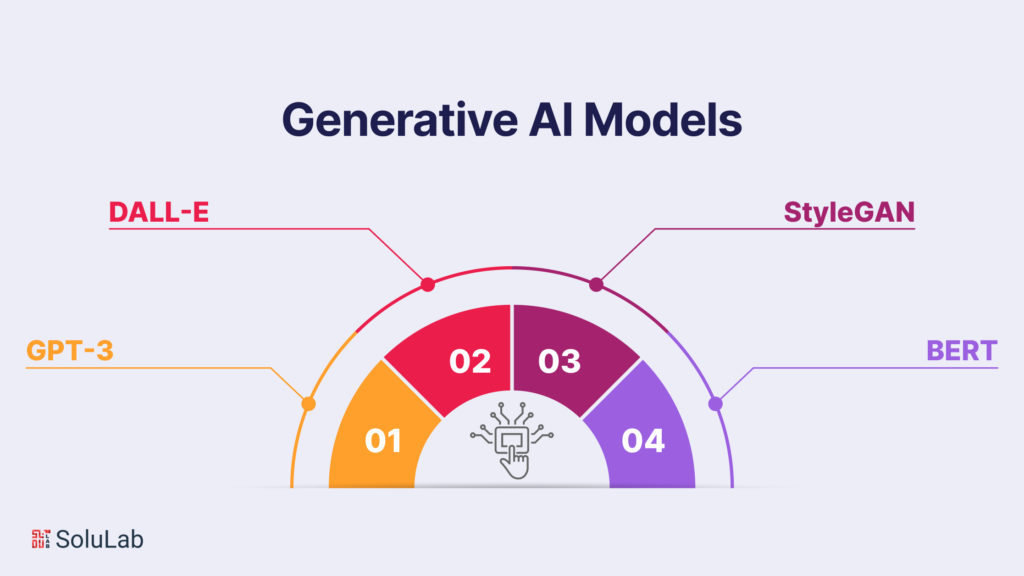
Generative AI is a vast field with numerous models, each designed for specific tasks. Some of the most prominent Generative AI models include:
  • GPT-3 (Generative Pre-trained Transformer 3): Developed by OpenAI, GPT-3 is a language-based model capable of generating human-like text. It has gained immense attention for its natural language understanding and generation capabilities.
  • DALL-E: Also from OpenAI, DALL-E generates images from text descriptions. It’s known for creating unique and imaginative visual content based on textual prompts.
  • StyleGAN: This model, developed by NVIDIA, is used for generating realistic images, especially faces. It can create high-resolution images of people who don’t even exist.
  • BERT (Bidirectional Encoder Representations from Transformers): Although primarily used for language understanding tasks, BERT has generative capabilities and can be fine-tuned for text generation tasks.

Use Cases of Generative AI

Use Cases of Generative AI

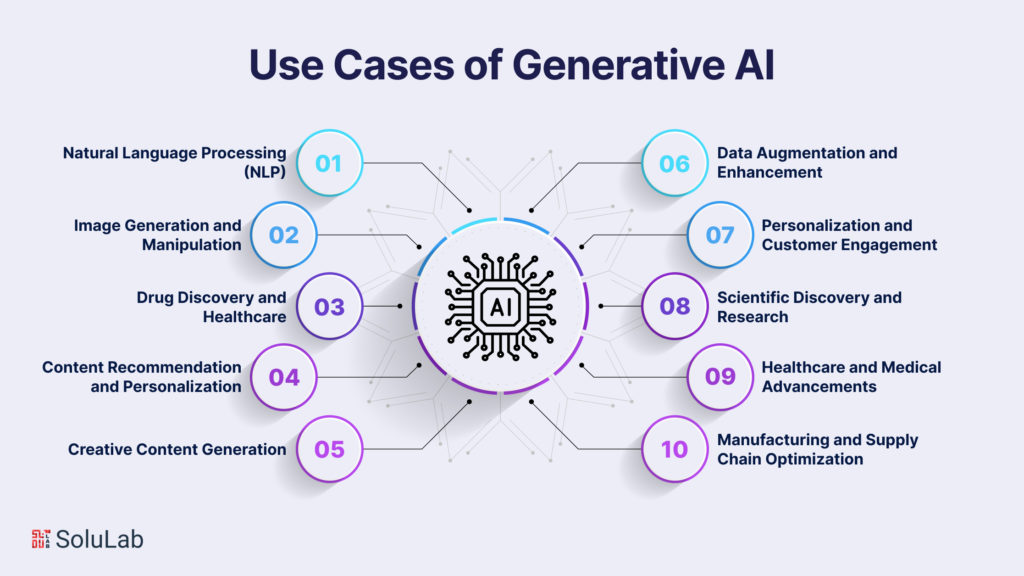
Generative AI, which includes models like GPT-3 and its successors, has a wide range of use cases across various industries. These models have the ability to generate human-like text, images, and even music. Here are some notable use cases of generative AI:

  • Natural Language Processing (NLP)

Generative AI technology has achieved remarkable success in natural language processing tasks. One of the key models driving this progress is GPT-3 (Generative Pre-trained Transformer 3). GPT-3 can generate coherent and contextually relevant text, making it a game-changer for various applications. Content generation is a prominent use case. GPT-3 can generate articles, marketing copy, and even code snippets. This has implications for content creators, businesses, and developers looking to streamline their workflows. Another application is chatbots and virtual assistants. GPT-3 can power chatbots that provide more human-like interactions, enhancing customer support and engagement. OpenAI’s ChatGPT is a prime example of this technology in action.

  • Image Generation and Manipulation

Generative AI models like StyleGAN and DALL-E have reshaped the creative landscape when it comes to images. StyleGAN, for instance, can create photorealistic faces of people who don’t exist. This has implications for the entertainment industry, where CGI characters can be generated with ease. DALL-E, on the other hand, takes textual descriptions and generates corresponding images. This is a boon for designers and artists looking to bring their ideas to life visually. Advertisers can also benefit from this technology by generating visuals for their campaigns.

CTA1

  • Drug Discovery and Healthcare

In the field of drug discovery, Generative AI has made significant strides. It can predict molecular structures and assess their potential as drugs. This accelerates the drug development process, reducing costs and timeframes. Generative AI is also vital in medical image analysis. It can assist radiologists in identifying anomalies in X-rays, MRIs, and CT scans. This not only enhances diagnostic accuracy but also speeds up the process, which is crucial in healthcare.

  • Content Recommendation and Personalization

Generative AI plays a crucial role in content recommendation systems. It can analyze user behavior and preferences to generate personalized recommendations. Streaming platforms like Netflix and music services like Spotify rely on these algorithms to keep users engaged. Moreover, e-commerce platforms use Generative AI to suggest products based on user browsing and purchase history. This leads to increased sales and customer satisfaction. As AI continues to improve its understanding of user preferences, these recommendations will become even more accurate and effective.

  • Creative Content Generation

Generative AI has transformed the way creative content is produced. Whether it’s generating text, images, music, or videos, Generative AI can assist or even take the lead in content creation. This has implications for content creators, marketers, and artists, who can now harness AI’s creative power to streamline their workflows and push the boundaries of their craft.

  • Data Augmentation and Enhancement

In data-driven fields like machine learning and research, Generative AI plays a vital role in data augmentation. By generating synthetic data that mimics real-world data, it helps improve the robustness and performance of AI models. Additionally, Generative AI can enhance low-quality images or videos, making them more usable and visually appealing.

  • Personalization and Customer Engagement

Generative AI has revolutionized personalization in customer experiences. Chatbots and virtual assistants powered by Generative AI technology can engage customers with human-like interactions, answering queries and providing personalized recommendations. This not only enhances customer satisfaction but also streamlines customer support.

  • Scientific Discovery and Research

Generative AI is a game-changer in scientific research. It can analyze complex datasets, identify patterns, and generate hypotheses that would be challenging for humans to discern. In genomics, AI-driven analysis of DNA sequences is helping uncover genetic patterns related to diseases and traits. Similarly, in materials science, AI models are aiding in the discovery of new materials with unique properties, potentially revolutionizing various industries.

  • Healthcare and Medical Advancements

The healthcare industry benefits immensely from Generative AI. It can assist radiologists in identifying anomalies in medical images like X-rays, MRIs, and CT scans, enhancing diagnostic accuracy and speed. In drug discovery, Generative AI models simulate molecular structures, significantly accelerating the process. This has the potential to revolutionize the pharmaceutical industry by reducing drug development timelines and costs.

Related: Generative AI in Healthcare

  • Manufacturing and Supply Chain Optimization

Manufacturing and Industry 4.0 are transformed by Generative AI. It plays a significant role in predictive maintenance, where AI models predict when machines or equipment are likely to fail, allowing for timely maintenance and reducing downtime. Supply chain optimization benefits from AI’s ability to forecast demand, optimize inventory levels, and streamline logistics, resulting in cost savings and operational efficiency.
Generative AI Transforming the Industries

Generative AI Transforming the Industries

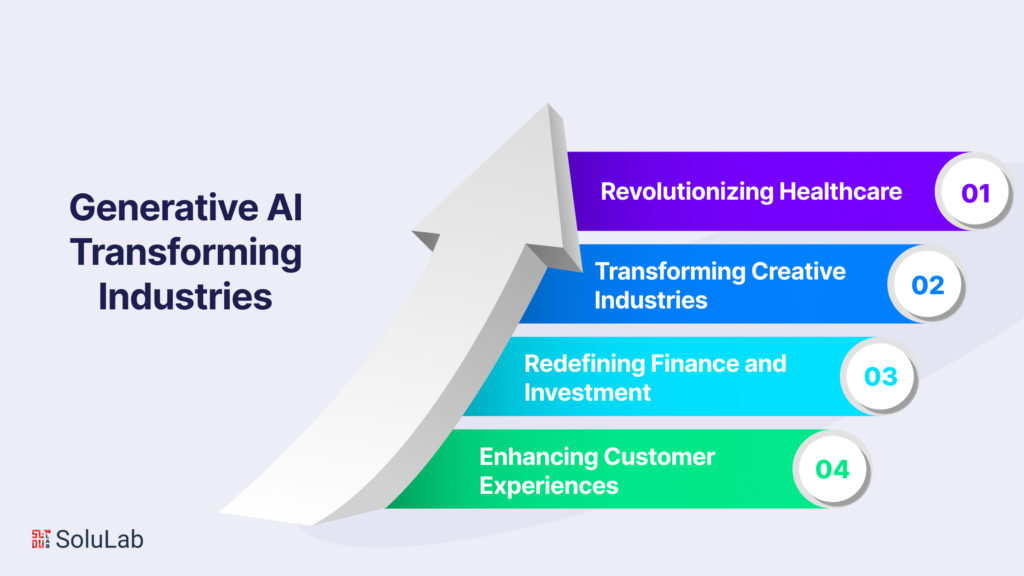
Generative AI has the potential to transform various industries by automating tasks, enhancing creativity, and improving decision-making processes. Here’s a look at how generative AI can impact different sectors:

  • Revolutionizing Healthcare

Generative AI industries are ushering in a revolution in healthcare. Its ability to analyze vast amounts of medical data and generate insights is invaluable. For instance, Generative AI can help in medical image analysis, assisting radiologists in detecting anomalies in X-rays or MRIs with high accuracy. Moreover, it can be used to predict disease outbreaks by analyzing global health data and recognizing patterns that humans might overlook. In drug discovery, Generative AI models can simulate molecular structures, significantly accelerating the process. Traditional drug discovery often takes years, but with the aid of AI-generated compounds, this timeline can be drastically reduced. Companies like Insilico Medicine are at the forefront of using Generative AI for drug development.

  • Transforming Creative Industries

The creative landscape is experiencing a paradigm shift thanks to Generative AI. One of the most notable examples is the art generation. Generative models like DALL-E can take textual descriptions and turn them into stunning and imaginative visual art. This has opened up new avenues for artists and designers, allowing them to explore ideas that were previously unattainable. Music composition is another area being transformed. AI can analyze existing music and create original compositions in various styles. This is not about replacing musicians but rather collaborating with AI to enhance creativity. Projects like AIVA are producing beautiful symphonies, demonstrating how Generative AI can be a muse for human artists.

  • Redefining Finance and Investment

The financial sector is no stranger to data-driven decision-making, and Generative AI is taking it to the next level. In trading, AI models can analyze vast datasets in real-time, identifying trading patterns and making split-second decisions. Hedge funds and asset management firms are increasingly relying on AI-powered trading algorithms to gain an edge in the market. Risk assessment is another critical area. Banks and insurance companies use Generative AI industries to predict creditworthiness and assess insurance claims. This not only speeds up processes but also enhances accuracy. It’s a win-win for businesses and customers.

  • Enhancing Customer Experiences

Generative AI is redefining customer experiences across industries. Chatbots and virtual assistants powered by Generative AI can provide more human-like interactions, solving customer queries and offering personalized recommendations. This not only improves customer satisfaction but also reduces the workload of customer support teams. In e-commerce, Generative AI models can generate product descriptions, reviews, and even personalized shopping suggestions. This enhances the overall shopping experience, leading to increased sales and customer loyalty. Retail giants like Amazon are already using AI to improve product recommendations.
Trends in Generative AI

Trends in Generative AI

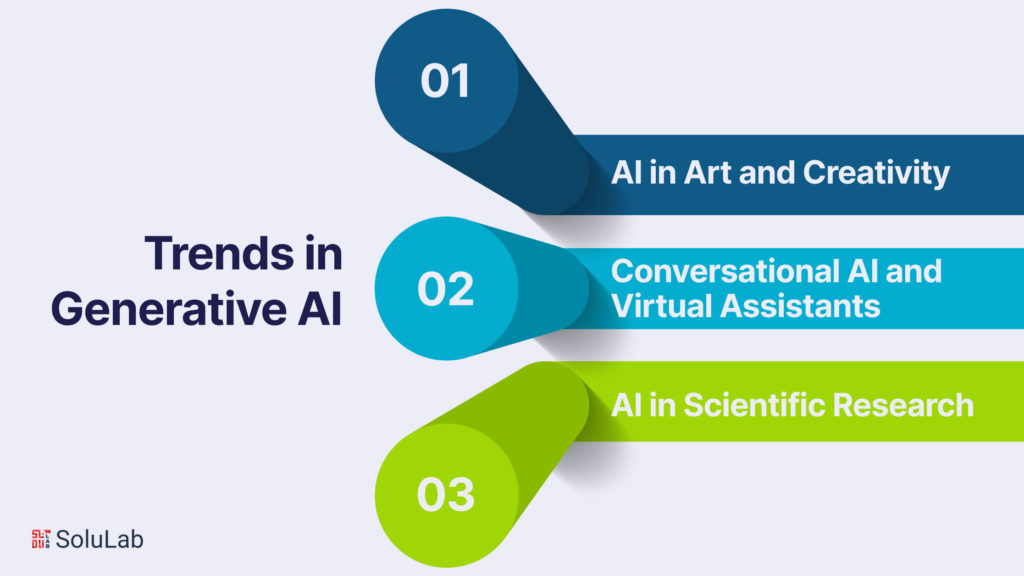
Generative AI is a rapidly evolving field, and several trends have emerged in 2023. These Generative AI trends continue to shape the development and applications of generative AI:

  • AI in Art and Creativity

The intersection of AI and creativity is a hotbed of innovation. Artists and designers are increasingly collaborating with Generative AI to push the boundaries of what’s possible. AI-generated art exhibitions are gaining popularity, blurring the lines between human and machine creativity. In music, AI-generated compositions are becoming more intricate and emotionally resonant. AI-generated literature and poetry are also emerging as fascinating experiments in generative AI & human-AI collaboration. The future of creative expression may well be a fusion of human ingenuity and AI assistance.

  • Conversational AI and Virtual Assistants

Conversational AI powered by Generative AI models is making waves in customer service and virtual assistants. These AI systems are becoming more conversational and context-aware, making interactions with AI-driven chatbots and virtual assistants feel increasingly human. Voice assistants like Siri, Alexa, and Google Assistant are also benefiting from Generative AI. They can generate natural-sounding responses and hold more dynamic and context-aware conversations. As AI becomes more integrated into our daily lives, conversational AI will continue to evolve.

  • AI in Scientific Research

Generative AI is transforming scientific research by accelerating data analysis and hypothesis generation. Researchers can use AI models to analyze complex datasets, identify patterns, and generate hypotheses that would be challenging for humans to discern. In fields like genomics, AI-driven analysis of DNA sequences is helping scientists uncover genetic patterns related to diseases and traits. Similarly, in materials science, AI models are aiding in the discovery of new materials with unique properties. These applications have the potential to revolutionize scientific discovery and innovation.
Tools and Frameworks of Generative AI

Tools and Frameworks of Generative AI

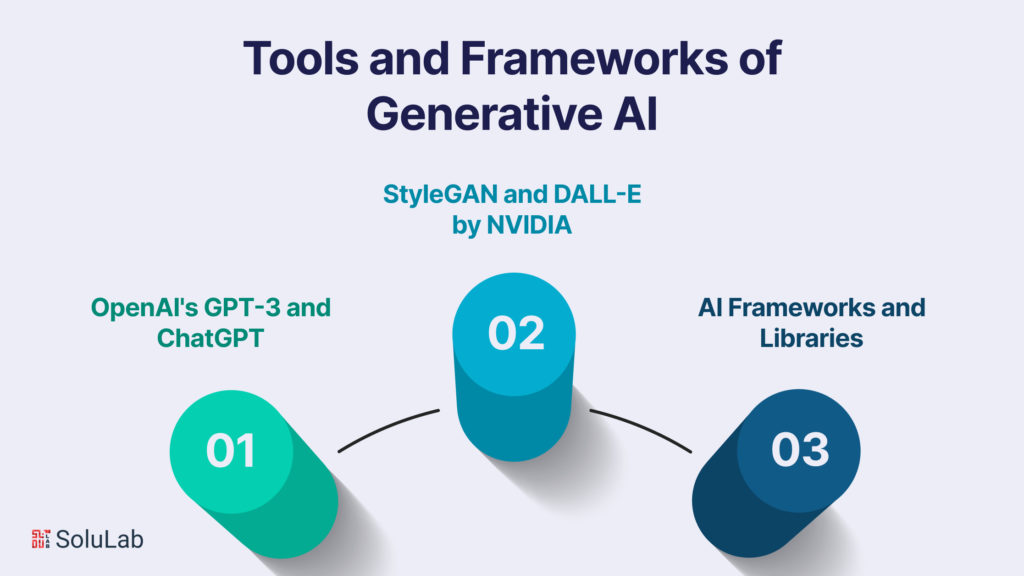
Generative AI relies on various tools and frameworks to develop, train, and deploy models for generating text, images, and other types of content. Here are some of the notable tools and frameworks commonly used in the field of generative AI:

  • OpenAI’s GPT-3 and ChatGPT

OpenAI’s GPT-3 is one of the most prominent Generative AI models available. It’s capable of a wide range of natural language processing tasks, making it a versatile tool for content generation, chatbots, and more. Developers can access GPT-3 through OpenAI’s API, allowing them to integrate it into their applications. ChatGPT, a sibling model to GPT-3, is specifically designed for chatbot applications. It powers human-like conversations and can be customized for various use cases. Developers can fine-tune ChatGPT to create chatbots that suit specific industries and customer needs.

  • StyleGAN and DALL-E by NVIDIA

NVIDIA’s StyleGAN and DALL-E have revolutionized image generation and manipulation. StyleGAN, known for its ability to create realistic faces, is available as an open-source tool. It’s widely used by artists, designers, and developers to generate high-quality images. DALL-E, another creation from NVIDIA, is currently in research and development. It has the potential to be a groundbreaking tool for generating images from textual descriptions. As these tools evolve, they are likely to become even more accessible to creative professionals.

  • AI Frameworks and Libraries

Various AI frameworks and libraries empower developers to work with Generative AI. TensorFlow and PyTorch are two popular frameworks that offer tools and resources for building and training AI models, including generative models. These frameworks come with pre-built models and tutorials to kickstart projects. Additionally, specialized libraries like Hugging Face Transformers provide pre-trained models for natural language processing tasks. These libraries simplify the process of incorporating Generative AI into applications, making it more accessible to developers.
Future Prospects of Generative AI

Future Prospects of Generative AI

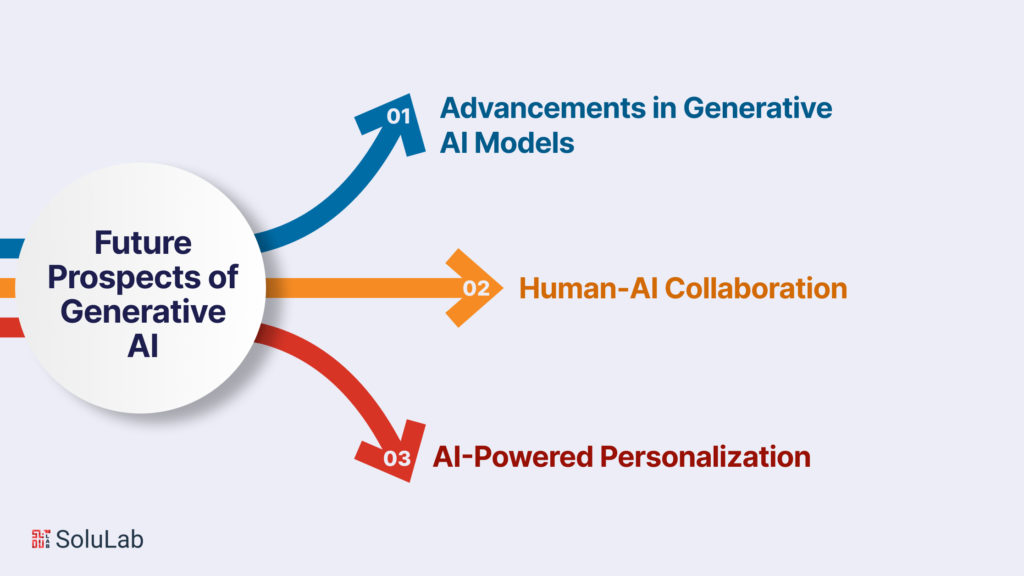
The future prospects of generative AI are promising and are expected to bring about significant advancements and transformations across various domains. Here are some of the key future prospects and trends for generative AI:

  • Advancements in Generative AI Models

The future of Generative AI promises even more advanced models that can create content of unprecedented quality. Researchers are working on refining existing models like GPT-3 and developing new architectures that can generate highly realistic text, images, and multimedia content.

  • Human-AI Collaboration

Generative AI will increasingly be seen as a creative tool, facilitating collaboration between humans and machines in various creative fields. Musicians, writers, artists, and designers will incorporate AI into their creative processes, pushing the boundaries of what’s possible.

  • AI-Powered Personalization

Generative AI technology will continue to enhance personalization in various industries, from entertainment to e-commerce. AI will better understand individual preferences and deliver highly tailored content, products, and experiences. This will lead to higher customer satisfaction and engagement.
CTA2

Conclusion

In conclusion, Generative AI has emerged as a transformative force across industries, revolutionizing content creation, data augmentation, personalization, and more. Its ability to generate creative and contextually relevant content is reshaping how businesses operate and innovate. As we’ve explored, Generative AI is not only a technological breakthrough but also a catalyst for efficiency, creativity, and innovation.

In this rapidly evolving landscape, staying ahead in Generative AI development is crucial. Businesses seeking to harness the full potential of Generative AI can benefit from Generative AI development services and solutions. These services encompass a spectrum of offerings, from custom Generative AI model development to consulting services that guide organizations in integrating Generative AI into their workflows.

When it comes to Generative AI development services, SoluLab stands out as a leading partner. With a team of top Generative AI developers and experts, SoluLab offers comprehensive Generative AI development solutions tailored to your specific needs. Whether you aim to automate content generation, enhance data quality, or innovate in your industry, SoluLab’s Generative AI consulting services can help you achieve your goals. By partnering with SoluLab and leveraging their expertise in Generative AI development, businesses can unlock new possibilities, streamline operations, and pioneer innovation in their respective domains. As Generative AI continues to evolve, SoluLab remains at the forefront, empowering businesses to thrive in a generative AI-powered future.

FAQs

1. What is Generative AI, and how does it differ from other AI models?

Generative AI is a subset of artificial intelligence that focuses on creating data, content, or solutions autonomously. Unlike other AI models that primarily analyze and interpret existing data, Generative AI has the unique ability to generate new and original content, making it a powerful tool for creative tasks, data augmentation, and personalization.

2. What are some prominent use cases of Generative AI technology?

Generative AI technology finds application in various industries, including content generation, data augmentation, personalized recommendations, scientific research, healthcare, finance, manufacturing, and more. Specific use cases include generating creative content, enhancing data quality, optimizing supply chains, and predicting financial trends.

3. How is Generative AI transforming industries?

Generative AI is driving significant transformations across industries by automating tasks, improving efficiency, and fostering innovation. In entertainment, it’s revolutionizing content creation; in healthcare, it’s accelerating drug discovery; and in finance, it’s enhancing risk management and forecasting.

4. What are the key trends in the Generative AI landscape?

Some key trends in the Generative AI landscape include the rapid evolution of Generative AI models, ethical considerations related to AI-generated content, privacy and security concerns, and the development of regulatory frameworks. Additionally, collaborative AI, where humans work alongside Generative AI systems, is gaining prominence.

5. How can businesses benefit from Generative AI development services?

Businesses can benefit from Generative AI development services by leveraging the expertise of top Generative AI developers to build custom AI models tailored to their needs. These services enable organizations to automate processes, enhance content quality, and innovate in their industries.

6. What sets SoluLab apart in the field of Generative AI development?

SoluLab distinguishes itself in Generative AI development by offering comprehensive solutions and consulting services. With a team of top Generative AI developers, SoluLab provides customized Generative AI development services, empowering businesses to harness the power of AI for content generation, data enhancement, and innovation.

7. How can I hire top Generative AI developers for my project?

To hire top Generative AI developers, you can reach out to experienced AI development firms like SoluLab. They have a pool of skilled professionals with expertise in Generative AI technology. By partnering with such firms, you gain access to top talent to bring your AI projects to life.

Generative AI and Human-AI Collaboration: A Look into the Future

Generative AI and Human-AI Collaboration: A Look into the Future

Generative Artificial Intelligence (AI), often referred to as Generative AI, is a cutting-edge branch of artificial intelligence that revolves around the creation of autonomous systems capable of producing content that is original, creative, and indistinguishable from human-generated output. Unlike traditional AI models, which primarily focus on data analysis and pattern recognition, Generative AI seeks to simulate human creativity and generate content autonomously, such as text, images, music, and even entire narratives.

Generative AI leverages deep learning techniques, including neural networks such as Generative Adversarial Networks (GANs) and Transformers, to understand patterns, styles, and contexts from vast datasets. This understanding allows it to generate content that is contextually relevant, coherent, and, in many cases, aesthetically pleasing. Whether it’s generating realistic images from textual descriptions or composing coherent and context-aware text, Generative AI holds immense potential to reshape various industries and human-machine interactions.

This blog intends to shed light on the revolutionary influence of generative artificial intelligence, how it is positioned to revolutionize numerous sectors, and the ways in which it might enhance human skills. Additionally, it emphasizes the necessity for the ethical and responsible integration of AI technology into our daily lives while exploring the collaboration possibilities of humans and AI.

Read Our Blog Post: Exploring the Current State of Generative AI: An In-Depth Analysis

How Does Generative AI Contribute to the Collaboration Between Humans and AI?

The journey of AI development has been a remarkable odyssey marked by ingenuity, persistence, and the pursuit of emulating human intelligence. The roots of AI can be traced back to ancient civilizations, where myths and legends often featured artificial beings, embodying mankind’s fascination with creating intelligent life. However, the modern era of AI development took shape in the mid-20th century.

In the 1950s and 1960s, the foundational concepts of AI were established, including symbolic reasoning and problem-solving. Pioneers like Alan Turing and John McCarthy laid the groundwork for AI by proposing theories and developing early computer programs that demonstrated machine learning capabilities.

What are the Key Advancements in AI Technology Over the Years?

Key Advancements in AI Technology

The journey of AI development has been a remarkable odyssey marked by ingenuity, persistence, and the pursuit of emulating human intelligence. The roots of AI can be traced back to ancient civilizations, where myths and legends often featured artificial beings, embodying mankind’s fascination with creating intelligent life. However, the modern era of AI development took shape in the mid-20th century.

In the 1950s and 1960s, the foundational concepts of AI were established, including symbolic reasoning and problem-solving. Pioneers like Alan Turing and John McCarthy laid the groundwork for AI by proposing theories and developing early computer programs that demonstrated machine learning capabilities.

Advancements in AI Technology

Advancements in AI technology have been nothing short of revolutionary, particularly in the past few decades. The evolution of AI can be categorized into several key phases:

CTA1

  • Expert Systems

In the 1970s and 1980s, AI development saw the rise of expert systems, and rule-based programs that could simulate human expertise in specific domains. This era marked the first practical applications of AI in fields like medicine and finance.

  • Machine Learning

The late 20th century saw a shift toward machine learning approaches, where AI systems learned from data. Techniques such as neural networks and decision trees emerged, enabling AI to make predictions and classify data with increasing accuracy.

  • Big Data

The advent of big data in the 21st century provided AI with massive datasets to train on. This led to breakthroughs in natural language processing, computer vision, and recommendation systems, transforming industries like e-commerce, healthcare, and entertainment.

  • Deep Learning

Deep learning, characterized by deep neural networks, emerged as a dominant AI paradigm. This technology powered significant advancements in image recognition, speech synthesis, and autonomous vehicles.

What is the Role of Generative AI in AI Development?

Role of Generative AI in AI Development

Generative AI stands at the forefront of AI development, playing a pivotal role in shaping the future of human-AI collaboration and the quest for artificial general intelligence (AGI). Generative AI encompasses a wide range of generative AI models, including Generative Adversarial Networks (GANs) and Transformers, which have revolutionized content generation and manipulation.

1. Human-AI Collaboration

Generative AI fosters collaboration between humans and machines by augmenting human creativity and productivity. It enables artists, writers, and designers to generate novel content, while also assisting professionals in tasks like data augmentation and content generation.

2. AI Development Services

The growth of Generative AI has spurred the emergence of specialized AI development services. Companies and organizations can now leverage these services to harness the power of Generative AI in their projects, further accelerating AI development across industries.

3. AGI Aspiration

Generative AI plays a crucial role in the pursuit of artificial general intelligence. Its ability to generate coherent and context-aware content brings us closer to creating AI systems that can understand and perform tasks across diverse domains, ultimately blurring the lines between AI and human intelligence.

4. Ethical Considerations

The rapid development of Generative AI also raises ethical concerns, particularly in terms of content manipulation and potential misuse. Thus, as the Generative AI landscape continues to evolve, ethical frameworks and responsible practices must be integral to AI development.

What are the Benefits of Collaboration Between Humans and AI?

Benefits of Collaboration Between Humans and AI

Collaboration between humans and AI, often referred to as human-AI collaboration, offers a multitude of benefits and advantages in the field of AI development and its real-world applications. Here’s a detailed exploration of these advantages:

  • Complementary Skillsets

Collaborative artificial intelligence leverages the strengths of both humans and AI. While humans excel in creativity, emotional intelligence, and contextual understanding, AI systems possess rapid data processing capabilities, precision, and scalability. Together, they can complement each other’s skill sets.

  • Enhanced Decision-Making

In various industries such as healthcare, finance, and cybersecurity, human-AI collaboration results in improved decision-making. AI can process vast amounts of data quickly, providing insights that humans might miss. Humans, on the other hand, can add critical judgment and ethical considerations to AI-generated recommendations.

  • Efficiency and Productivity

AI can automate repetitive and time-consuming tasks, freeing up human workers to focus on more complex and creative aspects of their jobs. This leads to increased efficiency and productivity in the workplace.

  • Cost Reduction

Integrating AI into processes can significantly reduce operational costs. AI-powered chatbots, for example, can handle customer queries 24/7, reducing the need for round-the-clock human customer support.

  • Personalization

Human-AI collaboration enables businesses to offer personalized experiences to their customers. AI algorithms can analyze user data and preferences to provide tailored recommendations, while humans can ensure that these recommendations align with brand values.

  • Risk Mitigation

In industries like aviation and healthcare, the collaboration between humans and AI helps in risk mitigation. Pilots and doctors, for instance, can rely on AI systems for real-time data analysis and diagnosis, reducing the chances of human errors.

  • Innovation and Creativity

AI can assist humans in creative tasks, such as content generation, art creation, and product design. Generative AI tools empower artists and designers by providing new perspectives and ideas. In the field of writing, for example, creators often use an AI to human text converter or an AI text humanizer to ensure that AI-generated content sounds natural, context-appropriate, and aligned with human tone and expression.

What are the Real-World Applications of Human-AI Collaboration?

Real-World Applications of Human-AI Collaboration

Human-AI collaboration has rapidly emerged as a transformative force across various industries, revolutionizing the way we approach problem-solving, decision-making, and innovation. The fusion of human expertise with the capabilities of AI development services and Generative AI tools has led to remarkable real-world applications. Here, we explore some of these applications:

1. Healthcare

  • Diagnostic Assistance

Human-AI collaboration aids healthcare professionals in diagnosing diseases more accurately. AI algorithms analyze medical images, such as X-rays and MRIs, and highlight potential issues for doctors to review.

  • Drug Discovery

AI systems process vast datasets to identify potential drug candidates, expediting the drug development process and enhancing the discovery of novel treatments.

2. Finance

  • Algorithmic Trading

Financial institutions use AI-powered algorithms to make split-second trading decisions, maximizing returns and minimizing risks.

  • Customer Service

Chatbots and virtual assistants handle customer inquiries, streamline account management, and offer financial advice, improving customer service efficiency.

Read Our Case Study: Generative AI in Banking and Finance

3. Manufacturing

  • Collaborative Robotics

Collaborative artificial intelligence robots (cobots) work alongside human workers on factory floors, automating repetitive tasks and ensuring precision in manufacturing processes.

  • Predictive Maintenance

AI predicts when machinery in manufacturing plants requires maintenance, reducing downtime and improving overall equipment efficiency.

4. Customer Service

  • Personalized Support

AI-driven systems analyze customer data to provide personalized recommendations and assistance, enhancing customer satisfaction.

  • Language Translation

AI-powered language translation tools enable businesses to communicate effectively with global customers and partners.

5. Education

  • Personalized Learning

AI in education adapts educational content to individual students’ abilities and learning styles, improving engagement and learning outcomes.

  • AI Tutors

AI tutors assist students in understanding complex topics and provide instant feedback on assignments and quizzes.

6. Content Creation

  • Text Generation

Generative AI tools generate high-quality written content for marketing, journalism, and creative writing.

  • Art and Design

AI-powered tools assist artists and designers in generating visual content and creative concepts.

7. Transportation

  • Autonomous Vehicles

Self-driving cars and trucks utilize AI to navigate roads, enhancing safety and potentially reducing traffic congestion.

  • Traffic Management

AI systems optimize traffic flow in smart cities, reducing commute times and improving transportation efficiency.

Related: The impact of AI in Transportation

8. Space Exploration

  • Data Analysis

AI processes and analyzes data from space missions, aiding scientists in discovering new insights about our universe.

  • Robotics

AI-powered robots are deployed on celestial bodies to conduct experiments and gather data.

How Will Human-AI Collaboration Change in the Future?

How Will Human-AI Collaboration Change in the Future?

The future of AI development and collaboration between humans and AI systems holds immense promise and transformative potential. As we look ahead, several Generative AI trends are poised to shape the landscape of Human-AI collaboration:

  • Advanced Generative AI

Generative AI tools will continue to evolve, enabling machines to create content with even greater sophistication. These AI systems will be able to generate high-quality text, images, videos, and music, revolutionizing content creation and artistic endeavors.

  • AI Development Services

The demand for AI development services will surge, driven by businesses seeking to harness the power of AI for automation, optimization, and innovation. AI development companies will play a crucial role in providing tailored solutions across industries.

  • Artificial General Intelligence (AGI)

While AGI remains a long-term goal, we can expect progress toward systems with broader problem-solving capabilities. AGI could revolutionize fields like healthcare, finance, and research, where complex decision-making is crucial.

  • Ethical Frameworks

Ethical considerations in Collaborative artificial intelligence will gain prominence. The development of responsible AI, privacy safeguards, and AI transparency will be key areas of focus to ensure that AI benefits society without causing harm.

  • Cross-Industry Impact

AI will continue to permeate various industries, including healthcare, finance, manufacturing, and education. In healthcare, AI-powered diagnostics and personalized treatments will improve patient outcomes. In finance, AI will enhance fraud detection and investment strategies.

  • Human-AI Synergy

Rather than replacing human jobs, AI will increasingly augment human capabilities. Collaborative artificial intelligence robots and AI assistants will become commonplace in workplaces, helping humans perform tasks more efficiently.

  • Generative AI Development Services

SoluLab is at the forefront of providing cutting-edge Generative AI development services that empower businesses to harness the full potential of AI-driven generative technologies. As a trusted partner in AI development solutions, SoluLab offers a comprehensive suite of services that cater to diverse industry needs, ensuring innovation, efficiency, and competitiveness.

Ethical Considerations in Human-AI Collaboration

The growth of Human-AI collaboration brings forth critical ethical considerations:

  • Bias Mitigation

Ethical AI development will prioritize the mitigation of biases in AI algorithms, ensuring fair and unbiased decision-making across diverse populations.

  • Data Privacy

Protecting individuals’ data privacy will remain paramount. Stricter regulations and robust data protection mechanisms will be implemented to safeguard user information.

  • Transparency

AI systems must be transparent, providing explanations for their decisions. This transparency is crucial for accountability and user trust.

  • Accountability

Establishing clear lines of accountability for AI systems’ actions will be essential. When AI is involved in critical decisions, responsibility must be clearly defined.

  • Job Displacement

Addressing the potential displacement of jobs due to automation, retraining programs, and policies to support affected workers will be crucial.

Potential Impact of Human-AI Collaboration on Various Industries

The impact of Human-AI collaboration will vary across industries:

  • Healthcare

AI will accelerate drug discovery, enhance diagnostics, and personalize treatment plans, improving patient outcomes and reducing healthcare costs.

  • Finance

AI will enhance risk assessment, fraud detection, and investment strategies, making financial systems more efficient and secure.

  • Manufacturing

Smart factories powered by AI will optimize production processes, leading to increased productivity and reduced waste.

Check Out Our Blog: Generative AI in Manufacturing – Benefits and Use Cases

  • Education

AI-driven personalized learning platforms will cater to individual student needs, improving educational outcomes.

  • Entertainment

Generative AI will transform content creation, enabling the production of highly customized and engaging media.

  • Transportation

Self-driving vehicles and AI-optimized traffic management will improve road safety and reduce congestion.

CTA2

Conclusion

In conclusion, the future of AI development and human-artificial intelligence collaboration holds immense promise, and SoluLab stands at the forefront of this transformative journey. 

With its expertise in Generative AI and a dedicated team of Generative AI developers, SoluLab is well-equipped to lead the way in harnessing the potential of generative AI tools. The synergy between Generative AI and Human collaboration not only paves the path towards achieving artificial general intelligence but also fosters a future where AI augments and complements human intelligence.

SoluLab’s commitment to providing top-notch Generative AI development services reaffirms their dedication to empowering businesses and industries with cutting-edge AI solutions. As we embark on this exciting journey into the future, SoluLab’s role as a trailblazer in the realm of Generative AI and human-AI collaboration is pivotal. 

So, if you’re looking to unlock the full potential of Generative AI, there’s no better choice than to hire the top Generative AI developers at SoluLab. Together, we can shape a world where the fusion of AI and human intelligence leads to unprecedented advancements and possibilities. Connect with SoluLab today to embark on this transformative journey.

FAQs

1. What is Generative AI, and how does it relate to Human-AI Collaboration?

Generative AI is a subset of artificial intelligence development that focuses on creating systems capable of generating content, such as text, images, or music, autonomously. Human-AI collaboration refers to the synergy between human intelligence and AI technologies. In the future, Generative AI will play a crucial role in enhancing this collaboration by assisting and augmenting human creativity and productivity.

2. How can Generative AI tools benefit the Development of Artificial Intelligence?

Generative AI tools can streamline the AI development process by automating the generation of code, data, and even design elements. They can assist AI developers in creating models, generating datasets, and optimizing algorithms, making the entire AI development cycle more efficient and productive.

3. What are the potential applications of Generative AI and Human-AI Collaboration?

The applications are vast, ranging from content generation, data analysis, and creative arts to scientific research, healthcare, and autonomous systems. Human-AI collaboration can bring about groundbreaking innovations and efficiencies across various industries.

4. Can Generative AI contribute to the development of artificial general intelligence (AGI)?

Yes, Generative AI plays a role in AGI development. It aids in creating more capable and versatile AI systems, which is a step towards achieving artificial general intelligence. Human-AI collaboration will be instrumental in advancing AGI research.

5. How can I find Generative AI development services or hire top Generative AI developers?

You can find Generative AI development services and hire skilled developers through AI development agencies, freelance platforms, or by reaching out to AI research institutions. Ensure that you assess the expertise, portfolio, and experience of developers or service providers to meet your specific project needs.

6. Are there any ethical concerns related to Generative AI and Human-AI Collaboration?

Yes, ethical concerns such as bias in AI-generated content, job displacement, and privacy issues must be addressed. Human-AI collaboration requires careful consideration of ethical guidelines and regulations to ensure responsible and fair AI development and usage.
