Talk to an Expert

The Impact of the Metaverse on Education and Learning

The Impact of the Metaverse on Education and Learning

The digital age has ushered in a wave of technological innovations that are transforming the way we live, work, and interact with the world around us. One of the most exciting and potentially revolutionary concepts to emerge in recent years is the Metaverse. A term that was once confined to the realms of science fiction and virtual gaming has now become a tangible and increasingly significant part of our digital reality.

The Metaverse, often described as a virtual, interconnected universe, has the power to change not only how we socialize and entertain ourselves but also how we educate and learn. In this blog, we will embark on an exploration of the Metaverse learning’s profound impact on education and learning.

So, let’s get started!

Understanding the Metaverse

Before we delve into its implications for education, it’s essential to grasp what the Metaverse is. In essence, the Metaverse is a digital universe, an expansive, interconnected realm where users can interact with each other and computer-generated environments. It blurs the lines between the physical and digital worlds, offering diverse experiences that can include social interactions, gaming, commerce, and, intriguingly, education.

Imagine a world where students can explore ancient civilizations in a virtual history class, collaborate on scientific experiments with peers from across the globe, or even conduct job interviews in a completely immersive virtual environment. This is the promise of the Metaverse in Education.

The Current Educational Landscape

To appreciate the potential impact of the Metaverse development, it’s essential to consider the current state of education. Traditional education methods have evolved over the centuries but remain largely classroom-centered, with students and teachers physically present. The internet and online learning platforms have brought about significant changes, offering flexibility and access to a wealth of resources.

However, challenges persist. Some students face barriers to access, and the one-size-fits-all approach to education doesn’t cater to individual learning styles. This is where the Metaverse comes into play, offering innovative solutions to these longstanding issues.

CTA1

The Potential of the Metaverse in Education

The concept of the Metaverse, a virtual, interconnected universe, has taken the world by storm, capturing the imagination of innovators and educators alike. Beyond its applications in gaming and entertainment, the Metaverse holds immense potential for the realm of education. In this section, we will delve deeper into the possibilities it offers and how it might reshape the way we teach and learn.

  • Immersive and Interactive Learning: The Metaverse provides an unprecedented level of immersion. Students can virtually step into historical events, explore complex scientific concepts, or even practice language skills in virtual environments. This immersive learning can make educational content more engaging and memorable.
  • Accessibility and Inclusivity: The Metaverse has the potential to bridge the digital divide. With the right infrastructure, students from all backgrounds can access the same high-quality educational experiences, creating a more inclusive learning environment.

Read Our Blog: Is Metaverse the Future of Digital Connection?

  • Personalized Learning Journeys: In the Metaverse, learning can be tailored to the individual. Smart algorithms can adapt content and experiences to match each student’s pace and preferences, making education more effective and enjoyable.
  • Collaboration and Social Learning: Just as in the physical world, students can collaborate and learn from one another. The Metaverse enables social interactions and group projects, enhancing the social aspects of learning.

The potential is vast, and as the technology matures, we are likely to see even more innovative applications in education.
How Does the Metaverse in Education Differ from the Internet and Virtual Reality?

How Does the Metaverse in Education Differ from the Internet and Virtual Reality?

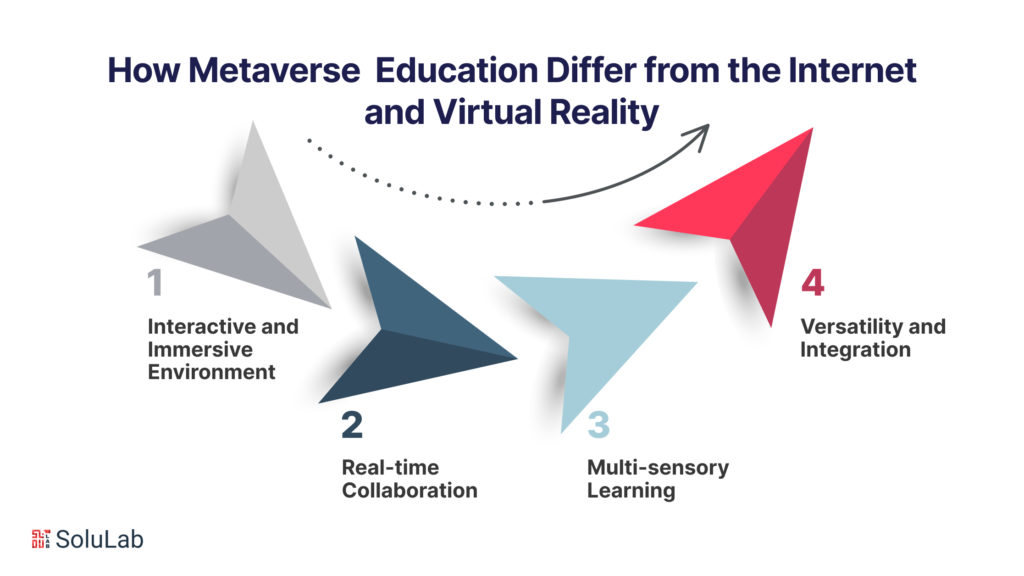
The integration of the Metaverse into education represents a significant departure from both the traditional Internet and virtual reality (VR). The Metaverse creates interactive and immersive environments where students can engage with one another and computer-generated worlds. It goes beyond the traditional internet by offering real-time interactions, socialization, and a sense of presence, similar to in-person experiences. In education, this translates to dynamic, 3D learning spaces and experiences that closely resemble real-world interactions, with the involvement of Metaverse development companies providing cutting-edge technological advancements. While there are similarities, there are also crucial differences that set the Metaverse apart. Let’s explore these distinctions:

Interactive and Immersive Environments

  • Metaverse: The Metaverse creates interactive and immersive environments where students can engage with one another and computer-generated worlds. It goes beyond the traditional internet by offering real-time interactions, socialization, and a sense of presence, similar to in-person experiences. In education, this translates to dynamic, 3D learning spaces and experiences that closely resemble real-world interactions.
  • Internet: The traditional internet primarily offers static web pages and resources. While it supports e-learning platforms, communication tools, and content sharing, the experience is generally two-dimensional and lacks the depth and immersion that the Metaverse provides.
  • Virtual Reality (VR): VR, on the other hand, is immersive but often isolating. It transports users to entirely virtual environments, but these are usually solitary experiences, making collaborative learning and social interaction more challenging.

Real-time Collaboration

  • Metaverse: The Metaverse enables real-time collaboration and communication within a virtual space. In educational settings, this means students and teachers can interact with each other, engage in discussions, and participate in group activities just as they would in a physical classroom.
  • Internet: While the Internet offers communication tools like email, chat, and video conferencing, these are typically separate from the learning content and often asynchronous. They lack the seamless integration and real-time interactivity that the Metaverse provides.
  • Virtual Reality (VR): VR experiences often lack real-time collaboration features, making them less suitable for synchronous group learning, discussions, and teamwork.

Read Also: Top 15 Metaverse Startups

Multi-sensory Learning

  • Metaverse: The Metaverse offers multi-sensory learning experiences by allowing students to engage with content through sight, sound, and sometimes touch. This enhances the retention and understanding of complex subjects.
  • Internet: The Internet primarily relies on text, images, and videos, offering a limited range of sensory input compared to the Metaverse.
  • Virtual Reality (VR): VR provides immersive sensory experiences, primarily focusing on sight and sound. However, it may lack the same depth of interactivity and the social aspects found in the Virtual Reality Metaverse.

Versatility and Integration

  • Metaverse: The Metaverse is versatile, as it integrates various technologies, including AR and VR, to provide a broad range of educational experiences. It supports diverse learning styles and can cater to a wide array of subjects and disciplines.
  • Internet: The Internet relies on external tools and platforms for specific learning needs, making it less seamless for educators and learners.
  • Virtual Reality (VR): VR is specialized for immersive experiences but may not have the same versatility for a wide range of educational applications as the Metaverse.

In brief, the Metaverse in education stands out by offering interactive, immersive, and real-time learning experiences with an emphasis on collaboration and multi-sensory engagement. While the traditional internet and VR have their respective strengths, the Metaverse combines elements of both to create a transformative educational environment that provides students with a truly unique and holistic learning experience.
Benefits of the Metaverse in Education

Benefits of the Metaverse in Education

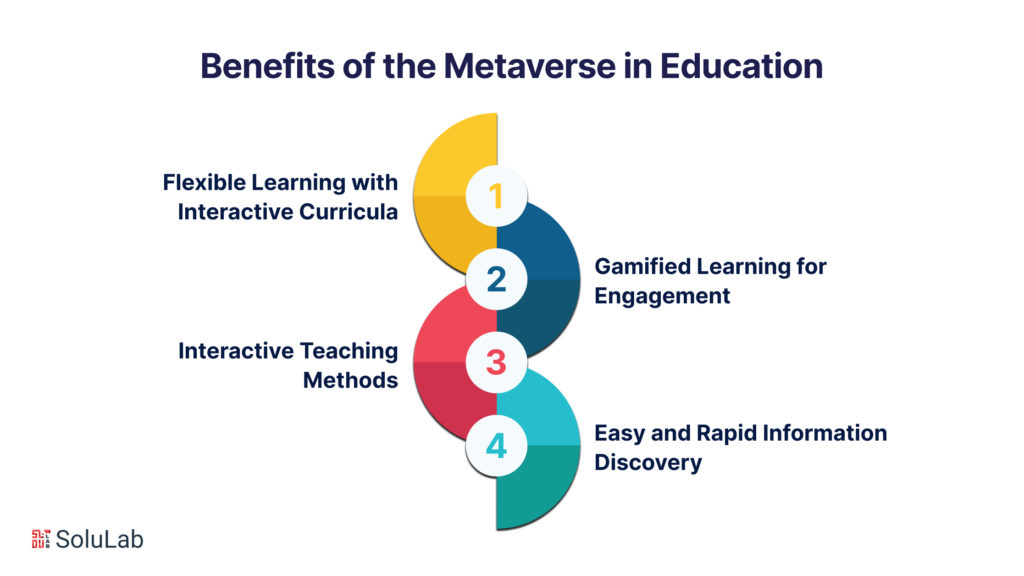
Technology has played a vital role in reshaping education, from virtual cloud-based classrooms and webinars to self-paced learning environments, microlearning applications, and now, with the integration of AR and VR, the introduction of immersive learning experiences. In this section, we’ll focus on the Metaverse’s impact on education and explore its key benefits in the educational sector.

  • Flexible Learning with Interactive Curricula

Explaining concepts interactively in a virtual environment simplifies understanding. For instance, comprehending the solar ecosystem becomes much easier when one can virtually traverse the galaxy, witnessing planet placements and orbits. 

Similarly, understanding rocket launches can be made more accessible by virtually experiencing the process from a space launch station. A virtual 3D classroom setup allows students to observe every detail, from pre-launch preparations to final assembly and technical aspects. Professions demanding practical skills, such as medical surgeries and astrophysics experiments, can be effectively practiced when education converges with the Metaverse.

  • Gamified Learning for Engagement

Gamification keeps learners motivated and engaged. The Metaverse in education can support focused learning by rewarding learners with badges and recognition for completing tasks.

For example, students can explore various geographical areas within the Metaverse to understand their features and environments. They can then create avatars based on the culture of their chosen location and even design the area according to their preferences.

Check Our Blog Post: Metaverse AI: Integrating Artificial Intelligence into Virtual Worlds

  • Interactive Teaching Methods

Effective teaching is essential to making learning interesting. The Metaverse offers numerous opportunities for educators to experiment and engage their students. Realistic social interactions in immersive scenarios enhance collaboration and problem-solving skills. 

Avatars can be used to explain concepts through role-playing techniques, bringing real-life situations into the educational experience. Creating different scenarios within the Metaverse facilitates hands-on, realistic learning experiences.

  • Easy and Rapid Information Discovery

The Metaverse, when used in education, widens access to knowledge. Courses, once created, can be accessed by multiple learners, saving time and resources.

Personalized search results and advanced social collaboration tools enable individualized learning paths that are easily comprehensible and accessible.
Application of Metaverse Technology in Education

Application of Metaverse Technology in Education

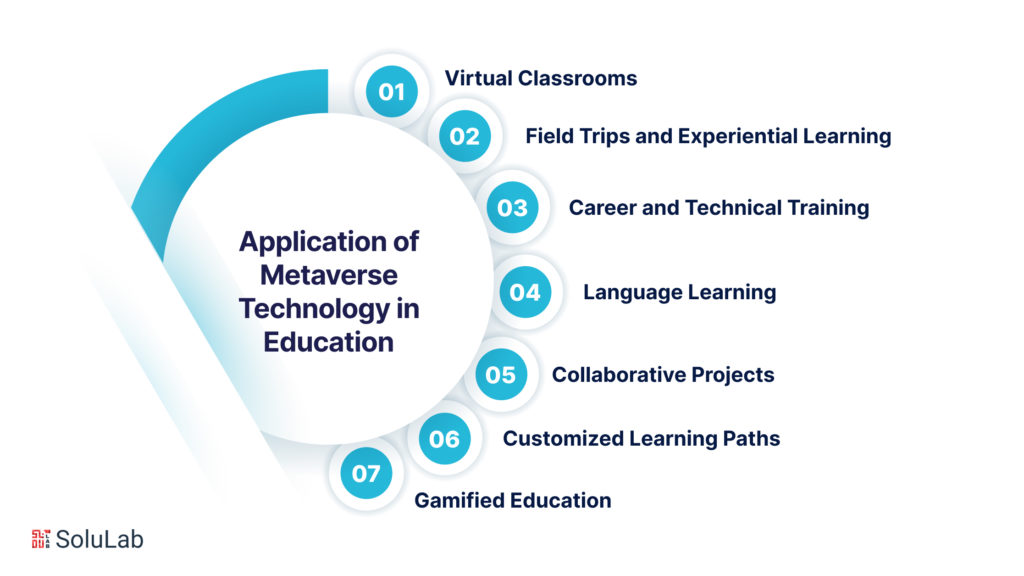
As the Metaverse continues to evolve, it’s making its presence felt in the field of education. With various top Metaverse platforms gaining traction, the possibilities for enhancing the learning experience are growing rapidly. Let’s explore some of the most promising use cases of the Metaverse technology in education.

  • Virtual Classrooms

Metaverse platforms offer an immersive alternative to traditional classrooms. Students and teachers can interact within a virtual environment, attending classes as avatars. This concept brings a new level of engagement, enabling students to explore and interact with the subject matter. Leading platforms such as “Metaverse” and “Decentraland” are increasingly used to create virtual classrooms and lecture halls.

  • Field Trips and Experiential Learning

The Metaverse opens up new horizons for experiential learning. Students can take virtual field trips to historical sites, explore ecosystems, or even journey to outer space. Platforms like “Roblox” and “Minecraft” provide tools for educators to create immersive, educational experiences.

  • Career and Technical Training

Metaverse technology can be particularly beneficial for technical and vocational training. Simulated environments, resembling real-world workplaces, enable students to gain practical experience. For example, medical students can practice surgeries, and aviation students can learn to operate aircraft. Platforms like “Second Life” and “Sansar” have been used to create such training simulations.

Read Also: How Will Metaverse Change the World? A New Era of Connectivity and Innovation!

  • Language Learning

Learning a new language becomes more engaging and effective in the Metaverse. Students can interact with native speakers in virtual environments, participate in role-playing scenarios, and practice language skills in realistic settings. “AltspaceVR” and “VRChat” are platforms that facilitate language exchange and practice.

  • Collaborative Projects

Metaverse platforms foster collaboration among students and educators, no matter where they are located. Group projects, workshops, and discussions become more dynamic and interactive. “High Fidelity” and “Engage” are platforms that promote collaborative learning experiences.

  • Customized Learning Paths

One of the most significant advantages of Metaverse technology is the ability to provide personalized learning experiences. Advanced AI algorithms can tailor educational content and experiences to individual preferences and learning styles. Leading platforms, such as “Facebook Horizon” and “Rec Room,” use Artificial Intelligence (AI) to adapt content to each learner’s unique needs.

  • Gamified Education

Gamification is an effective way to keep students engaged and motivated. The Metaverse supports the integration of gamification elements, offering rewards, badges, and competitive elements to encourage active learning. “VRChat” and “Mozilla Hubs” enable the gamification of educational content.

Incorporating Metaverse technology in education is a game-changer, offering a wide array of opportunities for creating immersive, engaging, and personalized learning experiences. As the Metaverse continues to expand and innovate, we can expect even more creative applications that revolutionize the way we teach and learn. These top Metaverse platforms, each with its unique features and capabilities, are at the forefront of this educational transformation.
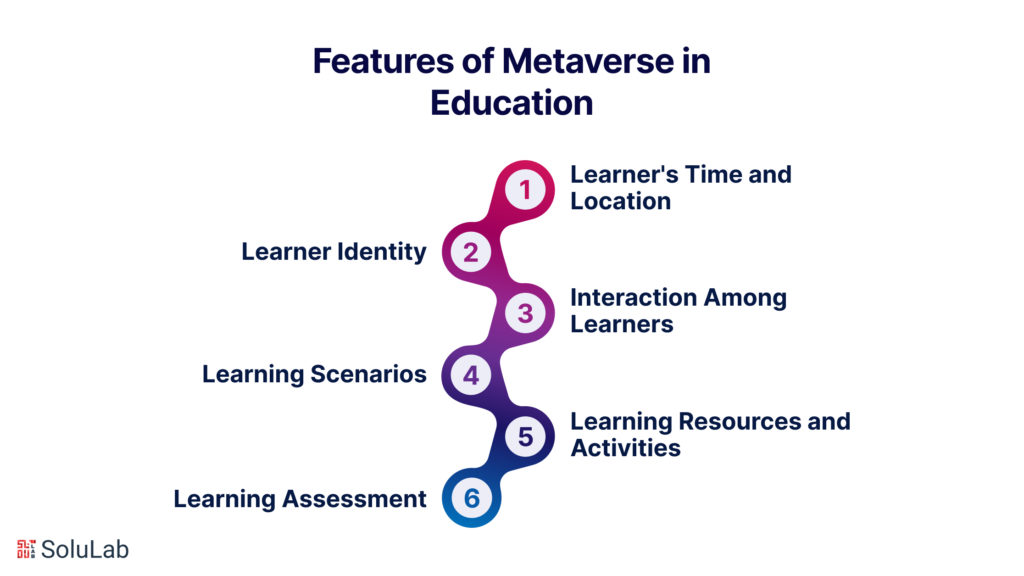
Features of Metaverse in Education

Features of Metaverse in Education

We have been emphasizing that Metaverse learning represents a distinct world offering experiences similar to the real world. However, there are key differences when comparing it to conventional classroom settings and remote learning. Let’s delve into these distinctions.

Learner’s Time and Location

  • Traditional learning necessitates both teacher and learner to be physically present at the same time and location. Remote learning provides flexibility in learning from different places, but it doesn’t grant the same flexibility regarding time for learners and teachers.
  • In contrast, the Metaverse offers complete flexibility. Learners can engage from anywhere, at any time, using smart wearable devices and robust internet connectivity. This empowers teachers to innovate teaching methods for both synchronous and asynchronous learning.

Learner Identity

  • Conventional and screen-based classrooms can only identify learners based on their real identities, limiting the scope for creative expression.
  • The Metaverse allows individuals to create avatars, representing themselves in imaginative, immersive ways, irrespective of background, race, or appearance.

Read Our Blog: Metaverse NFT – Foundation Of Next Blockchain Revolution!

Interaction Among Learners

  • In a traditional classroom, learners interact with teachers and peers in person, which can be challenging in remote or screen-based learning, leading to social isolation and limitations in collaboration.
  • The Metaverse overcomes these limitations by enabling learner avatars to interact with teacher and peer avatars, facilitating real-time feedback, socialization, expert assistance in concept comprehension, personalized support, and more.

Learning Scenarios

  • Conventional learning environments provide limited practical learning opportunities, such as labs and role-playing.
  • Screen-based learning primarily supports theoretical learning methods, lacking the engagement of hands-on experiences.
  • In contrast, the Metaverse can create realistic scenarios, allowing learners to actively participate in real-world situations, and providing practical and safe learning environments.

Learning Resources and Activities

  • Conventional and screen-based learning often rely on static learning materials like textbooks, images, videos, and similar resources.
  • The Metaverse equips learners with dynamic learning scenarios, offering the resources required to create and learn through hands-on activities and participation.

Check Our Blog Post: Metaverse Use Cases and Benefits
Learning Assessment

  • Conventional and screen-based learning frequently rely on summative assessments in the form of tests and scores, making real-time, impactful feedback a challenge.
  • The Metaverse in education facilitates both formative and summative assessments through learning analytics, providing comprehensive assessments and immediate feedback, thus contributing to more effective learner growth.

Future Trends and Developments of Metaverse in Education

Future Trends and Developments of Metaverse in Education

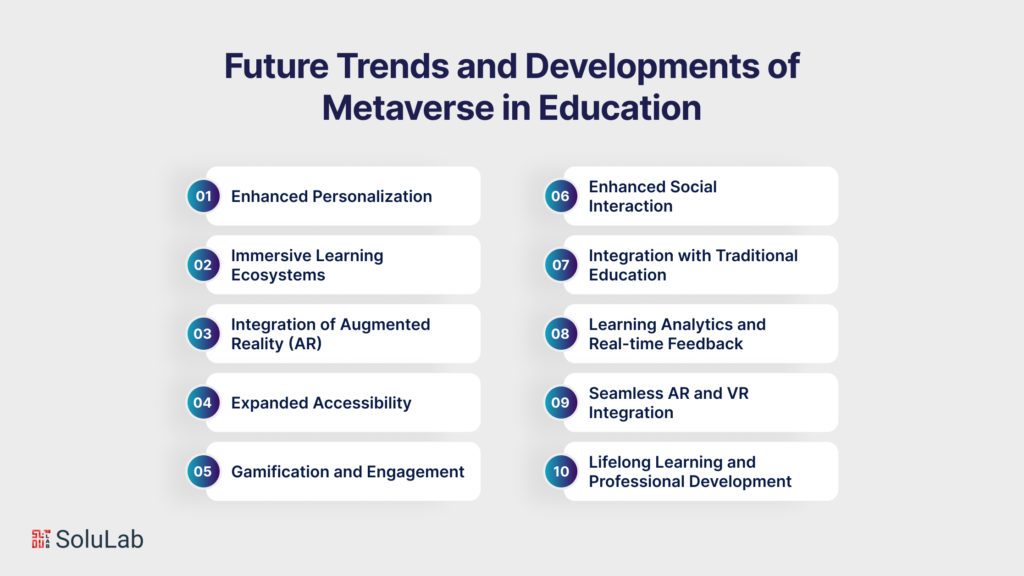
As the Metaverse continues to gain prominence in education, it’s essential to look ahead at the future-based developments that promise to reshape the landscape further. Let’s explore the potential trends, with a focus on the integration of augmented reality (AR) and the evolution of virtual reality and augmented reality in education.

  • Enhanced Personalization

Future Metaverse applications in education will prioritize even greater personalization. Advanced AI algorithms will adapt content to the specific needs, preferences, and learning styles of individual students, providing tailored educational experiences.

  • Immersive Learning Ecosystems

The Metaverse will increasingly become an immersive learning ecosystem. It will encompass a wide range of educational content, resources, and activities, enabling students to explore, interact, and learn in virtual environments.

  • Integration of Augmented Reality (AR)

AR technology will play a pivotal role in the Metaverse’s educational future. AR devices will seamlessly blend digital content with the real world, enabling students to access information, engage in interactive learning, and gain real-time insights through smart glasses or augmented reality applications.

  • Expanded Accessibility

The Metaverse will bridge geographical and socioeconomic gaps in education. It will provide access to high-quality educational experiences, connecting students and educators worldwide. The use of low-cost devices and platforms will make the Metaverse accessible to a broader audience.

Read Our Blog: Tech Stack of a Metaverse Developer

  • Gamification and Engagement

Gamification will continue to be a significant trend, making learning more engaging and interactive. Virtual badges, achievements, and competitive elements will motivate students to remain focused and complete educational tasks in the Metaverse.

  • Enhanced Social Interaction

Future Metaverse platforms will focus on further enhancing social interaction in virtual spaces. Students will collaborate, communicate, and learn with peers from diverse backgrounds, fostering cross-cultural interactions and global perspectives.

  • Integration with Traditional Education

The future of the Metaverse in education will involve greater integration with traditional educational institutions. Universities, schools, and training centers will incorporate Metaverse technologies into their curricula, offering blended learning experiences.

Read Also: Web 3 vs Metaverse: What’s The Difference

  • Learning Analytics and Real-time Feedback

Advanced learning analytics tools will provide in-depth insights into student progress. Educators can track student performance, identify areas for improvement, and provide real-time feedback to enhance the learning experience.

  • Seamless AR and VR Integration

The lines between virtual reality (VR) and augmented reality (AR) will blur as they converge into Mixed Reality (MR). This integration will allow for more seamless transitions between fully immersive virtual environments (VR) and augmented real-world experiences (AR).

  • Lifelong Learning and Professional Development

Metaverse technology will extend beyond K-12 and higher education, offering a platform for lifelong learning and continuous professional development. Professionals in various fields can engage in immersive training and skill development experiences.

Thus, the future based on Metaverse in Education is bright and dynamic. It will offer unparalleled personalization, immersive learning environments, and seamless integration of Augmented Reality (AR) and VR technologies. These trends will not only transform how we teach and learn but also open up new horizons for education in the digital age. As the Metaverse evolves, educators, students, and institutions must adapt to harness its full potential for the betterment of education worldwide.
CTA2

Conclusion

The Metaverse is on the verge of revolutionizing education and learning, offering a rich tapestry of opportunities for students and educators alike. As we’ve explored throughout this blog, the Metaverse provides immersive, interactive, and personalized learning experiences that surpass what the traditional internet and virtual reality can offer. The potential for bridging geographical divides, enhancing collaboration, and providing multi-sensory education is a tantalizing prospect. However, it’s not without its challenges. Privacy concerns, equitable access, and integration with traditional education systems must be carefully addressed as we journey into this new frontier. As we step into the Metaverse’s educational realm, the key to its success lies in collaboration, innovation, and the dedication of Metaverse development companies to shape the future of education.

SoluLab, a leading Metaverse development company, plays a pivotal role in crafting the future of the Metaverse. With expertise in a multitude of technologies, SoluLab is also a renowned Metaverse game development company that can bring your immersive experiences to life. We offer the capability to hire Metaverse developers who are dedicated to shaping your vision, ensuring that your Metaverse projects are built to the highest standards. Our comprehensive range of Metaverse development services encompasses design, development, and deployment, making them a one-stop solution for all your Metaverse needs. SoluLab is committed to pushing the boundaries of innovation in the Metaverse and continues to lead the way in creating transformative educational experiences.

FAQs

1. What is the Metaverse, and how can it benefit education?

The Metaverse is a virtual, interconnected universe that offers immersive, interactive learning experiences. It benefits education by providing personalized, multi-sensory, and real-time collaborative learning, transcending traditional Internet and VR limitations. SoluLab, a leading Metaverse Development Company, helps in realizing the potential of the Metaverse for education by offering innovative solutions and experiences.

2. What are the challenges of integrating the Metaverse into education?

Challenges include privacy concerns, equitable access, and the integration of the Metaverse with traditional education systems. SoluLab, as an experienced Metaverse Development Company, addresses these challenges by developing secure and accessible solutions that seamlessly blend with existing educational structures.

3. How can I hire dedicated Metaverse developers for my educational project?

SoluLab offers the opportunity to hire Metaverse developers who are experts in Metaverse development. They can work on your educational project, ensuring that it meets your unique requirements and delivers the desired learning experiences.

4. Can the Metaverse be used for creating educational games?

Yes, the Metaverse is an ideal platform for creating immersive educational games. SoluLab, a Metaverse game development company, specializes in designing and developing educational games that engage students and enhance learning.

5. What services does SoluLab offer for Metaverse development in education?

SoluLab provides a wide range of Metaverse development services, including design, development, and deployment. We create customized Metaverse solutions for educational institutions, ensuring that students and educators can make the most of this innovative technology.

Is Metaverse the Future of Digital Connection?


Is Metaverse the Future of Digital Connection?

In the fast-paced world of technology and interconnectedness, a new frontier has emerged, promising to revolutionize the way we connect and interact in the digital realm. This groundbreaking concept, known as the Metaverse, is capturing the imaginations of tech enthusiasts and visionaries alike. As we journey further into the digital age, it’s becoming increasingly clear that the Metaverse development is the future of digital connection. In this blog, we’ll delve into what the Metaverse is, how it’s shaping our digital landscape, and why it holds the key to a more immersive, interconnected world.

So, without any further ado, let’s get started!

The Emergence of the Metaverse

The concept of the Metaverse isn’t a recent development; it has been simmering in the world of technology and science fiction for several decades. However, what sets the present moment apart is the remarkable emergence of the Metaverse development into the mainstream consciousness and the substantial investments being made to make it a reality.

Historical Context and Development

The idea of a Metaverse has its roots in science fiction, notably in Neal Stephenson’s 1992 novel “Snow Crash.” In this futuristic vision, Stephenson introduced the concept of a virtual reality-based, shared digital universe. While Stephenson’s Metaverse was fictional, it planted a seed in the minds of technologists and futurists.

Over the years, this concept evolved alongside advances in technology. It was popularized in movies like “The Matrix” and “Ready Player One,” fueling the imagination of creators and technophiles. Still, it remained largely theoretical until recent years.

Read Our Blog: 10 Real-World Use Cases of the Metaverse in 2023

Major Tech Companies Investing in the Metaverse

Today, we’re witnessing a significant transformation. Major technology companies, including Facebook (now Meta), Microsoft, Google, and others, have made substantial commitments to bring the Metaverse to life. Meta’s CEO, Mark Zuckerberg, has been particularly vocal about his vision for the Metaverse, stating that it will be the successor to the internet as we know it.

These tech giants are investing billions in developing the necessary infrastructure, hardware, software, and platforms to enable the Metaverse development companies. They are collaborating with experts in virtual reality, augmented reality, and artificial intelligence to turn this ambitious concept into a concrete reality.

How the Metaverse Has Gained Prominence?

Several factors have contributed to the Metaverse’s rapid emergence and growing prominence. First and foremost is the exponential growth in computational power, making it possible to render complex and immersive virtual environments in real time. High-speed internet connectivity has become more widespread, allowing for seamless interactions in these digital realms.

The COVID-19 pandemic accelerated the need for remote work, remote learning, and virtual gatherings, highlighting the limitations of traditional digital communication. The Metaverse, with its potential for more immersive, personal, and dynamic interactions, became an appealing solution.

In brief, the Metaverse AI integration has emerged from the realm of science fiction and theoretical discussions into a tangible focus on technological development. The convergence of powerful computing, advanced networking, and the changing landscape of digital communication has propelled the Metaverse into the mainstream, where it is reshaping the way we envision the future of digital connection.

What the Metaverse Offers?

What the Metaverse Offers?

The Metaverse is more than just a buzzword; it represents a transformative shift in the way we connect and interact in the digital world. It offers a wealth of possibilities that go far beyond our current understanding of digital communication. Let’s explore what the Metaverse has in store for us.

  • Immersive Experiences and Digital Interactions

At its core, the Metaverse promises immersive experiences. Imagine putting on a virtual reality headset and stepping into a lifelike digital world where you can interact with others as if they were physically present. Whether it’s attending a concert, exploring a museum, or simply hanging out with friends, the Metaverse allows you to do it in a way that feels almost as real as the physical world.

This immersion extends beyond visual experiences. It encompasses other senses, such as touch and sound, through haptic feedback devices and advanced audio systems. As technology continues to advance, the sensory richness of the Metaverse will become even more compelling.

  • Beyond Virtual Reality: Exploring Augmented Reality

While virtual reality is a significant component of the Metaverse, augmented reality plays an equally vital role. Augmented reality enhances the physical world with digital overlays, adding a layer of interactivity and information to our surroundings. This means that the Metaverse doesn’t just exist in a virtual space; it can seamlessly integrate with the real world.

For instance, you might use AR glasses to see real-time information about the people you meet or the places you visit. Augmented reality empowers users to navigate and interact with both the digital and physical realms, blurring the lines between them.

Read Also: How Will Metaverse Change the World? A New Era of Connectivity and Innovation!

  • Integration of Gaming, Social Media, and More

The Metaverse is not limited to a single application or platform. It is a vast interconnected network of spaces and experiences, spanning everything from gaming and social media to e-commerce and education. This integration means that you can seamlessly transition between various activities within the Metaverse.

For instance, you might start your day with a virtual workout, attend a virtual meeting with colleagues, and then relax by joining friends in a virtual world for gaming or socializing. The Metaverse enables a diverse range of activities and interests, making it a versatile platform for both work and play.

  • Boundless Creative and Collaborative Opportunities

One of the most exciting aspects of the Metaverse is the creative freedom it offers. Users can create, design, and personalize their digital spaces and avatars, fostering a sense of ownership and identity. Whether you’re an artist, developer, educator, or entrepreneur, the Metaverse provides a canvas for innovation.

Collaboration takes on a new dimension in the Metaverse as well. Teams can work together in virtual environments that mimic physical offices, making remote work more engaging and productive. The Metaverse encourages creative problem-solving and collaboration in ways that extend beyond the limitations of traditional video conferencing or chat applications.

Digital Connection Reinvented

The Metaverse Artificial Intelligence is not merely a technological concept; it’s a profound shift in how we connect and communicate in the digital realm. In this section, we’ll explore how the Metaverse is reinventing digital connections, offering us experiences that go beyond the limits of traditional online interaction.

  • Virtual Social Interactions in the Metaverse

One of the most significant transformations the Metaverse offers is in the realm of social interaction. In traditional online communication, interactions often feel distant, lacking the nuance of in-person conversation. The Metaverse seeks to change that by creating immersive digital environments that mimic real-world social interactions.

Imagine attending a virtual social gathering with friends or family who live far away. In the Virtual Reality Metaverse, you can share the same virtual space, interact with one another’s avatars, and even replicate the physical gestures and expressions that make face-to-face interactions so meaningful. This level of immersion can bring loved ones closer, even when they’re physically separated.

Moreover, social interactions in the Metaverse aren’t constrained by geographic borders. You can connect with people from all around the world, breaking down the barriers of distance and making global connections easier and more meaningful than ever before.

CTA1

  • Transforming Remote Work and Education

The Metaverse has the potential to revolutionize the way we work and learn. Remote work and online education have become increasingly prevalent, but they often lack the collaboration and engagement found in physical settings. The Metaverse, with its virtual office spaces and interactive classrooms, can change this.

For remote work, employees can meet in a virtual office that mimics a physical workspace, making meetings and collaborations more personal and engaging. Colleagues can gather around a virtual whiteboard to brainstorm, just as they would in a traditional conference room.

In education, students can attend classes in a virtual environment that replicates the dynamics of a real classroom. Educators can use interactive tools and simulations to make learning more engaging. The Metaverse can bridge the gap between the convenience of online learning and the immersive experiences of in-person education.

  • Enhanced Communication and Personalization

The Metaverse is designed to enhance communication. In addition to voice and text, it offers rich visual and sensory cues that mimic face-to-face conversations. Avatars can express emotions, and users can use spatial audio to have more natural conversations.

Moreover, the Metaverse fosters personalization. Users can customize their avatars, surroundings, and experiences to reflect their individuality. This personal touch adds a layer of richness to digital interactions, making them more meaningful and authentic.

In the Metaverse, your digital presence is an extension of your identity, giving you the freedom to express yourself as you choose. Whether you’re meeting friends, colleagues, or strangers, you can tailor your digital presence to create the connection you desire.

Read Our Blog Post: Top 15 Metaverse Startups to Watch out in 2023

  • Experiencing Global Events and Spaces Virtually

The Metaverse allows us to experience global events and spaces in a new way. From attending virtual concerts to exploring iconic landmarks from your living room, the Metaverse opens up a world of experiences that were previously inaccessible.

For instance, you can attend a live concert by your favorite artist, sharing the experience with friends who may be thousands of miles away. Museums and art galleries can be explored in detail, with interactive exhibits and the ability to learn about art and history in an engaging way.

In essence, the Metaverse breaks down the barriers to experiencing the world’s wonders, no matter where you are located. It allows for shared experiences and exploration that are as close to being there in person as technology can currently offer.

Potential Benefits of the Metaverse Technology

Potential Benefits of the Metaverse Technology

The Metaverse is more than just a digital playground; it holds the potential to offer numerous advantages that can reshape the way we live, work, and connect. In this section, we’ll explore some of the potential benefits that the Metaverse brings to the table.

  • Improved Access and Inclusivity

One of the most promising aspects of the Metaverse is its ability to enhance access and inclusivity. In traditional digital communication, barriers can exist due to factors like geographical distance, physical disabilities, or socioeconomic limitations. The Metaverse, by its very nature, seeks to break down these barriers.

For individuals with physical disabilities, the top Metaverse platforms provide a level playing field. Virtual environments can be designed to be accessible to all, and avatars can represent people in a way that transcends physical limitations. This inclusivity promotes diversity and equal participation in digital spaces.

Additionally, the Metaverse has the potential to bridge the digital divide by making advanced technology and experiences more accessible to a broader range of people. As technology becomes more affordable and user-friendly, more individuals from diverse backgrounds can participate in the Metaverse.

  • Breaking Down Geographical and Cultural Barriers

Geographical and cultural barriers that often limit our interactions can be overcome in the Metaverse. In this digital realm, you can connect with people from different parts of the world without the need for travel. The physical distance between individuals becomes irrelevant, allowing for global collaboration, friendships, and connections to flourish.

Moreover, the Metaverse is a platform for cross-cultural interactions and understanding. It offers an opportunity for individuals to engage with different cultures, languages, and perspectives, promoting global tolerance and empathy. As more people share experiences within the Metaverse, it has the potential to foster a more interconnected and culturally diverse world.

  • New Opportunities for Businesses and Creators

The business world stands to gain significantly from the Metaverse. It provides a new frontier for commerce, marketing, and customer engagement. Businesses can set up virtual storefronts and immersive shopping experiences, creating innovative ways to connect with customers.

Entrepreneurs and content creators can thrive in the Metaverse. Artists, musicians, game developers, and other creatives can reach global audiences without the need for physical distribution. Virtual events, exhibitions, and performances open up new revenue streams and allow creators to interact directly with their fans.

Furthermore, the Metaverse offers unique marketing and branding opportunities. Companies can create engaging and interactive campaigns within the Metaverse, creating a more immersive and memorable brand experience. It’s a new way for businesses to connect with their audience and remain relevant in a rapidly evolving digital landscape.

Read Also: Metaverse Vs Virtual Reality

  • Opportunities for Education and Training

The Metaverse development has vast potential in the field of education and training. It offers a platform for immersive learning experiences that can benefit students, professionals, and organizations.

For students, the Metaverse can provide interactive and engaging virtual classrooms, making learning more enjoyable and effective. Students can explore historical landmarks, engage in scientific simulations, and connect with educators and peers from around the world.

In the corporate world, the Metaverse can be used for employee training, virtual meetings, and collaboration. It offers a dynamic and cost-effective way to provide professional development and enhance team productivity. The Metaverse can simulate real-world scenarios and offer practical training that is often challenging to achieve in a physical setting.

In essence, the Metaverse development has the potential to bring about a wide range of benefits, including improved access and inclusivity, the breaking down of geographical and cultural barriers, new opportunities for businesses and creators, and innovative solutions for education and training. As it continues to evolve, the Metaverse may become a catalyst for positive changes in various aspects of our lives.

The Future of Metaverse in the Digital World

The Future of Metaverse in the Digital World

As we stand on the cusp of the Metaverse’s integration into our lives, it’s crucial to consider how we can navigate this uncharted territory with responsibility and thoughtfulness. Here’s how individuals, businesses, and society as a whole can play their part in shaping the future based on Metaverse.

How Individuals Can Embrace the Metaverse

Embracing the Metaverse as an individual means approaching it with both curiosity and caution. Here are some key considerations:

  • Digital Citizenship: Learn and practice good digital citizenship. Respect others’ digital spaces, just as you would in the physical world.
  • Privacy Awareness: Be vigilant about your digital privacy. Understand the data you’re sharing and who has access to it.
  • Setting Boundaries: In the immersive world of the Metaverse, it’s important to set boundaries to prevent digital burnout and addiction. Balance your online and offline life.
  • Lifelong Learning: Continuously educate yourself about the Metaverse’s developments and its ethical implications.

Business Opportunities and Ethical Considerations

For businesses, the Metaverse presents a wealth of opportunities, but they should navigate with ethical responsibility:

  • Inclusivity: Ensure your Metaverse initiatives are accessible and inclusive to all potential users, including those with disabilities.
  • Data Ethics: Establish transparent data collection and usage policies, respecting user privacy and consent.
  • Authentic Engagement: Create genuine and immersive experiences in the Metaverse that align with your brand’s values, avoiding exploitative or harmful practices.
  • Ethical Marketing: Engage in responsible marketing practices within the Metaverse, adhering to established ethical guidelines.

Society’s Role in Shaping the Metaverse

As society adapts to the Metaverse, several factors should guide our collective approach:

  • Regulation and Oversight: Policymakers and governments should develop regulatory frameworks that protect users’ rights and ensure a fair and ethical Metaverse.
  • Education and Digital Literacy: Promote digital literacy programs to empower individuals to navigate the Metaverse safely and responsibly.
  • Ethical Design: Encourage the development of the Metaverse to align with ethical standards and respect for diverse cultures and values.
  • Global Collaboration: Foster international cooperation in shaping the Metaverse, addressing its cross-border implications.

Thus, the Metaverse is a digital frontier that offers incredible potential for connection and innovation. However, its responsible and ethical development is essential to ensure it benefits everyone. By taking a collective approach and considering the ethical and societal implications, we can collectively shape a Metaverse that enhances our lives and brings us closer while respecting the values that matter most.

CTA2

Final Words

In conclusion, the Metaverse is not just a technological concept but a profound shift in the way we connect and interact in the digital realm. It offers a transformative vision of a world where geographical distances matter less, inclusivity and accessibility are paramount, and creativity knows no bounds. From immersive social interactions that bridge physical gaps to reimagining the way we work and learn, the Metaverse has the potential to revolutionize our digital lives. As it continues to evolve, it becomes increasingly important for individuals, businesses, and society as a whole to navigate this uncharted territory with a balance of curiosity and caution, emphasizing ethical considerations and digital responsibility.

The journey into the Metaverse is an exciting one, filled with possibilities and opportunities for growth and connection. While challenges and concerns undoubtedly accompany this evolution, the potential benefits of the Metaverse are too significant to ignore. It’s up to all of us to shape the Metaverse responsibly and ensure that it becomes a force for positive change in our ever-connected, digital world. As we step into this new era, let’s remain vigilant, empathetic, and forward-thinking, working together to unlock the full potential of the Metaverse as the future of digital connection.

SoluLab, a Metaverse development company, with extensive experience in technology and digital innovation, is well-equipped to contribute significantly to the development of Metaverse technology. Whether it’s designing immersive Metaverse experiences, crafting secure and privacy-centric platforms, or aiding businesses in seizing the abundant opportunities in this evolving digital landscape, SoluLab is ready to provide creative and pragmatic Metaverse development services. With a forward-thinking approach and a strong commitment to responsible development, SoluLab can be your trusted partner to hire Metaverse developers for your business and in navigating the Metaverse’s potential. Contact us today to explore how we can assist you in embracing the future of digital connection.

FAQs

1. What is the Metaverse, and how does it differ from virtual reality (VR)?

The Metaverse is a collective virtual shared space that encompasses various digital environments, including VR. While VR focuses on immersive experiences in a virtual world, the Metaverse is a broader concept that includes augmented reality, social media integration, and online gaming, creating a more interconnected digital universe.

2. How can the Metaverse enhance remote work and education?

The Metaverse can create virtual office spaces for remote work, mimicking physical offices for more engaging meetings and collaboration. In education, it offers immersive virtual classrooms and practical training, making learning more enjoyable and effective.

3. What ethical concerns are associated with the Metaverse?

Ethical concerns include issues related to privacy and data security, digital addiction, and economic disparities in accessing the Metaverse. Ensuring responsible use, data protection and equitable access are key considerations.

4. How can businesses benefit from the Metaverse?

Businesses can benefit from the Metaverse development through innovative marketing and branding opportunities, virtual storefronts, and unique customer engagement experiences. It also opens up new revenue streams and global outreach for creators and entrepreneurs.

5. How can SoluLab assist in harnessing the potential of the Metaverse for my business or project?

SoluLab, with its extensive experience and forward-thinking approach, can provide a range of services tailored to your specific needs. From developing immersive Metaverse experiences to creating secure and privacy-conscious platforms, we can be your trusted partner in navigating the Metaverse’s vast potential and to hire dedicated developers. Our expertise can help you seize the opportunities presented by this emerging digital landscape, whether it’s for interactive marketing campaigns, virtual storefronts, or innovative customer engagement. To explore how SoluLab can assist you in shaping your Metaverse journey, contact SoluLab today for a consultation.
