


In the ever-evolving landscape of technology, the emergence of Generative AI technology has ignited a captivating conversation about its transformative potential in the realm of creativity. The fusion of Generative AI and creativity represents a dynamic synergy that is poised to revolutionize the way we approach artistic expression, innovation, and problem-solving.
In this blog, we delve into the fascinating world of Generative AI and its role in augmenting human creativity, exploring how these powerful algorithms are reshaping traditional boundaries and opening up new vistas for human ingenuity.
Before diving into how Generative AI can augment human creativity, it’s essential to understand what generative AI is. Generative AI refers to a subset of artificial intelligence that uses neural networks to generate content autonomously. One of the most notable examples is GPT-3, a language model capable of generating human-like text. Generative AI can create content across various domains, including text, art, and music.
Generative AI, with its ability to autonomously create content, has found applications across various domains. Here are some compelling examples of how this technology is making waves:
Read Our Blog Post: Top 10 Generative AI Development Companies
These examples illustrate the versatility and impact of Generative AI tools across diverse industries, showcasing their potential to augment human capabilities and transform the way we create, communicate, and innovate. As Generative AI continues to advance, it is likely that we will witness even more groundbreaking applications in the future.
In the ever-evolving landscape of technology, the synergy between human creativity and Generative AI has emerged as a remarkable force shaping the way we approach creativity, innovation, and problem-solving. Generative AI, a subset of artificial intelligence, holds the promise of enhancing and augmenting human creativity in unprecedented ways. This symbiotic relationship between humans and machines is a testament to the remarkable potential of combining human ingenuity with the computational prowess of AI.
One of the most profound ways in which Generative AI complements human creativity is by acting as an infinite wellspring of ideas and inspiration. AI models like GPT-3 can swiftly generate a multitude of concepts, helping artists, writers, and innovators overcome creative blocks. Whether it’s ideating for a new product, devising plot twists for a novel, or conceptualizing artwork, Generative AI models can provide an unending stream of fresh ideas, propelling the creative process forward.
Also, creativity often involves mundane and repetitive tasks that can be time-consuming and creatively draining. Generative AI excels at automating such tasks, liberating creators to concentrate on more substantial creative work. It can automate the generation of social media posts, design templates, or data analysis reports, allowing creative professionals to redirect their energy towards the artistic facets of their work.
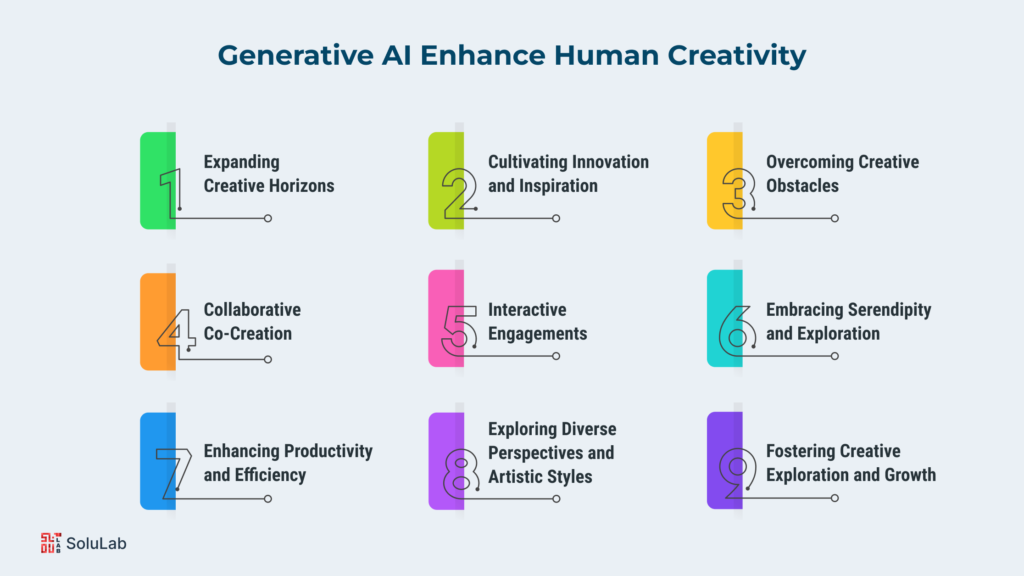
Generative AI solutions possess a unique capability to amplify and complement human creativity. This technology utilizes advanced algorithms and deep learning models to generate content such as text, graphics, music, and even entire virtual worlds. Importantly, it operates not as a substitute for human creativity but as a collaborative partner, enriching the creative toolkit and sparking fresh ideas.
Generative AI use cases provide creators with a vast reservoir of information and data, enabling them to venture into uncharted creative territories. Artists can harness these AI models, trained on diverse datasets, to produce original and imaginative content that pushes the boundaries of traditional artistic techniques.
Generative AI has the potential to invigorate human creativity by serving as a wellspring of inspiration. It encourages experimentation and creativity throughout the creative process. Artists can use AI-generated content as a starting point, exploring various modifications, remixes, and interpretations. This iterative and collaborative interaction between human creativity and generative AI inspires artists to push their creative boundaries.
Creativity can sometimes be stifled by a lack of fresh ideas or creative blocks. Generative AI trends can come to the rescue by acting as a source of creativity and generating original ideas, helping creators overcome these hurdles. It can expose creators to novel combinations, surprising juxtapositions, or contrasting viewpoints, acting as a catalyst to unlock creative potential and break through creative stagnation.
Generative AI development solutions facilitate collaborative co-creation between humans and machines. Artists can use AI technologies to generate preliminary sketches, concept art, or musical compositions, which they can later refine, personalize, and imbue with their unique artistic sensibilities. This collaborative process allows artists to infuse their distinct creative vision into the final product while leveraging the capabilities of AI.
Generative AI creativity supports interactive and expressive interactions between creators and their audiences. By employing AI-powered systems to create dynamic visual or auditory experiences responsive to user inputs, artists can craft immersive and captivating artistic experiences. This interplay between generative AI and audience participation adds a new dimension of inventiveness and interactivity to artistic expressions.
The use of Generative AI in the creative process can lead to unexpected and serendipitous discoveries. By examining the outputs of generative AI models, artists may uncover novel patterns, unconventional concepts, or hidden connections, potentially charting entirely new creative paths. This element of surprise and discovery injects excitement into artistic exploration and pushes the boundaries of creative expression.
Generative AI solutions can enhance the productivity and efficiency of creative endeavors. Through tasks like automating repetitive chores, generating initial drafts or prototypes, or offering creative suggestions, AI algorithms assist artists in streamlining their work processes. This allows artists to allocate more of their efforts toward making intricate creative decisions.
Generative AI & human-AI collaboration simplify the exploration of diverse viewpoints and artistic idioms. Creators can experiment with blending, reimagining, or reinterpreting multiple sources of inspiration, resulting in fresh hybrids and distinctive artistic expressions. By training AI models on various cultural references, historical eras, or aesthetic movements, artists can broaden their creative palette.
Generative AI promotes ongoing creative exploration and growth by providing continuous feedback and educational opportunities. Creators can use AI-generated content as a platform for experimentation, continuous skill development, and the exploration of new creative frontiers. This iterative approach nurtures growth, education, and the advancement of artistic abilities.
While Generative AI holds immense promise in enhancing human creativity, it also presents a set of challenges and limitations that must be addressed for its responsible and effective integration into creative processes. Understanding these challenges is essential for maximizing the potential benefits of AI while mitigating potential risks:
Read Blog Post: Generative AI Use Cases in 2025
While Generative AI offers immense potential in augmenting human creativity, it is not without its challenges and limitations. Responsible development and deployment of AI, combined with thoughtful human oversight and collaboration, can help harness the power of AI while preserving the integrity and depth of human creativity. Addressing these challenges is an ongoing process that requires collaboration among technologists, creatives, ethicists, and policymakers to ensure that AI remains a valuable creative ally.
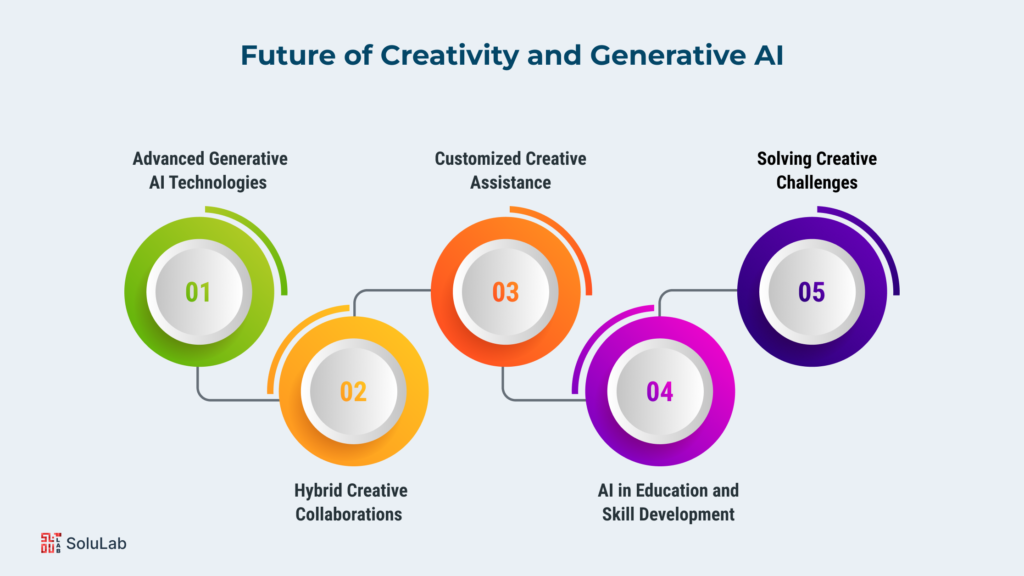
Creativity has always been a hallmark of human ingenuity, driving innovation across countless domains, from art and music to technology and science. However, as we stand on the cusp of a new era, the future of creativity is being shaped in unprecedented ways by Generative AI. This transformative technology holds the promise of augmenting, amplifying, and even redefining human creativity. In this exploration of the future, we delve into the exciting prospects and potential challenges that lie ahead at the intersection of human imagination and artificial intelligence.
Know More: How Generative AI is Transforming Industries
In summary, the future of human creativity and Generative AI is a landscape filled with both promise and uncertainty. While AI has the potential to enhance human creativity in unimaginable ways, we must navigate ethical, legal, and societal challenges along the way. The key will be to harness the power of Generative AI as a creative tool while preserving the essence of human ingenuity and the depth of human expression. As we venture into this uncharted territory, one thing is certain: the future of creativity will be a dynamic fusion of human and artificial intelligence, ushering in a new era of innovation and artistic exploration.
In conclusion, the symbiotic relationship between Generative AI and human creativity is a captivating journey into uncharted territories of innovation and artistic expression. As we’ve explored throughout this blog, Generative AI has the potential to revolutionize the creative landscape by offering unparalleled assistance, inspiration, and collaborative possibilities. It can automate repetitive tasks, provide limitless variations of creative content, and even challenge us to redefine the boundaries of imagination. However, we must proceed with a mindful approach, addressing ethical concerns, ensuring transparency, and preserving the authenticity of human creativity. The future is bright for those who embrace the possibilities of Generative AI, recognizing it not as a replacement for human creativity but as a powerful tool to augment and elevate our imaginative capacities.
At SoluLab, we are at the forefront of this creative revolution, harnessing the transformative potential of Generative AI to empower businesses and creators across diverse industries. Our team of experts specializes in developing Generative AI development services that seamlessly integrate with your creative processes. Whether you’re an artist looking to explore new artistic dimensions or a business seeking innovative solutions, SoluLab can tailor Generative AI applications to meet your specific needs. Together, we can embark on a journey of boundless creativity, where the synergy between human ingenuity and AI capabilities knows no limits. Contact SoluLab today to hire the best Generative AI developers and discover how SoluLab can help you unlock the full potential of Generative AI in your creative endeavors.
Generative AI refers to a subset of artificial intelligence that focuses on creating new content, such as images, text, music, or videos. It uses neural networks and deep learning techniques to generate original and creative output. Unlike other AI systems that primarily analyze data or make predictions, Generative AI’s primary function is to create something new and imaginative.
Generative AI can enhance human creativity in various ways. It can automate repetitive creative tasks, provide inspiration and suggestions, generate a wide range of creative content, and act as a collaborative partner for artists, writers, designers, and innovators. Handling the mundane aspects of creative work, allows humans to focus on higher-level ideation and innovation.
Generative AI has found applications in art, music composition, content generation, design, and even video game development. For example, artists use AI to create unique digital artworks, musicians use it to compose music, and content creators rely on AI to automate content production, such as generating product descriptions or news articles.
Yes, there are ethical considerations. Generative AI can inadvertently perpetuate biases present in training data, and there are concerns about authorship and copyright when AI contributes to creative works. Ensuring transparency, accountability, and responsible use of AI in creative processes is essential to address these concerns.
Companies like SoluLab specialize in developing customized Generative AI solutions tailored to the specific needs of businesses and creators. They can assist in integrating Generative AI into creative workflows, offering technical expertise, and ensuring that AI technologies are used effectively and ethically to augment human creativity.


