


Does your business get stuck with repetitive tasks, slow decision-making, or high content demands? Many enterprises face these hurdles daily, draining time and resources.
Traditional tools just can’t keep up. Manual processes delay outcomes, data overload overwhelms teams, and scaling creativity feels impossible. It’s not just inefficient, it’s unsustainable. However, what if we tell you that you can auto-create reports to streamline customer chats and generate design mockups in minutes? Generative AI cuts manual grind and speeds up innovation. Businesses need to know what works, where it fits, and how to sidestep risks.
78% of companies globally use AI in at least one function, with 71% regularly deploying generative AI tools, though only 1% have reached full AI maturity.
This blog breaks down how enterprises can apply Generative AI to real workflows, what challenges to watch out for, and how to make it work.
Generative artificial intelligence offers unique features that set it apart in the industry, and its integration, acceptance, and refinement represent a significant step above conventional AI models.
Although data is used by both generative and traditional artificial intelligence, such as machine learning, to produce insights and solutions, their approaches and effects on the business are very different.
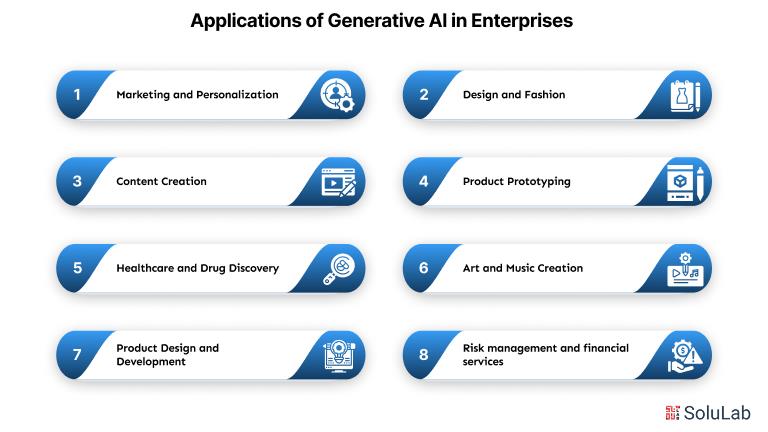
Incorporating generative AI into these fields has the potential to revolutionize how enterprises operate, fostering innovation and enabling them to offer more personalized and creative solutions to their customers. Generative AI’s potential for innovation has led to its incorporation into numerous real-world enterprise applications:
1. Marketing and Personalization: Generative AI can create tailored advertisements and promotional content that resonate with individual customer preferences, thereby enhancing engagement and conversion rates.
For example: Coca Cola used generative AI to make ads that are more relevant to each customer’s tastes or interests. They made customized marketing strategies that greatly interested conversion rates and engagement by looking at the data about their customers.
2. Design and Fashion: In the design realm, generative AI can assist in generating intricate patterns, architectural designs, and fashion styles that are both unique and in line with trends.
3. Content Creation: For content creators, generative AI offers tools that automate the generation of blog posts, articles, and even scripts. This can significantly speed up the content creation process.
For example: The Associated Press has been using Generative AI to write news stories automatically, especially financial reports, because of this automation, they can quickly write thousands of pieces without sacrificing accuracy. This frees up reporters to do more in-depth reporting.
4. Product Prototyping: In product design, generative AI can swiftly generate and iterate through multiple design options, accelerating the prototyping phase.
5. Healthcare and Drug Discovery: Generative models can be utilized to generate molecular structures and predict potential drug candidates, aiding in drug discovery efforts.
For example: Insilico Medicine is making molecular structures, that use generative models to find possible drug options. This method speeds up the process of finding new drugs, which means that potential candidates could go into clinical trials faster than the traditional methods.
6. Art and Music Creation: Artists and musicians are using generative AI to produce new forms of creative expression, generating art pieces, musical compositions, and more.
7. Product Design and Development: Generative AI algorithms are being used by businesses such as Autodesk to evaluate a variety of design options to optimize production, cost, and material usage. Speeding up the design process encourages creativity by revealing solutions that might not have been thought of otherwise.
8. Risk management and financial services: Systems can identify fraudulent activity with remarkable accuracy by analyzing transaction data and any abnormalities. Second, financial institutions can reduce possible losses and develop well-informed lending arrangements by using AI-based modeling to examine credit risks.
Related: Effective Generative AI Strategy For Your Enterprise
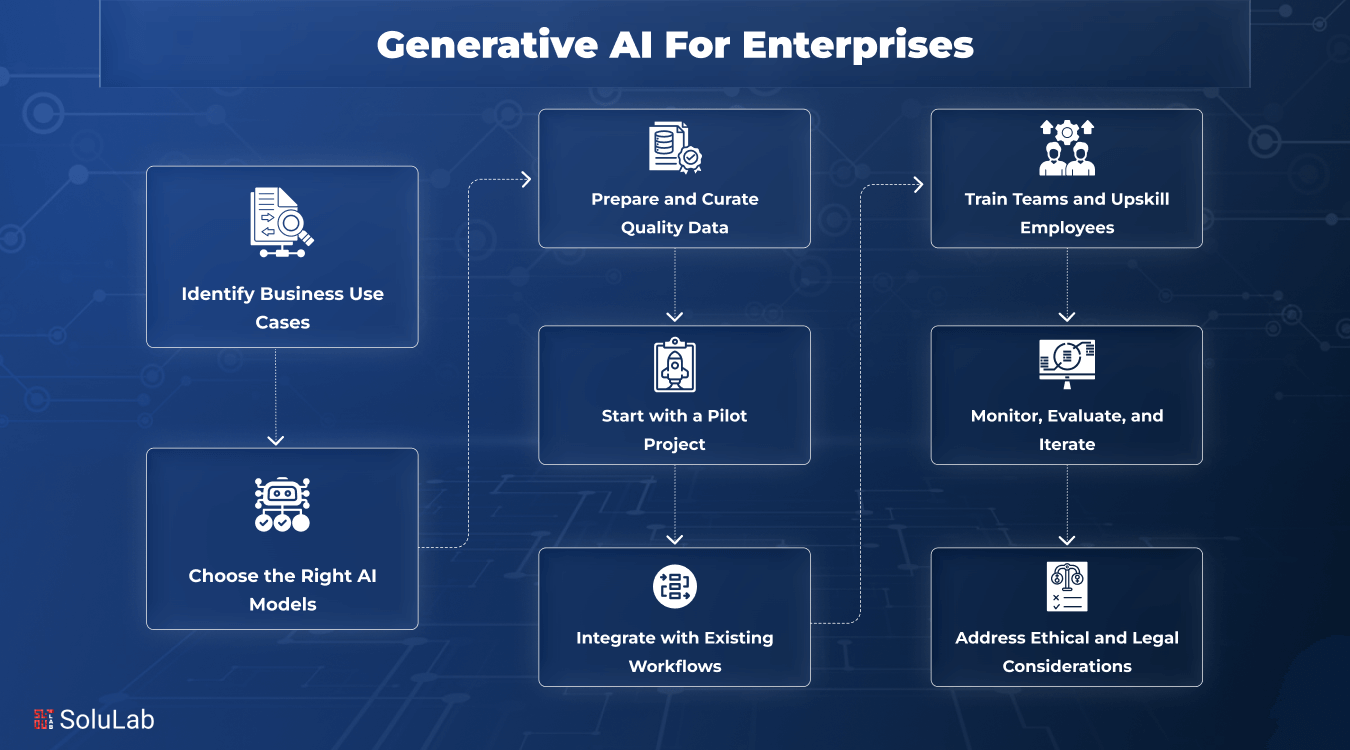
Integrating Generative AI into your business isn’t just about adopting new tech—it’s about reshaping how you operate, innovate, and deliver value. Here’s how you can make a smooth and effective transition into the world of Generative AI:
As with any technology, the implementation of generative AI raises ethical considerations. Enterprises must ensure that the content generated by their AI models adheres to ethical guidelines and does not propagate misinformation, hate speech, or other harmful content. Steps must be taken to prevent the model from generating biased or inappropriate outputs.
To address these concerns, AI developers can introduce constraints during training that encourage the model to generate content aligned with desired ethical values. Continuous monitoring of the model’s outputs is essential to identify and rectify any deviations from the intended ethical standards.
Generative Artificial Intelligence (generative AI) is poised to have a profound impact on how enterprises operate and innovate. Its ability to create new content, solve complex problems, and enhance customer experiences introduces a host of implications that extend across various aspects of the business.
Check Out Our Blog: Top 25 Generative AI Use Cases in 2026
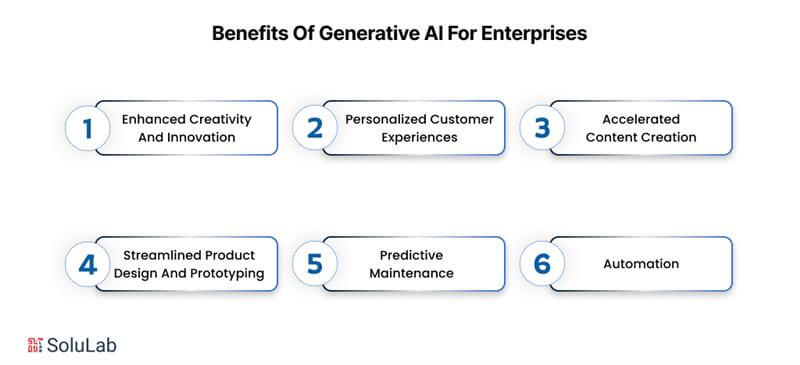
Generative AI offers enterprises a powerful tool to amplify their creativity and foster innovation. By generating novel ideas, designs, and concepts, businesses can break free from conventional thinking and explore uncharted territories. This can lead to the development of unique products, services, and solutions that stand out in competitive markets.
In creative industries like design, art, and fashion, generative AI provides a wellspring of inspiration. Designers can collaborate with AI to explore unconventional patterns and aesthetics, giving birth to entirely new artistic expressions. By automating certain aspects of the creative process, generative AI enables artists to focus on refining and elevating their work.
Customer-centricity is a cornerstone of modern business strategies, and generative AI empowers enterprises to deliver highly personalized experiences. By analyzing customer data, generative models can create content tailored to individual preferences. This ranges from personalized product recommendations in e-commerce to generating unique marketing content that resonates with each customer segment.
Generative AI’s ability to create personalized content at scale revolutionizes customer engagement. Enterprises can engage customers with targeted and relevant content across various touchpoints, leading to higher customer satisfaction, loyalty, and ultimately, increased revenue.
Content creation is an essential component of marketing, branding, and communication strategies. Generative AI streamlines this process by automating the generation of content such as blog posts, social media updates, and product descriptions. This not only saves time but also ensures a consistent and frequent content output.
Enterprises can leverage generative AI to create content templates that align with their brand voice and messaging. These templates can be customized and iterated upon, enabling marketing teams to focus on strategy and refinement rather than the repetitive task of content generation.
In industries involving physical products, generative AI has the potential to revolutionize the design and prototyping phases. By inputting design parameters and constraints, generative AI can explore a multitude of design possibilities, offering a range of options that human designers might not have considered.
Generative AI’s iterative nature also accelerates the prototyping process. Enterprises can quickly generate and assess different prototypes, facilitating a more efficient design validation process. This agility enables businesses to bring innovative products to market faster, gaining a competitive edge in rapidly evolving industries.
By examining data from sensors and equipment, algorithms can predict future failures before they occur. By scheduling inspections at the best possible moment, this proactive strategy helps businesses cut down on downtime and, consequently, repair expenses.
Preventive services lower expenses by extending the lifespan of machinery and equipment and lowering the need for replacements.
Numerous repetitive, time-consuming, and routine tasks can be eliminated by automating applications like data entry and report production and providing artificial intelligence-based customer support for clients who are looking for information.
Once more, as automation develops, the range of opportunities will increase, offering additional opportunities to cut expenses and succeed as a business.
Read More: How Can AI Help Businesses Cut Costs?
While the implications of generative AI for enterprises are promising, there are challenges and considerations to navigate:
Generative AI is changing how enterprises operate, create, and compete. It improves content generation, automates complex workflows, and personalizes customer experiences at scale. By integrating smart models and quality data, businesses can get new efficiencies and innovations.
However, challenges like data privacy, model bias, and implementation costs require careful handling. Enterprises must invest in upskilling, ethical frameworks, and continuous monitoring to drive real value. Instead of treating it as a tech trend, businesses should embed Generative AI into their strategy to stay relevant and agile.
SoluLab, a leading generative AI development company in the USA, can help you integrate generative AI services into your business and reduce costs. Contact us today to discuss further.
Generative AI can forecast machine breakdowns using enormous datasets, enabling proactive maintenance. This decreases downtime, machine life, and maintenance expenses. Generative AI developers optimize manufacturing processes using machine learning and data analysis.
Generative AI Solutions may produce unique ideas based on trending market trends, product data, and customer preferences. AI technology can inspire and encourage organizations to explore creative ideas for product development.
Generative AI uses AI to create fresh images, texts, audio, videos, and music. Generative AI uses foundation models (big AI models) that can multitask and do unique tasks such as Q&A, classification, and more.
Medical and financial applications have shown the significance of deep learning and are benefiting the most from it. These models have improved the diagnosis of cancer and fraud detection in finance.
Solulab is using generative AI to improve chatbot interactions, automate content creation, expedite code, and documentation, and optimize decision-making by creating data insights, improving operations efficiency and creativity.


