Talk to an Expert

How Generative AI Can Augment Human Creativity?

How Generative AI Can Augment Human Creativity?

In the ever-evolving landscape of technology, the emergence of Generative AI technology has ignited a captivating conversation about its transformative potential in the realm of creativity. The fusion of Generative AI and creativity represents a dynamic synergy that is poised to revolutionize the way we approach artistic expression, innovation, and problem-solving. 

In this blog, we delve into the fascinating world of Generative AI and its role in augmenting human creativity, exploring how these powerful algorithms are reshaping traditional boundaries and opening up new vistas for human ingenuity.

What is Generative AI?

Before diving into how Generative AI can augment human creativity, it’s essential to understand what generative AI is. Generative AI refers to a subset of artificial intelligence that uses neural networks to generate content autonomously. One of the most notable examples is GPT-3, a language model capable of generating human-like text. Generative AI can create content across various domains, including text, art, and music.

Generative AI, with its ability to autonomously create content, has found applications across various domains. Here are some compelling examples of how this technology is making waves:

  • Text Generation: Generative AI models like GPT-3 can produce human-like text, making them invaluable for content creation, copywriting, and even automated customer support chatbots. They can craft articles, generate code snippets, and compose emails, streamlining numerous written communication tasks.
  • Art Generation: Generative Adversarial Networks (GANs) have empowered AI to generate stunning artwork, illustrations, and even 3D designs. Artists and designers often use these AI-generated pieces as a starting point for their creative projects or as a source of inspiration.
  • Music Composition: AI is capable of creating music in a variety of genres and styles. Musicians and composers can use Generative AI to spark new musical ideas or even generate entire compositions. This application has led to the creation of unique soundscapes and musical pieces.
  • Video Game Content: In the gaming industry, Generative AI is employed to create dynamic game environments, characters, and quests. Games that adapt to the player’s actions use AI to generate content on the fly, providing a more immersive and personalized gaming experience.
  • Drug Discovery: In the field of pharmaceuticals, Generative AI is used to discover new drug candidates by analyzing molecular structures and predicting their effectiveness. This accelerates the drug development process and can potentially lead to the discovery of life-saving medications more quickly.
  • Language Translation: Generative AI has enhanced language translation services, making them more accurate and efficient. These models can translate text and even interpret spoken language in real-time, breaking down language barriers in global communication.

Read Our Blog Post: Top 10 Generative AI Development Companies

  • Content Personalization: Online platforms, such as streaming services and e-commerce websites, use Generative AI to recommend personalized content to users. This technology analyzes user preferences and behavior to suggest movies, music, products, and more.
  • Healthcare Imaging: In the medical field, Generative AI assists in image generation and enhancement for diagnostic purposes. It can reconstruct 3D images from 2D scans, generate synthetic medical images for training AI models, and improve the clarity of medical imaging.

CTA1

  • Autonomous Vehicles: Generative AI plays a crucial role in the development of self-driving cars. These vehicles use AI to generate real-time predictions, detect and respond to obstacles, and navigate complex road conditions safely.
  • Natural Language Generation (NLG): NLG models can transform data into human-readable text. They are employed in various applications, such as generating financial reports, weather updates, and sports summaries, providing valuable insights in a digestible format.

These examples illustrate the versatility and impact of Generative AI tools across diverse industries, showcasing their potential to augment human capabilities and transform the way we create, communicate, and innovate. As Generative AI continues to advance, it is likely that we will witness even more groundbreaking applications in the future.

The Interaction Between Human Creativity and Generative AI

In the ever-evolving landscape of technology, the synergy between human creativity and Generative AI has emerged as a remarkable force shaping the way we approach creativity, innovation, and problem-solving. Generative AI, a subset of artificial intelligence, holds the promise of enhancing and augmenting human creativity in unprecedented ways. This symbiotic relationship between humans and machines is a testament to the remarkable potential of combining human ingenuity with the computational prowess of AI.

How Generative AI Can Serve as a Creative Tool?

One of the most profound ways in which Generative AI complements human creativity is by acting as an infinite wellspring of ideas and inspiration. AI models like GPT-3 can swiftly generate a multitude of concepts, helping artists, writers, and innovators overcome creative blocks. Whether it’s ideating for a new product, devising plot twists for a novel, or conceptualizing artwork, Generative AI models can provide an unending stream of fresh ideas, propelling the creative process forward.

Also, creativity often involves mundane and repetitive tasks that can be time-consuming and creatively draining. Generative AI excels at automating such tasks, liberating creators to concentrate on more substantial creative work. It can automate the generation of social media posts, design templates, or data analysis reports, allowing creative professionals to redirect their energy towards the artistic facets of their work.
How Generative AI Can Enhance Human Creativity?

How Generative AI Can Enhance Human Creativity?

Generative AI solutions possess a unique capability to amplify and complement human creativity. This technology utilizes advanced algorithms and deep learning models to generate content such as text, graphics, music, and even entire virtual worlds. Importantly, it operates not as a substitute for human creativity but as a collaborative partner, enriching the creative toolkit and sparking fresh ideas.

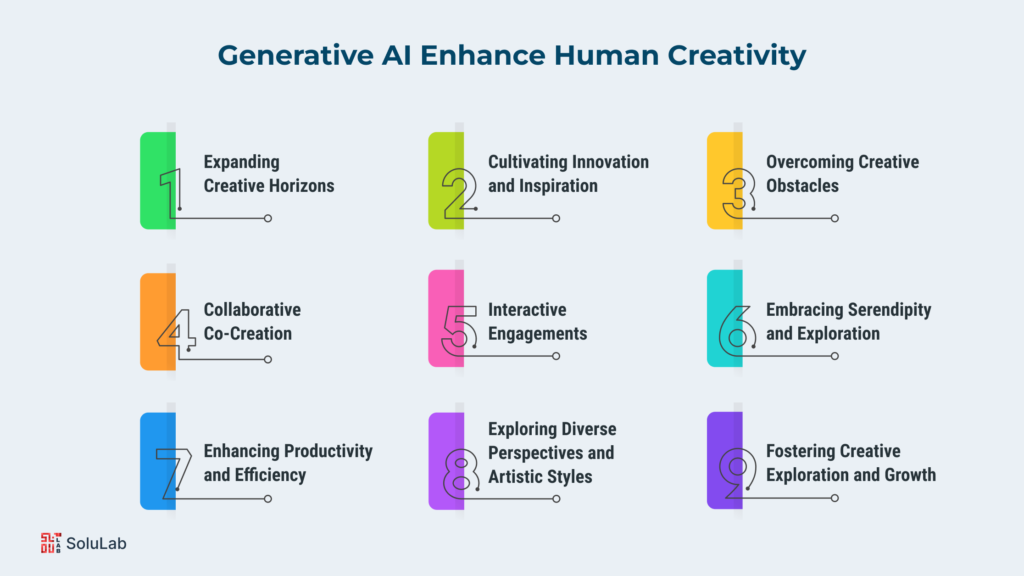
  • Expanding Creative Horizons

Generative AI use cases provide creators with a vast reservoir of information and data, enabling them to venture into uncharted creative territories. Artists can harness these AI models, trained on diverse datasets, to produce original and imaginative content that pushes the boundaries of traditional artistic techniques.

  • Cultivating Innovation and Inspiration

Generative AI has the potential to invigorate human creativity by serving as a wellspring of inspiration. It encourages experimentation and creativity throughout the creative process. Artists can use AI-generated content as a starting point, exploring various modifications, remixes, and interpretations. This iterative and collaborative interaction between human creativity and generative AI inspires artists to push their creative boundaries.

  • Overcoming Creative Obstacles

Creativity can sometimes be stifled by a lack of fresh ideas or creative blocks. Generative AI trends can come to the rescue by acting as a source of creativity and generating original ideas, helping creators overcome these hurdles. It can expose creators to novel combinations, surprising juxtapositions, or contrasting viewpoints, acting as a catalyst to unlock creative potential and break through creative stagnation.

  • Collaborative Co-Creation

Generative AI development solutions facilitate collaborative co-creation between humans and machines. Artists can use AI technologies to generate preliminary sketches, concept art, or musical compositions, which they can later refine, personalize, and imbue with their unique artistic sensibilities. This collaborative process allows artists to infuse their distinct creative vision into the final product while leveraging the capabilities of AI.

  • Interactive Engagements

Generative AI creativity supports interactive and expressive interactions between creators and their audiences. By employing AI-powered systems to create dynamic visual or auditory experiences responsive to user inputs, artists can craft immersive and captivating artistic experiences. This interplay between generative AI and audience participation adds a new dimension of inventiveness and interactivity to artistic expressions.

  • Embracing Serendipity and Exploration

The use of Generative AI in the creative process can lead to unexpected and serendipitous discoveries. By examining the outputs of generative AI models, artists may uncover novel patterns, unconventional concepts, or hidden connections, potentially charting entirely new creative paths. This element of surprise and discovery injects excitement into artistic exploration and pushes the boundaries of creative expression.

  • Enhancing Productivity and Efficiency

Generative AI solutions can enhance the productivity and efficiency of creative endeavors. Through tasks like automating repetitive chores, generating initial drafts or prototypes, or offering creative suggestions, AI algorithms assist artists in streamlining their work processes. This allows artists to allocate more of their efforts toward making intricate creative decisions.

  • Exploring Diverse Perspectives and Artistic Styles

Generative AI & human-AI collaboration simplify the exploration of diverse viewpoints and artistic idioms. Creators can experiment with blending, reimagining, or reinterpreting multiple sources of inspiration, resulting in fresh hybrids and distinctive artistic expressions. By training AI models on various cultural references, historical eras, or aesthetic movements, artists can broaden their creative palette.

  • Fostering Creative Exploration and Growth

Generative AI promotes ongoing creative exploration and growth by providing continuous feedback and educational opportunities. Creators can use AI-generated content as a platform for experimentation, continuous skill development, and the exploration of new creative frontiers. This iterative approach nurtures growth, education, and the advancement of artistic abilities.

Challenges and Limitations of Generative AI in Augmenting Human Creativity

While Generative AI holds immense promise in enhancing human creativity, it also presents a set of challenges and limitations that must be addressed for its responsible and effective integration into creative processes. Understanding these challenges is essential for maximizing the potential benefits of AI while mitigating potential risks:

  • Ethical Concerns: Generative AI can produce content that raises ethical questions. AI models trained on large datasets may inadvertently generate biased, offensive, or inappropriate material. Maintaining ethical standards and avoiding the propagation of harmful content is a pressing challenge. Rigorous content moderation and the development of ethical guidelines for AI-generated content are crucial. Human oversight is essential in curating and filtering AI outputs to ensure adherence to ethical principles.
  • Quality Control: While Generative AI can produce a vast amount of content, its quality may vary significantly. Ensuring that AI-generated work meets the desired standards can be a challenge, especially in creative fields where subjective judgment plays a crucial role. Human evaluators and quality control mechanisms can help assess and refine AI-generated content. Feedback loops between humans and AI can be established to improve the quality of output over time.
  • Data Availability: Generative AI models require extensive training on large datasets, which may not always be readily available, especially for niche or less-studied creative domains. Access to relevant and diverse training data can be a limitation.
    Efforts should be made to collect and curate datasets specific to various creative domains. Collaboration between AI researchers and domain experts can help address this limitation.
  • Computational Resources: Running advanced Generative AI models often demands substantial computational resources, including powerful hardware and significant energy consumption. This can be a constraint for individuals or organizations with limited resources. Advancements in cloud-based AI services and more energy-efficient AI hardware can help mitigate this challenge. Cost-effective solutions should also be explored.
  • Overreliance on AI: There is a risk that users may become overly reliant on generative AI, potentially stifling human creativity and innovation. Overreliance on AI-generated ideas or content can limit the diversity and depth of creative output. Encouraging a balanced approach that values human creativity and uses AI as a tool rather than a replacement is essential. Education and awareness campaigns can promote responsible AI use.
  • Intellectual Property Issues: Determining ownership and intellectual property rights for AI-generated content can be complex. It raises questions about who owns the rights to content produced by AI and how creators can protect their work from unauthorized use. Legal frameworks and policies need to be developed to address intellectual property issues related to AI-generated content. Clear guidelines for ownership and attribution are essential.
  • Lack of Emotional Depth: While AI can assist in generating creative content, it often lacks the emotional depth and nuanced understanding that humans bring to their creations. Artistic expressions may be limited in their ability to convey complex emotions and experiences. Creatives should strive to infuse their unique emotional and experiential perspectives into AI-generated content, ensuring that human emotions remain central in creative works.

Read Blog Post: Generative AI Use Cases in 2025

  • Unintended Consequences: The use of Generative AI may lead to unintended consequences, such as job displacement in creative industries or the creation of misleading content. Identifying and addressing these unintended outcomes is a critical challenge. Comprehensive impact assessments and proactive measures can help anticipate and mitigate unintended consequences. Adaptation and reskilling programs can also support individuals affected by automation.

While Generative AI offers immense potential in augmenting human creativity, it is not without its challenges and limitations. Responsible development and deployment of AI, combined with thoughtful human oversight and collaboration, can help harness the power of AI while preserving the integrity and depth of human creativity. Addressing these challenges is an ongoing process that requires collaboration among technologists, creatives, ethicists, and policymakers to ensure that AI remains a valuable creative ally.
The Future of Creativity and Generative AI

The Future of Creativity and Generative AI

Creativity has always been a hallmark of human ingenuity, driving innovation across countless domains, from art and music to technology and science. However, as we stand on the cusp of a new era, the future of creativity is being shaped in unprecedented ways by Generative AI. This transformative technology holds the promise of augmenting, amplifying, and even redefining human creativity. In this exploration of the future, we delve into the exciting prospects and potential challenges that lie ahead at the intersection of human imagination and artificial intelligence.

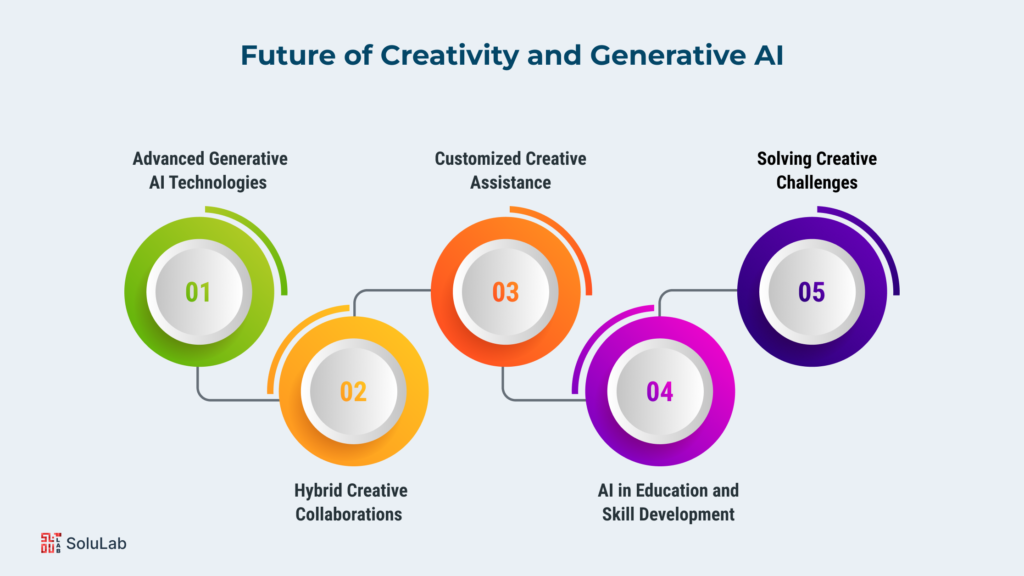
  • Advanced Generative AI Technologies: As Generative AI technologies continue to evolve, we can expect them to become more sophisticated and capable. Improved neural networks, training methods, and data sources will enable AI systems to generate increasingly high-quality and creative content. For example, we might see AI-generated art that rivals the works of famous painters, or music compositions that are indistinguishable from those created by human composers.

Know More: How Generative AI is Transforming Industries

  • Hybrid Creative Collaborations: The future will likely bring about a shift in the way humans collaborate with AI. Rather than AI replacing human creativity, we’ll see more hybrid models where AI acts as a creative partner or a tool to amplify human ideas. This collaborative approach will empower creators across various fields to explore new horizons and push the boundaries of what’s possible.
  • Customized Creative Assistance: AI systems will become more personalized, tailoring their creative assistance to individual users. Whether you’re a writer, designer, musician, or engineer, AI tools will adapt to your unique style and preferences, offering suggestions and enhancements that align with your creative vision. This level of customization will empower creators to achieve their artistic goals more efficiently.
  • AI in Education and Skill Development: Generative AI will play a significant role in education and skill development. Students and aspiring artists can use AI as a creative mentor, offering guidance, feedback, and practical exercises to hone their talents. AI-driven educational platforms will provide accessible and adaptive learning experiences for individuals of all skill levels.
  • Solving Creative Challenges: The future of creativity and Generative AI also involves addressing some pressing challenges. One key issue is the potential for AI-generated content to perpetuate biases present in training data. Striking a balance between creative freedom and ethical content generation will be crucial in ensuring responsible AI use.

In summary, the future of human creativity and Generative AI is a landscape filled with both promise and uncertainty. While AI has the potential to enhance human creativity in unimaginable ways, we must navigate ethical, legal, and societal challenges along the way. The key will be to harness the power of Generative AI as a creative tool while preserving the essence of human ingenuity and the depth of human expression. As we venture into this uncharted territory, one thing is certain: the future of creativity will be a dynamic fusion of human and artificial intelligence, ushering in a new era of innovation and artistic exploration.

CTA2

Concluding Remarks

In conclusion, the symbiotic relationship between Generative AI and human creativity is a captivating journey into uncharted territories of innovation and artistic expression. As we’ve explored throughout this blog, Generative AI has the potential to revolutionize the creative landscape by offering unparalleled assistance, inspiration, and collaborative possibilities. It can automate repetitive tasks, provide limitless variations of creative content, and even challenge us to redefine the boundaries of imagination. However, we must proceed with a mindful approach, addressing ethical concerns, ensuring transparency, and preserving the authenticity of human creativity. The future is bright for those who embrace the possibilities of Generative AI, recognizing it not as a replacement for human creativity but as a powerful tool to augment and elevate our imaginative capacities.

At SoluLab, we are at the forefront of this creative revolution, harnessing the transformative potential of Generative AI to empower businesses and creators across diverse industries. Our team of experts specializes in developing Generative AI development services that seamlessly integrate with your creative processes. Whether you’re an artist looking to explore new artistic dimensions or a business seeking innovative solutions, SoluLab can tailor Generative AI applications to meet your specific needs. Together, we can embark on a journey of boundless creativity, where the synergy between human ingenuity and AI capabilities knows no limits. Contact SoluLab today to hire the best Generative AI developers and discover how SoluLab can help you unlock the full potential of Generative AI in your creative endeavors.

FAQs

1. What is Generative AI, and how does it differ from other forms of artificial intelligence?

Generative AI refers to a subset of artificial intelligence that focuses on creating new content, such as images, text, music, or videos. It uses neural networks and deep learning techniques to generate original and creative output. Unlike other AI systems that primarily analyze data or make predictions, Generative AI’s primary function is to create something new and imaginative.

2. How can Generative AI enhance human creativity?

Generative AI can enhance human creativity in various ways. It can automate repetitive creative tasks, provide inspiration and suggestions, generate a wide range of creative content, and act as a collaborative partner for artists, writers, designers, and innovators. Handling the mundane aspects of creative work, allows humans to focus on higher-level ideation and innovation.

3. What are some real-world applications of Generative AI in creative fields?

Generative AI has found applications in art, music composition, content generation, design, and even video game development. For example, artists use AI to create unique digital artworks, musicians use it to compose music, and content creators rely on AI to automate content production, such as generating product descriptions or news articles.

4. Are there any ethical concerns associated with Generative AI in creativity?

Yes, there are ethical considerations. Generative AI can inadvertently perpetuate biases present in training data, and there are concerns about authorship and copyright when AI contributes to creative works. Ensuring transparency, accountability, and responsible use of AI in creative processes is essential to address these concerns.

5. What role can companies like SoluLab play in harnessing Generative AI for creative purposes?

Companies like SoluLab specialize in developing customized Generative AI solutions tailored to the specific needs of businesses and creators. They can assist in integrating Generative AI into creative workflows, offering technical expertise, and ensuring that AI technologies are used effectively and ethically to augment human creativity.

Generative AI in E-Commerce – Benefits and Applications

Strategies for Leveraging Generative AI in E-Commerce

In the landscape of e-commerce, where competition is fierce and consumer expectations continue to rise, staying ahead of the game is imperative for businesses. One transformative strategy that has gained prominence in recent years is the integration of Generative Artificial Intelligence (AI) into e-commerce operations. Generative AI, a subset of Artificial Intelligence (AI), possesses the remarkable ability to create new content, whether it’s text, images, videos, or even music. 

In this blog, we delve into the strategies for effectively harnessing the power of Generative AI in e-commerce, exploring its profound impact on the digital shopping experience and the strategies that underpin its successful implementation.

Before delving into strategies for its application, it’s crucial to grasp the fundamental concepts of Generative AI and generative AI development.

Generative Models: The Architects of Creativity

At the core of Generative AI lies generative models—sophisticated algorithms and neural networks that are trained to generate data that resembles the input data they were trained on. These models are capable of producing new content that can be remarkably indistinguishable from human-created content. Two notable types of generative models are Generative Adversarial Networks (GANs) and Variational Autoencoders (VAEs).

  • GANs (Generative Adversarial Networks): GANs consist of two networks, a generator, and a discriminator, engaged in a constant tug of war. The generator attempts to create counterfeit data, while the discriminator strives to distinguish between real and fake data. This adversarial process refines the generator’s ability to produce highly realistic content.
  • VAEs (Variational Autoencoders): VAEs take a different approach, focusing on encoding and decoding data within a probabilistic framework. They learn to represent data in a compressed form (latent space) and then decode it to generate new data points. VAEs are particularly valuable for tasks where controlled randomness is desirable.

Check Our Blog Post: Top 10 Generative AI Development Companies

Key Concepts of Generative AI

Two essential concepts underpin the workings of Generative AI: training and inference.

  • Training: The training phase involves exposing the generative model to vast datasets. During this phase, the model learns the patterns, features, and nuances of the data it will later generate. The training process can be computationally intensive and time-consuming, but it is foundational to the model’s performance.
  • Inference: Once trained, the model enters the inference phase, where it generates new content based on the knowledge it acquired during training. This content can take various forms, depending on the specific task, such as generating product descriptions, creating images, or making personalized product recommendations.

Now that we’ve established the fundamental principles of Generative AI, let’s delve into the myriad applications it offers within the realm of e-commerce.

Generative AI Applications in E-commerce

Generative AI Applications in E-commerce

Generative AI’s versatility finds myriad applications in the e-commerce landscape, revolutionizing the way businesses interact with consumers and enhancing the overall shopping experience.

  • Personalized Product Recommendations

One of the most powerful applications of Generative AI in e-commerce is its ability to deliver personalized product recommendations. Through the analysis of user behavior, purchase history, and preferences, generative models can create tailored product suggestions for each customer. This level of personalization not only improves the likelihood of conversion but also enhances customer satisfaction by presenting products that align with individual tastes.

Read Also: Generative AI in the Manufacturing Process

  • Content Generation

Content is the lifeblood of e-commerce, from product descriptions to customer reviews and marketing copy. Ecommerce Generative AI can efficiently produce this content, saving businesses valuable time and resources. Furthermore, AI-generated content tends to be consistent and engaging, ensuring that product listings and marketing materials maintain a high standard across a vast product catalog.

  • Visual Content Generation

In the visually-driven world of e-commerce, the ability to create compelling visual content is paramount. Generative AI development can generate product images, design eye-catching advertisements, and even produce video content. This not only streamlines the content creation process but also ensures a visually cohesive brand identity, captivating potential customers.

CTA1

  • Chatbots and Customer Service

Enhancing customer service through AI-driven chatbots is another avenue where Generative AI development shines. Chatbots powered by Generative AI can provide instant responses to customer inquiries, whether they pertain to product queries, order tracking, or general inquiries. These chatbots operate round-the-clock, improving accessibility and engagement, while freeing up human agents for more complex tasks.

These applications represent just the tip of the iceberg when it comes to Generative AI’s potential in e-commerce. However, to effectively leverage these capabilities, businesses must implement well-thought-out strategies. In the next section, we’ll explore the essential strategies that underpin the successful integration of Generative AI and e-commerce operations.

Strategies for Implementation of Generative AI in E-Commerce

Strategies for Implementation of Generative AI in E-Commerce

Implementing Generative AI in an e-commerce environment is a multifaceted endeavor, encompassing several crucial strategies and considerations.

  • Data Collection and Preprocessing

The foundation of any successful Generative AI project is high-quality data. Businesses must invest in data collection methods that yield rich, diverse, and representative datasets. Additionally, data preprocessing is essential to clean, format, and prepare the data for training. Without quality data and preprocessing, the AI model’s performance will be compromised.

  • Model Selection and Training

Selecting the appropriate generative model for a specific e-commerce task is paramount. The choice may depend on factors such as the type of content to be generated and the complexity of the task. Once a model is selected, it undergoes a rigorous training process. This process can be resource-intensive and time-consuming, but it’s the crucible in which the model acquires the knowledge necessary to generate high-quality content.

Read Our Blog: How Generative AI is Revolutionizing Art

  • Integration with E-commerce Platforms

For seamless operations, Generative AI solutions must integrate effectively with e-commerce platforms, such as Shopify, WooCommerce, or Magento. This integration ensures that AI-generated content and recommendations seamlessly flow into the customer experience, enhancing the overall shopping journey.

  • Continuous Learning and Improvement

The AI journey doesn’t end with deployment. To stay relevant and effective, Generative AI models must undergo continuous learning and improvement. This involves periodic updates, retraining, and adaptation to changing customer preferences and market trends. Businesses that commit to ongoing refinement can maintain a competitive edge in the ever-evolving e-commerce landscape.

Generative AI Ethical Considerations in E-commerce

Generative AI Ethical Considerations in E-commerce

While Generative AI holds immense promise, it also comes with a set of ethical considerations that cannot be overlooked. In the next section, we’ll delve into these crucial aspects of responsible AI implementation in e-commerce.

The integration of Generative AI in e-commerce brings forth a series of ethical considerations that businesses must carefully navigate. Addressing these concerns is not only essential for maintaining consumer trust but also for ensuring fair and responsible AI practices.

1. Data Privacy and Security

  • Consumer Data Protection: As businesses collect and utilize customer data for training AI models, safeguarding data privacy becomes paramount. Compliance with data protection regulations, such as GDPR or CCPA, is a legal obligation.
  • Secure Handling of Data: Robust security measures should be in place to protect sensitive customer information from breaches. Encryption, access controls, and regular security audits are crucial components of a secure data handling strategy.

2. Bias and Fairness

  • Mitigating Bias: Generative AI models can inadvertently perpetuate biases present in the training data. To mitigate bias, businesses should regularly audit their models and datasets for discriminatory patterns.
  • Fair Treatment: AI-generated content should be designed to treat all customers fairly, regardless of factors like race, gender, or socioeconomic status. Fairness should be a core principle in AI content generation.

Read Our Blog Post: 10 Ways Generative AI is Revolutionizing Healthcare

3. Transparency in AI-powered Decisions

  • Transparency: Customers should be informed when they are interacting with AI-driven systems, such as chatbots or AI-generated content. Transparency builds trust and allows consumers to make informed choices.
  • Explainability: Businesses should strive to make AI-driven decisions more interpretable and explainable. Customers should have a basic understanding of how AI influences the recommendations and content they encounter.

Maintaining ethical AI practices is not only a moral imperative but also a means to mitigate risks associated with public backlash, legal challenges, and reputational damage.

4. Outcomes and Benefits

  • Increased Conversion Rates: E-commerce companies leveraging Generative AI often report notable increases in conversion rates due to personalized recommendations and engaging AI-generated content.
  • Cost Savings: AI-driven content generation reduces the time and resources required for content creation, resulting in cost savings for businesses.
  • Enhanced Customer Satisfaction: Personalization and improved customer service through AI-powered chatbots contribute to higher levels of customer satisfaction and loyalty.

Challenges and Pitfalls

While Generative AI offers significant advantages, businesses must be aware of the challenges and potential pitfalls associated with its implementation.

1. Overcoming Data Limitations

  • Data Quality: Obtaining high-quality training data can be challenging. Businesses must invest in data collection and cleaning efforts to ensure the success of their AI projects.
  • Data Imbalance: Data may not always be evenly distributed across different product categories, leading to bias in AI recommendations. Addressing data imbalance is crucial for fairness.

2. Managing AI Development Costs

  • Computational Resources: Training Generative AI models can be resource-intensive, requiring substantial computational power and energy. Managing these costs is a significant consideration.
  • Expertise: Building and maintaining AI systems necessitates specialized expertise, which can be costly to acquire and retain.

3. Monitoring and Mitigating Bias

  • Continuous Monitoring: Regularly auditing AI models for bias and discrimination is an ongoing effort. It requires vigilance to ensure that the AI remains fair and ethical.
  • Bias Mitigation Strategies: Developing and implementing bias mitigation strategies is essential for responsible AI deployment. Businesses should be prepared to adapt their models and datasets as necessary.

Future Trends of Generative AI in E-commerce

The Generative AI landscape is continually evolving, and e-commerce is poised to experience further transformation in the years to come.

  • Improved Model Architectures: Expect advancements in generative model architectures, leading to more efficient and creative AI systems.
  • Multimodal AI: Future developments may enable AI models to generate content across multiple modalities simultaneously, such as text, images, and audio.

Read Our Blog: Generative AI and Human Creativity

Predictions for E-commerce

  • Hyper-personalization: E-commerce will witness an era of hyper-personalization, with AI-driven experiences tailored to individual preferences.
  • AI-driven Content Dominance: AI-generated content will become even more prevalent, shaping product listings, marketing materials, and customer interactions.

CTA2

Concluding Remarks

In conclusion, Generative AI development solutions are a transformative force in e-commerce, offering businesses the means to enhance personalization, streamline content creation, and improve customer service. By adhering to ethical considerations, staying vigilant about potential challenges, and adapting to future trends, businesses can fully leverage the potential of Generative AI technology to create a dynamic and engaging digital shopping experience for consumers. As the e-commerce landscape continues to evolve, embracing Generative AI will be pivotal in staying competitive and relevant in the digital marketplace.

Solulab is a prominent software development company known for its innovative solutions and cutting-edge technology expertise. Specializing in areas like blockchain, IoT, and artificial intelligence, Solulab has established itself as a trusted partner for businesses looking to harness the power of emerging technologies. While not directly linked to Generative AI development, Solulab’s expertise in AI and machine learning can undoubtedly be leveraged to assist e-commerce companies in implementing Generative AI consulting services. By utilizing Solulab’s technical prowess and experience, e-commerce businesses can navigate the complexities of AI integration more effectively, ensuring that Generative AI tools enhance the shopping experience for their customers and boost their competitive edge in the digital marketplace.

FAQs

1. What is Generative AI, and how does it apply to e-commerce?

Generative AI is a subset of artificial intelligence that can create new content, such as text, images, or videos, that closely resembles human-generated content. In e-commerce, it is used to personalize product recommendations, generate product descriptions, and create visual content like images and videos. It enhances the overall shopping experience by tailoring content to individual customer preferences.

2. How can Generative AI improve the customer shopping experience?

Generative AI enhances the customer shopping experience by providing personalized product recommendations based on individual preferences and behavior. It also streamlines content creation, ensuring consistent and engaging product descriptions and marketing materials. AI-powered chatbots further improve customer service by providing instant responses to inquiries.

3. What are the key challenges in implementing Generative AI in e-commerce?

Implementing Generative AI in e-commerce comes with challenges such as obtaining high-quality training data, managing the computational resources required for model training, and addressing bias in AI-generated content. Additionally, businesses must navigate ethical considerations related to data privacy, security, and transparency.

4. How can businesses ensure the ethical use of Generative AI in e-commerce?

Businesses can ensure the ethical use of Generative AI by prioritizing data privacy and security, implementing robust security measures, and complying with data protection regulations. They should also regularly monitor AI models for bias, mitigate bias when detected, and maintain transparency in AI-powered interactions with customers.

5. What are some future trends in Generative AI for e-commerce?

Future trends in Generative AI for e-commerce include the development of improved model architectures that enhance creativity and efficiency. Multimodal AI, capable of generating content across multiple modalities simultaneously, is also expected to gain prominence. Hyper-personalization and the dominance of AI-driven content in product listings and marketing materials are predicted to shape the future of e-commerce. So, to leverage this technology hire generative AI developers.


Generative AI and Human Creativity

Generative AI and Human Creativity: Where the Line is to be Drawn?

Generative AI, at its core, refers to a subset of Artificial intelligence (AI) that focuses on creating rather than merely processing data. It stands as a testament to the relentless evolution of technology, transforming the way we perceive and harness AI capabilities.

The evolution of Generative AI technology has been marked by significant milestones, from early experiments to the current era of advanced models. The journey involves the continuous refinement of algorithms, the introduction of deep learning techniques, and the exploration of novel architectures that enhance the generative capabilities of AI.

In the broader technological landscape, Generative AI holds immense significance, particularly in fostering a dynamic relationship between machines and human creativity. By enabling the creation of content that mirrors human-like expression, Generative AI becomes a powerful tool for artists, writers, and innovators seeking new avenues for creative exploration.

What Impact of Generative Al on Creativity?

What impact of Generative Al on Creativity?

The advent of Generative AI technology has ushered in a transformative era for creativity, profoundly impacting the creative process through its sophisticated models and collaborative potential.

  • Generative AI Models

Generative AI models, powered by advanced algorithms and neural networks, have become veritable engines of creativity. These models possess the capability to analyze vast datasets and generate content autonomously, mimicking and often surpassing human-like creative outputs. This impact is most evident in fields such as art, design, and content creation, where Generative AI models contribute novel perspectives, styles, and ideas that augment the creative repertoire.

  • Human-AI Collaboration

The intersection of Generative AI and human creativity unfolds in a dynamic collaboration. This synergy is not about replacing human creativity but enhancing it. Generative AI and Human-AI collaboration become a symbiotic relationship where Generative AI acts as a co-creator, aiding humans in ideation, suggesting alternative solutions, and automating routine tasks. This collaboration amplifies efficiency, allowing creatives to focus on high-level thinking and innovation.

  • Generative AI Use Cases

The impact of Generative AI extends across diverse use cases. In fields like graphic design, Generative AI tools assist in rapid prototyping and ideation. In content creation, language models generate coherent and contextually relevant text. In healthcare, Generative AI aids in drug discovery and medical imaging interpretation. The breadth of applications showcases the versatility of Generative AI in catalyzing creativity across industries.

CTA1

  • Trends Shaping Generative AI Landscape

The Generative AI landscape is marked by dynamic trends. Continuous advancements in algorithms, increased computing power, and improved datasets contribute to the evolution of Generative AI models. Ethical considerations, responsible AI deployment, and transparency are becoming pivotal trends, reflecting a growing awareness of the societal impact of Generative AI.

  • Generative AI Development Solutions

Navigating the complexities of Generative AI development requires tailored solutions. Specialized Generative AI development companies play a crucial role in providing expertise, from algorithmic development to ethical considerations. These solutions ensure responsible and effective integration of Generative AI into existing workflows.

How to Analyze the Intersection of Generative Al and Human Creativity?

How to Analyze the intersection of Generative Al and human creativity?

Generative AI, a powerful technological force, intersects with human creativity, sparking a nuanced exploration of boundaries, ethics, and collaborative potentials.

  • Identifying the Boundaries of Generative AI’s Creative Outputs

Generative AI, while capable of producing impressive creative outputs, operates within defined limits. Understanding these boundaries is crucial to harness its potential responsibly. By deciphering the extent of AI-generated creativity, we ensure harmonious integration without overshadowing the human touch.

  • Discussing Ethical Considerations in Generative AI and Creativity

The fusion of Generative AI and creativity introduces ethical dimensions. Delving into questions of authorship, intellectual property, and the unintended consequences of AI-generated content is imperative. Striking a balance between innovation and ethical integrity safeguards against potential pitfalls in the evolving landscape of AI-driven creativity.

Related: How Generative AI is Revolutionizing Art

  • Exploring Instances of Successful Human-AI Collaboration in Creative Endeavors

Examining instances where Generative AI collaborates with human creatives reveals the potential for groundbreaking synergy. From aiding artists in ideation to assisting writers in content creation, these collaborations showcase the harmonious coexistence of technology and human intuition. Such success stories serve as beacons guiding the path toward fruitful partnerships.

What are the Current Trends that are Shaping the Generative AI Landscape?

The current trends in the Generative AI landscape reflect a dynamic interplay between technology, creativity, and collaborative efforts, shaping the way we approach problem-solving and innovation.

Generative AI technology has witnessed a surge in advancements, with cutting-edge tools and models driving the landscape’s evolution. These technologies are not merely computational tools; they’ve become enablers of creativity, unlocking novel possibilities across various industries.

Generative AI and human creativity are converging, fostering a symbiotic relationship where AI acts as a catalyst for human ingenuity. This collaboration is particularly evident in fields like art, design, and content creation, where Generative AI tools serve as creative assistants, augmenting human capabilities and pushing the boundaries of what’s achievable.

Related:How Generative AI is Transforming Industries

The proliferation of Generative AI tools is influencing diverse use cases. From generating realistic AI images to aiding in complex decision-making processes, these tools are proving versatile across sectors such as healthcare, finance, and entertainment. The adaptability of Generative AI models ensures their relevance in addressing a broad spectrum of challenges.

With expertise in Generative AI technology, SoluLab provides comprehensive Generative AI consulting services that encompass strategic planning, implementation, and ongoing support. The company recognizes the critical intersection of Generative AI and human creativity, and its consulting services are designed to facilitate a seamless integration that enhances creative processes across industries.

What are the Challenges in Generative AI Development and Potential Solutions?

Developing Generative AI poses several challenges, reflecting the intricate nature of merging technology and human creativity.

Challenge: Building sophisticated Generative AI models requires a deep understanding of complex algorithms and neural networks.

Solution: Continuous research and collaboration among developers to simplify model architectures and enhance accessibility.

  • Ethical Concerns in Creativity

Challenge: Striking a balance between Generative AI’s creative outputs and ethical considerations is challenging.

Solution: Implementing robust ethical guidelines, involving diverse perspectives in development, and fostering responsible AI practices.

  • Limited Interpretability

Challenge: Understanding the decision-making process of Generative AI models can be challenging due to their black-box nature.

Solution: Incorporating explainable AI techniques to enhance model interpretability and build trust among users.

  • Data Quality and Bias

Challenge: Generative AI heavily relies on training data, and biased or low-quality data can lead to biased model outputs.

Solution: Rigorous data preprocessing, diverse dataset curation, and ongoing monitoring to identify and rectify biases.

Read Our Blog: Real-World Applications of Generative AI and GPT

  • Human-AI Collaboration Barriers

Challenge: Establishing effective collaboration between Generative AI systems and human creators requires overcoming communication barriers.

Solution: Develop intuitive user interfaces, foster interdisciplinary teams, and enhance AI’s adaptability to user preferences.

What is the Role of Generative AI Development Companies in Addressing Industry Needs?

What is the Role of Generative AI development companies in addressing industry needs?

Generative AI development companies play a pivotal role in addressing the evolving needs of industries in the era of artificial intelligence. As businesses increasingly leverage Generative AI technology to enhance creativity and streamline processes, these companies become essential catalysts for innovation and progress.

1. Expertise in Generative AI Technology

  • Generative AI development companies possess specialized knowledge in cutting-edge Generative AI technology, ensuring that businesses can tap into the full potential of these advancements.
  • Their expertise extends to the intricate workings of Generative AI tools and models, allowing for the seamless integration of these solutions into diverse industry frameworks.

2. Driving Human-AI Collaboration

  • Fostering effective collaboration between Generative AI and human creativity is a nuanced challenge. Development companies bridge this gap by crafting solutions that empower human-AI synergy.
  • They design Generative AI models that complement human capabilities, fostering a harmonious partnership where technology augments and enhances creative processes.

3. Tailoring Solutions to Industry-Specific Use Cases

  • Understanding the unique demands of various industries, Generative AI development companies tailor solutions to specific use cases, be it in healthcare, finance, or creative arts.
  • By customizing Generative AI applications, these companies address industry-specific challenges, maximizing the impact of AI on operational efficiency and creativity.

Related: 10 Ways Generative AI is Revolutionizing Healthcare

4. Staying Ahead of Generative AI Trends

  • The landscape of Generative AI is dynamic, with trends evolving rapidly. Development companies play a crucial role in staying ahead of these trends, ensuring that their clients benefit from the latest advancements.
  • Proactive adaptation to emerging Generative AI trends positions businesses to maintain a competitive edge in their respective sectors.

5. Offering Comprehensive Development Solutions

  • Generative AI development companies provide end-to-end solutions, encompassing everything from ideation and prototyping to deployment and maintenance.
  • This comprehensive approach streamlines the implementation of Generative AI, reducing the burden on businesses and enabling them to focus on leveraging the technology for strategic goals.

6. Ethical Considerations and Consulting Services

  • Addressing ethical concerns related to Generative AI is a crucial aspect of development. Companies in this domain often offer consulting services, guiding businesses on responsible AI practices.
  • Their role extends beyond technical expertise to encompass ethical considerations, ensuring that Generative AI is deployed with a mindful approach to societal impact.

What are the Essential Skills for Generative AI Developers?

What are the Essential Skills for Generative AI Developers?

To excel in the dynamic field of Generative AI development, developers must possess a diverse skill set that extends beyond traditional programming. The essential skills for Generative AI developers encompass technical expertise, creativity, and a deep understanding of the collaboration between Generative AI and human creativity.

  • Programming Proficiency

Generative AI developers should have a strong foundation in programming languages such as Python, TensorFlow, and PyTorch. Proficiency in these languages is crucial for implementing and fine-tuning Generative AI models.

  • Deep Learning Knowledge

A comprehensive understanding of deep learning principles is essential. Developers must grasp concepts like neural networks, backpropagation, and optimization algorithms to effectively design and train Generative AI models.

  • Mathematical Aptitude

Strong mathematical skills, particularly in linear algebra, calculus, and probability, are vital. These skills underpin the algorithms and statistical models used in Generative AI development.

  • Creativity and Innovation

Generative AI is at the intersection of technology and creativity. Developers should possess a creative mindset to push the boundaries of AI-generated content and explore innovative applications.

Understanding Human-AI Collaboration

Successful Generative AI developers understand how to facilitate meaningful collaboration between AI and human creativity. This involves developing models that augment human capabilities rather than replacing them entirely.

  • Domain Knowledge

Depending on the application, developers should have domain-specific knowledge. Whether it’s art, music, language, or other fields, a deep understanding enhances the ability to create relevant and impactful Generative AI solutions.

Read Also: Generative AI in the Manufacturing 

  • Problem-Solving Skills

Generative AI development often involves tackling complex problems. Developers must be adept at breaking down challenges, devising creative solutions, and iterating on models to achieve optimal results.

  • Ethical Considerations

Awareness of ethical implications is crucial. Generative AI developers should prioritize responsible AI practices, considering issues like bias, fairness, and the potential societal impact of their creations.

CTA2

Conclusion

In navigating the evolving landscape of Generative AI technology, the delineation between artificial intelligence and human creativity is a pivotal concern. As Generative AI models and tools continue to advance, the imperative lies in orchestrating a symbiotic relationship between the ingenuity of human minds and the computational prowess of AI. SoluLab emerges as a trailblazer in this paradigm, providing cutting-edge Generative AI development solutions.

The delicate balance between Generative AI and human creativity hinges on thoughtful collaboration. While Generative AI offers unprecedented capabilities to generate content, ideas, and designs, it is paramount to recognize its role as a tool rather than a replacement for human innovation. SoluLab, as a Generative AI development company, exemplifies this synergy, fostering an environment where human-AI collaboration amplifies creative outputs.

Exploring Generative AI use cases, SoluLab navigates diverse industries, harnessing the technology to streamline processes, enhance efficiency, and unlock novel possibilities. The company’s Generative AI consulting services underline a commitment to guiding clients in harnessing the technology responsibly, ensuring that AI augments human creativity rather than supplants it.

FAQs

1. What is Generative AI, and how does it differ from traditional AI?

Generative AI refers to technology that produces content, mimicking human creativity. It diverges from traditional AI by creating original outputs rather than relying solely on predefined patterns.

2. How can Generative AI technology enhance human creativity?

Generative AI tools empower creators by offering new perspectives, automating routine tasks, and fostering collaborative efforts, ultimately expanding the boundaries of human creativity.

3. Where is the line drawn between Generative AI and human creativity?

The line is defined by the synergy between Generative AI models and human input. While AI generates content, human creativity guides the process, ensuring a harmonious collaboration.

4. What are the key use cases for Generative AI in creative industries?

Generative AI finds applications in content creation, design, music composition, and more. Its versatility contributes to novel solutions across various creative domains.

5. What trends are emerging in the Generative AI landscape?

Trends include personalized content generation, improved natural language processing, and enhanced collaboration between Generative AI and human creators.

6. How can SoluLab contribute to Generative AI development solutions?

SoluLab, as a leading Generative AI development company, specializes in crafting innovative solutions. Their expertise lies in leveraging Generative AI to address specific industry challenges.
