Talk to an Expert

The Evolution of AI in Cybersecurity: From Rules to Deep Learning

The Evolution of AI in Cybersecurity: From Rule Based Systems to Deep Learning

In the ever-expanding digital landscape, the importance of robust cybersecurity measures cannot be overstated. With cyber threats becoming increasingly sophisticated, the need for intelligent, adaptable defense mechanisms has grown exponentially. Artificial Intelligence (AI) has emerged as a game-changer in this realm, revolutionizing the way we protect our digital assets. 

This blog delves into the captivating journey of AI in cybersecurity, tracing its evolution from the rudimentary rule-based systems to the cutting-edge realm of deep learning.

Rule-Based Systems in Cybersecurity

Before AI made its presence felt, cybersecurity heavily relied on rule-based systems. These systems operated on predefined sets of rules and signatures. They were effective to some extent in thwarting known threats but had glaring limitations, which is why many companies today depend on managed IT services Dallas providers for proactive protection. Rule-based systems struggled with zero-day attacks and evolved threats that didn’t fit neatly into predetermined patterns.

For example, an antivirus software employing rule-based systems could detect and quarantine a virus only if it matched a predefined signature. If a new strain of malware emerged, the system remained blind to it until a new rule was created. This reactive approach left systems vulnerable during the crucial time gap between a new threat’s emergence and the update of the security rules.

Machine Learning in Cybersecurity

Machine learning marked the first significant leap in AI cybersecurity. Unlike rule-based systems, machine learning systems/algorithms could learn from data. They analyzed patterns, anomalies, and behaviors to detect threats, even those with no predefined rules. This proactive approach opened new possibilities in the battle against cyber adversaries.

Supervised learning, a branch of machine learning, allowed security systems to be trained on labeled datasets. By learning from historical data, these systems could make informed decisions about the nature of incoming data and identify potential threats. For instance, a supervised learning model could identify known phishing emails by recognizing common characteristics shared among them.

Unsupervised learning algorithms, on the other hand, didn’t rely on labeled data. They analyzed incoming data to identify anomalies or deviations from the norm. This made them effective in detecting novel threats or insider attacks, where the patterns might not be predefined.

Semi-supervised learning blended the best of both worlds, combining labeled data for known threats with unsupervised techniques to uncover new ones. This approach improved detection accuracy and reduced false positives.

Reinforcement learning, often associated with AI in gaming, found its application in cybersecurity as well. It enabled systems to adapt and learn in real-time, making them more agile in responding to evolving threats.

CTA1

Emergence of Deep Learning

Deep learning, a subset of machine learning, brought about a paradigm shift in AI cyber-security. At its core were neural networks, models inspired by the human brain’s interconnected neurons. These networks could process vast amounts of data, automatically extract features, and make complex decisions.

Neural networks, with their ability to analyze unstructured data like images, texts, and network traffic, became invaluable in cybersecurity systems. They excelled in tasks such as anomaly detection, where identifying subtle deviations from normal behavior was critical. Deep learning models could recognize not only known malware but also previously unseen variants based on their underlying characteristics.

Deep learning also revolutionized the fight against phishing attacks. Neural networks could analyze email content, sender behavior, and contextual information to flag potentially malicious emails, even if they lacked familiar hallmarks of phishing attempts.

The use of deep learning in malware detection was another breakthrough. These models could identify malicious code by scrutinizing its structure and behavior, without relying on predefined signatures.
Challenges in Implementing Deep Learning for Cybersecurity

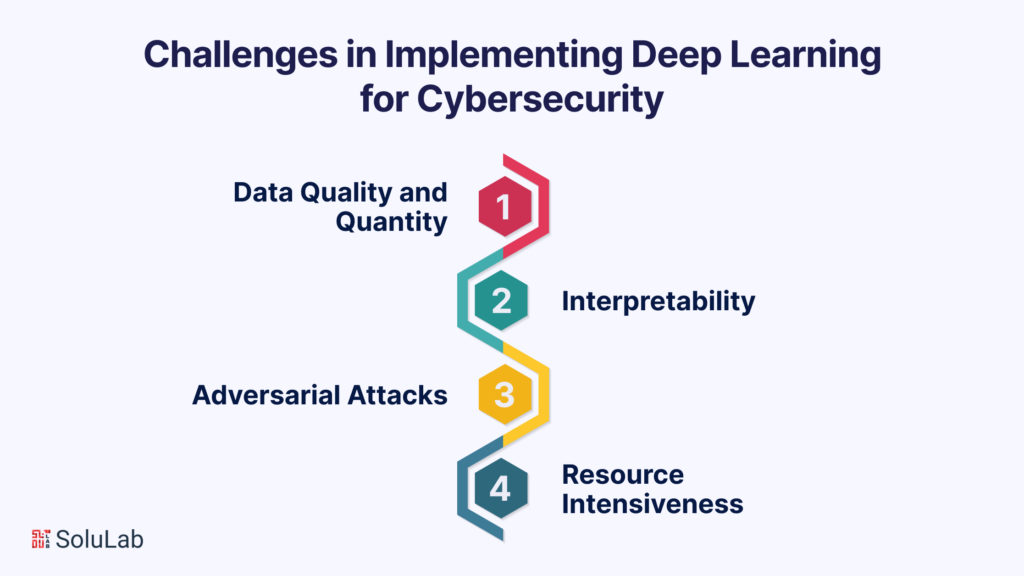
Challenges in Implementing Deep Learning for Cybersecurity

While deep learning has ushered in a new era of AI development companies, it’s not without its challenges and ethical considerations.

  • Data Quality and Quantity: Deep learning models hunger for data. In AI cybersecurity services, obtaining large, high-quality labeled datasets for training can be a significant hurdle. Additionally, the fast-paced nature of cyber threats demands real-time data, making the challenge even more daunting.
  • Interpretability: Deep learning models, particularly deep neural networks, are often considered “black boxes.” Their decision-making processes are complex and not easily interpretable. This opacity can be problematic when trying to understand why a model flagged a certain activity as malicious, hindering incident response and forensic analysis.
  • Adversarial Attacks: Cyber adversaries are getting smarter. They can craft attacks specifically designed to bypass deep learning models. Adversarial attacks manipulate input data in subtle ways to deceive the model, making them a serious concern.
  • Resource Intensiveness: Training and deploying deep learning models require substantial computational resources. This can be a roadblock for smaller organizations with limited IT infrastructure.

Ethical Concerns Surrounding AI in Cybersecurity

  • Privacy: AI systems, particularly those using deep learning, can process vast amounts of personal data. The line between legitimate cybersecurity monitoring and privacy invasion can become blurry. Striking the right balance between security and privacy is crucial.
  • Bias and Fairness: Deep learning models are susceptible to biases present in training data. If the data used to train these models is biased in terms of race, gender, or other attributes, the AI cybersecurity system can unintentionally discriminate against certain groups.
  • Transparency: As mentioned earlier, deep learning models are often seen as black boxes. This lack of transparency can hinder accountability and make it difficult to comply with regulations that require explanations for decisions made by AI systems.
  • Over-Reliance on AI: While AI can enhance cybersecurity, an over-reliance on AI systems without human oversight can lead to complacency. Cybersecurity professionals should always be in the loop to make critical decisions and understand the context.

Real-World Examples

Despite these challenges and ethical concerns, numerous organisations have embraced deep learning for cybersecurity, achieving remarkable results:

  • Darktrace: Darktrace utilises unsupervised machine learning and AI to detect and respond to cyber threats in real-time. Its “Enterprise Immune System” learns and understands the unique behaviours of a network and can identify deviations indicative of attacks.
  • Cylance: Acquired by BlackBerry, Cylance employs AI-driven threat detection to prevent malware and other security threats. Its approach is based on Generative AI tools trained to recognize both known and unknown threats.
  • FireEye: FireEye’s Mandiant Threat Intelligence uses AI and machine learning for cybersecurity i.e. to detect and respond to cyber threats. It leverages deep learning for rapid threat detection and offers automated response capabilities.
  • Google’s Chronicle: Chronicle, a subsidiary of Google, offers a cybersecurity platform that employs machine learning to help organizations analyze and detect threats in their network data.

These examples illustrate the practical application of deep learning in real-world cybersecurity scenarios. Organizations are increasingly relying on AI to bolster their defenses and respond swiftly to emerging threats.
The Future of AI in Cybersecurity

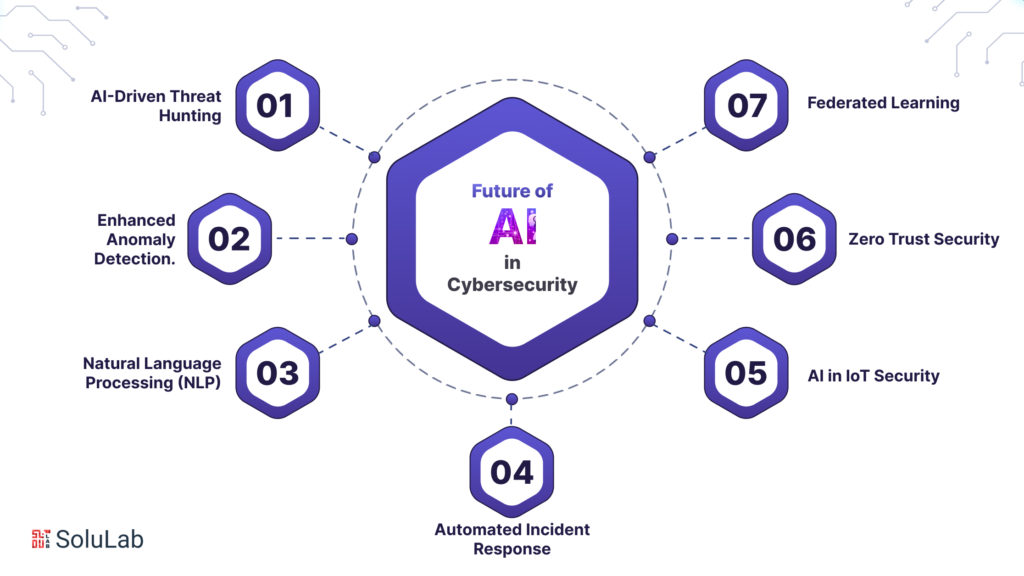
Future of AI in Cybersecurity

As we look ahead, the future of AI in cybersecurity promises continued evolution and transformation. Several key trends and developments are shaping the landscape:

  • AI-Driven Threat Hunting: AI-powered threat-hunting tools are becoming more sophisticated. Implementing these AI-driven detection capabilities typically requires robust managed security operations center (SOC) services that combine automated monitoring with expert human oversight.
  • Enhanced Anomaly Detection: Deep learning models are continuously improving in their ability to detect subtle anomalies and deviations from normal behavior, making them invaluable for identifying sophisticated threats.
  • Natural Language Processing (NLP): NLP techniques are being applied to cybersecurity to analyze text-based threats, such as phishing emails or social engineering attempts. This helps in the early detection and mitigation of such threats.
  • Automated Incident Response: AI is being used to automate incident response processes. AI-driven systems can not only detect threats but also take actions to mitigate them in real time, reducing the burden on cybersecurity teams.
  • AI in IoT Security: With the proliferation of Internet of Things (IoT) devices, AI is being used to secure these interconnected devices and networks. Machine learning models can detect unusual behavior or vulnerabilities in IoT ecosystems.
  • Zero Trust Security: AI plays a pivotal role in implementing the zero-trust security model. It continuously verifies the identity and security posture of devices and users accessing a network, enhancing overall security.
  • Federated Learning: This emerging approach allows organizations to collaborate on threat detection without sharing sensitive data. Generative AI models are trained collectively, enhancing the security of shared threat intelligence.

The Evolving Role of Human Experts

While AI is a powerful ally in the fight against cyber threats, human expertise remains irreplaceable:

  • Contextual Understanding: Human experts bring context to cybersecurity. They can understand the unique nuances of an organization’s environment, making judgment calls that AI may struggle with.
  • Adaptation and Innovation: Cyber adversaries continually evolve their tactics. Human cybersecurity professionals can adapt strategies and innovate responses, staying one step ahead.
  • Ethical Decision-Making: Ethical considerations in cybersecurity often require human judgment. Decisions regarding privacy, compliance, and the ethical use of AI are guided by human values.
  • Complex Investigations: In complex cyber incidents, human investigators are essential. They can piece together the puzzle, combining technical analysis with a broader understanding of the threat landscape.

In essence, the future of AI in cybersecurity is a collaboration between human expertise and artificial intelligence. AI enhances the capabilities of cybersecurity professionals, enabling them to work more efficiently and effectively.

CTA2

Conclusion

The evolution of AI in cybersecurity, from rule-based systems to deep learning, has been a remarkable journey. It has equipped us with powerful tools to defend against an ever-evolving threat landscape. As AI continues to advance, we must remain vigilant, addressing challenges such as data privacy and bias, while also recognizing the crucial role that human experts play in keeping our digital world secure.

In this era of rapid technological change, the fusion of human intelligence and AI-driven automation will be the key to staying resilient in the face of cyber threats. As we move forward, the synergy between human expertise and AI innovation will be our strongest defense in the dynamic and complex world of cybersecurity.

SoluLab, a forward-thinking technology company, is renowned for innovative solutions across domains, including cybersecurity. They excel in AI development services and hire AI developers, contributing significantly to AI’s evolution in cybersecurity. Leveraging advanced AI and deep learning, they shape a proactive defense against evolving threats. SoluLab exemplifies how tech companies integrate AI to create adaptive, proactive, and robust defense mechanisms, shaping the future of cybersecurity and providing AI development services and AI developer hiring solutions for organizations.

FAQs

1. What is the primary difference between rule-based systems and deep learning in cybersecurity?

Rule-based systems rely on predefined rules and signatures to detect threats, while deep learning uses neural networks to analyze data and make decisions based on learned patterns. Deep learning is more adaptable to evolving threats.

2. How does AI in cybersecurity address ethical concerns, such as privacy and bias?

AI in cybersecurity must be implemented with strict privacy policies and data protection measures. To address bias, diverse and unbiased training data should be used, and models should be regularly audited for fairness.

3. Can AI completely replace human cybersecurity professionals?

No, AI complements human expertise but cannot replace it entirely. Human professionals bring contextual understanding, ethical decision-making, and adaptability that AI lacks. They play a vital role in complex investigations and decision-making.

4. What are some real-world examples of organisations successfully using AI for cybersecurity?

Organisations like Darktrace, Cylance, FireEye, and Google’s Chronicle have successfully implemented AI-driven cybersecurity solutions. These companies employ AI for threat detection, incident response, and real-time monitoring.

5. What are the key trends shaping the future of AI in cybersecurity?

The future of AI in cybersecurity is marked by trends such as AI-driven threat hunting, enhanced anomaly detection, natural language processing (NLP), automated incident response, AI in IoT security, zero-trust security models, and federated learning for threat intelligence sharing. These trends aim to bolster cyber defenses and adapt to evolving threats.

Generative AI in E-Commerce – Benefits and Applications

Strategies for Leveraging Generative AI in E-Commerce

In the landscape of e-commerce, where competition is fierce and consumer expectations continue to rise, staying ahead of the game is imperative for businesses. One transformative strategy that has gained prominence in recent years is the integration of Generative Artificial Intelligence (AI) into e-commerce operations. Generative AI, a subset of Artificial Intelligence (AI), possesses the remarkable ability to create new content, whether it’s text, images, videos, or even music. 

In this blog, we delve into the strategies for effectively harnessing the power of Generative AI in e-commerce, exploring its profound impact on the digital shopping experience and the strategies that underpin its successful implementation.

Before delving into strategies for its application, it’s crucial to grasp the fundamental concepts of Generative AI and generative AI development.

Generative Models: The Architects of Creativity

At the core of Generative AI lies generative models—sophisticated algorithms and neural networks that are trained to generate data that resembles the input data they were trained on. These models are capable of producing new content that can be remarkably indistinguishable from human-created content. Two notable types of generative models are Generative Adversarial Networks (GANs) and Variational Autoencoders (VAEs).

  • GANs (Generative Adversarial Networks): GANs consist of two networks, a generator, and a discriminator, engaged in a constant tug of war. The generator attempts to create counterfeit data, while the discriminator strives to distinguish between real and fake data. This adversarial process refines the generator’s ability to produce highly realistic content.
  • VAEs (Variational Autoencoders): VAEs take a different approach, focusing on encoding and decoding data within a probabilistic framework. They learn to represent data in a compressed form (latent space) and then decode it to generate new data points. VAEs are particularly valuable for tasks where controlled randomness is desirable.

Check Our Blog Post: Top 10 Generative AI Development Companies

Key Concepts of Generative AI

Two essential concepts underpin the workings of Generative AI: training and inference.

  • Training: The training phase involves exposing the generative model to vast datasets. During this phase, the model learns the patterns, features, and nuances of the data it will later generate. The training process can be computationally intensive and time-consuming, but it is foundational to the model’s performance.
  • Inference: Once trained, the model enters the inference phase, where it generates new content based on the knowledge it acquired during training. This content can take various forms, depending on the specific task, such as generating product descriptions, creating images, or making personalized product recommendations.

Now that we’ve established the fundamental principles of Generative AI, let’s delve into the myriad applications it offers within the realm of e-commerce.

Generative AI Applications in E-commerce

Generative AI Applications in E-commerce

Generative AI’s versatility finds myriad applications in the e-commerce landscape, revolutionizing the way businesses interact with consumers and enhancing the overall shopping experience.

  • Personalized Product Recommendations

One of the most powerful applications of Generative AI in e-commerce is its ability to deliver personalized product recommendations. Through the analysis of user behavior, purchase history, and preferences, generative models can create tailored product suggestions for each customer. This level of personalization not only improves the likelihood of conversion but also enhances customer satisfaction by presenting products that align with individual tastes.

Read Also: Generative AI in the Manufacturing Process

  • Content Generation

Content is the lifeblood of e-commerce, from product descriptions to customer reviews and marketing copy. Ecommerce Generative AI can efficiently produce this content, saving businesses valuable time and resources. Furthermore, AI-generated content tends to be consistent and engaging, ensuring that product listings and marketing materials maintain a high standard across a vast product catalog.

  • Visual Content Generation

In the visually-driven world of e-commerce, the ability to create compelling visual content is paramount. Generative AI development can generate product images, design eye-catching advertisements, and even produce video content. This not only streamlines the content creation process but also ensures a visually cohesive brand identity, captivating potential customers.

CTA1

  • Chatbots and Customer Service

Enhancing customer service through AI-driven chatbots is another avenue where Generative AI development shines. Chatbots powered by Generative AI can provide instant responses to customer inquiries, whether they pertain to product queries, order tracking, or general inquiries. These chatbots operate round-the-clock, improving accessibility and engagement, while freeing up human agents for more complex tasks.

These applications represent just the tip of the iceberg when it comes to Generative AI’s potential in e-commerce. However, to effectively leverage these capabilities, businesses must implement well-thought-out strategies. In the next section, we’ll explore the essential strategies that underpin the successful integration of Generative AI and e-commerce operations.

Strategies for Implementation of Generative AI in E-Commerce

Strategies for Implementation of Generative AI in E-Commerce

Implementing Generative AI in an e-commerce environment is a multifaceted endeavor, encompassing several crucial strategies and considerations.

  • Data Collection and Preprocessing

The foundation of any successful Generative AI project is high-quality data. Businesses must invest in data collection methods that yield rich, diverse, and representative datasets. Additionally, data preprocessing is essential to clean, format, and prepare the data for training. Without quality data and preprocessing, the AI model’s performance will be compromised.

  • Model Selection and Training

Selecting the appropriate generative model for a specific e-commerce task is paramount. The choice may depend on factors such as the type of content to be generated and the complexity of the task. Once a model is selected, it undergoes a rigorous training process. This process can be resource-intensive and time-consuming, but it’s the crucible in which the model acquires the knowledge necessary to generate high-quality content.

Read Our Blog: How Generative AI is Revolutionizing Art

  • Integration with E-commerce Platforms

For seamless operations, Generative AI solutions must integrate effectively with e-commerce platforms, such as Shopify, WooCommerce, or Magento. This integration ensures that AI-generated content and recommendations seamlessly flow into the customer experience, enhancing the overall shopping journey.

  • Continuous Learning and Improvement

The AI journey doesn’t end with deployment. To stay relevant and effective, Generative AI models must undergo continuous learning and improvement. This involves periodic updates, retraining, and adaptation to changing customer preferences and market trends. Businesses that commit to ongoing refinement can maintain a competitive edge in the ever-evolving e-commerce landscape.

Generative AI Ethical Considerations in E-commerce

Generative AI Ethical Considerations in E-commerce

While Generative AI holds immense promise, it also comes with a set of ethical considerations that cannot be overlooked. In the next section, we’ll delve into these crucial aspects of responsible AI implementation in e-commerce.

The integration of Generative AI in e-commerce brings forth a series of ethical considerations that businesses must carefully navigate. Addressing these concerns is not only essential for maintaining consumer trust but also for ensuring fair and responsible AI practices.

1. Data Privacy and Security

  • Consumer Data Protection: As businesses collect and utilize customer data for training AI models, safeguarding data privacy becomes paramount. Compliance with data protection regulations, such as GDPR or CCPA, is a legal obligation.
  • Secure Handling of Data: Robust security measures should be in place to protect sensitive customer information from breaches. Encryption, access controls, and regular security audits are crucial components of a secure data handling strategy.

2. Bias and Fairness

  • Mitigating Bias: Generative AI models can inadvertently perpetuate biases present in the training data. To mitigate bias, businesses should regularly audit their models and datasets for discriminatory patterns.
  • Fair Treatment: AI-generated content should be designed to treat all customers fairly, regardless of factors like race, gender, or socioeconomic status. Fairness should be a core principle in AI content generation.

Read Our Blog Post: 10 Ways Generative AI is Revolutionizing Healthcare

3. Transparency in AI-powered Decisions

  • Transparency: Customers should be informed when they are interacting with AI-driven systems, such as chatbots or AI-generated content. Transparency builds trust and allows consumers to make informed choices.
  • Explainability: Businesses should strive to make AI-driven decisions more interpretable and explainable. Customers should have a basic understanding of how AI influences the recommendations and content they encounter.

Maintaining ethical AI practices is not only a moral imperative but also a means to mitigate risks associated with public backlash, legal challenges, and reputational damage.

4. Outcomes and Benefits

  • Increased Conversion Rates: E-commerce companies leveraging Generative AI often report notable increases in conversion rates due to personalized recommendations and engaging AI-generated content.
  • Cost Savings: AI-driven content generation reduces the time and resources required for content creation, resulting in cost savings for businesses.
  • Enhanced Customer Satisfaction: Personalization and improved customer service through AI-powered chatbots contribute to higher levels of customer satisfaction and loyalty.

Challenges and Pitfalls

While Generative AI offers significant advantages, businesses must be aware of the challenges and potential pitfalls associated with its implementation.

1. Overcoming Data Limitations

  • Data Quality: Obtaining high-quality training data can be challenging. Businesses must invest in data collection and cleaning efforts to ensure the success of their AI projects.
  • Data Imbalance: Data may not always be evenly distributed across different product categories, leading to bias in AI recommendations. Addressing data imbalance is crucial for fairness.

2. Managing AI Development Costs

  • Computational Resources: Training Generative AI models can be resource-intensive, requiring substantial computational power and energy. Managing these costs is a significant consideration.
  • Expertise: Building and maintaining AI systems necessitates specialized expertise, which can be costly to acquire and retain.

3. Monitoring and Mitigating Bias

  • Continuous Monitoring: Regularly auditing AI models for bias and discrimination is an ongoing effort. It requires vigilance to ensure that the AI remains fair and ethical.
  • Bias Mitigation Strategies: Developing and implementing bias mitigation strategies is essential for responsible AI deployment. Businesses should be prepared to adapt their models and datasets as necessary.

Future Trends of Generative AI in E-commerce

The Generative AI landscape is continually evolving, and e-commerce is poised to experience further transformation in the years to come.

  • Improved Model Architectures: Expect advancements in generative model architectures, leading to more efficient and creative AI systems.
  • Multimodal AI: Future developments may enable AI models to generate content across multiple modalities simultaneously, such as text, images, and audio.

Read Our Blog: Generative AI and Human Creativity

Predictions for E-commerce

  • Hyper-personalization: E-commerce will witness an era of hyper-personalization, with AI-driven experiences tailored to individual preferences.
  • AI-driven Content Dominance: AI-generated content will become even more prevalent, shaping product listings, marketing materials, and customer interactions.

CTA2

Concluding Remarks

In conclusion, Generative AI development solutions are a transformative force in e-commerce, offering businesses the means to enhance personalization, streamline content creation, and improve customer service. By adhering to ethical considerations, staying vigilant about potential challenges, and adapting to future trends, businesses can fully leverage the potential of Generative AI technology to create a dynamic and engaging digital shopping experience for consumers. As the e-commerce landscape continues to evolve, embracing Generative AI will be pivotal in staying competitive and relevant in the digital marketplace.

Solulab is a prominent software development company known for its innovative solutions and cutting-edge technology expertise. Specializing in areas like blockchain, IoT, and artificial intelligence, Solulab has established itself as a trusted partner for businesses looking to harness the power of emerging technologies. While not directly linked to Generative AI development, Solulab’s expertise in AI and machine learning can undoubtedly be leveraged to assist e-commerce companies in implementing Generative AI consulting services. By utilizing Solulab’s technical prowess and experience, e-commerce businesses can navigate the complexities of AI integration more effectively, ensuring that Generative AI tools enhance the shopping experience for their customers and boost their competitive edge in the digital marketplace.

FAQs

1. What is Generative AI, and how does it apply to e-commerce?

Generative AI is a subset of artificial intelligence that can create new content, such as text, images, or videos, that closely resembles human-generated content. In e-commerce, it is used to personalize product recommendations, generate product descriptions, and create visual content like images and videos. It enhances the overall shopping experience by tailoring content to individual customer preferences.

2. How can Generative AI improve the customer shopping experience?

Generative AI enhances the customer shopping experience by providing personalized product recommendations based on individual preferences and behavior. It also streamlines content creation, ensuring consistent and engaging product descriptions and marketing materials. AI-powered chatbots further improve customer service by providing instant responses to inquiries.

3. What are the key challenges in implementing Generative AI in e-commerce?

Implementing Generative AI in e-commerce comes with challenges such as obtaining high-quality training data, managing the computational resources required for model training, and addressing bias in AI-generated content. Additionally, businesses must navigate ethical considerations related to data privacy, security, and transparency.

4. How can businesses ensure the ethical use of Generative AI in e-commerce?

Businesses can ensure the ethical use of Generative AI by prioritizing data privacy and security, implementing robust security measures, and complying with data protection regulations. They should also regularly monitor AI models for bias, mitigate bias when detected, and maintain transparency in AI-powered interactions with customers.

5. What are some future trends in Generative AI for e-commerce?

Future trends in Generative AI for e-commerce include the development of improved model architectures that enhance creativity and efficiency. Multimodal AI, capable of generating content across multiple modalities simultaneously, is also expected to gain prominence. Hyper-personalization and the dominance of AI-driven content in product listings and marketing materials are predicted to shape the future of e-commerce. So, to leverage this technology hire generative AI developers.


Generative AI and Human Creativity

Generative AI and Human Creativity: Where the Line is to be Drawn?

Generative AI, at its core, refers to a subset of Artificial intelligence (AI) that focuses on creating rather than merely processing data. It stands as a testament to the relentless evolution of technology, transforming the way we perceive and harness AI capabilities.

The evolution of Generative AI technology has been marked by significant milestones, from early experiments to the current era of advanced models. The journey involves the continuous refinement of algorithms, the introduction of deep learning techniques, and the exploration of novel architectures that enhance the generative capabilities of AI.

In the broader technological landscape, Generative AI holds immense significance, particularly in fostering a dynamic relationship between machines and human creativity. By enabling the creation of content that mirrors human-like expression, Generative AI becomes a powerful tool for artists, writers, and innovators seeking new avenues for creative exploration.

What Impact of Generative Al on Creativity?

What impact of Generative Al on Creativity?

The advent of Generative AI technology has ushered in a transformative era for creativity, profoundly impacting the creative process through its sophisticated models and collaborative potential.

  • Generative AI Models

Generative AI models, powered by advanced algorithms and neural networks, have become veritable engines of creativity. These models possess the capability to analyze vast datasets and generate content autonomously, mimicking and often surpassing human-like creative outputs. This impact is most evident in fields such as art, design, and content creation, where Generative AI models contribute novel perspectives, styles, and ideas that augment the creative repertoire.

  • Human-AI Collaboration

The intersection of Generative AI and human creativity unfolds in a dynamic collaboration. This synergy is not about replacing human creativity but enhancing it. Generative AI and Human-AI collaboration become a symbiotic relationship where Generative AI acts as a co-creator, aiding humans in ideation, suggesting alternative solutions, and automating routine tasks. This collaboration amplifies efficiency, allowing creatives to focus on high-level thinking and innovation.

  • Generative AI Use Cases

The impact of Generative AI extends across diverse use cases. In fields like graphic design, Generative AI tools assist in rapid prototyping and ideation. In content creation, language models generate coherent and contextually relevant text. In healthcare, Generative AI aids in drug discovery and medical imaging interpretation. The breadth of applications showcases the versatility of Generative AI in catalyzing creativity across industries.

CTA1

  • Trends Shaping Generative AI Landscape

The Generative AI landscape is marked by dynamic trends. Continuous advancements in algorithms, increased computing power, and improved datasets contribute to the evolution of Generative AI models. Ethical considerations, responsible AI deployment, and transparency are becoming pivotal trends, reflecting a growing awareness of the societal impact of Generative AI.

  • Generative AI Development Solutions

Navigating the complexities of Generative AI development requires tailored solutions. Specialized Generative AI development companies play a crucial role in providing expertise, from algorithmic development to ethical considerations. These solutions ensure responsible and effective integration of Generative AI into existing workflows.

How to Analyze the Intersection of Generative Al and Human Creativity?

How to Analyze the intersection of Generative Al and human creativity?

Generative AI, a powerful technological force, intersects with human creativity, sparking a nuanced exploration of boundaries, ethics, and collaborative potentials.

  • Identifying the Boundaries of Generative AI’s Creative Outputs

Generative AI, while capable of producing impressive creative outputs, operates within defined limits. Understanding these boundaries is crucial to harness its potential responsibly. By deciphering the extent of AI-generated creativity, we ensure harmonious integration without overshadowing the human touch.

  • Discussing Ethical Considerations in Generative AI and Creativity

The fusion of Generative AI and creativity introduces ethical dimensions. Delving into questions of authorship, intellectual property, and the unintended consequences of AI-generated content is imperative. Striking a balance between innovation and ethical integrity safeguards against potential pitfalls in the evolving landscape of AI-driven creativity.

Related: How Generative AI is Revolutionizing Art

  • Exploring Instances of Successful Human-AI Collaboration in Creative Endeavors

Examining instances where Generative AI collaborates with human creatives reveals the potential for groundbreaking synergy. From aiding artists in ideation to assisting writers in content creation, these collaborations showcase the harmonious coexistence of technology and human intuition. Such success stories serve as beacons guiding the path toward fruitful partnerships.

What are the Current Trends that are Shaping the Generative AI Landscape?

The current trends in the Generative AI landscape reflect a dynamic interplay between technology, creativity, and collaborative efforts, shaping the way we approach problem-solving and innovation.

Generative AI technology has witnessed a surge in advancements, with cutting-edge tools and models driving the landscape’s evolution. These technologies are not merely computational tools; they’ve become enablers of creativity, unlocking novel possibilities across various industries.

Generative AI and human creativity are converging, fostering a symbiotic relationship where AI acts as a catalyst for human ingenuity. This collaboration is particularly evident in fields like art, design, and content creation, where Generative AI tools serve as creative assistants, augmenting human capabilities and pushing the boundaries of what’s achievable.

Related:How Generative AI is Transforming Industries

The proliferation of Generative AI tools is influencing diverse use cases. From generating realistic AI images to aiding in complex decision-making processes, these tools are proving versatile across sectors such as healthcare, finance, and entertainment. The adaptability of Generative AI models ensures their relevance in addressing a broad spectrum of challenges.

With expertise in Generative AI technology, SoluLab provides comprehensive Generative AI consulting services that encompass strategic planning, implementation, and ongoing support. The company recognizes the critical intersection of Generative AI and human creativity, and its consulting services are designed to facilitate a seamless integration that enhances creative processes across industries.

What are the Challenges in Generative AI Development and Potential Solutions?

Developing Generative AI poses several challenges, reflecting the intricate nature of merging technology and human creativity.

Challenge: Building sophisticated Generative AI models requires a deep understanding of complex algorithms and neural networks.

Solution: Continuous research and collaboration among developers to simplify model architectures and enhance accessibility.

  • Ethical Concerns in Creativity

Challenge: Striking a balance between Generative AI’s creative outputs and ethical considerations is challenging.

Solution: Implementing robust ethical guidelines, involving diverse perspectives in development, and fostering responsible AI practices.

  • Limited Interpretability

Challenge: Understanding the decision-making process of Generative AI models can be challenging due to their black-box nature.

Solution: Incorporating explainable AI techniques to enhance model interpretability and build trust among users.

  • Data Quality and Bias

Challenge: Generative AI heavily relies on training data, and biased or low-quality data can lead to biased model outputs.

Solution: Rigorous data preprocessing, diverse dataset curation, and ongoing monitoring to identify and rectify biases.

Read Our Blog: Real-World Applications of Generative AI and GPT

  • Human-AI Collaboration Barriers

Challenge: Establishing effective collaboration between Generative AI systems and human creators requires overcoming communication barriers.

Solution: Develop intuitive user interfaces, foster interdisciplinary teams, and enhance AI’s adaptability to user preferences.

What is the Role of Generative AI Development Companies in Addressing Industry Needs?

What is the Role of Generative AI development companies in addressing industry needs?

Generative AI development companies play a pivotal role in addressing the evolving needs of industries in the era of artificial intelligence. As businesses increasingly leverage Generative AI technology to enhance creativity and streamline processes, these companies become essential catalysts for innovation and progress.

1. Expertise in Generative AI Technology

  • Generative AI development companies possess specialized knowledge in cutting-edge Generative AI technology, ensuring that businesses can tap into the full potential of these advancements.
  • Their expertise extends to the intricate workings of Generative AI tools and models, allowing for the seamless integration of these solutions into diverse industry frameworks.

2. Driving Human-AI Collaboration

  • Fostering effective collaboration between Generative AI and human creativity is a nuanced challenge. Development companies bridge this gap by crafting solutions that empower human-AI synergy.
  • They design Generative AI models that complement human capabilities, fostering a harmonious partnership where technology augments and enhances creative processes.

3. Tailoring Solutions to Industry-Specific Use Cases

  • Understanding the unique demands of various industries, Generative AI development companies tailor solutions to specific use cases, be it in healthcare, finance, or creative arts.
  • By customizing Generative AI applications, these companies address industry-specific challenges, maximizing the impact of AI on operational efficiency and creativity.

Related: 10 Ways Generative AI is Revolutionizing Healthcare

4. Staying Ahead of Generative AI Trends

  • The landscape of Generative AI is dynamic, with trends evolving rapidly. Development companies play a crucial role in staying ahead of these trends, ensuring that their clients benefit from the latest advancements.
  • Proactive adaptation to emerging Generative AI trends positions businesses to maintain a competitive edge in their respective sectors.

5. Offering Comprehensive Development Solutions

  • Generative AI development companies provide end-to-end solutions, encompassing everything from ideation and prototyping to deployment and maintenance.
  • This comprehensive approach streamlines the implementation of Generative AI, reducing the burden on businesses and enabling them to focus on leveraging the technology for strategic goals.

6. Ethical Considerations and Consulting Services

  • Addressing ethical concerns related to Generative AI is a crucial aspect of development. Companies in this domain often offer consulting services, guiding businesses on responsible AI practices.
  • Their role extends beyond technical expertise to encompass ethical considerations, ensuring that Generative AI is deployed with a mindful approach to societal impact.

What are the Essential Skills for Generative AI Developers?

What are the Essential Skills for Generative AI Developers?

To excel in the dynamic field of Generative AI development, developers must possess a diverse skill set that extends beyond traditional programming. The essential skills for Generative AI developers encompass technical expertise, creativity, and a deep understanding of the collaboration between Generative AI and human creativity.

  • Programming Proficiency

Generative AI developers should have a strong foundation in programming languages such as Python, TensorFlow, and PyTorch. Proficiency in these languages is crucial for implementing and fine-tuning Generative AI models.

  • Deep Learning Knowledge

A comprehensive understanding of deep learning principles is essential. Developers must grasp concepts like neural networks, backpropagation, and optimization algorithms to effectively design and train Generative AI models.

  • Mathematical Aptitude

Strong mathematical skills, particularly in linear algebra, calculus, and probability, are vital. These skills underpin the algorithms and statistical models used in Generative AI development.

  • Creativity and Innovation

Generative AI is at the intersection of technology and creativity. Developers should possess a creative mindset to push the boundaries of AI-generated content and explore innovative applications.

Understanding Human-AI Collaboration

Successful Generative AI developers understand how to facilitate meaningful collaboration between AI and human creativity. This involves developing models that augment human capabilities rather than replacing them entirely.

  • Domain Knowledge

Depending on the application, developers should have domain-specific knowledge. Whether it’s art, music, language, or other fields, a deep understanding enhances the ability to create relevant and impactful Generative AI solutions.

Read Also: Generative AI in the Manufacturing 

  • Problem-Solving Skills

Generative AI development often involves tackling complex problems. Developers must be adept at breaking down challenges, devising creative solutions, and iterating on models to achieve optimal results.

  • Ethical Considerations

Awareness of ethical implications is crucial. Generative AI developers should prioritize responsible AI practices, considering issues like bias, fairness, and the potential societal impact of their creations.

CTA2

Conclusion

In navigating the evolving landscape of Generative AI technology, the delineation between artificial intelligence and human creativity is a pivotal concern. As Generative AI models and tools continue to advance, the imperative lies in orchestrating a symbiotic relationship between the ingenuity of human minds and the computational prowess of AI. SoluLab emerges as a trailblazer in this paradigm, providing cutting-edge Generative AI development solutions.

The delicate balance between Generative AI and human creativity hinges on thoughtful collaboration. While Generative AI offers unprecedented capabilities to generate content, ideas, and designs, it is paramount to recognize its role as a tool rather than a replacement for human innovation. SoluLab, as a Generative AI development company, exemplifies this synergy, fostering an environment where human-AI collaboration amplifies creative outputs.

Exploring Generative AI use cases, SoluLab navigates diverse industries, harnessing the technology to streamline processes, enhance efficiency, and unlock novel possibilities. The company’s Generative AI consulting services underline a commitment to guiding clients in harnessing the technology responsibly, ensuring that AI augments human creativity rather than supplants it.

FAQs

1. What is Generative AI, and how does it differ from traditional AI?

Generative AI refers to technology that produces content, mimicking human creativity. It diverges from traditional AI by creating original outputs rather than relying solely on predefined patterns.

2. How can Generative AI technology enhance human creativity?

Generative AI tools empower creators by offering new perspectives, automating routine tasks, and fostering collaborative efforts, ultimately expanding the boundaries of human creativity.

3. Where is the line drawn between Generative AI and human creativity?

The line is defined by the synergy between Generative AI models and human input. While AI generates content, human creativity guides the process, ensuring a harmonious collaboration.

4. What are the key use cases for Generative AI in creative industries?

Generative AI finds applications in content creation, design, music composition, and more. Its versatility contributes to novel solutions across various creative domains.

5. What trends are emerging in the Generative AI landscape?

Trends include personalized content generation, improved natural language processing, and enhanced collaboration between Generative AI and human creators.

6. How can SoluLab contribute to Generative AI development solutions?

SoluLab, as a leading Generative AI development company, specializes in crafting innovative solutions. Their expertise lies in leveraging Generative AI to address specific industry challenges.


Generative AI and Human-AI Collaboration: A Look into the Future

Generative AI and Human-AI Collaboration: A Look into the Future

Generative Artificial Intelligence (AI), often referred to as Generative AI, is a cutting-edge branch of artificial intelligence that revolves around the creation of autonomous systems capable of producing content that is original, creative, and indistinguishable from human-generated output. Unlike traditional AI models, which primarily focus on data analysis and pattern recognition, Generative AI seeks to simulate human creativity and generate content autonomously, such as text, images, music, and even entire narratives.

Generative AI leverages deep learning techniques, including neural networks such as Generative Adversarial Networks (GANs) and Transformers, to understand patterns, styles, and contexts from vast datasets. This understanding allows it to generate content that is contextually relevant, coherent, and, in many cases, aesthetically pleasing. Whether it’s generating realistic images from textual descriptions or composing coherent and context-aware text, Generative AI holds immense potential to reshape various industries and human-machine interactions.

This blog intends to shed light on the revolutionary influence of generative artificial intelligence, how it is positioned to revolutionize numerous sectors, and the ways in which it might enhance human skills. Additionally, it emphasizes the necessity for the ethical and responsible integration of AI technology into our daily lives while exploring the collaboration possibilities of humans and AI.

Read Our Blog Post: Exploring the Current State of Generative AI: An In-Depth Analysis

How Does Generative AI Contribute to the Collaboration Between Humans and AI?

The journey of AI development has been a remarkable odyssey marked by ingenuity, persistence, and the pursuit of emulating human intelligence. The roots of AI can be traced back to ancient civilizations, where myths and legends often featured artificial beings, embodying mankind’s fascination with creating intelligent life. However, the modern era of AI development took shape in the mid-20th century.

In the 1950s and 1960s, the foundational concepts of AI were established, including symbolic reasoning and problem-solving. Pioneers like Alan Turing and John McCarthy laid the groundwork for AI by proposing theories and developing early computer programs that demonstrated machine learning capabilities.

What are the Key Advancements in AI Technology Over the Years?

Key Advancements in AI Technology

The journey of AI development has been a remarkable odyssey marked by ingenuity, persistence, and the pursuit of emulating human intelligence. The roots of AI can be traced back to ancient civilizations, where myths and legends often featured artificial beings, embodying mankind’s fascination with creating intelligent life. However, the modern era of AI development took shape in the mid-20th century.

In the 1950s and 1960s, the foundational concepts of AI were established, including symbolic reasoning and problem-solving. Pioneers like Alan Turing and John McCarthy laid the groundwork for AI by proposing theories and developing early computer programs that demonstrated machine learning capabilities.

Advancements in AI Technology

Advancements in AI technology have been nothing short of revolutionary, particularly in the past few decades. The evolution of AI can be categorized into several key phases:

CTA1

  • Expert Systems

In the 1970s and 1980s, AI development saw the rise of expert systems, and rule-based programs that could simulate human expertise in specific domains. This era marked the first practical applications of AI in fields like medicine and finance.

  • Machine Learning

The late 20th century saw a shift toward machine learning approaches, where AI systems learned from data. Techniques such as neural networks and decision trees emerged, enabling AI to make predictions and classify data with increasing accuracy.

  • Big Data

The advent of big data in the 21st century provided AI with massive datasets to train on. This led to breakthroughs in natural language processing, computer vision, and recommendation systems, transforming industries like e-commerce, healthcare, and entertainment.

  • Deep Learning

Deep learning, characterized by deep neural networks, emerged as a dominant AI paradigm. This technology powered significant advancements in image recognition, speech synthesis, and autonomous vehicles.

What is the Role of Generative AI in AI Development?

Role of Generative AI in AI Development

Generative AI stands at the forefront of AI development, playing a pivotal role in shaping the future of human-AI collaboration and the quest for artificial general intelligence (AGI). Generative AI encompasses a wide range of generative AI models, including Generative Adversarial Networks (GANs) and Transformers, which have revolutionized content generation and manipulation.

1. Human-AI Collaboration

Generative AI fosters collaboration between humans and machines by augmenting human creativity and productivity. It enables artists, writers, and designers to generate novel content, while also assisting professionals in tasks like data augmentation and content generation.

2. AI Development Services

The growth of Generative AI has spurred the emergence of specialized AI development services. Companies and organizations can now leverage these services to harness the power of Generative AI in their projects, further accelerating AI development across industries.

3. AGI Aspiration

Generative AI plays a crucial role in the pursuit of artificial general intelligence. Its ability to generate coherent and context-aware content brings us closer to creating AI systems that can understand and perform tasks across diverse domains, ultimately blurring the lines between AI and human intelligence.

4. Ethical Considerations

The rapid development of Generative AI also raises ethical concerns, particularly in terms of content manipulation and potential misuse. Thus, as the Generative AI landscape continues to evolve, ethical frameworks and responsible practices must be integral to AI development.

What are the Benefits of Collaboration Between Humans and AI?

Benefits of Collaboration Between Humans and AI

Collaboration between humans and AI, often referred to as human-AI collaboration, offers a multitude of benefits and advantages in the field of AI development and its real-world applications. Here’s a detailed exploration of these advantages:

  • Complementary Skillsets

Collaborative artificial intelligence leverages the strengths of both humans and AI. While humans excel in creativity, emotional intelligence, and contextual understanding, AI systems possess rapid data processing capabilities, precision, and scalability. Together, they can complement each other’s skill sets.

  • Enhanced Decision-Making

In various industries such as healthcare, finance, and cybersecurity, human-AI collaboration results in improved decision-making. AI can process vast amounts of data quickly, providing insights that humans might miss. Humans, on the other hand, can add critical judgment and ethical considerations to AI-generated recommendations.

  • Efficiency and Productivity

AI can automate repetitive and time-consuming tasks, freeing up human workers to focus on more complex and creative aspects of their jobs. This leads to increased efficiency and productivity in the workplace.

  • Cost Reduction

Integrating AI into processes can significantly reduce operational costs. AI-powered chatbots, for example, can handle customer queries 24/7, reducing the need for round-the-clock human customer support.

  • Personalization

Human-AI collaboration enables businesses to offer personalized experiences to their customers. AI algorithms can analyze user data and preferences to provide tailored recommendations, while humans can ensure that these recommendations align with brand values.

  • Risk Mitigation

In industries like aviation and healthcare, the collaboration between humans and AI helps in risk mitigation. Pilots and doctors, for instance, can rely on AI systems for real-time data analysis and diagnosis, reducing the chances of human errors.

  • Innovation and Creativity

AI can assist humans in creative tasks, such as content generation, art creation, and product design. Generative AI tools empower artists and designers by providing new perspectives and ideas. In the field of writing, for example, creators often use an AI to human text converter or an AI text humanizer to ensure that AI-generated content sounds natural, context-appropriate, and aligned with human tone and expression.

What are the Real-World Applications of Human-AI Collaboration?

Real-World Applications of Human-AI Collaboration

Human-AI collaboration has rapidly emerged as a transformative force across various industries, revolutionizing the way we approach problem-solving, decision-making, and innovation. The fusion of human expertise with the capabilities of AI development services and Generative AI tools has led to remarkable real-world applications. Here, we explore some of these applications:

1. Healthcare

  • Diagnostic Assistance

Human-AI collaboration aids healthcare professionals in diagnosing diseases more accurately. AI algorithms analyze medical images, such as X-rays and MRIs, and highlight potential issues for doctors to review.

  • Drug Discovery

AI systems process vast datasets to identify potential drug candidates, expediting the drug development process and enhancing the discovery of novel treatments.

2. Finance

  • Algorithmic Trading

Financial institutions use AI-powered algorithms to make split-second trading decisions, maximizing returns and minimizing risks.

  • Customer Service

Chatbots and virtual assistants handle customer inquiries, streamline account management, and offer financial advice, improving customer service efficiency.

Read Our Case Study: Generative AI in Banking and Finance

3. Manufacturing

  • Collaborative Robotics

Collaborative artificial intelligence robots (cobots) work alongside human workers on factory floors, automating repetitive tasks and ensuring precision in manufacturing processes.

  • Predictive Maintenance

AI predicts when machinery in manufacturing plants requires maintenance, reducing downtime and improving overall equipment efficiency.

4. Customer Service

  • Personalized Support

AI-driven systems analyze customer data to provide personalized recommendations and assistance, enhancing customer satisfaction.

  • Language Translation

AI-powered language translation tools enable businesses to communicate effectively with global customers and partners.

5. Education

  • Personalized Learning

AI in education adapts educational content to individual students’ abilities and learning styles, improving engagement and learning outcomes.

  • AI Tutors

AI tutors assist students in understanding complex topics and provide instant feedback on assignments and quizzes.

6. Content Creation

  • Text Generation

Generative AI tools generate high-quality written content for marketing, journalism, and creative writing.

  • Art and Design

AI-powered tools assist artists and designers in generating visual content and creative concepts.

7. Transportation

  • Autonomous Vehicles

Self-driving cars and trucks utilize AI to navigate roads, enhancing safety and potentially reducing traffic congestion.

  • Traffic Management

AI systems optimize traffic flow in smart cities, reducing commute times and improving transportation efficiency.

Related: The impact of AI in Transportation

8. Space Exploration

  • Data Analysis

AI processes and analyzes data from space missions, aiding scientists in discovering new insights about our universe.

  • Robotics

AI-powered robots are deployed on celestial bodies to conduct experiments and gather data.

How Will Human-AI Collaboration Change in the Future?

How Will Human-AI Collaboration Change in the Future?

The future of AI development and collaboration between humans and AI systems holds immense promise and transformative potential. As we look ahead, several Generative AI trends are poised to shape the landscape of Human-AI collaboration:

  • Advanced Generative AI

Generative AI tools will continue to evolve, enabling machines to create content with even greater sophistication. These AI systems will be able to generate high-quality text, images, videos, and music, revolutionizing content creation and artistic endeavors.

  • AI Development Services

The demand for AI development services will surge, driven by businesses seeking to harness the power of AI for automation, optimization, and innovation. AI development companies will play a crucial role in providing tailored solutions across industries.

  • Artificial General Intelligence (AGI)

While AGI remains a long-term goal, we can expect progress toward systems with broader problem-solving capabilities. AGI could revolutionize fields like healthcare, finance, and research, where complex decision-making is crucial.

  • Ethical Frameworks

Ethical considerations in Collaborative artificial intelligence will gain prominence. The development of responsible AI, privacy safeguards, and AI transparency will be key areas of focus to ensure that AI benefits society without causing harm.

  • Cross-Industry Impact

AI will continue to permeate various industries, including healthcare, finance, manufacturing, and education. In healthcare, AI-powered diagnostics and personalized treatments will improve patient outcomes. In finance, AI will enhance fraud detection and investment strategies.

  • Human-AI Synergy

Rather than replacing human jobs, AI will increasingly augment human capabilities. Collaborative artificial intelligence robots and AI assistants will become commonplace in workplaces, helping humans perform tasks more efficiently.

  • Generative AI Development Services

SoluLab is at the forefront of providing cutting-edge Generative AI development services that empower businesses to harness the full potential of AI-driven generative technologies. As a trusted partner in AI development solutions, SoluLab offers a comprehensive suite of services that cater to diverse industry needs, ensuring innovation, efficiency, and competitiveness.

Ethical Considerations in Human-AI Collaboration

The growth of Human-AI collaboration brings forth critical ethical considerations:

  • Bias Mitigation

Ethical AI development will prioritize the mitigation of biases in AI algorithms, ensuring fair and unbiased decision-making across diverse populations.

  • Data Privacy

Protecting individuals’ data privacy will remain paramount. Stricter regulations and robust data protection mechanisms will be implemented to safeguard user information.

  • Transparency

AI systems must be transparent, providing explanations for their decisions. This transparency is crucial for accountability and user trust.

  • Accountability

Establishing clear lines of accountability for AI systems’ actions will be essential. When AI is involved in critical decisions, responsibility must be clearly defined.

  • Job Displacement

Addressing the potential displacement of jobs due to automation, retraining programs, and policies to support affected workers will be crucial.

Potential Impact of Human-AI Collaboration on Various Industries

The impact of Human-AI collaboration will vary across industries:

  • Healthcare

AI will accelerate drug discovery, enhance diagnostics, and personalize treatment plans, improving patient outcomes and reducing healthcare costs.

  • Finance

AI will enhance risk assessment, fraud detection, and investment strategies, making financial systems more efficient and secure.

  • Manufacturing

Smart factories powered by AI will optimize production processes, leading to increased productivity and reduced waste.

Check Out Our Blog: Generative AI in Manufacturing – Benefits and Use Cases

  • Education

AI-driven personalized learning platforms will cater to individual student needs, improving educational outcomes.

  • Entertainment

Generative AI will transform content creation, enabling the production of highly customized and engaging media.

  • Transportation

Self-driving vehicles and AI-optimized traffic management will improve road safety and reduce congestion.

CTA2

Conclusion

In conclusion, the future of AI development and human-artificial intelligence collaboration holds immense promise, and SoluLab stands at the forefront of this transformative journey. 

With its expertise in Generative AI and a dedicated team of Generative AI developers, SoluLab is well-equipped to lead the way in harnessing the potential of generative AI tools. The synergy between Generative AI and Human collaboration not only paves the path towards achieving artificial general intelligence but also fosters a future where AI augments and complements human intelligence.

SoluLab’s commitment to providing top-notch Generative AI development services reaffirms their dedication to empowering businesses and industries with cutting-edge AI solutions. As we embark on this exciting journey into the future, SoluLab’s role as a trailblazer in the realm of Generative AI and human-AI collaboration is pivotal. 

So, if you’re looking to unlock the full potential of Generative AI, there’s no better choice than to hire the top Generative AI developers at SoluLab. Together, we can shape a world where the fusion of AI and human intelligence leads to unprecedented advancements and possibilities. Connect with SoluLab today to embark on this transformative journey.

FAQs

1. What is Generative AI, and how does it relate to Human-AI Collaboration?

Generative AI is a subset of artificial intelligence development that focuses on creating systems capable of generating content, such as text, images, or music, autonomously. Human-AI collaboration refers to the synergy between human intelligence and AI technologies. In the future, Generative AI will play a crucial role in enhancing this collaboration by assisting and augmenting human creativity and productivity.

2. How can Generative AI tools benefit the Development of Artificial Intelligence?

Generative AI tools can streamline the AI development process by automating the generation of code, data, and even design elements. They can assist AI developers in creating models, generating datasets, and optimizing algorithms, making the entire AI development cycle more efficient and productive.

3. What are the potential applications of Generative AI and Human-AI Collaboration?

The applications are vast, ranging from content generation, data analysis, and creative arts to scientific research, healthcare, and autonomous systems. Human-AI collaboration can bring about groundbreaking innovations and efficiencies across various industries.

4. Can Generative AI contribute to the development of artificial general intelligence (AGI)?

Yes, Generative AI plays a role in AGI development. It aids in creating more capable and versatile AI systems, which is a step towards achieving artificial general intelligence. Human-AI collaboration will be instrumental in advancing AGI research.

5. How can I find Generative AI development services or hire top Generative AI developers?

You can find Generative AI development services and hire skilled developers through AI development agencies, freelance platforms, or by reaching out to AI research institutions. Ensure that you assess the expertise, portfolio, and experience of developers or service providers to meet your specific project needs.

6. Are there any ethical concerns related to Generative AI and Human-AI Collaboration?

Yes, ethical concerns such as bias in AI-generated content, job displacement, and privacy issues must be addressed. Human-AI collaboration requires careful consideration of ethical guidelines and regulations to ensure responsible and fair AI development and usage.
