Talk to an Expert

How to Build an NFT Marketplace on Ethereum Blockchain?

How to Build an NFT Marketplace on Ethereum Blockchain?

For many individuals, the thought of being able to sell their valued assets at a reasonable price was irresistible. The NFT marketplace is currently the preferred method of trading digital goods for people, companies, artists, and just about everyone else. The ease with which ownership and rights may be obtained during NFT trade is one of the reasons for the growing popularity of NFT markets. As an added convenience, NFT provides a comprehensive history of each asset for its users.

Why not benefit from the billions of dollars that individuals spend on these lavish digital goods without giving them a second thought? If you’re planning to build an NFT marketplace on Ethereum, you may check out this blog to learn more about the process.
What is an NFT Marketplace?

What is an NFT Marketplace?

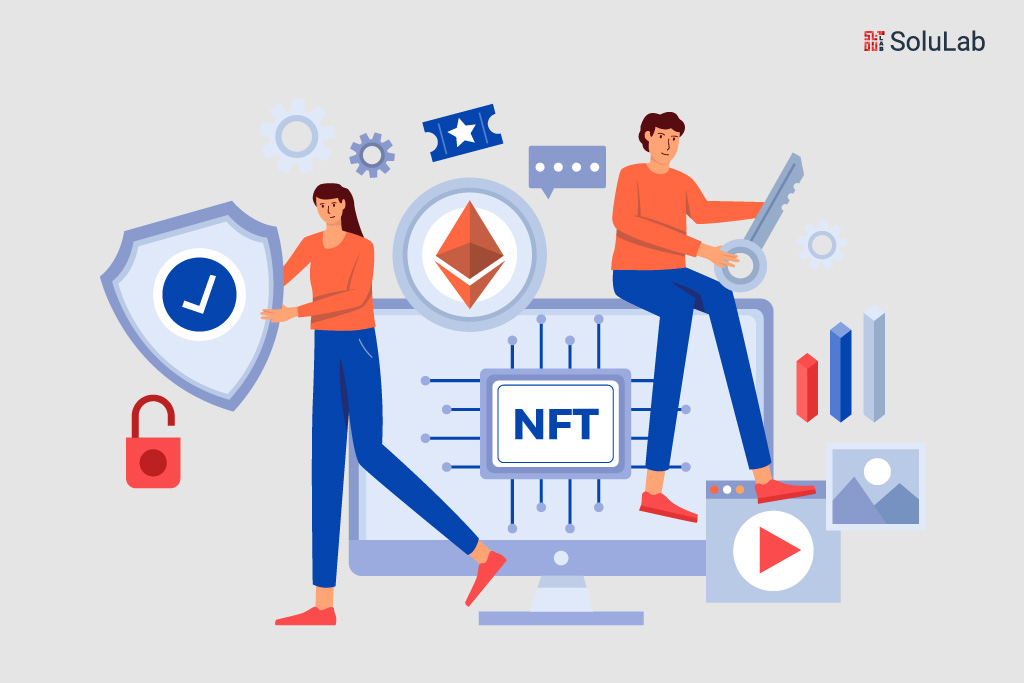
The NFT marketplace is a stage where consumers can store, display, trade, or produce NFTs (Non-Fungible Tokens). A Non-Fungible Token is a digital asset that is mainly built on Ethereum Blockchain technology and reflects real-world things. NFT marketplaces enable creators to reach a big audience with their NFT work. You can purchase or sell NFT artworks at a fixed price using these services. However, in order to access and operate on these marketplaces, you will require the following:

  • A cryptocurrency wallet.
  • In the wallet, there is cryptocurrency or coins.

The Non-Fungible Token marketplace features an extensive variety of NFT artworks from diverse sectors such as images, arts, movies, and other digital collectibles. Typically, niche marketplaces are in higher demand than ordinary ones since they offer what a client necessitates, concentrate on marketing specialized artwork, and aim at a detailed set of people.

Read Our Blog: Solana Marketplace NFT: How to build your own NFT Marketplace

Benefits of Ethereum Blockchain

1. Coordination of data:

The Ethereum blockchain enables efficient coordination of data by providing a decentralized platform where multiple parties can store, access, and update information in a transparent and secure manner. This allows for real-time data synchronization and eliminates the need for intermediaries, enhancing trust and reducing the chances of data manipulation or fraud.

2. Rapid mobilization:

Ethereum enables rapid mobilization of resources by allowing smart contracts to automate and streamline various processes. With programmable logic, tasks such as fundraising, supply chain management, and decentralized applications (dApps) can be executed quickly and efficiently, saving time and resources while promoting scalability.

3. Networks that need authorization:

Ethereum facilitates networks that require authorization, allowing permission access to specific participants. This feature is beneficial in industries where privacy and confidentiality are paramount, such as finance, healthcare, and supply chain management. It ensures that only authorized individuals or entities can participate and interact within the network.

4. Dimensions of the network:

The Ethereum network is designed to be highly scalable and adaptable to different use cases. It offers various solutions to address scalability challenges, such as layer 2 solutions like sidechains and state channels, allowing for increased throughput and improved performance. This flexibility enables the Ethereum blockchain to support a wide range of applications and accommodate a growing number of users.

5. Transactions between individuals:

Ethereum enables secure and direct transactions between individuals without the need for intermediaries, such as banks or payment processors. By utilizing the native cryptocurrency, Ether (ETH), individuals can transact peer-to-peer globally, with lower transaction fees and faster settlement times compared to traditional financial systems. This empowers individuals by giving them greater control over their financial interactions.

6. Finality:

Ethereum offers finality in transactions and smart contract execution. Once a transaction or smart contract is included in a block and added to the blockchain, it becomes immutable and tamper-proof. This ensures that transactions are irreversible, providing certainty and trust in the integrity of the network’s operations.

7. A layer of incentive:

Ethereum incorporates a layer of incentive through its native cryptocurrency, Ether (ETH), and its consensus mechanism known as proof-of-stake (PoS). Participants who validate and secure the network by staking their ETH are rewarded with additional tokens. This incentivizes network security, participation, and decentralization, creating a self-sustaining ecosystem that fosters innovation and growth.

Read Also: Everything You Need to Know About Metaverse NFT Marketplace Development
Steps For Developing An NFT Marketplace Based On Ethereum

Steps For Developing An NFT Marketplace Based On Ethereum

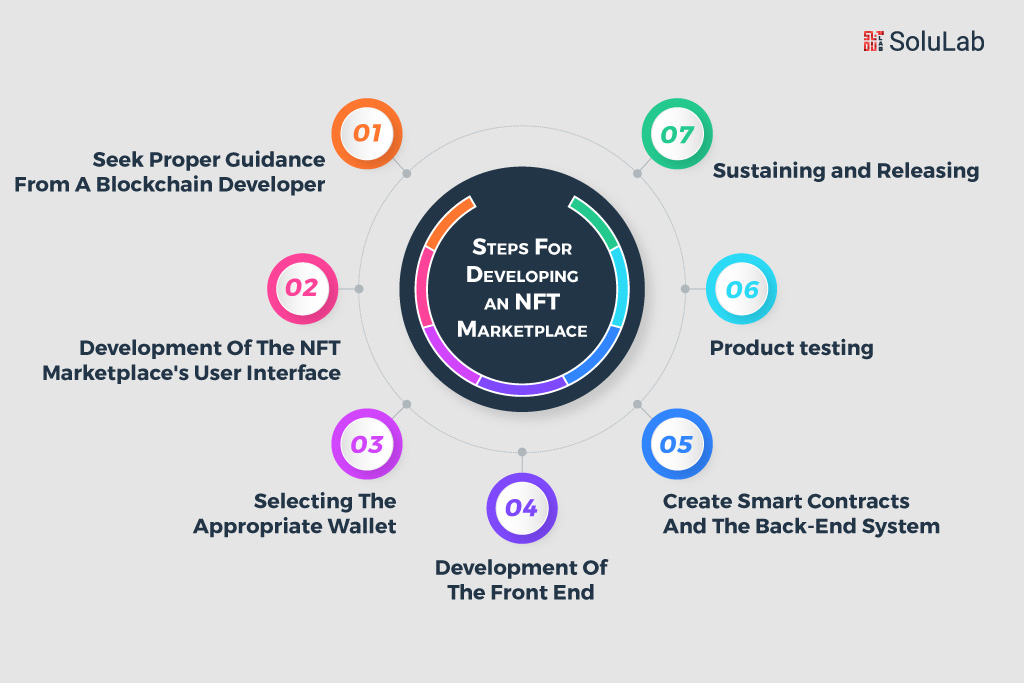
Step 1: Seek Proper Guidance From A Blockchain Developer

Ethereum serves as a forerunner in the blockchain network by ensuring its trustworthiness, consistency, security, and stability. Apart from the Ethereum network’s security, protocol developers always consider the types of apps and tools that users and developers prefer. Businesses should seek advice from a reputable blockchain development service provider when selecting an appropriate blockchain.

Step 2: Development Of The NFT Marketplace’s User Interface

An NFT marketplace must have a common user interface (UI) to facilitate interaction. It should have a search bar, filters, and a large number of categories, a community section, a dashboard, and an administration panel. All of these distinct categories and search bar filters are critical to providing an exceptional user experience since they lower the user’s search time.

Step 3: Selecting The Appropriate Wallet

Cross-chain interoperability is required for the integrated crypto-wallets, which must be utilized to acquire or use the cryptos stored in the wallet. To construct an Ethereum-based NFT, you must first create an Ethereum wallet, Metamask.

Step 4: Development Of The Front End

Front-end development is a component of the NFT trading platform that is used to communicate with the user. It has an intuitive UI, increased productivity, and security precautions.

Step 5: Create Smart Contracts And The Back-End System

A reputable NFT development business will provide assistance in establishing smart contracts. All logic for the NFT platform will be implemented at the back end. As previously stated, the NFT marketplace operates as a decentralized system, and smart contracts aid in the management of large data flows and their validation on the Blockchain. Ethereum is used to make the trading features of the NFT market work. A variety of smart contracts are used to make this happen.

It also helps set up a number of marketplace and business logic services that use Blockchain, digital wallets, auction processes, and so on to help people buy and sell things.

Step 6: Product Testing

Numerous test cycles will be used to determine the functioning of the created product. The QA team will guarantee that no defects or faults are left in order to ensure that the product is secure, useful, dependable, and productive. Throughout the testing process, the product must adhere to the project’s objectives and aims.

Step 7: Sustaining And Releasing

After completing the testing phase, it’s time to deploy your NFT platform to a cloud server. However, do not become complacent because this is not the final stage; you must continue to maintain and upgrade the program on a regular basis. Ascertain that the NFT platform you develop adheres to all market trends and meets the needs of your users.

CTA 1

Things to look out for when choosing an Ethereum NFT Marketplace

When we hunt for an Ethereum NFT marketplace, we may select one of the two processes:

1. Scratch-based NFT Marketplace on Ethereum

Scratch-based NFT Marketplace solutions require time to build all the features that satisfy the user’s expectations, and safety is deemed better in this category. Here, we may incorporate new features and upgrade an existing platform at any moment. It is a hard one, yet it delivers an apparent profit.

2. Opting White label NFT Marketplace on Ethereum

White label NFT Marketplace solutions are already developed, tested, and ready for implementation. It is an efficient and hassle-free approach that enables you to start your company sooner. This is useful for those who wish to launch their platform at a minimal cost. The key benefit is that there is no requirement for a huge development team as compared to producing new ones.

The Advantages of Developing an NFT Marketplace on Ethereum

1. Established Ecosystem:

Ethereum has the most mature and widely adopted blockchain ecosystem for NFTs. It has a strong developer community, extensive tooling support, and a wide range of existing decentralized applications (dApps) and wallets that support NFTs. This established ecosystem provides a solid foundation for building and integrating NFT marketplaces.

2. Interoperability and Standards:

Ethereum has defined and popularized key NFT standards, such as ERC-721 and ERC-1155, which have become industry standards for creating and exchanging NFTs. These standards ensure interoperability between different NFT projects, allowing seamless integration and transfer of assets between various platforms.

3. Network Effects:

Ethereum’s network effects contribute to its dominance in the NFT space. It has a large user base and a substantial number of active wallets, which enhances the visibility and discoverability of NFTs listed on Ethereum-based marketplaces. This widespread adoption helps attract buyers, sellers, and collectors to your marketplace.

4. Security and Immutability:

Ethereum is built on a secure and decentralized blockchain, providing robust security and immutability for NFT transactions. The distributed nature of the network ensures that NFT ownership records are resistant to censorship and tampering, instilling trust and confidence in users.

Read Our Blog: How To Launch Your Own NFT Marketplace Website in Less Than 2 Days?

5. Smart Contract Functionality:

Ethereum’s smart contract functionality is a powerful tool for developing advanced features and functionalities within an NFT marketplace. Smart contracts enable the automation of various processes, such as royalties, licensing, and secondary sales. They can also facilitate escrow services, auctions, and other complex transactions, enhancing the functionality and user experience of your marketplace.

6. Ecosystem Integration:

Ethereum offers extensive integration possibilities with other decentralized finance (DeFi) protocols and services. This integration allows for seamless liquidity pools, decentralized exchanges, lending platforms, and more, expanding the utility and potential use cases of NFTs within your marketplace.

7. Future Upgrades:

Ethereum is constantly evolving, with several improvements and upgrades planned. One of the significant upgrades is Ethereum 2.0, which aims to enhance scalability, reduce transaction costs, and improve overall network efficiency. Building on Ethereum ensures that your NFT marketplace can benefit from these upcoming improvements.
What Technological Stack Is Necessary For The Building Of An NFT Marketplace On Ethereum?

What Technological Stack Is Necessary For The Building Of An NFT Marketplace On Ethereum?

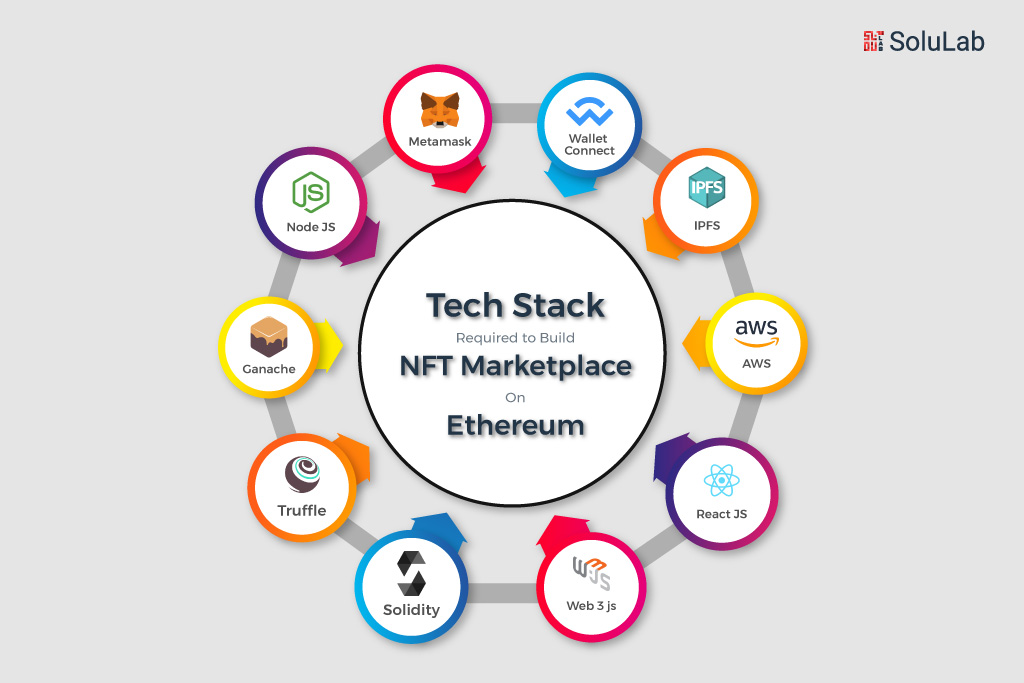
1. Solidity

A statically-typed curly-braces programming language, Solidity was created for use with the Ethereum Virtual Machine to develop smart contracts. Tokens of value, ownership, voting, and other types of logic may be implemented using smart contracts since they run on a peer-to-peer network with no central authority.

Use the most recent Solidity version for deploying contracts. This is due to the fact that new features, bug fixes, and breaking changes are released regularly.

2. Web3.js

Web3.js is a required JavaScript package that is used to establish connections to Ethereum’s blockchain technology. It is a collection of libraries that allow you to communicate with an Ethereum node via HTTP, IPC, or WebSocket.

3. Truffle

Truffle was made to help with the testing and deployment of Ethereum smart contracts and custom code. For private and public networks, Ethereum decentralized applications (dApps) are supported.

With Truffle –

  • The compilation, linking, deployment, and binary management of smart contracts are all built-in.
  • Automated contract verification is possible.
  • Custom build procedures are supported as part of the pipeline’s configuration.
  • There is a framework for scriptable deployments and migrations.
  • Implementation on several public and private networks is managed by a single system.
  • Direct contract communication through an interactive interface.
  • Immediate re-creation of assets while a project is in development can be done. 
  • Scripts may be executed in a Truffle environment using an external runner.

4. Ganache

Personal blockchains, such as Ganache, allow developers to rapidly build distributed applications on the Ethereum and Corda blockchains. If you’re developing, deploying, and testing your dApps in a deterministic environment, you can utilize Ganache. There are two versions of Ganache: a graphical user interface and a command-line interface.

5. IPFS

It is possible to store and access data in IPFS or InterPlanetary File System in a distributed fashion. While it doesn’t have its own incentive program, it may be utilized in conjunction with one or more contracts to ensure long-term success. Working with a pinning service, which “pins” your data for you, is another option for preserving IPFS data. It’s possible to operate your own IPFS node and contribute to the network in order to store your own and/or other people’s files for free.

6. React.js

React.js, which stands for React JavaScript, is a free and open-source front-end framework. JavaScript’s React framework lets you create user interfaces declaratively, efficiently, and with a lot of flexibility. It allows you to build complicated user interfaces out of tiny and separated “components” of code.

7. Metamask

Using MetaMask, you may access the Ethereum blockchain using a software wallet that connects to the network. In order to connect with decentralized apps, users may access their Ethereum wallets through a browser extension or mobile app.

8. Node. js

Node.js is a JavaScript runtime environment that is open-source and cross-platform. Node.js runs the V8 JavaScript engine, the basis of Google Chrome, outside of the browser. This enables Node.js to be incredibly performant.

Node.js software operates in a single process, without launching a new thread for every request. Node.js includes a set of asynchronous I/O primitives in its standard library that prevent JavaScript code from blocking and typically, libraries in Node.js are designed following non-blocking paradigms, making blocking behavior the exception rather than the rule.
CTA 2

Conclusion

Having gone over the specifics of Ethereum and the NFT Marketplace, anyone interested in understanding how to develop an NFT marketplace will be on the correct track.

SoluLab stands out as the ideal choice for NFT marketplace development and blockchain development. As a leading company in the industry, SoluLab offers comprehensive solutions tailored to the unique requirements of businesses. With their deep expertise in blockchain development, they ensure secure and efficient NFT marketplace platforms. Their services encompass end-to-end development, smart contract integration, and robust security measures. Partner with SoluLab to unlock the full potential of NFTs and blockchain technology, achieving success in the ever-evolving digital landscape, and hire blockchain developers from SoluLab today to get work experience like never before.

FAQs

1. What is an NFT marketplace on the Ethereum blockchain?

An NFT marketplace on the Ethereum blockchain is a platform where users can buy, sell, and trade non-fungible tokens (NFTs). NFTs are unique digital assets that can represent artwork, collectibles, virtual real estate, and more. Ethereum provides the underlying infrastructure for creating, storing, and transacting NFTs, making it a popular choice for building NFT marketplaces.

2. How can I build an NFT marketplace on the Ethereum blockchain?

Building an NFT marketplace on the Ethereum blockchain involves several key steps. First, define the scope and features of your marketplace. Then, choose a suitable development framework or partner with a blockchain development team. Next, design the user interface and implement functionalities such as NFT listing, search, bidding, and transaction management. Finally, integrate Ethereum smart contracts to handle NFT ownership and transfers securely.

3. What programming languages and tools are commonly used for building NFT marketplaces on Ethereum?

When building an NFT marketplace on Ethereum, the most commonly used programming language is Solidity, which is used for writing smart contracts. Additionally, web development languages like JavaScript, HTML, and CSS are used for building the front-end user interface. Popular tools and frameworks for Ethereum development include Truffle, OpenZeppelin, Web3.js, and Metamask for wallet integration.

4. How can I ensure the security and integrity of my NFT marketplace?

Ensuring the security and integrity of your NFT marketplace is crucial. Employ security best practices such as conducting thorough smart contract audits and testing for vulnerabilities. Implement strong user authentication and authorization mechanisms to protect user accounts and sensitive data. Regularly update and patch your platform’s dependencies to address any security vulnerabilities. Additionally, educate your users about best practices for secure wallet usage and transaction handling.

5. How do I handle transactions and payments on my NFT marketplace?

Handling transactions and payments on your NFT marketplace involves integrating cryptocurrency wallets and implementing secure payment gateways. Users will need to connect their Ethereum wallets (such as Metamask) to your marketplace to interact with the blockchain. Use appropriate libraries and APIs to process transactions, calculate fees, and handle escrow services if necessary. Provide clear instructions and user-friendly interfaces to guide users through the payment process.

How Will The Latest Ethereum Update “ERC-4337” Change Web3?

How will the latest Ethereum update "ERC-4337" Change Web3?

With its upgrade, unveiled at ETH Denver on March 1, 2023, and proposed by Ethereum co-founder Vitalik Buterin and others in September 2021, EIP-4337 and ERC-4337, Ethereum intends to change the routing of users into the cryptocurrency space. 

EIP-4337 and ERC-4337 are referred to as superchargers designed to boost web3 adoption and make Smart Accounts available to all web3 enthusiasts. This means that each cryptocurrency wallet can have its own unique authorization logic to suit the requirements of different users or programs. Contract accounts are the next step in wallet evolution needed to enhance web3’s user experience. 

Let’s examine ERC-4337 to better understand what it is, why it matters, and what it might portend for Web3.

Understanding ERC-4337

The term “request for comment” (or “ERC”), which stands for “Ethereum request for comment,” was developed by the Internet Engineering Task Force to communicate significant technical notes and requirements to a group of engineers and users.

Yoav Weiss, a security researcher at the Ethereum Foundation, observed, “The next billion users are not going to write twelve words on a piece of paper. Normal people don’t do that”. He said,” we need to give them better usability; they shouldn’t need to think about cryptographic keys.”

In order to change how users engage with wallet services, Ethereum introduced the ERC-4337 standard in 2023. The Ethereum update is known as ERC-4337, or “Ethereum Request for Comment 4337,” makes account abstraction possible. Account abstraction, to put it simply, is the suggestion to enable consumers to use smart contract wallets rather than EOAs. As a result, users are no longer required to conduct transactions using EOAs.

Yet why? What can’t EOAs do that contract accounts can? EOAs cannot compare to smart contracts in terms of flexibility. Several rules and configurations can be specified in the code of any smart contract.

In contrast to externally owned accounts (EOAs), account abstraction lets users use any cryptographic signature of their choice and authorize transactions securely over mobile devices. This allowed users to deploy smart contract wallets with flexible verification logic. Users could then add additional controls or features to their accounts, like two-factor authentication or alternatives for recovery with a friend or attorney.

How does Account Abstraction work?

There are two classifications of accounts available for Ethereum:

1. Contract Accounts (CA)—accounts managed by code rather than by private keys—cannot start transactions on their own. A contract account can be compared to a piece of code (smart contract) that lives on the blockchain and controls how the account operates.

2. Externally Owned Accounts (EOAs)- Consider EOAs as individuals (although a person could have many EOAs). They are the kind of account most Ethereum users choose to open, i.e., MetaMask and Coinbase Wallet.

EOAs are presumably already familiar to you. An EOA is your MetaMask wallet. Public and private cryptographic keys that manage account actions are included in EOAs. Nevertheless, contract accounts lack a private key. These smart contracts are driven by the internal logic of the code; users do not manage them. The main lesson from this is that users control what EOAs do, while code defines what contract accounts do. This is significant because, in contrast to EOAs, smart contracts may do any task that can be performed using code.

Read also: How to Create ERC-721 NFT Token?

Human mistake is at the root of the EOA problem; if users misplace their private keys, there is no way to get them back. By combining an EOA account with a CA, Account Abstraction handles the problems of an EOA account and constructs built-in mechanisms that permit users to maintain access to their cryptocurrency. A social recovery system is one of these built-in mechanisms. Multiple users can regain access to that account if someone loses their private key. Additionally, Account Abstraction allows users to create multi sig wallets, which require numerous users to sign off on transactions and grant access to an account to a group of users.

Why is ERC-4337 used?

Uses of ERC-4337

ERC-4337 resolves these major issues with current wallet structures:

Retrieve private keys 

The terrifying aspect of web3 is that it’s possible to forget the key with a crypto bit and lose access to one’s wallet. Using the “social recovery system” enabled by ERC-4337 development, authorized individuals can regain access to your wallet if they misplace their private keys. Several Account Recoveries choices, such as a normal Google or Bank account, are provided by this upgrade. Using reinvented cryptographic key storage, they transform your mobile device into something as useful as a hardware cryptocurrency wallet.

Negligible dependence on seed phrases

ERC-4337 Seed phrases, account managing code, and other developer-specific qualities are hidden away, resulting in a clear and usable user interface.ERC-4337 is anticipated to introduce “Group-Access” wallets for smart accounts. This implies that if you forget your seed phrase, you can contact the guardian contracts or accounts you previously chose to help you regain access. 

Users may now protect their wallets with 2FA (two-factor authentication) and biometrics, greatly enhancing their security and usability. Some users of Web 3 are there to safeguard themselves against the kind of institutional intrusion that security methods like biometrics imply. 

Furthermore, those users and others might not want to give up seed phrases because they offer an extra layer of security. Moreover, this measure would remove dependence on private keys through key abstraction. The seed phrase won’t even be required if someone attempts to build up a wallet after the ERC-4337 in order to reclaim the account if necessary. 

Gasless transactions

The ERC-4337 standard supports gasless transactions, further permitting the bundling of transactions to speed up and improve efficiency. With the help of this functionality, NFT collections and associated DAOs can sponsor users’ gas costs, lowering the cost of transactions.

This functionality also makes it possible to pay transaction fees using the tokens associated with an application, thus lowering transaction costs. To make this a primary feature, entire blockchains like Avalanche and its subnets have been created.

Automated DeFi and trading access

The level of involvement required to collect and trade NFTs is one of the most challenging aspects. Analyzing floor prices, timing mints, and tracking metrics all require almost constant effort.

However, ERC-4337 permits AI trading, adjusting yield farming positions, and automated trading with a monthly spend limit. Users of all levels may find trading NFTs much simpler and more accessible thanks to these features.

Bundled transactions

Sign-offs are required for every EOA transaction. Additionally, it may be tedious. With account reflection, it tends to be feasible to package exchanges and send them as one to save time and gas expenses.

User-specific benefits of ERC-4337

ERC-4337 would advance the idea of “Trustless Banks.” ERC-4337 smart accounts offer a number of advantages, some of which are listed here.

  • This innovation brings together all of the other aspects of Account Abstraction that other EIPs had in mind.
  • The decentralized relay system here is more secure and resistant to censorship.
  • They provide conventional mobile user onboarding.
  • Less likely a human error due to the deployment of smart contract wallets.
  • Modifications are simple to implement on other chains that are consistent with the Ethereum Virtual Machine.
  • The adaptability to activate features similar to those found in banks, such as auto-pay, account recovery, and multi-factor authentication.
  • Compatibility with upcoming signature schemes like Quantum resistance and BLS (Boneh-Lynn-Shacham), making the network less vulnerable to attacks.

Concluding remarks

How we communicate about ERC-4337 is crucial to realizing its potential. Anyone can start trading NFTs, join crypto newsletters, play web3 games, and create new smart account wallets with ERC-4337. ERC-4337 provides numerous features that traditional banks typically offer their customers without requiring trust. In general, ERC-4337 has the potential to revolutionize all industries. It might accelerate Ethereum’s daily transaction volume and active addresses in time. Additionally, with simple onboarding, gas-fee-specific revenue generation may improve.

CTA

Understanding the Ethereum ICO Token Hype

Understanding the Ethereum ICO Token Hype

Tokens and the Future of Crypto

Since the advent of bitcoin, the overall excitement around decentralized technologies has grown exponentially. The imagined possibilities of what these new systems will do for humanity have only just begun being explored in-depth. With a market capitalization of currently about ~$40 billion at the time of this writing, bitcoin remains the most valuable, and widely adopted cryptocurrency to date.

However, the rise of cryptocurrencies has birthed a few new breadwinners for our growing crypto family of public blockchains — specifically Ethereum (ETH).

Ethereum, which broke onto the scene only within the last 2 years, thanks to a very successful crowd sale, has since experienced astronomical gains…With an immense uptick in adoption from developers, institutions, and some of the largest enterprise-level organizations in the world, such as BP, Toyota, Intel, Microsoft, and more.

The core draw of generalized public blockchains like Ethereum is not purely a technical attraction, but more specifically “socio-technical”. The most disruptive aspect, thus far, for Ethereum, has been the growth of “tokenized assets” being created on the Ethereum public chain to create incentivized platforms; wherein the owners of the token use that asset to interact with and utilize the platform itself.

Read also: 7 Most Successful ICOs of All Time

The incentives for these tokens have many layers. Though the initial draw to these tokens is technical: the real benefit of tokens is the societal impact they have on the creation of new businesses, and raising funds in a borderless, global manner…without having to ask permission. Let’s jump into the specifics…

Smart Contracts 101 — An Introduction to Irrational Exuberance

If you read our previous article on our introduction to Ethereum, you should know by now that the project has the potential to solve major efficiency problems across a plethora of pre-existing industries; as well as create wholly new owned industries.

At the center of Ethereum lies the EVM or “Ethereum Virtual Machine”, a decentralized computer that can execute “smart contracts” (think mini-applications) that are submitted to run on the Ethereum public chain.

These contracts are self-enforcing, meaning that they will run exactly as pre-programmed, without the ability of manipulation or censorship, retroactively (though some will argue that this aspect isn’t true due to past events, that’s a discussion outside the scope of this post). This poses a tremendous advantage, allowing programmers to automate many processes throughout e-commerce, finance, real estate, legal contracts, and more.

Imagine an escrow system where “John” sells a product to “Mary”; a smart contract will securely store Mary’s payment, and will release it to John after the confirmation of delivery is made by an outside oracle. This eliminates the need for third parties to oversee the transaction (which creates additional counterparty risk by adding another trusted agent to the transaction).

Read also: How Do Smart Contract Applications Actually Work

Similarly, one can imagine a smart contract that automatically settles countless transactions in the banking sector, eliminating the need for costly settlement systems like the SWIFT network; systems that not only expend a large number of monetary resources but also precious human capital and intellect as well; intellect that could be best utilized in other ways than simply moving value from Point A to Point B across the globe.

Enter ERC20 Tokens

One of the main capabilities of Ethereum is that it allows a user to create their own token. A token is a representation of value, a sort of digital asset (dasset). The Ethereum developers decided to standardize this process, and so the ERC20 ‘Token Standard’ was created. This templated-contract standardization contains a series of functions that enables the issuance, distribution, and control of the assets in a formalized, standardized manner.

A token standard allows for the ease of interoperability between DApps (decentralized applications built on the Ethereum public chain) and the tokens built by the programmers.

What is an Ethereum Token sale?

Many developers have chosen Ethereum as the main platform to kickstart new projects; at the center of this, we have ICOs, which stands for “Initial Coin Offering” (there are other names as well but this is the most prevalent), similar to IPOs (initial public offerings, minus all the securities stuff, but that’s an on-going point of contingency).

ICOs are essentially a fundraising mechanism that allows a person/investor to receive a token in exchange for another well-known digital currency like Ether or Bitcoin. Typically, ICOs on the Ethereum network issue ERC20-compatible tokens to its users via smart contracts (barring the organization/individual holding the ICO from creating more tokens than originally specified in the initial contract); this allows developers to take advantage of the security the Ethereum protocol provides, minus all the additional technical overhead and complexity. Without having to worry as much about security (the initial token contract being secure is still, of course, a top priority) developers can keenly focus on the application layer; creating a more refined user experience to aid in the adoption of their platform/project.

It is also the norm that each new team that hopes to raise funding via an ICO launch platform also presents a ‘whitepaper’: a document explaining in detail the pitch of the future company and platform, going as far as to describe in detail the technology behind the proposal itself.

The various formats in which an individual or organization can hold an ICO crowd sale are ever-evolving, however; but, we’ll find a fair methodology that ensures optimal token distribution, and doesn’t create a quick cash exit, burning crowd sale participants.

What’s Got People Excited?

The initial appeal of ICOs should be fairly easy to see. Due to the borderless and decentralized nature of public blockchains like Bitcoin and Ethereum — the ease of transferring and moving wealth globally becomes almost effortless.

Now, because those transfers are effortless and permissionless, the barrier to entry for investing in a good company/venture is now freely available to everyone — even your gardener.

The tokens themselves do not offer the holder any particular rights or actual equity in these projects; however, it does enable the ability for individuals to speculate on the adoption and eventual real-world usage of those systems, creating liquidity and the ability for developers to fund their project and bring it to fruition. It also allows those users/investors to access any platforms or features that the developers create in the future with the token (think of it like an API key, that you pay for, Balaji puts that ever so succinctly).

With tokens, entrepreneurs have the ability to open up their projects to a global audience, allowing them to attract and raise funds from savvy investors all over the world salivating for the next “big thing” in tech. Technical Expertise, Developer Evangelism, and Product Marketing play a key role in helping ICO holders to establish a base of early adopters and fuel the initial bout of speculation to get the project off the ground (and enough attention to begin trading on prominent exchanges).

Token Sales Thus Far

We’ve seen many high-profile ICOs thus far. With companies like Storj, raising $ 30 million for their decentralized cloud storage platform; Brave raised a stagging ~$34mill in roughly 30 seconds; Aragon raised ~$25 million in about 20 minutes; and Gnosis, the originator of the Reverse Dutch Auction, who raised $12million in about 12 minutes.

But, we also can’t forget most recently, Bancor, who raised an astounding $140million in just a few hours (insert gasp here).

If those figures are stagging and surprising to you, you’re not the only one. But, who’s to say if these are proper valuations or not? This is the first time in history we’ve been given this ability to raise from a global audience, almost instantly. Perhaps these numbers are only a drop in the bucket for what’s to come next. Time will tell, and history will play out from here.

Picking a Good ICO

Creating an ERC20 token is easy. Paying a team to create amazing design mockups and marketing pages is even easier. The difficult aspect of ICO investing is learning to filter out the noise, and determine if the team is in it for the technology and use case — or a quick buck.

Now, you’d probably argue that’s the job of modern-day VCs, and in a way you’re right — that’s what VCs are good at. Finding the diamonds in the rough from a Founder perspective. Investing in ICOs like Brave’s Basic Attention Token Sale, an offering by an already established entity with a working product and sound team, are likely a safer bet. But, the risk/reward there might not be satisfactory (especially after you’ve gotten a taste of 5–10x returns, it can be hard to go back). Picking a great project is a combination of art, and science — due diligence remains more important than ever, especially when investing your hard-earned savings into such an unregulated and “Wild West” like industry.

Read also: How to Find the Best ICO Service Provider?

There is no clear-cut formula for token investing; it’s a matter of making informed and educated decisions, at the right time. But, fortune favors the bold, no?

Legal Risks

No primer on ICOs would be complete without a section on legal risk. As mentioned above, this space is highly unregulated and filled with opportunistic money grabbers looking to make a quick buck on your poorly informed decisions.

That said, regardless of how high-profile the token offering is, there is nothing stopping a development team from running off with the funds raised via an ICO, except for maybe burning years of social capital. Which, will stop some, but not all (greed can do powerful things, remember this).

Lock-up mechanisms (think vesting schedules and cliffs) with token contracts are becoming a more common norm; but, to think that’s enough to give you peace of mind in this (somedays seemingly) lawless jungle of cutthroats, would be naive.

Since most of these ICOs run with a disclaimer of not guaranteeing returns to investors if its associated token price plummets to zero based on negligence or malicious actions by the development team — there is likely not much legal recourse will do if the developers are good at masking their trail…this is the Wild West remember — watch out for cowboys (and cowgirls, it’s 2017).

Closing

Hopefully, this was a concise quick introduction to this growing phenomenon. For now, VCs and traditional accredited investors will do all they can to gain influence and hold ground in this fledging industry; performing the appropriate due diligence to calculate risk; maybe even picking a few winners along the way.

But, once this powerful new paradigm evolves a bit more, we may have finally created the global answer to Silicon Valley — only this time on the internet, where all can be sovereign and free.

Blog Credits: Medium

How To Make Erc20 Token?

[fusion_builder_container hundred_percent="no" hundred_percent_height="no" hundred_percent_height_scroll="no" hundred_percent_height_center_content="yes" equal_height_columns="no" menu_anchor="" hide_on_mobile="small-visibility,medium-visibility,large-visibility" status="published" publish_date="" class="" id="" border_size="" border_color="" border_style="solid" margin_top="" margin_bottom="" padding_top="" padding_right="" padding_bottom="" padding_left="" gradient_start_color="" gradient_end_color="" gradient_start_position="0" gradient_end_position="100" gradient_type="linear" radial_direction="center" linear_angle="180" background_color="" background_image="" background_position="center center" background_repeat="no-repeat" fade="no" background_parallax="none" enable_mobile="no" parallax_speed="0.3" background_blend_mode="none" video_mp4="" video_webm="" video_ogv="" video_url="" video_aspect_ratio="16:9" video_loop="yes" video_mute="yes" video_preview_image="" filter_hue="0" filter_saturation="100" filter_brightness="100" filter_contrast="100" filter_invert="0" filter_sepia="0" filter_opacity="100" filter_blur="0" filter_hue_hover="0" filter_saturation_hover="100" filter_brightness_hover="100" filter_contrast_hover="100" filter_invert_hover="0" filter_sepia_hover="0" filter_opacity_hover="100" filter_blur_hover="0"][fusion_builder_row][fusion_builder_column type="1_1" spacing="" center_content="no" link="" target="_self" min_height="" hide_on_mobile="small-visibility,medium-visibility,large-visibility" class="" id="" hover_type="none" border_size="0" border_color="" border_style="solid" border_position="all" border_radius="" box_shadow="no" dimension_box_shadow="" box_shadow_blur="0" box_shadow_spread="0" box_shadow_color="" box_shadow_style="" padding_top="" padding_right="" padding_bottom="" padding_left="" margin_top="" margin_bottom="" background_type="single" gradient_start_color="" gradient_end_color="" gradient_start_position="0" gradient_end_position="100" gradient_type="linear" radial_direction="center" linear_angle="180" background_color="" background_image="" background_image_id="" background_position="left top" background_repeat="no-repeat" background_blend_mode="none" animation_type="" animation_direction="left" animation_speed="0.3" animation_offset="" filter_type="regular" filter_hue="0" filter_saturation="100" filter_brightness="100" filter_contrast="100" filter_invert="0" filter_sepia="0" filter_opacity="100" filter_blur="0" filter_hue_hover="0" filter_saturation_hover="100" filter_brightness_hover="100" filter_contrast_hover="100" filter_invert_hover="0" filter_sepia_hover="0" filter_opacity_hover="100" filter_blur_hover="0" last="no"][fusion_text columns="" column_min_width="" column_spacing="" rule_style="default" rule_size="" rule_color="" hide_on_mobile="small-visibility,medium-visibility,large-visibility" class="" id="" animation_type="" animation_direction="left" animation_speed="0.3" animation_offset=""] The world of cryptocurrency might seem to be quite confusing to an average investor, particularly for the ones without technical knowledge of blockchain and smart contracts. But the prospects of a number of new digital currencies have attracted all types of investors, including ones who might have been cautious otherwise regarding an investment in cryptocurrency. Any interested investors without in-depth technical knowledge of cryptocurrency can be still successful in the same. But a basic understanding of some of the most important properties of a few major cryptocurrencies at present can play a crucial role in making a safe investment decision. In this regard, a major concept that covers a huge portion of the entire space that is relevant to smart contracts, as well as smart property, is known as ERC 20 token standard.

What is ERC 20 Token?

ERC 20 is a scripting standard used within the Ethereum blockchain. It is a technical standard that sets a few rules and actions that an ERC token should adhere to along with the steps for the purpose of implementing the same. It would be better to state ERC 20 as a set of guidelines as well as functions that should be necessarily followed by every token created in the Ethereum blockchain network. To state it in simpler terms, ERC 20 token refers to a standard used for the purpose of creation and issuance of smart contracts on the Ethereum blockchain. After that smart contracts can be used for the creation of tokenized assets or smart property that users can invest in. ERC is the abbreviated form of "Ethereum request for comment," and the year of implementation of the ERC20 standard was 2015.

Reasons for Attraction and Success of ERC 20 Tokens

It is very common to ask what makes ERC 20 tokens so attractive and successful. There are a number of reasons behind the same that are listed below.
  • These tokens are extremely simple and easy to deploy without taking up a lot of time.
  • ERC 20 tokens put forth a standardized set of commands for the purpose of facilitating easy communication with an array of tokens they manage, thereby providing the right solution towards the need of a single standard in blockchain-based marketplaces and crypto wallets. The standardized set of commands include the rules of interaction between various tokens and rules for purchasing tokens.
  • ERC 20 is the first popular specification that offered Ethereum token standardization. It is due to the immense popularity of the token that it became an industry standard.
Very similar to other ETH tokens, ERC 20 are also implemented as smart contracts and executed on the EVM or Ethereum Virtual Machine in a decentralized manner.

Steps to Make ERC 20 Token

Now, there are many who would be wondering how to make ERC 20 token. In this regard, there are many who are of the viewpoint that it is quite tough. On the other hand, there are many who believe that it is possible. In fact, it is not very difficult and can be made in a few steps with some knowledge of coding. Let us now understand the steps to make ERC 20 token. Step 1 – The first step is to decide what the token would be like. For the creation of an ERC 20 token, the name of the token, the symbol of the token, its decimal places, and the number of tokens in circulation is required. Step 2 – The second step is the technical step where the contact is required to be coded. During coding of contact, it needs to be kept in mind that the supply set for the token is in correlation to the number of places of decimals that are set. In addition to this, it is required to set the number of tokens that are received as the creator of the contract. Once all the variables are set, it is time to deploy the same into the blockchain and test it. Step 3 – The next step is to test the token on the Test Net. It is important to deploy the contract to the Test Net to check if it works fine or not. If there is any problem, it is identified and rectified so that it is good to go. Step 4 – The fourth step involves the verification of the source code. It is of immense importance since it verifies the validity of the created token to the users. In technical terms, it does not matter, and the created token would still be usable if the source code is not verified. But it is always a very good practice to conduct the verification so as to keep everything transparent in front of the users. Step 5 – Finally, it is time to publish after verification. The task here is to get the token on The Main Net and make it available for use. Step 6 – Next, the created token requires to be verified on Etherscan. This is not an essential step and might be skipped. But performing the steps plays a major role in adding to the validity of the token making it more transparent. This concludes the process of making the ERC 20 token.

Conclusion

Now, the users have a clear and complete understanding of the process of the creation of the ERC 20 token. Going through the steps makes it clear that it is not very difficult or tough. Still, if you are not sure and hesitating, it is always recommended to seek the help of an expert at the time of creating an ERC 20 token. [/fusion_text][/fusion_builder_column][/fusion_builder_row][/fusion_builder_container]

-Contact Us-

SoluLab being the top 3 Blockchain developers can help you build the perfect Blockchain Platforms.

Cardano – the latest buzz in Crypto space!

Cardano is a blockchain project founded in the year 2015 by Charles Hoskinson, who also happens to be the co-founder of Ethereum. The blockchain platform aims to provide a much more balanced as well as a sustainable ecosystem for cryptocurrencies.

What is Cardano?

Cardano (ADA) is an open-source and decentralized public blockchain platform where consensus is achieved by using proof of stake. It can very easily facilitate peer-to-peer transactions with its internal cryptocurrency, ADA. Cardano is also the largest cryptocurrency to make use of a proof-of-stake blockchain, which in turn is seen as a greener alternative to proof-of-work protocols. It is a blockchain platform for change-makers, innovators, and visionaries. Cardano has the required tools and technologies for the creation of the possibility for the many along with bringing about positive global change.

Cardano happens to be the first blockchain platform that is built through peer-reviewed research and is sufficiently secure to appropriately protect the data of billions. In addition to this, Cardano is scalable enough to accommodate global systems and sufficiently robust for the purpose of supporting foundational change. Cardano focuses on five major principles that are listed below.

  1. People – Working together to achieve more for the many.
  2. Purpose – It is a platform built to create a. sustainable future to help people work better together, rely on each other, and develop global solutions for global problems.
  3. Technology – Cardano aims to bring about new standards in technology both open and inclusive that can challenge the old and give birth to a new age of sustainable innovation that is globally distributed.
  4. Research – Ground-breaking research is the key to the birth of new technologies.
  5. Opportunity – Cardano helps empower businesses by creating new opportunities and discover the future of technology.

USP of Cardano

Here is a brief summary of the USP of Cardano.

  • Cardano helps restore trust to global systems by the creation of a more secure, transparent, as well as sustainable foundation for the users to transact and exchange, enterprises to grow, and systems to govern.
  • Cardano is the first blockchain platform to implement proof-of-stake and ouroboros which happens to be the protocol for the most environmentally sustainable blockchain. It is a clear-cut approach to save on energy costs and facilitate the rapid processing of transactions.
  • Cardano focuses on solving the problems of scalability, sustainability, and interoperability on cryptocurrency platforms.
  • Cardano offers unparalleled security for making a trustless world.
  • Cardano supports open as well as incentivized participation.


Future of Cardano

Cardano has raced to the third position in the cryptocurrency list after its price touched an all-time high overtaking the native token of Binance according to the market valuation. As per CoinMarketCap, the current price of Cardano is 2.82 dollars with market capitalization standing at 90.60 billion dollars. Its price three days ago went up by 11.3 percent in a matter of just 24 hours. Cardano’s year-to-date ratio is much higher as compared to Bitcoin & Ethereum, the top two cryptocurrencies, and is presently at 1444 percent. With no signs of stopping, Cardano has a phenomenal scope in the time to come.

Cardano has an array of use cases that are mentioned below.

  • Education
  • Retail
  • Agriculture
  • Government
  • Finance
  • Healthcare

With the list increasing slowly and steadily, it gives a clear indication of the potential as well as the scope of Cardano in the future.

Conclusion

The crypto market has been rallying in the previous two weeks with the total market capital going above two trillion dollars. The top two, Bitcoin and Ethereum have been leading after they sharply fell in mid-May. Meanwhile, the new Altcoins have also played their part in rallying in the price race. Cardano is considered to be a direct rival of Ethereum and Solana. Its recent increase in price was a result of the recent announcement regarding the upcoming ‘Alonzo’ upgrade. The update is all set to be launched in the month of September. The update is expected to introduce smart contracts to the blockchain which would certainly mark significant progress in the rollout of smart contracts on the Cardano main net.

- Contact Us -

SoluLab being the top 3 Blockchain developers can help you build the perfect decentralized apps.

10 Best Use Cases For Smart Contracts in DeFi (Decentralized Finance)

Smart contracts are a result of the evolution of blockchain technology. Let us first understand what smart contracts are and throw some light on the smart contract use cases. Smart contracts are referred to as paperless digital code providing a set of promises on some predefined conditions that have been agreed to by both parties. To state in simpler terms, it can be said that the parties can set a condition that has the ability to start an action or a series of actions at the time when the conditions are met.

Smart contracts have a wide array of applications that help automate all tasks or the entire network like the decentralized autonomous organizations making use of a set of smart contracts. The ones who are still skeptical about using smart contracts should have an idea about the benefits offered and start using the same.

  • One of the largest benefits offered by smart contracts is automation. This, in turn, makes it free from any kind of interruption and no third party can alter the agreement as well as decision.
  • Security is readily enhanced in the case of smart contracts where the entire process works in a secure manner.
  • Smart contracts are free from all sorts of interruption and hence operate smoothly.
  • The entire system is trustless and hence there is no requirement of trusting other parties for carrying out any transactions.
  • Smart contracts are able to make the transactions extremely cost-effective in nature because of the removal of intermediaries from the process.
  • The autonomous smart contracts are executed with a greater speed as compared to the traditional approach.
  • Finally, smart contracts are highly accurate and free from any kind of errors.

Use Cases of Smart Contracts

Now, we have a clear idea about the potential smart contracts and what benefits they have on offer. So, it is time now to understand the ten best smart contract use cases.

  1. Digital Identity

    One of the top smart contract use cases is providing a digital identity to assets that are individualized. It contains data, reputation, and digital assets. The digital identity when rightly used is able to bring about new opportunities to the person. In addition to this, the digital identity offered by smart contracts plays a vital role in protecting the identity of the asset from their counterparts.

  2. Loans, Mortgage, and Financial Service

    Smart contracts play a crucial role in bringing about a significant improvement in financial services. Smart contracts help the easy connection between the parties to make sure that the entire process is completed in a hassle-free manner. Moreover, the use of smart contracts also makes the process free from all sorts of errors. Another major benefit of using smart contracts in financial services is clarity and enhanced visibility to all the parties involved.

  3. Mortgage System

    The mortgage system is another use case of smart contracts. Smart contracts induce automation in the mortgage system to make it easier for both buyers as well as sellers. Now, when the system is automated, the entire process becomes less time-consuming and completely hassle-free which proves to be highly advantageous.

  4. Insurance

    Insurance has been one of the important use cases of smart contracts. Disputes are a common affair in the insurance sector and to effectively settle the disputes along with making the claim settling process smooth, smart contracts have a crucial role to play. Smart contracts facilitate the insurance policy and ensure it has the proper documentation to make the process convenient for both the insurance buyer as well as the insurance provider.

  5. Inter Border Payments

    With the help of smart contracts, inter-border payments become easy and convenient, thereby facilitating international trade. Smart contracts have the ability to revolutionize trade finance by propelling international transfer of goods and initiation of trade payments with the use of only a letter of credit. Moreover, smart contracts enhance the liquidity of financial assets, thereby improving the financial efficiency of buyers, suppliers, and institutions.

  6. Supply Chain Management

    Another use case of smart contracts is the supply chain management industry. With the help of smart contracts, supply can be readily improved. It helps easy and convenient tracking of items within the supply chain with complete transparency as well as visibility to improve overall inventory tracking. It also helps reduce verification and provides enhanced tracing which in turn results in lesser fraudulent activities.

  7. Clinical Trials

    Clinical trials improve with smart contracts since they can provide better inter-institutional visibility. It also helps automate sharing of data between institutions and enables privacy-preserving computations.

  8. Government

    Another major smart contract used case is in the Government. Smart contracts play a significant role in helping the government manage entire operations in an easy and automated manner. One of the major operations among those is recording land titles for easy property transfers. With the use of smart contracts, the entire process is quite transparent, and efficient.

  9. Recording of Financial Data

    Financial data is immensely important for every organization and the use of smart contracts is highly beneficial in this regard. Smart contracts provide the necessary way for recording data without compromising even a bit on accuracy and transparency. Therefore, financial data collection and recording are absolutely uniform across organizations resulting in decreased cost of auditing as well reporting.

  10. Management of Assets

    Smart contracts help manage assets in an efficient and effective manner. The entire process of asset management is quick because of the induced automation which is absent in the case of traditional practices. With the help of a smart contract, the process is fully transparent and hence does not give any of the users even a single chance to complain.

What Smart Contracts Have in Store for Us?

With the evolution and advancement of blockchain technology on a regular basis, the potential of smart contracts is bound to increase in the time to come. In addition to the smart contract use cases mentioned above, there are a number of other cases where smart contracts can be readily used and the number is all set to rise in the future.

- Contact Us -

SoluLab being the top 3 Blockchain developers can help you build the perfect smart contract applications.
