Talk to an Expert

How Will The Latest Ethereum Update “ERC-4337” Change Web3?

How will the latest Ethereum update "ERC-4337" Change Web3?

With its upgrade, unveiled at ETH Denver on March 1, 2023, and proposed by Ethereum co-founder Vitalik Buterin and others in September 2021, EIP-4337 and ERC-4337, Ethereum intends to change the routing of users into the cryptocurrency space. 

EIP-4337 and ERC-4337 are referred to as superchargers designed to boost web3 adoption and make Smart Accounts available to all web3 enthusiasts. This means that each cryptocurrency wallet can have its own unique authorization logic to suit the requirements of different users or programs. Contract accounts are the next step in wallet evolution needed to enhance web3’s user experience. 

Let’s examine ERC-4337 to better understand what it is, why it matters, and what it might portend for Web3.

Understanding ERC-4337

The term “request for comment” (or “ERC”), which stands for “Ethereum request for comment,” was developed by the Internet Engineering Task Force to communicate significant technical notes and requirements to a group of engineers and users.

Yoav Weiss, a security researcher at the Ethereum Foundation, observed, “The next billion users are not going to write twelve words on a piece of paper. Normal people don’t do that”. He said,” we need to give them better usability; they shouldn’t need to think about cryptographic keys.”

In order to change how users engage with wallet services, Ethereum introduced the ERC-4337 standard in 2023. The Ethereum update is known as ERC-4337, or “Ethereum Request for Comment 4337,” makes account abstraction possible. Account abstraction, to put it simply, is the suggestion to enable consumers to use smart contract wallets rather than EOAs. As a result, users are no longer required to conduct transactions using EOAs.

Yet why? What can’t EOAs do that contract accounts can? EOAs cannot compare to smart contracts in terms of flexibility. Several rules and configurations can be specified in the code of any smart contract.

In contrast to externally owned accounts (EOAs), account abstraction lets users use any cryptographic signature of their choice and authorize transactions securely over mobile devices. This allowed users to deploy smart contract wallets with flexible verification logic. Users could then add additional controls or features to their accounts, like two-factor authentication or alternatives for recovery with a friend or attorney.
How does Account Abstraction work?

There are two classifications of accounts available for Ethereum:

1. Contract Accounts (CA)—accounts managed by code rather than by private keys—cannot start transactions on their own. A contract account can be compared to a piece of code (smart contract) that lives on the blockchain and controls how the account operates.

2. Externally Owned Accounts (EOAs)- Consider EOAs as individuals (although a person could have many EOAs). They are the kind of account most Ethereum users choose to open, i.e., MetaMask and Coinbase Wallet.

EOAs are presumably already familiar to you. An EOA is your MetaMask wallet. Public and private cryptographic keys that manage account actions are included in EOAs. Nevertheless, contract accounts lack a private key. These smart contracts are driven by the internal logic of the code; users do not manage them. The main lesson from this is that users control what EOAs do, while code defines what contract accounts do. This is significant because, in contrast to EOAs, smart contracts may do any task that can be performed using code.

Read also: How to Create ERC-721 NFT Token?

Human mistake is at the root of the EOA problem; if users misplace their private keys, there is no way to get them back. By combining an EOA account with a CA, Account Abstraction handles the problems of an EOA account and constructs built-in mechanisms that permit users to maintain access to their cryptocurrency. A social recovery system is one of these built-in mechanisms. Multiple users can regain access to that account if someone loses their private key. Additionally, Account Abstraction allows users to create multi sig wallets, which require numerous users to sign off on transactions and grant access to an account to a group of users.
Why is ERC-4337 used?

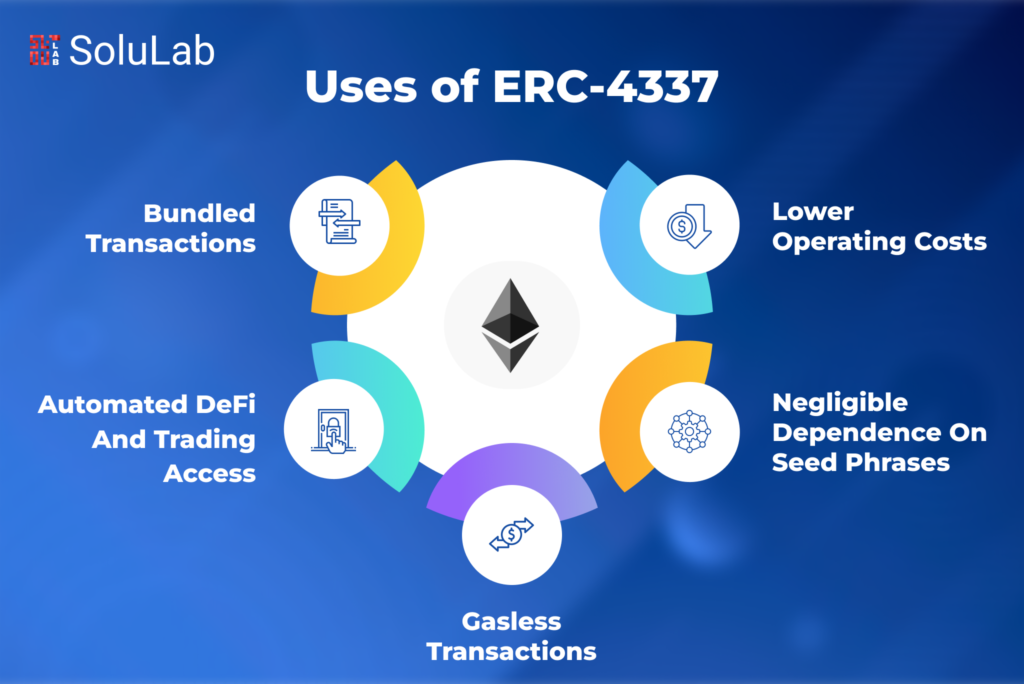
Uses of ERC-4337

ERC-4337 resolves these major issues with current wallet structures:

Retrieve private keys 

The terrifying aspect of web3 is that it’s possible to forget the key with a crypto bit and lose access to one’s wallet. Using the “social recovery system” enabled by ERC-4337 development, authorized individuals can regain access to your wallet if they misplace their private keys. Several Account Recoveries choices, such as a normal Google or Bank account, are provided by this upgrade. Using reinvented cryptographic key storage, they transform your mobile device into something as useful as a hardware cryptocurrency wallet.

Negligible dependence on seed phrases

ERC-4337 Seed phrases, account managing code, and other developer-specific qualities are hidden away, resulting in a clear and usable user interface.ERC-4337 is anticipated to introduce “Group-Access” wallets for smart accounts. This implies that if you forget your seed phrase, you can contact the guardian contracts or accounts you previously chose to help you regain access. 

Users may now protect their wallets with 2FA (two-factor authentication) and biometrics, greatly enhancing their security and usability. Some users of Web 3 are there to safeguard themselves against the kind of institutional intrusion that security methods like biometrics imply. 

Furthermore, those users and others might not want to give up seed phrases because they offer an extra layer of security. Moreover, this measure would remove dependence on private keys through key abstraction. The seed phrase won’t even be required if someone attempts to build up a wallet after the ERC-4337 in order to reclaim the account if necessary. 

Gasless transactions

The ERC-4337 standard supports gasless transactions, further permitting the bundling of transactions to speed up and improve efficiency. With the help of this functionality, NFT collections and associated DAOs can sponsor users’ gas costs, lowering the cost of transactions.

This functionality also makes it possible to pay transaction fees using the tokens associated with an application, thus lowering transaction costs. To make this a primary feature, entire blockchains like Avalanche and its subnets have been created.

Automated DeFi and trading access

The level of involvement required to collect and trade NFTs is one of the most challenging aspects. Analyzing floor prices, timing mints, and tracking metrics all require almost constant effort.

However, ERC-4337 permits AI trading, adjusting yield farming positions, and automated trading with a monthly spend limit. Users of all levels may find trading NFTs much simpler and more accessible thanks to these features.

Bundled transactions

Sign-offs are required for every EOA transaction. Additionally, it may be tedious. With account reflection, it tends to be feasible to package exchanges and send them as one to save time and gas expenses.

User-specific benefits of ERC-4337

ERC-4337 would advance the idea of “Trustless Banks.” ERC-4337 smart accounts offer a number of advantages, some of which are listed here.

  • This innovation brings together all of the other aspects of Account Abstraction that other EIPs had in mind.
  • The decentralized relay system here is more secure and resistant to censorship.
  • They provide conventional mobile user onboarding.
  • Less likely a human error due to the deployment of smart contract wallets.
  • Modifications are simple to implement on other chains that are consistent with the Ethereum Virtual Machine.
  • The adaptability to activate features similar to those found in banks, such as auto-pay, account recovery, and multi-factor authentication.
  • Compatibility with upcoming signature schemes like Quantum resistance and BLS (Boneh-Lynn-Shacham), making the network less vulnerable to attacks.

Concluding remarks

How we communicate about ERC-4337 is crucial to realizing its potential. Anyone can start trading NFTs, join crypto newsletters, play web3 games, and create new smart account wallets with ERC-4337. ERC-4337 provides numerous features that traditional banks typically offer their customers without requiring trust. In general, ERC-4337 has the potential to revolutionize all industries. It might accelerate Ethereum’s daily transaction volume and active addresses in time. Additionally, with simple onboarding, gas-fee-specific revenue generation may improve.


CTA

What is the Erc20 Standard and How it Links to Ethereum?

The world of cryptocurrency might seem to be quite daunting for any average investor particularly for the ones who possess very little or zero knowledge of blockchain or smart contracts. But the prospects of several new digital currencies have attracted the attention of almost all types of investors which includes the ones who have otherwise been a bit more cautious about making an investment in cryptocurrency. In order to be successful in the world of cryptocurrency, in-depth technical knowledge is not required. But a basic knowledge about some of the vital properties of the digital currencies existing at present would certainly be helpful in making a safe and sound financial decision.

What is ERC 20 Standard?

One of the vital portions that govern the space of cryptocurrency in relation to smart contracts and smart property is referred to as the ERC 20 Standard. It refers to the scripting of a standard that is used within the Ethereum blockchain. It is a technical standard that puts forth a set of rules and actions that should be necessarily followed as well as implemented by an Ethereum token or smart contract. To state it in the simplest of terms, it would be ideal to say that ERC 20 is a set of basic guidelines and functions that must be adhered to by all new tokens created in the Ethereum network.


ERC 20 is one of the most significant Ethereum tokens that has emerged as a standard for all smart contracts on the Ethereum blockchain. It is the standard token used for the purpose of creation and issuance of smart contracts on the Ethereum blockchain. Then the smart contracts can be used to create tokenized assets or smart property that can be invested in by the interested investors.

A Brief History of ERC 20 Standard

ERC 20 was developed by Ethereum developers on behalf of the broader Ethereum community in the year 2015 but it was officially recognized in September 2017. For creating a standard of this type of Ethereum, the developer should submit an Ethereum Improvement Proposal or EIP with its new functionality and its specific protocols as well as standards. Then a specialized committee reviews, approves, amends, and finalizes that proposal which then becomes an ERC. Smart contracts and different features within Ethereum are then bound to conform to one of the approved standards. ERC 20 Standard happens to be one of the most important and well-known ERC Standards but it is to be kept in mind that it is not the only one in existence.

Importance of ERC 20 Standard

ERC is the abbreviated form of Ethereum Request for Comment. Request for comment is a concept that is very similar to the one devised by the Internet Engineering Task Force as a means of transferring vital technical notes as well as requirements to a group of developers and users. The ERC 20 standard has been a commanding pathway for the development of new tokens in the world of cryptocurrency for quite some time. ERC 20 has been quite popular among crowdfunding companies and ICOs. At this point in time, there are tens of thousands of unique tokens that have been issued which operate as per the ERC 20 Standard.


There are a number of ERC 20 smart contracts that are used for the purpose of execution of a wide range of functions and routines in the digital space. On the other hand, many of the ERC 20 smart contracts are used in order to create non-fungible tokens or NFTs for the purpose of ICO or initial coin offering. ICO or initial coin offering in the world of cryptocurrency is equivalent to an IPO or initial public offering in the world of the stock market. Any of the crypto companies looking forward to raising money in order to create a new cryptocurrency, decentralized app, or service launches an initial coin offering as a way to raise funds from the investors and early adopters.


According to a report from Yahoo News, it said that ERC20 tokens entirely dominated the ICO bull market way back in the year 2017 and that a number of successful cryptocurrencies are founded as per the ERC 20 Standard. For instance, EOS is a very popular token based on ERC 20 that raised more than about 185 million dollars in its five-day ICO launch. Bancor or BNT is another popular example of a token-based on ERC 20 that earned about 153 million dollars in crowdfunds during its ERC20 token sale. There are a number of other tokens that are compliant with ERC 20 Standard that have raised several million dollars in ICOs.

Six Different Coding Functions Specified by ERC 20 Standard

There are about 442,647 ERC 20 compatible tokens that exist on the Ethereum network. The ERC 20 Standard puts forth a set of common rules which every Ethereum token must stick to. To make it easier for users to understand, here we have listed six different coding functions that every ERC 20 compliant token should be able to implement.

  1. Total Supply – It provides information regarding the total supply of tokens.
  2. Balance Of – It provides the account balance of the account of the owner.
  3. Transfer – It executes the transfers of a specific number of tokens to a specific address.
  4. Transfer From – It executes the transfers of a specific number of tokens from a specific address.
  5. Approve – It allows a spender to withdraw a fixed number of tokens from a specific account.
  6. Allowance – It returns a fixed number of tokens to the owner from a spender.

These code functions play an integral role in the implementation of tokens particularly in determining the total number of tokens in circulation storing & returning balances, making a transfer, withdrawal requests & granting approval, and agreeing to automated transfers. The set of functions makes sure that different types of Ethereum tokens will perform uniformly at every place within the Ethereum network.

-Contact Us-

The World is Upgrading to Blockchain. Don't get confused and take wrong base technology for your project. Get Free Consultation Now!

How ERC20 Contracts Works and Their Key Benefits

ERC20 Contract Guide

Smart contracts are nothing but simple programs stored on a blockchain. They tend to run when the predetermined conditions are met and are used for the purpose of automating the execution of an agreement so that each of the participants can be certain of the outcome almost instantaneously without the involvement of any kind of intermediaries or loss of time. At the same time, smart contracts have the ability to automate a workflow by facilitating the next action at the time when the requisite conditions are met.

What is the ERC20 Contract?

An ERC20 contract is a token contract that keeps track of fungible tokens that is any one of the tokens which is exactly equal to any other token. None of the other tokens have special rights or behavior associated with them. This, in turn, plays a significant role in making the ERC20 tokens quite useful for a wide range of things such as a medium of exchange currency, staking, voting rights, and a number of others. ERC20 contract is one of the most vital smart contract standards on Ethereum. It has emerged as the technical standard that is used for all smart contracts on the Ethereum blockchain for implementations of fungible tokens.

The ERC20 contract puts forth a set of common rules and regulations that each of the Ethereum tokens must abide by. As a result of this, the ERC20 token standard provides power to all types of developers to make an accurate prediction about the functioning of new tokens within the larger Ethereum system. This, in turn, plays a crucial role in simplifying and easing the tasks of developers. It is because the developers can proceed with their work since they know that each of the projects would not need to be done again each time when a new token is released, as long as the token adheres to the set rules and regulations.

Functions Implemented by ERC20 Contract

Let us individually understand the functions implemented by the ERC20 contract.

1. Getters – The function getter returns the amount of tokens in existence and does not alter the state of the contract. It is to be remembered that the Solidity programming language is devoid of floats and hence most tokens adopt 18 decimals which will be returning the total supply along with other results as follows: 1000000000000000000 for 1 token. Every token does not have 18 decimals and it is precisely where the users need to be extremely careful at the time of dealing with tokens. The ERC20 standard permits an address to give consent to another address so that it is able to retrieve tokens from it. This getter returns the number of tokens remaining that the spender is permitted to spend on behalf of the owner. As the function is a getter, it does not change the contract’s state and by default should return 0.

2. Functions – It moves the amount of tokens from the function address of the caller to the address of the recipient. This function releases the Transfer event. It returns the actual value if the transfer was possible. It is required to set the amount that a spender is allowed to transfer from the function caller balance. This function releases the Approval event. The function returns whether the allowance was sent successfully or not. The movement of the amount of tokens to the recipient from the sender is done by making use of the allowance mechanism and the amount is then deducted from the allowance of the caller.

3. Events – This event is released at the time when the value of the amount of tokens is sent from the sender’s address to the recipient’s address. At the time of minting of new tokens, the transfer is usually from the 0x00..0000 address, and on the other hand, at the time of burning tokens, the transfer is to 0x00..0000. The release of the event takes place at the time when the value of the number of tokens gets approval from the owner that is to be used by the sender.

How Does the ERC20 Contract Work?

ERC20 smart contracts work by following the simple “if/when…then…” type of statements that are coded on a blockchain technology. The actions are executed by a vast network of computers at the time when the preset conditions have been met as well as verified. These actions could include registration of a vehicle, the release of funds to the appropriate parties, issuing a ticket, or sending notifications. After the completion of the transaction, the blockchain is updated. It indicates that the transaction cannot be altered and only the parties who have permission can view the results.

Within the contract, there can be as many stipulations as per the requirements for the purpose of satisfying the participants by the satisfactory completion of the tasks. For the purpose of establishing the terms, the participants are required to determine how transactions and their data are represented on the blockchain, agree on the “if/when…then…” regulations & rules that control those transactions, explore each of the possible exceptions, and define a framework for providing appropriate resolution for the disputes.

Benefits of ERC20 Contract

Here are a few benefits of the ERC20 smart contract.

1. The speed of execution is very high along with a hundred percent efficiency as well as accuracy.

2. No involvement of third parties readily enhances the level of trust and transparency among the users.

3. Records of blockchain transactions are encrypted and hence very difficult to hack, therefore security is enhanced significantly.

4. ERC20 smart contract eliminates the need for intermediaries and hence saves a lot of the transaction fees along with saving time.

Conclusion

The use of smart contracts in a wide array of industries is readily increasing and businesses are on the lookout for exploring the benefits of smart contracts in active blockchain development solutions. The time is not very far when we would see the use of smart contracts in almost every business be it hospitality, pharmaceuticals, or retail. So, let us wait to see what the future has in store for the applications of smart contracts.

How To Make Erc20 Token?

[fusion_builder_container hundred_percent="no" hundred_percent_height="no" hundred_percent_height_scroll="no" hundred_percent_height_center_content="yes" equal_height_columns="no" menu_anchor="" hide_on_mobile="small-visibility,medium-visibility,large-visibility" status="published" publish_date="" class="" id="" border_size="" border_color="" border_style="solid" margin_top="" margin_bottom="" padding_top="" padding_right="" padding_bottom="" padding_left="" gradient_start_color="" gradient_end_color="" gradient_start_position="0" gradient_end_position="100" gradient_type="linear" radial_direction="center" linear_angle="180" background_color="" background_image="" background_position="center center" background_repeat="no-repeat" fade="no" background_parallax="none" enable_mobile="no" parallax_speed="0.3" background_blend_mode="none" video_mp4="" video_webm="" video_ogv="" video_url="" video_aspect_ratio="16:9" video_loop="yes" video_mute="yes" video_preview_image="" filter_hue="0" filter_saturation="100" filter_brightness="100" filter_contrast="100" filter_invert="0" filter_sepia="0" filter_opacity="100" filter_blur="0" filter_hue_hover="0" filter_saturation_hover="100" filter_brightness_hover="100" filter_contrast_hover="100" filter_invert_hover="0" filter_sepia_hover="0" filter_opacity_hover="100" filter_blur_hover="0"][fusion_builder_row][fusion_builder_column type="1_1" spacing="" center_content="no" link="" target="_self" min_height="" hide_on_mobile="small-visibility,medium-visibility,large-visibility" class="" id="" hover_type="none" border_size="0" border_color="" border_style="solid" border_position="all" border_radius="" box_shadow="no" dimension_box_shadow="" box_shadow_blur="0" box_shadow_spread="0" box_shadow_color="" box_shadow_style="" padding_top="" padding_right="" padding_bottom="" padding_left="" margin_top="" margin_bottom="" background_type="single" gradient_start_color="" gradient_end_color="" gradient_start_position="0" gradient_end_position="100" gradient_type="linear" radial_direction="center" linear_angle="180" background_color="" background_image="" background_image_id="" background_position="left top" background_repeat="no-repeat" background_blend_mode="none" animation_type="" animation_direction="left" animation_speed="0.3" animation_offset="" filter_type="regular" filter_hue="0" filter_saturation="100" filter_brightness="100" filter_contrast="100" filter_invert="0" filter_sepia="0" filter_opacity="100" filter_blur="0" filter_hue_hover="0" filter_saturation_hover="100" filter_brightness_hover="100" filter_contrast_hover="100" filter_invert_hover="0" filter_sepia_hover="0" filter_opacity_hover="100" filter_blur_hover="0" last="no"][fusion_text columns="" column_min_width="" column_spacing="" rule_style="default" rule_size="" rule_color="" hide_on_mobile="small-visibility,medium-visibility,large-visibility" class="" id="" animation_type="" animation_direction="left" animation_speed="0.3" animation_offset=""] The world of cryptocurrency might seem to be quite confusing to an average investor, particularly for the ones without technical knowledge of blockchain and smart contracts. But the prospects of a number of new digital currencies have attracted all types of investors, including ones who might have been cautious otherwise regarding an investment in cryptocurrency. Any interested investors without in-depth technical knowledge of cryptocurrency can be still successful in the same. But a basic understanding of some of the most important properties of a few major cryptocurrencies at present can play a crucial role in making a safe investment decision. In this regard, a major concept that covers a huge portion of the entire space that is relevant to smart contracts, as well as smart property, is known as ERC 20 token standard.

What is ERC 20 Token?

ERC 20 is a scripting standard used within the Ethereum blockchain. It is a technical standard that sets a few rules and actions that an ERC token should adhere to along with the steps for the purpose of implementing the same. It would be better to state ERC 20 as a set of guidelines as well as functions that should be necessarily followed by every token created in the Ethereum blockchain network. To state it in simpler terms, ERC 20 token refers to a standard used for the purpose of creation and issuance of smart contracts on the Ethereum blockchain. After that smart contracts can be used for the creation of tokenized assets or smart property that users can invest in. ERC is the abbreviated form of "Ethereum request for comment," and the year of implementation of the ERC20 standard was 2015.

Reasons for Attraction and Success of ERC 20 Tokens

It is very common to ask what makes ERC 20 tokens so attractive and successful. There are a number of reasons behind the same that are listed below.
  • These tokens are extremely simple and easy to deploy without taking up a lot of time.
  • ERC 20 tokens put forth a standardized set of commands for the purpose of facilitating easy communication with an array of tokens they manage, thereby providing the right solution towards the need of a single standard in blockchain-based marketplaces and crypto wallets. The standardized set of commands include the rules of interaction between various tokens and rules for purchasing tokens.
  • ERC 20 is the first popular specification that offered Ethereum token standardization. It is due to the immense popularity of the token that it became an industry standard.
Very similar to other ETH tokens, ERC 20 are also implemented as smart contracts and executed on the EVM or Ethereum Virtual Machine in a decentralized manner.

Steps to Make ERC 20 Token

Now, there are many who would be wondering how to make ERC 20 token. In this regard, there are many who are of the viewpoint that it is quite tough. On the other hand, there are many who believe that it is possible. In fact, it is not very difficult and can be made in a few steps with some knowledge of coding. Let us now understand the steps to make ERC 20 token. Step 1 – The first step is to decide what the token would be like. For the creation of an ERC 20 token, the name of the token, the symbol of the token, its decimal places, and the number of tokens in circulation is required. Step 2 – The second step is the technical step where the contact is required to be coded. During coding of contact, it needs to be kept in mind that the supply set for the token is in correlation to the number of places of decimals that are set. In addition to this, it is required to set the number of tokens that are received as the creator of the contract. Once all the variables are set, it is time to deploy the same into the blockchain and test it. Step 3 – The next step is to test the token on the Test Net. It is important to deploy the contract to the Test Net to check if it works fine or not. If there is any problem, it is identified and rectified so that it is good to go. Step 4 – The fourth step involves the verification of the source code. It is of immense importance since it verifies the validity of the created token to the users. In technical terms, it does not matter, and the created token would still be usable if the source code is not verified. But it is always a very good practice to conduct the verification so as to keep everything transparent in front of the users. Step 5 – Finally, it is time to publish after verification. The task here is to get the token on The Main Net and make it available for use. Step 6 – Next, the created token requires to be verified on Etherscan. This is not an essential step and might be skipped. But performing the steps plays a major role in adding to the validity of the token making it more transparent. This concludes the process of making the ERC 20 token.

Conclusion

Now, the users have a clear and complete understanding of the process of the creation of the ERC 20 token. Going through the steps makes it clear that it is not very difficult or tough. Still, if you are not sure and hesitating, it is always recommended to seek the help of an expert at the time of creating an ERC 20 token. [/fusion_text][/fusion_builder_column][/fusion_builder_row][/fusion_builder_container]

-Contact Us-

SoluLab being the top 3 Blockchain developers can help you build the perfect Blockchain Platforms.
