
Talk to an Expert

Defi : The Influensive Trend in Blockchain- A Complete Guide

Defi The Influensive Trend in Blockchain- A Complete Guide

Decentralized Finance, often referred to as DeFi, has emerged as one of the most influential trends in the blockchain space. This revolutionary concept leverages blockchain technology to create a decentralized financial ecosystem that operates without traditional intermediaries like banks. In this comprehensive guide, we will delve into the world of DeFi, exploring its platforms, protocols, development companies, lending platforms, trading platforms, and how it all ties into the broader blockchain landscape.

What is DeFi?

Decentralized Finance, commonly known as DeFi, is a revolutionary movement within the blockchain ecosystem protocols that seeks to recreate traditional financial systems using blockchain technology. Unlike traditional finance, which relies on centralized intermediaries like banks and financial institutions, DeFi operates on decentralized platforms and smart contracts. 

It encompasses a wide range of financial services and applications, including lending, borrowing, trading, asset management, and more, all built on blockchain networks. DeFi platforms, protocols, and development companies play a pivotal role in enabling this ecosystem, while blockchain technology provides the foundation for its transparency and security. 

Furthermore, DeFi is closely intertwined with blockchain trends, as it leverages blockchain’s potential to disrupt traditional finance and expand into other industries beyond the financial sector. This transformative trend is redefining the way we think about and interact with financial services, offering users greater control and accessibility to their financial assets and transactions.

How Does DeFi Work?

DeFi applications are built on blockchain technology, which is a distributed ledger system that records transactions in a secure and transparent manner. Blockchain technology allows DeFi applications to operate without the need for a central intermediary.  Top DeFi protocols use smart contracts to automate transactions and interactions between users. 
Benefits of DeFi

Benefits of DeFi

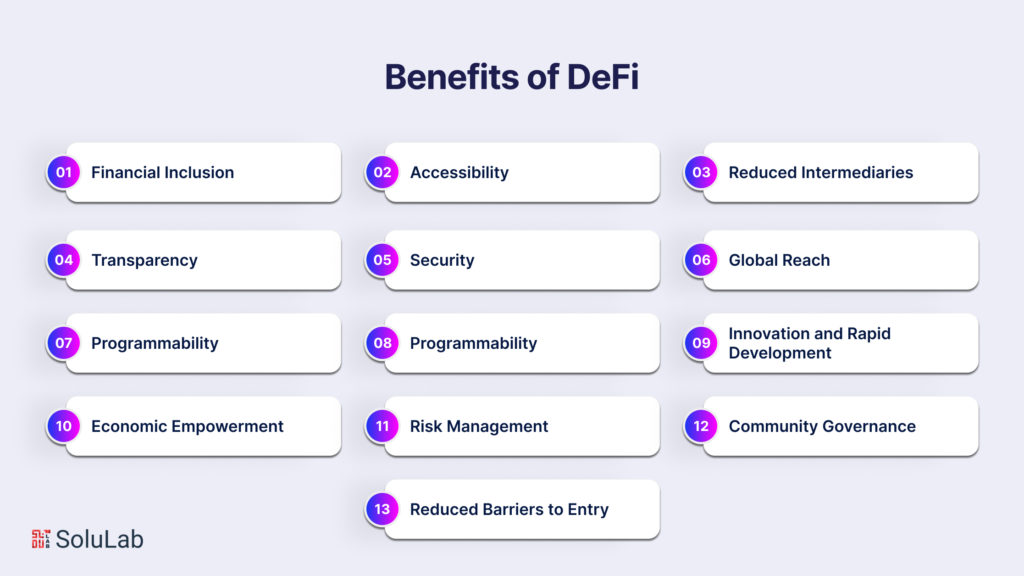
Decentralized Finance (DeFi) is transforming the financial landscape in numerous ways, offering a wide array of benefits to users, developers, and the global economy. 

  • Financial Inclusion

DeFi opens up financial services to anyone with internet access, enabling global financial inclusion. This is especially significant in regions with limited access to traditional banking. According to the World Bank, around 1.7 billion adults worldwide remain unbanked. DeFi can bridge this gap and empower individuals to access and manage their finances.

  • Accessibility

Unlike traditional financial markets with set trading hours, DeFi operates 24/7, allowing users to trade, lend, and borrow at their convenience. This accessibility provides flexibility and empowers users to make real-time financial decisions.

  • Reduced Intermediaries

Traditional financial systems rely on intermediaries like banks, brokers, and clearinghouses, which charge fees for their services. DeFi minimizes or eliminates these intermediaries, reducing costs for users. Smart contracts execute transactions automatically, bypassing the need for intermediaries and their associated fees.

  • Transparency

DeFi leverages blockchain technology to ensure transparent and immutable record-keeping. Every transaction is recorded on a public ledger, providing users with complete transparency. This transparency enhances trust, as users can independently verify all transactions.

  • Security

DeFi benefits from the security features of blockchain technology. Smart contracts, once deployed, are immutable, reducing the risk of tampering or fraud. The security of blockchain has contributed to a significant decrease in successful attacks on DeFi platforms.

  • Global Reach

Cross-border payments are a significant part of the global economy. DeFi enables seamless cross-border transactions, allowing users to send and receive funds globally without the delays and high fees associated with traditional cross-border banking services.
CTA1

  • Programmability

DeFi platforms are highly programmable, allowing developers to create customized financial solutions. This programmability has led to the development of a diverse range of applications, including yield farming, decentralized exchanges, automated trading bots, and more. Users can participate in these innovative financial services.

  • Yield Opportunities

DeFi platforms like Compound and Aave offer users the opportunity to earn interest on their assets. Users can participate in lending or liquidity provision, often earning yields that surpass traditional savings account rates by a significant margin. This opens up new avenues for passive income and wealth creation.

  • Innovation and Rapid Development

DeFi is characterized by its rapid pace of innovation. New projects, tokens, and protocols continually emerge, offering new financial products and services. The open-source nature of DeFi fosters competition and innovation, driving the development of cutting-edge solutions.

  • Economic Empowerment

DeFi can empower individuals to take control of their finances. Users are not reliant on centralized institutions; they have custody of their assets and can engage in financial activities autonomously. This increased agency can lead to greater financial empowerment and self-reliance.

  • Risk Management

DeFi platforms often allow users to set their own risk parameters. For example, users can choose the level of collateral required for loans, mitigating risk to some extent. Additionally, DeFi insurance projects offer coverage against smart contract vulnerabilities and hacks, further enhancing risk management.

  • Community Governance

Many DeFi projects employ decentralized governance mechanisms. Token holders have a say in protocol upgrades and decision-making. This approach promotes a more democratic and community-driven ecosystem.

  • Reduced Barriers to Entry

In traditional finance, launching financial products and services can be highly regulated and costly. DeFi reduces these barriers to entry for entrepreneurs and developers, making it easier to create and launch financial innovations.
Applications of Defi

Applications of Defi

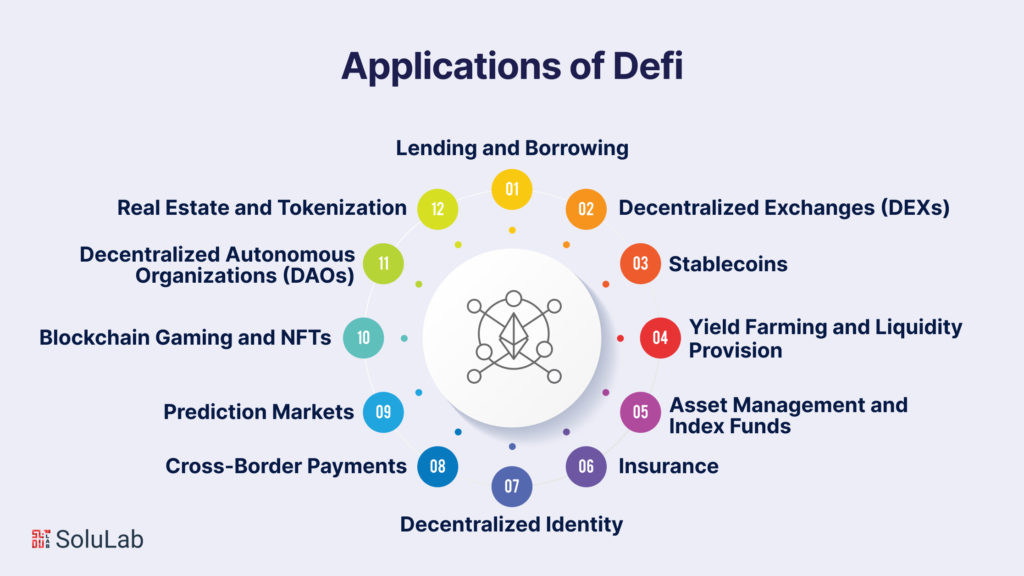
Decentralized Finance (DeFi) has a wide range of applications that are transforming the traditional financial landscape. These applications leverage blockchain technology to provide innovative and decentralized solutions to various financial services. Here are some key applications of DeFi:

  • Lending and Borrowing

DeFi lending platforms allow users to lend their crypto assets to earn interest, while borrowers can use their crypto holdings as collateral to secure loans. These platforms often offer more attractive interest rates than traditional banks.

Examples: Compound Finance, Aave, MakerDAO

  • Decentralized Exchanges (DEXs)

DEXs enable users to trade cryptocurrencies directly without the need for a centralized intermediary. They provide liquidity and allow for trustless and transparent trading.

Examples: Uniswap, SushiSwap, Balancer

  • Stablecoins

Stablecoins are digital currencies crafted with the intention of preserving a fixed value, frequently linked to a traditional currency such as the US dollar. They serve as a stable medium of exchange and a store of value within the volatile crypto market.

Examples: USDC, USDT, DAI

  • Yield Farming and Liquidity Provision

Yield farming encompasses the act of supplying liquidity to DeFi protocols in return for incentives. Users can earn tokens and interest by locking up their assets in liquidity pools.

Examples: Yearn.finance, Curve Finance, Balancer

  • Asset Management and Index Funds

DeFi allows users to create, manage, and invest in tokenized portfolios, enabling automated trading and diversification of assets.

Examples: Set Protocol, PieDAO

  • Insurance

DeFi insurance platforms provide coverage against smart contract vulnerabilities and hacks in the DeFi ecosystem, offering protection to users.

Examples: Nexus Mutual, Cover Protocol

  • Decentralized Identity

DeFi can be used to establish decentralized identity systems, giving users more control over their personal information.

Examples: uPort, SelfKey

  • Cross-Border Payments

DeFi facilitates cost-effective and rapid cross-border transactions, reducing the fees and delays associated with traditional international transfers.

Examples: Stablecoin-based remittance services

  • Prediction Markets

DeFi prediction markets enable users to create and participate in markets for predicting real-world events, offering a decentralized way to speculate on outcomes.

Examples: Augur, Gnosis

  • Blockchain Gaming and NFTs

DeFi and blockchain technology are integrated into the gaming industry, allowing players to buy, sell, and trade in-game assets and NFTs.

Examples: Axie Infinity, Decentraland

  • Decentralized Autonomous Organizations (DAOs)

DAOs are organizations governed by smart contracts and token holders, enabling decentralized decision-making and governance.

Examples: Yearn Governance, Compound Governance

  • Real Estate and Tokenization

DeFi can be used to tokenize real estate assets, making it easier for users to invest in properties and participate in real estate markets.

Examples: RealT, Propy
Blockchain and its Role in DeFi

Blockchain and its Role in DeFi

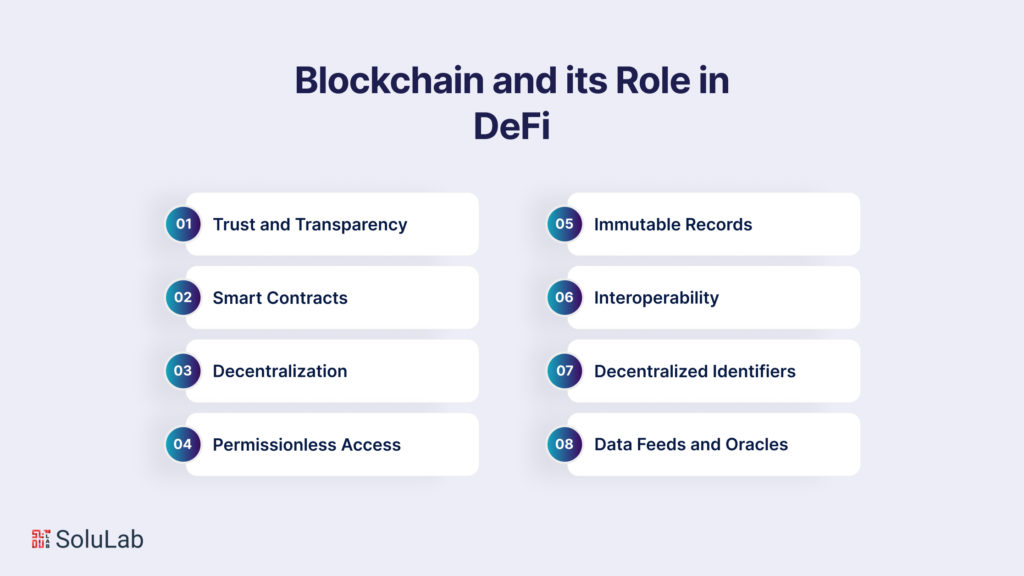
Blockchain technology plays a pivotal role in the success and functionality of Decentralized Finance (DeFi). It underpins the entire DeFi ecosystem, providing the infrastructure and key features necessary for its operation. Here’s how blockchain contributes to DeFi:

  • Trust and Transparency

Blockchain is a decentralized and distributed ledger technology. It records transactions in a secure and transparent manner across a network of nodes. This transparency ensures that all DeFi transactions are publicly verifiable, and participants can audit the transaction history. Users can trust that the information on the blockchain is accurate and tamper-proof.

  • Smart Contracts

DeFi relies heavily on smart contracts to automate and execute financial agreements without the need for intermediaries. These contracts are immutable and executed according to predefined rules, enhancing the security and reliability of financial transactions.

  • Decentralization

Blockchain networks, such as Ethereum, are decentralized, meaning there is no central authority or intermediary controlling the system. DeFi applications leverage this decentralization, eliminating the need for trusted third parties like banks. Users retain control of their assets and transactions, reducing counterparty risk.

  • Permissionless Access

DeFi platforms built on blockchain technology are generally permissionless, meaning anyone with an internet connection and the required assets can access and use these services. This inclusivity opens financial services to a global audience without regard for geographical location, background, or identity.

  • Immutable Records

Once a transaction has been added to a blockchain, it becomes immutable, i.e. it cannot be altered or deleted. This immutability enhances the security of financial transactions, making it difficult for fraudulent or unauthorized changes to occur.

  • Interoperability

Blockchain networks and protocols are often designed to be interoperable, allowing DeFi platforms to communicate and interact seamlessly. This interoperability enables various DeFi applications to work together and create a more interconnected financial ecosystem.

  • Decentralized Identifiers

Blockchain can provide a foundation for decentralized identity solutions, allowing users to control and manage their personal data and identity. This is particularly important in DeFi, where privacy and identity verification are essential.

  • Data Feeds and Oracles

To provide real-world data to smart contracts, DeFi projects often rely on oracles. These oracles are external data sources that feed information from the real world into the blockchain. They play a critical role in enabling smart contracts to respond to real-world events and conditions.

CTA2

Conclusion

Decentralized Finance (DeFi) is reshaping the financial landscape, offering a more inclusive and transparent way of managing assets and accessing financial services. As blockchain technology continues to advance, we can expect even greater innovation and adoption in both the DeFi space and across various industries. 

Bear in mind that the DeFi arena is ever-changing, and new entrants may come into play. Hence, it’s crucial to engage in comprehensive research and due diligence when deciding on a DeFi development company. With the right team and a forward-looking vision, your DeFi project has the potential to become a game-changing force in the financial realm.

If you’re still in search of the ideal DeFi development company, get in touch with Solulab without delay. Solulab boasts extensive experience in DeFi development services, a strong technical acumen, and a commitment to fostering innovation, making them an excellent option for businesses and entrepreneurs looking to embark on DeFi endeavors or enhance their existing DeFi solutions.

FAQs

1. What is DeFi, and how does it differ from traditional finance?

DeFi, short for Decentralized Finance, is a blockchain-based financial ecosystem that offers decentralized alternatives to traditional financial services like lending, borrowing, and trading. Unlike traditional finance, DeFi operates on blockchain technology, removing the need for intermediaries, providing transparency, and enabling users to have full control over their assets.

2. How do I get started with DeFi?

To start with DeFi, you need a crypto wallet, usually compatible with the Ethereum blockchain, as many DeFi projects are built on Ethereum. You can fund your wallet with cryptocurrencies, connect to a DeFi platform, and then explore and use various DeFi applications, such as lending, borrowing, or trading.

3. Are DeFi platforms safe and secure?

DeFi platforms prioritize security, but they are not immune to risks. Users should conduct thorough research, use reputable platforms, and follow best practices such as enabling two-factor authentication and using hardware wallets. Additionally, smart contract vulnerabilities and exploits have occurred, so it’s crucial to assess the risk before participating.

4. What is yield farming in DeFi?

Yield farming is a DeFi strategy where users provide liquidity to decentralized exchanges or lending platforms in exchange for rewards or interest. It involves staking assets in liquidity pools and earning tokens or a percentage of transaction fees. Yield farming can offer attractive returns but carries risks and should be approached with caution.

5. Can I earn passive income with DeFi?

Yes, DeFi offers opportunities for passive income. Staking assets in DeFi platforms, providing liquidity to DEXs, or participating in yield farming can all generate passive income. However, these strategies come with varying degrees of risk, so it’s essential to research and understand the potential rewards and risks associated with each method.

Blockchain Technology as a Platform for Digitization

Blockchain Technology as a Platform for Digitization

Blockchain technology has emerged as a groundbreaking innovation, reshaping the way we manage digital transactions and data. In this introduction, we’ll explore the fundamentals of blockchain technology, its inner workings, and its far-reaching applications in the modern digital landscape.

At its core, a blockchain is a decentralized and distributed digital ledger. It comprises a chain of blocks, with each block containing a record of multiple transactions. This technology is characterized by its transparency, security, and immutability. Unlike centralized databases, blockchain operates on a network of computers (nodes), enabling every participant to view and validate transactions. Once data is recorded in a block and added to the chain, it becomes exceedingly challenging to alter, ensuring the integrity of the information.

In the digital age, blockchain technology has emerged as a game-changer, offering transparency, security, and efficiency in various domains. From blockchain platforms to development services and consulting, the blockchain ecosystem continues to expand, presenting abundant opportunities for businesses and developers alike. Blockchain technology has given rise to a plethora of companies specializing in various aspects of this revolutionary tech. These companies range from blockchain platform developers to blockchain development service providers. 

How Does Blockchain Work?

How Does Blockchain Work?

Blockchain technology has garnered significant attention for its potential to revolutionize various industries, from finance to supply chain management. Understanding how blockchain works is essential to grasp its transformative power. This article delves into the key components of blockchain, cryptography’s role, decentralization, and consensus mechanisms.

Key Components of Blockchain

At its core, a blockchain is a distributed and immutable ledger in blockchain that records transactions across a network of computers. Its key components include:

  • Blocks

These are containers that store data about transactions. Each block contains a group of transactions and has a unique identifier called a “hash.”

  • Chain

Blocks are linked together in chronological order, forming a chain. The previous block’s hash is included in each subsequent block, creating a secure connection.

  • Decentralization

Blockchain operates on a decentralized network of computers (nodes). Each node has a copy of the entire blockchain, ensuring redundancy and security.

Cryptography in Blockchain

Blockchain relies heavily on cryptographic techniques to secure data and ensure privacy. Key cryptographic aspects include:

Read Our Blog: Top Blockchain Technology Companies in 2024

  • Public and Private Keys

Users have a pair of cryptographic keys—a public key for identification and a private key for digital signatures. Transactions are signed with the private key and verified with the public key.

  • Hash Functions

Transactions and blocks are transformed into fixed-length alphanumeric strings using cryptographic hash functions. Even minor changes in data result in significantly different hash values, enhancing security.

Decentralization and Distributed Ledger

Decentralization is a fundamental principle of blockchain technology. Unlike traditional centralized systems, blockchain operates on a distributed ledger:

  • Network Consensus

Transactions are validated through a consensus mechanism, typically requiring a majority of nodes to agree on their validity.

  • Immutable Ledger

Once a block is added to the blockchain, it becomes virtually impossible to alter past transactions due to cryptographic integrity and the consensus mechanism.

Read Also: Top 10 Blockchain Development Companies in 2024

Consensus Mechanisms (e.g., Proof of Work, Proof of Stake)

Consensus mechanisms are pivotal to blockchain’s functionality. They ensure agreement among network participants regarding transaction validity. Two prominent mechanisms are:

  • Proof of Work (PoW)

PoW requires miners to solve complex mathematical puzzles to add new blocks to the chain. This process demands significant computational power and energy but is highly secure.

  • Proof of Stake (PoS)

PoS relies on validators who are chosen to create new blocks based on the number of coins they hold and are willing to “stake” as collateral. PoS is more energy-efficient than PoW.

What are the Fundamental Components and Characteristics of a Blockchain Network?

What are the Fundamental Components and Characteristics of a Blockchain Network

Blockchain technology is at the forefront of digital innovation, offering a secure and transparent way to record transactions and data. To comprehend blockchain fully, it’s essential to delve into the intricacies of its network. In this discussion, we will explore the various facets of a blockchain network, including nodes and participants, peer-to-peer communication, the role of miners/validators, and the distinction between public and private blockchains.

Nodes and Participants

  • At the core of a blockchain network are its nodes and participants. Nodes are individual computers or devices connected to the network. They play a crucial role in maintaining the decentralized nature of the blockchain. 
  • Participants can be individuals, organizations, or entities that engage with the blockchain by creating, validating, or storing transactions. These participants collectively form the network’s ecosystem.

Read Our Blog Post: Best Companies to Hire Blockchain Developers in 2024

Peer-to-Peer Communication

  • Blockchain operates on a peer-to-peer (P2P) network, where nodes communicate directly with each other without the need for intermediaries. This decentralized structure enhances security and eliminates single points of failure. 
  • When a participant initiates a transaction or updates the blockchain, the information is broadcast to all nodes in the network. This ensures that all nodes have a consistent and up-to-date copy of the blockchain.

The Role of Miners/Validators

  • In public blockchain networks, miners or validators play a critical role in maintaining the integrity of the blockchain. Miners validate transactions by solving complex mathematical puzzles through a process known as consensus (e.g., Proof of Work or Proof of Stake).
  • Once a transaction is verified, it is added to a new block, which is then appended to the existing blockchain. Miners are incentivized with rewards, such as cryptocurrencies, for their computational efforts.

Public vs. Private Blockchains

Blockchain networks can be categorized as either public or private, each with distinct characteristics:

  • Public Blockchains

These are open and permissionless networks accessible to anyone. They are decentralized, transparent, and often used for cryptocurrencies like Bitcoin and Ethereum. Public blockchains are maintained by a global network of miners.

Read Also: What Are The Benefits of Hiring a Blockchain Developer?

  • Private Blockchains

In contrast, private blockchains are restricted to specific participants or organizations. They are permissions, meaning that only authorized entities can validate transactions and access the blockchain. Private blockchains are commonly used for enterprise applications, supply chain management, and consortiums.

Understanding the blockchain network’s structure, participants, and communication mechanisms is crucial for grasping how blockchain technology works. It forms the foundation for various applications, including secure digital transactions, supply chain traceability, and even the creation of decentralized applications (DApps). As blockchain technology continues to evolve, it opens up new avenues for innovation, leading to exciting developments and trends in the field. 

Companies and developers are actively engaged in blockchain development, offering services and solutions to harness the full potential of this transformative technology. Blockchain consulting services can assist businesses in navigating the complexities of blockchain adoption and integration, ensuring they remain at the forefront of digital transformation.

What are the Applications of Blockchain Technology?

What are the Applications of Blockchain Technology?

Blockchain technology, often referred to as the backbone of cryptocurrencies like Bitcoin and Ethereum, is a revolutionary innovation that has found applications far beyond the realm of digital currencies. It is a distributed ledger system that provides transparency, security, and immutability to transactions. Let’s explore various applications of blockchain technology:

  • Cryptocurrencies (e.g., Bitcoin, Ethereum)

Blockchain’s most well-known application is in the creation and management of cryptocurrencies. It serves as a decentralized ledger that records all transactions. Users can conduct peer-to-peer transactions without the need for intermediaries like banks.

  • Supply Chain Management

Blockchain technology is transforming supply chain management by providing end-to-end visibility and transparency. It allows tracking of products from their origin through every touchpoint in the supply chain. This reduces fraud, ensures the authenticity of products, and enhances efficiency.

Read Our Blog: What Are The Top 10 Companies To Hire Blockchain Developers from

  • Smart Contracts

Smart contracts are self-executing contracts with the terms of the agreement directly written into code. They automatically execute when predefined conditions are met. Blockchain’s security and trustworthiness make it an ideal platform for deploying smart contracts, which find applications in legal agreements, insurance, and more.

  • Identity Verification

Blockchain can be used for secure and tamper-proof identity verification. Individuals can have control over their data and selectively share it with trusted entities, reducing the risk of identity theft and fraud.

  • Healthcare and Medical Records

Blockchain ensures the integrity and confidentiality of medical records. It enables patients to grant access to their medical data securely, streamlining the sharing of information among healthcare providers while maintaining privacy.

  • Voting Systems

Blockchain-based voting systems offer secure and transparent elections. Each vote is recorded as a transaction, making it nearly impossible to tamper with results. This application enhances trust in the democratic process.

Read Also: Investing in Blockchain Development: A Strategic Guide for Businesses

  • Intellectual Property Rights

Blockchain can be used to prove ownership and protect intellectual property rights. Artists, writers, and creators can timestamp their work on the blockchain, providing undeniable proof of creation and ownership.

As blockchain technology continues to evolve, it opens up new possibilities across various industries. Companies and organizations are exploring innovative ways to leverage blockchain for increased efficiency, security, and transparency in their operations. The trends in blockchain point to a future where blockchain’s impact will be even more significant, ushering in a new era of digital transformation.

What are the Latest Trends in Blockchain Technology?

What are the Latest Trends in Blockchain Technology?

Blockchain technology, initially introduced as the underlying technology for cryptocurrencies, has evolved significantly in recent years. Today, it extends far beyond digital currencies, with various trends shaping its trajectory.

NFTs (Non-Fungible Tokens)

  • Non-Fungible Tokens, or NFTs, have taken the digital art and collectibles world by storm. NFTs are unique digital assets that represent ownership of digital or physical items. They utilize blockchain technology to establish ownership and provenance, making them highly valuable in the world of art, music, gaming, and even virtual real estate.
  • NFTs have introduced a new paradigm for ownership and authenticity verification, challenging traditional copyright and intellectual property norms. Artists, musicians, and creators are leveraging NFTs to monetize their digital works directly, eliminating intermediaries.

DeFi (Decentralized Finance)

  • Decentralized Finance, or DeFi, is revolutionizing the traditional financial sector. Built on blockchain networks, DeFi applications provide open and permissionless access to financial services like lending, borrowing, trading, and yield farming. DeFi platforms eliminate intermediaries like banks, enabling users to have more control over their assets.
  • The DeFi trend has seen exponential growth, attracting both users and developers. However, it also comes with challenges, such as security vulnerabilities and regulatory concerns, that need to be addressed for long-term sustainability.

Central Bank Digital Currencies (CBDCs)

  • Central Bank Digital Currencies are digital versions of fiat currencies issued by central banks. These CBDCs aim to combine the advantages of blockchain technology with the stability of traditional currencies. Governments and central banks worldwide are exploring the potential of CBDCs to modernize payment systems, enhance financial inclusion, and combat illicit activities.
  • CBDCs represent a significant shift in the financial landscape and could impact the adoption and use of cryptocurrencies like Bitcoin and stablecoins.

Read Our Blog Post: Top 20 Supply Chain Startups That Are Using Blockchain Technology

Sustainability and Green Blockchain

  • Sustainability is a growing concern in the blockchain space. The energy-intensive nature of some blockchain networks, particularly Proof of Work (PoW), has raised environmental concerns. As a result, there’s a growing trend towards developing and adopting more eco-friendly consensus mechanisms, such as Proof of Stake (PoS).
  • Green blockchain initiatives aim to reduce the carbon footprint of blockchain technology while maintaining its security and decentralization benefits. These efforts align with broader global sustainability goals.

Interoperability Solutions

  • Interoperability is a critical challenge in the blockchain industry. Different blockchain networks often operate in isolation, limiting the flow of assets and data between them. Interoperability solutions seek to bridge these gaps, enabling seamless communication and value transfer between disparate blockchain networks.
  • Projects and protocols dedicated to interoperability, like Polkadot and Cosmos, are gaining traction. They facilitate cross-chain communication and the creation of interconnected blockchain ecosystems.

How is SoluLab Pioneering the Digital Revolution Through its Blockchain Development Expertise?

Blockchain technology, often referred to as the backbone of cryptocurrencies like Bitcoin, has transcended its initial purpose. It is now a transformative force driving innovation across various industries. In this era of digitalization, understanding how blockchain works, its applications, and leveraging it effectively are paramount. SoluLab, a leader in blockchain development and consulting, is at the forefront of this revolution.

At its core, a blockchain is a decentralized and immutable digital ledger that records transactions across a network of computers. It operates on a peer-to-peer basis, utilizing complex cryptography to secure data. Each “block” in the chain contains a set of transactions, and they are linked in chronological order, ensuring transparency and security.

Blockchain Development with SoluLab

  • Blockchain Platforms

SoluLab leverages leading blockchain platforms like Ethereum and Hyperledger to create scalable and secure solutions. These platforms provide the foundation for building decentralized applications (DApps) and enterprise-grade blockchain networks.

  • Role of Blockchain Development Companies

SoluLab plays a pivotal role in guiding organizations through their blockchain journey. They offer consultation, development, and implementation services to ensure seamless integration into existing systems.

  • Blockchain Development Services

SoluLab offers end-to-end blockchain development services, including smart contract development, decentralized application development, blockchain consulting, and blockchain integration into existing systems.

In conclusion, blockchain technology is reshaping industries, and SoluLab is your trusted partner in harnessing its power. With their expertise in blockchain development and consulting services, they pave the way for organizations to unlock the full potential of this transformative technology.

Conclusion

In conclusion, SoluLab stands as a beacon of innovation and expertise in the realm of blockchain technology. As we’ve explored the intricacies of what blockchain is and how it works, it becomes evident that this revolutionary technology has become the cornerstone of digital transformation. SoluLab’s commitment to excellence and its status among leading blockchain companies are testament to its prowess in developing blockchain solutions.

With an in-depth understanding of blockchain technology, SoluLab not only explains the nuances of this groundbreaking technology but also empowers businesses with cutting-edge blockchain development services. In a landscape where blockchain trends continue to evolve, SoluLab remains at the forefront, ready to adapt and harness blockchain’s potential to drive digital transformation.

For those seeking to harness the power of blockchain, SoluLab is the go-to blockchain development company. The ability to hire top blockchain developers and access comprehensive blockchain consulting services sets SoluLab apart. In an era where blockchain is more than just a buzzword, SoluLab paves the way for businesses to unlock the full spectrum of opportunities presented by blockchain technology, ushering in a new era of innovation and efficiency.

FAQs

1. What is a Blockchain?

A blockchain is a distributed and decentralized digital ledger technology that securely records transactions across multiple computers. It consists of a chain of blocks, each containing a batch of transactions, and is designed to be transparent, immutable, and resistant to tampering.

2. How Does Blockchain Work?

Blockchain works through a network of nodes (computers) that validate and record transactions into blocks. Once verified, these blocks are linked in chronological order, forming a chain. Consensus algorithms ensure agreement among nodes, and cryptographic techniques secure the data.

3. What Are Some Applications for Blockchain Technology?

Blockchain technology has diverse applications, including cryptocurrency transactions (e.g., Bitcoin), supply chain management, identity verification, voting systems, healthcare record management, and smart contracts in various industries.

4. What Are the Key Trends in Blockchain Technology?

Current trends in blockchain technology include the rise of decentralized finance (DeFi) platforms, non-fungible tokens (NFTs), central bank digital currencies (CBDCs), and sustainability efforts to reduce blockchain’s energy consumption.

5. How Can I Develop Blockchain Solutions?

To develop blockchain solutions, you can either hire top blockchain developers or engage with blockchain development companies. It involves designing and implementing smart contracts, choosing the right blockchain platform, and ensuring security and scalability.

Investing in Blockchain Development: A Strategic Guide for Businesses

Investing in Blockchain Development: A Strategic Guide for Businesses

Blockchain technology is a decentralized and immutable digital ledger system that records transactions across a network of computers in a secure and transparent manner. It consists of a chain of blocks, each containing a set of transactions. What sets blockchain apart is its cryptographic security and consensus mechanism, which ensures that once information is recorded, it cannot be altered or deleted without the consensus of the network participants. This technology was originally created as the underlying framework for cryptocurrencies like Bitcoin, but its potential applications have since expanded far beyond digital currencies.

Each block in a blockchain contains a group of transactions, and these blocks are linked together in chronological order, forming a chain. The unique feature of blockchain is its cryptographic validation mechanism, which ensures that once data is added to the chain, it cannot be altered or tampered with without consensus from the majority of network participants. This inherent security makes blockchain technology a trustworthy and tamper-resistant solution for various applications.

Read Our Blog Post: Top Blockchain Technology Companies in 2023

What is the Importance of Blockchain for Businesses?

Importance of Blockchain for Businesses

The importance of blockchain for businesses cannot be overstated, as it has the potential to transform traditional business operations, enhance security, and drive efficiency in a multitude of ways. Blockchain technology offers several key advantages:

  • Enhanced Security

Blockchain’s cryptographic nature makes it highly secure, reducing the risk of fraud and unauthorized access to data. This is especially critical in industries where data integrity is paramount, such as finance and healthcare.

  • Transparency and Trust

Blockchain’s transparent and immutable ledger fosters trust among participants. Businesses can verify the authenticity of transactions and data, reducing disputes and the need for intermediaries.

  • Efficiency and Cost Savings

Smart contracts, a feature of blockchain, automate contract execution and enforce terms without the need for intermediaries. This leads to reduced administrative costs and faster transaction processing times.

CTA1

  • Supply Chain Management

Blockchain enables end-to-end visibility in supply chains, reducing fraud, errors, and delays. Businesses can track products from origin to destination with greater accuracy.

Check Out the Blog Post: Top 10 Real World Applications of Blockchain Technology

  • Cross-Border Transactions

Blockchain facilitates cross-border transactions by eliminating the need for multiple intermediaries and reducing transaction fees. This is particularly beneficial for international trade.

  • Innovation

Blockchain is a catalyst for innovation, driving the development of new business models and revenue streams. Companies can explore blockchain applications that were previously unthinkable.

How does Blockchain work?

How does Blockchain work

Understanding how blockchain operates is crucial for businesses looking to leverage this technology effectively:

  • Transaction Submission

Users initiate transactions by creating a request to add data to the blockchain. This data can represent various actions, such as transferring assets, verifying identities, or recording ownership changes.

  • Validation

Transactions are sent to the network’s nodes, where they undergo verification. In public blockchains, this verification is typically done through a consensus mechanism like PoW.

  • Adding to the Ledger

Once a transaction is validated, it is added to a new block. This block is then linked to the previous one, forming a continuous chain.

  • Decentralized Verification

Multiple nodes on the network must reach a consensus before a transaction is considered valid. This decentralized verification ensures trust and security.

What are the Types of Blockchains?

Types of Blockchains

Blockchains come in various forms, each suitable for different business needs:

  • Public Blockchains

Public blockchains, like Bitcoin and Ethereum, are open to anyone and offer complete transparency. They are ideal for businesses looking to create blockchain-based applications with widespread accessibility.

  • Private Blockchains

Private blockchains are restricted to a specific group of participants, making them suitable for businesses that require control over access and data privacy. They are often used for internal processes and collaborations.

  • Consortium Blockchains

Consortium blockchains are a hybrid of public and private blockchains. They are governed by a group of organizations rather than a single entity. This type is beneficial for industries with multiple stakeholders, such as blockchain in supply chains.

How Can Businesses Leverage Blockchain Technology to Identify and Address Their Specific Needs?

In today’s fast-paced and ever-evolving business landscape, staying competitive requires constant innovation and the ability to leverage cutting-edge technologies. Blockchain technology has emerged as a transformative force, offering a wide array of applications for businesses across various industries. To embark on this journey, it’s crucial to start with the right blockchain business idea. In this guide, we’ll delve into the essential steps of blockchain business idea generation.

 Identifying Business Needs

  • Businesses must begin by identifying their specific needs and challenges. This introspective process involves examining existing inefficiencies, security concerns, or operational bottlenecks. 
  • For example, a company might struggle with supply chain transparency, financial fraud, or data privacy issues. Identifying these pain points is the first step in determining how blockchain can provide a solution.

Exploring Blockchain Applications

  • Once the business needs are clear, the next step is to explore the myriad blockchain applications available. Blockchain has proven its versatility, and it can be applied to various domains. 
  • Some popular blockchain use cases for businesses include supply chain management, smart contracts, identity verification, and decentralized finance (DeFi). Businesses should thoroughly research these applications to understand how they can address their specific challenges.

Assessing Market Demand

  • While blockchain technology holds immense potential, it’s essential to assess the market demand for your proposed blockchain solution. 
  • Market research is critical to determine whether there’s a demand for your idea. It involves analyzing your target audience, competitors, and potential partners. Understanding market trends, such as the increasing adoption of blockchain in various sectors, can help validate your business concept.

Formulating a Unique Blockchain Business Idea

  • To stand out in a competitive landscape, it’s crucial to formulate a unique blockchain business idea that aligns with your identified needs, blockchain applications, and market demand. This idea should address a specific pain point effectively and provide a clear value proposition.
  • For instance, if you’re in the logistics industry and have identified supply chain inefficiencies, your unique blockchain business idea could involve creating a blockchain-based platform that offers real-time visibility and traceability of goods. This solution could utilize smart contracts to automate and optimize processes, reducing costs and enhancing transparency

What are Some Key Emerging Trends and Innovations in Blockchain Technology?

Emerging Trends and Innovations in Blockchain Technology

Current State of Blockchain Adoption

Blockchain technology has made significant strides in recent years, with a growing number of businesses recognizing its potential to revolutionize various industries. The current state of blockchain adoption reflects a dynamic landscape of innovation and transformation.

  • Pilot Projects

Many businesses have moved beyond the initial experimentation phase and are now actively implementing blockchain solutions. Pilot projects are being conducted across diverse sectors, from supply chain management to healthcare.

Read Also: Top 10 Blockchain Development Companies in 2023

  • Mainstream Recognition

Blockchain is no longer a niche concept. It has gained recognition and support from major tech companies, financial institutions, and governments worldwide, showcasing its mainstream appeal.

  • Blockchain in Finance

In the financial sector, blockchain is being used for cross-border payments, remittances, and even central bank digital currencies (CBDCs). This adoption has the potential to disrupt traditional banking systems.

  • Supply Chain Optimization

Blockchain’s traceability and transparency features are driving its adoption in supply chain management. Businesses are utilizing blockchain to track and authenticate the origin of products, improving trust and reducing fraud.

Emerging Trends and Innovations

The blockchain landscape is continuously evolving, with several emerging trends and innovations shaping the future of business applications.

  • DeFi (Decentralized Finance)

DeFi projects are growing rapidly, offering decentralized lending, borrowing, and trading platforms. These innovations challenge traditional financial intermediaries and offer greater financial inclusion.

  • NFTs (Non-Fungible Tokens)

NFTs have gained immense popularity, particularly in the art, entertainment, and gaming industries. These digital assets are revolutionizing ownership and provenance verification.

  • Interoperability

Cross-chain compatibility and interoperability solutions are emerging, allowing different blockchains to communicate and share data seamlessly. This will enhance the flexibility and utility of blockchain networks.

  • Scalability Solutions

The challenge of blockchain scalability is being addressed through various solutions, such as Layer 2 solutions and sharding, enabling faster and more cost-effective transactions.

Read Our Blog: Best Companies to Hire Blockchain Developers in 2023

Regulatory Developments

Blockchain technology has prompted regulatory bodies to respond with new frameworks and guidelines.

  • Regulatory Clarity

Governments are increasingly providing regulatory clarity, which is essential for businesses to navigate the blockchain space confidently. This includes defining the status of cryptocurrencies and tokens.

  • AML/KYC Compliance

Regulations regarding Anti-Money Laundering (AML) and Know Your Customer (KYC) procedures are being strengthened to mitigate risks associated with blockchain-based financial transactions.

  • Taxation and Reporting

Tax authorities are developing guidelines for cryptocurrency taxation, ensuring that businesses and individuals are compliant with tax obligations related to blockchain assets.

Industry-specific Trends

Blockchain’s impact is felt differently across various industries, each with its unique trends and opportunities.

  • Finance

In finance, blockchain is leading to the tokenization of assets, making it easier to trade and transfer ownership of real estate, stocks, and other assets.

Read Our Blog: Blockchain Security: Best Practices Every Developer Should Know

  • Healthcare

In healthcare, blockchain is improving data security and interoperability, facilitating the secure sharing of patient records among healthcare providers.

  • Supply Chain

The supply chain industry is witnessing blockchain adoption to enhance traceability and reduce fraud, addressing consumer demands for transparency.

  • Energy

Blockchain is being used to create decentralized energy grids, allowing peer-to-peer energy trading and optimizing resource allocation.

What are the Key Components and Benefits of Blockchain Development Services?

Key Components and Benefits of Blockchain Development Services

Blockchain development services play a pivotal role in enabling businesses to harness the power of blockchain technology for their growth and innovation. These services encompass a wide range of solutions tailored to meet the specific needs of businesses seeking to leverage blockchain’s potential. Let’s delve into the essential aspects of blockchain development services, their significance, and how to make the right choice for your business.

Choosing a Reliable Development Partner

Selecting the right development partner for your blockchain project is a critical decision that can significantly impact its success. When considering blockchain development services, businesses should look for reliability, expertise, and a track record of delivering high-quality solutions. Here are key factors to consider when choosing a development partner:

  • Experience

Evaluate the development partner’s experience in blockchain technology. Have they worked on similar projects or blockchain use cases relevant to your business idea?

  • Portfolio

Examine their portfolio to gauge the quality of their previous work. Look for successful implementations of blockchain applications with businesses.

  • Expertise

Assess the team’s expertise in various blockchain platforms and technologies. Are they well-versed in blockchain trends and best practices?

  • Client References

Request client references and testimonials to gain insights into the partner’s reputation and the satisfaction of past clients.

  • Scalability

Ensure that the development partner can accommodate your project’s scalability requirements as your blockchain application grows.

Services Offered by Blockchain Development Firms

Blockchain development firms offer a comprehensive range of services to cater to diverse business needs. These services typically include:

  • Blockchain Consulting

Identifying viable blockchain use cases for your business, helping define blockchain business strategies, and assessing the feasibility of blockchain adoption.

  • Custom Blockchain Development

Creating tailor-made blockchain solutions to meet specific business requirements, whether it’s developing decentralized applications (DApps), smart contracts, or private blockchains.

  • Integration Services

Integrating blockchain technology seamlessly with existing business systems and processes to ensure smooth operations.

  • Security Audits

Conducting security audits and implementing robust security measures to protect blockchain assets and data.

  • Tokenization

Developing and launching tokens for fundraising or asset management purposes, such as initial coin offerings (ICOs) or security token offerings (STOs).

  • Smart Contract Development

Designing and coding smart contracts to automate business processes, enforce agreements, and enhance transparency.

Evaluating Development Solutions

When considering SoluLab for blockchain development services, businesses benefit from a reputable and experienced partner. SoluLab offers a wide array of blockchain services, including:

  • Blockchain Ideation

Assisting businesses in identifying blockchain use cases and crafting innovative blockchain business ideas.

  • Development on Multiple Platforms

Expertise in developing various blockchain platforms, such as Ethereum, Hyperledger, and Corda.

  • Comprehensive Blockchain Solutions

Providing end-to-end solutions, from consulting and development to deployment and maintenance.

  • Blockchain Consulting

Offering strategic guidance and insights to help businesses align their blockchain strategy with their goals.

  • Top Blockchain Developers

Access to a talented team of blockchain developers who are proficient in the latest blockchain technologies and trends.

By collaborating with SoluLab, businesses can leverage their blockchain expertise and commitment to delivering reliable, scalable, and secure blockchain solutions.

Blockchain development services are indispensable for businesses looking to harness the potential of blockchain technology. Choosing a reliable development partner and assessing the services offered are crucial steps in ensuring the success of your blockchain project. SoluLab stands as a reputable option for businesses seeking blockchain development solutions that align with their objectives and aspirations.

CTA2

Conclusion

In conclusion, SoluLab’s comprehensive Blockchain Business Strategy Guide offers invaluable insights into the dynamic world of blockchain development for businesses. As the landscape of technology evolves, it’s evident that blockchain is more than just a buzzword; it’s a transformative force with numerous blockchain use cases that can revolutionize your business. From enhancing security to streamlining operations and fostering trust among stakeholders, the potential of blockchain technology is boundless.

By investing in blockchain development services from SoluLab, you are not only staying ahead of blockchain trends but also positioning your business to thrive in an increasingly digital and decentralized world. Our expert blockchain developers can tailor blockchain solutions to match your unique needs, whether you’re exploring blockchain applications with business processes, considering new blockchain business ideas, or seeking to optimize your existing operations through blockchain technology.

With SoluLab’s blockchain consulting services, you gain a trusted partner who can guide you through the intricacies of blockchain technology, helping you make informed decisions and seize opportunities in this rapidly evolving space. Our commitment to delivering top-notch blockchain development solutions ensures that your business stays at the forefront of innovation and maintains a competitive edge. SoluLab’s blockchain consulting services provide expert guidance in the ever-evolving blockchain landscape. Trust us to lead your way to innovation and success. Contact SoluLab today for a brighter future.

FAQs

1. What is Blockchain Development, and why should businesses consider it?

Blockchain development involves creating decentralized, secure, and transparent digital ledgers. Businesses should consider it to streamline operations, enhance security, and explore innovative opportunities like blockchain applications with business.

2. What are some blockchain use cases for businesses?

Blockchain has numerous applications in businesses, including supply chain management, smart contracts, identity verification, and tokenization of assets. These use cases can improve efficiency and reduce costs.

3. What are the latest blockchain trends businesses should be aware of?

Blockchain trends evolve rapidly. Stay updated on trends like DeFi (Decentralized Finance), NFTs (Non-Fungible Tokens), and interoperability solutions to make informed investment decisions.

4. How can blockchain development benefit my business strategy?

Blockchain development can offer competitive advantages by increasing transparency, reducing fraud, and enhancing trust among stakeholders. It can also open up new revenue streams with blockchain platforms and innovative solutions.

5. What should you look for in blockchain development services?

When seeking blockchain development services, consider their expertise, track record, and ability to align blockchain technology with your business goals. Look for providers offering comprehensive blockchain solutions.

Top 11 Blockchain Trends to Follow in 2026

Blockchain Trend 2026

2026 is becoming a major turning point for digital money and enterprise blockchain. Big businesses, banks, global payment networks, and even governments are no longer testing blockchain. They are now using it for real financial operations, tokenized assets, and on-chain finance. The change is fast and happening across every major industry.

The global blockchain market size is estimated at $33 billion in 2026 and expected to grow at a compound annual growth rate (CAGR) of over 43% to reach nearly $393 billion by 2030. Meanwhile, over 137 countries are exploring CBDC, with 49 currently in pilot or launch stages.

If you are a founder, investor, or decision-maker, these trends matter. They tell you where the market is moving, what customers will expect, and how companies will use blockchain solutions to cut costs, move money faster, and unlock new business models. This guide gives you a clear view of the biggest Blockchain Trends for 2026 and shows how they will impact global finance, technology, and business growth.

How the Blockchain World Will Change from 2026 to 2030?

Before we talk about specific blockchain technology trends, it helps to zoom out and understand the size and direction of the market you are building for.

Analyst reports place the global blockchain market in the mid-tens of billions of dollars. By 2030, many expect it to reach hundreds of billions, or even low trillions, depending on what is counted, like crypto assets, tokenization, DeFi, and core infrastructure, but a few signals matter more than the big headline number:

  • Institutional finance is moving fast. Tokenized Treasuries, tokenized funds, and regulated institutional DeFi pilots are no longer small tests. They are becoming part of real financial systems.
  • The number of countries testing or exploring CBDCs has now crossed into triple digits. These pilots are also shifting from small local tests to real cross-border payment corridors.
  • Real-world asset tokenization (RWA) has grown from an idea into a multi-billion-dollar segment. Many now project it to reach double-digit trillions by 2030.

For you, this means the blockchain projects you build in 2026 are not side projects. They should be connected to where global liquidity, regulation, and infrastructure are heading over the next 5–10 years.

11 Big Blockchain Trends That Will Change 2026

Here are the 11 most important blockchain trends you should watch in 2026. These trends matter if you are building real products, raising money, or upgrading your tech systems. In all, these blockchain future trends will shape how money, data, and digital ownership move in 2026 and the years ahead.

1. Real-World Asset (RWA) Tokenization

If you follow only one blockchain trend in 2026, let it be this one. Real-world asset tokenization is already moving tens of billions of dollars of real estate, private credit, Treasuries, and other assets on-chain. RWA platforms let you break a building, a fund, or invoices into digital units that trade 24/7 with instant settlement and built-in compliance. Here is why you should care:

  • You can unlock liquidity from assets that were stuck in files and manual paperwork.
  • You can offer smaller ticket sizes to more investors without changing your whole system.
  • You can test new revenue ideas like streaming yields or auto-rebalancing that old banking systems can’t support.

From a business point of view, if something on your balance sheet is big, slow, and hard to move, tokenization will enter that market in the next 3–5 years. For example 

  • By late 2025, BlackRock’s BUIDL alone crossed $500M in tokenized Treasuries, becoming the world’s largest on-chain fund. 
  • Franklin Templeton and Ondo Finance together manage billions in tokenized real estate and private credit. Even JPMorgan is running tokenized private credit pilots on-chain.

This is one of the clearest blockchain predictions for 2026, and it’s already live in real products.

2. AI x Blockchain Convergence  

AI x Blockchain Convergence

From 2023 to 2025, everyone was busy with AI, but in 2026, founders finally started asking, that How do I make my AI safer, more transparent, and easier to monetize. That is where AI with blockchain becomes one of the biggest blockchain trends for real businesses. Blockchain for AI helps with:

  • data provenance (proving where training data came from)
  • on-chain audit logs for AI models
  • clear royalty and attribution flows

AI for blockchain helps with smarter risk engines, better fraud detection, automated governance, and dynamic settings for on-chain systems.

For example, Projects like SingularityNET, Fetch.ai, and Ocean Protocol have already proven working AI × Blockchain models. Enterprises now integrate these systems for regulated AI deployments where audits and traceability are required.

If you run any AI product today, adding even a small on-chain layer for provenance or billing can move you closer to the latest blockchain development trends, instead of looking like another black-box AI tool with a Stripe payment link.

3. Central Bank Digital Currencies (CBDCs)

Central Bank Digital Currencies (CBDCs)

Central Bank Digital Currencies (CBDCs) are no longer ideas on paper. In 2026, many countries will have strong pilots or small-scale launches, and some will run CBDCs at a large scale. CBDCs matter for businesses because they change how you:

  • Settle cross-border payments
  • Handle compliance and reporting
  • Build your wallet, treasury, or payment systems

CBDCs sit at the middle of blockchain technology trends, digital identity, and regulated finance.  For example – 

  • China’s e-CNY surpassed $986B in transactions, making it the largest CBDC pilot in the world.
  • Countries like the Bahamas, Jamaica, and Nigeria have already launched retail CBDCs.
  • The EU Digital Euro pilot is underway with a 2027 launch window.

If you ignore CBDCs while building any payment, banking, or treasury product for 2026, it will be like ignoring mobile apps in 2010.

4. Institutional DeFi

Institutional DeFi didn’t die after the early hype; it simply grew up. Now, large banks, asset managers, and regulated companies are testing on-chain finance with KYC, verified identities, and permissioned pools. They are running pilots in tokenized repo, tokenized collateral, on-chain FX, and even digital syndicated loans.

For a founder, institutional DeFi is not about yield farms anymore. It is about:

  • Cutting back-office costs with faster, automated systems
  • Building new on-chain product lines with transparent and programmable rules
  • Opening access to new markets, new users, and new capital flows

This is where enterprise blockchain trends start to matter. For example – 

  • JPMorgan’s Onyx and MAS’s Project Guardian have run institutional pools with verified identities since 2023.
  • Aave Arc and Syndicate Protocol provide institutional lending rails.
  • BlackRock and Securitize are issuing tokenized funds accessible through DeFi.

If your industry begins settling transactions on public blockchains with permissioned layers, then the tech stack, vendors, and architecture you choose in 2026 will shape your business for years.

5. Layer-2 Scaling Solutions

You can’t talk about blockchain future trends without talking about scaling. Layer-2 networks (L2s) on Ethereum and Bitcoin are now handling most real transactions. These include rollups, optimistic systems, zero-knowledge L2s, and payment channels.

  • Fees drop from dollars to a few cents
  • Speed goes from a few transactions per second to thousands
  • You still keep the security of a major Layer-1 chain

If you are building in payments, gaming apps, micro-transactions, IoT systems, or AI-powered agents space, you will almost always use an L2 instead of an L1. Here are the Real adoption numbers:

  • Arbitrum: $15B+ TVL, largest L2 ecosystem
  • Optimism: Backed by Coinbase integrations
  • Base: Fastest-growing consumer L2
  • StarkNet: Enterprise-trusted zkRollup

This is one of the most important blockchain development trends for founders, architects, and CTOs today.

6. Blockchain-as-a-Service (BaaS)

Blockchain-as-a-Service (BaaS)

Most teams today don’t want to run their own nodes, build custom explorers, or manage security systems. They want simple tools, managed hosting, and ready-made blockchain infrastructure.

That’s why Blockchain-as-a-Service (BaaS) is becoming one of the most important blockchain industry trends. Big cloud companies and Web3 infra providers now offer hosted nodes, fast indexers, strong APIs, monitoring dashboards, testing tools, and full turnkey setups. 

With BaaS, businesses can build blockchain apps without worrying about servers, uptime, or heavy DevOps work. Here are a few enterprises like AWS, Azure, IBM, and Oracle that now dominate BaaS, and over 90% of enterprise blockchain deployments use BaaS to reduce cost and ship faster.

BaaS also helps with scaling, multi-chain support, security audits, RPC load balancing, and easy upgrades. Teams can focus on their product while the BaaS platform handles all the hard technical work in the background. For many companies, this means faster launches, fewer risks, better performance, and lower long-term costs.

7. Supply Chain & Provenance Systems

Supply chain and provenance tools were hyped early, but today they are becoming one of the strongest enterprise blockchain use cases. Real value is now clear in:

  • Lot-level tracking for food and pharma
  • Anti-counterfeit checks for luxury goods and key components
  • Carbon and ESG reporting linked to real product movement

It’s no longer about putting everything on a blockchain; it’s about adding just enough cryptographic proof in the right places so regulators, partners, and customers can trust what a company claims. For example – 

  • Walmart reduced traceability time from 7 DAYS to 2.2 SECONDS using blockchain.
  • De Beers tracks diamonds end-to-end to eliminate counterfeiting.

For many mid-market manufacturers, logistics teams, and retailers, this will be their first real step into blockchain development and supply chain blockchain systems in 2026.

8. Tokenized Securities & Treasury Bills

Tokenized Securities & Treasury Bills

In 2026, tokenized Treasuries quietly crossed several billion dollars in AUM. In 2026, this entire category will grow even more and expand into new asset classes. Today, you already see:

  • Tokenized government bonds
  • On-chain money market funds
  • Tokenized private credit and real estate portfolios

These tokenized assets are now used for yield products, treasury operations, and daily cash-management tools. The biggest shift is how tokenized securities bring faster settlements, better liquidity, transparent audits, and easy global access. Here are a few live examples:

  • BlackRock BUIDL & Franklin Templeton Utilize Securities and created $7.3B+ AUM
  • Ondo Finance is running corporate repo and credit products
  • JPMorgan is testing tokenized money market workflows

Banks, asset managers, and fintechs are now exploring on-chain versions of T-Bills, corporate bonds, repo markets, and credit products because tokenization cuts costs, reduces errors, and speeds up the entire workflow.

9. Zero-Knowledge Proofs (ZK-Tech)

Zero-Knowledge Proofs (ZK-Tech)

Zero-knowledge proofs are no longer just research. Today, ZK-tech is used in privacy Layer 2s, digital identity tools, and even compliance systems. ZK-tech is important because it lets you:

  • Prove something about your data, like age, KYC, or solvency, without sharing the data
  • Follow privacy rules while still giving partners or regulators verified proof
  • Build safer finance apps, health systems, public tools, and consumer products

As global rules around data get tighter, zero-knowledge proofs are becoming one of the most important blockchain innovations for businesses to understand. zkSync, Polygon ID, and Aztec Network are already used globally by banks, fintechs, and enterprises. 

CTA1

10. Cross-Chain Interoperability

Cross-Chain Interoperability

By 2026, no serious company can depend on only one blockchain. The market moves too fast, and users expect smoother, bigger networks. That’s why bridges, messaging layers, and interoperability protocols are becoming core parts of Web3, and Chainlink CCIP, LayerZero, Wormhole, and Cosmos IBCare are now the base layer for real products. For founders and teams, this means:

  • Build with multi-chain support from day one
  • Make the chain invisible to users
  • Plan for future liquidity, rules, and ecosystems, not just today’s trends

11. Green & Sustainable Blockchain 

Green & Sustainable Blockchain

This is one of the key blockchain technology trends that will decide if your app feels stuck on one chain or works smoothly across the full Web3 world. It’s a major factor in long-term product success and user trust.

Today, regulators, investors, and large companies want clear answers about energy use, carbon impact, and sustainability. This is pushing people to think in a more serious way about how blockchain platforms affect the environment.

You will see:

  • More chains sharing audited energy reports
  • More companies are asking for proof-of-stake or other low-energy systems
  • More use of on-chain carbon tracking and digital carbon offset tools

If you sell blockchain solutions to enterprises, staying aligned with these sustainability-focused blockchain trends will help you close deals faster. Big companies now ask clear questions about energy use, carbon footprint, and long-term environmental impact, and they are already using Ethereum, Polygon, Deso, and Solana to publish verified energy usage reports.

They prefer green blockchain systems that run on proof-of-stake, use low-power nodes, and offer real data on how much energy the network uses. You will also see more interest in on-chain carbon tracking, digital carbon credits, and blockchain-based offset tools. These help companies meet ESG targets and report their climate numbers with confidence. 

How Enterprises Will Actually Use Web3 in 2026?

2026 is the year Web3 becomes a real enterprise tool, not just a crypto space. Because companies will start using it only where it truly helps their business. Here’s what you’ll see:

  • Finance: RWA tokenization, DeFi payment rails, CBDCs, and on-chain KYC
  • Supply chain: provenance tracking, real-time compliance, and ESG reporting
  • Healthcare: secure data, medical record integrity, and drug tracking
  • Media & gaming: digital ownership, loyalty systems, and assets that work across platforms

Most people won’t even call it Web3. They’ll just feel the benefits like faster settlement, better rewards, and smoother digital experiences. But behind the scenes, these are real blockchain future trends finally being used in day-to-day business operations.

How SoluLab Can Build Any of These 11 Use Cases in Just 4 Weeks?

If you want to turn your idea into a real Web3 product, SoluLab can help you build any of these 11 use cases in only 4 weeks. Our team works with blockchain, smart contracts, CBDC solutions, tokenization platforms, DeFi apps, and enterprise blockchain development. We follow a fast, reliable, and transparent system:

1. Week 1 — Plan & Architect

We map your idea, pick the right tech, and prepare the full flow for your crypto, tokenization, or CBDC-based system.

2. Week 2 — Smart Contracts & Backend Development

We develop secure smart contracts, set up all backend logic, and integrate major chains like Ethereum, Polygon, BNB Chain, or a private blockchain.

3. Week 3 — Frontend & Dashboard

We design a clean UI and link your user dashboard to the on-chain with backend logic.

4. Week 4 – 5 — Test & Launch

We run audits, QA, security checks, and prepare your product for launch.

CTA2

Conclusion  

The real value of learning about blockchain development trends is using them to make smarter business decisions. The biggest opportunities now sit in real assets, compliance, and efficiency. As a founder or leader, your edge comes from choosing one or two clear bets and executing well. 

Let’s turn your 2026 blockchain vision into a real MVP. Book a discovery call and get feedback in days, not months. A strong blockchain development company like SoluLab, should guide you with solid business outcomes, not noise. 2026 can be the year you watch these trends or the year you build with them.

FAQs

1. How do I decide which blockchain use case is right for my startup or company?

Start by looking at your biggest pain points around data trust, asset liquidity, and operational delays. Then check if tokenization, supply chain tracking, or compliant DeFi systems can solve them. Working with a skilled blockchain development company helps you map your real needs to the right solution, ensuring measurable ROI without guesswork.

2. Why should I consider working with a blockchain development agency instead of building in-house?

Agencies bring deep expertise, faster execution, and tried-and-tested frameworks that prevent costly mistakes. They help you pick the right architecture, meet compliance standards, and scale safely. For founders focused on growth and product-market fit, a blockchain development agency makes adoption smoother without adding extra internal load.

3. What are the typical timelines and costs involved in building blockchain-based solutions like tokenization or DeFi?

Timelines depend on complexity, but an MVP usually takes 4–6 weeks, costing around $75K–$250K. Full enterprise builds for tokenization or institutional DeFi take 6–10 months and can cross $500K. A reliable agency will give clear estimates that match your goals, scope, and compliance needs.

4. How can I ensure compliance and security when integrating blockchain into my product?

You need to align your solution with rules like MiCA, OFAC, and strong KYC/AML checks. Security means smart contract audits, safe key management, and penetration testing. Agencies with regulated-industry experience build these controls into the product from day one, lowering risk and supporting innovation in areas like asset tokenization services or compliant DeFi.

5. What ongoing support do blockchain development agencies provide after product launch?

A good agency offers continuous monitoring, updates, smart contract improvements, and help adjusting to new regulations. They support scaling, infrastructure upgrades, and new feature rollouts. With ongoing partnership, your solution stays secure, compliant, and ready for future trends like RWA tokenization and advanced payment systems.
