
Talk to an Expert

Investing in Blockchain Development: A Strategic Guide for Businesses

Investing in Blockchain Development: A Strategic Guide for Businesses

Blockchain technology is a decentralized and immutable digital ledger system that records transactions across a network of computers in a secure and transparent manner. It consists of a chain of blocks, each containing a set of transactions. What sets blockchain apart is its cryptographic security and consensus mechanism, which ensures that once information is recorded, it cannot be altered or deleted without the consensus of the network participants. This technology was originally created as the underlying framework for cryptocurrencies like Bitcoin, but its potential applications have since expanded far beyond digital currencies.

Each block in a blockchain contains a group of transactions, and these blocks are linked together in chronological order, forming a chain. The unique feature of blockchain is its cryptographic validation mechanism, which ensures that once data is added to the chain, it cannot be altered or tampered with without consensus from the majority of network participants. This inherent security makes blockchain technology a trustworthy and tamper-resistant solution for various applications.

Read Our Blog Post: Top Blockchain Technology Companies in 2023
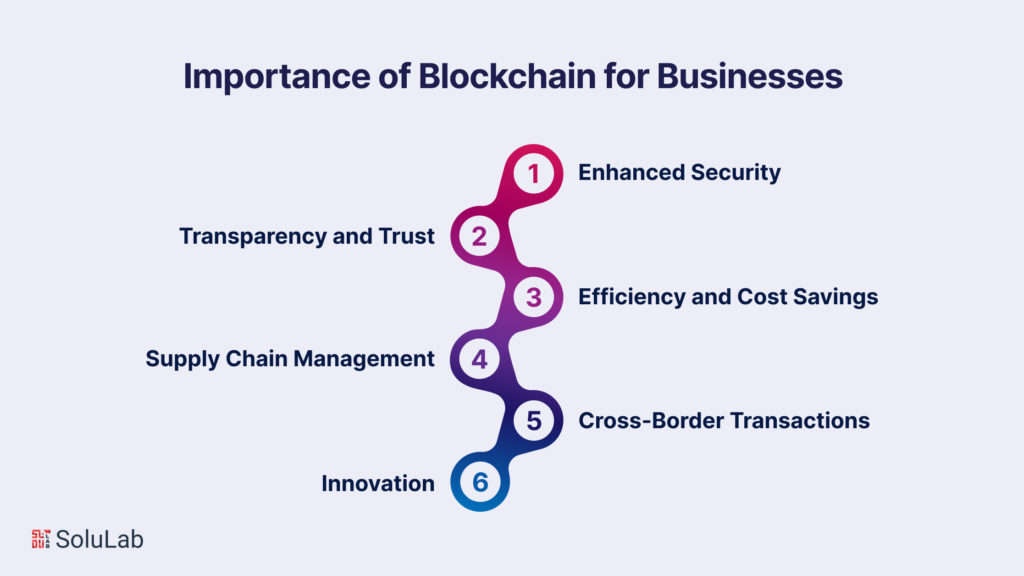
What is the Importance of Blockchain for Businesses?

Importance of Blockchain for Businesses

The importance of blockchain for businesses cannot be overstated, as it has the potential to transform traditional business operations, enhance security, and drive efficiency in a multitude of ways. Blockchain technology offers several key advantages:

  • Enhanced Security

Blockchain’s cryptographic nature makes it highly secure, reducing the risk of fraud and unauthorized access to data. This is especially critical in industries where data integrity is paramount, such as finance and healthcare.

  • Transparency and Trust

Blockchain’s transparent and immutable ledger fosters trust among participants. Businesses can verify the authenticity of transactions and data, reducing disputes and the need for intermediaries.

  • Efficiency and Cost Savings

Smart contracts, a feature of blockchain, automate contract execution and enforce terms without the need for intermediaries. This leads to reduced administrative costs and faster transaction processing times.

CTA1

  • Supply Chain Management

Blockchain enables end-to-end visibility in supply chains, reducing fraud, errors, and delays. Businesses can track products from origin to destination with greater accuracy.

Check Out the Blog Post: Top 10 Real World Applications of Blockchain Technology

  • Cross-Border Transactions

Blockchain facilitates cross-border transactions by eliminating the need for multiple intermediaries and reducing transaction fees. This is particularly beneficial for international trade.

  • Innovation

Blockchain is a catalyst for innovation, driving the development of new business models and revenue streams. Companies can explore blockchain applications that were previously unthinkable.
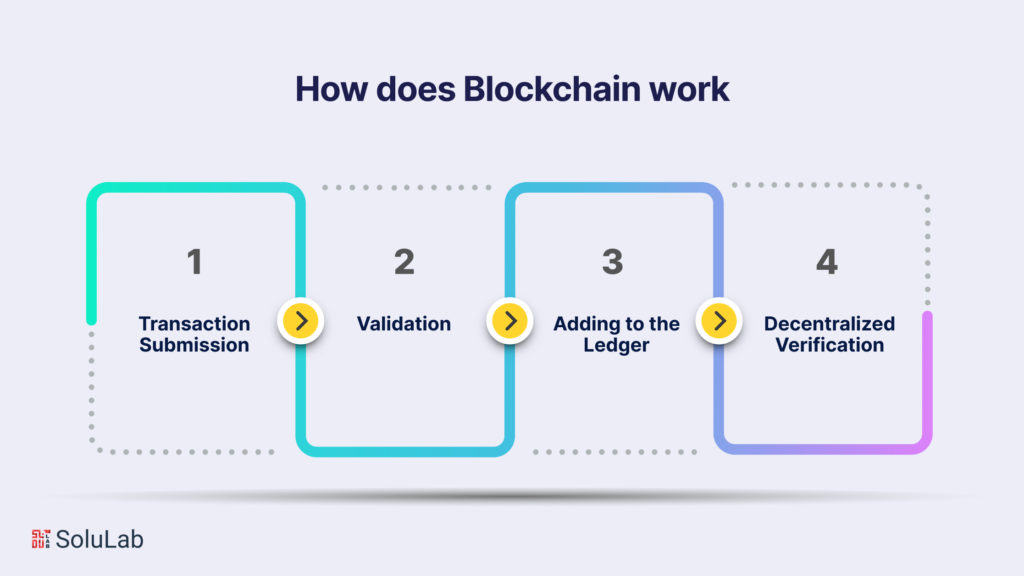
How does Blockchain work?

How does Blockchain work

Understanding how blockchain operates is crucial for businesses looking to leverage this technology effectively:

  • Transaction Submission

Users initiate transactions by creating a request to add data to the blockchain. This data can represent various actions, such as transferring assets, verifying identities, or recording ownership changes.

  • Validation

Transactions are sent to the network’s nodes, where they undergo verification. In public blockchains, this verification is typically done through a consensus mechanism like PoW.

  • Adding to the Ledger

Once a transaction is validated, it is added to a new block. This block is then linked to the previous one, forming a continuous chain.

  • Decentralized Verification

Multiple nodes on the network must reach a consensus before a transaction is considered valid. This decentralized verification ensures trust and security.
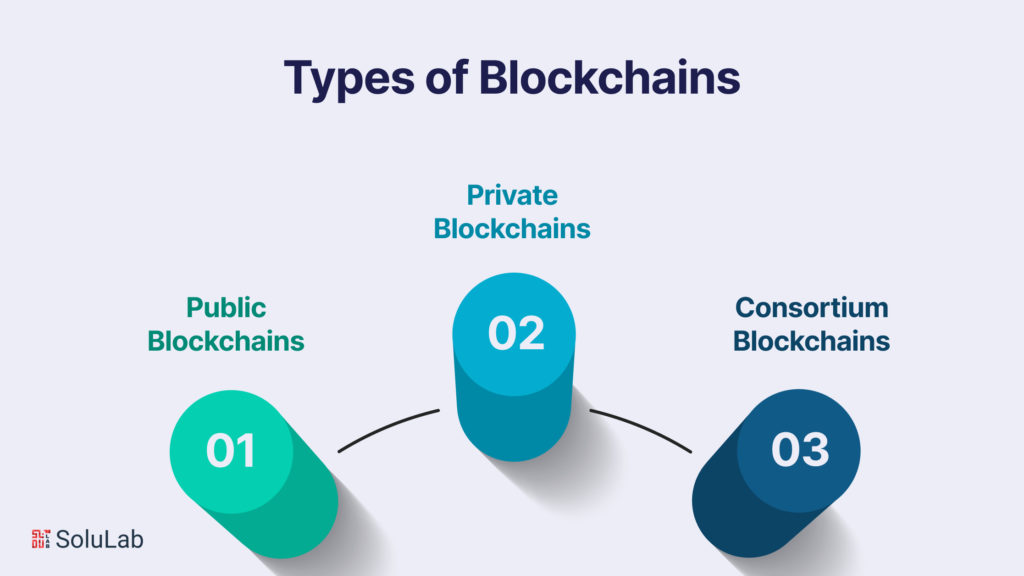
What are the Types of Blockchains?

Types of Blockchains

Blockchains come in various forms, each suitable for different business needs:

  • Public Blockchains

Public blockchains, like Bitcoin and Ethereum, are open to anyone and offer complete transparency. They are ideal for businesses looking to create blockchain-based applications with widespread accessibility.

  • Private Blockchains

Private blockchains are restricted to a specific group of participants, making them suitable for businesses that require control over access and data privacy. They are often used for internal processes and collaborations.

  • Consortium Blockchains

Consortium blockchains are a hybrid of public and private blockchains. They are governed by a group of organizations rather than a single entity. This type is beneficial for industries with multiple stakeholders, such as blockchain in supply chains.

How Can Businesses Leverage Blockchain Technology to Identify and Address Their Specific Needs?

In today’s fast-paced and ever-evolving business landscape, staying competitive requires constant innovation and the ability to leverage cutting-edge technologies. Blockchain technology has emerged as a transformative force, offering a wide array of applications for businesses across various industries. To embark on this journey, it’s crucial to start with the right blockchain business idea. In this guide, we’ll delve into the essential steps of blockchain business idea generation.

 Identifying Business Needs
  • Businesses must begin by identifying their specific needs and challenges. This introspective process involves examining existing inefficiencies, security concerns, or operational bottlenecks. 
  • For example, a company might struggle with supply chain transparency, financial fraud, or data privacy issues. Identifying these pain points is the first step in determining how blockchain can provide a solution.

Exploring Blockchain Applications

  • Once the business needs are clear, the next step is to explore the myriad blockchain applications available. Blockchain has proven its versatility, and it can be applied to various domains. 
  • Some popular blockchain use cases for businesses include supply chain management, smart contracts, identity verification, and decentralized finance (DeFi). Businesses should thoroughly research these applications to understand how they can address their specific challenges.

Assessing Market Demand

  • While blockchain technology holds immense potential, it’s essential to assess the market demand for your proposed blockchain solution. 
  • Market research is critical to determine whether there’s a demand for your idea. It involves analyzing your target audience, competitors, and potential partners. Understanding market trends, such as the increasing adoption of blockchain in various sectors, can help validate your business concept.

Formulating a Unique Blockchain Business Idea

  • To stand out in a competitive landscape, it’s crucial to formulate a unique blockchain business idea that aligns with your identified needs, blockchain applications, and market demand. This idea should address a specific pain point effectively and provide a clear value proposition.
  • For instance, if you’re in the logistics industry and have identified supply chain inefficiencies, your unique blockchain business idea could involve creating a blockchain-based platform that offers real-time visibility and traceability of goods. This solution could utilize smart contracts to automate and optimize processes, reducing costs and enhancing transparency

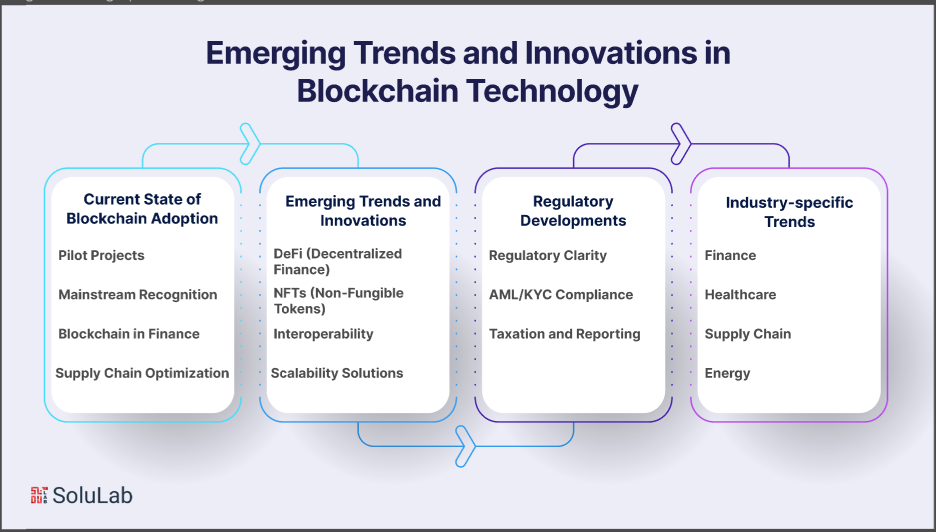
What are Some Key Emerging Trends and Innovations in Blockchain Technology?

Emerging Trends and Innovations in Blockchain Technology

Current State of Blockchain Adoption

Blockchain technology has made significant strides in recent years, with a growing number of businesses recognizing its potential to revolutionize various industries. The current state of blockchain adoption reflects a dynamic landscape of innovation and transformation.

  • Pilot Projects

Many businesses have moved beyond the initial experimentation phase and are now actively implementing blockchain solutions. Pilot projects are being conducted across diverse sectors, from supply chain management to healthcare.

Read Also: Top 10 Blockchain Development Companies in 2023

  • Mainstream Recognition

Blockchain is no longer a niche concept. It has gained recognition and support from major tech companies, financial institutions, and governments worldwide, showcasing its mainstream appeal.

  • Blockchain in Finance

In the financial sector, blockchain is being used for cross-border payments, remittances, and even central bank digital currencies (CBDCs). This adoption has the potential to disrupt traditional banking systems.

  • Supply Chain Optimization

Blockchain’s traceability and transparency features are driving its adoption in supply chain management. Businesses are utilizing blockchain to track and authenticate the origin of products, improving trust and reducing fraud.

Emerging Trends and Innovations

The blockchain landscape is continuously evolving, with several emerging trends and innovations shaping the future of business applications.

  • DeFi (Decentralized Finance)

DeFi projects are growing rapidly, offering decentralized lending, borrowing, and trading platforms. These innovations challenge traditional financial intermediaries and offer greater financial inclusion.

  • NFTs (Non-Fungible Tokens)

NFTs have gained immense popularity, particularly in the art, entertainment, and gaming industries. These digital assets are revolutionizing ownership and provenance verification.

  • Interoperability

Cross-chain compatibility and interoperability solutions are emerging, allowing different blockchains to communicate and share data seamlessly. This will enhance the flexibility and utility of blockchain networks.

  • Scalability Solutions

The challenge of blockchain scalability is being addressed through various solutions, such as Layer 2 solutions and sharding, enabling faster and more cost-effective transactions.

Read Our Blog: Best Companies to Hire Blockchain Developers in 2023

Regulatory Developments

Blockchain technology has prompted regulatory bodies to respond with new frameworks and guidelines.

  • Regulatory Clarity

Governments are increasingly providing regulatory clarity, which is essential for businesses to navigate the blockchain space confidently. This includes defining the status of cryptocurrencies and tokens.

  • AML/KYC Compliance

Regulations regarding Anti-Money Laundering (AML) and Know Your Customer (KYC) procedures are being strengthened to mitigate risks associated with blockchain-based financial transactions.

  • Taxation and Reporting

Tax authorities are developing guidelines for cryptocurrency taxation, ensuring that businesses and individuals are compliant with tax obligations related to blockchain assets.

Industry-specific Trends

Blockchain’s impact is felt differently across various industries, each with its unique trends and opportunities.

  • Finance

In finance, blockchain is leading to the tokenization of assets, making it easier to trade and transfer ownership of real estate, stocks, and other assets.

Read Our Blog: Blockchain Security: Best Practices Every Developer Should Know

  • Healthcare

In healthcare, blockchain is improving data security and interoperability, facilitating the secure sharing of patient records among healthcare providers.

  • Supply Chain

The supply chain industry is witnessing blockchain adoption to enhance traceability and reduce fraud, addressing consumer demands for transparency.

  • Energy

Blockchain is being used to create decentralized energy grids, allowing peer-to-peer energy trading and optimizing resource allocation.
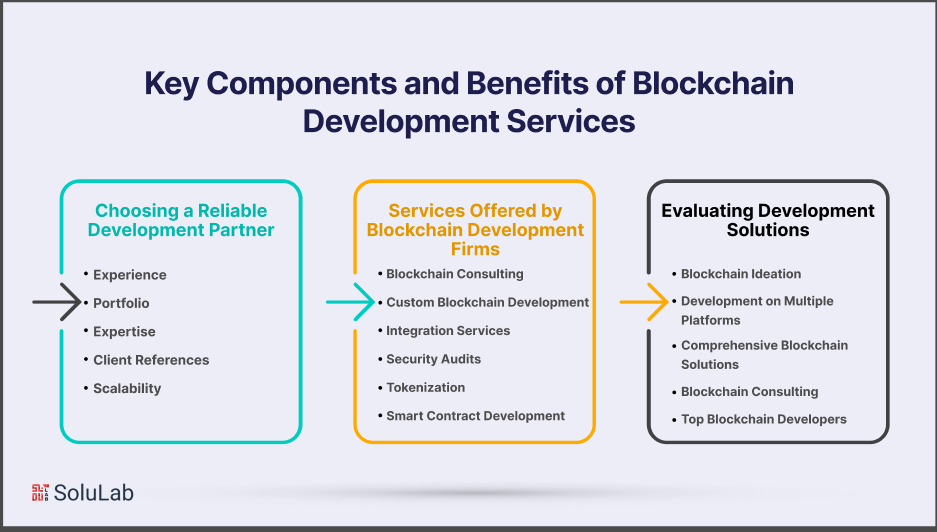
What are the Key Components and Benefits of Blockchain Development Services?

Key Components and Benefits of Blockchain Development Services

Blockchain development services play a pivotal role in enabling businesses to harness the power of blockchain technology for their growth and innovation. These services encompass a wide range of solutions tailored to meet the specific needs of businesses seeking to leverage blockchain’s potential. Let’s delve into the essential aspects of blockchain development services, their significance, and how to make the right choice for your business.

Choosing a Reliable Development Partner

Selecting the right development partner for your blockchain project is a critical decision that can significantly impact its success. When considering blockchain development services, businesses should look for reliability, expertise, and a track record of delivering high-quality solutions. Here are key factors to consider when choosing a development partner:

  • Experience

Evaluate the development partner’s experience in blockchain technology. Have they worked on similar projects or blockchain use cases relevant to your business idea?

  • Portfolio

Examine their portfolio to gauge the quality of their previous work. Look for successful implementations of blockchain applications with businesses.

  • Expertise

Assess the team’s expertise in various blockchain platforms and technologies. Are they well-versed in blockchain trends and best practices?

  • Client References

Request client references and testimonials to gain insights into the partner’s reputation and the satisfaction of past clients.

  • Scalability

Ensure that the development partner can accommodate your project’s scalability requirements as your blockchain application grows.

Services Offered by Blockchain Development Firms

Blockchain development firms offer a comprehensive range of services to cater to diverse business needs. These services typically include:

  • Blockchain Consulting

Identifying viable blockchain use cases for your business, helping define blockchain business strategies, and assessing the feasibility of blockchain adoption.

  • Custom Blockchain Development

Creating tailor-made blockchain solutions to meet specific business requirements, whether it’s developing decentralized applications (DApps), smart contracts, or private blockchains.

  • Integration Services

Integrating blockchain technology seamlessly with existing business systems and processes to ensure smooth operations.

  • Security Audits

Conducting security audits and implementing robust security measures to protect blockchain assets and data.

  • Tokenization

Developing and launching tokens for fundraising or asset management purposes, such as initial coin offerings (ICOs) or security token offerings (STOs).

  • Smart Contract Development

Designing and coding smart contracts to automate business processes, enforce agreements, and enhance transparency.

Evaluating Development Solutions

When considering SoluLab for blockchain development services, businesses benefit from a reputable and experienced partner. SoluLab offers a wide array of blockchain services, including:

  • Blockchain Ideation

Assisting businesses in identifying blockchain use cases and crafting innovative blockchain business ideas.

  • Development on Multiple Platforms

Expertise in developing various blockchain platforms, such as Ethereum, Hyperledger, and Corda.

  • Comprehensive Blockchain Solutions

Providing end-to-end solutions, from consulting and development to deployment and maintenance.

  • Blockchain Consulting

Offering strategic guidance and insights to help businesses align their blockchain strategy with their goals.

  • Top Blockchain Developers

Access to a talented team of blockchain developers who are proficient in the latest blockchain technologies and trends.

By collaborating with SoluLab, businesses can leverage their blockchain expertise and commitment to delivering reliable, scalable, and secure blockchain solutions.

Blockchain development services are indispensable for businesses looking to harness the potential of blockchain technology. Choosing a reliable development partner and assessing the services offered are crucial steps in ensuring the success of your blockchain project. SoluLab stands as a reputable option for businesses seeking blockchain development solutions that align with their objectives and aspirations.

CTA2

Conclusion

In conclusion, SoluLab’s comprehensive Blockchain Business Strategy Guide offers invaluable insights into the dynamic world of blockchain development for businesses. As the landscape of technology evolves, it’s evident that blockchain is more than just a buzzword; it’s a transformative force with numerous blockchain use cases that can revolutionize your business. From enhancing security to streamlining operations and fostering trust among stakeholders, the potential of blockchain technology is boundless.

By investing in blockchain development services from SoluLab, you are not only staying ahead of blockchain trends but also positioning your business to thrive in an increasingly digital and decentralized world. Our expert blockchain developers can tailor blockchain solutions to match your unique needs, whether you’re exploring blockchain applications with business processes, considering new blockchain business ideas, or seeking to optimize your existing operations through blockchain technology.

With SoluLab’s blockchain consulting services, you gain a trusted partner who can guide you through the intricacies of blockchain technology, helping you make informed decisions and seize opportunities in this rapidly evolving space. Our commitment to delivering top-notch blockchain development solutions ensures that your business stays at the forefront of innovation and maintains a competitive edge. SoluLab’s blockchain consulting services provide expert guidance in the ever-evolving blockchain landscape. Trust us to lead your way to innovation and success. Contact SoluLab today for a brighter future.

FAQs

1. What is Blockchain Development, and why should businesses consider it?

Blockchain development involves creating decentralized, secure, and transparent digital ledgers. Businesses should consider it to streamline operations, enhance security, and explore innovative opportunities like blockchain applications with business.

2. What are some blockchain use cases for businesses?

Blockchain has numerous applications in businesses, including supply chain management, smart contracts, identity verification, and tokenization of assets. These use cases can improve efficiency and reduce costs.

3. What are the latest blockchain trends businesses should be aware of?

Blockchain trends evolve rapidly. Stay updated on trends like DeFi (Decentralized Finance), NFTs (Non-Fungible Tokens), and interoperability solutions to make informed investment decisions.

4. How can blockchain development benefit my business strategy?

Blockchain development can offer competitive advantages by increasing transparency, reducing fraud, and enhancing trust among stakeholders. It can also open up new revenue streams with blockchain platforms and innovative solutions.

5. What should you look for in blockchain development services?

When seeking blockchain development services, consider their expertise, track record, and ability to align blockchain technology with your business goals. Look for providers offering comprehensive blockchain solutions.

Top 10 Real World Applications of Blockchain Technology

Top 10 Real World Applications of Blockchain Technology

In today’s rapidly evolving digital landscape, blockchain technology has emerged as a transformative force, reshaping the way we approach data management, security, and transparency. Originally conceived as the underlying technology for cryptocurrencies like Bitcoin, blockchain has evolved far beyond its initial application. This decentralized, immutable, and secure system has paved the way for a multitude of practical use cases across various industries. In this blog, we will delve into the top 10 real-world applications of blockchain technology, showcasing its versatility and potential to revolutionize the way we conduct business and secure information.

What is Blockchain Technology?

Before we dive into its applications, it’s crucial to grasp the fundamental concept of blockchain technology. At its core, a blockchain solution is a distributed ledger system that records transactions across a network of computers in a secure and immutable way. It operates within a blockchain ecosystem of protocols, networks, and platforms, providing a tamper-proof system for data management and exchange.

The blockchain network consists of nodes (computers) that validate and store transactions in a decentralized manner, ensuring no single entity has complete control. Transactions are grouped into blocks, and each new block is linked to the previous one, forming a chain of data blocks – hence the name “blockchain.” This architecture ensures data integrity, security, and transparency, making blockchain technology suitable for a wide range of applications.

Is Blockchain Safe to Use?

In a number of ways, blockchain technology allows decentralized security and trust. To begin, new blocks are constantly added in a chronological and linear order. They are always appended to the blockchain’s “end”.

Unless a significant part of the network agrees to do so, changing what is inside of a block after it has been appended to the end of the blockchain is extremely difficult. This is due to the fact that each block will include its own hash, as well as the hash of the prior one and the previously determined date.

A mathematical function converts digital information into a sequence of numbers and characters to generate hash codes. If that data is changed in any manner, the hash code will be changed as well. This makes blockchain development solutions safe to use.

Read Also: Top Blockchain Trends in 2025

How Does it Work?

Blockchain transactions are both anonymous and safe. Peer-to-peer transactions on the blockchain are immediate and transparent.

Trust is distributed from strong middlemen to a wide global network via blockchain. This worldwide network uses vast cooperation, coding, and encryption to create a public record of every transaction that occurs on the network.

A block is a piece of data or a transaction that is recorded in a blockchain. When a transaction or data storage is completed, the data block is added to the Blockchain as a permanent database. 

When a block is finished, a new block is created to hold fresh data. Every block is linked in a chain in chronological sequence, with each block having a connection to the previous block.

CTA2

Benefits of Using Blockchain Technology

Blockchain technology has gained widespread recognition for its potential to revolutionize various industries. From financial services to supply chain management, the benefits of utilizing blockchain technology are numerous and far-reaching. In this section, we will explore some of the key benefits of incorporating blockchain into your business processes with a focus on the role of blockchain development services and blockchain developers.

Benefits of Using Blockchain Technology

1. Enhanced Security: One of the foremost benefits of blockchain technology is its exceptional security features. Data stored on a blockchain is cryptographically secured, making it highly resistant to hacking and fraud. Each block of data is linked to the previous one, creating an unbreakable chain. Blockchain development services ensure that robust security protocols are implemented to protect sensitive information.

2. Transparency and Traceability: Blockchain’s transparent and immutable nature allows for real-time tracking and auditing of transactions and data. This transparency is especially valuable in supply chain management, where it can be used to trace the origin and journey of products, ensuring authenticity and quality. Blockchain services can help businesses set up such systems efficiently.

3. Reduced Costs: Implementing blockchain technology can significantly reduce operational costs by eliminating intermediaries and streamlining processes. Smart contracts, for example, automate agreements and transactions, reducing the need for intermediaries like lawyers and brokers. Blockchain developers can customize smart contracts to fit specific business needs.

4. Efficiency and Speed: Blockchain technology enables faster and more efficient transactions, particularly in cross-border payments and remittances. Transactions that typically take days or weeks can be completed in minutes or even seconds. Blockchain development services play a crucial role in optimizing the performance of blockchain networks.

Top 10 Real-World Applications of Blockchain Technology

Blockchain technology, once primarily associated with cryptocurrencies, has evolved into a versatile solution with a wide range of real-world applications. The ability of blockchain platforms to provide security, transparency, and decentralization makes it a game-changer across various industries. In this article, we’ll explore the top 10 real-world applications of blockchain technology.

Real-World Applications of Blockchain Technology

  • Smart Contracts

Smart contracts are self-executing agreements with terms encoded in code. They automate and enforce contract execution, reducing the need for intermediaries in legal and financial transactions. Blockchain ensures their security and immutability, making them reliable tools for various applications, from insurance payouts to real estate transactions.

These contracts execute automatically when predefined conditions are met, minimizing the risk of disputes and fraud. Smart contracts enhance efficiency, reduce costs, and increase transparency in a wide range of industries.

  • Healthcare

Healthcare will be regarded as among the most competitive industries in the world, and blockchain technology is likely to be utilized or pushed by it. It may be viewed as the development of Blockchain Technology. The whole healthcare value chain can use blockchain, which is the supply chain’s potential business model.

Blockchain technology applications in healthcare will basically automate and change everything, from payments and health records to data collection and analytics, to the benefit of all parties involved, including patients and consumers as well as clinicians, administrators, and healthcare organizations.

  • Real Estate

Blockchain technology and applications have the ability to completely transform the real estate industry. Smart contracts are being developed by stakeholders to allow real estate agreements, escrows, and property documentation to be completed without the use of title firms or attorneys. In the future, a buyer may be able to purchase a property and finalize the transaction by simply clicking on a shopping cart on a website.

The blockchain solution will make sure that the buyer receives the title and that the seller is compensated in cryptocurrency. Money and transaction processing will undoubtedly alter, and that shift is already beginning. To prosper in the blockchain era, brokers will need to adjust their business models in order to comprehend smart transactions.

Read Also: Top 5 Enterprise Blockchain Platforms of 2025

  • IoT

Blockchain enables all Internet of Things devices to improve transparency and safety in their interconnected ecosystems. One significant example of blockchain implementation in IoT is around smart homes. Although IoT allows home security systems to be handled remotely from mobile devices, the typical centralized way to transmit data created by IoT devices fails security standards as well as data ownership. Blockchain has the ability to take smart homes to the next level by addressing security concerns and eliminating centralized infrastructure.

Telstra, an Australian telecommunications and media business, for example, offers smart home solutions. To ensure that data gathered by smart devices is not tampered with, the firm employs blockchain and biometric authentication—the blockchain stores sensitive user data such as fingerprints, voice recognition, and facial recognition. When data is recorded on the blockchain, it becomes unchangeable, and access is restricted to a small group of people.

  • Supply Chain

Companies are seeking methods that will not only streamline supply chain management but also figure out various business processes that comprise supply chains in an era where supply chains have grown increasingly complicated due to the developing demands of the consumer and other stakeholders. Many supply chain providers feel that blockchain technology may be used to successfully handle their problems because of its numerous and diverse uses.

The applications of blockchain in the supply chain vertical may improve a variety of operations, from streamlining supplier payments, cold chain tracking, and performing RFID-driven contract bids to gathering product status at the point of production and utilizing smart contracts for transferring excess power from solar panels. Ethereum will be used to tokenize the shipping sector in a future enterprise.

  • Government Sector

While blockchain applications are increasingly diminishing the requirement for centralized government organizations, the conflict between governments and cryptocurrencies is expected to reach a climax in the coming years. Governments, on the other hand, are aware of the potential that blockchains may unlock and are thus always on the lookout for ways to apply blockchain services to enhance and overhaul operational procedures. Many governments have used blockchains for a number of purposes.

Countries such as Venezuela and Russia are implementing their own national cryptocurrencies in order to increase transparency and reduce corruption. Furthermore, blockchains may be utilized to create immutable voting systems that eliminate forgeries and fraud as myths. Additionally, blockchains may be used to enhance identity management and tax administration.

  • Cybersecurity

As firms become increasingly reliant on the Internet and technologies to generate money and articulate business models, the opportunity for hackers to attack enterprises has grown enormously. The demand for effective cybersecurity solutions is at a record high in this state of amazement. What solution is more effective than blockchains’ decentralized structure? Blockchain development, with its distributed ledger technology, may fundamentally improve cyber protection.

 Based on the fundamental qualities of operating resilience, data encryption, auditability, transparency, and immutability, blockchain systems can prevent fraudulent actions and identify data tampering. Because blockchains are distributed, they do not allow for a single point of failure and hence provide better security than database-driven transactional systems.

  • Social Media

Not long ago, social media platforms absorbed humanity from all sides. However, due to various transgressions, such as personal data breaches and inadequate recompense for consumers, these platforms are losing appeal. The social media is losing its edge’ is not incorrect.

Blockchain enters the picture to transform the social media landscape. Technology improves social media systems to a whole new level. Blockchain technology, with its decentralized and distributed ledger structure, presents a system through which individuals may exert more control over the protection of personal information while possibly receiving monetary rewards for the viral material they select and share. Blockchain technology has the potential to elevate traditional social media to new heights. 

  • AI

AI built on top of blockchains is frequently referred to as an accounting technology disruptor and has the potential to be one of the most potent and hazardous inventions ever. Decentralized Autonomous Organizations (DAOs) might be created by decentralizing AI.

DAOs are businesses that can function independently and decentralizedly thanks to smart contracts, without a single entity controlling everything and making all the choices. When carried out properly, an AI DAO may eventually replace human design by learning from data to optimize itself far more effectively than was possible. Together, blockchains and AI, or what we may refer to as a “decentralized AI,” might open up new avenues for data security, data monetization, and intelligent algorithms.

  • Food Safety

Blockchain enables the tracking of food items from farm to table, ensuring food safety and traceability. In the event of contamination outbreaks, authorities can quickly identify affected products and minimize health risks. Consumers can also verify the authenticity of organic or locally sourced foods.

This technology builds trust in the food supply chain, reduces waste through better inventory management, and facilitates compliance with food safety regulations.

CTA1

Final Words

Blockchain technology is growing, from powering cryptocurrencies to impacting various real-world industries. From improving supply chain transparency to securing digital identities, blockchain’s decentralized, transparent, and immutable nature is transforming how businesses operate. These real-world applications of blockchain showcase its potential to drive innovation across finance, healthcare, logistics, real estate, and more. By leveraging blockchain, businesses can achieve higher levels of security, efficiency, and trust while reducing costs and complexity.

However, implementing blockchain solutions requires specialized expertise and a strategic approach. Partnering with an experienced Blockchain Consulting Company like SoluLab can help you unlock the full potential of this technology. SoluLab offers end-to-end blockchain development services, designed to your business needs. Whether you want to streamline processes, secure data, or introduce smart contracts, SoluLab has the technical expertise and industry experience to make it happen.

When you Hire Blockchain Developer from SoluLab, you gain access to a dedicated team of professionals skilled in building secure, scalable, and compliant blockchain applications. SoluLab helps businesses navigate the complexities of blockchain implementation, ensuring that their solution is robust and future-proof. From consultation and development to deployment and maintenance, SoluLab guides you at every step, ensuring a seamless transition to blockchain technology that drives growth and success.

If you’re ready to explore how blockchain can benefit your business, SoluLab is here to help you turn your ideas into reality.

FAQs

1. What is blockchain technology, and how does it work?

Blockchain is a decentralized digital ledger that records transactions across multiple computers securely and transparently. It works by organizing data into blocks, which are linked in a chain, making the information immutable and tamper-resistant.

2. What are the main benefits of using blockchain technology in real-world applications?

Blockchain technology offers benefits like enhanced security, transparency, decentralization, and immutability. It can reduce fraud, streamline processes, and provide a higher level of trust in transactions.

3. Which industries are currently adopting blockchain technology?

Blockchain is being adopted in industries such as finance, healthcare, logistics, real estate, supply chain management, government, and entertainment, among others. It is used to improve security, transparency, and efficiency in these sectors.

4. Can blockchain technology improve supply chain management?

Yes, blockchain can significantly improve supply chain management by providing real-time tracking, ensuring transparency, and reducing inefficiencies. It enables stakeholders to trace products and verify authenticity throughout the supply chain.

5. How can blockchain improve the security of digital identity systems?

Blockchain ensures that digital identity systems are more secure by creating decentralized, immutable records that cannot be tampered with. This prevents fraud, unauthorized access, and identity theft.

6. How can businesses get started with blockchain technology?

Businesses can start by consulting with a Blockchain Development Company to assess their needs, identify areas for blockchain implementation, and develop a custom blockchain solution. Hiring expert blockchain developers can help ensure a smooth adoption process and successful project execution.
