Talk to an Expert

Blockchain: For Life Science and Healthcare Industry

[fusion_builder_container hundred_percent="no" equal_height_columns="no" menu_anchor="" hide_on_mobile="small-visibility,medium-visibility,large-visibility" class="" id="" background_color="" background_image="" background_position="center center" background_repeat="no-repeat" fade="no" background_parallax="none" parallax_speed="0.3" video_mp4="" video_webm="" video_ogv="" video_url="" video_aspect_ratio="16:9" video_loop="yes" video_mute="yes" overlay_color="" video_preview_image="" border_size="" border_color="" border_style="solid" padding_top="" padding_bottom="" padding_left="" padding_right=""][fusion_builder_row][fusion_builder_column type="1_1" layout="1_1" background_position="left top" background_color="" border_size="" border_color="" border_style="solid" border_position="all" spacing="yes" background_image="" background_repeat="no-repeat" padding_top="" padding_right="" padding_bottom="" padding_left="" margin_top="0px" margin_bottom="0px" class="" id="" animation_type="" animation_speed="0.3" animation_direction="left" hide_on_mobile="small-visibility,medium-visibility,large-visibility" center_content="no" last="no" min_height="" hover_type="none" link=""][fusion_text columns="" column_min_width="" column_spacing="" rule_style="default" rule_size="" rule_color="" hide_on_mobile="small-visibility,medium-visibility,large-visibility" class="" id="" animation_type="" animation_direction="left" animation_speed="0.3" animation_offset=""]

Blockchain: For life sciences and healthcare  - What broader integration is making possible today

Blockchain is essentially a living list of linked digital records—a distributed ledger—that permanently stores updates via a consensus among those who share it. A record of every transaction is embedded in the information itself, without the need for a central repository. While information can be added, it cannot be copied or deleted. As a result, multiple groups—life sciences companies, health plans, physicians, hospital systems, and even patients for e.g. can add to and share information through a secure system. Today, blockchain is garnering headlines once again, this time for the vast ecosystem of cross-industry use cases emerging around it. For e.g.
  • Europe’s largest shipping port has launched a research lab to explore the technology’s applications in logistics
  • Utilities in North America and Europe are using blockchain to trade energy futures and manage billing at electric vehicle charging stations
  • Blockchain is disrupting social media by giving users an opportunity to own and control their images and content.
The shift from blockchain to blockchains—to networks of networks—is particularly compelling in life sciences and health care where the distinct sectors work together in one broadly interdependent ecosystem.

So what are the possibilities within life sciences and health care?

For life sciences and health care, blockchain has the potential to enhance collaboration, trust, interoperability, traceability, and auditability across a range of functions such as clinical trials, supply chain management, financial transactions, credentialing, and claims processing. The shift from blockchain to blockchains—to networks of networks—is particularly compelling in life sciences and health care where the distinct sectors work together in one broadly interdependent ecosystem A number of working groups are examining blockchain’s potential in areas such as counterfeit drugs, licensure, and technical knowledge sharing. As the technology unfolds, it could help in below areas of healthcare to solve problems:
  • Address legacy technology debt
  • Shorten negotiation cycles
  • Improve medical record centralization
  • Improve network coordination
  • Clarify drug traceability
  • Make clinical trial processes more consistent.

Prospects by sector

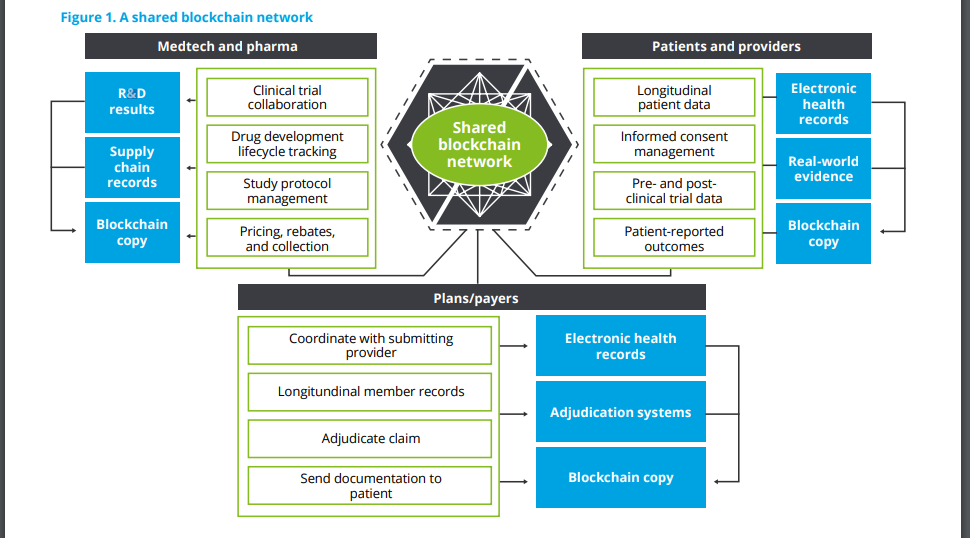
A shared network that links medtech and pharma, patients and providers, and plans and payers on the same standard could touch every part of the industry from drug trials to claims adjudication to clinical outcomes. For now, however, the challenges and the opportunities are worth exploring sector by sector.

Blockchain for Health Care Service Providers:

  • Blockchain offers the potential to address poor network communication and a scattered view of transactions in the provider arena. 
  • It can also provide a bulwark against fraud and abuse. 
  • With fluent collaboration not only within but across networks, and visibility into patient transactions and measurable outcomes, blockchain may be a key element in the implementation of value-based care. 
  • For providers, who rely on insurance-related transactions but don’t own the processes behind them, blockchain may help reduce cost and inefficiency.
A shared network that links medtech and pharma, patients and providers, and plans and payers on the same standard could touch every part of the industry from drug trials to claims adjudication to clinical outcomes.

Blockchain in Life Sciences 

  • As in other sectors, blockchain in life sciences is in a nascent form. But storing and tracking critical data on a blockchain could reshape the sector. 
  • In clinical trials, blockchain could be a common frame of reference for an entire ecosystem of solutions that may improve participation and processes and ultimately lead to better health outcomes, with patients, investigators, managers, and doctors all touching different parts of the same ledger. 
  • A person’s cloud-based “health passport” could use blockchain to carry consistent information securely across the entire process of searching for relevant trials, matching criteria and registering, documenting consent, and participation. 
  • The same unbroken information chain could then support trial functions such as sample collection, tracking, and analysis. 
  • Many of the current systems used to track clinical trial samples and document proper storage, transport, and handling leverage spreadsheets that are hard to read or automate. 
  • Blockchain could help the data follow the samples, promoting more efficiency in the process and greater confidence in the results. 

Blockchain for Healthcare Data Security

  • For payers, blockchain could be used to help ensure the control, integrity, and traceability of data and serve as an essential tool for creating trust and reliability when sharing data across multiple parties. 
  • More specifically, blockchain could have a significant impact in areas such as medical records, claims processing, payments, provider data management, insurance design, and consent management. 
  • Broadly shared, consistent data on a blockchain might help health plans streamline administrative processes and combat fraud, waste, and abuse. 
  • Blockchain-based medical records and interoperability have been a focal point in streamlining patient-centric care management and delivery. 
  • Members want control of personal medical data and often are frustrated with the need to repeat data entry processes. 
  • This could be addressed by a customer-controlled blockchain for identity verification. While there is consensus around the longitudinal medical records use case, there has been some disagreement on how quickly this would happen. Challenges still exist around data protection and consumer incentives.  

Challenges to overcome

  • Scalability

    Many of the processes for blockchain would require more scalability and balance between permissionless blockchains (which offer more computing power) and permissioned ones (which offer faster processing). 
  • Standardization

    To foster greater efficiency and performance, organizations can consider implementing governance to control what type of data may be written into a blockchain. 
  • Incentives

    Blockchain participants should determine technical, financial, and business incentives that could encourage organizations to adopt the technology and lend their computing power. 
  • Cost

    Organizations need to determine their costs for operating a blockchain. 
  • Regulatory

    While a blockchain solution could address the Health Insurance Portability and Accountability Act (HIPAA) privacy rule in part by separating and encrypting PHI/PII data, regulatory bodies should consider deep collaboration with the industry to facilitate adoption.
Blockchain’s broad implementation in the life sciences and health care ecosystem will require a “tipping point” of trust and adoption among stakeholders, including patients.

Conclusion 

Companies should look to standardize the technology, talent, and platforms that will drive future initiatives—and, after that, look to coordinate and integrate multiple blockchains working together across a value chain. An effective way to get started is by getting to know blockchain— the reality, not the hype: 
  • Dive deep into workshops and proofs of technology. 
  • When it’s time to launch the first pilot, define the use case in detail, and plan an iterative, agile way to deliver a measurable solution to an identified business challenge. 
  • Focus blockchain development resources on use cases with a clear path to commercialization. 
  • Support standardization in technology, business processes, and talent skill sets. 
  • Work to integrate and coordinate multiple blockchains within a value chain. 
[/fusion_text][/fusion_builder_column][/fusion_builder_row][/fusion_builder_container]

Do you need assistance to run your business successfully in a pandemic situation and want to outsource?

In today’s time, the whole world is suffering, and it has become challenging for us to get back to our daily routine. But still many of us are trying to stick to our work by doing remote work. SoluLab is a group of developers, programmers, engineers, consultants, and many more. If you are looking to outsource work, you can hire from our time.

Our team will provide you with the best product, and 100% tested. Also, it will allow you to access high performed developers, multi-skilled and experienced resources at your convenience. Also, you can quickly scale up and down your resources according to your need.

Various big tech companies such as Google, Amazon, and many more have brought several policies regarding remote work and working hard to avoid the spread of the novel coronavirus. It could be an issue, such as a pandemic, event preparation of over urbanization, the news is getting flooded with several ways for remote work.

You might be a sole proprietor of some tech company or any employee who would be giving or had given a choice to everyone to work remotely. For any industry, employees are of utmost importance. And during times like this, several employees find it challenging to work from home.

To make all departments function correctly, we do need to have all hardware and software to assist them in working correctly and staying safe at home.  For building the best project, one needs to follow some preliminary goals.

  • Best quality services
  • Delivery on time with accuracy
  • Clients should be satisfied

Applications that you can use to run your business hassle free

Several IT experts have taken care of all the security measures and worked on privacy. If you want to run smooth communication with your clients, you can use the following tools.

  • Skype
  • Slack
  • Google Hangout 

For time management you may use

  • Hubstaff

For code development and management

  • Github

Project management

  • Jira

SoluLab would take care of everything when it comes to the safety of the team. In any case, your business would not suffer if you outsource projects to us.

What is it like to outsource IT projects?

Outsourcing is an agreement held between companies when a company hires another company to do projects and several activities. Outsourcing does occur in several IT teams, which work on tasks like web development, IT support, and social media management. Outsourcing makes companies earn revenue.

Being an entrepreneur, you need to consider several things before you choose an outsourcing agency or remote staff. Also, you need to build a strategy wisely before you make any call. 

Several factors are considered before outsourcing a project, and below section, we will discuss some of the factors.

  • It is essential to know if outsourcing a project would still benefit your business.
  • The outsourcing project would make some spare time for you to grow your business.
  • If outsourcing, staff can do your task with more efficiency as compared to other staff members.
  • Is it a rare project or nonrecurring work

What are the benefits of outsourcing any IT project?

It keeps a seamless workflow

Once you outsource a project to any other company or developer, then you will be surely benefited from it since they would be working round the clock with all your permanent employees.

It would upscale your work

If you are working with any experienced outsourcing agency, then your work would be leveraged, and it would upscale, revenue, profit, and work.

It would be time efficient

A huge amount of time would be saved, and several resources for advertising, hiring, inhouse staff, and interviewing won’t be needed since you will be outsourcing a project to an agency.

A diverse talent

In case you hire any outsource agency, then you would be enabled to get access to some of the best professionals who might not be located in your location.

It is really cost efficient to outsource a project

As you will outsource a project, you would need to hire fewer employees who will cut costs in production. Also, you can pay lower salaries to all remote workers, and several operational expenses and infrastructure would be saved

Do you need a big team

Are you looking for developers, as your project is large. You don’t need to worry, as SoluLab would provide you with the best solution. You can hire a developer or team. We should be happy to set up a team with you.

According to you, we will conduct all the interviews. And we will hire the best developer for you. You need to give us your requirement. Also, all the rights would be given to you to manage all resources. We will take care of all issues, like administrative, developer retention, and infrastructure. If you need us to assign a project manager, we will also do that. We make sure that there is no leak of information. Hence you will sign an NDA to make sure all your details  Are secure with us.

What are the several advantages of having an augmentation model?

Several advantages are there for augmentation. Some of the advantages are discussed below

  • Now hire while you work.
  • Access to a vast pool of talent
  • A cost-effective solution and a competitive edge.
  • It makes operations more efficient.
  • Lets you expand the business and work in a new environment.
  • You get access to several diversified opinions.
  • It leads to sustainable management

Summary

You must have understood how outsourcing works and is required, especially in situations like these. It is a wise decision to make your business more profitable. If you are looking to outsource any project or looking to hire developers, you can contact us from our website.

How Blockchain Can Help Create Better Public Services

Blockchain began as a publicly accessible shared ledger that formed the basis of cryptocurrency surge witnessed worldwide. Does this technology play any role in creating better public services or improving the way public sectors work?

Well, it wasn’t long before the idea of an incorruptible ledger caught the fancy of entrepreneurs worldwide. This resulted in the integration of blockchain technology into several industrial sectors. Startups sprang up worldwide that dealt with this new technology and helped create solutions that could improve the efficiency of services.

In a similar fashion, the government officials of many countries have also began to take notice. Government agencies which require speed, efficiency, and security at the helm are pushing for the infusion of blockchain into their systems. Mature institutions need to recognize opportunities where implementation is possible. Pilot projects can be used to cautiously roll out this tech. The main advantage that governments have to gain is trust – in an open system such as this, the citizens can hope to have more faith in their institutions.

Blockchain Solutions For Public Sectors In Improving Public Services

Every country has its own unique needs and it’s worthwhile to see how they adapt this blockchain solutions for public sector  into their day to day operations.

Countries such as India, Canada, China and Brazil have begun trials and pilots to test how the open ledger can be applied to day to day applications in their offices.

Given below are some issues in public sectors that can be catered to with blockchain.

Blockchain country data

MAINTENANCE OF DIGITAL ASSETS AND DATA

One of the key roles played by any government is to maintain confidential data about its citizens. It is supposed to store information such as birth and death certificates, property deeds, and criminal data amongst other assets. All of this is supposedly kept at secure locations at the regional and national level. The data must be secured from forgery and unauthorized alteration. This is easier said than done in the current scenario which is heavily reliant on the physical proof. The records exist on pieces of paper which can be toyed around with. Moreover any editing requires the person to not only be physically present but also go through a lot of bureaucracy.

Blockchain can help sidestep all the issues that currently plague the system. It can help store all data on public ledgers that can be shared with all necessary institutions. Since these stored blocks of information cannot be edited without verification they’ll remain virtually tamper proof.

DIGITIZATION OF PROPERTY OWNERSHIP

As is the case with identification data, property details such as ownership, transfer, and registries are mostly stored on paper or centralized libraries. Maintaining the vast records of all land under a government and all exchanges that occur on a day to day basis can be a mammoth task. In addition to the huge volume, this process is also prone to inadvertent errors and manipulation. To transfer the ownership rights of a property from one person to another, one must go through several government agencies who take ages to get any work done.

Instead of paper based deeds and titles, permanent registries can be created for each property using blockchain. This will ease the verification process vastly decreasing the time and costs involved. All meddling agencies can be eliminated and the process can become more personalized and streamlined.

VOTING

Elections stand to be the most defining moment for any functioning democracy. Not only do these large scale events take time, they also consume a lot of resources and money. A lot of care needs to be taken to ensure that the votes are not manhandled, miscounted, or forged. Huge sums of money are spent on preparing ballots, electronic voting machines, and necessary man force. Even this cannot guarantee an election that is completely free of rigging.

Blockchain can help digitize the whole process. Votes can be likened to any other online transaction conducted across a secure space free of threats. These votes once audited into the registry will not remain prone to alteration. Moreover, voting will also be easily conducted in remote areas allowing greater participation.

CREATION OF A DATA REPOSITORY

Every agency collects their data separately and stores it in different locations. Sometimes, this data needs to be shared with other government agencies. According to a study, the officials of one Scandinavian country spent over half their days collecting data on criminals from different agencies. All the time wasted on this can be better utilized if a central repository can be created to store all data in one location.

A block containing data can be created and stored on the blockchain ledger. This block will remain encrypted and available only to a private network of computers to avoid data leakage. With blockchain, government institutions and public services will no longer need to lobby for information. They can simply check it in the central data silo.

blockchain for public services

Closing thoughts on blockchain for public services

While these changes seem plausible, they remain a distant possibility unless officials decide to take the plunge. With careful planning and investments, governments can increase transparency and fluency of the public services they offer. This eventually benefits the end users, that is, the citizens.