Talk to an Expert

Blockchain: For Life Science and Healthcare Industry

[fusion_builder_container hundred_percent="no" equal_height_columns="no" menu_anchor="" hide_on_mobile="small-visibility,medium-visibility,large-visibility" class="" id="" background_color="" background_image="" background_position="center center" background_repeat="no-repeat" fade="no" background_parallax="none" parallax_speed="0.3" video_mp4="" video_webm="" video_ogv="" video_url="" video_aspect_ratio="16:9" video_loop="yes" video_mute="yes" overlay_color="" video_preview_image="" border_size="" border_color="" border_style="solid" padding_top="" padding_bottom="" padding_left="" padding_right=""][fusion_builder_row][fusion_builder_column type="1_1" layout="1_1" background_position="left top" background_color="" border_size="" border_color="" border_style="solid" border_position="all" spacing="yes" background_image="" background_repeat="no-repeat" padding_top="" padding_right="" padding_bottom="" padding_left="" margin_top="0px" margin_bottom="0px" class="" id="" animation_type="" animation_speed="0.3" animation_direction="left" hide_on_mobile="small-visibility,medium-visibility,large-visibility" center_content="no" last="no" min_height="" hover_type="none" link=""][fusion_text columns="" column_min_width="" column_spacing="" rule_style="default" rule_size="" rule_color="" hide_on_mobile="small-visibility,medium-visibility,large-visibility" class="" id="" animation_type="" animation_direction="left" animation_speed="0.3" animation_offset=""]

Blockchain: For life sciences and healthcare  - What broader integration is making possible today

Blockchain is essentially a living list of linked digital records—a distributed ledger—that permanently stores updates via a consensus among those who share it. A record of every transaction is embedded in the information itself, without the need for a central repository. While information can be added, it cannot be copied or deleted. As a result, multiple groups—life sciences companies, health plans, physicians, hospital systems, and even patients for e.g. can add to and share information through a secure system. Today, blockchain is garnering headlines once again, this time for the vast ecosystem of cross-industry use cases emerging around it. For e.g.
  • Europe’s largest shipping port has launched a research lab to explore the technology’s applications in logistics
  • Utilities in North America and Europe are using blockchain to trade energy futures and manage billing at electric vehicle charging stations
  • Blockchain is disrupting social media by giving users an opportunity to own and control their images and content.
The shift from blockchain to blockchains—to networks of networks—is particularly compelling in life sciences and health care where the distinct sectors work together in one broadly interdependent ecosystem.

So what are the possibilities within life sciences and health care?

For life sciences and health care, blockchain has the potential to enhance collaboration, trust, interoperability, traceability, and auditability across a range of functions such as clinical trials, supply chain management, financial transactions, credentialing, and claims processing. The shift from blockchain to blockchains—to networks of networks—is particularly compelling in life sciences and health care where the distinct sectors work together in one broadly interdependent ecosystem A number of working groups are examining blockchain’s potential in areas such as counterfeit drugs, licensure, and technical knowledge sharing. As the technology unfolds, it could help in below areas of healthcare to solve problems:
  • Address legacy technology debt
  • Shorten negotiation cycles
  • Improve medical record centralization
  • Improve network coordination
  • Clarify drug traceability
  • Make clinical trial processes more consistent.

Prospects by sector

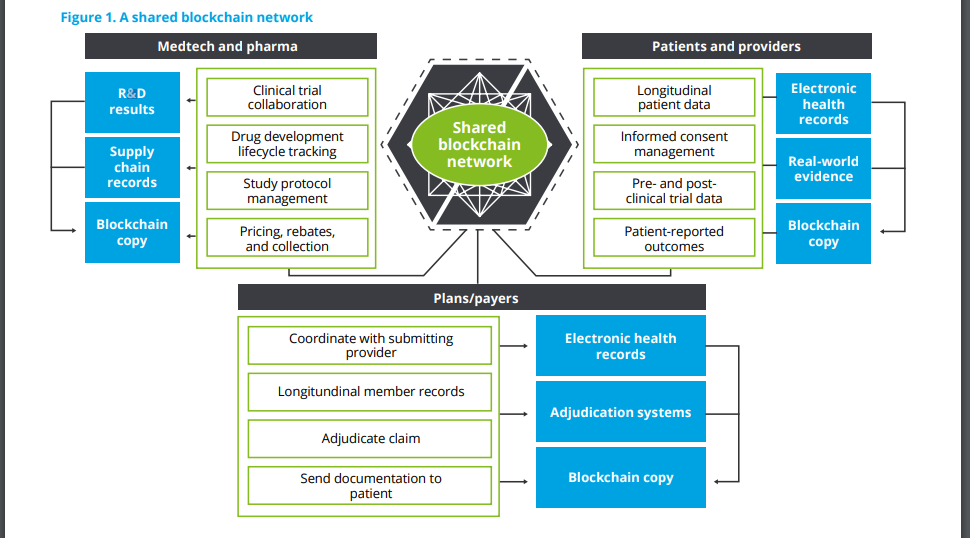
A shared network that links medtech and pharma, patients and providers, and plans and payers on the same standard could touch every part of the industry from drug trials to claims adjudication to clinical outcomes. For now, however, the challenges and the opportunities are worth exploring sector by sector.

Blockchain for Health Care Service Providers:

  • Blockchain offers the potential to address poor network communication and a scattered view of transactions in the provider arena. 
  • It can also provide a bulwark against fraud and abuse. 
  • With fluent collaboration not only within but across networks, and visibility into patient transactions and measurable outcomes, blockchain may be a key element in the implementation of value-based care. 
  • For providers, who rely on insurance-related transactions but don’t own the processes behind them, blockchain may help reduce cost and inefficiency.
A shared network that links medtech and pharma, patients and providers, and plans and payers on the same standard could touch every part of the industry from drug trials to claims adjudication to clinical outcomes.

Blockchain in Life Sciences 

  • As in other sectors, blockchain in life sciences is in a nascent form. But storing and tracking critical data on a blockchain could reshape the sector. 
  • In clinical trials, blockchain could be a common frame of reference for an entire ecosystem of solutions that may improve participation and processes and ultimately lead to better health outcomes, with patients, investigators, managers, and doctors all touching different parts of the same ledger. 
  • A person’s cloud-based “health passport” could use blockchain to carry consistent information securely across the entire process of searching for relevant trials, matching criteria and registering, documenting consent, and participation. 
  • The same unbroken information chain could then support trial functions such as sample collection, tracking, and analysis. 
  • Many of the current systems used to track clinical trial samples and document proper storage, transport, and handling leverage spreadsheets that are hard to read or automate. 
  • Blockchain could help the data follow the samples, promoting more efficiency in the process and greater confidence in the results. 

Blockchain for Healthcare Data Security

  • For payers, blockchain could be used to help ensure the control, integrity, and traceability of data and serve as an essential tool for creating trust and reliability when sharing data across multiple parties. 
  • More specifically, blockchain could have a significant impact in areas such as medical records, claims processing, payments, provider data management, insurance design, and consent management. 
  • Broadly shared, consistent data on a blockchain might help health plans streamline administrative processes and combat fraud, waste, and abuse. 
  • Blockchain-based medical records and interoperability have been a focal point in streamlining patient-centric care management and delivery. 
  • Members want control of personal medical data and often are frustrated with the need to repeat data entry processes. 
  • This could be addressed by a customer-controlled blockchain for identity verification. While there is consensus around the longitudinal medical records use case, there has been some disagreement on how quickly this would happen. Challenges still exist around data protection and consumer incentives.  

Challenges to overcome

  • Scalability

    Many of the processes for blockchain would require more scalability and balance between permissionless blockchains (which offer more computing power) and permissioned ones (which offer faster processing). 
  • Standardization

    To foster greater efficiency and performance, organizations can consider implementing governance to control what type of data may be written into a blockchain. 
  • Incentives

    Blockchain participants should determine technical, financial, and business incentives that could encourage organizations to adopt the technology and lend their computing power. 
  • Cost

    Organizations need to determine their costs for operating a blockchain. 
  • Regulatory

    While a blockchain solution could address the Health Insurance Portability and Accountability Act (HIPAA) privacy rule in part by separating and encrypting PHI/PII data, regulatory bodies should consider deep collaboration with the industry to facilitate adoption.
Blockchain’s broad implementation in the life sciences and health care ecosystem will require a “tipping point” of trust and adoption among stakeholders, including patients.

Conclusion 

Companies should look to standardize the technology, talent, and platforms that will drive future initiatives—and, after that, look to coordinate and integrate multiple blockchains working together across a value chain. An effective way to get started is by getting to know blockchain— the reality, not the hype: 
  • Dive deep into workshops and proofs of technology. 
  • When it’s time to launch the first pilot, define the use case in detail, and plan an iterative, agile way to deliver a measurable solution to an identified business challenge. 
  • Focus blockchain development resources on use cases with a clear path to commercialization. 
  • Support standardization in technology, business processes, and talent skill sets. 
  • Work to integrate and coordinate multiple blockchains within a value chain. 
[/fusion_text][/fusion_builder_column][/fusion_builder_row][/fusion_builder_container]

How ML, Blockchain Technology & IoT can bring Innovation in Healthcare?

With technological advancements, several things have been simplified. Now many of us own a smartphone and computer and have access to the internet. The Healthcare Industry has hugely benefited from such emerging technologies. 

Blockchain IoT and ML is an amazing trio of Emerging technologies. Blockchain technology makes data more secure, ML analyses the data, and IoT makes Data more Secure. In the coming few decades, a blockchain-based ecosystem will emerge. Blockchain would reduce several issues like Applications, growth opportunities, Identity Management, supply chain province, and many more. 

As per the conclusion drawn by the report made by Frost and Sullivan’s, Blockchain technology will be used in Healthcare in the coming years. Also, the report discussed how blockchain could solve several issues like billing fraud, notarization, drug supply chain, and many more.

How IoT can be used in Healthcare

IoT devices can help patients to interact with doctors in a much better way. IoT based devices can innovatively connect doctors and patients. Also, there are several applications where the Internet of things applications can be used for things like remote monitoring, medical device integration, and smart sensors. All these will help to monitor the patient’s data in realtime continually, and it will give realtime data to doctors for the health of patients.

Also, these IoT devices will be able to collect, analyze, and make a report of data instantaneously. It will help to provide a complete analysis of the data collected that will also assist doctors in understanding much more about patients’ health. 

With the help of realtime devices, it will let doctors diagnose the health of doctors in realtime. IoT devices have huge potential to improve the treatment process of the patients and save their lives. It will make it easy for doctors to monitor critical patients.

How Machine Learning can be used in Healthcare

Several health providers, using IoT devices, get a huge amount of data. With the help of that data, doctors can create a bot and several applications that will help to track the health regimen. ML-based chatbots will be considered as assistants that will provide feedback and coaching based on data.

All the data could be captured using wearable IoT devices like Smart Watches. And these bots can provide realtime information and feedback to the patients or people using these services. It will make customer care service more interactive.

Another significant use of ML in healthcare is that it leads doctors to store information easily. Also, analysis can be done in a better way. It will also minimize waiting time in healthcare.

How Blockchain can be used in the Healthcare 

Blockchain promises to bring more transparency and accessibility to the patient’s record. Also, it will increase the healthcare providers, patients’ numbers, and much more. As the data will increase, it will become more difficult to handle such information. Blockchain would help to make a hyper ledger for the patient data that will be more tamper-proof and reliable. 

Blockchain would bring more transparency, integration, and immutability. It will make health records updated securely. Also, with the use of smart contracts, this will make sure that the data is correct and can be cross-checked with various patients. And much more. It will also allow the data to be shared in different organizations in the healthcare blockchain network.

Blockchain can Be used with IoT

The convergence of Emerging technologies like Machine Learning Blockchain, ML, and IOT will bring a lot more opportunities for digital healthcare. Also, blockchain is very potential to bring decentralization in health care that would ensure authenticity, access control, security, and integrity. It will help to build a new Value-based System for reimbursement and healthcare.

How IOT can be used with ML in Healthcare

IOT or internet of things can help devices, to allow doctors, and collect a record of patients . all this data can be stored in an online database, which could be easily accessible by doctors. Such data can be used for ML-based chatbots developments., and ML-enabled devices, which will help doctors to understand patients in a much better way.

Such new technologies will allow doctors to store information that could be later stored as an archive. According to the professional editor of trust my paper, creating medical histories of the patient is already a hectic task. It leads to making mistakes, and there are chances that the information can be missed. Hence with the use of technologies like ML and IOT and Blockchain, All the data can be stored securely and analyzed. Hence ML and IOT or internet of thing applications has huge potential to bring Innovation in the healthcare industry.

Conclusion

As there is huge innovation done in the technologies, several patients are becoming more aware and involved in the healthcare process. Such improvements in healthcare will lead to making it more usable and secure. Several healthcare providers can make use of these high potential technologies, to enhance the experience of healthcare. And also, it will reduce several costs on board and would make them winners in the competitive health care sector.

Especially technologies, IOT, ML, and blockchain would make the healthcare industry run more accurately and easily. It helps to create a better experience of the patients, also with such technologies healthcare.

In conclusion, everyone would be given proper healthcare facilities. Also, it will reduce the huge number of frauds happening in healthcare since all the medical data would be stored securely on the blockchain.

If you are looking to know more about the convergence of innovative technologies like ML, IOT and blockchain in health care, then you should join an exclusive webinar exclusively for the enthusiasts by the Solulab. Such kind of webinars would give you more information and let you learn more about the technologies and their use cases in different industries.

If you want to bring such innovations as a healthcare provider, well companies like SoluLab will assist you in making several solutions using several innovative technologies like ML, IOT, and blockchain.

How Blockchain Can Help Fight The Problem Of Fake And Counterfeit Drugs?

In the healthcare industry, where ever loopholes are available in the pharma supply chain, mal-practitioners try to counterfeit original drugs with fraudulent drugs. Hence, blockchain in drug supply chain is now the talk of the town.

According to the report submitted by World Health Organization (WHO), 15% to 30% of the total drugs sold in the world account to fake or counterfeit drugs, especially in the developing countries.

In industrialized countries, counterfeit drugs account to a minimum of 1% in every single pharma supply chain.

If healthcare industry keeps progressing with counterfeit drugs at this rate, the world is only going to get worse. Blockchain in drug supply chain, serves to take care of the healthcare industry in fighting against fake and counterfeit drugs. It hurts even to imagine counterfeit drugs for cancer. In the recent years, WHO report states that there has been a significant increase in medicinal theft and selling of uncertified drugs.

Enterprise blockchain development for medicines focus on ensuring that pharmaceutical retailers sell only the genuinely certified and verified drugs.

To avoid chronic spread of epidemic diseases and fighting medical fraud, blockchain is one of the best solutions. With the help of blockchain technology, identifying toxic ingredients and identifying counterfeit ingredients deviated from original prescription can be identified before any sales.

Keep reading to know how blockchain in drug supply chain fights to ensure that a safe and sound healthcare service is provided.

Role of Blockchain in Drug Supply Chain To Fight Fake And Counterfeit Drugs

Here is how blockchain is re-structuring medical industry to fight fake and counterfeit drugs.

blockchain in drug supply chain

Identify The Source of Origin For Every Drug

One of the major reasons for counterfeit drugs to enter the industry of healthcare is due to the obstacles in identifying the original source from where the drugs are originating from. If the location of the manufacturer and supplier of the drugs can be identified with appropriate certifications, that is already a big step towards stopping production of counterfeit drugs.

Blockchain in drug supply chain helps to identify manufacturers, suppliers and vendors with authenticated identity and certification via its proof of work, proof of stake and proof of providence.

Detail recording of data with smart contracts

One of the major challenges faced in healthcare and medical industry as a whole is the handling of discrepancies in data stored. Every medical supply chain and operation goes through a channel involving one too many personnel and technology devices. Retrieving necessary drug data is traditionally hard because information is stored in multiple systems at different locations and even time zones.

Smart contracts that operate with blockchain aims at putting a full stop confusion caused due to storage of information in multiple systems. Smart contracts combine all drug manufacturers and suppliers under one smart system. Starting from drug dispatch till end delivery location, all transactions and operations can be monitored in real-time.

Read More: Insights of Blockchain Technology in Drug Discovery

Seek out the ingredients of every drug sold

One another major factors that influence fraudulent activities to occur in the healthcare industry is the failure to track minutest details such as ingredients used to manufacture drugs. Not because pharmaceuticals didn’t want to track such details. Rather it was because information of drug manufacturing was spread and it was time consuming to get too many approvals to have visibility in ingredients used.

With blockchain, the process or attaining such details is simplified. Using smart contracts and proof of authenticity, every drug detail will be visible to everyone. Manufacturers can even protect the ingredient details with encryption installation of QR codes in drugs sold.

Ensures regulatory compliance

According to World Health Organization (WHO), today, most of the drugs are exported from country to country due to differences in manufacturing costs, raw material availability, etc.

Blockchain ensures that every drug manufactured and sold is compliant with the standard regulations set by the Food and Drug Administration (FDA).

With blockchain, medical industry can say goodbye to long and lengthy paperwork and time-consuming processes of getting drugs approved or process of verifying drug quality.

Transparency in supply chain

Pharmacist Panel

Blockchain based Digital Ledger Technology (DLT) is one way to counterfeit fake drugs extensively in medical industry. DLT integrated with (Internet of Things) IoT allows data transfer at the speed of light without compromising transparency. Each user gets to create their own node system and each information is split between different nodes with its own encryption and decryption key.

Thus, everyone involved within a particular drug supply can see all transactions anytime from anywhere without accessibility to manipulate any data.

Integration with IoT for temperature-controlled shipment  

Certain drugs require highly cold-based environment to ensure preservation of ingredients. Different drugs have different temperature and packaging requirements. Traditionally, such drugs were transported in temperature-controlled trucks and shipment containers but how far temperature was controlled is not visible. For instance, maybe the suppler decided to control the temperature in secrecy only for half of the shipment journey to save cost. This is hard to identify.

With blockchain, now consumers and pharmacies can track and monitor the temperature-controlled environment throughout the shipment journey.

Avoid glitching of networks

Storing medical information and drug data in a centralized system has higher chances of getting hacked and being vulnerable to security threats. This is because all information is under one single system maintained and controlled by one server. If the server fails or system fails, the consequences maybe catastrophic in medical industry.

Blockchain stores information under one platform but with multiple systems and each system with a group of clusters and nodes each of within which the information is spread. Thus, even when one system fails, the drug information can be accessed from another system.

Conclusion: Blockchain protects medical industry against harmful drugs

blockhain for medicines

Saving life and maintaining a good health-life balance is of the utmost importance today. All of us are busy with our respective daily chores and professional works. We may not have the time to wait for longer periods of time to identify drug authenticity and ingredient originality. But with blockchain in drug supply chain, every one of us get the accessibility to stay informed and take care of health in a smarter way with smarter drugs.

Reducing transactional costs and managing supply chain end-to-end is possible with blockchain which also helps to reduce fake drugs in the process. Let us know your perceptions and views on approaches provided through blockchain in drug supply chain to fight against counterfeit drugs.