
Talk to an Expert

Investing in Blockchain Development: A Strategic Guide for Businesses

Investing in Blockchain Development: A Strategic Guide for Businesses

Blockchain technology is a decentralized and immutable digital ledger system that records transactions across a network of computers in a secure and transparent manner. It consists of a chain of blocks, each containing a set of transactions. What sets blockchain apart is its cryptographic security and consensus mechanism, which ensures that once information is recorded, it cannot be altered or deleted without the consensus of the network participants. This technology was originally created as the underlying framework for cryptocurrencies like Bitcoin, but its potential applications have since expanded far beyond digital currencies.

Each block in a blockchain contains a group of transactions, and these blocks are linked together in chronological order, forming a chain. The unique feature of blockchain is its cryptographic validation mechanism, which ensures that once data is added to the chain, it cannot be altered or tampered with without consensus from the majority of network participants. This inherent security makes blockchain technology a trustworthy and tamper-resistant solution for various applications.

Read Our Blog Post: Top Blockchain Technology Companies in 2023
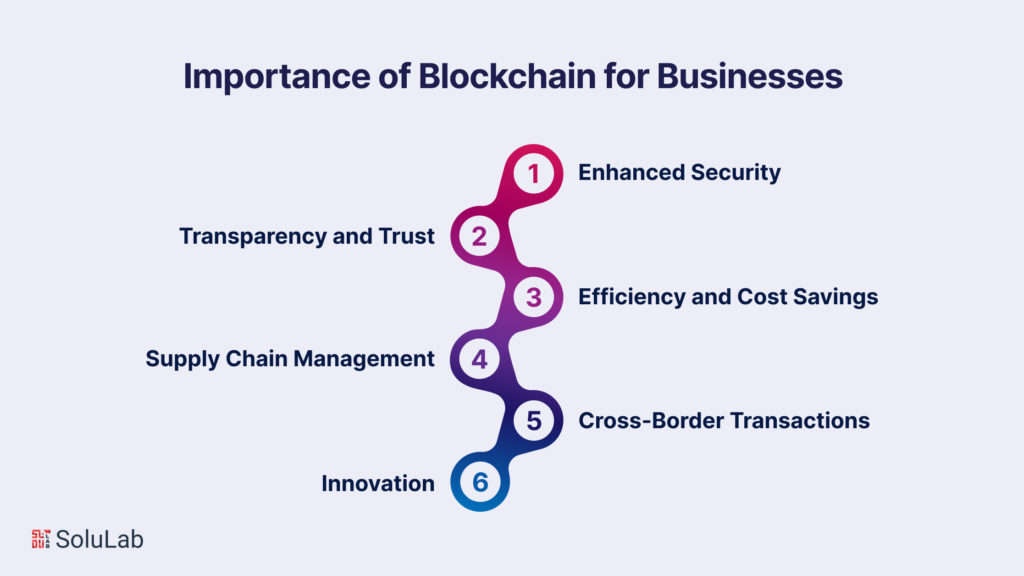
What is the Importance of Blockchain for Businesses?

Importance of Blockchain for Businesses

The importance of blockchain for businesses cannot be overstated, as it has the potential to transform traditional business operations, enhance security, and drive efficiency in a multitude of ways. Blockchain technology offers several key advantages:

  • Enhanced Security

Blockchain’s cryptographic nature makes it highly secure, reducing the risk of fraud and unauthorized access to data. This is especially critical in industries where data integrity is paramount, such as finance and healthcare.

  • Transparency and Trust

Blockchain’s transparent and immutable ledger fosters trust among participants. Businesses can verify the authenticity of transactions and data, reducing disputes and the need for intermediaries.

  • Efficiency and Cost Savings

Smart contracts, a feature of blockchain, automate contract execution and enforce terms without the need for intermediaries. This leads to reduced administrative costs and faster transaction processing times.

CTA1

  • Supply Chain Management

Blockchain enables end-to-end visibility in supply chains, reducing fraud, errors, and delays. Businesses can track products from origin to destination with greater accuracy.

Check Out the Blog Post: Top 10 Real World Applications of Blockchain Technology

  • Cross-Border Transactions

Blockchain facilitates cross-border transactions by eliminating the need for multiple intermediaries and reducing transaction fees. This is particularly beneficial for international trade.

  • Innovation

Blockchain is a catalyst for innovation, driving the development of new business models and revenue streams. Companies can explore blockchain applications that were previously unthinkable.
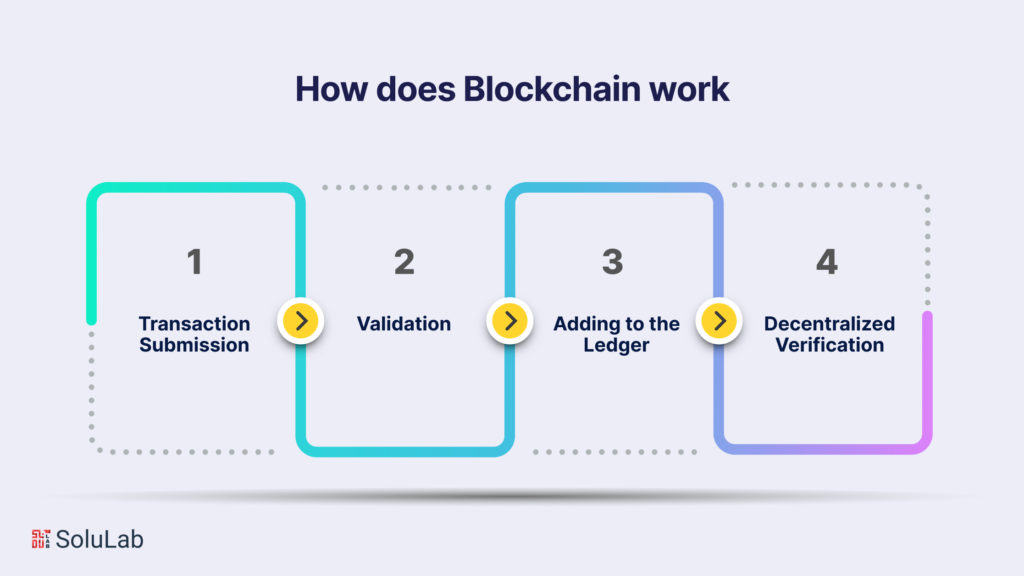
How does Blockchain work?

How does Blockchain work

Understanding how blockchain operates is crucial for businesses looking to leverage this technology effectively:

  • Transaction Submission

Users initiate transactions by creating a request to add data to the blockchain. This data can represent various actions, such as transferring assets, verifying identities, or recording ownership changes.

  • Validation

Transactions are sent to the network’s nodes, where they undergo verification. In public blockchains, this verification is typically done through a consensus mechanism like PoW.

  • Adding to the Ledger

Once a transaction is validated, it is added to a new block. This block is then linked to the previous one, forming a continuous chain.

  • Decentralized Verification

Multiple nodes on the network must reach a consensus before a transaction is considered valid. This decentralized verification ensures trust and security.
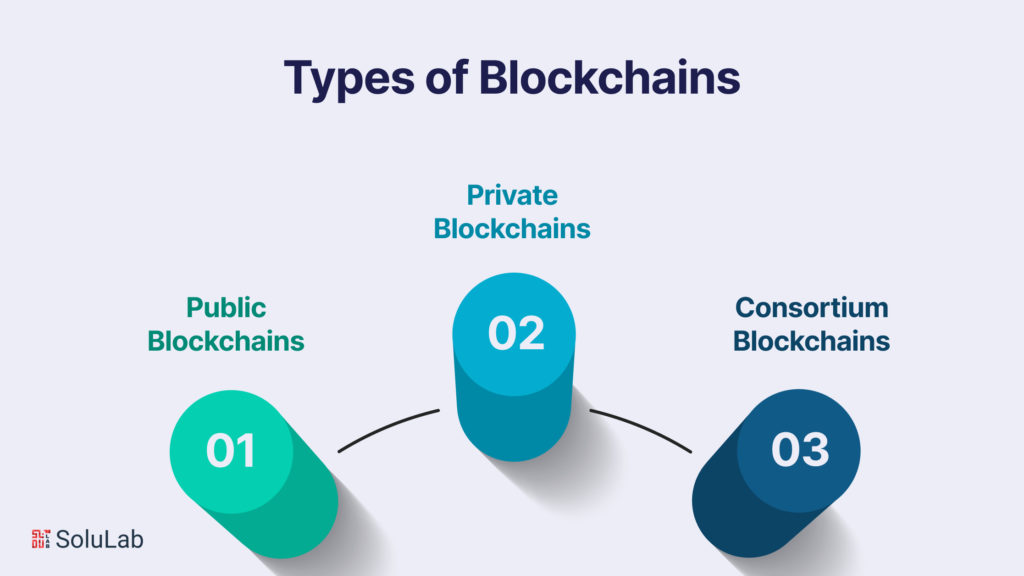
What are the Types of Blockchains?

Types of Blockchains

Blockchains come in various forms, each suitable for different business needs:

  • Public Blockchains

Public blockchains, like Bitcoin and Ethereum, are open to anyone and offer complete transparency. They are ideal for businesses looking to create blockchain-based applications with widespread accessibility.

  • Private Blockchains

Private blockchains are restricted to a specific group of participants, making them suitable for businesses that require control over access and data privacy. They are often used for internal processes and collaborations.

  • Consortium Blockchains

Consortium blockchains are a hybrid of public and private blockchains. They are governed by a group of organizations rather than a single entity. This type is beneficial for industries with multiple stakeholders, such as blockchain in supply chains.

How Can Businesses Leverage Blockchain Technology to Identify and Address Their Specific Needs?

In today’s fast-paced and ever-evolving business landscape, staying competitive requires constant innovation and the ability to leverage cutting-edge technologies. Blockchain technology has emerged as a transformative force, offering a wide array of applications for businesses across various industries. To embark on this journey, it’s crucial to start with the right blockchain business idea. In this guide, we’ll delve into the essential steps of blockchain business idea generation.

 Identifying Business Needs
  • Businesses must begin by identifying their specific needs and challenges. This introspective process involves examining existing inefficiencies, security concerns, or operational bottlenecks. 
  • For example, a company might struggle with supply chain transparency, financial fraud, or data privacy issues. Identifying these pain points is the first step in determining how blockchain can provide a solution.

Exploring Blockchain Applications

  • Once the business needs are clear, the next step is to explore the myriad blockchain applications available. Blockchain has proven its versatility, and it can be applied to various domains. 
  • Some popular blockchain use cases for businesses include supply chain management, smart contracts, identity verification, and decentralized finance (DeFi). Businesses should thoroughly research these applications to understand how they can address their specific challenges.

Assessing Market Demand

  • While blockchain technology holds immense potential, it’s essential to assess the market demand for your proposed blockchain solution. 
  • Market research is critical to determine whether there’s a demand for your idea. It involves analyzing your target audience, competitors, and potential partners. Understanding market trends, such as the increasing adoption of blockchain in various sectors, can help validate your business concept.

Formulating a Unique Blockchain Business Idea

  • To stand out in a competitive landscape, it’s crucial to formulate a unique blockchain business idea that aligns with your identified needs, blockchain applications, and market demand. This idea should address a specific pain point effectively and provide a clear value proposition.
  • For instance, if you’re in the logistics industry and have identified supply chain inefficiencies, your unique blockchain business idea could involve creating a blockchain-based platform that offers real-time visibility and traceability of goods. This solution could utilize smart contracts to automate and optimize processes, reducing costs and enhancing transparency

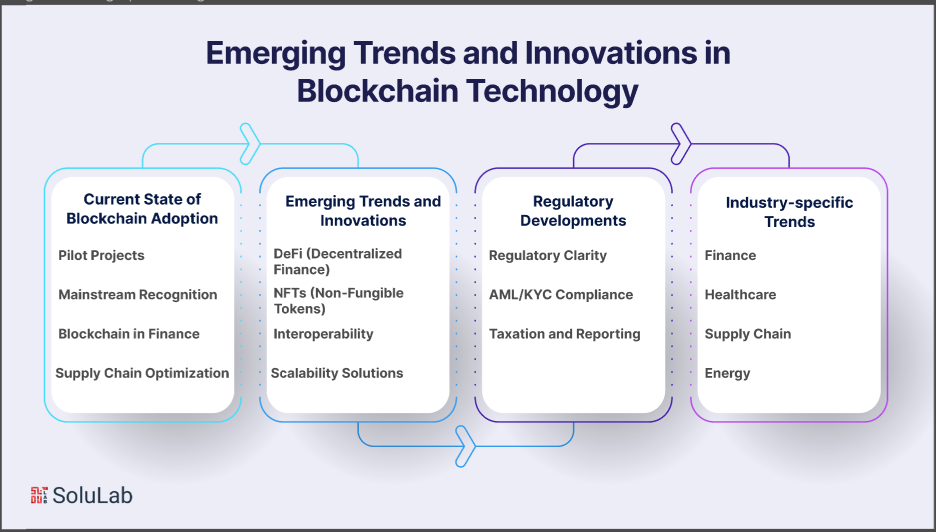
What are Some Key Emerging Trends and Innovations in Blockchain Technology?

Emerging Trends and Innovations in Blockchain Technology

Current State of Blockchain Adoption

Blockchain technology has made significant strides in recent years, with a growing number of businesses recognizing its potential to revolutionize various industries. The current state of blockchain adoption reflects a dynamic landscape of innovation and transformation.

  • Pilot Projects

Many businesses have moved beyond the initial experimentation phase and are now actively implementing blockchain solutions. Pilot projects are being conducted across diverse sectors, from supply chain management to healthcare.

Read Also: Top 10 Blockchain Development Companies in 2023

  • Mainstream Recognition

Blockchain is no longer a niche concept. It has gained recognition and support from major tech companies, financial institutions, and governments worldwide, showcasing its mainstream appeal.

  • Blockchain in Finance

In the financial sector, blockchain is being used for cross-border payments, remittances, and even central bank digital currencies (CBDCs). This adoption has the potential to disrupt traditional banking systems.

  • Supply Chain Optimization

Blockchain’s traceability and transparency features are driving its adoption in supply chain management. Businesses are utilizing blockchain to track and authenticate the origin of products, improving trust and reducing fraud.

Emerging Trends and Innovations

The blockchain landscape is continuously evolving, with several emerging trends and innovations shaping the future of business applications.

  • DeFi (Decentralized Finance)

DeFi projects are growing rapidly, offering decentralized lending, borrowing, and trading platforms. These innovations challenge traditional financial intermediaries and offer greater financial inclusion.

  • NFTs (Non-Fungible Tokens)

NFTs have gained immense popularity, particularly in the art, entertainment, and gaming industries. These digital assets are revolutionizing ownership and provenance verification.

  • Interoperability

Cross-chain compatibility and interoperability solutions are emerging, allowing different blockchains to communicate and share data seamlessly. This will enhance the flexibility and utility of blockchain networks.

  • Scalability Solutions

The challenge of blockchain scalability is being addressed through various solutions, such as Layer 2 solutions and sharding, enabling faster and more cost-effective transactions.

Read Our Blog: Best Companies to Hire Blockchain Developers in 2023

Regulatory Developments

Blockchain technology has prompted regulatory bodies to respond with new frameworks and guidelines.

  • Regulatory Clarity

Governments are increasingly providing regulatory clarity, which is essential for businesses to navigate the blockchain space confidently. This includes defining the status of cryptocurrencies and tokens.

  • AML/KYC Compliance

Regulations regarding Anti-Money Laundering (AML) and Know Your Customer (KYC) procedures are being strengthened to mitigate risks associated with blockchain-based financial transactions.

  • Taxation and Reporting

Tax authorities are developing guidelines for cryptocurrency taxation, ensuring that businesses and individuals are compliant with tax obligations related to blockchain assets.

Industry-specific Trends

Blockchain’s impact is felt differently across various industries, each with its unique trends and opportunities.

  • Finance

In finance, blockchain is leading to the tokenization of assets, making it easier to trade and transfer ownership of real estate, stocks, and other assets.

Read Our Blog: Blockchain Security: Best Practices Every Developer Should Know

  • Healthcare

In healthcare, blockchain is improving data security and interoperability, facilitating the secure sharing of patient records among healthcare providers.

  • Supply Chain

The supply chain industry is witnessing blockchain adoption to enhance traceability and reduce fraud, addressing consumer demands for transparency.

  • Energy

Blockchain is being used to create decentralized energy grids, allowing peer-to-peer energy trading and optimizing resource allocation.
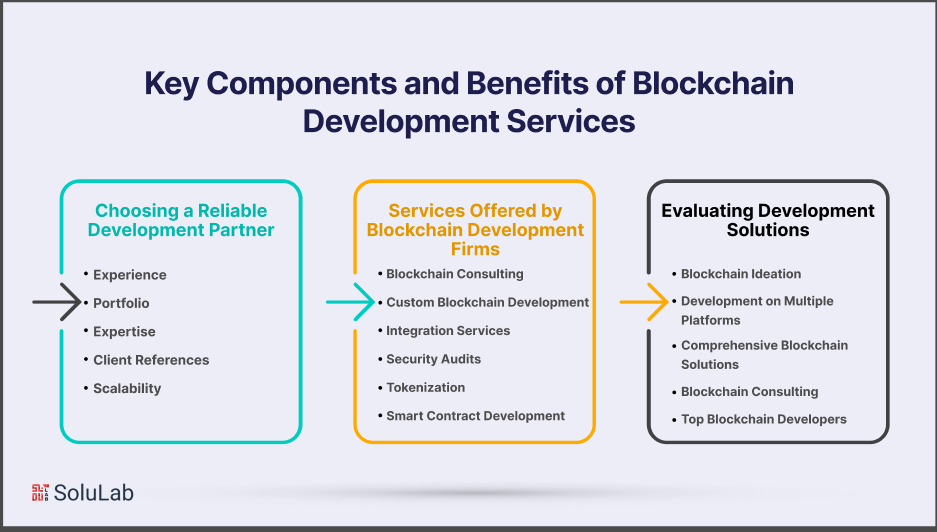
What are the Key Components and Benefits of Blockchain Development Services?

Key Components and Benefits of Blockchain Development Services

Blockchain development services play a pivotal role in enabling businesses to harness the power of blockchain technology for their growth and innovation. These services encompass a wide range of solutions tailored to meet the specific needs of businesses seeking to leverage blockchain’s potential. Let’s delve into the essential aspects of blockchain development services, their significance, and how to make the right choice for your business.

Choosing a Reliable Development Partner

Selecting the right development partner for your blockchain project is a critical decision that can significantly impact its success. When considering blockchain development services, businesses should look for reliability, expertise, and a track record of delivering high-quality solutions. Here are key factors to consider when choosing a development partner:

  • Experience

Evaluate the development partner’s experience in blockchain technology. Have they worked on similar projects or blockchain use cases relevant to your business idea?

  • Portfolio

Examine their portfolio to gauge the quality of their previous work. Look for successful implementations of blockchain applications with businesses.

  • Expertise

Assess the team’s expertise in various blockchain platforms and technologies. Are they well-versed in blockchain trends and best practices?

  • Client References

Request client references and testimonials to gain insights into the partner’s reputation and the satisfaction of past clients.

  • Scalability

Ensure that the development partner can accommodate your project’s scalability requirements as your blockchain application grows.

Services Offered by Blockchain Development Firms

Blockchain development firms offer a comprehensive range of services to cater to diverse business needs. These services typically include:

  • Blockchain Consulting

Identifying viable blockchain use cases for your business, helping define blockchain business strategies, and assessing the feasibility of blockchain adoption.

  • Custom Blockchain Development

Creating tailor-made blockchain solutions to meet specific business requirements, whether it’s developing decentralized applications (DApps), smart contracts, or private blockchains.

  • Integration Services

Integrating blockchain technology seamlessly with existing business systems and processes to ensure smooth operations.

  • Security Audits

Conducting security audits and implementing robust security measures to protect blockchain assets and data.

  • Tokenization

Developing and launching tokens for fundraising or asset management purposes, such as initial coin offerings (ICOs) or security token offerings (STOs).

  • Smart Contract Development

Designing and coding smart contracts to automate business processes, enforce agreements, and enhance transparency.

Evaluating Development Solutions

When considering SoluLab for blockchain development services, businesses benefit from a reputable and experienced partner. SoluLab offers a wide array of blockchain services, including:

  • Blockchain Ideation

Assisting businesses in identifying blockchain use cases and crafting innovative blockchain business ideas.

  • Development on Multiple Platforms

Expertise in developing various blockchain platforms, such as Ethereum, Hyperledger, and Corda.

  • Comprehensive Blockchain Solutions

Providing end-to-end solutions, from consulting and development to deployment and maintenance.

  • Blockchain Consulting

Offering strategic guidance and insights to help businesses align their blockchain strategy with their goals.

  • Top Blockchain Developers

Access to a talented team of blockchain developers who are proficient in the latest blockchain technologies and trends.

By collaborating with SoluLab, businesses can leverage their blockchain expertise and commitment to delivering reliable, scalable, and secure blockchain solutions.

Blockchain development services are indispensable for businesses looking to harness the potential of blockchain technology. Choosing a reliable development partner and assessing the services offered are crucial steps in ensuring the success of your blockchain project. SoluLab stands as a reputable option for businesses seeking blockchain development solutions that align with their objectives and aspirations.

CTA2

Conclusion

In conclusion, SoluLab’s comprehensive Blockchain Business Strategy Guide offers invaluable insights into the dynamic world of blockchain development for businesses. As the landscape of technology evolves, it’s evident that blockchain is more than just a buzzword; it’s a transformative force with numerous blockchain use cases that can revolutionize your business. From enhancing security to streamlining operations and fostering trust among stakeholders, the potential of blockchain technology is boundless.

By investing in blockchain development services from SoluLab, you are not only staying ahead of blockchain trends but also positioning your business to thrive in an increasingly digital and decentralized world. Our expert blockchain developers can tailor blockchain solutions to match your unique needs, whether you’re exploring blockchain applications with business processes, considering new blockchain business ideas, or seeking to optimize your existing operations through blockchain technology.

With SoluLab’s blockchain consulting services, you gain a trusted partner who can guide you through the intricacies of blockchain technology, helping you make informed decisions and seize opportunities in this rapidly evolving space. Our commitment to delivering top-notch blockchain development solutions ensures that your business stays at the forefront of innovation and maintains a competitive edge. SoluLab’s blockchain consulting services provide expert guidance in the ever-evolving blockchain landscape. Trust us to lead your way to innovation and success. Contact SoluLab today for a brighter future.

FAQs

1. What is Blockchain Development, and why should businesses consider it?

Blockchain development involves creating decentralized, secure, and transparent digital ledgers. Businesses should consider it to streamline operations, enhance security, and explore innovative opportunities like blockchain applications with business.

2. What are some blockchain use cases for businesses?

Blockchain has numerous applications in businesses, including supply chain management, smart contracts, identity verification, and tokenization of assets. These use cases can improve efficiency and reduce costs.

3. What are the latest blockchain trends businesses should be aware of?

Blockchain trends evolve rapidly. Stay updated on trends like DeFi (Decentralized Finance), NFTs (Non-Fungible Tokens), and interoperability solutions to make informed investment decisions.

4. How can blockchain development benefit my business strategy?

Blockchain development can offer competitive advantages by increasing transparency, reducing fraud, and enhancing trust among stakeholders. It can also open up new revenue streams with blockchain platforms and innovative solutions.

5. What should you look for in blockchain development services?

When seeking blockchain development services, consider their expertise, track record, and ability to align blockchain technology with your business goals. Look for providers offering comprehensive blockchain solutions.

Top 10 Blockchain Development Companies 2026

Many companies struggle to assess technical skills, past performance, and client satisfaction, making the selection process even more stressful. Choosing the wrong company can lead to delayed projects, security vulnerabilities, and subpar solutions that fail to scale.

The global blockchain technology market is projected to reach USD 57.72 billion in 2025, with a Compound Annual Growth Rate (CAGR) of 90.1%, and is expected to surge to USD 1,431.54 billion by 2030.

That’s why we’ve compiled this list of the top 10 blockchain development companies in 2026. Each company has been evaluated based on technical expertise, client feedback, security compliance, team capabilities, and overall service quality.

How Did We Compile the List of Top Blockchain Development Companies?

To bring you the most reliable list of top blockchain development companies, we followed a structured evaluation process combining research, client insights, and technical expertise to ensure accuracy, transparency, and trust. 

1. In-Depth Market Research & Expertise: We analyzed the blockchain industry thoroughly, studying company performance, service diversity, and technical capabilities. Our team reviewed market reports and case studies to shortlist companies with proven blockchain expertise and real-world project experience.

2. Client Feedback & Portfolio Review: Client feedback is invaluable in evaluating credibility. We considered authentic reviews, testimonials, and case studies. A strong portfolio with diverse blockchain solutions was a major factor in determining a company’s reliability and reputation.

3. Communication & Client-Centric Approach: We prioritized companies that maintain transparency, provide regular updates, and focus on client needs. A client-first approach shows professionalism, ensuring smooth collaboration and long-term success.

4. Security & Regulatory Compliance: Blockchain projects demand robust security and compliance. We assessed companies based on their adherence to industry regulations, secure coding practices, and ability to build solutions that protect data while meeting global compliance standards.

5. Overall Services and Technical Knowledge: Beyond blockchain, many projects need integration with AI, IoT, or cloud. We evaluated companies on their overall technical expertise, ability to deliver end-to-end services, and innovation across multiple industries and technologies.

6. Team Size: A company’s team size reflects its capacity to handle complex projects. We considered whether they had enough blockchain developers, specialists, and consultants to deliver scalable, enterprise-grade solutions within deadlines.

Top 10 Blockchain Development Companies in 2026

Here’s a list of the top 10 blockchain development companies:

1. SoluLab

With 10+ years of experience in blockchain development, SoluLab has delivered 1500+ projects across industries like healthcare, fintech, and supply chain. Their expertise covers DeFi platforms, NFT marketplaces, and enterprise blockchain solutions, tailored to client needs.

What sets them apart is their agile methodology, transparent communication, and client-first approach, ensuring scalable, secure, and future-ready solutions.


$25-$49


50-249


2014


Los Angeles, CA, USA


Morpheus, NovaPay Nexus

PixelPlex

2. PixelPlex

PixelPlex specializes in building custom blockchain solutions, from dApps to DeFi platforms and enterprise-grade ecosystems. They provide blockchain solutions, including dApp development across industries.

Their strength lies in combining blockchain with AI, IoT, and AR/VR to deliver innovative blockchain solutions. Ideal for enterprises, startups, and fintechs looking to launch secure, scalable, and future-ready blockchain solutions.


$70-$150/hr


100+


2007


United States

Innowise

3. Innowise

Innowise has a strong expertise in blockchain development, offering solutions like DeFi platforms, NFT marketplaces, and enterprise-grade dApps. Known for its innovative approach, the company serves startups, mid-sized businesses, and large enterprises across industries such as fintech and healthcare.

With a talented team of blockchain experts, Innowise provides transparency, scalability, and custom-tailored solutions, making it an ideal partner for businesses looking to integrate blockchain into their business.


$50-$99/hr


700+


2007


Germany

Unicsoft

4. Unicsoft

Leading blockchain development company Unicsoft has been working on blockchain since 2005 and has been entirely focused on it for almost a decade. Completed 250+ projects in the blockchain space, including NFT marketplaces, custom tokens, a carbon credit trading platform, a metaverse, etc.

Their extensive expertise enables them to create enterprise-grade blockchain platforms and safe, scalable, and creative decentralized apps.


$25-$49/hr


200+


2005


United Kingdom

Nadcab Labs

5. Nadcab Labs

Nadcab Labs is a blockchain development company that specializes in token development, DeFi platforms, decentralized applications (dApps), and NFT marketplaces. With a strong focus on innovation, it delivers secure, scalable, and customized blockchain products.

The company caters to startups, enterprises, and entrepreneurs looking to launch blockchain projects. Known for its technical expertise and client-first approach.


$50/hr


700+


2017


India

Quytech

6. Quytech

Quytech offers end-to-end services—smart contract development, custom blockchain apps and dApps, NFT marketplaces, crypto wallets, trading platforms, and asset tokenization. Quytech works across many blockchains, including Ethereum, Solana, Hyperledger, BSC, Polkadot, TRON & others, enabling scalable, performant solutions.

Their ideal clients are startups, small businesses, and enterprises seeking secure, transparent, and custom blockchain solutions.


$25-$49/hr


50–249


2010


India

Dev Technosys

7. Dev Technosys

With over 15 years of experience, they offer a range of services, including smart contract development, decentralized application (dApp) creation, cryptocurrency solutions, and enterprise blockchain platforms.

Their team specializes in Solana blockchain development, providing high-speed, secure, and scalable solutions tailored to client needs. Dev Technosys serves industries like finance, healthcare, supply chain, and more.


$25-$49/hr


50-249


2010


United States

Systango Technologies

8. Systango Technologies

Systango Technologies is a blockchain development company that offers end-to-end blockchain services, including decentralized applications (dApps), smart contracts, and DeFi platforms.

Their approach combines innovation with scalability, ensuring secure and efficient solutions. Systango caters to startups, SMEs, and enterprises seeking to integrate blockchain technology into their operations.


$50-$99/hr


350+


2007


United Kingdom

Alchemy

9. Alchemy

Alchemy is a well-known blockchain development company that has gained recognition for its strong infrastructure and developer tools that support the Web3 ecosystem. They are known for improving the dependability and facilitating blockchain development for developers of all skill levels.

These companies lead innovation and offer solutions that satisfy the changing needs of the clients, making them prime examples of blockchain development excellence.


N/A


165+


2013


United States

4irelabs

10. 4irelabs

4irelabs is a blockchain development firm with over 12 years of experience, specializing in DeFi, FinTech, and GreenFi solutions. They offer end-to-end services, including smart contract audits, decentralized applications (dApps), and tokenization platforms.

Their team collaborates with leading blockchain protocols like Solana and Polkadot. Ideal clients include enterprises and startups seeking scalable, secure, and innovative blockchain products.


$25-$49/hr


10-49


2010


United States

Blockchain Development Company

Conclusion

Every blockchain development company aims to differentiate itself from the competition by providing something unique. Therefore, you should first clearly define your objectives, concentrating on what is most important to you, be it a certain tech stack, the lack of time differences, or the price range. 

When selecting a blockchain developer, use your priorities as a guide, and always do your research to know who you will be working with. NovaPay Nexus partnered with SoluLab to integrate multi-crypto support, enhance security, and build a user-friendly interface. 

The result? A decentralized, fee-free payment solution empowering businesses with full control and privacy. NovaPay Nexus now drives wider adoption of ISO-compliant cryptocurrencies across industries.

SoluLab, a leading blockchain development company, can help you build blockchain platforms from scratch and provide end-to-end support. Contact us today to discuss further!

FAQs

1. What is the average cost of hiring a blockchain development company?

Costs vary based on project complexity, technology stack, team size, and location. Simple projects can start at a few thousand dollars, while enterprise-grade blockchain platforms can cost tens or hundreds of thousands of dollars.

2. How do I know if a blockchain company is reliable?

Look for verified client testimonials, portfolio of successful projects, whitepapers or case studies, technical certifications, and strong post-development support.

3. Can these companies help with both public and private blockchains?

Yes. Leading blockchain development companies develop solutions on public chains (Ethereum, Solana) and private/permissioned blockchains (Hyperledger, Corda, Quorum) depending on business requirements.

4. How do blockchain companies ensure project success?

Top blockchain firms follow agile methodologies, end-to-end consultation, proof-of-concept (PoC) development, continuous QA testing, and post-launch support.

5. How can SoluLab help with blockchain development projects?

SoluLab is a leading blockchain development company offering custom dApps, DeFi solutions, NFT marketplaces, crypto wallets, and enterprise blockchain systems. We focus on security, scalability, and innovation, helping businesses implement end-to-end blockchain solutions.

Top 11 Blockchain Trends to Follow in 2026

Blockchain Trend 2026

2026 is becoming a major turning point for digital money and enterprise blockchain. Big businesses, banks, global payment networks, and even governments are no longer testing blockchain. They are now using it for real financial operations, tokenized assets, and on-chain finance. The change is fast and happening across every major industry.

The global blockchain market size is estimated at $33 billion in 2026 and expected to grow at a compound annual growth rate (CAGR) of over 43% to reach nearly $393 billion by 2030. Meanwhile, over 137 countries are exploring CBDC, with 49 currently in pilot or launch stages.

If you are a founder, investor, or decision-maker, these trends matter. They tell you where the market is moving, what customers will expect, and how companies will use blockchain solutions to cut costs, move money faster, and unlock new business models. This guide gives you a clear view of the biggest Blockchain Trends for 2026 and shows how they will impact global finance, technology, and business growth.

How the Blockchain World Will Change from 2026 to 2030?

Before we talk about specific blockchain technology trends, it helps to zoom out and understand the size and direction of the market you are building for.

Analyst reports place the global blockchain market in the mid-tens of billions of dollars. By 2030, many expect it to reach hundreds of billions, or even low trillions, depending on what is counted, like crypto assets, tokenization, DeFi, and core infrastructure, but a few signals matter more than the big headline number:

  • Institutional finance is moving fast. Tokenized Treasuries, tokenized funds, and regulated institutional DeFi pilots are no longer small tests. They are becoming part of real financial systems.
  • The number of countries testing or exploring CBDCs has now crossed into triple digits. These pilots are also shifting from small local tests to real cross-border payment corridors.
  • Real-world asset tokenization (RWA) has grown from an idea into a multi-billion-dollar segment. Many now project it to reach double-digit trillions by 2030.

For you, this means the blockchain projects you build in 2026 are not side projects. They should be connected to where global liquidity, regulation, and infrastructure are heading over the next 5–10 years.

11 Big Blockchain Trends That Will Change 2026

Here are the 11 most important blockchain trends you should watch in 2026. These trends matter if you are building real products, raising money, or upgrading your tech systems. In all, these blockchain future trends will shape how money, data, and digital ownership move in 2026 and the years ahead.

1. Real-World Asset (RWA) Tokenization

If you follow only one blockchain trend in 2026, let it be this one. Real-world asset tokenization is already moving tens of billions of dollars of real estate, private credit, Treasuries, and other assets on-chain. RWA platforms let you break a building, a fund, or invoices into digital units that trade 24/7 with instant settlement and built-in compliance. Here is why you should care:

  • You can unlock liquidity from assets that were stuck in files and manual paperwork.
  • You can offer smaller ticket sizes to more investors without changing your whole system.
  • You can test new revenue ideas like streaming yields or auto-rebalancing that old banking systems can’t support.

From a business point of view, if something on your balance sheet is big, slow, and hard to move, tokenization will enter that market in the next 3–5 years. For example 

  • By late 2025, BlackRock’s BUIDL alone crossed $500M in tokenized Treasuries, becoming the world’s largest on-chain fund. 
  • Franklin Templeton and Ondo Finance together manage billions in tokenized real estate and private credit. Even JPMorgan is running tokenized private credit pilots on-chain.

This is one of the clearest blockchain predictions for 2026, and it’s already live in real products.

2. AI x Blockchain Convergence  

AI x Blockchain Convergence

From 2023 to 2025, everyone was busy with AI, but in 2026, founders finally started asking, that How do I make my AI safer, more transparent, and easier to monetize. That is where AI with blockchain becomes one of the biggest blockchain trends for real businesses. Blockchain for AI helps with:

  • data provenance (proving where training data came from)
  • on-chain audit logs for AI models
  • clear royalty and attribution flows

AI for blockchain helps with smarter risk engines, better fraud detection, automated governance, and dynamic settings for on-chain systems.

For example, Projects like SingularityNET, Fetch.ai, and Ocean Protocol have already proven working AI × Blockchain models. Enterprises now integrate these systems for regulated AI deployments where audits and traceability are required.

If you run any AI product today, adding even a small on-chain layer for provenance or billing can move you closer to the latest blockchain development trends, instead of looking like another black-box AI tool with a Stripe payment link.

3. Central Bank Digital Currencies (CBDCs)

Central Bank Digital Currencies (CBDCs)

Central Bank Digital Currencies (CBDCs) are no longer ideas on paper. In 2026, many countries will have strong pilots or small-scale launches, and some will run CBDCs at a large scale. CBDCs matter for businesses because they change how you:

  • Settle cross-border payments
  • Handle compliance and reporting
  • Build your wallet, treasury, or payment systems

CBDCs sit at the middle of blockchain technology trends, digital identity, and regulated finance.  For example – 

  • China’s e-CNY surpassed $986B in transactions, making it the largest CBDC pilot in the world.
  • Countries like the Bahamas, Jamaica, and Nigeria have already launched retail CBDCs.
  • The EU Digital Euro pilot is underway with a 2027 launch window.

If you ignore CBDCs while building any payment, banking, or treasury product for 2026, it will be like ignoring mobile apps in 2010.

4. Institutional DeFi

Institutional DeFi didn’t die after the early hype; it simply grew up. Now, large banks, asset managers, and regulated companies are testing on-chain finance with KYC, verified identities, and permissioned pools. They are running pilots in tokenized repo, tokenized collateral, on-chain FX, and even digital syndicated loans.

For a founder, institutional DeFi is not about yield farms anymore. It is about:

  • Cutting back-office costs with faster, automated systems
  • Building new on-chain product lines with transparent and programmable rules
  • Opening access to new markets, new users, and new capital flows

This is where enterprise blockchain trends start to matter. For example – 

  • JPMorgan’s Onyx and MAS’s Project Guardian have run institutional pools with verified identities since 2023.
  • Aave Arc and Syndicate Protocol provide institutional lending rails.
  • BlackRock and Securitize are issuing tokenized funds accessible through DeFi.

If your industry begins settling transactions on public blockchains with permissioned layers, then the tech stack, vendors, and architecture you choose in 2026 will shape your business for years.

5. Layer-2 Scaling Solutions

You can’t talk about blockchain future trends without talking about scaling. Layer-2 networks (L2s) on Ethereum and Bitcoin are now handling most real transactions. These include rollups, optimistic systems, zero-knowledge L2s, and payment channels.

  • Fees drop from dollars to a few cents
  • Speed goes from a few transactions per second to thousands
  • You still keep the security of a major Layer-1 chain

If you are building in payments, gaming apps, micro-transactions, IoT systems, or AI-powered agents space, you will almost always use an L2 instead of an L1. Here are the Real adoption numbers:

  • Arbitrum: $15B+ TVL, largest L2 ecosystem
  • Optimism: Backed by Coinbase integrations
  • Base: Fastest-growing consumer L2
  • StarkNet: Enterprise-trusted zkRollup

This is one of the most important blockchain development trends for founders, architects, and CTOs today.

6. Blockchain-as-a-Service (BaaS)

Blockchain-as-a-Service (BaaS)

Most teams today don’t want to run their own nodes, build custom explorers, or manage security systems. They want simple tools, managed hosting, and ready-made blockchain infrastructure.

That’s why Blockchain-as-a-Service (BaaS) is becoming one of the most important blockchain industry trends. Big cloud companies and Web3 infra providers now offer hosted nodes, fast indexers, strong APIs, monitoring dashboards, testing tools, and full turnkey setups. 

With BaaS, businesses can build blockchain apps without worrying about servers, uptime, or heavy DevOps work. Here are a few enterprises like AWS, Azure, IBM, and Oracle that now dominate BaaS, and over 90% of enterprise blockchain deployments use BaaS to reduce cost and ship faster.

BaaS also helps with scaling, multi-chain support, security audits, RPC load balancing, and easy upgrades. Teams can focus on their product while the BaaS platform handles all the hard technical work in the background. For many companies, this means faster launches, fewer risks, better performance, and lower long-term costs.

7. Supply Chain & Provenance Systems

Supply chain and provenance tools were hyped early, but today they are becoming one of the strongest enterprise blockchain use cases. Real value is now clear in:

  • Lot-level tracking for food and pharma
  • Anti-counterfeit checks for luxury goods and key components
  • Carbon and ESG reporting linked to real product movement

It’s no longer about putting everything on a blockchain; it’s about adding just enough cryptographic proof in the right places so regulators, partners, and customers can trust what a company claims. For example – 

  • Walmart reduced traceability time from 7 DAYS to 2.2 SECONDS using blockchain.
  • De Beers tracks diamonds end-to-end to eliminate counterfeiting.

For many mid-market manufacturers, logistics teams, and retailers, this will be their first real step into blockchain development and supply chain blockchain systems in 2026.

8. Tokenized Securities & Treasury Bills

Tokenized Securities & Treasury Bills

In 2026, tokenized Treasuries quietly crossed several billion dollars in AUM. In 2026, this entire category will grow even more and expand into new asset classes. Today, you already see:

  • Tokenized government bonds
  • On-chain money market funds
  • Tokenized private credit and real estate portfolios

These tokenized assets are now used for yield products, treasury operations, and daily cash-management tools. The biggest shift is how tokenized securities bring faster settlements, better liquidity, transparent audits, and easy global access. Here are a few live examples:

  • BlackRock BUIDL & Franklin Templeton Utilize Securities and created $7.3B+ AUM
  • Ondo Finance is running corporate repo and credit products
  • JPMorgan is testing tokenized money market workflows

Banks, asset managers, and fintechs are now exploring on-chain versions of T-Bills, corporate bonds, repo markets, and credit products because tokenization cuts costs, reduces errors, and speeds up the entire workflow.

9. Zero-Knowledge Proofs (ZK-Tech)

Zero-Knowledge Proofs (ZK-Tech)

Zero-knowledge proofs are no longer just research. Today, ZK-tech is used in privacy Layer 2s, digital identity tools, and even compliance systems. ZK-tech is important because it lets you:

  • Prove something about your data, like age, KYC, or solvency, without sharing the data
  • Follow privacy rules while still giving partners or regulators verified proof
  • Build safer finance apps, health systems, public tools, and consumer products

As global rules around data get tighter, zero-knowledge proofs are becoming one of the most important blockchain innovations for businesses to understand. zkSync, Polygon ID, and Aztec Network are already used globally by banks, fintechs, and enterprises. 

CTA1

10. Cross-Chain Interoperability

Cross-Chain Interoperability

By 2026, no serious company can depend on only one blockchain. The market moves too fast, and users expect smoother, bigger networks. That’s why bridges, messaging layers, and interoperability protocols are becoming core parts of Web3, and Chainlink CCIP, LayerZero, Wormhole, and Cosmos IBCare are now the base layer for real products. For founders and teams, this means:

  • Build with multi-chain support from day one
  • Make the chain invisible to users
  • Plan for future liquidity, rules, and ecosystems, not just today’s trends

11. Green & Sustainable Blockchain 

Green & Sustainable Blockchain

This is one of the key blockchain technology trends that will decide if your app feels stuck on one chain or works smoothly across the full Web3 world. It’s a major factor in long-term product success and user trust.

Today, regulators, investors, and large companies want clear answers about energy use, carbon impact, and sustainability. This is pushing people to think in a more serious way about how blockchain platforms affect the environment.

You will see:

  • More chains sharing audited energy reports
  • More companies are asking for proof-of-stake or other low-energy systems
  • More use of on-chain carbon tracking and digital carbon offset tools

If you sell blockchain solutions to enterprises, staying aligned with these sustainability-focused blockchain trends will help you close deals faster. Big companies now ask clear questions about energy use, carbon footprint, and long-term environmental impact, and they are already using Ethereum, Polygon, Deso, and Solana to publish verified energy usage reports.

They prefer green blockchain systems that run on proof-of-stake, use low-power nodes, and offer real data on how much energy the network uses. You will also see more interest in on-chain carbon tracking, digital carbon credits, and blockchain-based offset tools. These help companies meet ESG targets and report their climate numbers with confidence. 

How Enterprises Will Actually Use Web3 in 2026?

2026 is the year Web3 becomes a real enterprise tool, not just a crypto space. Because companies will start using it only where it truly helps their business. Here’s what you’ll see:

  • Finance: RWA tokenization, DeFi payment rails, CBDCs, and on-chain KYC
  • Supply chain: provenance tracking, real-time compliance, and ESG reporting
  • Healthcare: secure data, medical record integrity, and drug tracking
  • Media & gaming: digital ownership, loyalty systems, and assets that work across platforms

Most people won’t even call it Web3. They’ll just feel the benefits like faster settlement, better rewards, and smoother digital experiences. But behind the scenes, these are real blockchain future trends finally being used in day-to-day business operations.

How SoluLab Can Build Any of These 11 Use Cases in Just 4 Weeks?

If you want to turn your idea into a real Web3 product, SoluLab can help you build any of these 11 use cases in only 4 weeks. Our team works with blockchain, smart contracts, CBDC solutions, tokenization platforms, DeFi apps, and enterprise blockchain development. We follow a fast, reliable, and transparent system:

1. Week 1 — Plan & Architect

We map your idea, pick the right tech, and prepare the full flow for your crypto, tokenization, or CBDC-based system.

2. Week 2 — Smart Contracts & Backend Development

We develop secure smart contracts, set up all backend logic, and integrate major chains like Ethereum, Polygon, BNB Chain, or a private blockchain.

3. Week 3 — Frontend & Dashboard

We design a clean UI and link your user dashboard to the on-chain with backend logic.

4. Week 4 – 5 — Test & Launch

We run audits, QA, security checks, and prepare your product for launch.

CTA2

Conclusion  

The real value of learning about blockchain development trends is using them to make smarter business decisions. The biggest opportunities now sit in real assets, compliance, and efficiency. As a founder or leader, your edge comes from choosing one or two clear bets and executing well. 

Let’s turn your 2026 blockchain vision into a real MVP. Book a discovery call and get feedback in days, not months. A strong blockchain development company like SoluLab, should guide you with solid business outcomes, not noise. 2026 can be the year you watch these trends or the year you build with them.

FAQs

1. How do I decide which blockchain use case is right for my startup or company?

Start by looking at your biggest pain points around data trust, asset liquidity, and operational delays. Then check if tokenization, supply chain tracking, or compliant DeFi systems can solve them. Working with a skilled blockchain development company helps you map your real needs to the right solution, ensuring measurable ROI without guesswork.

2. Why should I consider working with a blockchain development agency instead of building in-house?

Agencies bring deep expertise, faster execution, and tried-and-tested frameworks that prevent costly mistakes. They help you pick the right architecture, meet compliance standards, and scale safely. For founders focused on growth and product-market fit, a blockchain development agency makes adoption smoother without adding extra internal load.

3. What are the typical timelines and costs involved in building blockchain-based solutions like tokenization or DeFi?

Timelines depend on complexity, but an MVP usually takes 4–6 weeks, costing around $75K–$250K. Full enterprise builds for tokenization or institutional DeFi take 6–10 months and can cross $500K. A reliable agency will give clear estimates that match your goals, scope, and compliance needs.

4. How can I ensure compliance and security when integrating blockchain into my product?

You need to align your solution with rules like MiCA, OFAC, and strong KYC/AML checks. Security means smart contract audits, safe key management, and penetration testing. Agencies with regulated-industry experience build these controls into the product from day one, lowering risk and supporting innovation in areas like asset tokenization services or compliant DeFi.

5. What ongoing support do blockchain development agencies provide after product launch?

A good agency offers continuous monitoring, updates, smart contract improvements, and help adjusting to new regulations. They support scaling, infrastructure upgrades, and new feature rollouts. With ongoing partnership, your solution stays secure, compliant, and ready for future trends like RWA tokenization and advanced payment systems.


Best Companies to Hire Blockchain Developers in 2023

Best Companies to Hire Blockchain Developers in 2023

Recent studies show that over the past several years, demand for blockchain engineers has been rising substantially. In fact, since 2018, the number of job posts for blockchain-related roles has grown by more than 200%. Finding and employing blockchain engineers may take much work for any organisation. The popularity of blockchain technology has boosted the need for qualified and seasoned developers.

Have you ever been curious about the origins of blockchain technology? It was developed by someone or a group of people using the name Satoshi Nakamoto. However, the true identity of the creator(s) remains a mystery.

A decentralised ledger technology called the blockchain enables safe and open transactions. In order to design blockchain-based apps, it is imperative to hire developers that have a thorough grasp of blockchain technology. This post will examine the important elements and leading companies for hiring blockchain engineers.

Check Out Our Blog: What Are The Benefits of Hiring a Blockchain Developer?

How Did We Assess the Top 15 Blockchain Development Companies for Hiring Developers?

Finding someone who comprehends the business use cases for blockchain technology is crucial when searching for skilled blockchain engineers. Make sure they have a proven track record of completing projects on schedule and under budget and take into account their capacity to collaborate on projects that are decentralised.

We compiled the following list of top companies for hiring blockchain developers by keeping these considerations in mind.

  • Size, expertise, and expansion, including earnings and personnel, expansion of the clientele, and expansion
  • Conducted in-depth research on the best firms for blockchain engineers to work at
  • Examined recruiting practises, job listings, and employee feedback
  • Assessed technological stack, industry alliances, and blockchain community involvement
  • Companies who have been shortlisted have a strong commitment to blockchain innovation and a distinct vision for blockchain initiatives.
  • Selected businesses with promise for creating cutting-edge blockchain solutions and offering intriguing career opportunities.
  • Considered a supportive work environment, reputation, financial stability, and development potential.

CTA 1

Interested? Here are the Best Companies to Hire Blockchain Developers in 2023.

1. SoluLab

Over nine years, SoluLab has made a name for itself as a trustworthy pioneer in the blockchain technology sector. Customised blockchain solutions, the creation of decentralised apps, the creation of smart contracts, blockchain consulting services, and blockchain integration services are all part of their service offering.

They also provide blockchain-based tools for other industries, including supply chain management, healthcare, and finance. Their team of highly qualified developers thoroughly understands all facets of blockchain technology. They are the finest firm to hire blockchain developers for blockchain solutions because they are fully aware of the regulatory environment and can create solutions specifically designed for financial organisations.


$25-49


50-249


2014


Los Angeles, CA, USA


Disney, Mercedes Benz, Goldman Sachs

2. ConsenSys

In the blockchain industry, ConsenSys is a pioneer, providing solutions for everything from decentralised banking to digital identification. Their team of professionals is committed to creating a future that is more decentralised and sustainable.

ConsenSys is a well-known business that specialises in building private blockchain networks for business customers. They have in-depth understanding of the particular challenges and demands encountered by huge organisations and are adept at tailoring solutions to meet those needs. Their team of blockchain experts is highly qualified and committed to providing clients with top-notch services.


$50-99


250-999


2014


Brooklyn, NY


JPMorgan Chase, ING, EY

3. Chain

When searching for blockchain engineers to employ, Chain is another excellent organisation to take into account. They also specialise in building private blockchain networks for business clients and have a tonne of expertise dealing with the particular problems that big companies encounter. They are renowned for their great attention to detail and customer care, and their team of developers is dedicated to producing cutting-edge solutions that satisfy the demands of their clients.

Delivering enterprise-grade solutions for companies wishing to innovate and simplify operations is the primary objective of Chain’s blockchain development. Their platform provides scalable and secure solutions for anything from asset tracking to supply chain management.


$40


500


2012


NY, New York


Walmart, State Street, Amazon Web Services

4. IBM

In the field of blockchain development, IBM is a significant participant. They are experts in offering large-scale blockchain solutions for companies of various sizes. Businesses may fully use blockchain technology and promote innovation in their sector with the aid of their skilled developers.

You can rely on IBM’s blockchain technology to keep your data safe and unaltered. Their system offers a clear and effective method for managing intricate supply chains and streamlining company processes.


$99+


345,000


1911


Armonk, New York


ABN AMRO, Walmart, Maersk, Indian State Bank

5. Circle

In the world of cryptocurrencies, Circle is a reputable brand that provides a variety of goods and services for both consumers and companies. Their technology facilitates the sending and receiving of digital payments, and their OTC desk offers institutional clients liquidity.

Circle has created a complete platform for managing digital assets and offers solutions for managing digital assets. They are the ideal organisation to hire blockchain developers for digital asset management solutions since they can provide businesses customised solutions.


$100


500


2013


Boston, Massachusetts


Coinbase, BitPay, Poloniex

6. Microsoft

If you’re seeking experience creating blockchain apps, Microsoft advises employing blockchain developers. Microsoft has many tools and services accessible to help the development process, and it has a wealth of knowledge in this field.

Microsoft can assist you in creating blockchain applications that satisfy your business requirements, from training and education to development tools and support services. Businesses wishing to take use of this game-changing technology can choose from a number of options provided by Microsoft’s blockchain development. Their Azure Blockchain platform offers safe and scalable solutions and makes it simple to integrate with current systems.


$110


180,000


1975


Redmond, Washington


Financial institutions, governments, and businesses

The financial industry’s blockchain technology is the focus of R3, another top blockchain development business. They are a group of more than 200 financial institutions, and their Corda platform aims to offer safe and effective financial transactions. Because of this, banks and other financial organisations frequently choose it. Companies may fully utilise the potential of blockchain technology and advance their industry by working with professional developers.


$60


1,000


2013


Boston, MA


Bank of America, Santander, CIBC, Natixis

8. Kraken

In the world of cryptocurrencies, Kraken is a well-known brand that provides both individual investors and institutional clients with a variety of goods and services. On their site, you may pick from a variety of digital assets and powerful trading capabilities. Kraken is a fantastic choice if you’re searching for a business that specialises in blockchain development.

Kraken can assist you in developing unique blockchain solutions for your company with the support of a team of skilled blockchain developers. Kraken provides the knowledge and resources to support your endeavours, whether you want to build a decentralised application or launch a new cryptocurrency.


$90


200


2011


San Francisco, California


Individuals and businesses

9. Bitfury

With an emphasis on security and scalability, Bitfury is a major provider of blockchain infrastructure and technology. Governments and businesses all across the world utilise their solutions to increase confidence in digital systems.

The security and infrastructure of blockchains are areas of competence for Bitfury. They are the perfect firm to employ top blockchain developers for secure blockchain solutions since they have created cutting-edge security solutions to safeguard blockchain networks and data.


$50


100


2014


Tel Aviv, Israel


Samsung, Fidelity Digital Assets, Northern Trust

10. BitGo

Blockchain security expert BitGo provides solutions for companies wishing to protect their digital assets. Your valuables are always protected thanks to their multi-signature technology.

In order to safeguard blockchain networks and assets, BitGo offers secure blockchain solutions and has created cutting-edge security solutions. As a result, they are the ideal business to hire blockchain developers for secure blockchain solutions.


$100


400


2013


Palo Alto, CA


Coinbase, Galaxy Digital, Bitfinex, Kraken

11. Blockstream

Blockstream is a pioneer in the blockchain industry and has helped to create numerous significant standards and protocols. They are the perfect business to employ/hire best blockchain developers for cutting-edge blockchain solutions since they have a thorough grasp of the technology.

Building the foundation for the financial and data management industries of the future is the primary goal of Blockstream’s blockchain development. Both companies and consumers may conduct transactions quickly and securely using their Liquid Network.


$120


100


2014


New York City, New York


Individuals and businesses

12. Ripple

Blockchain firm Ripple is dedicated to transforming international payments. Their technology makes it a preferred choice for companies wishing to grow internationally since it enables quick and safe transactions in any currency.

Cross-border payment solutions are Ripple’s area of expertise. They are the right firm to employ blockchain developers for cross-border payment solutions since they have created a special blockchain technology that enables quick and safe cross-border payments.


$130


300


2012


San Francisco, California


Financial institutions and banks

13. Bitmain

In terms of blockchain architecture and technology, Bitmain is a market leader with an emphasis on mining and hardware solutions. Some of the most effective and potent mining rigs on the market belong to their Antminer series.

Bitmain has a thorough grasp of technology relevant to cryptocurrency mining. The ideal firm to hire blockchain developers for mining-related blockchain solutions is because they can create blockchain solutions that are optimised for mining and offer advice on mining techniques.


$140


10,000


2013


Shenzhen, China


Miners and cryptocurrency enthusiasts

14. Coinbase

A well-known brand in the digital currency sector, Coinbase provides an easy-to-use platform for purchasing, trading, and storing digital assets. Both private investors and institutional clients like them because of their dedication to security and compliance.

Their blockchain development services are intended to assist organisations in scaling their operations, integrating blockchain technology, and generating new income sources. Blockchain solutions from Coinbase are safe, dependable, and scalable, enabling companies to develop and prosper in the quickly changing cryptocurrency market.


$150


3,000


2012


San Francisco, California


Individuals and businesses

15. Binance

One of the biggest cryptocurrency exchanges in the world, Binance provides a variety of trading pairs and reasonable costs. Their platform is simple to use and provides a variety of sophisticated trading options for seasoned traders. Binance can provide businesses with the resources they need to thrive in the digital economy because of its extensive knowledge of the cryptocurrency sector.

The goal of Binance’s blockchain development services is to assist businesses in developing unique, specialised blockchain solutions. They collaborate closely with customers to pinpoint their problems’ pain areas, create solutions to address those issues, then quickly and effectively deploy those solutions.


$160


5,000


2017


Shanghai, China


Individuals and businesses

Conclusion

The top blockchain development firms we’ve mentioned are a wonderful place to start, but it’s essential to remember that the field of blockchain technology is continuously developing, so there may be more reputable businesses that aren’t included. To identify the solution that best suits your needs, we urge you to consider all of your alternatives and conduct independent research.

SoluLab is the best option for a business owner looking for a blockchain development team. It covers all of your blockchain development demands because of its large pool of knowledgeable and talented developers, QAs, PMs, and business analysts. Working collaboratively around shared goals is the foundation of IT outsourcing at SoluLab. SoluLab is the best choice if you need blockchain development because of its capacity to scale up and down rapidly, seamless connectivity, and round-the-clock assistance.

FAQs

1. What is a blockchain developer?

A software developer that focuses on building apps that utilise blockchain technology is known as a blockchain developer. Decentralised apps (dApps), smart contracts, and other blockchain-based solutions are all included in this.

2. How much do blockchain developers earn in the US?

A blockchain developer’s pay may differ based on their level of expertise, where they live, and the kind of projects they are working on. However, the average salary for a blockchain developer is around $150,000 per year, making it a highly lucrative career choice in the tech industry.

3. What are some common blockchain development tools?

Ethereum, Hyperledger Fabric, Corda, and EOSIO are some of the most popular blockchain development tools. These tools give programmers the foundations and infrastructure they need to create blockchain-based apps.

4. What types of projects can blockchain developers work on?

Decentralised finance (DeFi) platforms, supply chain management systems, blockchain-based games, and social networks are just a few of the many projects that blockchain developers may work on.

How Blockchain Anonymity Is Maintained?

How is Blockchain anonymity maintained?

An assumption persists since long that cryptocurrencies such as Bitcoin were a refuge for criminals. This was because of their significant properties of being untraceable and being completely anonymous.

Meanwhile, as businesses and the general public grew more familiar with blockchain technology, it was becoming clear that the public transaction record of Bitcoin was, in reality, a gold mine of information for authorities. However, the issue of how anonymous cryptocurrency remains unanswered.

Difference between anonymity and privacy

To fully grasp the issue we’ll be discussing in this essay; we must first define those two – in reality, quite distinct – ideas. Anonymity “describes circumstances in which the actor’s name is unknown.” There is no mention of concealing the deed itself. In contrast, privacy is described as “the capacity of a person or group to seclude themselves, or information about themselves, and therefore express themselves selectively.”

Anonymity is about concealing the “who,” while privacy is about hiding the “what.” Anonymity in the context of blockchains refers to the capacity for parties to trade data without revealing any off-chain identifying information or previous transactions they have completed. Bitcoin, for example, is partly anonymous (each address is nothing more than a public key hash that seems random) but not private at all (we know all transactions done from/to that address

Blockchain Anonymity

Cryptocurrencies have sparked much interest from people, companies, and hackers, with Bitcoin once worth more than $5,000 per unit. Anonymity is one of the benefits of Bitcoin and other cryptocurrencies. However, there are worries that internet money transactions may not be as private as many would want.

There are many types of cryptocurrencies, the most popular being Bitcoin, Litecoin, and Ethereum. Altcoins are cryptocurrencies that were launched after the popularity of Bitcoin. Bitcoin, the father of all cryptocurrencies, mandates that the ledger, or record of transactions, be open to the public, making all transactions public knowledge. Many people are concerned about their anonymity and privacy as a result of this. In this post, we will look at some of the ways that cryptocurrency anonymity has been handled.

Bitcoin is regarded as pseudonymous

Fortunately, the blockchain doesn’t record everything. This means that the identities of the people involved in the transaction are not recorded. As a result, rather than being anonymous, bitcoin is pseudonymous. In many instances, though, one’s personal identity can be connected to one’s bitcoin address.

Bitcoin transactions with a person knowing that your identity exposes information that may be used for the identification of your past and future blockchain activities. Suppose, you send bitcoins to an online store, an exchange, or any business that collects client identification information. In that case, you allow them to connect that identity to your blockchain pseudonym, possibly exposing previous transactions you are involved in.

As a result, Bitcoin offers the ideal paper trail for law enforcement, tax authorities, and compliance experts. Because of this traceability, bitcoin theft becomes a much less appealing endeavor.

Of course, tools that launder bitcoin such as mixers,’ or tumblers’ have emerged. These services try to sever the paper trail by swapping one set of bitcoins for another, each with distinct addresses and transaction histories. But, these services come with limitations. They do not scale effectively for big quantities, and the laundering process is often traceable on the blockchain.

How can you purchase cryptocurrency anonymously?

  • Purchase it from a street vendor

This may seem suspicious, and it may even be counterintuitive to reveal your real identity at the time of purchase. However, if you do your homework, it is not as risky as it appears to be actually.

Bitcoin was exchanged in a particular manner in the early days. Bitcoin meetings would be held. Holders of the cryptocurrency would scream out prices. On the other hand, buyers used to come forward. After agreeing upon a particular price, cash would be exchanged for Bitcoin, sent immediately.

You may utilize services like Facebook, Localbitcoins.com, or Meetup.com to locate vendors in your area that you can get in touch with to exchange Bitcoin for cash. Additionally, you should utilize Tor, a VPN, and burner accounts to maintain more anonymity when you are searching and signing up for such events.

  • Purchase it at cryptocurrency or Bitcoin ATM

Purchasing Bitcoin at a cryptocurrency ATM isn’t always the greatest financial decision. To buy coins, Bitcoin ATMs mostly utilize APIs directly connected to cryptocurrency exchanges, and the person operating the ATM will surely charge a service fee for making the transaction.

They are, nevertheless, helpful for purchasing bitcoin secretly. However, one should choose their Bitcoin ATM wisely since some demand you to establish an account, thereby, exposing your name. You can go in, put some money in, and receive some bitcoin on a paper wallet for those who don’t. One may then transfer this Bitcoin to their preferred wallet using a mixer service. This will conceal its origin further and protect one’s identity.

Purchasing bitcoin by not disclosing your name is one thing. But, what one does with it may still expose your identity. Therefore, it’s important to be aware of how you’re utilizing your bitcoin at all times.

Techniques for preserving blockchain anonymity

1. Decentralized: Not under the control of governments

One of the most significant advantages of blockchain technology is its decentralized nature. Nobody has complete control over it. The blockchain of Bitcoin, for example, is maintained by hundreds of thousands of nodes. Hacking one percent, or even half, of the computer nodes, will not give you control over bitcoin.

To get power, you must launch a 51 percent assault on the whole blockchain. According to studies, a successful assault would cost $1.4 billion and months of effort. But, in exchange, you would have momentary control over the network and nothing to show for it monetarily since the coins would lose value immediately.

Blockchain communities rule themselves because they have such a high degree of security and no centralized authority. After all, self-rule was the original aim of bitcoin, and the policy was successfully handed down to all subsequent blockchain initiatives.

2.  VPNs and Tor

The best VPN and Tor services are both intended to protect the user and may be used to preserve anonymity. These technologies are utilized for both safety and privacy by researchers, journalists, businesses, governments, and others. Many bitcoin users with comparable worries utilize them as well. For example, many ransomware decryption tools are hosted on Tor as secret services.

VPNs are often used to conceal personal information while requesting bitcoin transactions. Both VPN and Tor can conceal a user’s personal information during a transaction by utilizing an alternative IP address or geolocation, which is occasionally customizable by the user. These technologies make it impossible for an attacker or analyst to observe traffic by correlating IP addresses and transactions. It may also be used to communicate with others, such as merchants while concealing your address from them.

VPNs are often used to conceal personal information while requesting bitcoin transactions. Both VPN and Tor can conceal a user’s personal information during a transaction by utilizing an alternative IP address or geolocation, which is occasionally customizable by the user. These technologies make it impossible for an attacker or analyst to observe traffic by correlating IP addresses and transactions. It may also be used to communicate with others, such as merchants while concealing your address from them.

3. CoinJoin

Typically, the back-end technology of decentralized mixers is the most frequently utilized technology. Gregory Maxwell proposed the CoinJoin protocol in 2013. The fundamental idea is that a group of payers combine their money and make a collective payment, obscuring the connection between payer and payee.

CoinJoin is made feasible because not every input in a transaction must originate from the same wallet or user. Because the signatures needed to verify a transaction are independent for each input, many users may agree to execute a single transaction to numerous unconnected payees. As a result, the information regarding which input paid which payee is not part of the blockchain and can be avoided.

CoinJoin is a critical tool for preserving anonymity since it serves as the foundation for numerous methods and implementations. SharedCoins, Darkwallet, CoinShuffle, PrivateSend, and JoinMarket are a few examples of implementations.

4. Ecosystems of Blockchain

Secure blockchain ecosystems can reduce many of the security risks associated with blockchain technology. However, using bitcoins to purchase items on Amazon does not provide much privacy. Amazon already has your name and address.

However, blockchain ecosystems that prioritize user privacy can remove all such risks. Blockchains may create secure chains that enable transparent, anonymous transactions ranging from product descriptions to purchasing and selling.

In the e-commerce industry, merchants post their products on the blockchain and enable customers to evaluate and verify the components used in their production. The transit of products from the shop to the delivery destination may be monitored safely without revealing any unnecessary addresses. Payments are made possible by digital currencies, and internet reviews help consumers discover the finest purchasing sites.

5. CryptoNote

A ring signature is a digital signature that enables one member in a group to sign on their behalf. This phase adds security by making it computationally difficult to identify which group members’ keys were used to generate the signature.

Conclusion

Bitcoin is a decentralized payment system that offers a method for obtaining numerous anonymous credentials, bitcoin addresses that may be used to conduct and receive payments. However, the previous study has shown that the system that utilizes such addresses may provide information about their owners. Furthermore, because all transactions conducted by the system are publicly accessible for study in the blockchain, it is possible to cluster various addresses belonging to the same user and classify certain usage.

Furthermore, if one of the cluster’s addresses can be linked to a real person, the payment history of the whole cluster may provide important information about that user. Although interesting research has been conducted in this area, the dynamism of the bitcoin ecosystem, which constantly modifies and improves bitcoin usage, implies that some of the hypotheses assumed for those blockchain analyses may not hold completely. Thus blockchain analysis still presents interesting open questions.

– Contact Us –

SoluLab being the top 3 Blockchain developers can help you build the perfect blockchain ecosystem.

Reach Out To Us Today

How to launch a successful Initial Exchange Offering (IEO) ?

What is an IEO? 

IEO or an Initial Exchange Offering is a method of raising funds for a startup administered by an exchange. To break it down, it is quite similar to an IPO (Initial Public Offering) of shares in the stock market. Like an IPO, there is a company involved, an exchange that scrutinizes the authenticity of the company/project, and the necessity for raising funds. In an IEO, tokens are raised through a cryptocurrency exchange. IEO covers a global market with fewer constraints and timeframes. Binance, the largest cryptocurrency exchange organized the first-ever IEO in December 2017. Investment in cryptocurrencies is gaining importance these days, owing to the fact that it provides huge returns on investments.

Initially, the public offering of tokens was made through ICOs or Initial Coin Offering. It is similar to an IEO, but the only difference is the platform through which they are conducted. ICOs are essentially organized by the developers or the holding company on their own platform, whereas IEOs are conducted on a cryptocurrency exchange. ITOs (Initial Token Offering) and STO ( Security Token Offering) also came up as alternatives to ICOs. However, IEOs have earned greater popularity than any other alternative. This is mainly because of the drawbacks that eventually led to the unpopularity of ICOs. This was mainly because of the increasing fraudulent practices that discouraged investments.

The biggest ICO scam, Pincoin, and iFan stole $660 million, with an estimated 32,000 investors falling prey to the money-making plot from Modern Tech. Pertaining to this factor, a lot of alternatives like ITO, STO, and IEO have been launched to avoid the same. However, IEO has proven to be the best alternative as the exchange guarantees basic standards of security. 

Benefits of an IEO 

Now naturally, there has got to be a reason why an IEO holds the upper hand when it comes to raising funds through cryptocurrencies. A lot of these benefits revolve around the platform on which it is conducted i.e. the exchange. To elaborate a little more about these benefits, take a look at the following points:

  • More secure:

    IEOs are conducted on a third party exchange and not the holding company, which builds up the trust amongst investors. The platforms already have an established payment structure that is more reliable and trustworthy. The investors do not have to worry about the security of their funds, the exchange takes care of it for them. Since IEOs are conducted on a credible exchange, the probability of a scam/fraud is negligible.

  • Investors get a wider set of alternatives: 

    Since the exchange offers the platform to more projects and startups, the investors have a wider set of options that they can research on and invest accordingly. Being informed about the alternatives and then investing boosts the confidence of the investors.

  • KYC/AML:

    The exchange already completes KYC ( Know your customer) of the investors, so the investors do not have to go through the trouble of repeating the same set of actions every time they want to invest. This also provides assurance and saves time for the providers of the tokens.

  • Heavy Scrutiny:

    Registering for an IEO is much more difficult than registering for an ICO. To register for an IEO, you first have to go through the rigid process of the exchange registration. This ensures investors the credibility of the project/startup that they are investing in. The tedious registration process of the exchange ensures the listing of authentic companies. This adds to the advantages of an IEo, because ICOs are organized by the holding company on their platform which makes the investors doubtful about its reliability.

  • Engages a larger investor base:

    The exchange has a built-up reputation which gauges more investors. Since a larger number of investors are listed on the exchange, it benefits the startups as they can raise more funds due to this increased investor base. The ICOs have to do rigorous advertising to make people aware of the investment opportunity, on the other hand reaching a larger audience becomes easier for an IEO, as exchanges have an established user base.

  • Bridges the gap between investors and issuers:

    The investor makes the payment to an escrow account first to get the payment verified and process it when the purchased token is delivered to the investor’s account. It ensures that the token is added to the investor’s account if the payment has been made. In other words, it works as a depository.

How to launch an IEO?

  • The Preparation Stage

The preparation stage will naturally start with the development of an idea. This idea should be structured as per the market requirements and demand. You need to check the economical, financial, and social feasibility of the idea. 

To do this and put your idea to life, it is best to have a team of experts, who know blockchain space and crowdfunding mechanisms, to evaluate and develop the various aspects of the execution. You should have a road map depicting the stages and growth of your startup in the future and minimize the risks associated with it.

Understand the stake of your competitors in the industry. Your project should look legitimate, and unlike an ICO,  you should have an MVP ( Minimum Viable Product) or some progress under development to get listed on the exchange.

  • Selection of the Exchange and Drafting the Whitepaper

Before getting yourself listed on the exchange, you need to draft a whitepaper meeting the aforementioned requirements. This process is very crucial as the exchanges approve your request depending on the clarity and scope of the whitepaper. This also helps the investors to make an informed decision.

The next step is to select the right cryptocurrency exchange for IEO. There are a number of exchanges that you can choose from according to your requirements and feasibility. Make sure to read the exchange specific terms and conditions before making a decision. Some of the popular and trusted cryptocurrency exchanges are 

  • Binance Launchpad 
  • KuCoin Spotlight 
  • Huobi Prime
  • Bitmax Launchpad
  • ProBit 
  • Bittrex IEO
  • OK Jumpstart.

Choose the exchange for your IEO wisely after researching well about these exchanges.

  • Registering and Getting Approved on the Exchange.

Registering on an exchange:

After you have successfully decided which exchange is most suitable for you, you have to fill the application of the exchange which is generally 8-10 pages long. This form is available on the page of the exchange. This evidently is a complex job, and it is recommended to hire a SAG IPL for the job. Once you have carefully filled the form, you can submit it to get reviewed by the exchange.

Review of your application:

After you submit your application, it becomes available to the exchange team for scrutiny and verification.they will review your application based on a lot of factors like product development, market readiness, token readiness for sale, the authenticity of the project, etc. In order to avoid rejection, make sure you provide transparency and comply with the guidelines provided by the exchange.

Listing Payment:

There is no such thing as free lunch’, it goes without saying that the exchanges charge upfront and recurring fees (as applicable) to list your project or startup on its platform. An exchange will usually also help you decide the offering price of your token to attract more investors. Once this structure has been established, your project is ready to be listed on the exchange.

  • IEO

After completing the tedious and rigorous procedure of getting listed, create an appropriate hard cap to encourage reliability and trust amongst investors. Once it is listed on the platform, there has to be strong marketing and promotion to draw attention to your token. You need to offer higher returns to convince the investors, why is it worth investing in your token.

Some key points to make IEO finer 

  • Having a prototype or an MVP always works in favor of your product as investors rest assured of the development of your product. In the absence of a prototype, you should at least be able to provide some progress report about your project to get better funding. This builds trust among investors.
  • Remember when we talked about the importance of the whitepaper, it is a crucial document that helps the investors to make an informed decision and it also works as an ambassador of your product.
  • Market your product well. This you can do by Social Media Marketing, Blog Writing, SEO, Press Release, and Commenting on related forums. However, don’t make it purely promotional but informative.
  • Be careful about setting your caps in order to maximize your profits and enhance investor’s interest.
  • Have a reputable team at your disposal. The qualification, experience, and reputation of the team directly influence the confidence of investors. Along with technical and business expertise, it is always an advantage to have legal experts within the core team of a project so that investors know that professional opinions will be present in case of any legal troubles.

CONCLUSION

 The market for cryptocurrency is increasing as investors are becoming more and more aware of the investment opportunities. Owing to lesser restrictions and time constraints, this is the fastest-growing market, offering its services around the globe. BitTorrent launched its IEO on the Binance Exchange Platform and reached the cap in less than 15minutes. One of the IEO projects, Fetch.AI could sell their tokens during IEO within only 22 seconds. This indicates the plausible potential of the industry. Cryptocurrency exchanges can bring a revolution in the financial markets.

Quick Read: What are blockchain node providers? How do they work?

What transformations Blockchain can bring in charities and donations?

Introduction

Blockchain technology is another emerging technology, which has revolutionized several other industries. Several digital currencies based on the blockchain are new forms of digital money which is not linked to any authority. It is one of the revolutionary things since all the transactions are maintained and owned by the nodes or users of the blockchain network rather than being controlled by a single authority.

Blockchain technology and Cryptocurrencies, yes, digital currencies are also known as cryptocurrencies. Some of the fascinating industries where it can be used are charitable giving and charities.

How smart contracts can be useful for charities and donations?

Smart contracts are the autonomous contracts which are self executable when all the conditions are met in the contract. Hence smart contracts, transactions can be only done but not deleted or modified which is a great advantage. Once the transaction takes place it is stored in the blockchain and timestamped, also the ownership of the sender and receiver remains anonymous since they are given public and private addresses. Since the transactions are anonymous, decentralised, distributed, tamper proof, and immutable you can use it four building crowdfunding applications.

How do digital currencies such as Bitcoin can bring more opportunities for charities and donations?

Various cryptocurrencies like bitcoin can be a two edged sword when it comes to opportunities and challenges. Blockchain has huge potential to bring radical transparency in the donation. A major benefit is it would make it easier for NGOs to get donations when needed. And the challenges would be anonymous cryptocurrencies donation.

Blockchain technology is decentralised technology and it is a shared public ledger. Several advantages of blockchain have led to transformation in several industries. A blockchain could play a significant role in boosting up the trust and transparency in charities. Also, it will impact the new assets that will become available for giving.  Also, it has led to the idea of AI philanthropists.

Blockchain technology can be used to transform the whole idea of donation if created in a regulated way. It will let users register and monitor charities since every single charity would be transparent. Also with the use of smart contracts, A whole new set of rules can be enforced in an automated way.

What are some advantages of Involving Blockchain technology in charities and donations?

  • Improves efficiency and workflow.

In today’s era, everyone is moving to the digital world, and charitable organisations do need a platform that people can trust. Since old times there has been a privacy issue, in several companies that collect the information. For example, Cambridge Analytic and Facebook, how it impacted when digital accounts of people were stolen. Hence here comes the need for a platform where trust and privacy are not an issue. 

Several NGOs and charitable organizations do face similar kinds of issues several NGOs and charitable organizations are looking for some efficient way that is reliable and efficient, which will manage all the donations and seamless workflow. With the use of blockchain 2.0 or smart contracts, several organisations do not need to rely on intermediaries in order to confirm all the transactions. Also, smart contracts make the process much faster since they do not need to rely on any traditional workflow. Several organisations have been implementing blockchain technology in order to improve the workflow and internal processes. Technology Giants like IBM are working on Blockchain technology to bring more efficiency in the workflow in the industries like supply chain management. A huge set of industries would incorporate blockchain technology as several case studies have come up that talks about the advantage of blockchain technology.

  • Innovation and advancement can be a huge risk for Non Profits

As several businesses have benefited from the innovation, and they have continued to offer a large number of projects which will lead to huge progress. A huge set of organisations can be benefited from the innovations, but many times it is riskier for nonprofits to sacrifice all their resources and make an innovation. Since most of the NGOs rely on third party funds hence, it does not allow them to go for innovation at a large scale, unlike traditional companies.

It is believed that several charitable organisations and non profit organisations do need to rely on funds. And since the cryptocurrency community is new and several investors are there to invest, it brings huge benefits in the non-profit sector.

  • A bright future in there for all nonprofit organisations.

Blockchain will bring a huge revolution in the charitable industry, it is no doubt. Many communities are working in collaboration with several other blockchain projects, to build all the use cases for blockchain solution seekers. 

In Ethereum blockchain, A nonfungible token ERC-721 is developed which represents the physical and digital goods. Ethereum Blockchain is one of the promising technologies for non profit organisations. And it is considered to be a leading platform for deploying all the self executable contracts also known as smart contracts. It brings a huge number of projects and many more.

What all charities should know about blockchain technology?

As you have seen there are several advantages of blockchain technology. Digital currencies are incredible technology and it has a huge potential to bring a difference in the world. Also, there is a huge opportunity for charities which would lead them to generate new revenue. 

Also, many charities are under financial pressure. Since the financial pressure from the government has been reduced and it has become a huge challenge for them to get money. Charities do need to engage several new supporters even after this, they are able to get only a few pennies.

How cryptocurrencies can be good for charities?

Cryptocurrencies allow several users to accumulate wealth by solving a complex problem i.e. verification for transactions. Several users have come up to solve this compels problem. If you own any cryptocurrency, it can be held or sold based on the need.  Cryptocurrencies are a transparent and secure way of fundraising and there can be no fraud with mining. here the situation is much more clear, either you own funds or not. 

How NGOs can select ways to stay safe for getting funds?

Some of the several steps which NGOs must take are the following.

  • It is really important to use a well-known platform for accepting the donation. For example, BItpay has built a platform for getting funds for nonprofits. 
  • It is necessary to have a financial advisor in order to know more about cryptocurrencies. 
  • NGOs should do research and try to find other NGOs that are taking cryptocurrencies for funds.
  • Also, you need to save all your funds and treat it as security. Many times, the cryptocurrency market brings several advantages for ngos. 

With the use of blockchain technology, it will be made sure that all the transactions are secure and you don’t need to wait for a long time to receive money unlike now. All the transactions are done at a fast pace hence, you don’t need to depend on any third party company for validating and transferring funds. Blockchain technology would change the whole way of transactions. Also, it would be more trustable than any other medium for collecting the funds.

Conclusion

Blockchain technology is one of the advantageous technologies and several industries are making use of it. From the perspective of the donor, it gives some reliability since they know that the amount is used for a good cause. Unlike now, people know where the money goes and for what it is used. If we look at the current scenario, several third parties are involved and it is not sure whether the money is used by them or sent to the NGO. hence, with the help of blockchain, every transaction would be transparent and genuine. 

If you want to get a crowdfunding application for your charities or NGO, then you should go for it because it will be more trustable and genuine. Hence, you may find companies like Solulabs that provide the best services in the field of blockchain development. All developers have worked on several projects in different domains. You will find different NGOs and charities that have already implemented blockchain technology for collecting funds. In case you are not sure and would like to know more about it you can contact our consultants and developers or several NGOs that are using Blockchain. Our consultants would guide you in a better way.

How Blockchain Automotive solutions can assist drivers?

Blockchain Automotive solutions can assist drivers

What uses does blockchain have in the automotive industry and how will this technology improve drivers’ everyday lives? Find out how blockchain works and discover potential applications that could improve the mobility of the future.

When they hear the term “blockchain”, most people think of bitcoin. While cryptocurrency is the best-known example of how this technology is used, blockchain offers a solution to a variety of future issues and can also make life easier for motorists, for example when they’re buying a used car.

“Blockchain technology itself is not the end-all solution,” explains Chintan Thakkar, Head of Distributed Ledger and Emerging Technologies at the SoluLab Inc. “What it does is give us the technical foundation we need to create helpful and effective solutions.”Chintan leads the IT team in the SoluLab Inc that works with the specialist departments to develop potential blockchain use cases that could shape the mobility of the future. Read on to find out about three of them. 

What is Blockchain?

Blockchains are a new form of a database. They store transactions (such as transfers, deliveries, or purchases) in blocks. Their advantages arise primarily from two principles: A blockchain works decentrally. All participants first determine what information should go into the blockchain – they agree, so to speak, on certain rules of cooperation. Then they store all transactions on the blockchain as equals and monitor each other. There is no central server that could fail or be manipulated. Anyone who tries to change data, later on, would have to do so with more than half of all participants.

Each block receives a digital fingerprint known as a “hash”. And each block contains the hash of the previous block and thus its encoded content. This means that all blocks are linked together (hence the word “chain”). So if someone were to change a block of data, the manipulation would immediately attract attention because the content and fingerprint would no longer match.

USE CASE #1: A DIGITAL VEHICLE PASSPORT THROUGH BLOCKCHAIN

At the very latest when the car is being resold, questions like “What’s the mileage of this car? Has it been in an accident? Did the previous owner regularly take it to check up on?” will come up. Until now, buyers couldn’t be completely certain of the answers.

Blockchain-based solutions like VerifyCar offer a cure for this problem. This app, currently being piloted, could enable users to track and verify the complete vehicle history, and share data – like the mileage – with third parties. It could even be used in conversation with the seller: “As a potential buyer, I could use the VerifyCar app on my phone to scan the QR code in the seller’s app,” Chintan explains. “A green check mark then tells me that the used vehicle’s data is plausible and has been verified.”

Blockchain automotive solutions: more secure than a workshop stamp in a logbook digital blockchain method would, therefore, be more secure against forgery than conventional proofs of a vehicle’s mileage. “Theoretically, you can forge a stamp for checkbooks with a color printer,” says Chintan. “A data record on a blockchain, on the other hand, cannot be manipulated with current technology.” Occurrences like accidents or the number of previous owners could also be stored in the VerifyCar app without risk of subsequent falsification.

However, the blockchain doesn’t only facilitate data transfer between private individuals. Car owners could, for example, also send verified data on the mileage of their car to a car insurance company in order to receive a discount for infrequent drivers. For security reasons, this has so far only been possible by accessing an isolated database. The decentralized blockchain could facilitate access to this information without compromising security.

USE CASE #2: SAFE RAW MATERIAL SOURCES THANKS TO BLOCKCHAIN TECHNOLOGY

The key term here is “supply chain verification” – the tracking and documentation of supply chains. Both tasks are important not only for construction and spare parts but also for materials. Some raw materials like cobalt or wolframite come from sources that are difficult to monitor, like mines in developing countries. Many supply chains run through dozens of stations and middlemen. Such broad and diverging paths are susceptible to manipulation. That’s why SoluLab Inc is pursuing blockchain-based pilot projects that make the path of minerals traceable.

The first question is: How can we physically prevent material from being replaced or mixed? This is done using traditional methods such as barcodes and seals – but also with innovative techniques like chemical tracers. These are chemical additives that are added to a batch of material to make it individually identifiable and machine-readable with a scanner.

A supply chain with blockchain

What follows is the connection between the physical and the digital world – each step of the supply chain is documented in a blockchain, meaning it is decentralized, always visible, and forgery-proof. This would enable a refinery, for example, to prove that the raw material it supplies actually comes from a specific mine and not from questionable sources.

The blockchain-based method offers many advantages to everyday business, such as easier certification and shorter customs procedures. For end-users, the advantages of a blockchain-verified supply chain are obvious: better protection against counterfeit spare parts, for example, or a clear conscience regarding the raw materials used in a car.

USE CASE #3: CHARGE E-CARS MORE EASILY WITH BLOCKCHAIN AUTOMOTIVE SOLUTIONS

Drivers of electric cars and plug-in hybrids (➜ Types of e-cars) will be familiar with this problem: You drive your vehicle to a charging station only to find that you don’t have the right kind of customer card because you’re not signed up to the right provider.

Blockchain promises to remedy this situation through a decentralized charging network and so-called smart contracts with electricity providers. Smart contracts are virtual contracts whose execution and compliance are guaranteed via a blockchain.

That’s why the “Charge Chain” blockchain model project supported by the SoluLab aims for the most comfortable scenario possible. Customers simply plug their vehicle into a charging station and don’t need to worry about anything else – not the provider, not identification (which currently requires a customer card), not the cheapest available charging tariff at that particular station. All of this is taken care of behind the scenes by a blockchain.

This pilot project allows blockchain technology to demonstrate one of its biggest strengths: the verification and secure settlement of transactions, machine-based, and without a middleman. For example, the electricity companies or the charging station providers do not need a bank to handle money transactions. They can do this themselves with the help of blockchain technology.

Autonomous cars that charge themselves

The full potential of blockchain in the automotive industry will be maximized by autonomous cars (➜ The road to autonomous driving) when they will drive themselves to charging stations. At that point, there will no longer be any need for a human being to plug the vehicle in or hold a card to the device. All the transactions that a driver triggers today can then be triggered by the vehicle itself. And blockchain will be the technology in the background making all of this possible.

Blockchain in the automotive industry – a technology with potential

It is not yet possible to say whether and when the applications of blockchain automotive solutions described above will be implemented. In any event, for experts like Chintan Thakkar, they are just the beginning. “At this point, we can’t even foresee what possibilities blockchain will bring in the future. That makes it all the more important for us to play an active role in developing this potential.”

How Blockchain provides the opportunities for healthcare?

Blockchain Opportunities for healthcare: A new model for health information exchanges

​Blockchain technology has the potential to transform health care, placing the patient at the center of the healthcare ecosystem and increasing the security, privacy, and interoperability of health data. This technology could provide a new model for health information exchanges (HIE) by making electronic medical records more efficient, disintermediated, and secure. While it is not a panacea, this new, rapidly evolving field provides fertile ground for experimentation, investment, and proof-of-concept testing.​

What is Blockchain?

At its core, blockchain is a distributed system recording and storing transaction records. More specifically, blockchain is a shared, immutable record of peer-to-peer transactions built from linked transaction blocks and stored in a digital ledger. Blockchain relies on established cryptographic techniques to allow each participant in a network to interact (e.g. store, exchange, and view information), without preexisting trust between the parties. In a blockchain system, there is no central authority; instead, transaction records are stored and distributed across all network participants. Interactions with the blockchain become known to all participants and require verification by the network before information is added, enabling trustless collaboration between network participants while recording an immutable audit trail of all interactions.

How Blockchain provides opportunities for healthcare?

​A blockchain powered health information exchange could unlock the true value of interoperability. Blockchain-based systems have the potential to reduce or eliminate the friction and costs of current intermediaries.

The promise of blockchain has widespread implications for stakeholders in the healthcare ecosystem. Capitalizing on this technology has the potential to connect fragmented systems to generate insights and to better assess the value of care. In the long term, a nationwide blockchain network for electronic medical records may improve efficiencies and support better health outcomes for patients.

Blockchain as an enabler of nationwide interoperability

The Office of the National Coordinator for Health Information Technology issued a shared nationwide interoperability roadmap, which defines critical policy and technical components needed for nationwide interoperability, including:

  1. Ubiquitous, secure network infrastructure
  2. Verifiable identity and authentication of all participants
  3. Consistent representation of authorization to access electronic health information, and several other requirements.

However, current technologies do not fully address these requirements, because they face limitations related to security, privacy, and full ecosystem interoperability.

Key potential blockchain use cases

  • Medical records and interoperability

A patient’s medical history that is spread across providers, payers, etc., could be centralized in a blockchain, where the patient has visibility and control over their medical record. Providers, patients, insurers could see the relevant health information needed for enhanced patient care and experience.

  • Prescription sharing

A patient could provide consent to have personal prescriptions tracked and operated on the blockchain to improve transparency and data validation.

  • Patient wearables

A connected device that broadcasts patient information could offer a real-time, scalable solution for monitoring and treating patient outcomes.

  • Supply chain

Blockchain supply chain recording could begin at the manufacturer, undergo updates by intermediaries, and be authenticated by the buyer.

  • Clinical trials

The tracking and reporting of results could be directed to a blockchain to improve the efficiency of drug development.

  • Provider credentialing

Credentialing organizations could accrue data to the blockchain ledger and make it available to other organizations, potentially expediting the provider credentialing process.

  • Value-based care

Tracking a patient’s episode of care and related medical events on a blockchain could be used to determine quality of care over time.

  • Discounts, rebates, and refund tracking

Blockchain could be used to help clear and settle transactions between drug manufacturers and intermediaries to track financial rebates and other incentives tied to drugs.

  • Study protocol management

The complete history of changes could be immutably tracked through blockchain to enforce controls and streamline adherence.

  • Adverse events

A blockchain solution could enable an incubation group of companies to securely share adverse events data, permissioned such that only contributing members could view others’ data.

  • Consent management

A blockchain solution could manage and track informed consent across multiple sites, systems, and protocols. The consent and use could be tracked forward in research.

Implementation challenges and considerations

Blockchain technology presents numerous opportunities for health care; however, it is not fully mature today nor a panacea that can be immediately applied. Several technical, organizational, and behavioral economics challenges must be addressed before a healthcare blockchain can be adopted by organizations nationwide.

Shaping the Blockchain future

Blockchain technology creates unique opportunities to reduce complexity, enable trustless collaboration, and create secure and immutable information. HHS is right to track this rapidly evolving field to identify trends and sense areas where government support may be needed for the technology to realize its full potential in health care. To shape blockchain’s future, HHS should consider mapping and convening the blockchain ecosystem, establishing a blockchain framework to coordinate early-adopters, and supporting a consortium for dialogue and discovery.​

Accelerating technology disruption in the Automotive market

Accelerating technology disruption in the automotive market – Blockchain in the automotive industry

The automotive market of the future will be starkly different from that of today. It will need to be more integrated and offer on-demand and personalized services that will include autonomous, shared, and connected cars. Blockchain has the potential to play a major role in underpinning the industry transformation that is coming. We expect that interest will grow over the next two to three years as more businesses explore blockchain opportunities, which will develop into detailed enterprise strategies.

The rationale and value of investing in blockchain will depend on a company’s overarching strategic objectives as well as its capacity and capabilities. However, enterprises that do not consider the impact are at risk of falling behind. Those who are more proactive will have the ability to take an earlier advantage in generating value for their business. With an analysis of the value and practical applications of blockchain in the automobile industry, this report explores the blockchain opportunities and helps shape the understanding so businesses can develop the most appropriate approach.

Viewpoints / Key findings

  • Understanding of blockchain –  The level of knowledge among the majority of executives relates to the concept and benefits at a broad level, rather than a specific and detailed understanding of which applications would be most relevant and valuable to their business.

Figure 1. Overview of blockchain

  • Blockchain opportunities across the value chain –  The rationale for blockchain across the automotive industry is considerable. Opportunities exist across the industry, including for Original Equipment Manufacturers (OEMs), suppliers, dealers, financers and end-consumers among others. Thinking about the business operating model, blockchain can be applied in different ways, which can be used to make existing processes more efficient, support the move into adjacent services and markets, and help the development of new transformative services. While blockchain can be used in isolation, it is likely to have a bigger impact when combined with other technologies such as big data, Internet of Things, and Artificial Intelligence.
  • Practical applications of blockchain –  From an initial analysis of over 40 use cases which were short-listed and combined by ‘use case purpose’, we developed three case groups to cover the breadth of the automotive market and blockchain application:
    • Verification and process improvements: To improve process efficiencies across the supply chain and back office, including knowing our supplier (KYS), provenance/trace and verify parts, connected supply chain, and targeted recall.
    • Vehicle management and incentives: To improve vehicle information and usage data across the industry, including dealer and customer incentives, extended vehicle ledger, odometer fraud, ride-sharing, and on-demand mobility services (MaaS).
    • Finance, payments and insurance: To improve transaction processes and information relating to this, including insurance contracts, auto leasing and finance, connected services, and electric vehicle payments.
  • Four opportunities of assessing blockchain –  Depending on the strategic objectives of the business, we divide the impacts of blockchain cases into four segments.
  • Trial projects –  These opportunities are attractive as they are less complex to implement, while the immediate value is lower relative to others due to a narrower focus of the application. Businesses could consider these as a starting point, if relevant to their organization, and expand them to obtain more value in the future.
    • Investigate: These opportunities are more attractive in terms of value yet have similar levels of complexity, offering greater value relative to investment in the short-term.
    • Wait and see: These opportunities currently offer a lower value and are more complex to implement. Although they will provide value for businesses and have the potential to generate further benefit, at the most basic level they may not be worth investing heavily yet. Businesses, where these opportunities may be relevant, should keep a close eye on how these evolve in future and consider combining these with other opportunities.
    • Transformative:  These opportunities are the most attractive in terms of the value they offer. However, they are heavily influenced by external factors and also considered the highest risk option. Businesses that pursue these opportunities are likely to form part of a consortium in order to deliver these projects.

The rapid pace of improvements in blockchain technology mean that, within one to two years, blockchain could provide a solution to many of the challenges faced by the industry today. We expect the tipping point to be within the next five years, with a wholesale adoption across the industry. In order to realize potential benefits, organizations need to evaluate their strategic objectives, assess which blockchain capabilities are most suitable for them, as well as how to invest. 

Businesses should also consider their organization’s readiness to adopt blockchain, understand what technology is needed and develop their blockchain strategy to iterate and scale up on this basis. Businesses that do not consider how blockchain may impact their operations are at risk of falling behind and losing out on potential growth opportunities offered by blockchain.
