
Talk to an Expert

Defi : The Influensive Trend in Blockchain- A Complete Guide

Defi The Influensive Trend in Blockchain- A Complete Guide

Decentralized Finance, often referred to as DeFi, has emerged as one of the most influential trends in the blockchain space. This revolutionary concept leverages blockchain technology to create a decentralized financial ecosystem that operates without traditional intermediaries like banks. In this comprehensive guide, we will delve into the world of DeFi, exploring its platforms, protocols, development companies, lending platforms, trading platforms, and how it all ties into the broader blockchain landscape.

What is DeFi?

Decentralized Finance, commonly known as DeFi, is a revolutionary movement within the blockchain ecosystem protocols that seeks to recreate traditional financial systems using blockchain technology. Unlike traditional finance, which relies on centralized intermediaries like banks and financial institutions, DeFi operates on decentralized platforms and smart contracts. 

It encompasses a wide range of financial services and applications, including lending, borrowing, trading, asset management, and more, all built on blockchain networks. DeFi platforms, protocols, and development companies play a pivotal role in enabling this ecosystem, while blockchain technology provides the foundation for its transparency and security. 

Furthermore, DeFi is closely intertwined with blockchain trends, as it leverages blockchain’s potential to disrupt traditional finance and expand into other industries beyond the financial sector. This transformative trend is redefining the way we think about and interact with financial services, offering users greater control and accessibility to their financial assets and transactions.

How Does DeFi Work?

DeFi applications are built on blockchain technology, which is a distributed ledger system that records transactions in a secure and transparent manner. Blockchain technology allows DeFi applications to operate without the need for a central intermediary.  Top DeFi protocols use smart contracts to automate transactions and interactions between users. 
Benefits of DeFi

Benefits of DeFi

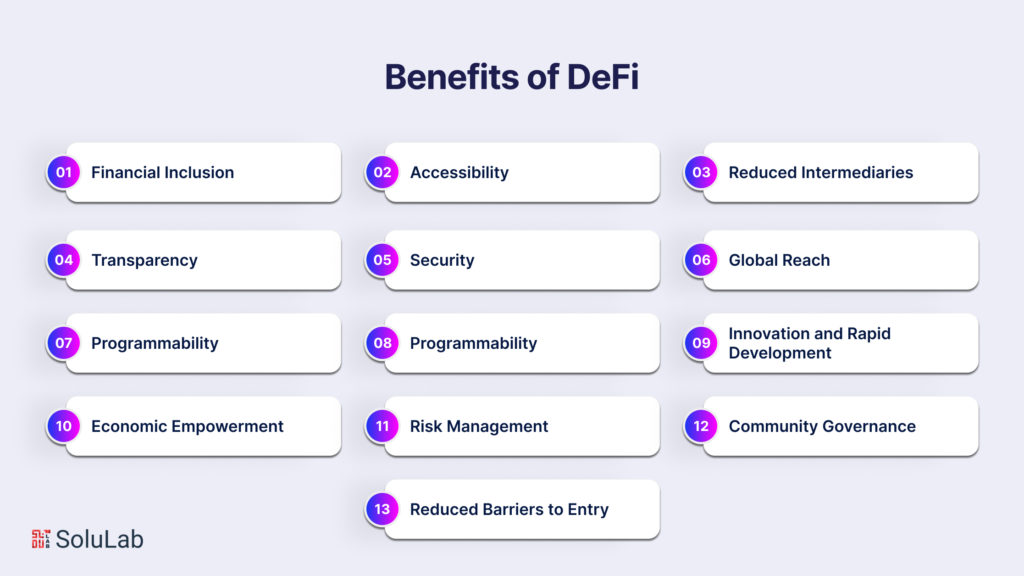
Decentralized Finance (DeFi) is transforming the financial landscape in numerous ways, offering a wide array of benefits to users, developers, and the global economy. 

  • Financial Inclusion

DeFi opens up financial services to anyone with internet access, enabling global financial inclusion. This is especially significant in regions with limited access to traditional banking. According to the World Bank, around 1.7 billion adults worldwide remain unbanked. DeFi can bridge this gap and empower individuals to access and manage their finances.

  • Accessibility

Unlike traditional financial markets with set trading hours, DeFi operates 24/7, allowing users to trade, lend, and borrow at their convenience. This accessibility provides flexibility and empowers users to make real-time financial decisions.

  • Reduced Intermediaries

Traditional financial systems rely on intermediaries like banks, brokers, and clearinghouses, which charge fees for their services. DeFi minimizes or eliminates these intermediaries, reducing costs for users. Smart contracts execute transactions automatically, bypassing the need for intermediaries and their associated fees.

  • Transparency

DeFi leverages blockchain technology to ensure transparent and immutable record-keeping. Every transaction is recorded on a public ledger, providing users with complete transparency. This transparency enhances trust, as users can independently verify all transactions.

  • Security

DeFi benefits from the security features of blockchain technology. Smart contracts, once deployed, are immutable, reducing the risk of tampering or fraud. The security of blockchain has contributed to a significant decrease in successful attacks on DeFi platforms.

  • Global Reach

Cross-border payments are a significant part of the global economy. DeFi enables seamless cross-border transactions, allowing users to send and receive funds globally without the delays and high fees associated with traditional cross-border banking services.
CTA1

  • Programmability

DeFi platforms are highly programmable, allowing developers to create customized financial solutions. This programmability has led to the development of a diverse range of applications, including yield farming, decentralized exchanges, automated trading bots, and more. Users can participate in these innovative financial services.

  • Yield Opportunities

DeFi platforms like Compound and Aave offer users the opportunity to earn interest on their assets. Users can participate in lending or liquidity provision, often earning yields that surpass traditional savings account rates by a significant margin. This opens up new avenues for passive income and wealth creation.

  • Innovation and Rapid Development

DeFi is characterized by its rapid pace of innovation. New projects, tokens, and protocols continually emerge, offering new financial products and services. The open-source nature of DeFi fosters competition and innovation, driving the development of cutting-edge solutions.

  • Economic Empowerment

DeFi can empower individuals to take control of their finances. Users are not reliant on centralized institutions; they have custody of their assets and can engage in financial activities autonomously. This increased agency can lead to greater financial empowerment and self-reliance.

  • Risk Management

DeFi platforms often allow users to set their own risk parameters. For example, users can choose the level of collateral required for loans, mitigating risk to some extent. Additionally, DeFi insurance projects offer coverage against smart contract vulnerabilities and hacks, further enhancing risk management.

  • Community Governance

Many DeFi projects employ decentralized governance mechanisms. Token holders have a say in protocol upgrades and decision-making. This approach promotes a more democratic and community-driven ecosystem.

  • Reduced Barriers to Entry

In traditional finance, launching financial products and services can be highly regulated and costly. DeFi reduces these barriers to entry for entrepreneurs and developers, making it easier to create and launch financial innovations.
Applications of Defi

Applications of Defi

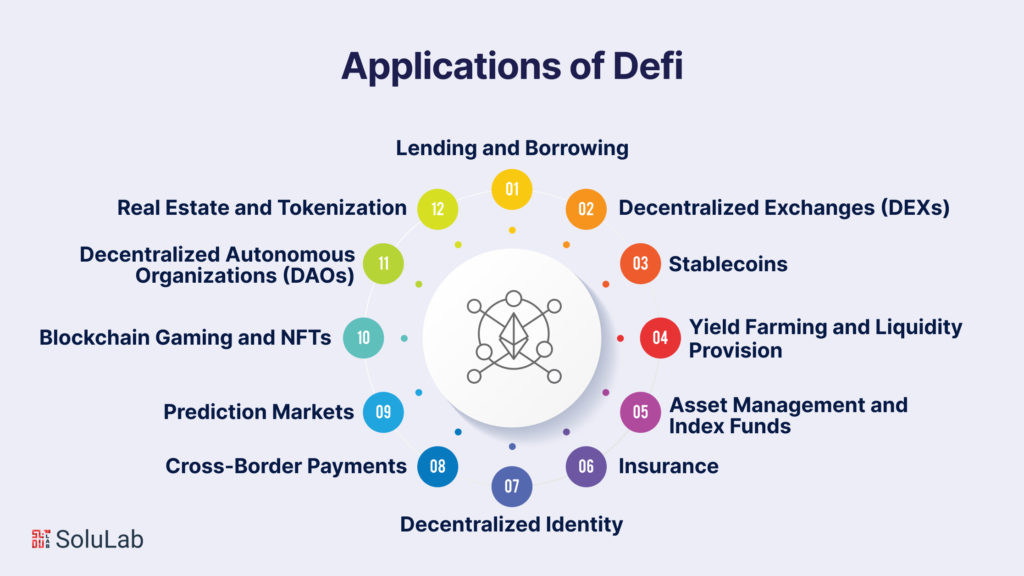
Decentralized Finance (DeFi) has a wide range of applications that are transforming the traditional financial landscape. These applications leverage blockchain technology to provide innovative and decentralized solutions to various financial services. Here are some key applications of DeFi:

  • Lending and Borrowing

DeFi lending platforms allow users to lend their crypto assets to earn interest, while borrowers can use their crypto holdings as collateral to secure loans. These platforms often offer more attractive interest rates than traditional banks.

Examples: Compound Finance, Aave, MakerDAO

  • Decentralized Exchanges (DEXs)

DEXs enable users to trade cryptocurrencies directly without the need for a centralized intermediary. They provide liquidity and allow for trustless and transparent trading.

Examples: Uniswap, SushiSwap, Balancer

  • Stablecoins

Stablecoins are digital currencies crafted with the intention of preserving a fixed value, frequently linked to a traditional currency such as the US dollar. They serve as a stable medium of exchange and a store of value within the volatile crypto market.

Examples: USDC, USDT, DAI

  • Yield Farming and Liquidity Provision

Yield farming encompasses the act of supplying liquidity to DeFi protocols in return for incentives. Users can earn tokens and interest by locking up their assets in liquidity pools.

Examples: Yearn.finance, Curve Finance, Balancer

  • Asset Management and Index Funds

DeFi allows users to create, manage, and invest in tokenized portfolios, enabling automated trading and diversification of assets.

Examples: Set Protocol, PieDAO

  • Insurance

DeFi insurance platforms provide coverage against smart contract vulnerabilities and hacks in the DeFi ecosystem, offering protection to users.

Examples: Nexus Mutual, Cover Protocol

  • Decentralized Identity

DeFi can be used to establish decentralized identity systems, giving users more control over their personal information.

Examples: uPort, SelfKey

  • Cross-Border Payments

DeFi facilitates cost-effective and rapid cross-border transactions, reducing the fees and delays associated with traditional international transfers.

Examples: Stablecoin-based remittance services

  • Prediction Markets

DeFi prediction markets enable users to create and participate in markets for predicting real-world events, offering a decentralized way to speculate on outcomes.

Examples: Augur, Gnosis

  • Blockchain Gaming and NFTs

DeFi and blockchain technology are integrated into the gaming industry, allowing players to buy, sell, and trade in-game assets and NFTs.

Examples: Axie Infinity, Decentraland

  • Decentralized Autonomous Organizations (DAOs)

DAOs are organizations governed by smart contracts and token holders, enabling decentralized decision-making and governance.

Examples: Yearn Governance, Compound Governance

  • Real Estate and Tokenization

DeFi can be used to tokenize real estate assets, making it easier for users to invest in properties and participate in real estate markets.

Examples: RealT, Propy
Blockchain and its Role in DeFi

Blockchain and its Role in DeFi

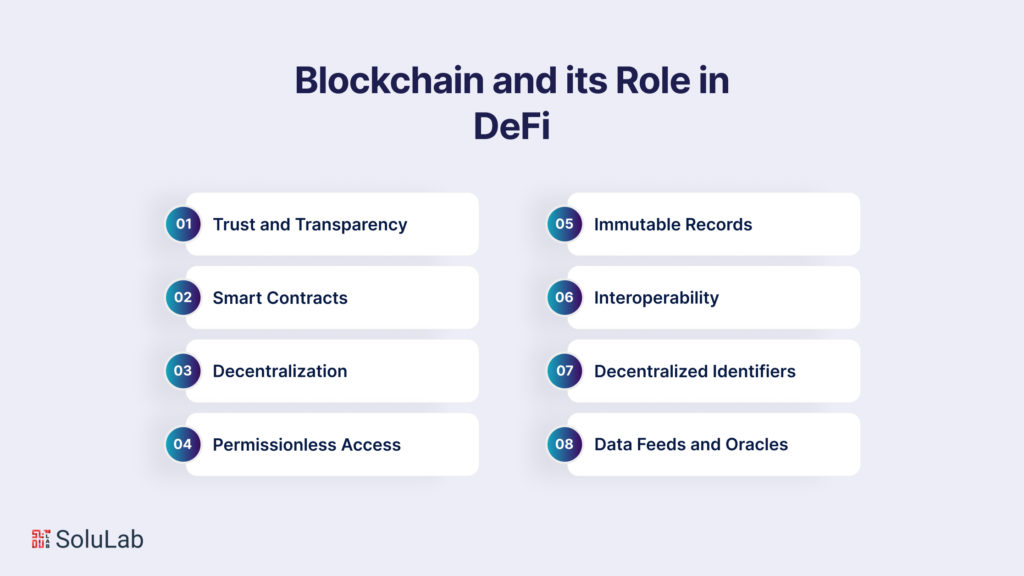
Blockchain technology plays a pivotal role in the success and functionality of Decentralized Finance (DeFi). It underpins the entire DeFi ecosystem, providing the infrastructure and key features necessary for its operation. Here’s how blockchain contributes to DeFi:

  • Trust and Transparency

Blockchain is a decentralized and distributed ledger technology. It records transactions in a secure and transparent manner across a network of nodes. This transparency ensures that all DeFi transactions are publicly verifiable, and participants can audit the transaction history. Users can trust that the information on the blockchain is accurate and tamper-proof.

  • Smart Contracts

DeFi relies heavily on smart contracts to automate and execute financial agreements without the need for intermediaries. These contracts are immutable and executed according to predefined rules, enhancing the security and reliability of financial transactions.

  • Decentralization

Blockchain networks, such as Ethereum, are decentralized, meaning there is no central authority or intermediary controlling the system. DeFi applications leverage this decentralization, eliminating the need for trusted third parties like banks. Users retain control of their assets and transactions, reducing counterparty risk.

  • Permissionless Access

DeFi platforms built on blockchain technology are generally permissionless, meaning anyone with an internet connection and the required assets can access and use these services. This inclusivity opens financial services to a global audience without regard for geographical location, background, or identity.

  • Immutable Records

Once a transaction has been added to a blockchain, it becomes immutable, i.e. it cannot be altered or deleted. This immutability enhances the security of financial transactions, making it difficult for fraudulent or unauthorized changes to occur.

  • Interoperability

Blockchain networks and protocols are often designed to be interoperable, allowing DeFi platforms to communicate and interact seamlessly. This interoperability enables various DeFi applications to work together and create a more interconnected financial ecosystem.

  • Decentralized Identifiers

Blockchain can provide a foundation for decentralized identity solutions, allowing users to control and manage their personal data and identity. This is particularly important in DeFi, where privacy and identity verification are essential.

  • Data Feeds and Oracles

To provide real-world data to smart contracts, DeFi projects often rely on oracles. These oracles are external data sources that feed information from the real world into the blockchain. They play a critical role in enabling smart contracts to respond to real-world events and conditions.

CTA2

Conclusion

Decentralized Finance (DeFi) is reshaping the financial landscape, offering a more inclusive and transparent way of managing assets and accessing financial services. As blockchain technology continues to advance, we can expect even greater innovation and adoption in both the DeFi space and across various industries. 

Bear in mind that the DeFi arena is ever-changing, and new entrants may come into play. Hence, it’s crucial to engage in comprehensive research and due diligence when deciding on a DeFi development company. With the right team and a forward-looking vision, your DeFi project has the potential to become a game-changing force in the financial realm.

If you’re still in search of the ideal DeFi development company, get in touch with Solulab without delay. Solulab boasts extensive experience in DeFi development services, a strong technical acumen, and a commitment to fostering innovation, making them an excellent option for businesses and entrepreneurs looking to embark on DeFi endeavors or enhance their existing DeFi solutions.

FAQs

1. What is DeFi, and how does it differ from traditional finance?

DeFi, short for Decentralized Finance, is a blockchain-based financial ecosystem that offers decentralized alternatives to traditional financial services like lending, borrowing, and trading. Unlike traditional finance, DeFi operates on blockchain technology, removing the need for intermediaries, providing transparency, and enabling users to have full control over their assets.

2. How do I get started with DeFi?

To start with DeFi, you need a crypto wallet, usually compatible with the Ethereum blockchain, as many DeFi projects are built on Ethereum. You can fund your wallet with cryptocurrencies, connect to a DeFi platform, and then explore and use various DeFi applications, such as lending, borrowing, or trading.

3. Are DeFi platforms safe and secure?

DeFi platforms prioritize security, but they are not immune to risks. Users should conduct thorough research, use reputable platforms, and follow best practices such as enabling two-factor authentication and using hardware wallets. Additionally, smart contract vulnerabilities and exploits have occurred, so it’s crucial to assess the risk before participating.

4. What is yield farming in DeFi?

Yield farming is a DeFi strategy where users provide liquidity to decentralized exchanges or lending platforms in exchange for rewards or interest. It involves staking assets in liquidity pools and earning tokens or a percentage of transaction fees. Yield farming can offer attractive returns but carries risks and should be approached with caution.

5. Can I earn passive income with DeFi?

Yes, DeFi offers opportunities for passive income. Staking assets in DeFi platforms, providing liquidity to DEXs, or participating in yield farming can all generate passive income. However, these strategies come with varying degrees of risk, so it’s essential to research and understand the potential rewards and risks associated with each method.

7 Best Defi Trading Platforms in 2025

7 Best Defi Trading Platforms

Cryptocurrency has taken the financial world by storm, providing an alternative to traditional banking and finance systems. Among the numerous crypto platforms, Decentralized Finance (DeFi) platforms are garnering significant attention. These platforms leverage blockchain technology to provide decentralized versions of various financial services like loans, insurance, asset trading, and more. One such platform that stands out is Ethereum, the underlying top blockchain platform for a vast majority of DeFi protocols.

In this blog post, we will discuss some of the best DeFi development platforms expected to witness significant growth in 2024-2025. We will explore their unique features and capabilities and why they might be worth your investment. Let’s delve into the exciting realm of Top Defi Trading Platforms!

Introduction

As we plunge into the world of leading DeFi development platforms, it’s essential to comprehend what DeFi is and what it has to offer. DeFi, otherwise known as Decentralized Finance, is a comprehensive term for a multitude of financial applications built on cryptocurrency or blockchain technology. It takes advantage of decentralized networks and open-source software to create a vast array of financial services and products.

DeFi development platforms are revolutionizing the blockchain landscape, bringing new and exciting platforms to life on platforms like Ethereum. These platforms use the platform’s native token (ETH in Ethereum’s case) to power payments and facilitate value transfers. Some of the most well-known Ethereum-based DeFi platforms are MakerDAO, Aave, Synthetix, Compound, Curve Finance, Kyber Network, Uniswap, 0x Protocol, Balancer, and Chainlink. These platforms provide decentralized financial services such as lending, borrowing, and trading. Investors and enthusiasts alike are drawn to these platforms for their unique features and capabilities, such as Uniswap’s token exchanges and Nexus Mutual’s risk cover products. Decentralized Finance (DeFi) is a thriving space filled with diversity and innovation, making it a compelling opportunity for all.

The Importance and Risks of Investing in DeFi Crypto

Investing in Top Defi Trading Platforms is a way to take part in the future of finance. It offers benefits like financial inclusivity, eliminating intermediaries, reducing costs, enhancing security, and increasing transparency. Moreover, it provides greater control and ownership of assets to individuals as transactions are executed through smart contracts on public blockchains.

However, like any investment, it comes with risks. The Defi Trading space is still relatively new and evolving, which means there are potential pitfalls and uncertainties. It’s crucial to understand these risks and do thorough research before investing.

CTA 1

Top DeFi Trading Platforms for 2024-2025

1. Frax Finance

At Frax Finance, you’ll find a one-stop shop for all your Defi Trading needs! Our comprehensive development solution features a swapping protocol powered by AMM, a lending application, a token transfer protocol, and a variety of stablecoins. Supporting eight major blockchains, Frax has achieved a stunning US$830 million in Total Value Locked (TVL) since its launch. With a strong focus on stability, Frax Finance uses a unique algorithm to maintain the value of its stablecoins, making it an attractive option for investors seeking a reliable store of value within the DeFi space. Frax Finance is not only focused on stability but also emphasizes security and user experience. Our team of experienced developers and auditors work tirelessly to ensure that our protocols are robust and free from vulnerabilities. We understand the importance of protecting users’ funds and have implemented various security measures, including regular smart contract audits and bug bounty programs.

One of the key features of Frax Finance is its decentralized lending application. Through this application, users can borrow and lend assets without the need for a central authority. This opens up opportunities for individuals to access credit and earn interest on their holdings, all while maintaining full control over their funds. In addition to lending, Frax Finance offers a swapping protocol powered by an Automated Market Maker (AMM). This allows users to easily exchange one asset for another without relying on traditional order books or intermediaries. The AMM ensures liquidity for various trading pairs, allowing for seamless and efficient transactions.

2. Morpho

Morpho is an innovative, on-chain peer-to-peer lending DeFi development solution that guarantees unbeatable annual percentage yield rates for both borrowers and lenders via its secure and decentralized P2P matching platform. To further ensure top-notch security and decentralization, Morpho runs its smart contracts through the most reliable global cybersecurity firms for regular audits and vulnerability assessments. This ensures that our protocols remain robust and impervious to potential threats. With Morpho, borrowers can easily access credit without the need for intermediaries or traditional financial institutions. Our decentralized lending platform allows individuals to borrow assets directly from lenders, eliminating the cumbersome process of credit checks and paperwork. This opens up new opportunities for individuals who may not have had access to traditional banking services.

On the other hand, lenders can earn attractive interest rates by providing liquidity to the platform. Our P2P matching system efficiently matches borrowers with lenders, ensuring that funds are utilized effectively and generating high returns for lenders. The annual percentage yield rates offered through Morpho are unbeatable, making it an enticing option for those looking to maximize their earning potential. In addition to the lending platform, Morpho also offers a comprehensive suite of tools and features to enhance the overall user experience. Our user-friendly interface allows for seamless navigation and easy execution of transactions. Whether you’re a borrower or a lender, you’ll find our platform intuitive and efficient.

3. Nexus Mutual

Nexus Mutual is revolutionizing DeFi development insurance with its expansive coverage of investor risks, certified audits from top cybersecurity companies, and trustless Ethereum-based smart contracts. Boasting an impressive US$275 million in Total Value Locked (TVL), the platform is a top player in the crypto insurance space and continues to attract users with its robust features and commitment to security. One of the key aspects that set Nexus Mutual apart is its comprehensive coverage of investor risks. Unlike traditional insurance providers, Nexus Mutual focuses exclusively on covering risks associated with decentralized finance. This means that users can protect their investments against smart contract failures, hacks, and other unforeseen events specific to the DeFi ecosystem. By offering tailored coverage, Nexus Mutual ensures that users have the peace of mind they need to participate confidently in the rapidly growing DeFi space.

To further bolster user confidence, Nexus Mutual undergoes regular audits and vulnerability assessments conducted by trusted global cybersecurity firms. These audits help identify and address any potential vulnerabilities within the platform’s smart contracts, ensuring that user funds are safeguarded against malicious attacks. By prioritizing security and transparency, Nexus Mutual aims to create a trusted environment where users can confidently engage in DeFi activities. Operating on the Ethereum blockchain, Nexus Mutual leverages trustless smart contracts to automate and streamline the insurance process. Through the use of smart contracts, the platform eliminates the need for intermediaries, reducing bureaucracy and costs associated with traditional insurance providers. This decentralized approach not only enhances efficiency but also eliminates the risk of human error or manipulation, providing users with a truly transparent and reliable insurance experience.

4. ParaSpace

ParaSpace is an innovative decentralized lending protocol that brings liquidity to NFTs. Powered by the Ethereum network, the platform is looking to expand its capabilities to other EVM-compatible chains in the near future to cater to a wider range of users. With the rise of non-fungible tokens (NFTs) and their increasing popularity, ParaSpace aims to bridge the gap between the vibrant world of NFTs and the financial opportunities they bring. By leveraging decentralized finance principles, ParaSpace allows users to collateralize their NFT assets and borrow against them, unlocking liquidity without the need to sell their prized digital collectibles. This opens up a whole new realm of possibilities for NFT holders, enabling them to access funds for various purposes, such as purchasing additional NFTs, investing in other cryptocurrencies, or even funding real-world platforms.

ParaSpace stands out by offering a seamless user experience and a wide range of supported NFTs, including artwork, virtual land, and in-game items. The platform provides users with a user-friendly interface where they can easily connect their wallets, view their NFT holdings, and explore available borrowing options. To ensure the safety and security of user assets, ParaSpace implements robust measures such as smart contract audits and rigorous risk management protocols. By partnering with reputable auditing firms and conducting regular security assessments, ParaSpace strives to mitigate potential vulnerabilities and protect user funds from potential threats.

5. DeFi Saver

DeFi Saver is one of the Best Defi Trading Platforms. Take control of your Decentralized Finance investments with DeFi Saver – a comprehensive management solution for protocols like MakerDAO, Compound, and Aave. Easily manage your investments and create an automated strategy to protect against market volatility and optimize your returns. DeFi Saver offers a user-friendly interface that allows you to monitor and adjust your positions in real-time, ensuring that you can make informed decisions based on the latest market conditions. With features like automated debt repayment, collateral swapping, and liquidation protection, DeFi Saver simplifies the management of your DeFi portfolio, saving you time and maximizing your potential profits.. Additionally, DeFi Saver provides advanced risk management tools, such as stop-loss orders and portfolio diversification strategies, to help you mitigate potential losses and maximize your returns. With DeFi Saver, you can easily connect your wallets and seamlessly access multiple DeFi protocols from one platform. This eliminates the need for manual transactions and reduces the complexity of managing your investments across different platforms.

One of the standout features of DeFi Saver is its automated strategy creation. Using intelligent algorithms, you can set predefined rules and triggers to automatically rebalance your portfolio based on market conditions. Whether you want to take advantage of flash loan opportunities or protect your assets during market downturns, DeFi Saver’s automation capabilities allow you to optimize your returns without the need for constant monitoring. Furthermore, DeFi Saver offers a comprehensive dashboard that provides real-time insights into your portfolio performance, including detailed analytics and historical data. This allows you to track the success of your investment strategies and make data-driven decisions to improve your overall performance.

6. Gamma

Gamma is an ultra-useful DeFi development solution that works as an automated concentrated liquidity manager, deploying specialized non-custodial position manager contracts called Vaults for strategic liquidity pool management. Compatible with a range of blockchains and DEXs, Gamma makes liquidation simple and efficient for DeFi users. By leveraging advanced algorithms and smart contract technology, Gamma identifies optimal entry and exit points for liquidity provision, ensuring maximum returns while minimizing risk. One of the key advantages of Gamma is its ability to automatically rebalance liquidity across different pools based on market conditions. This dynamic approach allows users to capture lucrative opportunities and adapt to changing market trends seamlessly. With Gamma, you can be confident that your liquidity is always deployed in the most advantageous way, maximizing your potential profits.

In addition to its automated liquidity management features, Gamma also provides comprehensive risk management tools. Users can set customized risk parameters, such as maximum exposure limits and slippage thresholds, to protect their assets from unexpected market fluctuations. Furthermore, Gamma’s intelligent monitoring system constantly scans the market for potential risks and alerts users in real-time, allowing for quick decision-making and proactive risk mitigation. Gamma’s user-friendly interface makes it accessible to both experienced DeFi investors and newcomers to the space. The platform provides intuitive dashboards and analytics, giving users a clear view of their liquidity positions, performance metrics, and historical data. With this information at hand, users can make informed decisions and optimize their liquidity pool strategies.

7. Opyn

Opyn is revolutionizing the DeFi development space with its novel purpose – providing and executing investment strategies for crypto traders. Invest in Ethereum’s native currency Ether ($ETH), or the stablecoin USD Coin ($USDC), and enjoy the opportunity to earn strategically! Opyn’s platform leverages cutting-edge technology and advanced algorithms to identify and execute investment strategies that maximize profitability while minimizing risk. One of the key features of Opyn is its ability to analyze market data in real-time, allowing it to adapt quickly to changing market conditions. By constantly monitoring various indicators and signals, Opyn can identify lucrative investment opportunities and execute trades at optimal entry and exit points. This dynamic approach ensures that users can capture the most profitable moments in the market.

Opyn also provides a wide range of investment options to cater to different risk appetites and investment goals. Whether you’re an experienced trader looking for high-risk, high-reward opportunities or a conservative investor seeking stable returns, Opyn offers a diverse set of investment strategies to suit your needs. From short-term trading to long-term holdings, Opyn has you covered. In addition to its investment capabilities, Opyn prioritizes security to safeguard user funds. The platform utilizes state-of-the-art security measures, including multi-factor authentication, encryption protocols, and secure storage solutions, to protect against potential threats. With Opyn, you can have peace of mind knowing that your assets are well-protected.

Final Thoughts on Investing in DeFi Development Platforms

The world of DeFi trading platforms is evolving rapidly, with 2024 bringing forth some of the best options for traders and investors seeking decentralized financial solutions. These platforms offer enhanced security, transparency, and control, making them ideal for users looking to maximize their trading experiences. We recently published a case study on Token World, a crypto launchpad platform developed with SoluLab’s expertise. Token World needed to overcome challenges like smart contract security and scalability, and with SoluLab’s solutions, the platform successfully launched secure token sales and engaged investors through a seamless and reliable interface. 

SoluLab’s tailored blockchain services ensure that platforms like Token World can thrive in the ever-evolving decentralized finance landscape. As the demand for innovative and secure DeFi platforms grows, working with a trusted DeFi development company like SoluLab can help businesses build cutting-edge, scalable solutions. SoluLab offers expertise in blockchain development, smart contract security, and tokenization strategies, allowing businesses to hire DeFi developers who can bring their vision to life.

CTA2

FAQs

1. What are DeFi trading platforms?

DeFi trading platforms are decentralized exchanges built on blockchain technology that allows users to trade cryptocurrencies directly with each other without the need for intermediaries. These platforms offer secure, transparent, and autonomous financial transactions, making them a crucial component of the Decentralized Finance ecosystem.

2. How do DeFi trading platforms differ from traditional exchanges?

Unlike traditional exchanges, DeFi platforms operate on decentralized networks, meaning there’s no central authority controlling the exchange. This ensures more transparency, greater user control, and enhanced security. Many DeFi platforms also integrate with DeFi lending platforms, allowing users to lend and borrow assets directly.

3. What should I look for when choosing a DeFi trading platform?

When choosing a DeFi platform, consider factors like security, ease of use, supported tokens, liquidity, and integration with DeFi lending platforms. Additionally, look for platforms that offer robust blockchain development solutions to ensure long-term sustainability and growth.

4. Are DeFi trading platforms safe to use?

Most reputable DeFi trading platforms prioritize security by using smart contracts and blockchain technology to ensure safe transactions. However, it’s important to verify the platform’s security audits and smart contract protocols before investing. Using a trusted Blockchain development solutions provider can also ensure the platform adheres to the highest security standards.

5. How do DeFi lending platforms work?

DeFi lending platforms allow users to lend their cryptocurrencies to others in exchange for interest. These platforms operate on smart contracts, automating the lending and borrowing process while ensuring secure and transparent transactions without intermediaries.
