Talk to an Expert

How AI Agents Are Personalizing Insurance for Smarter Decisions?

AI Agents in Insurance

Insurance as an industry works on data and risk evaluation. Functions like underwriting, claims processing, and customer service– all depend on how accurately insurers can assess and manage risk. 

Wherein traditional methods struggle to keep up with the growing complexity and volume of data, resulting in slow processes, impersonal policy recommendations, and a less-than-ideal customer experience. Artificial Intelligence (AI) is improving it all. AI is crucial in helping insurers move from a reactive to a proactive model. Its ability to process and analyze vast amounts of data in real time enables insurance providers to deliver more accurate, personalized, and timely services.

Insurers utilizing AI for personalized services have observed a 15–30% increase in customer satisfaction, owing to more accurate risk profiling and tailored policy offerings. In this blog, we’ll explore how AI agents are personalizing and shaping the future of insurance and what this means for insurers and policyholders.

Let’s begin!

What are AI Agents in Insurance?

AI Agents in Insurance are intelligent systems often powered by machine learning, natural language processing (NLP), and automation that perform tasks traditionally handled by human insurance agents. These AI agents can operate independently or assist human agents in tasks across the entire insurance lifecycle. AI agents are constantly learning, evolving, and becoming capable over time.

AI can recognize trends in large datasets and anticipate possible hazards before they materialize. Their customer service, claims processing, risk assessment, and fraud detection functions make them essential tools to improve insurance industry efficiency, accuracy, and consumer satisfaction. AI in the insurance industry with AI chatbots can now provide basic answers around the clock, walk you through policy specifics, and even handle basic transactions.

How AI Agents in Insurance Work?

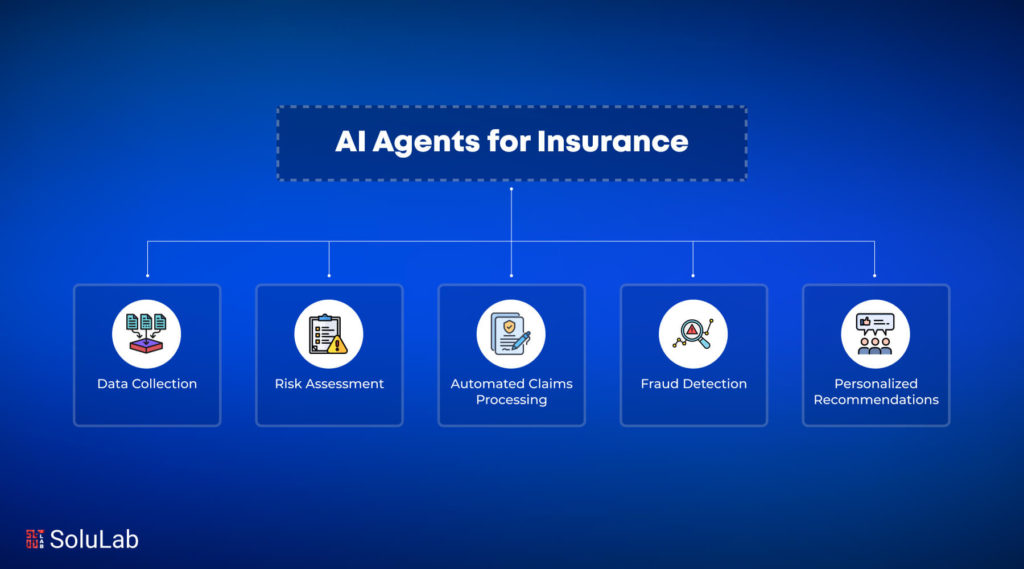
AI Agents work by automating and enhancing key processes, leading to more accurate risk assessments, pricing, and improved experiences. Here’s how AI Agents in Insurance work:

1. Data Collection

AI Insurance agents can gather information using data from various sources, this includes customer applications, medical records, public records, and history. AI Agents for Insurance algorithms analyze this data to identify patterns, correlations, and risk factors that humans might miss this includes predictive modeling, clustering, and natural language processing.

2. Risk Assessment

Insurance Agents with Artificial Intelligence can work on the analysis of a vast amount of data and can work on creating more accurate risk profiles for customers. This enables insurers to offer personalized premiums, identify high-risk individuals, and reduce underwriting bias.

3. Automated Claims Processing 

AI for insurance agents can automate tasks like initial claim assessment, document verification, and payment processing. This has its benefits like reduced waste times, improved customer satisfaction, minimized automation, fewer errors, and consistent application of policies 

4. Fraud Detection

It is easy for AI for life insurance agents to detect fraudulent claims by analyzing patterns in data, such as inconsistencies in claim narratives or unusual claims. AI Agents in Insurance help insurers reduce losses and protect their bottom line. These suspicious patterns can be frequent claims for the same individual or group and discrepancies between claim descriptions and supporting.

5. Personalized Recommendations 

AI tools for insurance agents help with customer data analysis to recommend insurance products that best suit their individual needs and circumstances. This assists insurers to improve customer satisfaction and loyalty. Understanding customer needs based on analysis can help AI for customizing insurance policies, and personalizing communication resulting in improved customer loyalty.

AI Solutions

Benefits of Using AI Agents for Insurance

Adopting AI in the insurance industry brings a variety of benefits not alone for insurers but also for policyholders:

1. Improved Accuracy and Efficiency

AI is great for automating repetitive tasks that take a toll on such agents. Usually, it is seen in intro clerical jobs that entail digit entry, documentation, and responding to basic consumer inquiries, artificial intelligence insurance also allows human agents to spend more time-solving complex issues and providing customers with specific attention. capable of processing massive amounts of data to identify patterns and trends to enhance traditional insurance processes.

2. Customized consumer Experience

An example of a business process that can be provided by AI agents in finance is insurance policies tailored to meet the customer’s needs and how much s/he is willing to take. This has the double benefits of happier customers and better risk selection for the insurance company. The insurance company can provide 24/7 help, answering common questions and helping clients with their insurance.

3. Cost Reduction and Fraud Detection

It can be noted that AI for life insurance agents algorithms can be trained in an even better way to detect false claims. Such AI systems can shave millions of dollars off insurance companies’ costs as they help to evaluate previous information on fraudulent claims and suspicious trends.

4. Innovation and Product Development

This might help insurance agent AI to analyze enormous amounts of data and provide insightful observations about trends and demands of the markets. This allows insurers to develop new products and services that are innovative and geared toward some segments. For instance, AI can be applied, for example, usage-based insurance where one will be charged depending on how safe.
Applications of AI Agents in Insurance

Application of AI Agents in Insurance

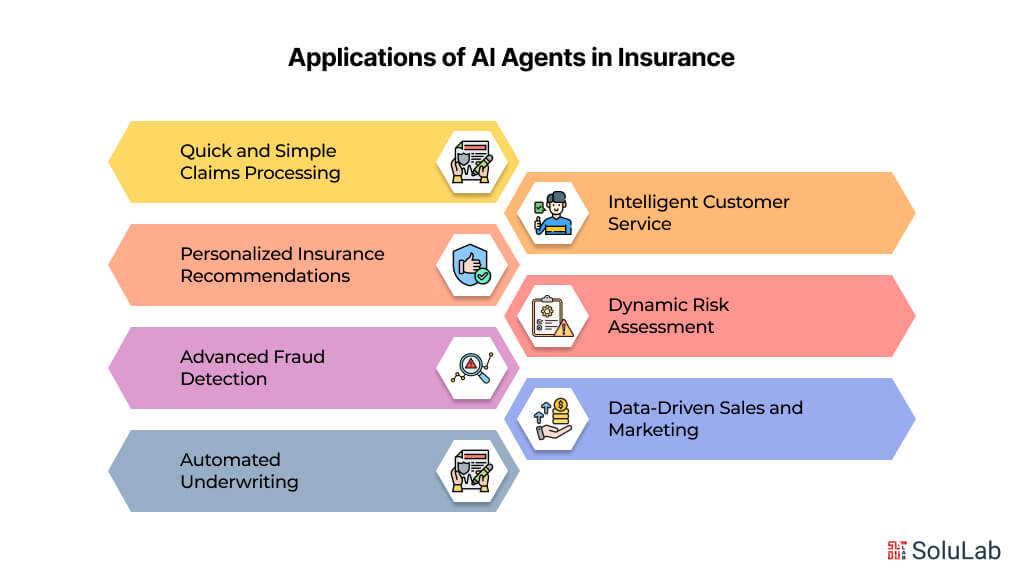
AI Agents for Insurance are shaking things up by automating tasks, and building intelligent services. Here are use cases of AI and insurance:  

1. Quick and Simple Claims Processing

Technology plays a crucial role and with the applications in the insurance industry, it is possible to offer clients a chance to file claims in an instant, collation of other important details including the verification of the claims and even the beginning of the repair estimates.

2. Personalized Insurance Recommendations

AI Agents in Insurance are used to analyze customer data, including demographics, driving history, health records, and lifestyle choices to assess risk more accurately. This allows insurers to offer personalized premiums based on individual risk profiles, leading to fairer pricing and improved customer perception. This enables customers to receive valuable options for specific needs.

3. Intelligent Customer Service

It could be termed that with the use of AI-powered chatbots, clients can get quick assistance in answering some basic insurance queries, locating particulars related to policies, and undertaking basic solved procedures and self-serving facilities at any time and from any location that the client may opt for.

4. Advanced Fraud Detection

Cautiously, the same database analysis can be presented as an attempt to find specific trends or inconsistencies that may point to the fact that the case is filled with false statements. The use cases of AI agents insurers by pointing out the activities on which they should or could concentrate more.

5. Dynamic Risk Assessment

The features, traffic, and climate of several automobiles can be considered by the real-time data to result in lively risk analysis with the help of artificial intelligence insurance. It allows insurers to set rather reasonable tariffs and will most probably stimulate safe behavior.

6. Automated Underwriting

Using insurance agent AI in underwriting can ease the underwriters’ burden and make the underwriting process quicker, assisting in delivering answers sooner so that these personnel can concentrate on more complicated issues.

7. Data-Driven Sales and Marketing

AI Agents for Insurance may use customer details to determine the place where the insurance products may be advertised and sold alongside the appropriate marketing texts that will reach the correct persons at appropriate times.

Changes AI Agents are Bringing in Insurance 

There are sophisticated solutions known as Artificial Intelligence (AI) that are changing not only the bureaucratic insurance companies’ processes and methods of interacting with customers. These are some of the main adjustments that AI agents are bringing about:

1. Transitioning from Reactive to Proactive

Insurance has been mostly claim-based which means that it goes into action when events happen and claims are filed. Due to the interventions offered by AI Insurance agents, one can take a more proactive approach. AI can monitor all the signs in a system that may be associated with potential threats before these threats become detectable. Think of getting specific recommendations on your health depending on the wearable data that you have or a reminder to alert you of the need to service your car depending on the trends in your driving.

2. Customized Insurance

Chances Insurance that fits all people well is starting to fade away. To create a unique risk score for each consumer, the AI for life insurance agents can analyze specific pieces of information like driving history, passenger’s health, and even data from the smart house. This evolves into individual insurance solutions that meet specific needs, or ensure that you are not being overcharged for the insurance.

3. Frictionless Claims Processing

Endless questionnaires and hours-long talks on the phone are no longer a thing of the future. Other Appropriate Insurance Agents with Artificial Intelligence is revolutionizing that procedure. Of course, the use of a smartphone camera may let one instantly file a claim with the app, and the underlying AI would gather information, verify a claim, and even launch the repair estimate. Contained herein are the key changes that make it easier to manage and work or operate the company, free from bureaucratic intervention, paperwork, delay in payments or settlements, and tough situations.

4. AI-powered Customer Support

It can be annoying to wait on hold for a customer support agent. Chatbots with AI are altering that. These virtual assistants can manage simple transactions, walk you through the terms of your policy, and respond to your basic insurance questions around the clock. In addition to offering prompt assistance, this frees up human agents for more intricate client engagements.

5. Improved Fraud Detection

Insurance companies face a major obstacle as a result of fraudulent claims. In this battle, AI has the potential to be quite effective. AI for life insurance agents algorithms can detect suspicious patterns and warning signs with remarkable accuracy by examining past data on fraudulent claims. This saves insurers millions of dollars by enabling them to flag questionable claims for additional examination.

What Does the Future of AI Agents Look Like in Insurance?

It is expected that AI agents in the insurance sector will develop and broaden their skills and uses in the future. The following are some possible future trends:

1. Explainable AI: The need for explainable AI models will grow as AI agents grow in crucial decision-making procedures such as claims processing and underwriting. 

2. Custom Insurance Solutions: AI agents will use machine learning and advanced analytics to provide highly customized insurance services and products based on the requirements, preferences, and risk profiles of each consumer.

3. Telematics and Internet of Things (IoT): AI agents will easily interface with telematics systems and IoT devices to collect real-time information about insured assets, including equipment, homes, and cars. 

4. Natural Language Processing (NLP): As AI agents develop their natural language processing skills, they will be able to engage with clients in more conversational and organic ways. 

5. Collaborative intelligence: AI agents will work with human specialists like analysts, claims adjusters, and underwriters. By combining the advantages of AI and human experience, this collaborative intelligence will provide more precise and informed decisions.

6. Ethical AI: There will be an increasing focus on creating ethical AI frameworks and adherence to legal requirements for dealing with concerns about algorithmic bias, data privacy, and accountability.

These upcoming developments show how AI agents can alter the insurance sector by improving risk assessment, client satisfaction, operational effectiveness, and decision-making procedures in general.

Connect Now

Take Away

AI agents are set to redefine personalized risk evaluation in insurance by making assessments smarter, faster, and more accurate. With access to real-time data, behavioral patterns, and advanced analytics, insurers can now tailor policies to individual needs rather than relying on broad risk categories. 

This shift not only improves customer experience but also enhances underwriting precision and fraud detection. While human oversight remains crucial, AI agents will continue to handle complex tasks with greater autonomy. SoluLab, a leading AI agent development company in USA, is a dedicated team of expert professionals backed by years of experience and technical prowess. Even though we got a chance to develop a project on health insurance powered by AI , resultingly processing time was reduced by 70% and held financial benefits also.

SoluLab is a dedicated team of AI and finance experts ready to help you with all your queries. Get in touch with us today!

FAQs

1. What roles do AI agents play in improving the client satisfaction of insurance services?

AI-enabled chatbots attempt to supplement consumer support 24/7 to respond to most of the queries and help users with policy-related information. In addition, insurance as a service can be advised and claims processed by AI through AI apps hence enhancing the general flow of insurance.

2. In what ways can Artificial Intelligence help insurance risk management?

AI brings the advantage of real-time risk evaluation since it can consider big volumes of data, current traffic, and weather conditions, for instance. This makes it efficient for insurance firms to afford fair tariffs and possibly promote effective conduct such as safe driving.

3. Will AI replace insurance agents?

No. They will work like more of smart companions, AI agents perform repetitive work and provide the first contact. This means freeing up the human agent’s time for tackling complex problems, personal one-on-one correspondence, and enhancing their relations with clients on average.

4. What may be the possibilities of applying AI in insurance risk management?

Hence, AI offers a more multifaceted risk analysis, one that is capable of deploying not only in raw data but also in the actual real-time inflow of data such as traffic and weather conditions. This in turn allows insurance organizations to offer more fair tariffs and in the future – safe behaviors such as proper driving.

5. How can SoluLab help insurance companies with AI Agents?

At SoluLab we design efficient insurance solutions, These solutions will help you identify potential fields that require the integration of the best AI for insurance agents with your company’s operations, create new products, and gradually apply to liberalize the insurance market for your enterprise.

The Impact of AI on the Insurance Sector

AI in the Insurance Sector

The insurance business has traditionally been one of the most data-intensive. With a significant quantity of customer data, claims data, and other types of information, insurers are using artificial intelligence (AI) to simplify their operations and improve consumer experiences. The insurance sector is not indifferent to artificial intelligence. AI life insurance has revolutionized risk management, underwriting policies, and other traditional insurance procedures. AI has had a tremendous influence on the insurance industry, allowing insurers throughout the world to adopt innovative methods and achieve remarkable efficiency.

According to Forbes, the efficiency of operations in the insurance industry has grown by 60%, with a 99.99% rise in claims accuracy and a 95% improvement in customer satisfaction. Furthermore, AI in the insurance business is expected to attain a value of USD 35.77 billion by 2030, growing at a CAGR of 33.06%.

AI-powered solutions have helped insurers simplify claims processing, fraud detection, and underwriting, amongst other things. This blog will take a closer look at the function and use of AI in insurance, including its advantages, use cases, impact, and current trends.

Understanding the Need for AI in Insurance

Previously, insurance was linked with copious amounts of documentation, time-consuming meetings, submitting complex claims, and expecting months for a judgment.

Artificial intelligence in insurance has introduced automation, which has begun to reestablish trust in insurance companies. Businesses are currently using AI solutions for insurance to boost business development, eliminate risks and fraud, and automate key business operations to cut total costs.

AI in health insurance is also pivotal in optimizing operations, enabling insurers to offer tailored premium pricing by leveraging comprehensive data insights. Furthermore, AI streamlines the underwriting process, reducing human intervention and facilitating direct connections between applicants and health insurance carriers for enhanced efficiency.

Read Blog: Generative AI in Healthcare

In summary, AI insurance benefits both insurers and policyholders. Here’s how.

  • AI in the insurance sector improves insurers’ ability to analyze risks, identify fraud, and eliminate human mistakes.
  • AI in insurance improves and streamlines customer service while also making claims processing easier and faster.
  • Underwriting procedures can be improved with AI disruption and less human involvement.
  • Using AI and ML in insurance allows underwriters to measure risk better and offer more personalized premium pricing.
  • Furthermore, AI in the insurance sector optimizes the process of linking applicants with insurers directly, making the process simpler.

How Does Artificial Intelligence Add Value to the Insurance Sector?

The insurance sector must integrate modern technologies such as metaverse, blockchain, artificial intelligence, robotic process automation, and others in order to remain competitive and relevant. Let us look at how the use of the latest technologies might improve the current time-consuming and exhausting insurance process. However, bringing value to the existing process makes sense when the implementation of Gen AI in insurance industry yields tangible advantages. Let’s examine a few of them:

  • Optimized Claim Processing

Claims processing is a difficult procedure. Agents must examine numerous policies and understand them in depth in order to estimate how much the customer will get for the claim. AI for insurance can handle such automated operations, reducing mistakes and claim processing time.

As companies embrace emerging technologies like AI, RPA, and IoT, operational efficiency is heightened, allowing insurers to tap into a plethora of IoT devices such as smart home assistants, fitness trackers, and healthcare wearables. This AI and Insurance if worked together facilitates seamless data collection, enabling insurers to stay closely connected with policyholders and derive comprehensive insights crucial for informed decision-making in underwriting and claim management, ultimately mitigating risks.

CTA 1

  • Assessing Risk

The underwriting procedure mostly relied on the applicant personally filling out routine paperwork. There is always the potential that the candidate is dishonest or makes errors, which might result in an erroneous risk assessment.

According to research, the advantages of AI in insurance, particularly underwriting, include the capacity to:

  • Model a future market with 83% accuracy.
  • Reduce processing time in underwriting by 10-fold.
  • Boost case acceptance by 25%.
  • Fraud Detection and Prevention

The vast insurance sector receives almost $1 trillion in premiums each year. With this magnitude, the fraud rate is very large. Non-health insurance fraud is expected to cost more than $40 billion per year, raising premiums by $400 to $700 per household.

Gen AI in insurance is transforming fraud detection and prevention. Analyzing vast volumes of data can reveal unusual trends and warn insurers of suspected fraud in real time. It assists insurers in reducing risks, minimizing financial losses, and ensuring the authenticity of their operations. AI enables insurers to safeguard policyholders from false claims. 

  • Reporting of Claims

In Insurance claim filing, AI can manage the first notification of loss with little to no assistance from humans, allowing insurers to allocate, route, report, and prioritize claims. 

As clients may report events from any device, anywhere, at any time, chatbots can effectively streamline the claim reporting process. Build Chatbots with AI capabilities have the ability to distribute information for additional processing.

  • Investigation and Management of Insurance Claims

AI and ML in insurance may be used in conjunction with various applications to automate the identification of fraudulent activities process, saving time and money, by controlling every step of the process, including data collection, claims processing, authorizations, permits, payment tracking, and recovery tracking. 

Artificial Intelligence in insurance processes can efficiently manage and enhance a range of functions. 

  • Enhanced Standard Procedures

Customer service in the insurance sector has undergone a radical transformation because to artificial intelligence. As was also previously noted, chatbots are the simplest way to start a process and distribute information toward the next aligned step without the need for human participation, making the process quick, easy, and error-free.

Chatbots driven by AI have the ability to upsell and cross-sell items based on a customer’s past purchases and profile. Operations may be readily scaled up while using human resources in higher-profile positions by automating the repetitious process.

  • Better Way to Estimate Losses

Damage assessment is now simpler than ever thanks to recent developments in AI technology, such as machine learning, deep learning, and optical character recognition (OCR). It is possible to ascertain the degree of the damage quickly and effectively by just uploading a picture of the damaged object.

Furthermore, these technologies enable the prediction of prospective losses and the provision of insightful advice. 

Use Cases of AI in Insurance

Use Cases of AI in Insurance

There are various AI use cases in insurance. These use cases show AI is transforming various aspects of the insurance industry, from risk management and underwriting to customer service and product innovation, ultimately driving efficiency, profitability, and customer satisfaction.

Here are some of the AI in insurance use cases:

Customer Segmentation and Targeted Marketing: AI-driven analytics identify distinct customer segments based on demographic, behavioral, and psychographic factors. Insurers can then tailor marketing campaigns and product offerings to specific customer segments, improving engagement and conversion rates.

  • Dynamic Pricing and Personalized Premiums: AI algorithms analyze individual risk factors and behavioral data to dynamically adjust insurance premiums in real time. This personalized pricing approach rewards safer behaviors and incentivizes policyholders to take proactive measures to reduce risks.
  • Automated Underwriting for Micro-Insurance: AI-powered underwriting models streamline the assessment of small, low-premium insurance policies, such as micro-insurance products for low-income individuals. By automating underwriting decisions, insurers can offer affordable coverage to underserved populations while maintaining profitability.
  • Natural Language Processing (NLP) for Policy Analysis: AI-powered NLP tools can parse and analyze complex insurance policies to extract key information, such as coverage limits, exclusions, and terms. This helps insurers quickly understand policy details and make informed decisions during underwriting and claims processing.

Read Also: Top 10 Applications of Natural Language Processing

  • IoT Integration for Telematics and Health Monitoring: Insurers leverage IoT devices such as telematics in automobiles and health monitoring wearables to gather real-time data on policyholders’ behaviors and health conditions. This data informs risk assessment, pricing strategies, and incentive programs, promoting safer behaviors and healthier lifestyles among policyholders.
  • Product Development and Innovation: AI-driven insights help insurers identify market trends, customer preferences, and emerging risks, facilitating the development of new products and services tailored to evolving consumer needs. This fosters innovation and competitiveness in the insurance market.
  • Predictive Health Analytics: AI in health insurance analyzes health data from wearable devices, electronic health records, and other sources to identify patterns indicative of potential health risks or chronic conditions. Insurers use predictive health analytics to intervene early, offering proactive health management programs and preventive care services to policyholders, ultimately improving health outcomes and reducing healthcare costs.

Top Trends and Innovations Driven by AI Changing the Insurance Industry

The application of different AI technologies will require the insurance business to climb a steep learning curve in order to reach new heights. People who have insurance will also be impacted, in addition to the insurance companies. Here are a few of the trends:

  • High Personalization

Insurance businesses may now provide highly customized plans and solutions that are tailored to the individual demands of each consumer thanks to AI’s ability. By examining data on lifestyle, behavior, and preferences, artificial intelligence (AI) systems may generate personalized insurance solutions. In the cutthroat market of today, maintaining and gaining new clients depends on this degree of customization.

  • Explosion of Data from Networked Devices

A huge increase in data creation has been caused by the proliferation of connected devices. Massive amounts of data are being collected and transmitted by IoT sensors and smart devices, leading to a data explosion. This offers possibilities and problems for handling, evaluating, and making decisions using this data. Businesses must manage this flood of data well in order to remain competitive in the modern digital environment.

  • Extended Reality

The next generation of virtual reality is called extended reality. It won’t be required for the insured object to be present in person at the location. AI technology will be used to conduct a virtual examination following the filing of the claim. Better rates will be simpler to generate if the safety features of the car that needs insurance are known.

  • Data Accuracy

In AI, data is king. Artificial intelligence (AI) is the process of gathering data from many sources and interpreting it. Better business judgments may be made, nevertheless, if the data is reliable and exact. Accurate data may be used by insurance firms to reduce risks and fraud before they happen.

Factors Driving Implementation of AI in Insurance Industry

AI in Insurance: Key Factors

AI-powered solutions are increasing insurers’ market share and profitability. This technology is being used in the insurance industry due to a number of factors.

  • Quick Developments in Artificial Intelligence and Machine Learning

The rapid development of machine learning and artificial intelligence has opened up new avenues for value extraction from data. A prime example is large language modeling (LLM), a subfield of artificial intelligence that can interpret document data intelligently. Insurance companies may expedite their claims procedures and identify fraudulent claims more accurately by using LLMs. Generative AI is another example; it combines functions, data, and tools and uses reasoning to produce a response. Although generative AI is still in its early stages, it has enormous potential for the insurance sector.

  • Availability of Greater and More Varied Data Sources 

There is more raw material ready to mine for value as a result of the dramatic increase in the number and diversity of data sources. As insurers complement their data with consumer credit, marketing, social networking posts, information on shopping behavior, criminal histories, prior insurance claims, and weather data, third-party information has also become more and more significant. Insurers benefit from third-party data in many ways, including better marketing strategies, risk modeling, policy underwriting, and claims handling.

  • Call for Improved Customer Support

With the help of AI-powered solutions, insurers can now provide customers with timely, individualized support that is offered around the clock, thanks to chatbots and virtual assistants. Front-line customer care systems that offer 24/7 basic help free up human agents to handle more complicated client concerns are powered by natural language processing (NLP), a sort of artificial intelligence that enables machines to comprehend and react to written and verbal communication.

  • Features of the Modern Cloud Data Platform 

Massive amounts of data may be processed and stored effectively and affordably with the help of contemporary cloud data systems like Snowflake. Insurers may employ a variety of data sets for the training and improvement of their AI models because the model supports structured, semi-structured, and unstructured data. Compute power that is elastically scalable enables teams to efficiently handle AI and ML workloads. 

CTA 2

Final Words

In conclusion, the integration of AI technologies within the insurance sector has profoundly reshaped operations, customer experiences, and risk management strategies. From streamlining underwriting processes to enhancing fraud detection and personalized customer service, AI has proven to be a transformative force. As insurers continue to embrace AI-driven solutions, they stand to unlock even greater efficiencies and competitive advantages in an increasingly digitized era. However, stakeholders need to remain cognizant of the ethical considerations surrounding AI implementation, ensuring transparency, fairness, and accountability in its usage to foster trust and mitigate potential risks.

Insurance businesses may benefit greatly from collaborating with seasoned AI development companies such as SoluLab as they endeavor to make use of AI’s capabilities and manage intricate deployment processes. Insurance companies may benefit from SoluLab’s AI technology expertise by receiving specialized solutions to handle certain business problems. These solutions can include chatbots and virtual assistants for improving client interaction, pricing model optimization, and claims processing automation. SoluLab is a trustworthy AI development company in advances the insurance industry’s transformation through modern artificial intelligence (AI) solutions, with an emphasis on innovation and customer happiness. Get in touch with us right now to start a cooperative journey toward success and learn more about how SoluLab can support your company’s AI journey.

FAQs

1. How does AI benefit insurance companies?

AI benefits insurance companies in various ways, such as automating repetitive tasks like claims processing, enabling predictive analytics for risk assessment, enhancing fraud detection, and providing personalized customer experiences through chatbots and recommendation systems.

2. Does the integration of AI in insurance reduce operational costs?

Yes, the integration of AI can significantly reduce operational costs for insurance companies. By automating manual processes, AI streamlines workflows, minimizes errors, and increases efficiency, ultimately leading to cost savings across various departments.

3. What impact does AI have on customer experiences in the insurance sector?

AI enhances customer experiences in the insurance sector by enabling personalized interactions, quicker response times, and more accurate policy recommendations. Chatbots and virtual assistants powered by AI provide 24/7 support, addressing customer inquiries promptly and efficiently.

4. How does AI help in mitigating insurance fraud?

AI helps mitigate insurance fraud by analyzing large volumes of data to identify suspicious patterns and anomalies. Machine learning algorithms can detect fraudulent claims by flagging inconsistencies in claims information, behavior analysis, and historical data comparison, thereby reducing financial losses for insurers.

5. How can SoluLab assist insurance companies in adopting AI technologies?

SoluLab specializes in AI development and offers tailored solutions to assist insurance companies in adopting AI technologies. From automating claims processing to implementing predictive analytics models, SoluLab collaborates closely with insurers to address specific business challenges and optimize processes for enhanced efficiency and customer satisfaction. Contact SoluLab today to explore how AI can revolutionize your insurance operations.
