Talk to an Expert

AI in Media and Entertainment: Use cases, Benefits, Future and solution

AI in Media and Entertainment

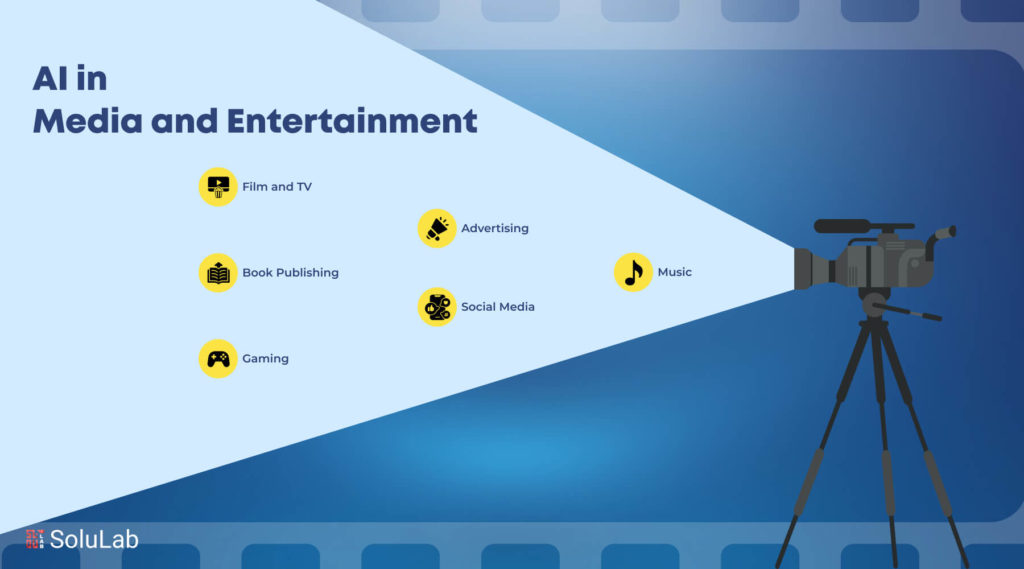
The Media and Entertainment Industry has always been about thinking outside the box and even more now with AI use cases leading the charge. Regarding artificial intelligence, there is no such concept in science fiction anymore. Indeed the M&E sector globally is a fast-evolving industry and the same can be said about this part of the world. The utilization of AI in media and entertainment is now an essential part of global society as it ranges from depicting realistic special effects in Hollywood movies to recommending your next film on Netflix. While it is influencing entertainment to the highest degree, this element is also revolutionizing the very media, both its production and distribution.

How AI Works in Media and Entertainment?

In this media and entertainment industry, AI brings significant changes through aspects such as assigning tasks, increasing creativity, and improving the experience. artificial intelligence in media and entertainment function is based on the ability to embrace large amounts of information, observe patterns, and utilize this knowledge to accomplish certain tasks. AI is capable of providing the real voices of characters, indicating possible enhancements of speech in scripts, and composing original musical scores for films.

It can also create realistic CGI characters and environments, thus, there is no more a need for another exhausting traditional method. As for distribution, AI in media and entertainment algorithms uses the analysis of data provided by users to provide the latter with content they would presumably find useful. Also, the studios get in a better position to understand the fans’ needs and trends and thus be in a position to alter their next productions.

Further, AI in social media marketing is being applied to such rich engagements, in the form of chatbots that discuss with the users and provide personalized responses, and is even being used to generate realistic deep fakes and raise ethical concerns for opening up new possibilities. The benefits of AI in social media are changing the landscape of media and entertainment making it more efficient for creators and audiences.

What is the Impact of AI in Media and Entertainment?

AI in the entertainment industry and the benefits of AI in media are no longer seen as futuristic. It is revolutionizing the media consumption of entertainment altering not only the programs and the music that are watched and listened to, but also the games books read and played. The Global AI In Media And Entertainment Market size is expected to be worth around USD 195.7 Billion by 2033, from USD 17.1 Billion in 2023, growing at a CAGR of 27.6% during the forecast period from 2024 to 2033. Let’s examine the complex effects of AI in several important domains: 

Content Creation

  • Music: The technology is creating lyrics, writing melodies, and some artists’ replicas, all of which are thought-provoking. There are companies like Jukebox that are designing the smart music generation which has attributes of artificial intelligence, on the other hand, there are platforms like music that employ artificial intelligence for the creation of soundtracks. Perhaps, applying artificial intelligence in the given case will not allow one to get rid of human composers, still, it can be a helpful assistant in choosing new ideas and tones of a musical composition.
  • Film & TV: AI is finding its way into film and television production enhancing the processes behind the scenes. Challenging tasks including color grading, screenplay reviewing, and even the use of special effects are being done by it. AI agent use cases for instance can generate weather effects, and synthetic crowd behavior, that otherwise can consume artistic personnel’s valuable time and resources focusing them on narrative crafting.
  • Book Publishing: It has become possible for authors to seek help for duties such as grammatical checks, plagiarism checks, and character descriptions among others from automated editing assistance. AI can also rate the readers to help the publisher know the articles that hold potential.

Personalized Activities

  • Gaming: AI in gaming is now used to send narratives attached to the players’ gameplay, changing the difficulty levels of a game, introducing new characters, or side missions inspired by the user’s decisions. A racing game where the AI sets an opponent that is of a similar skill level as you.
  • Streaming Services: We may hit the like button on Netflix and belong to Spotify, but these streaming services are powered by artificial intelligence recommendation systems. These algorithms base their suggestions on other content you may have listened to or watched and presume you will enjoy similar content. This is because the recommended individualized strategy enhances content discovery and keeps the users engaged.
  • Advertising: The way advertising is being done is being revolutionized through the use of AI through adverts placed based on the data of users. This ensures that the advertisements that are viewed by the viewers are appropriate to the view’s interests hence enhancing the level of viewership and conversion.

Related: How are AI Agents Redefining Sales and Marketing

Improved Operational Efficiency 

  • Captioning and Subtitling: Media firms are automating the process of adding captions and subtitles for television and film videos by utilizing AI-driven tools with natural language processing (NLP) capabilities. Subtitling is the process of turning a video’s spoken story or conversation into the next language that the viewer speaks, whereas captioning is the written description of all the audio content. 
  • Normalizing Data Automatically: Before this data can be properly evaluated to obtain revenue and content performance insights, it needs to be combined and standardized. At scale, it becomes more expensive and time-consuming to manually aggregate and normalize this data; however, with the aid of AI-powered technologies, data collection, and normalization may now be streamlined. 
  • Metadata Automatic Generation: Artificial intelligence-driven metadata creation systems evaluate television and film assets using machine learning and computer vision techniques to identify everything from emotional tone and explicit content to character and actor appearances and scene descriptions.

Case Study

Top Use Cases of AI in Media and Entertainment 

AI use cases in media and entertainment are a few of the most fascinating ways artificial intelligence is changing this ever-changing landscape: 

1. Recommendations

AI and entertainment are utilized in services such as Netflix and Spotify in which they look at what you like to listen to or watch and suggest other things that you would possibly like to watch. With this kind of approach, viewers are engaged, and; there is always more content to watch because it is recommended based on individual habits.

2. AI Special Effects

When it comes to Special Effects with the help of Artificial Intelligence integrated into the films, one must brace themselves for stunning views. Thus, AI for startups is eliminating time-consuming operations like special effects object removal and background production. This allows great settings, characters, and especially animals in motion pictures and TV shows while letting the artists focus on inspiring work.

3. Social Media Gets Smarter

AI in the media has come to improve all the interactions with social sites and has made it easier and more efficient. These algorithms are growing and adapting to be more functional for the consumer, be it the news feeds seen on Facebook and Twitter down to content filtering seen on most platforms where obscene material is prevalent online.

4. The Emergence of Chatbots

 Are you having difficulties operating a streaming platform or have questions about a new game that was recently released? Machine learning is also making the chatbots smarter and smarter – providing real-time customer service and question responses. It makes the user interface more friendly and at the same time it creates more work for the human attendant to solve other complex issues.

5. Personalized Advertising

Say goodbye to aimless advertising with personal advertising. Based on the collection of the user’s data, AI facilitates advertisement to social media and streaming services. This ensures that viewers are fed with adverts that are of interest to them which in turn increases the number of viewers who are likely to make the intended purchases.
Benefits of AI in Media and Entertainment 

Benefits of AI in Media and Entertainment

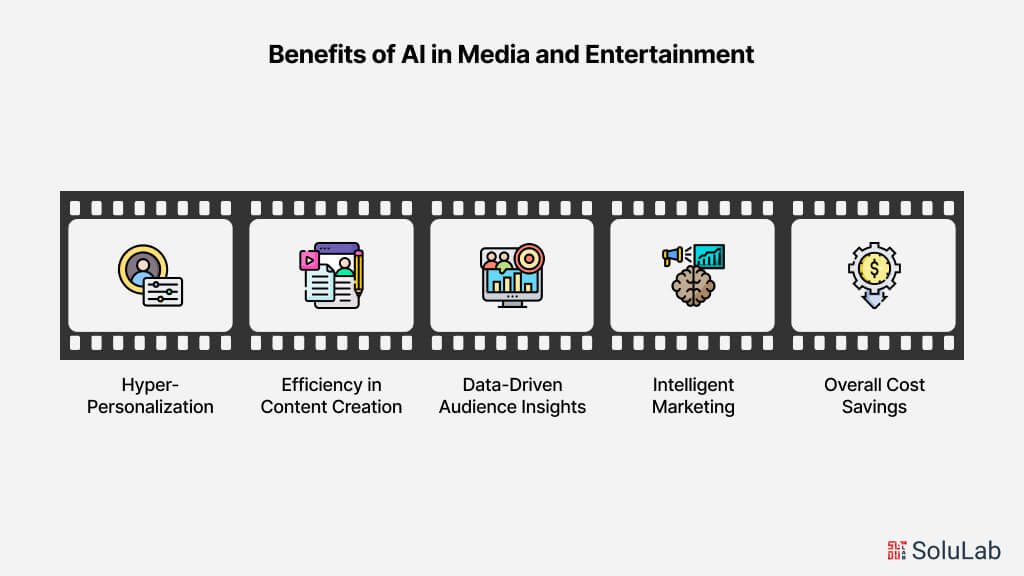
Media production with AI changes and enhances media and entertainment making it economical and personalized entertainment. Here are some more details about its advantages: 

Features Description
Hyper-Personalization Based on loads of user information procured from mobile devices, AI serves media such as movies, episodes of shows, and songs that exactly cater to the user’s requirements. This makes the user happy and stick to what they are using in the sense that they do not get bored with it.
Efficiency in Content Creation Artificial Intelligence in media handling exhibits jobs like computer animations, video footage compilation, and even creating tunes are processes that can be enhanced by Artificial Intelligence. It may now be possible for professionals to concentrate on ideas and directions on the creative side. Scripts can also be analyzed using AI compounding suggestions to enhance them or at least reduce the number of reshoots and these are always big savings.
Data-Driven Audience Insights User activity analysis is done in artificial intelligence to define what entices them. This makes it easy for content producers to fine-tune their marketing strategies and copies for the best results. Think of films that have humor, drama, and action in the right proportions that you would best like. This state of affairs reduces the likelihood of costly mistakes while at the same time satisfying the readers.
Intelligent Marketing AI helps in targeting the right people, in intelligent marketing and advertising, in the right places. Is it possible to imagine only the shows or the movies that you would like to watch in the advertisements? This reduces the unrequired cost of marketing and enhances the income a marketing firm or business organization gets from its investment.
Overall Cost Savings The application of AI in automation saves time in creating streaming videos, improving the quality, decreasing production time, and general production of content. This leads to time-saving on the overall market which is vital, and more importantly, the reduction of the production costs, which is beneficial for both the initiators and recipients of the product.

Real-World Examples 

1. Amazon Prime

With the use of artificial language and machine learning, Amazon has been able to improve its operations and increase operational efficiency. One of Amazon’s best-selling items is Alexa, an intelligent speaker, that can speak 15 different languages available in 80 different countries, constantly improving the creation of customized information. 

2. Netflix

One of the top television networks has revolutionized its technology stack and expanded with a rush throughout 190 countries. By examining past view data, Netflix uses both AI and ML to calculate bandwidth. One of the most important sources of information on what and how viewers act as well as their emotional gaze is now considered as metadata.

3. VR and AR

AI apps have increased the possibilities of AR and VR by allowing media and entertainment companies to create immersive experiences or non-player characters in video games which enhances user experiences. Both AR and VR are becoming more and more common because of the growing number of artificial intelligence-supported materials as well as the decreasing cost of equipment. 

Read Our Blog: Impact of AI on Copywriting

Future Of AI in Media and Entertainment 

As it looks, the future of AI in media and entertainment is not only brimming with new opportunities but also evolving continuously to provide consumers with even more immersive and tailored experiences. To understand this better try to think of it as an interactive narrative that will adapt to your choices, content requirements, and user-specific taste. As far as media and entertainment are concerned AI will now play a crucial role in preventing fraud news, filling the gaps between reality and fiction, and creating a new environment for storytelling.

However, with AI there will always be a challenge to consider ethical understanding to avoid potential biases and spread of misinformation. The future of media and communication is more inclined towards a collaboration of humans and AI altogether for creating a distinct dynamic landscape for workflows and pushing the boundaries. 

AI Services

Take Away

To sum up, it is possible to state that artificial intelligence has a highly transformative impact on the media and entertainment industry. AI has a massive impact on the improvement of such facets as simplified content creation, content authenticity protection, and integrated suggestions, as well as the provision of enhanced virtual experiences. Quite to the contrary, the situation is much more exciting than some might perceive it and fear the AI-written scripts or computer-generated actors. AI is making human creativity even better since creators focus on creating content’s DNA and properly formatting it since AI could do the rest. 

In the future, we could probably see even more innovative, lifelike experiences that blur the perception of entertainment and real life as an implication of AI. Due to the continual progress of artificial intelligence and people’s imagination, the media and entertainment industries have promising perspectives. It is your time now to hire an AI developer or an AI development company to see the changes that artificial intelligence in media and entertainment is bringing to the table.

FAQs

1. Can AI be used in the media and entertainment industry?

Yes, AI is used in media and entertainment not alone for creation of the content but also for providing improved advertising and marketing, better animations, and allows extraction of real-time clip extraction. 

2. What does metadata mean in Media?

Metadata in media refers to the data about other data, in simple words it stands for the description of the information that is being shared, like how and when was the content created, and when was it modified recently. 

3. Are there any problems involved with metadata in media and entertainment?

The main metadata problems in media and entertainment are because of the volume of content which has expanded and the variety of metadata sources and formats with metadata at scale offer issues. 

4. What are the recent trends of 2025 in media and entertainment? 

The most recent trends of 2025 in the media and entertainment industry are the creative use of NFTs and digital treasures, the supremacy of OTT platforms such as Netflix for streaming, and making immersive experiences possible. 

5. Can SoluLab help with using AI for entertainment and media?

Indeed! It considers how it may enhance the live experiences, generate more content in less time, as well as tailor them. SoluLab can collaborate with you on the most exciting prospects of using AI to change your media and entertainment business.

 

AI in Social Media: Transforming Engagement

AI In Social Media

In the twenty-first century, artificial intelligence has turned out to be an influential force that is converting each aspect of our everyday lives. Its most important impact is seen within the social media surroundings, which has taken center degree because of the primary online interplay and connection platform. AI in social media is now an amazing force this is changing the dynamics of our online interactions, influencing the whole thing from the commercials that overtake our feeds to automated content moderation and customized content material suggestions.

The integration of artificial intelligence in social media systems is a strategic flow that could revolutionize how agencies interact with their target audience and the market. AI allows agencies to automate and improve a couple of components of their social media presence, which include content moderation, customer service with the help of AI chatbots, and a streamlined concentration on the audiences. In addition to this, AI empowers organizations to offer tremendously customized content material tips, growing a tailored revel that enhances user engagement and boosts conversions.

In this blog, we will assist you in apprehending the entirety related to AI for social media and the way this generation can remodel how we interact and interact in the digital age. We will even look into real-life examples of how is AI used in social media to attain maximum ROI and explore this environment’s contemporary and future developments. 

Overview of AI in Social Media

Artificial intelligence for social media refers to the use of modern technologies in the framework of social networking systems. This consists of harnessing the power of AI algorithms and gadgets gaining knowledge of models to beautify numerous components of social media, along with consumer engagement, content advent, and data interpretation. The essential goal of AI inside the social media domain is to beautify user interactions, simplify advertising operations, and empower knowledgeable, records-sponsored choice-making.

AI is remodeling social media, making it more personalized, efficient, and attractive for users and companies. AI algorithms can analyze consumer behavior and alternatives to supply tailored content and suggestions. This enables users to find new and thrilling content and hook up with human beings and groups they’re most possibly interested in.

AI can also help organizations to automate and streamline their advertising efforts. For example, AI-powered equipment can help discover the best clients, create personalized advert campaigns, and measure the ROI of marketing campaigns.

The mixture of personalization, efficiency, and knowledgeable decision-making is the driving pressure at the back of AI’s transformative effect on social media. It has turned out to be the defining characteristic of the AI era, bringing in an era of smarter and greater attractive online reports.

AI’s capacity to realize user preferences, behavior, and context permits social media systems to supply exceptionally resonant content to every individual. This degree of personalization is innovative, creating a digital landscape where customers experience a deep connection with the content they witness, increasing the general experience of engagement.

The market size for AI in social media attained a valuation of $2.2 billion in 2023, witnessing a CAGR of 28.3%. The increasing marketplace size can be attributed to the increasing adoption of AI generation in the social media ecosystem that lets most important brands leverage data-driven insights for powerful marketing techniques and customized consumer experiences.

Applications of AI for Social Media

AI has a significant influence on the panorama of social media. It can help in enhancing personalization, performance, and content relevance. There are a couple of programs of artificial intelligence in social media that help enrich consumer experiences and streamline operations. Let us look at a couple of AI social media applications to recognize the effect of artificial intelligence on social media: 

  • Sentiment Analysis

AI is employed to investigate the sentiment of social media posts and comments. This helps companies to recognize the overall mood and feelings behind content material however additionally assists in monitoring patron comments and reactions. For instance, Twitter employs sentiment analysis algorithms to determine the emotional tone of the user’s tweets. This enables the companies to apprehend how people are feeling about particular subjects or manufacturers, taking into account actual-time insights into public opinion and sentiment trends.

  • Chatbots and Virtual Assistants

AI-powered chatbots offer actual-time help and facts to customers. They can solve questions whilst guiding users toward relevant content material and improving client engagement. For instance, Facebook Messenger’s social media chatbots increase the platform’s customer support by presenting quick responses to user inquiries, fostering engagement, and enhancing consumer stories, thereby keeping users active and increasing the time they spend on the platform.

  • Trend Analysis

AI is utilized to become aware of emerging tendencies and subjects in a couple of social media conversations. This empowers agencies to create content material that resonates with the modern-day pursuits and conversations in their target market. For example, Twitter uses AI for social media posts to tune trending hashtags and topics, allowing companies to align their content with famous discussions.

Related: AI in Trend Analysis

  • User Behavior Prediction

AI algorithms can expect user conduct by way of reading their past interactions and alternatives. This empowers groups to provide fairly customized content and guidelines, fostering stronger patron engagement and pleasure. For example, Facebook makes use of AI to expect personal behavior by analyzing their interactions and alternatives.

  • Voice and Speech Recognition

AI-pushed speech popularity technology increasingly integrates into social media structures, enabling voice commands and transcription services for diverse purposes. For example, social media structures like Facebook have incorporated AI-powered voice popularity to offer voice instructions and transcription services.

  • Advertising Management

AI-enabled equipment streamlines marketing with the aid of analyzing patron facts and targeting ad variations. For example, Facebook’s ad platform utilizes AI to optimize advert delivery based totally on consumer behavior. It is one of the simplest platforms that can help you analyze the impact of artificial intelligence on social media.

Related: Impact of AI on Consumer Electronics

  • Influencer Marketing

AI in marketing allows for identifying the right influencer for a specific ad marketing campaign. Platforms like AspireIQ use AI in social media marketing to shape manufacturers with influencers whose target audience demographics align with the campaign’s target market.

  • Content Moderation

AI-driven bots test and filter out content for spam, tenet violations, or beside-the-point fabric. For instance, Instagram employs AI to dam comments that violate its hints. Video Filtering

AI in facial recognition and photograph analysis software acknowledges facial systems and identifies customers making use of overly edited filters, ensuring content great and authenticity. For example, TikTok employs AI-based facial popularity and photo analysis to perceive customers who observe immoderate and unnatural filters in their videos.

After looking at a couple of AI in social media examples, let us look at more than the many benefits it offers to agencies across the globe.

CTA1

Benefits of AI in Social Media

Artificial intelligence is unexpectedly transforming the social media panorama. AI algorithms now electricity diverse capabilities and equipment that make social media extra personalized, efficient, and engaging for customers and businesses. Here are a number of the key advantages of AI use in social media: 

  • Personalized Content Recommendations: AI can examine consumer behavior and choices to propose content more likely to hobby them. This helps your users discover new and thrilling content and save time by way of keeping off inappropriate content material.
  • Improved Search Results: AI can help to enhance the accuracy and relevance of seeking consequences. This makes it easier for your customers to locate the information they are trying to find quickly even saving treasured time.
  • Language Translation: One of the foremost blessings of AI use in social media is language translation. AI can translate languages in real-time, making it less complicated for your customers to hook up with people globally.
  • Spam and Malware Detection: Artificial intelligence for social media platforms may be used to come across and dispose of spam and malware. This helps to create a safer and extra stable environment for your customers.
  • Harmful Content Moderation: AI can be used to perceive and take away harmful content material from social media platforms, such as hate speech and violence. This helps to create a greater wonderful and inclusive surroundings for your users.
  • User Privacy Protection: AI may be used to defend consumer privacy by using encrypting records and growing new technologies that hold privacy.
  • Ideal Customer Identification: AI can be used to analyze personal conduct and preferences facts to pick out and target ideal clients. This lets you target the right humans with the right advertising efforts.

Related: Generative AI in Customer Service Experience

  • Personalized Ad Campaigns: AI can be used to create personalized advert campaigns tailor-made to character customers’ interests. This helps you to boost the effectiveness of your marketing campaigns. 
  • ROI Measurement: AI can be used to tune and degree the results of advertising and marketing campaigns. This information may be used to perceive which campaigns are performing well and make vital modifications.
  • Data-Driven Content Creation: AI can examine facts on consumer engagement to pick out the varieties of content that their target market is most interested in. It is one of the advantages of AI use in social media that allows businesses to create and proportion content much more likely to be visible, favored, and shared.
  • Efficient Customer Support: AI-powered chatbots can offer 24/7 customer support, responding to customer inquiries promptly and effectively. This helps you to improve your client’s pride and loyalty.
  • Exciting Contests and Giveaways: AI may be used to run social media contests and giveaways extra effectively and efficiently. For example, AI may be used to routinely choose winners and distribute prizes. To improve contest visibility on Instagram, brands can also collaborate with credible paid followers who help distribute the giveaway content through their own profiles, increasing overall participation.
  • Data-Driven Strategies: AI can help businesses gather and analyze social media performance records. These records may be used to perceive regions for development and increase greater effective social media strategies. For instance, companies can use social media analytics information to identify which forms of content are appearing properly, which channels power the maximum visitors, and which influencers generate the maximum engagement

Future AI Trends in Social Media

Future AI Trends in Social Media

As artificial intelligence keeps conforming, it’s reshaping the social media panorama in extraordinary methods. Keeping abreast of the modern-day developments in AI for social media and expertise the destiny outlook is vital for groups seeking to stay beforehand and leverage that technology effectively. Let’s delve into the trendy developments and what they imply for businesses: 

  • AI-Driven Chatbots

AI-powered chatbots have revolutionized social media customer service by way of presenting immediate responses, streamlining inquiries, and offering personalized assistance. Voice bots pushed by means of AI are also gaining a reputation, allowing customers to engage with the social media channel through voice instructions and responses. Businesses are investing in chatbots as a result of the AI trend for social media, which increases customer interaction and provides round-the-clock service.

  • Augmented Reality (AR) in Social Media

AR has revolutionized social media, making it interactive and tasty. Businesses are leveraging AR to interact with users through interactive marketing campaigns and branded AR stories. Platforms like Instagram and Snapchat offer AR filters that businesses use to reinforce brand visibility and increase consumer engagement.

  • AI for Content Creation

AI is a useful asset in content material introduction, assisting businesses in producing pinnacle-notch and applicable content material for their favored target market. By reading consumer behavior and choices, AI algorithms allow content creators to understand what content simply connects with their target audience. AI-generated content, inclusive of articles, product descriptions, and social media posts, successfully conserves the time and assets of organizations.

  • Video Analysis and Recognition

Video content material popularity is growing unexpectedly with every passing day. AI-powered tools are being incorporated into social media platforms to identify and evaluate language, faces, and objects in videos. This allows agencies to higher apprehend consumer-generated content, acquire insights, and improve video engagement through vehicle-captioning, sentiment analysis and targeted video pointers.

  • AI-Powered Influencer Marketing

AI plays a first-rate position in identifying the best influencers for brands. Through system learning algorithms, it could assess influencer demographics, content appropriateness, and audience engagement. This permits social media platforms to attach brands with influencers who set up authentic connections with their audiences, resulting in extra-a-hit influencer advertising campaigns carried out within the app.

Related: AI in Gaming

  • Privacy and Data Protection

As AI continues to accumulate and examine personal facts, making sure privacy and records safety turns into essential. Businesses are staying knowledgeable about the ever-changing policies and security features related to AI for social media. Since users are becoming more involved in using their statistics, agencies are looking forward to methods to address those worries for you to set up and consider.

  • Hyper-Personalization

AI is revolutionizing personalization by handing over hyper-customized content and suggestions primarily based on the man or woman person preferences and conduct. This fashion that highlights the position of synthetic intelligence in social media presents a unique opportunity for agencies to interact with customers on a one-to-one degree, resulting in elevated personal pride and loyalty. 

  • AI-Powered Social Media Assistants

For social media businesses, AI-Powered Social Media Assistants may simplify customer interactions, content sharing, and account management.

  • AI-powered Social Media Analytics

AI-powered Social Media Analytics offer social media manufacturers comprehensive information-driven insights. AI trends permit them to create more effective and exactly centered advertising campaigns, refine their techniques to align with audience choices, and optimize their approach to drive higher engagement and user pleasure.

  • Deepfake Detection

Deepfake Detection, powered via AI, plays a crucial position in ensuring the authenticity of content shared on social media structures. By utilizing advanced synthetic intelligence algorithms, this era is capable of identifying and flagging manipulated content inclusive of videos or snapshots, that have been altered to deceive viewers. This functionality is of utmost significance in fostering trust and security within those platforms, because it enables you to save from the spread of incorrect information and fraudulent content material.

  • Content Creation Assistance

AI gear is set to revolutionize content creation by supplying assistance to content material creators in numerous approaches. This equipment will recommend subjects, generate captions, and even create visual elements, making sure a consistent go-with-the-flow of extraordinary posts. This functionality enhances personal engagement on the platform, ultimately attracting more users and growing typical hobbies.

Related: AI Agents in Supply Chain and Logistics

  • Regulatory Compliance

Stricter policies surrounding using AI and records privacy are set to emerge in the near future. This would require social media businesses to evolve and comply with the evolving legal frameworks, further safeguarding their operations and consumer acceptance as true.

Best Practices of AI for Social Media

Human intervention is an ought to unleash the strength of AI for social media or any other task. Follow the below-referred practices to keep away from probabilities of errors:

1. Understanding Your Audience

The manufacturers on social media can utilize the maximum capability by figuring out the clients’ variety, work lifestyle, likes, dislikes, familiarity with the logo, evaluations, and other matters. Thus, a sizable part of AI-powered social media advertising for the focused target audience is devising a powerful advertising plan or even the services or products.

2. Choosing the Right AI Tools

Know the necessities earlier than choosing the AI for social media. Being the top or functional device is one of many things to test. Knowing the unique domain or if it meets the intention is essential. For example, if a content material introduction tool meets the desired phrase count, offers plagiarism-loose articles, and can write content or simplest create headings. One may also check if it can optimize or update the content material. Identifying the goals is going for all the required AI equipment.

3. Ensuring Quality Control and Human Oversight

Remember that AI assists people. Quality manipulation over its motion is necessary to recognize the best interpretation of patterns and consequences, and human oversight is the simplest reliable energy to achieve this. Employing any other AI for first-class management is awful for information accuracy, safety, and upholding human values.

CTA2

4. Continuous Learning and Improvement

The viable mistakes must be constantly rectified in AI for social media. The consistent adjustments in demand further require AI improvement to feature well and meet consumer requirements. It will lead to wise social media control and dataset growth. Improvement in best and data augmentation are a few of the techniques for AI development.

5. Adapting to Changes in Social Media Trends and Algorithms

The AI for social media can adapt to everyday modifications in social media by means of imparting commands from applicable sources and summaries of conversations and experiences from online communities.

Concluding Remarks

In conclusion, the integration of AI is significantly transforming social media platforms, enhancing user experiences, and driving innovative solutions across various functions. AI use cases and applications in social media range from personalized content recommendations and advanced image and video recognition to sophisticated chatbots and sentiment analysis. These applications not only streamline user interactions but also enable platforms to deliver more relevant and engaging content, thereby increasing user retention and satisfaction. Furthermore, AI-driven analytics provide deep insights into user behavior, helping businesses to tailor their strategies effectively.

However, the deployment of AI in social media is not without its challenges. Issues such as data privacy concerns, algorithmic biases, and the need for vast amounts of training data can hinder the effectiveness and ethical implementation of AI technologies. SoluLab, as an AI development company, is well-equipped to address these challenges. By using our expertise in developing robust AI applications and ensuring compliance with data protection regulations, we can help social media platforms navigate these complexities. Our solutions are designed to mitigate biases and optimize data usage, ensuring that AI implementations are both ethical and efficient, thus enabling social media platforms to harness the full potential of AI technology. Ready to transform your social media platform with modern AI technology? Contact us today to discover how SoluLab can help you overcome challenges and leverage AI to enhance user experiences and drive growth. 

FAQs

1. How is AI used to improve content recommendations on social media platforms?

AI improves content recommendations by analyzing user behavior, preferences, and interactions. Machine learning algorithms track what users engage with and use this data to suggest similar or relevant content, enhancing the user experience and keeping users engaged for longer periods.

2. What are some common AI applications in social media beyond content recommendations?

Beyond content recommendations, AI applications in social media include chatbots for customer service, sentiment analysis to gauge public opinion, image and video recognition for content moderation, and automated scheduling and posting of content to optimize engagement times.

3. How does AI help in maintaining data privacy on social media platforms?

AI helps in maintaining data privacy by implementing advanced encryption methods, detecting and preventing unauthorized access, and ensuring compliance with data protection regulations. AI can also monitor for unusual activity patterns that might indicate a breach, thereby providing an additional layer of security.

4. What are the ethical considerations for using AI in social media?

Ethical considerations include addressing algorithmic biases, ensuring transparency in how data is used, and protecting user privacy. AI algorithms must be designed to avoid reinforcing harmful stereotypes or unfair treatment of certain groups. Additionally, platforms need to be clear about data collection practices and obtain user consent.

5. How can SoluLab assist in AI development for social media platforms?

SoluLab can assist by providing expertise in developing tailored AI solutions that address the specific needs of social media platforms. They ensure compliance with data protection regulations, mitigate biases in AI algorithms, and optimize data usage for efficient and ethical AI implementation. Their experience helps platforms leverage AI to enhance user engagement and streamline operations effectively.
