


The core of any organization is procurement, which is in charge of managing supplies and supplier relationships. It entails acquiring the products and services—such as raw materials for manufacturing or daily services—that are required for a business to run. A company’s financial performance, sustainability, and competitiveness are all impacted by effective procurement processes. Businesses might experience significant gains in procurement when they use advanced analytics. For instance, Sanofi achieved an average 10% reduction in spend through should-cost modeling, and an advanced analytics platform reduced the time required to evaluate tenders by two-thirds. Furthermore, digitally enabled negotiations increased the savings achieved by 281%.
“Request for X,” or “RFx,” is a commonly used procurement phrase that encompasses a variety of vendor requests. For many forms of procurement papers, including Request for Proposal (RFP), Request for Quotation (RFQ), and Request for Information (RFI), the letter “X” acts as a stand-in. Transparent bidding, negotiations, vendor selection, and communication are made possible by these procedures. RFx makes sure companies get the most out of their investments while meeting compliance and quality standards.
Conventional RFx responses, however, have significant difficulties. Data input and analysis are two procedures that take time and increase the chance of bias and mistakes when done by hand. Procurement is transformed when AI into the RFx response is used, allowing teams to make data-driven, fast, and correct decisions. Businesses may save costs, reduce risks, and gain a competitive edge in today’s fast-paced market through increased productivity, strengthened supplier relationships, and strategic insights from AI-driven analytics.
In addition to discussing the basics of AI for RFx response, this blog will address the fundamentals of RFx response and how AI may expedite the process. It will also offer advice on how to create an AI-powered RFP response system.
RFx refers to Request for X, where “X” can refer to a variety of items, including a proposal (RFP), a quote (RFQ), or information (RFI). These are the typical RFx responses utilized by business and procurement operations.
These RFx documents are critical in procurement procedures because they assist buyers in acquiring information, analyzing possibilities, and making educated decisions when selecting suppliers or providers. They also give suppliers clear guidance on what is expected and how their offers will be assessed.
Read Also: AI Agents for Procurement
The structure presented below is a classic and widely used style for RFx responses, particularly Requests for Proposals (RFPs). It has the following sections:
Here’s an overview of how RFx responses are commonly structured:
1. Cover Letter/Introduction: The response frequently starts with a cover letter or introduction in which the supplier introduces themselves, shows interest in the offer, and emphasizes significant aspects of their organization.
2. Compliance Matrix: It is typical for suppliers to include a compliance matrix in their RFP responses, which matches the RFP criteria with the respective sections or pages of their response. This assures comprehensive covering of all needs and makes evaluation easy for the customer.
3. Executive Summary: This part summarizes the supplier’s proposal, emphasizing important features, advantages, and reasons why the customer should select their solution.
4. Detailed Answer: Following the executive summary, the response often includes thorough information addressing each need or question mentioned in the RFx document. Suppliers utilize this opportunity to provide information about their products/services, their strategy for addressing the buyer’s needs, planned implementation plans, price frameworks, and any other relevant details.
5. Technical Specs: In RFPs and RFQs, suppliers may give technical specifications, product details, or service descriptions to illustrate how their offering fulfills the buyer’s needs.
6. Pricing: It is an important consideration when responding to an RFQ. Suppliers give specific price information, such as unit costs, volume discounts (where available), terms and conditions, and any additional fees.
7. References and Case Studies: Suppliers may add references, testimonials, or case studies to illustrate their success and trustworthiness in providing related products or services to previous clients.
Finally, the response may involve the proposed agreement’s terms and conditions, such as terms of payment, warranties, service level agreements (SLAs), and other contract specifics. This traditional style is intended to give a clear and thorough summary of the supplier’s proposal, covering all parts of the RFx criteria and making it easy for buyers to assess the responses.
Artificial intelligence (AI) transforms the RFx response process by fusing advanced analytics, machine learning, and natural language processing to improve submission accuracy, streamline document creation, and boost overall productivity. AI allows for quicker, more accurate solutions suited to the individual requirements of each RFx by leveraging powerful Large Language Models (LLMs) and integrating them with organizational statistics.
The AI-powered RFx response system’s architecture combines several parts and functions as follows:
1. Sources of Data: Diverse and comprehensive data inputs are necessary for effective RFx response techniques, such as:
2. Data Pipelines: The data from these many sources undergoes processing using complex data pipelines that manage ingestion, cleansing, and structuring, prepping it for further analysis.
3. Embedding Model: An embedding model processes the prepared data. This approach converts textual input into numerical representations termed vectors, which AI models can interpret. OpenAI, Google, and Cohere have all developed notable embedding models.
4. Vector Database: The created vectors are kept in a vector database, including Pinecone, Weaviate, or PGvector, which allows for efficient and speedy searching.
5. APIs and Plugins: APIs and plugins including Serp, Zapier, and Wolfram play a crucial role in linking different components and providing new functionality, such as obtaining more data, connecting with external tools or platforms, or completing specific activities.
6. Query Execution: It starts when the user sends a query to the RFx response app. These inquiries may be connected to particular RFx requirements, strategic guidance, or document preparation.
7. LLM Processing: After receiving the query, the app sends it to the orchestration layer. This layer gathers pertinent information from the vector database and LLM cache and routes it to the appropriate LLM for processing. The nature of the question determines which LLM to use.
8. Output: The LLM produces an output based on the query and data it receives. This output can take several forms, including proposed compliance checks and strategic suggestions based on the RFx specifications.
9. RFx Response App: This specialized software helps proposal teams effectively modify and finish proposals by providing AI-generated drafts and insights in an approachable way.
10. Feedback Loop: Another crucial component of this design is user input on the result of the LLM. User feedback is included in the system to constantly enhance the relevancy and accuracy of the LLM’s results.
11. Agent: AI agents enter this phase to tackle challenging issues, engage with the outside world, and improve learning via experiences after deployment. They accomplish this by using strategic tool use, complex reasoning/planning, memory, recursion, and self-reflection.
12. LLM Cache: To speed up the AI system’s reaction time, frequently used data is cached using programs like Redis, SQLite, or GPTCache.
13. Logging/LLMOps: LLM operations (LLMOps) tools such as Weights & Biases, MLflow, Helicone, and Prompt Layer are used during the process to record activities and analyze performance. This guarantees that the LLMs run at maximum effectiveness and evolve continuously via continuous feedback mechanisms.
14. Validation: A validation layer is used to ensure that the LLM output is correct. This is accomplished via technologies such as Guardrails, Guidance, Rebuff, and LMQL, which assure the quality and dependability of the information presented.
15. LLM APIs and Hosting: In order to host the application and carry out RFx response duties, LLM APIs and hosting platforms are necessary. Depending on the specifications, developers can use open-source models or LLM APIs from companies like Anthropic and OpenAI. In a similar vein, customers may select hosting platforms from cloud service providers such as Databricks, Mosaic, Anyscale, AWS, GCP, Azure, and Coreweave, or they can go with clouds with strong opinions. The requirements of the project and the preferences of the developers choose which cloud hosting platforms and LLM APIs to use.
This structured flow describes how AI uses powerful data analysis and technologies to expedite preparation, increase quality, and raise response rates of success in the RFx response process.
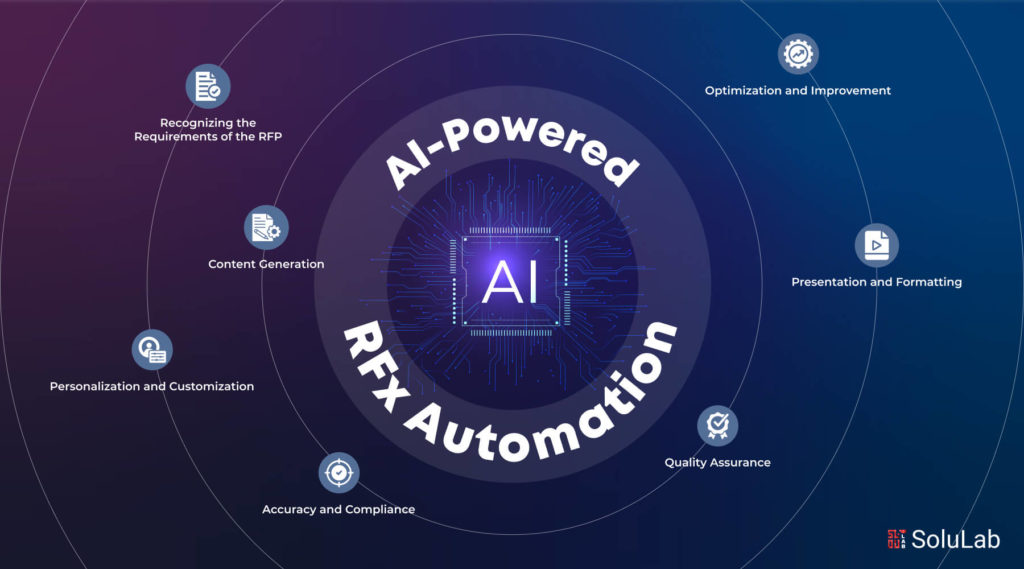
Responding to requests for proposals (RFPs), requests for quotes (RFQs), or requests for information (RFIs) can be intricate and time-consuming. Below are some common challenges in RFx responses and how AI-powered solutions can address them:
Challenge: RFP documents often contain numerous questions that touch on various aspects of a project or product. Accurately understanding the nuances and requirements of each question is crucial for crafting a compelling response.
AI-RFX Procurement Solution: Natural Language Processing (NLP) techniques can analyze RFP documents, extracting essential questions and requirements to provide a clearer understanding.
Challenge: Organizations typically have extensive content repositories, including past proposals, case studies, white papers, and product information. Manually searching for relevant content segments can be labor-intensive and time-consuming.
AI-Powered RFx Management Solution: Artificial intelligence (AI)-powered content management systems can quickly suggest pertinent information from sizable collections, improving response effectiveness and consistency.
Challenge: Writing comprehensive and well-structured responses within tight deadlines can be challenging, especially for complex RFPs that require input from multiple stakeholders.
AI-RFX Procurement Solution: AI can generate initial drafts of proposals, providing a solid foundation for further refinement by human experts.
Challenge: Each RFP is unique and may require tailored responses that address the issuing organization’s specific needs, goals, and preferences.
AI-Powered RFx Management Solution: AI tools can customize existing content to meet the unique requirements of each RFP, ensuring a personalized response.
Challenge: Responses to a lot of RFPs have to be sent via online portals or platforms, which frequently contain guidelines for formatting and document uploads.
AI-RFX Procurement Solution: AI automation simplifies the submission process by handling form filling, document uploads, and adherence to guidelines.
AI and analytics improve RFx processes by enhancing collaboration, establishing clear evaluation criteria, enabling data-driven decision-making, improving communication, and automating response evaluations.

One of the most significant developments in the procurement process is the incorporation of AI into RFx response. Let’s see how AI-powered RFx management can be done in each stage of the RFP response procedure using the following example:
AI response process integration can increase response quality overall, increase accuracy, and simplify procedures. By utilizing AI-powered RFx, organizations may boost output, cut down on manual labor, and provide more persuasive and competitive RFP responses.
Responding to requests for proposals (RFPs), requests for quotes (RFQs), or requests for information (RFIs) can be intricate and time-consuming. Here are some of the applications of AI in RFx processes:
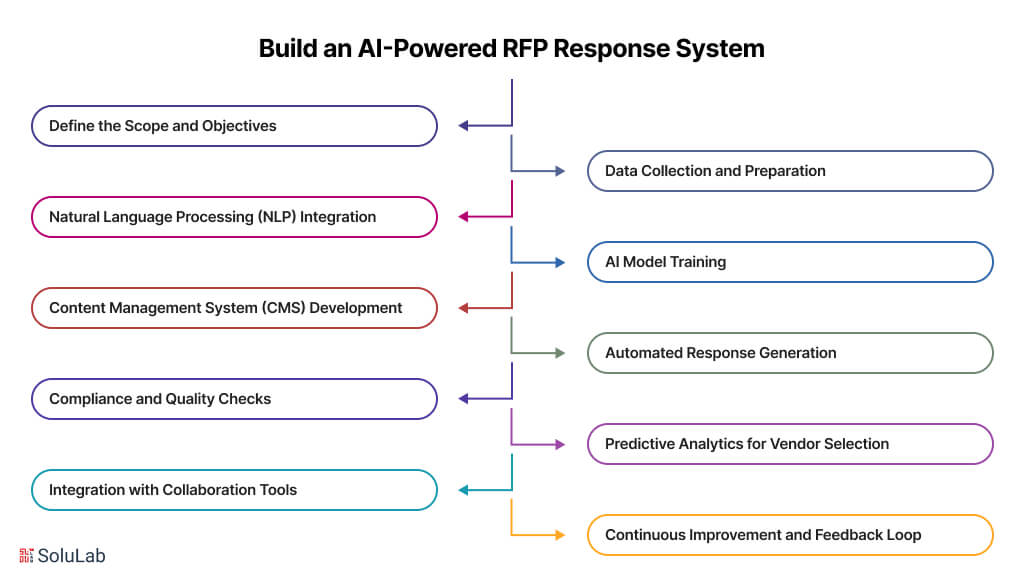
Creating an AI-powered RFP response system involves several key steps. This process integrates various AI technologies to streamline and enhance the efficiency of managing RFPs. Here’s a guide to building an effective AI-powered RFx management system:
Start by identifying the specific goals you want to achieve with your AI-powered RFP response system. Determine the challenges you aim to address, such as reducing response time, improving accuracy, or increasing win rates. Clear objectives will guide the development process and ensure that the system meets your organization’s needs.
Gather a comprehensive dataset of past RFPs, RFQs, and RFIs, along with corresponding responses, successful proposals, and other relevant documents. To train successful AI models, you need high-quality data, therefore make sure this data is clean and well-organized. To ensure confidentiality and abide by data privacy laws, anonymize sensitive information.
To help the system comprehend and handle RFP materials, apply natural language processing (NLP) approaches. NLP algorithms can extract key information, such as project requirements, deadlines, and evaluation criteria, from the RFP documents. This allows the system to generate relevant and accurate responses.
Train AI models using historical RFP data. Utilize machine learning techniques to find trends and insights in bids that are successful. These models can learn to predict the best responses and recommend content based on past performance. Regularly update and retrain the models to improve accuracy and adapt to changing requirements.
Develop a robust content management system that stores all relevant documents, such as past proposals, case studies, and product information. Integrate AI-powered search capabilities to quickly retrieve relevant content segments. This ensures that the system can efficiently generate tailored responses based on the vast repository of information.
Use AI algorithms to create proposal response first drafts quickly. Use template-based approaches combined with AI-driven customization to ensure that responses are tailored to specific RFP requirements. This speeds up the response process and provides a solid foundation for further refinement by human experts.
Incorporate automated compliance checks to ensure that responses adhere to formatting guidelines, legal requirements, and other specifications. Use AI to review responses for consistency, accuracy, and completeness. This reduces the time and effort required for manual compliance checks and ensures high-quality submissions.
Leverage predictive analytics to enhance vendor selection processes. AI algorithms can analyze vendor performance data, market trends, and other relevant factors to predict which vendors are most likely to meet the buyer’s needs. This helps in making data-driven decisions and improves the chances of success.
Integrate the AI-powered RFP response system with existing collaboration tools used by your team. This facilitates seamless communication and collaboration among team members, ensuring that inputs from various stakeholders are efficiently incorporated into the response process.
Establish a feedback loop to continuously improve the AI-powered RFP response system. Collect feedback from users to identify areas for enhancement and update the system accordingly. Analyze the performance of submitted proposals to refine AI models and improve future responses.
By following these steps, you can build a comprehensive and effective AI-powered RFx Management system that streamlines the RFP response process, enhances accuracy, and increases your organization’s competitive edge.

In conclusion, the automation of procurement through AI-powered RFx Management revolutionizes how organizations handle RFPs, RFQs, and RFIs. By leveraging advanced AI technologies, businesses can streamline their response processes, enhance accuracy, and make data-driven decisions with unprecedented efficiency. From automated proposal generation and compliance checks to predictive analytics for vendor selection, AI significantly reduces the time and effort required for procurement activities. This transformation not only boosts productivity but also increases the likelihood of winning bids, thereby giving organizations a competitive edge in the marketplace.
However, implementing an AI-RFx procurement system comes with its own set of challenges, such as data quality issues, integration with existing systems, and the need for continuous model updates. This is where SoluLab, as a leading AI development company, can make a difference. SoluLab offers comprehensive solutions to address these challenges, ensuring seamless integration, high-quality data management, and regular model training to keep your AI system up-to-date. With a team of experts in AI and procurement processes, SoluLab provides tailored solutions that meet your specific needs. Ready to transform your procurement process? Contact us today to learn how we can help you harness the power of AI for AI-powered RFx management.
AI-powered RFx management involves using artificial intelligence to streamline and automate the processes of handling requests for proposals (RFPs), requests for quotes (RFQs), and requests for information (RFIs). It enhances efficiency by automating tasks such as document analysis, response generation, and vendor selection.
AI improves the procurement process by automating repetitive tasks, analyzing large datasets for better decision-making, and ensuring compliance with requirements. This reduces the time and effort involved, improves accuracy, and increases the likelihood of successful bids.
Challenges include data quality issues, integration with existing systems, and the need for continuous model updates. Ensuring that AI systems are trained on accurate and relevant data is crucial for their effectiveness.
SoluLab provides end-to-end AI solutions tailored to your procurement needs. Our services include seamless integration, high-quality data management, and regular model updates, ensuring your AI system remains effective and up-to-date.
To get started, you can reach out to an AI Consulting company like SoluLab. Our team of experts will work with you to understand your needs, develop a customized solution, and implement it seamlessly into your procurement process.


