Talk to an Expert

AI in Media and Entertainment: Use cases, Benefits, Future and solution

AI in Media and Entertainment

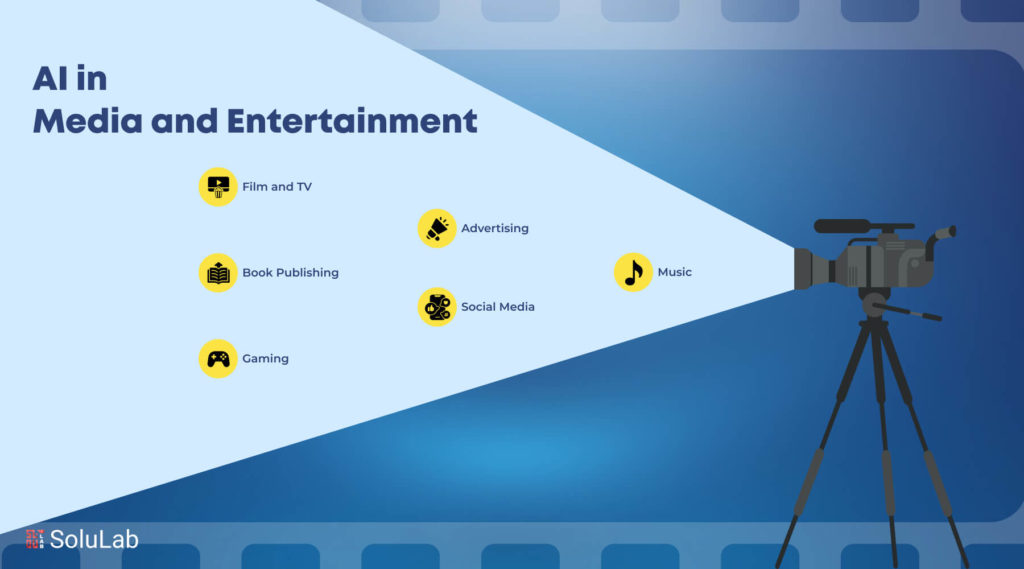
The Media and Entertainment Industry has always been about thinking outside the box and even more now with AI use cases leading the charge. Regarding artificial intelligence, there is no such concept in science fiction anymore. Indeed the M&E sector globally is a fast-evolving industry and the same can be said about this part of the world. The utilization of AI in media and entertainment is now an essential part of global society as it ranges from depicting realistic special effects in Hollywood movies to recommending your next film on Netflix. While it is influencing entertainment to the highest degree, this element is also revolutionizing the very media, both its production and distribution.

How AI Works in Media and Entertainment?

In this media and entertainment industry, AI brings significant changes through aspects such as assigning tasks, increasing creativity, and improving the experience. artificial intelligence in media and entertainment function is based on the ability to embrace large amounts of information, observe patterns, and utilize this knowledge to accomplish certain tasks. AI is capable of providing the real voices of characters, indicating possible enhancements of speech in scripts, and composing original musical scores for films.

It can also create realistic CGI characters and environments, thus, there is no more a need for another exhausting traditional method. As for distribution, AI in media and entertainment algorithms uses the analysis of data provided by users to provide the latter with content they would presumably find useful. Also, the studios get in a better position to understand the fans’ needs and trends and thus be in a position to alter their next productions.

Further, AI in social media marketing is being applied to such rich engagements, in the form of chatbots that discuss with the users and provide personalized responses, and is even being used to generate realistic deep fakes and raise ethical concerns for opening up new possibilities. The benefits of AI in social media are changing the landscape of media and entertainment making it more efficient for creators and audiences.

What is the Impact of AI in Media and Entertainment?

AI in the entertainment industry and the benefits of AI in media are no longer seen as futuristic. It is revolutionizing the media consumption of entertainment altering not only the programs and the music that are watched and listened to, but also the games books read and played. The Global AI In Media And Entertainment Market size is expected to be worth around USD 195.7 Billion by 2033, from USD 17.1 Billion in 2023, growing at a CAGR of 27.6% during the forecast period from 2024 to 2033. Let’s examine the complex effects of AI in several important domains: 

Content Creation

  • Music: The technology is creating lyrics, writing melodies, and some artists’ replicas, all of which are thought-provoking. There are companies like Jukebox that are designing the smart music generation which has attributes of artificial intelligence, on the other hand, there are platforms like music that employ artificial intelligence for the creation of soundtracks. Perhaps, applying artificial intelligence in the given case will not allow one to get rid of human composers, still, it can be a helpful assistant in choosing new ideas and tones of a musical composition.
  • Film & TV: AI is finding its way into film and television production enhancing the processes behind the scenes. Challenging tasks including color grading, screenplay reviewing, and even the use of special effects are being done by it. AI agent use cases for instance can generate weather effects, and synthetic crowd behavior, that otherwise can consume artistic personnel’s valuable time and resources focusing them on narrative crafting.
  • Book Publishing: It has become possible for authors to seek help for duties such as grammatical checks, plagiarism checks, and character descriptions among others from automated editing assistance. AI can also rate the readers to help the publisher know the articles that hold potential.

Personalized Activities

  • Gaming: AI in gaming is now used to send narratives attached to the players’ gameplay, changing the difficulty levels of a game, introducing new characters, or side missions inspired by the user’s decisions. A racing game where the AI sets an opponent that is of a similar skill level as you.
  • Streaming Services: We may hit the like button on Netflix and belong to Spotify, but these streaming services are powered by artificial intelligence recommendation systems. These algorithms base their suggestions on other content you may have listened to or watched and presume you will enjoy similar content. This is because the recommended individualized strategy enhances content discovery and keeps the users engaged.
  • Advertising: The way advertising is being done is being revolutionized through the use of AI through adverts placed based on the data of users. This ensures that the advertisements that are viewed by the viewers are appropriate to the view’s interests hence enhancing the level of viewership and conversion.

Related: How are AI Agents Redefining Sales and Marketing

Improved Operational Efficiency 

  • Captioning and Subtitling: Media firms are automating the process of adding captions and subtitles for television and film videos by utilizing AI-driven tools with natural language processing (NLP) capabilities. Subtitling is the process of turning a video’s spoken story or conversation into the next language that the viewer speaks, whereas captioning is the written description of all the audio content. 
  • Normalizing Data Automatically: Before this data can be properly evaluated to obtain revenue and content performance insights, it needs to be combined and standardized. At scale, it becomes more expensive and time-consuming to manually aggregate and normalize this data; however, with the aid of AI-powered technologies, data collection, and normalization may now be streamlined. 
  • Metadata Automatic Generation: Artificial intelligence-driven metadata creation systems evaluate television and film assets using machine learning and computer vision techniques to identify everything from emotional tone and explicit content to character and actor appearances and scene descriptions.

Case Study

Top Use Cases of AI in Media and Entertainment 

AI use cases in media and entertainment are a few of the most fascinating ways artificial intelligence is changing this ever-changing landscape: 

1. Recommendations

AI and entertainment are utilized in services such as Netflix and Spotify in which they look at what you like to listen to or watch and suggest other things that you would possibly like to watch. With this kind of approach, viewers are engaged, and; there is always more content to watch because it is recommended based on individual habits.

2. AI Special Effects

When it comes to Special Effects with the help of Artificial Intelligence integrated into the films, one must brace themselves for stunning views. Thus, AI for startups is eliminating time-consuming operations like special effects object removal and background production. This allows great settings, characters, and especially animals in motion pictures and TV shows while letting the artists focus on inspiring work.

3. Social Media Gets Smarter

AI in the media has come to improve all the interactions with social sites and has made it easier and more efficient. These algorithms are growing and adapting to be more functional for the consumer, be it the news feeds seen on Facebook and Twitter down to content filtering seen on most platforms where obscene material is prevalent online.

4. The Emergence of Chatbots

 Are you having difficulties operating a streaming platform or have questions about a new game that was recently released? Machine learning is also making the chatbots smarter and smarter – providing real-time customer service and question responses. It makes the user interface more friendly and at the same time it creates more work for the human attendant to solve other complex issues.

5. Personalized Advertising

Say goodbye to aimless advertising with personal advertising. Based on the collection of the user’s data, AI facilitates advertisement to social media and streaming services. This ensures that viewers are fed with adverts that are of interest to them which in turn increases the number of viewers who are likely to make the intended purchases.
Benefits of AI in Media and Entertainment 

Benefits of AI in Media and Entertainment

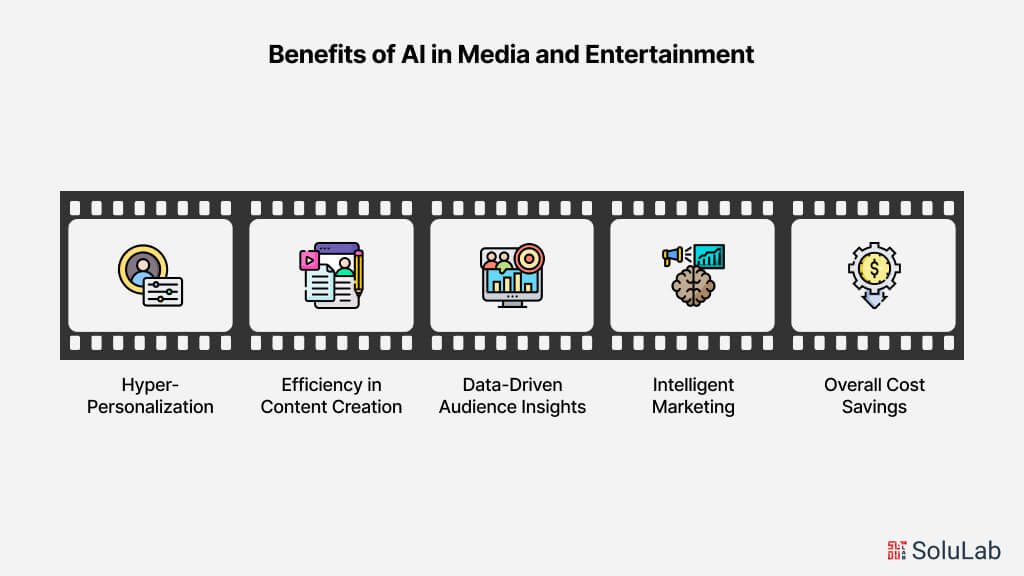
Media production with AI changes and enhances media and entertainment making it economical and personalized entertainment. Here are some more details about its advantages: 

Features Description
Hyper-Personalization Based on loads of user information procured from mobile devices, AI serves media such as movies, episodes of shows, and songs that exactly cater to the user’s requirements. This makes the user happy and stick to what they are using in the sense that they do not get bored with it.
Efficiency in Content Creation Artificial Intelligence in media handling exhibits jobs like computer animations, video footage compilation, and even creating tunes are processes that can be enhanced by Artificial Intelligence. It may now be possible for professionals to concentrate on ideas and directions on the creative side. Scripts can also be analyzed using AI compounding suggestions to enhance them or at least reduce the number of reshoots and these are always big savings.
Data-Driven Audience Insights User activity analysis is done in artificial intelligence to define what entices them. This makes it easy for content producers to fine-tune their marketing strategies and copies for the best results. Think of films that have humor, drama, and action in the right proportions that you would best like. This state of affairs reduces the likelihood of costly mistakes while at the same time satisfying the readers.
Intelligent Marketing AI helps in targeting the right people, in intelligent marketing and advertising, in the right places. Is it possible to imagine only the shows or the movies that you would like to watch in the advertisements? This reduces the unrequired cost of marketing and enhances the income a marketing firm or business organization gets from its investment.
Overall Cost Savings The application of AI in automation saves time in creating streaming videos, improving the quality, decreasing production time, and general production of content. This leads to time-saving on the overall market which is vital, and more importantly, the reduction of the production costs, which is beneficial for both the initiators and recipients of the product.

Real-World Examples 

1. Amazon Prime

With the use of artificial language and machine learning, Amazon has been able to improve its operations and increase operational efficiency. One of Amazon’s best-selling items is Alexa, an intelligent speaker, that can speak 15 different languages available in 80 different countries, constantly improving the creation of customized information. 

2. Netflix

One of the top television networks has revolutionized its technology stack and expanded with a rush throughout 190 countries. By examining past view data, Netflix uses both AI and ML to calculate bandwidth. One of the most important sources of information on what and how viewers act as well as their emotional gaze is now considered as metadata.

3. VR and AR

AI apps have increased the possibilities of AR and VR by allowing media and entertainment companies to create immersive experiences or non-player characters in video games which enhances user experiences. Both AR and VR are becoming more and more common because of the growing number of artificial intelligence-supported materials as well as the decreasing cost of equipment. 

Read Our Blog: Impact of AI on Copywriting

Future Of AI in Media and Entertainment 

As it looks, the future of AI in media and entertainment is not only brimming with new opportunities but also evolving continuously to provide consumers with even more immersive and tailored experiences. To understand this better try to think of it as an interactive narrative that will adapt to your choices, content requirements, and user-specific taste. As far as media and entertainment are concerned AI will now play a crucial role in preventing fraud news, filling the gaps between reality and fiction, and creating a new environment for storytelling.

However, with AI there will always be a challenge to consider ethical understanding to avoid potential biases and spread of misinformation. The future of media and communication is more inclined towards a collaboration of humans and AI altogether for creating a distinct dynamic landscape for workflows and pushing the boundaries. 

AI Services

Take Away

To sum up, it is possible to state that artificial intelligence has a highly transformative impact on the media and entertainment industry. AI has a massive impact on the improvement of such facets as simplified content creation, content authenticity protection, and integrated suggestions, as well as the provision of enhanced virtual experiences. Quite to the contrary, the situation is much more exciting than some might perceive it and fear the AI-written scripts or computer-generated actors. AI is making human creativity even better since creators focus on creating content’s DNA and properly formatting it since AI could do the rest. 

In the future, we could probably see even more innovative, lifelike experiences that blur the perception of entertainment and real life as an implication of AI. Due to the continual progress of artificial intelligence and people’s imagination, the media and entertainment industries have promising perspectives. It is your time now to hire an AI developer or an AI development company to see the changes that artificial intelligence in media and entertainment is bringing to the table.

FAQs

1. Can AI be used in the media and entertainment industry?

Yes, AI is used in media and entertainment not alone for creation of the content but also for providing improved advertising and marketing, better animations, and allows extraction of real-time clip extraction. 

2. What does metadata mean in Media?

Metadata in media refers to the data about other data, in simple words it stands for the description of the information that is being shared, like how and when was the content created, and when was it modified recently. 

3. Are there any problems involved with metadata in media and entertainment?

The main metadata problems in media and entertainment are because of the volume of content which has expanded and the variety of metadata sources and formats with metadata at scale offer issues. 

4. What are the recent trends of 2025 in media and entertainment? 

The most recent trends of 2025 in the media and entertainment industry are the creative use of NFTs and digital treasures, the supremacy of OTT platforms such as Netflix for streaming, and making immersive experiences possible. 

5. Can SoluLab help with using AI for entertainment and media?

Indeed! It considers how it may enhance the live experiences, generate more content in less time, as well as tailor them. SoluLab can collaborate with you on the most exciting prospects of using AI to change your media and entertainment business.

 

How are AI Agents Redefining Sales and Marketing

AI Agents in Sales and Marketing

Can you imagine a world where your sales never miss a beat, your marketing campaigns are always on point with your customers, and your business thrives on data-driven insights? Well, don’t just imagine, with the emergence of artificial intelligence (AI) you can make this happen with accuracy and efficiency. AI Agents in Sales and Marketing are evolving with the development of better customer involvement and higher conversion rates. AI is more than automation and virtual assistants, it can transform your future where every interaction is tailored to an individual’s needs.

In the present fast-paced world, the attention span is shrinking, and information overloading, making it even more important for businesses to focus on data-driven campaigns and offer values that resonate with existing customers and attract new ones. This blog will help you understand what AI Agents for Sales and Marketing are, how they enhance the traditional ways of sales and marketing, and how to use AI in sales.

What are AI Agents and What Do They Do?

AI Agents are intelligent software programs designed to automate and enhance tasks in sales and marketing particularly relevant for Gen AI in sales. They leverage artificial intelligence (AI) to analyze data, learn from patterns, and make decisions, ultimately improving efficiency and effectiveness which is crucial. AI gives insights they’d miss otherwise to 73% of consumers and dealers. 

Think of AI Agents in marketing as your virtual assistants, working tirelessly behind the scenes to streamline your processes and handle repetitive tasks like scheduling appointments, sending emails, and qualifying leads. In particular, AI SDR (Sales Development Representative) agents can elevate the early stages of customer engagement by automating lead qualification and outreach, ensuring that potential clients are properly identified and engaged.

AI agents’ examples go beyond simple automation. They can also help you to manage the complexities of and ensure a smooth launch. For example, they can automate outreach to potential investors, analyze market trends to identify ideal launch timing and personalize communication to maximize engagement. By leveraging AI in sales, you can streamline your sales process, optimize your marketing efforts, and increase your chances of success. 

Role of AI Agents in Sales and Marketing

Role of AI Agents in Sales and Marketing

The relationship managers between consumers and businesses are becoming more associated with the touch of AI agents, which are prominent assets to artificial intelligence and sales. Essentially, AI use cases and applications show these agents play a complex role in today’s sales and marketing industries.

1. Enhanced Personalization

AI for startups can analyze a large turnover of consumer information such as; their demographic data, interconnect internet usage, and past orders. Since they can collect information about the customers, they can advise how to work and sell their products to every customer uniquely. Imagine how such a Generative AI in E-Commerce can benefit the overall relevancy and efficiency of a campaign by creating a stream of emails with products that correspond to the client’s purchase history.

2. Streamlined Sales Automation

For sales AI agents can be used to drive many of those time-wasting activities such as appointment making, follow-up e-mails, and even the qualification of prospects. This makes it gives the human salespeople more time to dedicate their time in brewing relationships, closing the sales, and coming up with more projects such as projects. Organizations can also manage the marketing AI agent because options for cost savings are nearly endless in terms of automation.

Read Our Blog: Role of AI Agents in Supply Chain and Logistics

3. Better Lead Scoring and Generation

The field of Cognitive Sciences can engage web and consumer data to detail possible customers with buying intentions. The qualified prospects are thus eagerly out there waiting to be contacted by the salespeople to enhance the chances of converting these leads into customers. By this marketing, AI agent makes it possible to get the right messenger to the most probable leads with the help of this efficient lead-scoring system to support outreach.

4. Data-Driven Insights and Forecasting

Another AI agent use cases is in the aspects of data analysis especially when dealing with large chunks of data to look for, patterns and trends beyond the reach of human perception and with the help of given data, be in a position to predict what will be ahead. This makes it possible for firms to invest in the right locations and channels, coordinate and develop the proper type of campaigns, and sometimes even concoct new products from information.

Benefits of AI Agents in Sales and Marketing

What directly pertains to business organizations is that such abilities of AI Agents for Sales and Marketing, which challenge business houses to huge strides are possibly the most fulfilling when explored. This is an insightful look at how agents AI helps sales and marketing teams:

Improved Targeting and Customer Insights:

  • They enable better targeting and a better understanding of the customer.
  • There is another area where artificial intelligence is very effective; it is for the examination of the clients’ larger data, their demographic data, past purchase data, World Wide Web use social media account data, etc.
  • With these realizations, marketers might design potent advertisements that have the motivation of pro-trial sentiments within particular client segments.
  • It can also translate to organizations ensuring that IOTs do not fail in meeting the client’s needs and wants because there are solutions available informing the clients what IOTs can offer.

Tailored Customer Experiences

  • Information and content are personalized, and Artificial Intelligence (AI) modifies the given choice and proposal.
  • This enhances the results of the relationship that the firm has with its clients as well as customer loyalty ultimately enhancing sales conversion rates.
  • The main stand of fortune of chatbots is the round-the-clock customer service and immediate personal response.

Simplified Procedures for Sales

  • Thus, AI frees the sales representatives’ time to engage in more productive activities instead of spending their time on lead scoring, lead qualification, and appointment scheduling.
  • More benefits can also be seen in the use of the AI sales intelligence system by the brokers since it provides information on the prospect and competitors.
  • This in turn will have higher possibilities of sale production and can also identify predictive difficulties before altering the revenue techniques.

Contact Us

Large-Scale Content Creation

  • By applying the Artificial Intelligence technique, firms would be confident that the messages that they post through the blogging websites, the interaction through social sites, and even on any products’ descriptions are identical.
  • This one may be favorable for the search engines and the generation of leads for a target client thus boosting site traffic.

Check Out Our Blog Post: Impact of AI on Copywriting

Advantage of Competition

  • Introducing AI into the strategic management system enables an organization to have an edge over a rival in business deals.
  • Therefore, adopting AI in the areas of marketing and sales leads to coming up with more potential customers, more chances of developing conversion rates, and enhanced relationships between the business and the customer.

In addition to the benefits, nearly 6 in 10 users believe they are on their way to mastering the technology. The importance of AI Agents in Sales provides and AI marketing agent insights to 34% of salespeople and helps 31% of sales reps write sales messaging.

Examples of AI Agents in Sales and Marketing

AI for startups is transforming sales and marketing through various means such as automating tasks, analyzing data, and personalizing interactions. Here are a few examples of AI agents in sales and marketing:

1. Chatbots

The latter is to greet the users of particular websites, answer their questions or inquiries, and filter leads 24/7. Also, they can schedule demos, make suggestions on what product they think the client should purchase, and handle simple sales.

2. Intelligent Content Engines

Targeted advertising involves the use of the user’s information and the pattern at which he or she surfs the internet to modify emails, social media posts, and web content. Due to this, customers shall be exposed to content that is relevant to them hence improving interaction.

3. Lead Prioritization and Scoring

This means that AI assesses talk sequences regarding prospects and assigns them a score based on their ability to sell. By focusing on strong leads, a sales representative can increase their productivity and impact positively on the system.

4. Market Trend Prediction

 AI involves a massive amount of data processing and utilizes it in the prediction of the consumers’ behavior and development of the market. This also makes marketers future-ready and prepares them for change, they can predict the market and its demands to alter marketing efforts.

Read Blog: AI Agents in Retail and E-Commerce

Importance of AI Agents in Sales and Marketing

Independent intelligent agents are a major force that is revolutionizing the methods of selling and marketing, speaking of agent artificial intelligence is no longer a fantasy. Here are the reasons behind the Importance of AI Agents in Sales and marketing AI agent:

1. Enhancing Human Capabilities: Currently, managers will hire AI developers to assist with the sales and marketing duties but they won’t replace the sales and marketing personnel. Instead, it is just smart helpers that automate some of the tedious work and provide immediate information. This makes human knowledge for doing business, relationship creation, and contract closure and thinking available.

2. Unlocking the Power of Personalization: Consumers require tangible personalization in the current age of big data. AI agents can therefore generate highly specific content, recommended services/products, and promotional messages based on the client’s behavior and past choices. Such laser-like focus is well appreciated by customers, improving the relations and boosting the actual conversions.

3. Predicting Customer Needs: The application of AI in sales and marketing gives those departments a type of ‘ peek’ into the future. Here, AI can predict what the consumers would want, and what they are most likely to purchase, forecasted from records and trend analysis of sales. This makes companies to be a step ahead ensuring they offer the right service to customers at the right time.

4. Encouraging Constant Customer Engagement: Customers Shift The rigid work schedules or what used to be called a 9-5 working week do not exist again. AI bots can provide support 24/7 and answer questions. This way client satisfaction and hence loyalty are achieved since a client gets the required information at the right time.

5. Optimal Resource Allocation: To say this, AI is beneficial for work on sales and marketing for employees as it makes this work more intelligent rather than increasing the load. AI optimizes everyone’s resource utilization since it provides accurate data and minimizes the amount of manual labor. He has put much effort into elaborating how teams can work to guarantee that they get the most out of their investment resources, specifically by focusing more on activities that produce a big impact.

Read Also: Voice AI Agents In Conversions and Sales

Sales and Marketing in the Future with AI

One can therefore be very sure that the increasing development and integration of AI Agents in Sales and Marketing will greatly affect sales and marketing in the future. Thus, as AI technology continues to improve,  we may expect to have even more sophisticated features that intertwine the relationship between humans and machines. Chatbots will evolve into comprehensive communicational companions that understand complex questions and respond accordingly. AI agent use case engines shall become even more anticipatory to envision the clients’ needs before they are identified. These frictionless consumer journey maps to be generated from this hyper-personalization will make customers happier they will buy like never before. These frictionless consumer journey maps to be generated from this hyper-personalization will make customers happier they will buy like never before.

AI use cases and applications will shift the traditional marketing and sales team to that of a consultation agency. For marketing, AI agents will give strategic insights into the consumers’ attitudes, competitors’ expectations, and market expectations, by analyzing large volumes of data in real time. In turn, the teams will be more prepared to adapt campaigns toward better performance, use data to their advantage, and stay relevant to occurrences. Sales and marketing is a field that will see a beautiful dance between AI’s unsurpassed analytical prowess and human hard-won knowledge shortly hence a level of consumer interaction that could barely be imagined.

AI Agent Solutions

The Final Word

It has to be recognized that AI Agents in Sales and Marketing are currently redefining the historical concept of ‘consumer connection’ at its most basic levels. It is possible to expect the day when intelligent automation delivers seamless, personalized, intelligent client experiences due to the existing AI advancements. Companies have huge opportunities in the future to grow sustainably, spike up their sales, and align more with their customers.

However, the factors that are required for the implementation of AI are the skill and the right approach. can help companies unleash their potential with the help of AI. Given the fact that they possess innovative strategies in developing applications that tackle key concerns, intending and committed consumers can seek the aid of an AI agent development company or hire an AI developer like SoluLab to comprehend the potential of the extensive area of application entailing AI in sales and marketing.

FAQs

1. What are the major advantages of using AI agents in marketing and sales functions?

The benefits that come with the use of AI agents include; persistent customer interaction, personalization of clients’ experiences, removal of monotonous tasks, insights, and increased efficiency for the marketing and selling teams.

2. How might the customer come across these AI agents’ presence and how might the agents adapt the experience?

One of the most important advantages is the possibility to adapt the information, the recommendation as well as the marketing and sale messages according to the client’s preferences and even behavioral characteristics that have been collected regarding him/ her. Due to the unique customer focus this creates, the level of engagement and possible conversions rises.

3. Will we see bots that will work more like real marketers and real salespeople?

AI bots are in no way intended to replace human experts. Instead, they are intelligent assistants, sparing the true knowledge for deal-making, relationship-closing, and strategic thinking.

4. What must be considered when using AI agents?

Note that structured and clean data is critical in successfully feeding it to the AI algorithms Integrating AI could lead to certain distortions to the existing organizational processes. Thus, there ought to be guidelines that companies must adhere to about the safeguarding of the identity and rights of their clients, especially in AI selection and operation.

5. How can SoluLab help firms that want to utilize AI for marketing and selling?

We can help define the demands and then recommend the right instruments. The data should not be created through integrating AI. The main benefit that can be mentioned here is that current CRM, marketing automation, as well as other company systems, can be integrated into the new system with the help of solutions providers.

AI for Startups: Use Cases and Role in Early-Stage Success

AI for Startups: Use Cases and Role in Early-Stage Success

In the dynamic landscape of startups, Artificial Intelligence (AI) has emerged as a transformative force, reshaping the way businesses operate and innovate. AI, in its essence, refers to the simulation of human intelligence in machines, allowing them to learn, reason, and make decisions. In the startup ecosystem, the integration of AI has become synonymous with progress and efficiency.

AI for startups encompasses a broad spectrum of technologies and applications designed to augment human capabilities and streamline processes. It involves the development of algorithms that enable machines to analyze data, recognize patterns, and adapt to changing circumstances. From machine learning to natural language processing, AI empowers startups to automate tasks, gain insights, and make data-driven decisions.

For early-stage startups, the adoption of AI is not merely a technological choice but a strategic imperative. The competitive edge that AI provides can be a game-changer, allowing startups to navigate the complexities of the market with agility. By leveraging AI-driven solutions, startups can optimize operations, enhance product offerings, and gain a deeper understanding of customer needs, thereby fostering growth and sustainability.

What is AI’s Fundamental Role in Startups?

In the dynamic landscape of modern entrepreneurship, the integration of Artificial Intelligence (AI) has emerged as a pivotal factor in shaping the success trajectory of startups. From the inception stage, AI offers multifaceted advantages that redefine traditional business operations, providing a competitive edge and fostering innovation.

Benefits of AI in Startup Inception

Benefits of AI in Startup Inception

  • Enhanced Efficiency

AI-powered tools streamline various processes, automating repetitive tasks and allowing startups to allocate resources more efficiently. This not only reduces operational costs but also enables teams to focus on strategic, high-value tasks.

  •  Intelligent Decision-Making

Leveraging AI for market research equips startups with data-driven insights, enabling informed decision-making. Analyzing vast datasets, AI identifies market trends, consumer preferences, and competitor strategies, empowering startups to make strategic moves.

  • AI-Driven Chatbots

Integration of AI-driven chatbots transforms customer interactions. These virtual assistants offer real-time support, handle queries, and personalize user experiences. This not only enhances customer satisfaction but also frees up human resources for more complex tasks.

  • Scalability

Startups often face challenges related to scalability. AI provides scalable solutions that can adapt to growing demands seamlessly. This scalability is particularly crucial for startups experiencing rapid expansion.

CTA1

How Can Startups Harness the Power of AI for Growth and Innovation?

  • Customer Service Enhancement

Startups are increasingly relying on AI-driven chatbots to revolutionize customer service. These virtual assistants provide real-time responses, enhancing engagement and satisfaction. Additionally, personalization through AI-powered recommendations ensures a tailored customer experience, boosting retention rates.

  • Operational Efficiency

AI contributes significantly to operational efficiency by automating routine tasks and minimizing errors. Startups benefit from streamlined operations, allowing teams to focus on strategic initiatives. AI algorithms further optimize workflows, identifying bottlenecks and inefficiencies for improved productivity.

  • Product Development and Innovation

AI plays a pivotal role in product development and innovation for startups. Leveraging AI in product development and for market research provides valuable insights into consumer preferences and market trends. Additionally, AI-powered tools enable predictive analysis and trend forecasting, guiding startups in designing products that align with market demands.

  • Marketing and Sales

In the realm of marketing and sales, AI is a game-changer for startups. AI-driven targeted marketing strategies leverage consumer data for precise campaigns, enhancing marketing ROI and customer engagement. Sales forecasting and lead generation benefit from AI’s analytical capabilities, empowering startups to identify opportunities and challenges in the market.

Incorporating AI into startup operations is not just a trend but a strategic necessity. From enhancing customer interactions to optimizing workflows and driving innovation, startups that integrate AI into their business model position themselves for sustained growth and success in today’s digital landscape.

Read Also: AI In Marketing

How Has the Integration of AI Empowered Early-Stage Success for Startups?

In the dynamic landscape of modern business, the strategic implementation of artificial intelligence (AI) has emerged as a game-changer for startups, propelling them toward unprecedented success. This article explores the impact of AI on early-stage ventures, shedding light on case studies that vividly illustrate how startups have harnessed the power of AI to achieve remarkable growth and scalability.

  • AI for Startups: Catalyst for Growth

Startups are increasingly recognizing AI as an indispensable tool for gaining a competitive edge. The ability of AI to analyze vast datasets, identify patterns, and generate valuable insights has revolutionized decision-making processes. One standout case is that of a tech startup leveraging AI for market research, enabling it to decipher market trends, consumer preferences, and competitor strategies with unparalleled precision.

  • AI-Driven Chatbots: Transforming Customer Interaction

The integration of AI-driven chatbots has become a pivotal strategy for startups aiming to enhance customer engagement. These intelligent chatbots, armed with natural language processing capabilities, not only provide instant responses but also gather valuable customer data. A case study in point involves an e-commerce startup utilizing AI-powered chatbots to provide personalized product recommendations, resulting in a significant boost in sales and customer satisfaction.

  • Scalability Unleashed: AI Tools for Startups

AI tools have proven to be instrumental in enhancing the scalability of startups. Automation of routine tasks, predictive analytics, and process optimization are among the myriad ways AI facilitates operational efficiency. An innovative startup, specializing in logistics, implemented AI integration to optimize route planning, reduce delivery times, and lower operational costs, leading to rapid scalability and market expansion.

  • Unlocking Insights: AI Use Cases in Startups

The transformative potential of AI extends beyond operational efficiency to profound insights generation. Startups engaged in diverse sectors, from healthcare to finance, are leveraging AI for data analysis, uncovering trends, and making data-driven decisions. This article delves into a case study of a healthcare startup that harnessed AI to analyze patient data, leading to groundbreaking discoveries and personalized treatment approaches

How Can Startups Navigate the Complexities of AI Integration to Overcome Challenges?

In the rapidly evolving landscape of technology, startups are increasingly turning to Artificial Intelligence (AI) as a transformative force to gain a competitive edge. While the benefits of AI for startups are undeniable, the journey of integrating AI into business processes is often riddled with complexities. Navigating these challenges strategically is crucial for startups to harness the full potential of AI and unlock new opportunities.

  • Understanding the Landscape: AI for Startups

AI for startups is not a one-size-fits-all solution. Startups must first identify and understand their unique needs and objectives before diving into AI integration. Conducting a thorough assessment of existing processes and pinpointing areas where AI can add value is the initial step. This approach ensures a tailored and efficient integration process.

  • AI Use Cases in Startups: Tailoring Solutions to Needs

Startups must explore diverse AI use cases to find the applications most relevant to their industry and goals. Whether it’s streamlining operations, enhancing customer experiences, or optimizing decision-making, identifying the right AI use cases is pivotal. Startups can leverage AI for market research, gaining valuable insights to inform business strategies and stay ahead in dynamic markets.

Related: Use Cases Of AI Agents

  • The Rise of AI-Driven Chatbots: Personalized Customer Interactions

AI-driven chatbots stand out as a powerful tool for startups looking to enhance customer engagement. These intelligent chatbots not only provide instant responses but also learn from interactions, improving their effectiveness over time. Integrating AI-driven chatbots into customer support and communication channels can significantly boost efficiency and customer satisfaction.

  • Overcoming Integration Challenges: A Strategic Approach

AI integration in business is often met with challenges such as data compatibility, infrastructure limitations, and workforce adaptation. Startups need to approach integration strategically, addressing these challenges one step at a time. Collaborating with AI experts, investing in employee training, and gradually implementing AI tools can facilitate a smoother integration process.

Strategies and Solutions for Overcoming AI Integration Challenges

Strategies and Solutions for Overcoming AI Integration Challenges

In the dynamic realm of business, startups are increasingly turning to Artificial Intelligence (AI) to gain a competitive edge. However, integrating AI into existing business frameworks poses a unique set of challenges. From the inception of AI for startups to leveraging AI tools for market research, businesses must adopt strategic approaches to overcome integration hurdles.

  •  Comprehensive AI Integration Strategy

Developing a comprehensive strategy is fundamental to successful AI integration in startups. Start by conducting a thorough assessment of business processes and identifying areas where AI can enhance efficiency. Prioritize use cases in startups that align with core business objectives, ensuring a focused and impactful implementation.

  • Tailored AI Solutions for Startups

Off-the-shelf AI solutions might not always align with the specific needs of startups. Customized solutions tailored to the unique requirements of the business can ensure seamless integration. This approach maximizes the benefits of AI integration in business by addressing specific pain points and streamlining operations.

  •  Gradual Implementation Approach

Avoiding a rushed integration is crucial, especially for startups with limited resources. Adopt a phased implementation approach, starting with AI-driven chatbots for customer support or basic AI use cases in startups. Gradually scaling up allows for better adaptation, minimizes disruptions, and helps in identifying and resolving integration issues promptly.

  • Employee Training and Involvement

AI integration in startups necessitates a cultural shift within the organization. Provide adequate training to employees to ensure they are well-versed in working alongside AI tools for startups. Encourage a collaborative environment where employees actively participate in the integration process, fostering a smoother transition.

  • Data Security and Privacy Measures

As AI relies heavily on data, ensuring robust security and privacy measures is paramount. Establish protocols for data collection, storage, and usage, adhering to compliance standards. This is particularly crucial for AI integration in business, where customer trust and data integrity play pivotal roles.

  • Continuous Monitoring and Optimization

Post-integration, continuous monitoring is essential for identifying potential issues and optimizing AI algorithms. Regularly evaluate the performance of AI-driven chatbots and other integrated solutions. This iterative process ensures that the AI remains aligned with evolving business needs and market dynamics.

  • Collaboration With AI Experts

For startups venturing into AI for market research or other complex applications, collaborating with AI experts can be invaluable. Seek partnerships with professionals who specialize in AI integration, leveraging their expertise to navigate challenges effectively.

Read More: How Can AI Help Businesses Cut Costs?

How Can Startups Strategically Implement AI Tools to Drive Innovation and Growth?

In the ever-evolving landscape of business, startups are increasingly turning to Artificial Intelligence (AI) as a strategic ally to gain a competitive edge. This article provides an insightful overview of accessible AI tools for startups, emphasizing cost-effective solutions tailored for early-stage companies.

  • AI for Startups: A Game-Changer in Business Strategy

Startups are harnessing the power of AI to revolutionize various aspects of their operations. From streamlining processes to gaining valuable insights, AI is proving to be a versatile tool for enhancing efficiency. One of the prominent AI use cases in startups is its integration into business strategies, transforming how companies operate and engage with their customers.

  • AI-Driven Chatbots: Enhancing Customer Interaction

The integration of AI-driven chatbots has become a cornerstone for startups looking to enhance their customer interaction. These intelligent bots not only provide instant responses to queries but also learn from interactions, improving their performance over time. This cost-effective solution allows startups to provide round-the-clock support and personalized experiences without the need for an extensive human workforce.

  • AI Integration in Business: Maximizing Efficiency

AI integration in business extends beyond customer service. Startups are increasingly adopting AI tools to automate routine tasks, analyze large datasets, and derive actionable insights. This integration enhances decision-making processes, enabling startups to make informed choices based on real-time data. From inventory management to predictive analytics, AI is a transformative force in optimizing business operations.

  • Cost-Effective AI Solutions for Early-Stage Companies

Recognizing the budget constraints of early-stage companies, several AI tools cater specifically to startups. These tools offer a range of functionalities, from basic automation to advanced analytics, at affordable prices. Startups can leverage these cost-effective solutions to kickstart their AI journey without compromising on quality or functionality.

  • AI for Market Research: Unveiling Insights for Growth

Market research is a critical component for startups aiming to understand their target audience and industry dynamics. AI tools for startups in market research provide advanced analytics, sentiment analysis, and predictive modeling. These tools not only save time but also unveil valuable insights that can drive informed decision-making and fuel growth strategies.

  • The Future of AI in Startups

As technology continues to advance, the future of AI in startups will only become more significant. The key lies in strategic integration, choosing the right AI tools, and staying abreast of the latest developments in the field. From enhancing customer experiences with AI-driven chatbots to optimizing business processes through intelligent automation, startups can leverage these resources to pave the way for success in today’s competitive business landscape.

How is the Integration of Artificial Intelligence (AI) Influencing the Trajectory of Startup Ecosystems?

AI integration shapes startup ecosystems' trajectory

In a rapidly evolving technological landscape, the integration of artificial intelligence (AI) is poised to reshape the future of startups, offering innovative solutions and unlocking unprecedented opportunities. Here’s a closer look at the profound impact of AI on startups, highlighting key use cases and benefits:

  • Enhanced Operational Efficiency

Implementation of AI-driven tools and algorithms streamlines various operational processes, reducing manual workload and optimizing resource allocation.

AI integration in business operations automates repetitive tasks, allowing startups to focus on core competencies and strategic initiatives.

  • AI for Market Research

Startups can leverage AI algorithms to gather and analyze vast amounts of market data swiftly and accurately.

AI-driven market research tools provide valuable insights into consumer behavior, preferences, and market trends, enabling startups to make informed decisions and refine their strategies.

  • Customer Engagement with AI-driven chatbots

AI-powered chatbots revolutionize customer interactions, providing personalized and immediate responses.

Startups employing AI-driven chatbots enhance customer satisfaction, improve engagement, and gain a competitive edge in the market.

  • Data-Driven Decision-Making

AI tools for startups enable data analysis on a large scale, facilitating data-driven decision-making processes.

Startups can harness the power of AI to extract meaningful patterns from data, identify trends, and make informed business decisions that drive growth.

  • Optimized Marketing Strategies

AI facilitates targeted marketing campaigns by analyzing customer preferences and behaviors.

Startups can deploy AI algorithms to create personalized marketing strategies, ensuring more effective customer outreach and improved conversion rates.

  • Cost Savings and Scalability

AI integration in startups leads to cost savings through automation, reducing the need for extensive human intervention.

Scalability becomes more achievable as AI systems can adapt and handle increased workloads without a proportional increase in operating costs.

  • Predictive Analytics for Financial Planning

AI-driven predictive analytics assist startups in forecasting financial trends and identifying potential risks.

By integrating AI into financial planning, startups can develop more robust strategies and navigate uncertainties with greater confidence.

  • Customized Product Recommendations

AI algorithms analyze customer preferences and purchase history to provide personalized product recommendations.

Startups can enhance user experience and drive sales by offering tailored suggestions through their AI-driven recommendation systems.

CTA2

Conclusion

In conclusion, the pivotal role of AI for startups cannot be overstated, particularly when examining its diverse use cases and its impact on early-stage success. SoluLab, as a forward-thinking entity, recognizes the transformative potential of AI and has strategically positioned itself to harness its power for the benefit of startups.

The integration of AI in business processes, exemplified by SoluLab’s commitment, underscores its dedication to innovation and efficiency. AI-driven chatbots, a standout use case, play a central role in enhancing customer engagement, streamlining communication, and ultimately contributing to a positive customer experience. This not only establishes a competitive edge for startups but also fosters brand loyalty.

Furthermore, the application of AI in market research stands out as a game-changer. SoluLab’s as an AI development company emphasis on leveraging AI tools for startups facilitates data-driven decision-making, enabling entrepreneurs to glean valuable insights into market trends, consumer behavior, and competitive landscapes. This, in turn, empowers startups to make informed strategic choices and adapt swiftly to dynamic market conditions.

FAQs

1. What is the significance of AI for startups in today’s business landscape?

AI for startups plays a pivotal role in enhancing operational efficiency, automating processes, and gaining a competitive edge. Its ability to analyze vast datasets and provide actionable insights can significantly contribute to early-stage success.

2. How can startups leverage AI use cases to streamline their operations?

Startups can employ AI use cases in various domains, such as customer service, marketing, and product development. AI-driven chatbots, for instance, offer real-time customer support, reducing response times and improving user experience.

3. What are the key AI use cases in startups for market research?

AI empowers startups in market research by automating data analysis, predicting market trends, and extracting valuable insights. This not only saves time but also enables startups to make data-driven decisions that are crucial for their growth.

4. How can AI integration in business impact the scalability of startups?

Integrating AI in business processes can enhance scalability by automating repetitive tasks, allowing startups to focus on strategic initiatives. This integration optimizes resource allocation, fostering growth and adaptability in the dynamic startup environment.

5. Can you provide examples of AI tools tailored for startups?

Several AI tools cater specifically to startups, aiding in tasks like data analytics, customer relationship management, and workflow automation. These tools empower startups to harness the full potential of AI without overwhelming complexity.

6. How does AI for startups contribute to early-stage success in customer engagement?

AI-driven chatbots and virtual assistants are instrumental in customer engagement, offering personalized interactions and quick problem resolution. This not only improves customer satisfaction but also frees up resources for startups to invest in core business activities.
