


Did you know AI Chatbots can help you stay competitive in the business world? Behind the success of any business, customer engagement plays a major role. While attention is hard-earned, technological advancements like AI chatbots for customer engagement offer numerous productive approaches to capture and retain it.
According to the Gartner Report, AI Chatbots will become the primary source of customer engagement in the majority of businesses. It has been predicted that revenue earned using AI Chatbots in global businesses will reach up to $454.8 million by the year 2027.
These smart conversational agents help enhance customer engagement, simplify business operations, and redefine customer interactions. Emerging as the future of Virtual Assistants, AI Chatbots are transforming the client landscape. This guide highlights how AI chatbot customer service is revolutionizing the business world.
AI Chatbots are computer programs created to mimic human-user communication and offer an interactive and conversational user experience. They are available 24/7 to help customers with their queries, offer solutions, and provide the required information. These bots employ artificial intelligence algorithms to comprehend, analyze, and reply in natural language to user inputs. The main goal of text or voice-enabled chatbots is to establish a smooth, human-like interface that enables people to converse with robots for a variety of reasons.
Here are 10 common chatbot applications and examples showing their capabilities:
Read Also: How to Build a Multilingual Chatbot in 2025?
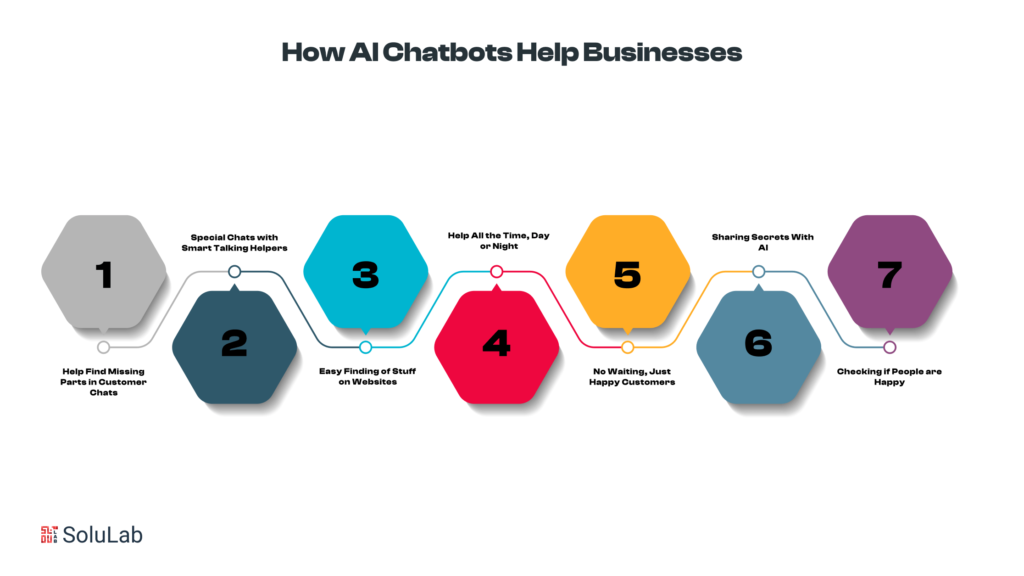
Here is what AI chatbot for customer service can do for businesses:
Online communication continues to grow for businesses, and it is vital for businesses to master customer interactions to drive conversions and improve experiences. Implementing AI chatbots eliminates communication obstacles between companies and users, bringing them closer. Customer service chatbots enabled with Artificial Intelligence offer numerous benefits of AI chatbots that revolutionize customer experiences and streamline operations.
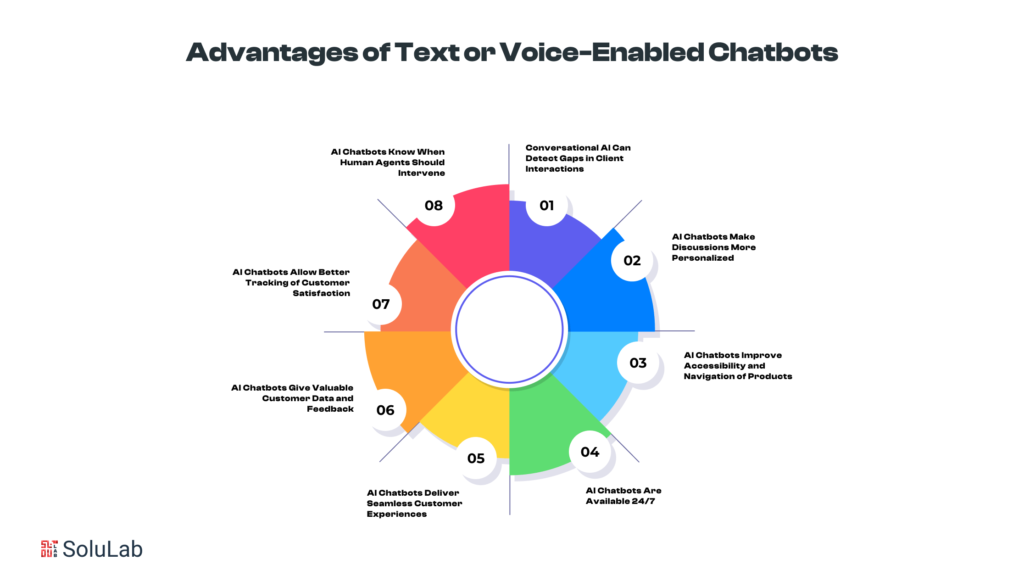
Gaps mid-discussion with customers frequently go unnoticed. However, neglecting to address them could result in missing critical inquiries. AI chatbots can pinpoint these gaps by studying interaction patterns with users, facilitating quick resolution of their issues. Most importantly, the chatbot can adjust the flow of the conversation during client engagement, producing highly satisfied and content customers.
AI chatbots enable automated customer engagement by delivering swift replies to various questions. Along with speedy service, AI powered chatbots add a customized feel to chats. Chatbots can respond to users’ basic questions as the programming utilizes AI logic and straightforward rules that imitate human speech. Implementing AI in chatbots assists them in comprehending the context of each exchange. Fast and effective issue resolution increases satisfaction and improves customer experience.
We often struggle to navigate websites to locate the product we want. It’s like entering a store with a vast inventory and having to browse many categories and options to reach the item. With an AI chatbot, clients can type the product name, and the bot will guide them to it. This chatbot assistance boosts customer engagement and satisfies users.
Brands make every effort to keep customers happy. However, certain gaps remain. For example, users now expect 24/7 availability, which humans can’t provide. This is making way for AI customer engagement through chatbots. The combined efforts of AI and humans are transforming the customer experience. Many people now have short attention spans and are highly impatient. With AI customer service chatbot brands can address inquiries, offer round-the-clock support in any language, via text and voice. Users can obtain assistance anytime, anywhere and resolve queries with minimal human input.
In addition to 24/7 customer service and help, AI chatbots increase customer experience standards. Users gain instant access to appropriate resources without waiting for an agent or repeating their issue. AI chatbots ensure customers receive satisfactory solutions to their questions. This enhanced experience is vital for improving customer loyalty and engagement. AI chatbots provide tailored interactions and suggestions as they learn from prior discussions. Chatbot conversations replace signup forms, contact forms, etc.
Consider the huge volume of information exchanged during a conversation. There is sharing between parties, whether chatting with humans or AI chatbots. A unified customer data view assists businesses in understanding the customer journey and key drop-off and conversion points. These touchpoints are essential for designing customer-centric experiences. Businesses can also utilize this information to refine marketing efforts and recommend specific products and services to users.
Online businesses struggle to efficiently track and quantify customer satisfaction. AI chatbots provide a practical solution to this problem. Chatbots let customers rate the company via short surveys or questionnaires in a helpful manner. The surveys are usually sent via messaging apps like WhatsApp, Facebook Messenger, etc. Response rates are quite satisfactory. Once businesses determine the customer satisfaction score, they can improve their entire workflow. With these metrics, businesses can modify their processes to increase customer satisfaction. AI chatbots store valuable customer data and effectively track satisfaction.
AI chatbots simulate human-like conversations and engagement. However, they cannot fully replace human support. The human takeover is likely the most vital characteristic of an AI chatbot. The company or support team can intervene and take over any ongoing chatbot discussion. There are many intricate issues and questions involving deal closure, real-time payments, etc., that chatbots cannot resolve. AI chatbots recognize situations requiring human input, immediately involving an agent for quick resolution.
Many businesses across the globe are using AI Chatbots to enhance their customer experience. Here are the top-most AI Chatbot use cases of various industries using taking advantage to this emerging technology to boost their business:
AI chatbots enhance customer experience across multiple industries worldwide by providing quick, customized, and convenient interactions.
In the upcoming years, the chatbot industry will expand at an impressive rate. Current projections indicate the market will exceed $994 million in the near future, representing a phenomenal year-over-year gain of around $200 million. This translates to a remarkable 22% compound annual growth rate (CAGR).
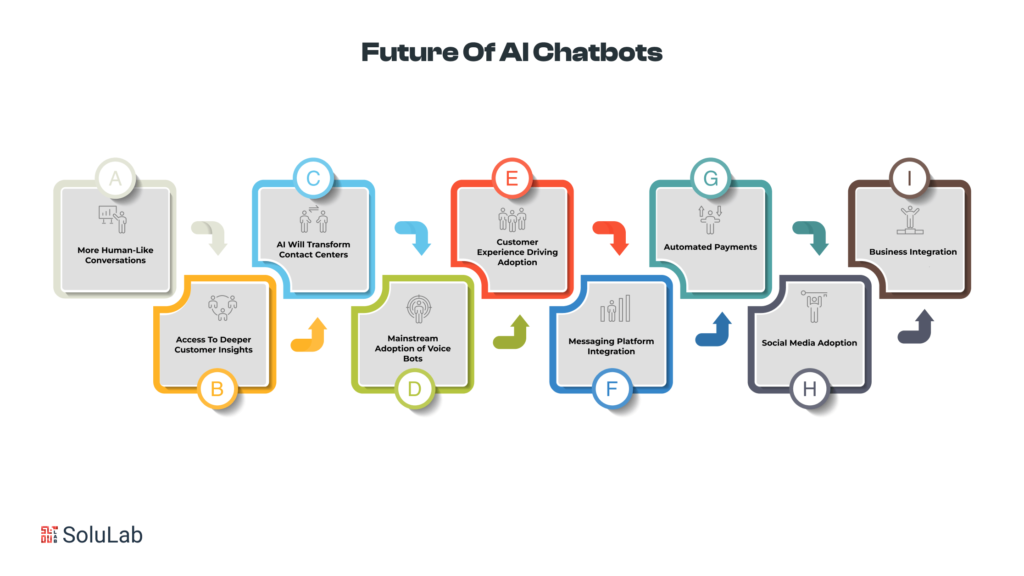
Businesses of all sizes are integrating AI chatbots for customer service. They recognize chatbots’ potential to enable efficient customer connections on a budget. Here are some key trends that will shape the future of AI chatbots:
While Chatbots offer enormous potential to transform customer service operations, to fully realize their benefits, businesses must approach implementation strategically with these key factors in mind:
Choose the Right Chatbot Solution: Carefully assess your business’s specific needs and characteristics to determine the most suitable chatbot technology. Factors to evaluate include expected query types, required integration capabilities, scalability needs, and budget constraints.
Define the Balance Between Automation and Human Assistance: View chatbots as enhancing, not replacing, human agents. Clearly delineate responsibilities between chatbots and live agents to optimize both digital and human customer interactions.
Continuously Monitor Performance and Refine: Regularly analyze chatbot usage metrics, review customer feedback, and fine-tune responses through ongoing machine learning. This ensures chatbots remain effective as customer needs evolve.
Maintain a Human Touch: Recognize situations requiring human interaction and empathy, such as complex troubleshooting or emotional conversations. Ensure a seamless handover to agents for these scenarios to deliver optimal customer experiences.
Consider Long-Term Evolution: Adopt an iterative, user-focused mindset for ongoing enhancement rather than viewing implementation as a one-time project. As chatbot capabilities advance, regularly re-evaluate opportunities to improve their role in customer service.
By keeping these key considerations central throughout the implementation process, businesses can maximize the value from AI chatbots for customer service as part of a holistic omnichannel support strategy.
As 2023 comes to an end, it is evident that AI chatbots for cutsomer engagement are just getting started and has an exciting future ahead, transforming how we interact with technology. The possibilities for AI-powered chatbots are extensive. As more customer data is stored in the cloud where it can be easily accessed, chatbots will be able to manage customer relationships, data, and communications more seamlessly. This improves agility for businesses and increases their productivity.
SoluLab is the ideal chatbot development partner for businesses aiming to implement AI-powered conversational interfaces. With over a decade of experience in building intelligent chatbots, SoluLab has the expertise to comprehend your needs and design chatbots that deliver genuine value. Its full-stack developers leverage cutting-edge natural language processing, machine learning, and AI capabilities to construct chatbots that feel natural, provide relevant recommendations, and enhance customer experience.
Partner with SoluLab today and receive reliable solutions that are scalable, secure, and seamlessly integrate with your tech stack, along with ongoing support.
AI chatbots are software programs that use artificial intelligence and machine learning to have conversations with users through text or voice-activated chatbots. They are designed to understand natural language and provide useful responses.
Yes, AI chatbots can work alongside human agents to enhance customer support. Chatbots can handle common inquiries, allowing human agents to focus on more complex issues.
AI chatbots improve customer engagement by providing instant, personalized responses at any time. They can make recommendations, handle tasks, and anticipate user needs, improving overall customer satisfaction.
AI enables chatbots to interpret user input, learn from conversations, and make smart decisions based on data patterns. This allows them to have natural dialogues similar to human interactions.
Businesses can identify their customer engagement needs, choose a chatbot platform, and work with experts to design, train, and integrate an AI chatbot that meets those specific needs.
AI can give chatbots skills like natural language processing, sentiment analysis, intent recognition, and conversational memory to understand users and respond intelligently.
Chatbots are trained by feeding them large datasets of dialogues and conversations to analyze patterns and learn how to respond appropriately. They are continuously improved through trial-and-error interactions.


