Talk to an Expert

Google Gemini Vs ChatGPT: All That You Need To Know

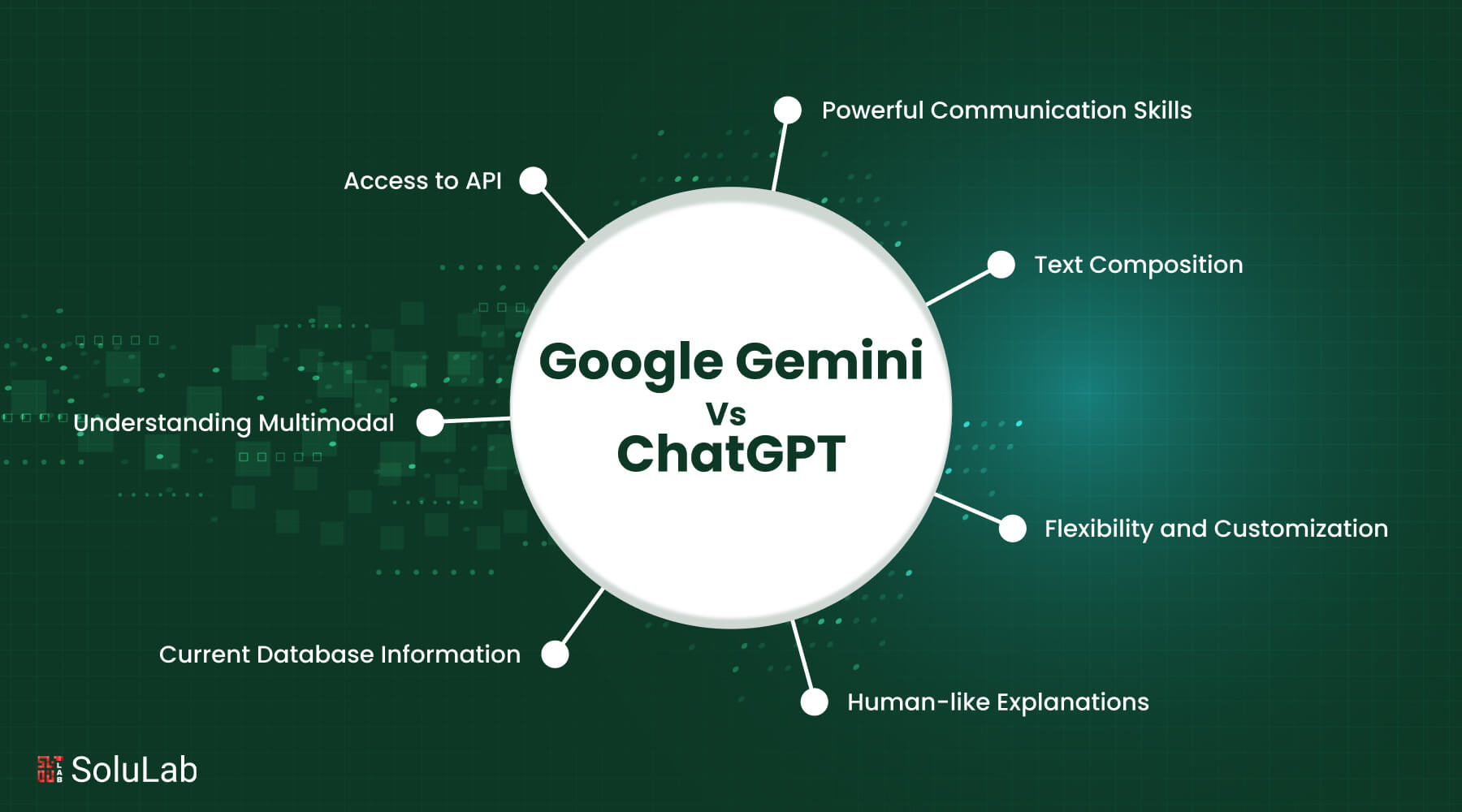
Google Gemini Vs ChatGPT

Over the past few years, generative AI has dominated the tech sector more than anything else. The first step was the introduction of OpenAI’s ChatGPT, which astounded users with its capacity to create text and respond to queries on nearly any subject in the globe.

Since that time, AI has taken over Silicon Valley, leading some of the largest tech companies to develop their own Large Language Models (LLMs) in an attempt to capitalize on ChatGPT’s growing user base.

Among these LLMs is Google’s Gemini, which debuted as Bard at the beginning of 2023 and has since become as one of the top ChatGPT substitutes available today. 

However, how does ChatGPT and Gemini compare? In order to determine which ChatGPT vs. Gemini is superior in 2024, this blog compares and contrasts their features, benefits, and drawbacks.

What is ChatGPT?

ChatGPT is a large language model (LLM) that can have discussions and respond to user inquiries on any subject since it was trained on an enormous amount of text and code from the internet.

The AI chatbot, created by OpenAI, has the ability to produce writing of human caliber, translate across languages, create a variety of artistic output, and—above all—have lively discussions on a range of subjects.

ChatGPT is a large language model (LLM) that can have discussions and respond to user inquiries on any subject since it was trained on an enormous amount of text and code from the internet.

However, this does not imply that ChatGPT is the greatest chatbot available; rather, it only indicates that it is the oldest, and that can occasionally be a good thing. Today are a lot of chatbots out today with features comparable to ChatGPT since many other chatbot providers have now taken OpenAI’s GPT LLM and used it in their own, specialized chatbots.

There are two versions of ChatGPT:
  • Free GPT-3.5 Version: The most commonly accessible version of GPT-3.5 is the free version, which is available to everyone via the ChatGPT website. It provides creative text production, information retrieval, and rudimentary conversational skills using the GPT-3.5 language model.
  • Paid GPT-4 Version (ChatGPT Plus): Similar to the free version, this premium edition has more features and functionalities. It makes use of the stronger GPT-4 language model.

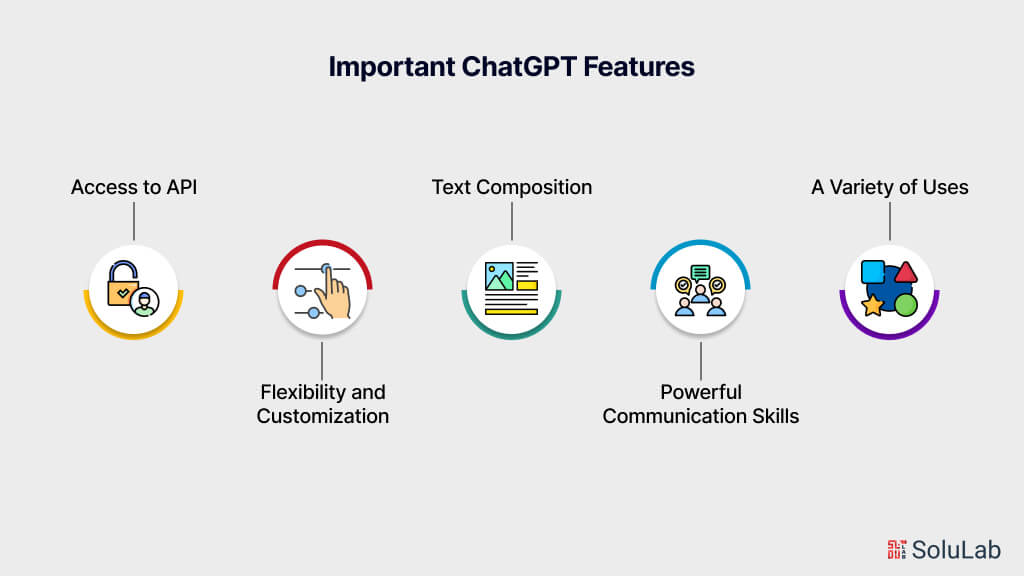
Important ChatGPT Features

Important ChatGPT Features

OpenAI ChatGPT offers an array of functionalities to facilitate question-answering, content creation, and user communication. Among its noteworthy features are:

1. Powerful Communication Skills

With its strong natural language processing (NLP) engine, ChatGPT development excels in conducting discussions that sound natural. It may replicate human contact by responding to your questions in a manner and tone that suits the situation. Consider it your talkative, intelligent friend with whom you may share ideas.

2. Text Composition

With ChatGPT, you may generate a variety of creative text formats, including emails, letters, screenplays, poetry, and music. If you give it precise directions or suggestions, it will create interesting and engaging writing.

3. A Variety of Uses

The possibilities of ChatGPT go beyond straightforward dialogue. It can compose various forms of creative material, translate across languages, summarize facts, and even provide you with an intelligent response to open-ended, difficult, or unusual inquiries.

4. Flexibility and Customization

ChatGPT’s capacity for learning and adaptation is one of its main advantages. It gets a better understanding of your preferences and communication style the more you use it. Over time, more pertinent and meaningful interactions may result from this customization feature.

5. Access to API

Make use of ChatGPT’s capabilities by integrating it into your own projects and apps with the help of OpenAI’s open-source API. Because of this, it is very flexible and usable by both developers and end users. 

What is Gemini?

Google created Gemini, an AI-powered chatbot that can converse and produce text that appears human in answer to a variety of queries.

The chatbot, which was first introduced in February 2023 under the name Bard and has since changed its name to Gemini, has drawn a lot of attention for its capacity for understanding, reasoning, and problem-solving in a variety of fields.

Gemini’s multimodality is one of its main advantages. Google app Gemini is intended to comprehend and interpret information from several modalities, including text, code, and even silent movies, in contrast to many AI models that have only been trained on text. This enables it to understand intricate ideas and carry out activities that were before difficult for AI.

Three versions of Google Gemini app are accessible:
  • Gemini Ultra: The most advanced model, Gemini Ultra, is perhaps the one with the highest processing power and capabilities. Consider it a powerful V8 engine designed to tackle tough jobs.
  • Gemini Pro: Power and efficiency are well-balanced in this edition. Much like a dependable V6 engine, it’s probably appropriate for a variety of applications.
  • Gemini Nano: This is probably the least resource-intensive and lightest variant. Think of it as a 4-cylinder engine that uses less gasoline and is excellent for jobs that don’t need the maximum power of the other types.

ChatGPT development company

Important Gemini Features

Gemini has a wide range of functions to provide you with accurate and pertinent answers to your questions. Among these features are:

1. Understanding Multimodal

In contrast to many text-only AI models, Gemini is highly adept at analyzing data from several sources. This comprises:

  • Text: Producing and comprehending text that is human-like for activities like question-answering, translation, and summarization.
  • Code: Examining codebases, spotting possible problems, offering fixes, and providing programmers with an explanation of the reasons behind them.
  • Visuals: Interpreting silent movies, deducing themes and storylines, and even identifying items and their relationships in pictures.

2. Current Database Information

In order to provide your replies, Gemini continually scans webpages, indexing and analyzing data in real-time. This eliminates the need for you to wait for the AI algorithms to catch up and gives you access to the most recent information and breaking news as soon as it happens.

3. Human-like Explanations

Gemini does more than simply provide you with answers; it also explains them in simple, understandable terms. Gemini’s sophisticated natural language processing (NLP) skills enable it to understand the context and underlying meaning of your inquiries. This enables it to deliver outcomes that are more insightful and relevant, especially for difficult or open-ended inquiries. 

Key Differences Between Google Gemini vs. Open AI ChatGPT

Here are the key differences between Google Gemini vs Open AI ChatGPT:

Parameters Google Gemini OpenAI ChatGPT
Functionality and Capabilities Google Gemini is Google’s latest advancement in natural language processing (NLP) and conversational AI. It employs advanced machine-learning techniques to generate human-like text responses based on provided prompts. Beyond simple text generation, Gemini can comprehend context, generate multi-turn conversations, and seamlessly integrate with other Google products and services. Its capabilities encompass language understanding, context preservation, and the generation of diverse and contextually relevant responses. OpenAI ChatGPT, built on the Generative Pre-trained Transformer (GPT) architecture, specializes in generating text-based responses in conversational settings. It excels in understanding natural language inputs and producing human-like text outputs across a wide spectrum of topics and conversational contexts. ChatGPT offers flexibility through fine-tuning models for specific use cases or domains, enabling customized responses tailored to individual needs.
Performance and Accuracy Google Gemini aims for high levels of accuracy in understanding and generating natural language text. Through extensive training on large datasets and sophisticated algorithms, Gemini endeavors to provide accurate and contextually relevant responses to user queries. It undergoes rigorous evaluation and testing procedures to ensure the quality and reliability of its outputs. OpenAI ChatGPT has garnered widespread acclaim for its impressive performance and accuracy in generating human-like text responses. Trained on vast amounts of text data from the internet, ChatGPT exhibits a strong understanding of language nuances and context, enabling it to produce coherent and contextually appropriate responses. While occasional errors may occur, ChatGPT’s overall performance is commendable, with users often praising its ability to engage in meaningful and lifelike conversations.
Ease of Integration and Deployment Google Gemini offers various integration options for developers and businesses seeking to incorporate its capabilities into their applications or platforms. With access to Google’s suite of developer tools and APIs, integrating Gemini into existing workflows or applications is relatively straightforward. Additionally, comprehensive documentation, tutorials, and support resources provided by Google facilitate the deployment and integration process for developers of all skill levels. Integrating ChatGPT into applications or systems is typically achieved through its API, which allows developers to send text prompts to the model and receive generated responses in return. OpenAI provides clear documentation and code examples to guide developers through the integration process, making it accessible to a wide range of users. Furthermore, pre-trained versions of ChatGPT are available for quick deployment, while advanced users can fine-tune models for specific use cases or domains using transfer learning techniques.
Cost-effectiveness and Scalability The cost-effectiveness of Google Gemini depends on factors such as usage volume, resource requirements, and any associated licensing fees. Google may offer flexible pricing models tailored to different use cases and customer needs, allowing businesses to scale their usage of Gemini accordingly. Additionally, integration with other Google products and services may provide cost-saving opportunities for organizations already invested in the Google ecosystem. OpenAI offers several pricing plans for accessing ChatGPT’s API, ranging from free tiers for limited usage to paid subscriptions for higher volumes of requests. The cost-effectiveness of using ChatGPT depends on factors such as usage frequency, complexity of requests, and additional features or support services required. While scaling usage of ChatGPT to accommodate growing demand is generally feasible, organizations should consider potential costs associated with increased usage and plan accordingly.
User Feedback and Reviews User feedback and reviews for Google Gemini may vary based on factors such as implementation quality, user experience, and overall satisfaction with the product. Positive reviews often highlight Gemini’s ability to generate accurate and contextually relevant responses, ease of integration with other Google services, and overall performance in real-world applications. Negative feedback may point out limitations or areas for improvement, such as occasional errors in response generation or challenges in fine-tuning the model for specific use cases. ChatGPT has received widespread acclaim from users, developers, and businesses for its impressive performance and versatility. Positive reviews emphasize ChatGPT’s ability to understand natural language inputs, produce coherent and contextually appropriate responses, and engage in meaningful conversations across various topics and domains. While some users may encounter occasional inconsistencies or limitations, the overall consensus is overwhelmingly positive, with many considering ChatGPT to be a game-changer in the field of conversational AI.

Future Outlook for Google Gemini and Open AI ChatGPT

Future Outlook for Google Gemini and Open AI ChatGPT

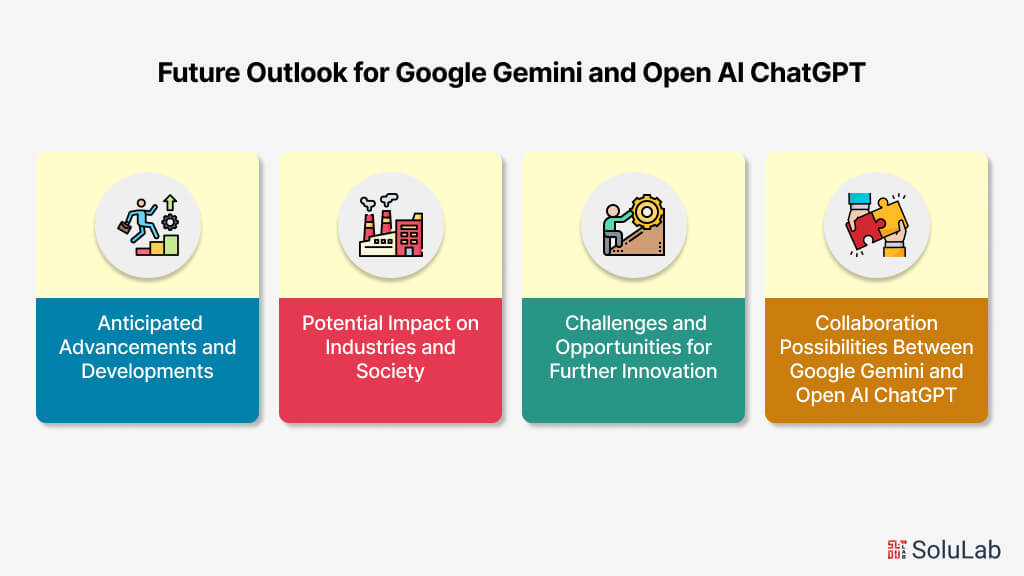
In the future, Google Gemini and ChatGPT are expected to continue pushing the boundaries of natural language processing applications and conversational AI, ushering in a new era of human-computer interaction. Here are some future trends you can expect with Google Gemini and Open-AI ChatGPT.

A. Anticipated Advancements and Developments

Both Google Gemini and ChatGPT are undergoing significant advancements and developments in innovation and technological evolution. Here’s a glimpse into the potential future trajectories for these modern AI systems:

With Google Gemini:

  • Continued advancements in natural language processing (NLP) capabilities, including improved understanding of context and nuanced language nuances.
  • Integration of Gemini with other Google services and platforms for enhanced user experiences and seamless interactions.
  • Exploration of advanced AI techniques such as reinforcement learning to further refine and optimize Gemini’s conversational abilities.

Regarding Open AI ChatGPT:

  • Further refinement of model architectures and training methodologies to enhance performance and generate more contextually relevant responses.
  • Development of specialized versions of ChatGPT for specific industries or use cases, catering to diverse needs and requirements.
  • Exploration of novel techniques such as few-shot or zero-shot learning to enable ChatGPT to adapt to new tasks and domains with minimal training data.

B. Potential Impact on Industries and Society

The potential impact of Google Gemini and ChatGPT extends far beyond their immediate applications, with profound implications for industries and society at large. Here’s a look at the transformative effects these technologies may have:

Google Gemini’s Impact:

  • Revolutionizing customer service and support through AI-powered chatbots capable of handling complex queries and providing personalized assistance.
  • Transforming content creation and marketing by enabling automated generation of engaging and relevant content across various platforms and channels.
  • Facilitating knowledge dissemination and accessibility through conversational interfaces that make information more easily accessible and digestible.

Open AI ChatGPT’s Impact:

  • Redefining human-computer interactions by enabling more natural and intuitive communication with AI systems.
  • Empowering individuals and businesses to leverage artificial intelligence for various tasks, from writing assistance to decision support and creative expression.
  • Addressing societal challenges such as language barriers and information overload by providing AI-driven tools for communication, translation, and information synthesis.

C. Challenges and Opportunities for Further Innovation

While the future looks promising for Google Gemini and ChatGPT, there are several challenges to overcome and numerous opportunities to explore. Here’s a breakdown of the key hurdles and potential avenues for further innovation:

Challenges and Opportunities for Google Gemini:

  • Addressing biases and ethical considerations inherent in AI systems, particularly in sensitive or high-stakes domains. Expanding Gemini’s capabilities to support additional languages, dialects, and communication modalities to reach a broader audience.
  • Ensuring data privacy and security in the collection and processing of user interactions and personal information. Collaborating with industry partners and domain experts to co-develop specialized versions of Gemini tailored to specific industries or use cases.

Challenges and Opportunities for Open AI ChatGPT:

  • Mitigating the risk of misinformation and malicious use of AI-generated content, such as fake news or deceptive marketing. Enhancing ChatGPT’s interpretability and explainability to improve user trust and understanding of AI-generated responses.
  • Addressing limitations in understanding and generating nuanced or complex language expressions, particularly in specialized domains or cultural contexts. Using advances in multimodal AI to enable ChatGPT to process and generate text-based responses from diverse input modalities, such as images, audio, and video.

Read Blog: Google’s Gemini AI: Capabilities and Applications

D. Collaboration Possibilities Between Google Gemini and Open AI ChatGPT

The synergies between Google Gemini and ChatGPT present exciting opportunities for collaboration and mutual reinforcement. Here’s how these two innovative technologies could join forces to drive innovation and create new possibilities:

  • Integration of ChatGPT’s conversational capabilities into Google Gemini’s ecosystem, enhancing its ability to engage in natural and fluid interactions with users.
  • Utilizing Google’s vast resources and infrastructure to accelerate the development and deployment of ChatGPT models and services.
  • Collaborating on research and development initiatives to advance innovation in NLP and conversational AI, pushing the boundaries of what’s possible.

Which One is Better- Google Gemini or Open AI ChatGPT?

Determining which AI model, Google Gemini or ChatGPT, is better depends on the specific needs, objectives, and context of the user. Both systems have their own strengths and areas of expertise, making them suitable for different applications and scenarios.

Google Gemini stands out with its focus on analysis, reasoning, and factual accuracy. It excels in tasks such as information retrieval, problem-solving, and research, leveraging its ability to understand information from multiple sources and provide insightful responses. Additionally, its integration with Google’s suite of products and services offers seamless interoperability and access to a wide range of tools and resources.

On the other hand, ChatGPT shines in creative writing, storytelling, and generating various text formats. With its prowess in generating human-like text responses and engaging in natural conversations, ChatGPT is well-suited for tasks requiring creativity, expression, and interaction with users. Its versatility and adaptability make it suitable for a diverse range of applications, from content generation to virtual assistance.

Ultimately, the choice between Google Gemini and ChatGPT depends on factors such as the nature of the task or problem at hand, the desired outcomes, and the specific requirements of the user or organization. While Google Gemini may be preferred for tasks requiring factual accuracy and reasoning, ChatGPT may be favored for applications demanding creativity and natural language interaction. It is essential to evaluate each AI model’s capabilities, limitations, and compatibility with the intended use case to make an informed decision about which one is better suited to meet the desired objectives.
Hire ChatGPT Developers

Conclusion

In conclusion, the comparison between Google Gemini and ChatGPT highlights the diverse capabilities and applications of modern AI technologies in natural language processing and conversational AI. While Google Gemini excels in analytical tasks and seamless integration with Google’s ecosystem, ChatGPT stands out for its creative writing abilities and engaging conversational skills. The choice between these AI models ultimately depends on the specific needs and objectives of the user, with each offering unique advantages for different use cases.

For businesses looking to use AI in their initiatives, SoluLab provides professional advice and development services. As an experienced AI development company, SoluLab focuses in creating personalized AI solutions that are matched to the particular needs of every customer. From conception to execution, SoluLab’s group of AI specialists works directly with customers to provide creative and significant AI solutions that promote company expansion and achievement. Get in touch with us right now to find out how SoluLab can assist you in realizing the AI potential of your projects.

FAQs

1. What is the primary difference between Google Gemini and ChatGPT?

Google Gemini focuses on analysis, reasoning, and factual accuracy, making it ideal for tasks such as information retrieval and problem-solving. On the other hand, ChatGPT specializes in creative writing and storytelling, excelling in generating human-like text responses and engaging in natural conversations.

2. How can I integrate Google Gemini or ChatGPT into my application?

Both Google Gemini and ChatGPT offer integration options through their respective APIs. Dedicated Developers can utilize these APIs to send text prompts to the models and receive generated responses in return. Additionally, comprehensive documentation and support resources are available to guide developers through the integration process.

3. What are the potential use cases for Google Gemini and ChatGPT?

Google Gemini can be applied in various industries and domains, including customer service, content creation, research, and education. It can power chatbots for personalized assistance, generate informative content, and facilitate knowledge dissemination. ChatGPT, on the other hand, can be used for tasks such as virtual assistance, creative writing, storytelling, and generating diverse text formats.

4. How do Google Gemini and ChatGPT ensure accuracy and reliability in their responses?

Google Gemini undergoes extensive training on large datasets and utilizes sophisticated algorithms to achieve high levels of accuracy in understanding and generating natural language text. ChatGPT, trained on vast amounts of text data from the internet, exhibits a strong understanding of language nuances and context, contributing to its accuracy and reliability in response generation.

5. What factors should I consider when choosing between Google Gemini and ChatGPT for my project?

When selecting between Google Gemini and ChatGPT, it is essential to consider the specific requirements and objectives of your project. Evaluate factors such as the nature of the task, desired outcomes, and compatibility with existing systems or workflows. Additionally, consider the strengths and limitations of each AI model in relation to your project’s needs to make an informed decision.

What is an AI Powered Chatbot?

AI Powered Chatbot

Even prior to the pandemic, the chatbot industry had been experiencing consistent growth. However, as the statistics indicate, the crisis significantly accelerated the industry’s adoption. In 2020, the chatbot market was valued at $17.17 billion, and it is projected to reach a staggering $102.29 billion by 2026, representing a compound annual growth rate (CAGR) of 34.75% during the forecast period from 2021 to 2026. The pandemic has highlighted the importance of data-driven decision-making, with 74% of decision-makers reporting increased reliance on data compared to pre-COVID times. However, only 30% of them excel at making data-driven decisions. The pandemic’s efficiency in exposing gaps in business workflows has caused 78% of decision-makers to invest in new technologies as a direct response to COVID-19.

CTA

How AI Powers Chatbots?

Understanding natural language processing (NLP) and machine learning (ML), two key AI building blocks is crucial to comprehending how chatbots work.

The term “natural language processing” (NLP) describes a computer system’s capacity to comprehend and decipher human discourse. It entails dissecting linguistic components, including words and phrases, to derive meaning. Chatbots can grasp user inquiries thanks to NLP and answer in a way that seems natural and kind.

A subset of artificial intelligence (AI) called machine learning (ML) aims to make it possible for computers to learn from experience and advance without explicit programming. Chatbots can study and comprehend patterns in enormous volumes of data thanks to ML algorithms, which help them improve over time.

What is the Role of NLP in Enabling Chatbots to Understand and Respond to User Queries?

NLP plays a crucial role in enabling chatbots to understand and respond effectively to user queries. Through NLP techniques, chatbots can break down user input, identify the intent behind the message, and extract relevant information.

Chatbots equipped with NLP algorithms employ techniques such as entity recognition, part-of-speech tagging, and syntactic parsing. These techniques allow chatbots to identify important keywords, understand the grammatical structure of sentences, and extract relevant entities or entities. As a result, chatbots can comprehend user queries in a more accurate and nuanced manner.

NLP also enables chatbots to handle variations in user language, including slang, misspellings, and abbreviations. By employing techniques like stemming and lemmatization, chatbots can normalize and understand different forms of words, ensuring a higher level of accuracy in their responses.

What is the Role of ML in Improving Chatbot Performance Through Data Analysis and Pattern Recognition?

Machine Learning(ML) plays a significant role in improving chatbot performance by analyzing data and recognizing patterns. ML algorithms enable chatbots to learn from past interactions and apply that knowledge to future conversations.

Through ML, chatbots can analyze vast amounts of data, including historical chat logs and user interactions, to identify patterns and extract meaningful insights. This analysis helps chatbots understand user preferences, predict user intent, and deliver more personalized responses.

ML algorithms also enable chatbots to continuously improve their performance. By leveraging techniques like supervised learning, unsupervised learning, and reinforcement learning, chatbots can refine their responses based on feedback and optimize their conversational AI abilities. This iterative learning process helps chatbots become more accurate, efficient, and capable of providing valuable assistance to users.

Read Case Study

What are the Features and Capabilities of AI-powered Chatbots ?

AI-powered chatbots have changed the way businesses interact with their customers by offering advanced features and capabilities that go beyond traditional rule-based chatbots. Let’s explore some of the key features and capabilities that make AI-powered chatbots stand out:

  • Ability to Gather and Utilize User Data for Personalized Interactions

AI-powered chatbots can gather and analyze user data to provide personalized interactions. By integrating with customer relationship management (CRM) systems or leveraging data from previous interactions, chatbots can access user preferences, purchase history, and other relevant information. 

This allows them to tailor responses and recommendations based on individual user profiles, creating a personalized and engaging experience.

For example, a chatbot in an e-commerce store can recommend products based on a user’s browsing history and past purchases. By understanding user preferences and behavior, the chatbot can provide personalized product suggestions, increasing the likelihood of conversion.

DO YOU KNOW?
Chatbot usage statistics indicate a wonderful 67% growth between 2018 and 2020, highlighting the significant incorporation of chatbots in various industries.

  • Contextual Understanding to Maintain Conversational Flow and Continuity

Ai-powered chatbots are designed to understand and maintain context during conversations. They can comprehend the context of a user’s queries and provide relevant responses, ensuring a smooth conversational flow.

Chatbots achieve contextual understanding through techniques like session management, where they retain information from previous interactions to provide consistent and coherent responses. This allows chatbots to remember user inputs, preferences, and even specific questions asked earlier, creating a seamless user experience.

For instance, if a user asks a chatbot about flight options and later follows up with a question like “What are the prices?”, the chatbot can understand the context and provide prices related to the previous flight options discussed. This contextual understanding enhances user satisfaction and eliminates the need for users to repeat information.

AI-powered chatbots can also handle interruptions or changes in the conversation flow gracefully. They can recognize topic shifts, respond appropriately, and seamlessly transition back to the previous context if needed. This capability enhances the conversational experience and mimics human-like interactions.

Org. Use Chatbots

What are the Benefits of AI-powered Chatbots?

AI-powered chatbots have become a game-changer for businesses, offering numerous benefits and advantages that significantly enhance customer service and support. Let’s explore some of the key benefits of incorporating AI-powered chatbots into customer interactions:

  • 24/7 Availability and Instant Response Times

One of the significant advantages of AI-powered chatbots is their ability to provide round-the-clock customer support. Unlike human agents with limited working hours, chatbots are available 24/7, ensuring that customers can get assistance whenever they need it. This availability eliminates the frustration of waiting for business hours or being put on hold, leading to higher customer satisfaction.

Moreover, AI-powered chatbots can offer instant response times. They can provide immediate answers to frequently asked questions, eliminating the need for customers to wait for a human agent to become available. Quick response times contribute to a positive user experience and demonstrate a commitment to customer service.

  • Efficient Handling of Customer Inquiries and Issue Resolution

AI-powered chatbots excel in efficiently handling customer inquiries and resolving issues. They can handle a large volume of inquiries simultaneously, ensuring that customers don’t experience long wait times or delays in getting assistance.

Chatbots can provide accurate and relevant information based on their training and access to data sources. By leveraging machine learning and natural language processing, they can understand user queries, identify the intent behind them, and provide appropriate responses. This leads to faster issue resolution and reduces the need for customers to reach out to human agents for basic inquiries.

Additionally, AI-powered chatbots can guide customers through troubleshooting steps, provide step-by-step instructions, or offer solutions to common problems. By delivering self-service options, chatbots empower customers to resolve issues independently, further enhancing efficiency and reducing support costs.

What are the Applications of AI-powered Chatbots?

AI-powered chatbots have found widespread applications across various industries, changing the way businesses interact with customers and streamline their operations. Let’s explore some of the key applications of AI-powered chatbots:

1. Customer Support and Service

AI-powered chatbots are extensively used for customer support and service. They can handle a wide range of customer inquiries, provide instant responses, and assist with common issues. 

Chatbots can offer 24/7 support, ensuring customers receive assistance at any time. They can also provide personalized recommendations, track order statuses, and handle returns or refunds, enhancing the overall customer experience.

2. E-commerce and Sales

Chatbots are valuable tools for e-commerce businesses. They can engage customers in personalized conversations, recommend products based on preferences and purchase history, and provide real-time product information. 

Chatbots can also assist in completing transactions, offering payment options, and answering questions about shipping and delivery. By guiding customers through the sales process, chatbots contribute to increased conversions and revenue generation.

3. Information Retrieval and FAQs

Chatbots excel in providing quick and accurate information retrieval. They can answer frequently asked questions (FAQs) and guide users to relevant resources or web pages. By utilizing natural language processing, chatbots can understand user queries, extract key information, and provide precise responses. This application is particularly useful for businesses with extensive knowledge bases or information-heavy websites.

DO YOU KNOW?
In the forecast period between 2021 and 2026, the chatbot market, which was valued at billion, is anticipated to experience tremendous growth, reaching an astounding $102.29 billion. During this period, the compound annual growth rate (CAGR) is predicted to be an impressive 34.75%.

4. Appointment Scheduling and Reservations

AI-powered chatbots can handle appointment scheduling and reservation requests. They can access calendars, check availability, and book appointments or make reservations on behalf of customers. Chatbots can also send reminders and notifications to ensure customers don’t miss their appointments. This automation streamlines the booking process and reduces administrative tasks for businesses.

5. Virtual Assistants and Personal Productivity

Chatbots can act as virtual assistants, helping users with personal productivity tasks. They can set reminders, manage to-do lists, send notifications, and even provide recommendations for time management or productivity improvement. Chatbots can integrate with various productivity tools and platforms, becoming a central hub for users’ daily activities.

6. Lead Generation and Qualification

Chatbots play a crucial role in lead generation and qualification for businesses. They can engage website visitors, collect contact information, and qualify leads based on predefined criteria. 

By initiating conversations, chatbots can gather valuable insights about potential customers, identify their needs, and provide recommendations or offers. This application streamlines the lead generation process and enables businesses to capture valuable leads.

7. Healthcare and Telemedicine

AI-powered chatbots are making significant contributions to the healthcare industry. They can assist in patient triage, providing initial assessments based on symptoms, and directing patients to appropriate resources or healthcare professionals. 

Chatbots can also offer medication reminders, answer basic health-related questions, and provide lifestyle recommendations. In telemedicine applications, chatbots can facilitate virtual consultations, collect patient information, and assist with appointment scheduling.

Chatbot Market

What are the Considerations and Challenges in Implementing AI-powered Chatbots?

Implementing AI-powered chatbots can bring numerous benefits to businesses, but it also involves several considerations and challenges that need to be addressed for successful deployment. Let’s explore some key considerations and challenges in implementing AI-powered chatbots:

  • Data Privacy and Security

One of the primary considerations when implementing AI-powered chatbots is ensuring the privacy and security of user data. Chatbots interact with customers, collect information, and store data. 

It’s crucial to have robust data protection measures in place to safeguard sensitive information and comply with relevant data privacy regulations. Businesses need to implement secure data storage, encryption, and access controls to protect user data and build trust with customers.

  • Natural Language Understanding and Accuracy

AI-powered chatbots heavily rely on natural language processing (NLP) to understand and respond to user queries. However, achieving high accuracy in natural language understanding can be challenging. Chatbots need to accurately interpret user intent, context, and nuances in language to provide relevant responses. 

It requires extensive training, fine-tuning, and testing to improve the accuracy of chatbot interactions. Continuous monitoring and refinement are essential to enhance the chatbot’s language capabilities and deliver satisfactory user experiences.

  • Integration with Existing Systems

Integrating AI-powered chatbots with existing systems and processes is another consideration. Chatbots may need to access databases, customer relationship management (CRM) systems, or other software applications to provide accurate and up-to-date information. 

Seamless integration ensures that chatbots have access to the necessary data and can provide comprehensive and personalized responses to users. Businesses should assess their existing infrastructure and ensure compatibility and smooth integration with chatbot platforms.

  • Scalability and Performance

As chatbot usage grows, scalability becomes a critical consideration. Businesses need to ensure that their AI-powered chatbots can handle increasing user demand without compromising performance. 

Chatbots should be capable of handling a large volume of concurrent conversations, providing quick response times, and maintaining a seamless user experience. Scalability can be achieved through robust architecture, efficient resource allocation, and effective load-balancing techniques.

  • User Experience and Human Handover

Designing a user-friendly and intuitive chatbot interface is crucial for a positive user experience. Chatbots should be able to guide users effectively, understand complex queries, and provide clear and concise responses. However, there may be instances where chatbots cannot handle certain queries or when human intervention is required. 

Implementing a smooth handover process from chatbot to human agents ensures that users receive appropriate assistance when needed. Finding the right balance between automated interactions and human support is crucial for a satisfactory user experience.

  • Continuous Improvement and Maintenance

AI-powered chatbots require ongoing monitoring, maintenance, and improvement. Regular analysis of chatbot performance, user feedback, and user interactions can provide insights for enhancing the chatbot’s capabilities. 

Businesses should establish processes to gather user feedback, track key metrics, and iterate on the chatbot’s functionality and responses. Continuous improvement ensures that chatbots stay relevant, accurate, and effective in meeting user needs.

In conclusion, an AI-powered chatbot is an advanced technological solution that combines the power of artificial intelligence and natural language processing to interact with users and provide automated assistance. These chatbots have gained increasing popularity due to their ability to understand and respond to user queries in a human-like manner. By leveraging technologies such as machine learning, NLP applications, sentiment analysis, and predictive analytics, AI-powered chatbots offer a wide range of features, benefits, and applications.

They can personalize interactions, gather and utilize user data, and maintain contextual understanding to ensure a seamless conversational flow. AI-powered chatbots have changed customer service and support by offering 24/7 availability, instant response times, and efficient handling of customer inquiries and issue resolution. They find applications across various industries, including e-commerce, healthcare, customer support, lead generation, and more.

AI Chatbot solution

How SoluLab Can Improve Your Chatbot Development Journey?

In conclusion, AI-powered chatbots are transforming the way businesses interact with customers by providing real-time, personalized responses, streamlining customer service, and improving operational efficiency. As AI continues to evolve, businesses can harness its power to enhance user experiences and optimize various processes. A great example of this is InfuseNet, a recent case study we published, which demonstrates how companies can leverage AI for data-driven decision-making. InfuseNet integrates advanced AI models like GPT-4 and FLAN, allowing real-time data processing from over 80 sources. By fine-tuning AI models with proprietary data, businesses can achieve unprecedented innovation and efficiency while ensuring data security through encrypted, self-hosted solutions.

If you’re looking to develop an AI-powered chatbot designed to your business needs, SoluLab, an experienced AI chatbot Development Company, is here to help. With expertise in building intelligent AI solutions, we empower businesses to enhance customer interactions, reduce operational costs, and drive growth. Whether you’re looking to Hire AI Developers or partner with a trusted Development Company to bring your AI chatbot vision to life, SoluLab can guide you through the entire process, ensuring your business stays ahead in the competitive market.

FAQs

1. What is an AI-powered chatbot?

An AI-powered chatbot is a computer program that utilizes artificial intelligence (AI) technologies to interact with users through conversational interfaces. These chatbots are designed to understand natural language, analyze user input, and provide automated responses or assistance.

2. How does an AI-powered chatbot work?

AI-powered chatbots work by employing various technologies such as natural language processing (NLP), machine learning (ML), and deep learning algorithms. They learn from user interactions and data, allowing them to understand user intent, generate appropriate responses, and provide relevant information or services.

3. What are the key features of an AI-powered chatbot?

The key features of an AI-powered chatbot include natural language understanding, context awareness, personalization, scalability, and integration with other systems or platforms. These features enable chatbots to deliver accurate responses, maintain conversational flow, provide specific experiences, handle high user volumes, and integrate with existing software or databases.

4. How is an AI-powered chatbot different from a rule-based chatbot?

An AI-powered chatbot differs from a rule-based chatbot in terms of its capabilities and intelligence. While rule-based chatbots follow predetermined rules and responses, AI-powered chatbots can learn and adapt through machine learning algorithms. They can understand complex queries, provide more nuanced responses, and improve their performance over time.

5. What are the benefits of using an AI-powered chatbot?

There are several benefits of using an AI-powered chatbot. They include improved customer service and support, 24/7 availability, instant response times, personalized interactions, increased efficiency and productivity, reduced operational costs, and enhanced user experiences.

How to Build an AI-Powered Chatbot For Your Business?

Build AI chatbot

Want to build your artificial intelligence chatbot? They are making waves across education and consumer service. We are going to walk you through the exciting journey of developing a chatbot—from concept to dialog. We will show you how to pick the best resources, design engaging conversations, and even train your AI-powered chatbot to grow and change. Get ready to build informative, entertaining, amazing chatbots!

What are Chatbots?

Have you ever used a virtual assistant or visited some website to ask for help and never really had to talk to a person? Chances are, you are talking with a chatbot. Chatbots are programs designed to mimic human conversation. They range from simple, rule-based applications that provide preset responses to basic questions to complex AI-driven bots.

One of the techniques creating an AI chatbot uses is Natural Language Processing, NLP, which helps them understand all sublimities in human language. This helps chatbots to gauge and assess questions, answer them naturally, and improve with time.

Chatbots are now across the board in messaging apps, websites, and even in phone calls. This is how businesses take orders, answer frequently asked questions, and deal with customer service. AI use cases have applied even in educational settings, giving individualized instruction and answering questions.

What are the Different Types of Chatbots?

We can’t deny the presence of chatbots in our digital lives. Given the many chatbots out there, it is only understandable to be interested in the different types of Chatbots and how they differ from one another. Today, we will consider six well-known chatbot categories:

1. Menu-driven chatbots

 Just think of a vending machine that speaks for itself. Well, most of the time, menu-driven chatbots are that. These simple bots present their user with a set of choices in the form of buttons or menus. After the user has selected an option, they receive a hard-coded response, guiding them through some specific function or answering an FAQ. For such basic transactions, like booking an appointment or ordering, they work great.

2. Rule-based Chatbots

They, too, use a predefined set of rules and keywords. While processing the user’s inputs, they look for terms that have pre-written responses related to them. In case the user’s question matches any of the recognized keywords, the chatbot responds with the appropriate response, which can be seen in AI agent use cases Even though menu-driven bots are less flexible compared to complicated ones, they still are incapable of answering complex requests or phrasing known queries differently.

3. AI-Powered Chatbots

Now we enter the age of intelligent dialogue. AI chatbots follow a method of natural language processing to identify the communications made by the user and try to infer what they want to say. The power of AI chatbot can detect synonyms, paraphrase, consider the context of the conversation, and adjust accordingly based on how the user responded previously. All this provides for a better user experience since it allows more organic, human-like dialogues and the perfect example would be chatbots in healthcare.

4. Voice-Activated Chatbots

 Imagine talking to your phone or giving voice commands to a virtual assistant. That is what voice-activated chatbots can do. These chatbots allow users to communicate by using their voices through speech recognition technology that converts spoken words to text. They are designed hands-free for applications where typing is a hassle—for example while driving or cooking.

5. Generative AI Chatbots

Embracing the Future! Generative AI chatbots push the boundaries of this technology. The complex bot, in line with machine learning algorithms, generates new formats of text, like scripts or poems, and provides a better understanding of the intent of the user. They even tailor material according to the available information about users, offering a unique and engaging experience. 

6. Hybrid Chatbots

The hybrid AI chatbot holds an advantage for both rule-based and AI-driven methodologies. They are capable of handling basic jobs and frequently asked questions with pre-established guidelines and easily escalating complicated queries to AI modules for deeper comprehension. Their adaptiveness enables them to provide a strong, effective conversational experience to a broader spectrum of users.

What is an AI-powered Chatbot?

Imagine a computer program keeping a meaningful dialogue with you, understanding what you intend to do, and even learning new things. That explains what is an AI chatbot. They are not ordinary chatbots but much more advanced compared to their basic relatives. Indeed, to deeply understand human language, they use artificial intelligence, more especially natural language processing.

Enterprise AI Chatbot works with NLP and allows AI chatbots to read your messages, assess the situation, and get what you mean. AI-powered chatbots learn the tone of the message, understand synonyms, and even use experience learned from previous conversations to make their responses more intelligent in the future. This power of chatty ability with a helpful friend becomes a more real flowing one, less like talking to a computer.

AI-powered chatbots have several advantages that enable companies to respond to complex inquiries, provide customer care, and individualize user experiences 24/7. They can replace teachers in the classroom, working according to the needs of students with their very own peculiarities and providing answers with meaning for them. You must build an AI-powered chatbot to make new ways of engaging with technology—from the eased execution of day-to-day activities to having interesting conversations.

How to Build an AI Chatbot?

The area of chatbots is developing in leaps and bounds. It revolutionizes communication in many various industries. Ever felt the urge to create your AI-powered friend? Now you’ll get the breaking of how to create an AI chatbot

Step 1: Set Your Goals

Clearly define what your chatbot is trying to achieve before you start designing your chatbot. What problem is it going to solve? Who is your target audience?  Your idea of these will dictate the design and training data. Some examples include the following:

  • Customer Service: Answer frequently asked questions, troubleshoot, and direct users to relevant resources.
  • Education: Allow Students to go through personalized learning curves, field questions, and provide comments. 
  • Sales and Marketing: Organize leads, answer product questions, and walk customers through the sales funnel.

CTA1

Step 2: Choosing the Development Method

The two main paths to consider are:

  • Codeless platforms: These are best for beginners and have inbuilt themes, graphical discussion builders, and drag-and-drop interfaces, making them quite user-friendly. This will help support fewer complicated functionalities but reduce technical expertise in return.
  • Coding with Frameworks: Microsoft Bot Framework and Rasa are two frameworks that allow additional freedom to a developer while making a customized chatbot. This way gives considerable customization and system integration but requires experience in programming.

Step 3: Design the Conversation Flow

Think about your chatbot as a sort of digital storyteller. Give life to the flowchart in an outline detailing how users will make their way through your bot. Here are a few things you might want to consider:

  • You should come up with a friendly, instructive introduction for your chatbot.
  • You should consider what kind of questions your bot must be able to answer.
  • You should have short and clear responses that answer various user questions.
  • Design the conversation to allow consumers to discover its many capabilities and blob around it.

Step 4: Get Your Chatbot Started

This is where the life of your chatbot begins! In this training phase, you feed your bot data that helps it recognize user intent and linguistic patterns. Among the sources are: 

  • Conversation Scripts: Hand-write exemplar dialogues that illustrate the different user inquiries and intended chatbot replies.
  • Chat logs: In case you have already anonymized customer chat data, then this could be a brilliant training tool.
  • Public Datasets: There are a lot of publicly available datasets that provide pre-labeled text data to train chatbots.

Step 5: Testing and Refining

Test it a lot. Tweak the responses of your chatbot, understand where it fails, and simulate user interaction. The following are some ways to test:

  • Internal Testing: Conduct internal testing within your team to identify technological issues and strange dialogue flows.
  • Beta-testing the chatbot with a limited number of outside users will give you input on its efficacy and usability.

Step 6: Analytics and Deployment

Now that you are satisfied with the performance, it is time to bring your HR chatbot into action. Deploy it before your target audience; integrate it with a website, messaging app, or any other platform of your choice. Not to forget, you need to monitor its performance. Track user interactions, identify areas of development, and update your chatbot frequently with new information and features.

Dos and Don’ts While Building a Chatbot

Designing a successful AI chatbot requires careful thought. To help, here is a summary of important dos and don’ts:

 Dos:

  • Clearly state what you want your chatbot to achieve. What kind of tasks is it able to do? Who is it helping? Avoid developing a chatbot with no clear goal in mind.
  • Give users a user-friendly experience. Keep the interactions easy to follow, concise, and clear. Avoid confusing users with complex menus or jargon.
  • Do use Natural Language Processing fully to determine the intent of the user and modify the response accordingly. Avoid using simple keyword matching that can often lead to frustrating misunderstandings.
  • Be very clear about your chatbot’s constraints. Make sure to tell users where they might need to connect with a human agent. Don’t make the chatbot seem like a super-human in some way. It will only lead to frustration and shattered confidence.
  • Test, elicit user feedback, and analyze the data to improve your chatbot further. Avoid letting your chatbot go stale. Keep in touch with the new developments in NLP and the requirements expressed by users.

Don’t’s:

  • Avoiding a soul-less, robotic personality. Do give your chatbot a personality fitting your target market or brand.
  • Abandon users when they make mistakes or misinterpret. Create mistake-handling systems for unforeseen inquiries and tactful raising of complicated problems.
  • Make sure to test well before the release. Have hard internal and external testing to find and fix problems within conversational  AI flow and functionality.
  • Don’t Build an insular chatbot. To provide a more holistic experience, explore how you can integrate your chatbot with other platforms such as CRM or your knowledge base.
  • Don’t Install and forget! Use analytics tools to test, regularly, the performance of your chatbot. View user interaction, highlight areas of improvement, and update your chatbot based on user feedback.

Why Do You Need a Chatbot?

What clients want in this fast-moving world is instant satisfaction. Chatbots are virtual assistants who, 24 hours a day, 7 days a week, respond to inquiries, help fix issues, or simply engage with your audience. But why, in particular, should your business create your own AI chatbot? Here are some compelling reasons:

  • Chatbots free human agents from more challenging jobs to be in a position to answer frequently asked questions, resolve common problems, and even set up appointments. Customers will end up being happier because of the quicker response times.
  • Since chatbots are always available—unlike human agents who require breaks!—they can ensure that your consumers always have support available by making sure there is reliable support around the clock, including on weekends and holidays.
  • Chatbots can gather information from users and modify their responses in line with such information. Imagine a bot able to remember previous purchases a customer made and suggest relevant products.
  • Capturing vital client information, chatbots can capture website visitors, answer questions about products, and even qualify the lead for you. This automates your sales process and lets you use your time with high-value prospects.
  • Chatbots are cost-effective for customer service compared to other more traditional methods. They can handle large amounts of inquiries, cutting down operational costs and the need for additional staff.

CTA2

The Final Word

This artificial intelligence bot personalizes user experiences and speeds up customer service for future communication. Building your chatbot is a goal you can reach no matter the level of experience as a developer with available tools and resources and understand the types of Chatbots.  As always, the secret is knowing who your audience is, what your objective is, and how to keep improving your work. As you embark on this thrilling adventure, keep in mind the dos and don’ts we have talked about. You can build a chatbot that automates tasks and makes meaningful connections with users if you take serious effort and thought to make it work for them. 

Now that you’re ready to jump into the revolution of AI chatbots? It’s your time now to hire an AI developer or AI chatbot development company like SoluLab to experience the difference in technology, the era of powerful and engrossing communication.

FAQs 

1. Are chatbots hard to build?

How difficult it would be depends on how you approach the task. No-code platforms’ UI is easy for a beginner to understand, and then again, the code method through frameworks offers more personalization. Programming skills are essential.

2. What are examples of chatbots in live applications?

Chatbots are everywhere! While educational chatbots provide a personalized experience in learning, customer service chatbots answer all your questions on websites. Chatbots are also used extensively in messaging apps for information and entertainment purposes.

3. How can I ensure users get a good experience with my chatbot?

Using NLP, focus on clarity, brevity of speech, and natural interactions in the conversations. Always test thoroughly, elicit user feedback, and constantly refine your chatbot’s responses.

4. What are some limitations of AI chatbots?

Even as Natural Language Processing(NLP) continues improving, chatbots might sometimes miss complex questions or very subtle nuances in language. Be forthright in the admission of your limitations, and always provide a path for more complex issues to be handled by human actors.

5. Can SoluLab help me make a chatbot?

Of course! A team of energetic AI enthusiasts, SoluLab, is here to walk with you in the process of developing a chatbot.  SoluLab can collaborate with you on developing a chatbot that will enhance user experience—right from defining your goals to choosing the best platform and establishing captivating conversation flows.