


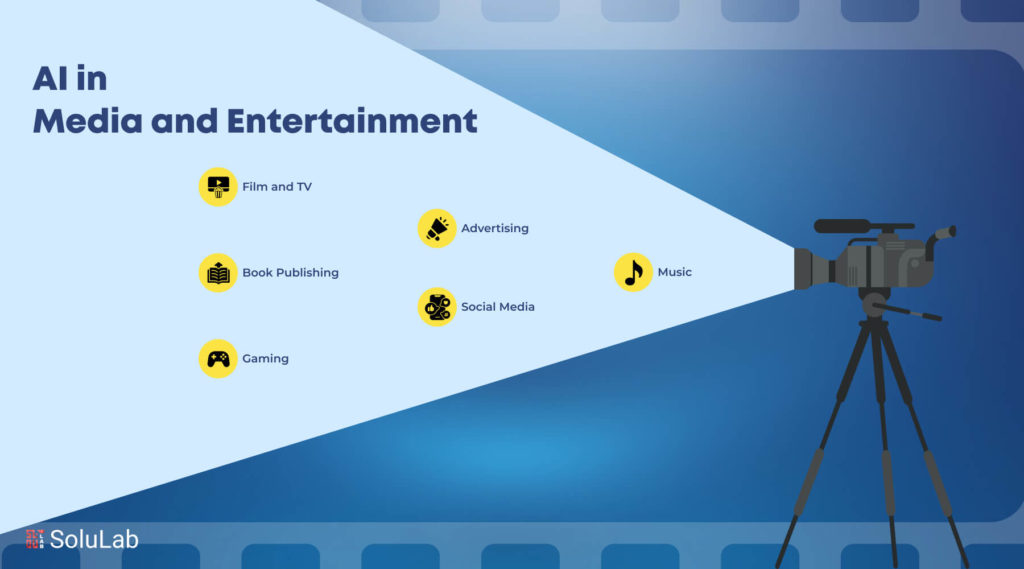
The Media and Entertainment Industry has always been about thinking outside the box and even more now with AI use cases leading the charge. Regarding artificial intelligence, there is no such concept in science fiction anymore. Indeed the M&E sector globally is a fast-evolving industry and the same can be said about this part of the world. The utilization of AI in media and entertainment is now an essential part of global society as it ranges from depicting realistic special effects in Hollywood movies to recommending your next film on Netflix. While it is influencing entertainment to the highest degree, this element is also revolutionizing the very media, both its production and distribution.
In this media and entertainment industry, AI brings significant changes through aspects such as assigning tasks, increasing creativity, and improving the experience. artificial intelligence in media and entertainment function is based on the ability to embrace large amounts of information, observe patterns, and utilize this knowledge to accomplish certain tasks. AI is capable of providing the real voices of characters, indicating possible enhancements of speech in scripts, and composing original musical scores for films.
It can also create realistic CGI characters and environments, thus, there is no more a need for another exhausting traditional method. As for distribution, AI in media and entertainment algorithms uses the analysis of data provided by users to provide the latter with content they would presumably find useful. Also, the studios get in a better position to understand the fans’ needs and trends and thus be in a position to alter their next productions.
Further, AI in social media marketing is being applied to such rich engagements, in the form of chatbots that discuss with the users and provide personalized responses, and is even being used to generate realistic deep fakes and raise ethical concerns for opening up new possibilities. The benefits of AI in social media are changing the landscape of media and entertainment making it more efficient for creators and audiences.
AI in the entertainment industry and the benefits of AI in media are no longer seen as futuristic. It is revolutionizing the media consumption of entertainment altering not only the programs and the music that are watched and listened to, but also the games books read and played. The Global AI In Media And Entertainment Market size is expected to be worth around USD 195.7 Billion by 2033, from USD 17.1 Billion in 2023, growing at a CAGR of 27.6% during the forecast period from 2024 to 2033. Let’s examine the complex effects of AI in several important domains:

AI use cases in media and entertainment are a few of the most fascinating ways artificial intelligence is changing this ever-changing landscape:
AI and entertainment are utilized in services such as Netflix and Spotify in which they look at what you like to listen to or watch and suggest other things that you would possibly like to watch. With this kind of approach, viewers are engaged, and; there is always more content to watch because it is recommended based on individual habits.
When it comes to Special Effects with the help of Artificial Intelligence integrated into the films, one must brace themselves for stunning views. Thus, AI for startups is eliminating time-consuming operations like special effects object removal and background production. This allows great settings, characters, and especially animals in motion pictures and TV shows while letting the artists focus on inspiring work.
AI in the media has come to improve all the interactions with social sites and has made it easier and more efficient. These algorithms are growing and adapting to be more functional for the consumer, be it the news feeds seen on Facebook and Twitter down to content filtering seen on most platforms where obscene material is prevalent online.
Are you having difficulties operating a streaming platform or have questions about a new game that was recently released? Machine learning is also making the chatbots smarter and smarter – providing real-time customer service and question responses. It makes the user interface more friendly and at the same time it creates more work for the human attendant to solve other complex issues.
Say goodbye to aimless advertising with personal advertising. Based on the collection of the user’s data, AI facilitates advertisement to social media and streaming services. This ensures that viewers are fed with adverts that are of interest to them which in turn increases the number of viewers who are likely to make the intended purchases.
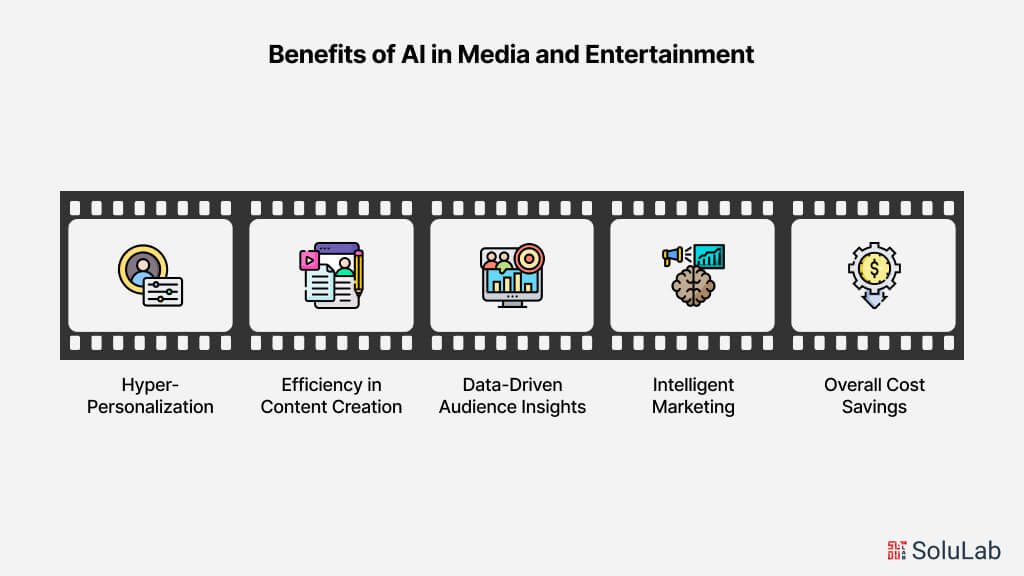
Media production with AI changes and enhances media and entertainment making it economical and personalized entertainment. Here are some more details about its advantages:
| Features | Description |
| Hyper-Personalization | Based on loads of user information procured from mobile devices, AI serves media such as movies, episodes of shows, and songs that exactly cater to the user’s requirements. This makes the user happy and stick to what they are using in the sense that they do not get bored with it. |
| Efficiency in Content Creation | Artificial Intelligence in media handling exhibits jobs like computer animations, video footage compilation, and even creating tunes are processes that can be enhanced by Artificial Intelligence. It may now be possible for professionals to concentrate on ideas and directions on the creative side. Scripts can also be analyzed using AI compounding suggestions to enhance them or at least reduce the number of reshoots and these are always big savings. |
| Data-Driven Audience Insights | User activity analysis is done in artificial intelligence to define what entices them. This makes it easy for content producers to fine-tune their marketing strategies and copies for the best results. Think of films that have humor, drama, and action in the right proportions that you would best like. This state of affairs reduces the likelihood of costly mistakes while at the same time satisfying the readers. |
| Intelligent Marketing | AI helps in targeting the right people, in intelligent marketing and advertising, in the right places. Is it possible to imagine only the shows or the movies that you would like to watch in the advertisements? This reduces the unrequired cost of marketing and enhances the income a marketing firm or business organization gets from its investment. |
| Overall Cost Savings | The application of AI in automation saves time in creating streaming videos, improving the quality, decreasing production time, and general production of content. This leads to time-saving on the overall market which is vital, and more importantly, the reduction of the production costs, which is beneficial for both the initiators and recipients of the product. |
With the use of artificial language and machine learning, Amazon has been able to improve its operations and increase operational efficiency. One of Amazon’s best-selling items is Alexa, an intelligent speaker, that can speak 15 different languages available in 80 different countries, constantly improving the creation of customized information.
One of the top television networks has revolutionized its technology stack and expanded with a rush throughout 190 countries. By examining past view data, Netflix uses both AI and ML to calculate bandwidth. One of the most important sources of information on what and how viewers act as well as their emotional gaze is now considered as metadata.
AI apps have increased the possibilities of AR and VR by allowing media and entertainment companies to create immersive experiences or non-player characters in video games which enhances user experiences. Both AR and VR are becoming more and more common because of the growing number of artificial intelligence-supported materials as well as the decreasing cost of equipment.
Read Our Blog: Impact of AI on Copywriting
As it looks, the future of AI in media and entertainment is not only brimming with new opportunities but also evolving continuously to provide consumers with even more immersive and tailored experiences. To understand this better try to think of it as an interactive narrative that will adapt to your choices, content requirements, and user-specific taste. As far as media and entertainment are concerned AI will now play a crucial role in preventing fraud news, filling the gaps between reality and fiction, and creating a new environment for storytelling.
However, with AI there will always be a challenge to consider ethical understanding to avoid potential biases and spread of misinformation. The future of media and communication is more inclined towards a collaboration of humans and AI altogether for creating a distinct dynamic landscape for workflows and pushing the boundaries.

To sum up, it is possible to state that artificial intelligence has a highly transformative impact on the media and entertainment industry. AI has a massive impact on the improvement of such facets as simplified content creation, content authenticity protection, and integrated suggestions, as well as the provision of enhanced virtual experiences. Quite to the contrary, the situation is much more exciting than some might perceive it and fear the AI-written scripts or computer-generated actors. AI is making human creativity even better since creators focus on creating content’s DNA and properly formatting it since AI could do the rest.
In the future, we could probably see even more innovative, lifelike experiences that blur the perception of entertainment and real life as an implication of AI. Due to the continual progress of artificial intelligence and people’s imagination, the media and entertainment industries have promising perspectives. It is your time now to hire an AI developer or an AI development company to see the changes that artificial intelligence in media and entertainment is bringing to the table.
Yes, AI is used in media and entertainment not alone for creation of the content but also for providing improved advertising and marketing, better animations, and allows extraction of real-time clip extraction.
Metadata in media refers to the data about other data, in simple words it stands for the description of the information that is being shared, like how and when was the content created, and when was it modified recently.
The main metadata problems in media and entertainment are because of the volume of content which has expanded and the variety of metadata sources and formats with metadata at scale offer issues.
The most recent trends of 2025 in the media and entertainment industry are the creative use of NFTs and digital treasures, the supremacy of OTT platforms such as Netflix for streaming, and making immersive experiences possible.
Indeed! It considers how it may enhance the live experiences, generate more content in less time, as well as tailor them. SoluLab can collaborate with you on the most exciting prospects of using AI to change your media and entertainment business.


