Companies are shifting to multi-agent conversational artificial intelligence systems capable of collaborating and acting in an actual sense throughout the workflows. Companies are now adopting agentic AI in business to support and sell products and services, as well as internal processes, to support high-volume and multi-step conversations.
Multi-agent bots do not rely on one model but on more specialized agents, which cooperate, rendering them faster, more accurate, and more satisfying to the user. The global conversational AI market is projected to be valued at about $4.95 billion in 2026 and grow to $57.87 billion by 2035 at a 17.1% CAGR.
Moreover, the development of such systems takes more than the selection of a big language model. It entails the design of agent architectures, context, and memory management, as well as linking AI to actual business systems.
In this blog, we’ll explore what a conversational AI multi-agent bot is, how to build one, and more. Let’s get started!
Key Takeaways
- Specialized agents in conversational AI multi-agent bots support business conversations that are complex and multi-step.
- An efficient layer of agent orchestration guarantees flawless coordination, precision, and scalability.
- In comparison to single bots, a multi-agent architecture is more effective in customer support, sales, and internal operations.
- Enterprise-ready deployments require strong memory, validation, and system integrations.
What Is a Conversational AI Multi-Agent Bot?
A Conversational AI Multi-Agent Bot is an advanced AI system in which two or more special-purpose AI agents collaborate to manage complicated, real- life conversations rather than have a single chatbot do so.
Every agent is assigned a particular task: to interpret the intent of the user, control the flow of conversation, access information, or do something, like updating a CRM or generating a support ticket. The orchestration layer is what coordinates these agents and determines who acts and when to act.
This strategy enables companies to process more precise and personalized conversations, multi-step queries, and high-volume interactions. Multi-agent bots are reasoning, cooperative, and task-performing in contrast to traditional chatbots and are therefore best suited for customer support, sales, operations, and automation of enterprise functions.
Why Businesses Are Adopting Multi-Agent Conversational AI?
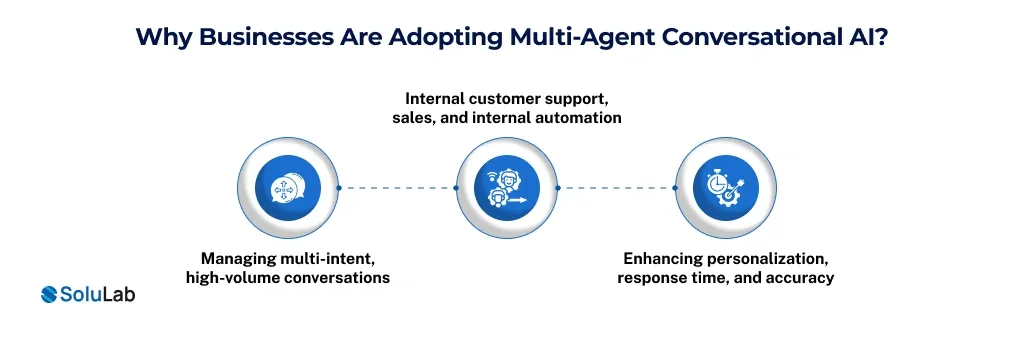
Multi-agent conversational AI is fast becoming the business solution to address multi-purpose interactions, scale operations, and provide rapid, smarter, and more personalized customer experience in a wide range of channels.
- Managing multi-intent, high-volume conversations: Multi-agent systems divide the work between specialized agents and therefore enable businesses to handle thousands of parallel conversations and correctly process multiple user intents in the same interaction.
- Internal customer support, sales, and internal automation: Support queries, sales qualification, and internal tasks are managed by different agents, which eases manual work and allows end-to-end automation of customer-facing and internal business processes.
- Enhancing personalization, response time, and accuracy: The cooperation of agents makes their answers quicker, remembers the context better, and gets personalized, which results in increased customer satisfaction and trustworthy interactions between AI and humans.

Conversational AI Multi-Agent Bot Architecture and Components
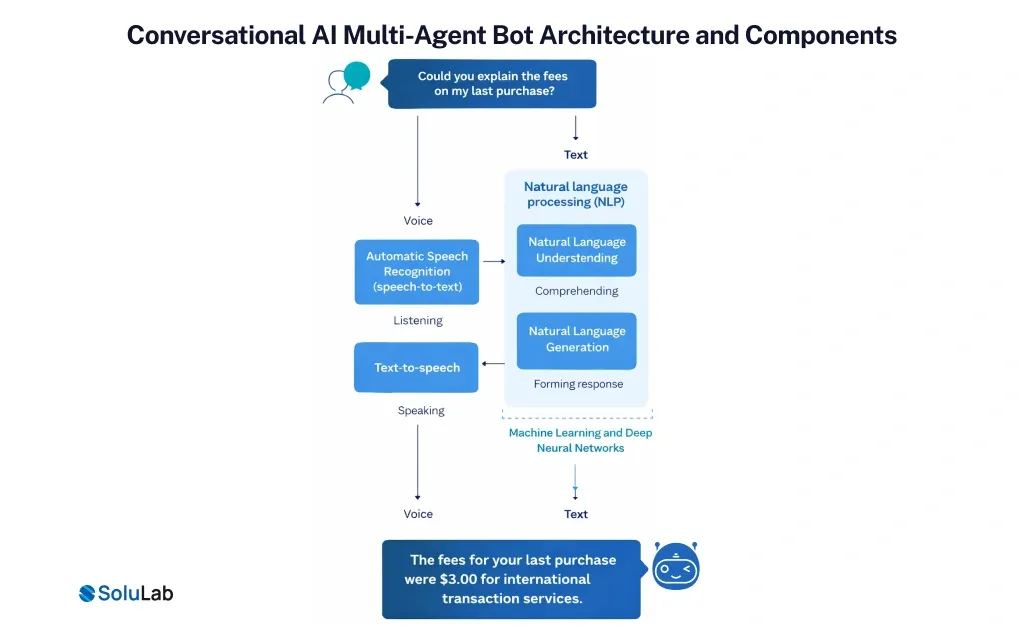
The conversational AI technology is an interplay of various smart systems that collaborate to interpret human language, learn to respond naturally, and use text or voice technology on digital platforms.
Natural Language Processing (NLP): Natural Language Processing enables AI systems to understand, reason, and take actions on the human language by the way of interpreting intent, context, grammar, and meaning of written or spoken conversations.
Machine Learning (ML): Machine learning allows conversational AI to be improved with time by interacting with a user, observing patterns, and predicting better without necessarily being programmed.
Deep Learning (DL): The neural networks are used to process complex language patterns to make the accuracy more accurate and to complete such sophisticated tasks as retaining context, detecting sentiment, and natural-sounding responses.
Speech-to-Text (STT): Converts speech into text and converts AI replies to speech to enable voice browsing between assistants and call centers and between assistants and smart devices.
Step-by-Step Guide to Building a Conversational AI Multi-Agent Bot
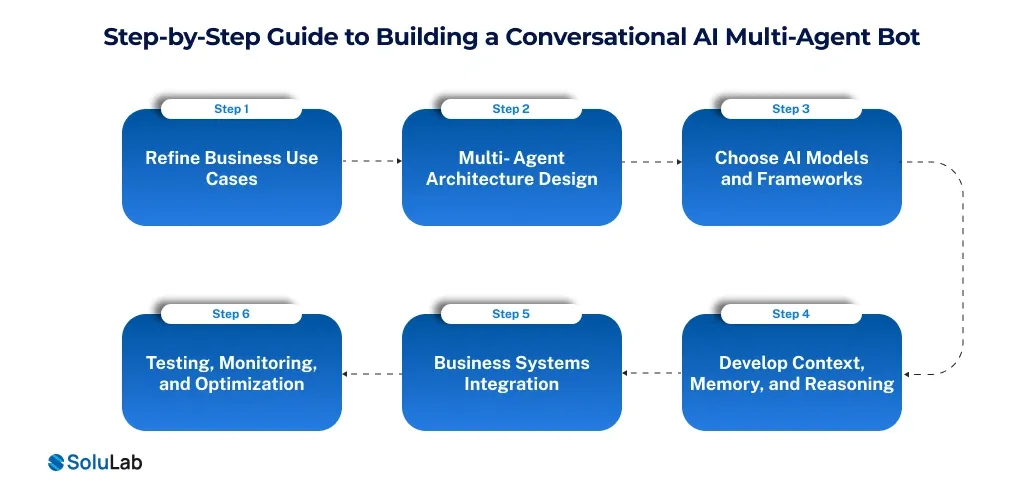
Conversational AI multi-agent bot development begins with business objectives and a well-organized process so that the system can provide relevant, scalable, and action-oriented conversations in multi-business processes. Here’s a complete guide for building an agentic AI system:
Step 1: Refine Business Use Cases
Determine the points at which the bot can provide practical business value, customer support, sales, onboarding, or internal operations. Model user flows, intentions, and edge cases to create conversation flows that conform to quantifiable business results.
Step 2: Multi-Agent Architecture Design.
Establish specific roles for each agent, including intent detection, task execution, validation, and escalation. Design an orchestration layer to coordinate the work of agents to prevent conflicts and provide end-to-end conversation management.
Step 3: Choose AI Models and Frameworks.
Select the appropriate combination of LLMs and additional ML models by accuracy, latency, and cost. Optimize agent frameworks that facilitate coordination, memory management, and enterprise customization.
Step 4: Develop Context, Memory, and Reasoning
Use short-term and long-term memory to sustain a flow of conversation. Add reasoning and validation logic to allow agents to process multi-step requests, minimize hallucinations, and give coherent and context-sensitive responses.
Step 5: Business Systems Integration.
Integrate the AI into CRM, ticketing, ERP, and internal databases over secure APIs. This allows the agents to perform real actions such as the creation of tickets, record updates, and workflow activation, other than mere conversations.
Step 6: Testing, Monitoring, and Optimization.
Test accuracy, agent coordination, edge cases, and load tests. Continually and constantly track conversations, retrain, and optimize the workflows to enhance reliability, scale, and business impact over time.
Future of Conversational Multi-Agent AI in Business
Conversational multi-agent AI is moving beyond chatbots, and businesses can implement intelligent agents, which can work independently, talk naturally, and handle complex processes with minimal or no human intervention.
- Autonomous AI agents: AI agents will make decisions on their own, cooperate with other agents, and perform tasks in real time, minimizing the involvement of humans and maximizing speed, accuracy, and efficiency in their work.
- Voice-first and multimodal agents: Agents of the future will mean voice, text, images, and documents and enable more natural and human-like conversations between devices, channels, and customer touchpoints.
- AI agents working on end-to-end processes: Multi-agent systems will process entire business processes, including the user request and the final implementation process, by automating approvals, data updates, and system actions.

Conclusion
In 2026, creating a multi-agent bot based on conversations is no longer an experiment with chatbots but reflects more of a business-ready and scalable AI system. With the increasing customer expectations, single-agent bots are no longer able to maintain a complex, multi-step discussion.
A properly designed multi-agent solution allows greater precision, quicker response, and actual automation of support processes, sales, and internal processes. Businesses can target clear use cases, durable agent coordination, solid memory, and profound system integrations.
SoluLab, an AI agent development company, can help you build a conversational AI multi-agent bot to automate your business processes. Book a free discovery call today to discuss further!
FAQs
Multi-agent conversational AI systems are good in industries such as SaaS, e-commerce, BFSI, healthcare, logistics, and enterprises with a high volume of interactions.
Memory allows the bot to remember the context, learn about the previous interactions, personalize the responses, and have multi-step conversations without relaying questions or getting lost in a conversation.
Yes, multi-agent bots can be connected with CRMs, ticketing, ERPs, databases, and APIs and perform real actions such as updating records or workflow activations.
Prices are based on the complexity, integrations, and size. An MVP can be as cheap as the $15k-$30k, but multi-agent systems that are enterprise-grade can be very expensive.
For chatbot development companies, it takes 6–8 weeks, while enterprise deployments typically require 3–5 months, depending on customization, integrations, testing, and compliance requirements.